- Главная
- Разное
- Образование
- Спорт
- Естествознание
- Природоведение
- Религиоведение
- Французский язык
- Черчение
- Английский язык
- Астрономия
- Алгебра
- Биология
- География
- Геометрия
- Детские презентации
- Информатика
- История
- Литература
- Математика
- Музыка
- МХК
- Немецкий язык
- ОБЖ
- Обществознание
- Окружающий мир
- Педагогика
- Русский язык
- Технология
- Физика
- Философия
- Химия
- Шаблоны, фоны, картинки для презентаций
- Экология
- Экономика
Презентация, доклад на тему Natural disasters
Содержание
- 1. Natural disasters
- 2. Lesson objectivesUnderstand independently specific information and detail
- 3. “Draw three houses on
- 4. Слайд 4
- 5. Lightning Volcanic eruption Drought Tornado Earthquake Explosion Forest fire Flood Tsunami`Landslide Hurricane Avalanche
- 6. Слайд 6
- 7. Vocabulary task: match the words with the pictures
- 8. Слайд 8
- 9. Task 1: 1) hurricane, 2) tsunami,
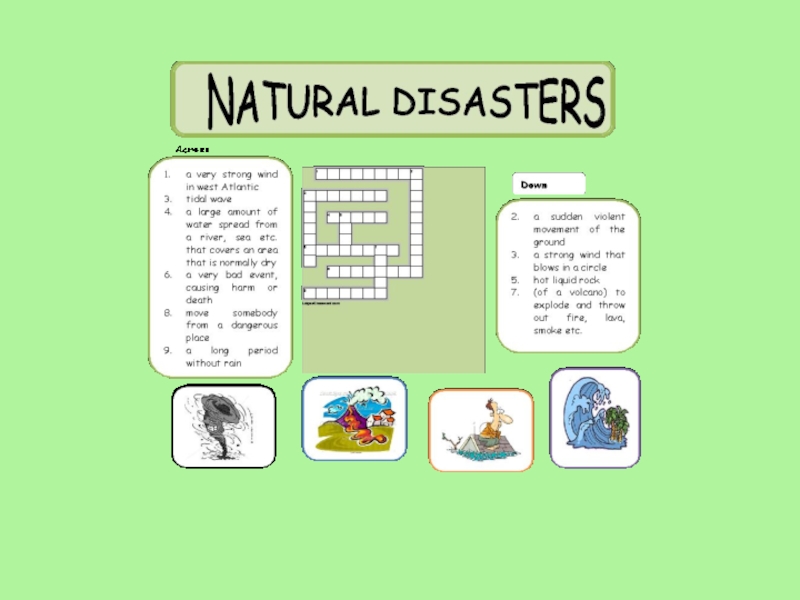
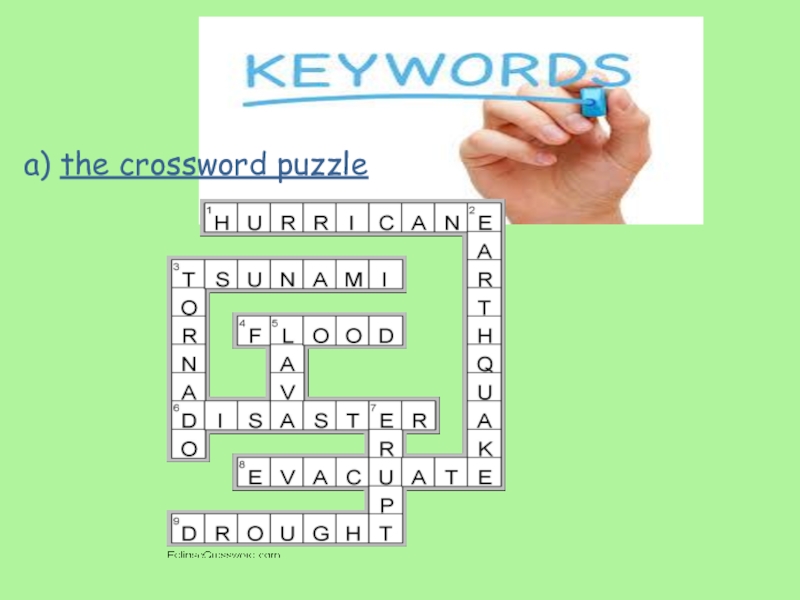
- 10. Vocabulary task : solve the crossword
- 11. Слайд 11
- 12. a) the crossword puzzle
- 13. Reading taskVolcano Natural disasterThe basic structure Earthquake Tsunami Avalanche What can we do?
- 14. Слайд 14
- 15. Vulcan and Volcanoes Ever wonder where the word
- 16. The Basic Structure of a Volcano
- 17. Pulling a Tablecloth What
- 18. Tsunamis Does “tsunami” sound like a
- 19. Avalanches We get an idea about
- 20. What Can We Do? We cannot
- 21. What are the safety rules for an
- 22. Thank you for your attention
Lesson objectivesUnderstand independently specific information and detail in short, simple texts on a limited range of general and curricular topicsUnderstand with limited support the main points of extended talk on a range of general and curricular
Слайд 2Lesson objectives
Understand independently specific information and detail in short, simple texts
on a limited range of general and curricular topics
Understand with limited support the main points of extended talk on a range of general and curricular topics
Understand with limited support the main points of extended talk on a range of general and curricular topics
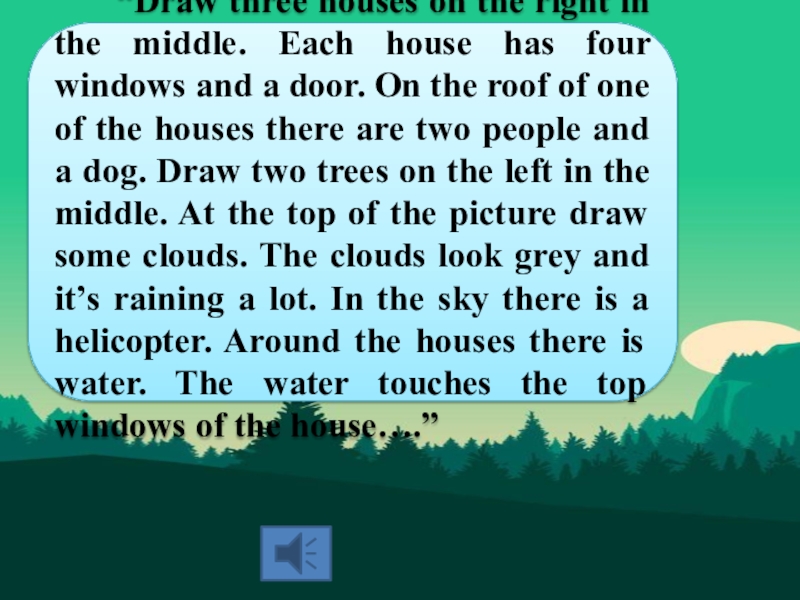
Слайд 3 “Draw three houses on the right in the
middle. Each house has four windows and a door. On the roof of one of the houses there are two people and a dog. Draw two trees on the left in the middle. At the top of the picture draw some clouds. The clouds look grey and it’s raining a lot. In the sky there is a helicopter. Around the houses there is water. The water touches the top windows of the house….”

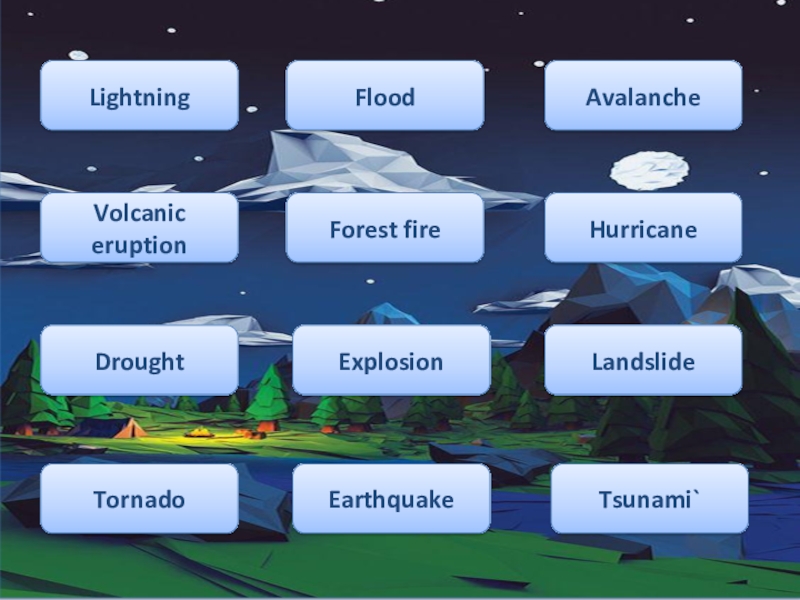
Слайд 5Lightning
Volcanic eruption
Drought
Tornado
Earthquake
Explosion
Forest fire
Flood
Tsunami`
Landslide
Hurricane
Avalanche

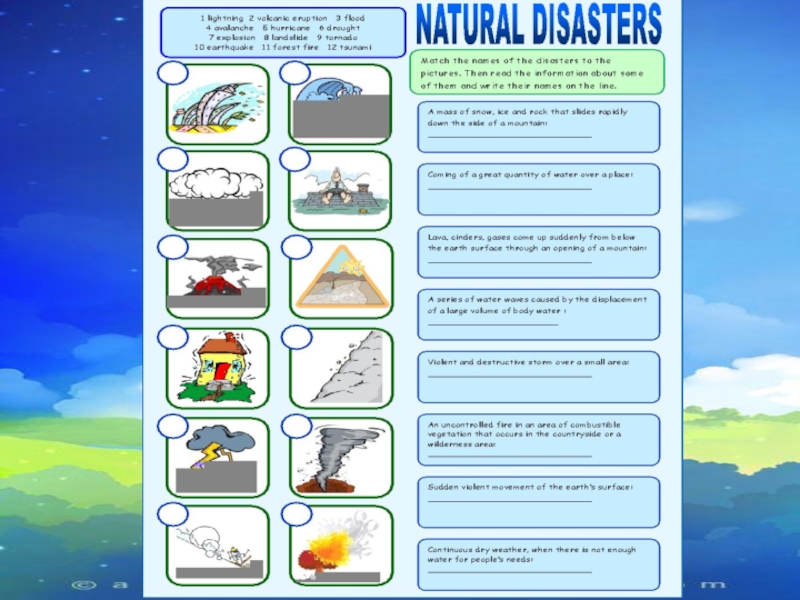
Слайд 9 Task 1: 1) hurricane, 2) tsunami, 3) explosion, 4) flood, 5)
volcanic eruption, 6) drought, 7) earthquake, 8) landslide, 9) lightning, 10) tornado, 11) avalanche, 12) forest fire
task 2: 1) avalanche, 2) flood, 3) volcanic eruption, 4) tsunami, 5) tornado, 6) forest fire, 7) earthquake, 8) drought
Слайд 13Reading task
Volcano
Natural disaster
The basic structure
Earthquake
Tsunami
Avalanche
What can
we do?
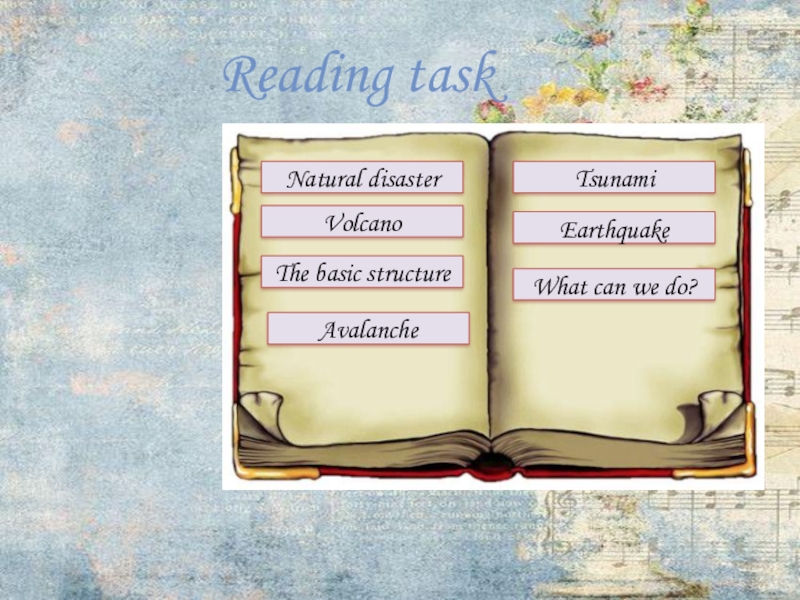
Слайд 14 Our planet has many wondrous things. We plant a tiny sapling
and it becomes a mighty tree. Water runs in rivers. Rainbows appear in the sky. But it is not always easy to deal with nature. For instance, sometimes the earth cracks up, slides and slips. The very hot matter inside it oozes out on the surface. Strong waves of water destroy everything in their way. All these events that result from natural processes and can harm human and other life are called natural hazards, and can lead to natural disasters. Volcanoes, earthquakes, avalanches, sinkholes, tsunamis and landslides are some examples of natural disasters. Sometimes, one disaster is related to another. For example: volcanic eruptions can cause earthquakes, and earthquakes can cause landslides and tsunamis.
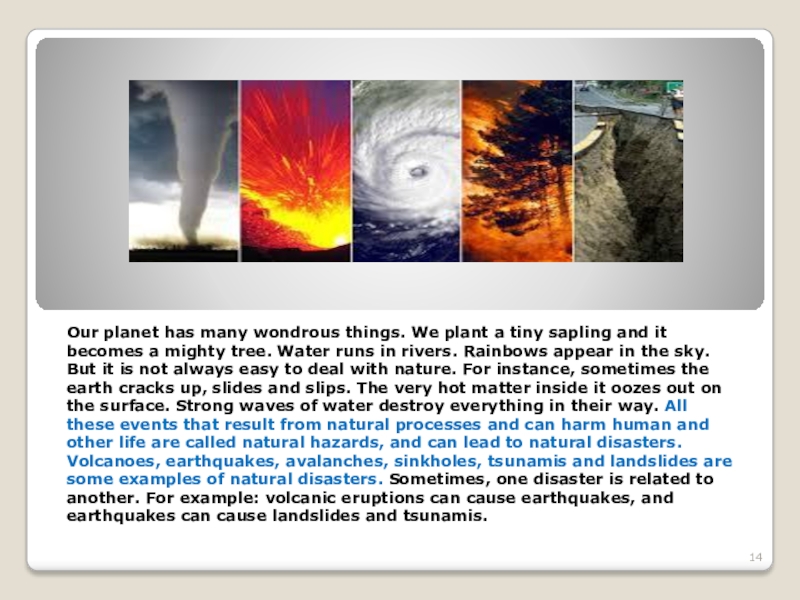
Слайд 15Vulcan and Volcanoes
Ever wonder where the word “volcano” comes from? It
comes from Vulcan—the god of fire and metalwork in Roman mythology. It was believed that he worked inside Mt. Etna, one of the world’s oldest volcanoes, located in Sicily. “Etna” means chimney or furnace. Fire, metal, chimney and furnace—do you see any similarities to a volcano?
Слайд 16The Basic Structure of a Volcano
A volcano is
a vent (rupture/crack) in the Earth through which molten (melted) magma and ash come out. Volcanoes occur at places where tectonic plates (under the Earth’s surface) come together or move apart. The “Ring of Fire” under the Pacific Ocean is one of the places where these plates converge. It is the site of 75% of the world’s volcanoes. There are about 452 volcanoes in the Pacific Ocean’s basin. Volcanoes are of three types. An active volcano is one that is erupting or has erupted in the last 10,000 years. An extinct volcano is unlikely to erupt again. A dormant or inactive volcano is between the two. There may be no record of its eruption in the recent past, but it is likely to erupt again. Some volcanoes can remain dormant for millions of years. The study of volcanoes is called volcanology.
Слайд 17Pulling a Tablecloth
What do you think would happen
if you quickly pulled the tablecloth off a dining table? The placemats, plates, glasses and cutlery on the table would “quake.” The plates might break into pieces as they land on the surface of the table. The water in the glasses might spill. There might be a loud noise and a mess. The movement that occurs during an earthquake is similar.
An earthquake happens when blocks of earth slide past one another and cause a “fault” on the earth’s surface. The “hypocenter” is the place where the blocks of earth slide and the earthquake starts. It is below the surface. Its corresponding point on the surface is called “epicenter.” Southern California has about 10,000 earthquakes every year. Most of these, fortunately, go unnoticed. The study of earthquakes is called seismology.
An earthquake happens when blocks of earth slide past one another and cause a “fault” on the earth’s surface. The “hypocenter” is the place where the blocks of earth slide and the earthquake starts. It is below the surface. Its corresponding point on the surface is called “epicenter.” Southern California has about 10,000 earthquakes every year. Most of these, fortunately, go unnoticed. The study of earthquakes is called seismology.
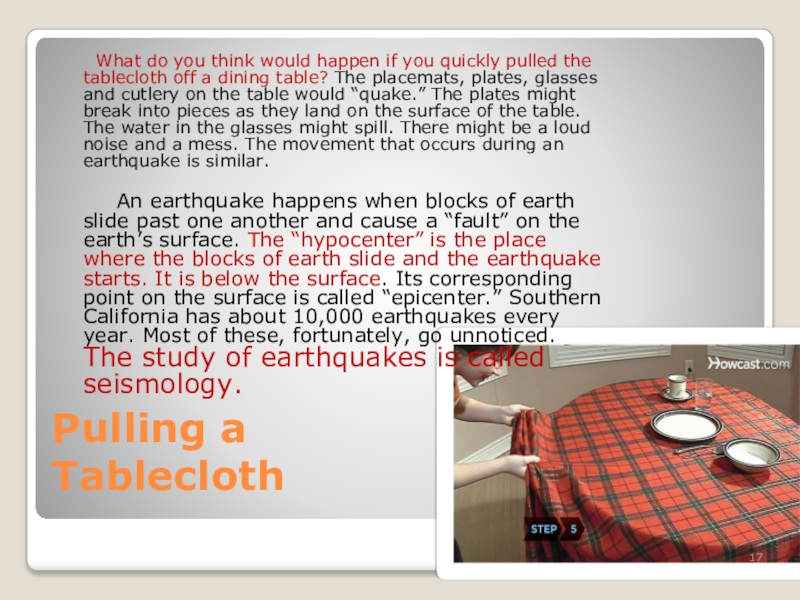
Слайд 18Tsunamis Does “tsunami” sound like a word from a foreign language? That’s
because it is! The word is pronounced with a silent “t” and means “harbor wave” in Japanese. It refers to a series of very long ocean waves that are caused by large disturbances in/under the ocean. Volcanoes, earthquakes, landslides and meteorites are the most common causes of a tsunami.
Who looks into tsunamis? Geologists, oceanographers, and seismologists—like earthquakes, tsunamis are caused by movements below the earth’s surface.
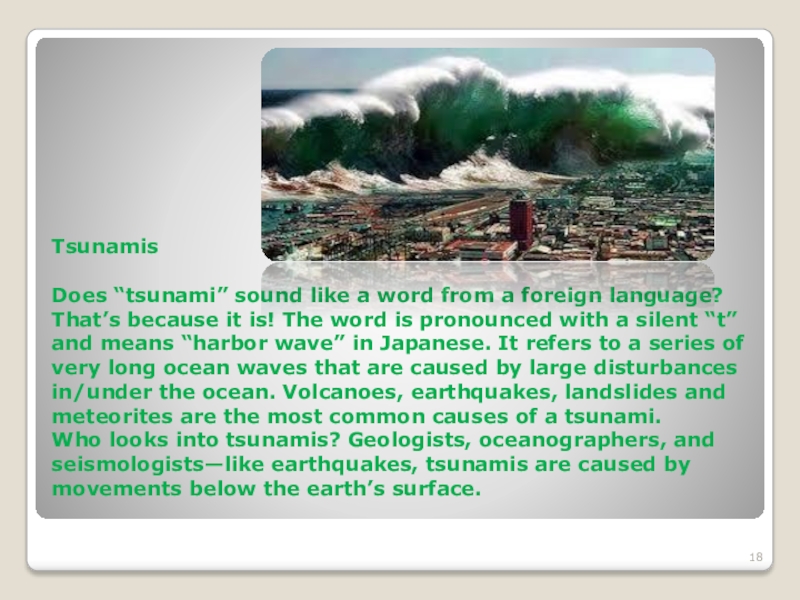
Слайд 19Avalanches We get an idea about what an avalanche is by its
other names: snow slide and snow slip. It is the sliding of snow down the slope of a mountain. We know that gravity pulls things downward on earth. A mass of snow on a slope slides down when the pull of gravity is greater than its own strength. When this mass is large, it takes things in its path along with it. A person who studies avalanches is called an avalanche meteorologist.
Слайд 20What Can We Do? We cannot prevent natural disasters entirely. They arise
from forces which are beyond our individual control. But there are some small ways in which we can take care of our planet. When we plant or preserve trees, we make our earth more stable. It is better able to clean polluted air and keep water in balance. We can walk to our school or the market and use less electricity. This would save our fossil fuels and keep the planet’s climate in order. We can avoid products (such as some deodorants) that are harmful to the environment. We must remember that things in nature are connected to each other. The water, soil, air and forces under the earth’s surface are all affected by our actions.
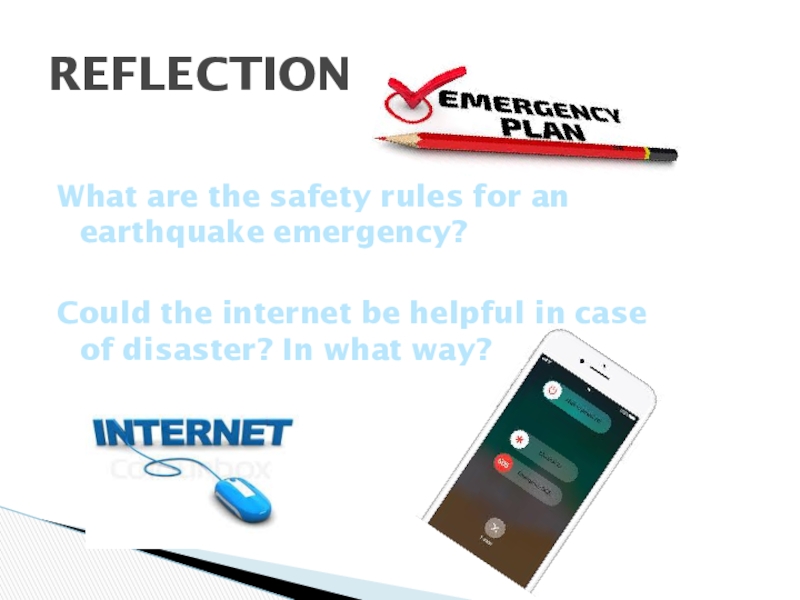
Слайд 21What are the safety rules for an earthquake emergency?
Could the internet
be helpful in case of disaster? In what way?
REFLECTION