- Главная
- Разное
- Образование
- Спорт
- Естествознание
- Природоведение
- Религиоведение
- Французский язык
- Черчение
- Английский язык
- Астрономия
- Алгебра
- Биология
- География
- Геометрия
- Детские презентации
- Информатика
- История
- Литература
- Математика
- Музыка
- МХК
- Немецкий язык
- ОБЖ
- Обществознание
- Окружающий мир
- Педагогика
- Русский язык
- Технология
- Физика
- Философия
- Химия
- Шаблоны, фоны, картинки для презентаций
- Экология
- Экономика
Презентация, доклад на тему Экономика Объединенного королевства Великобритании и Северной Ирландии
Содержание
- 1. Экономика Объединенного королевства Великобритании и Северной Ирландии
- 2. UK economy 10th world economy by GDP
- 3. industry structure of the UK economy GDP
- 4. The development of modern industry in
- 5. Services sectorPresented by such industries as Finance
- 6. AgricultureBritish agriculture is highly productive, with its
- 7. Great Britain, like all the leading
- 8. The largest companies in the UK, included
- 9. Features of economic policy and the main
- 10. Over the past 20 years, the
- 11. A huge role for the UK
- 12. Economic problems of the UKIn recent years,
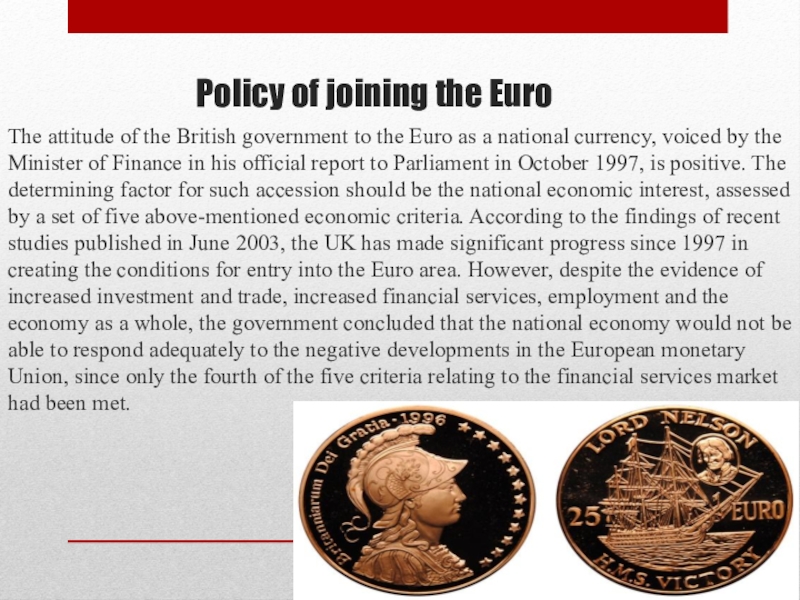
- 13. Policy of joining the EuroThe attitude of
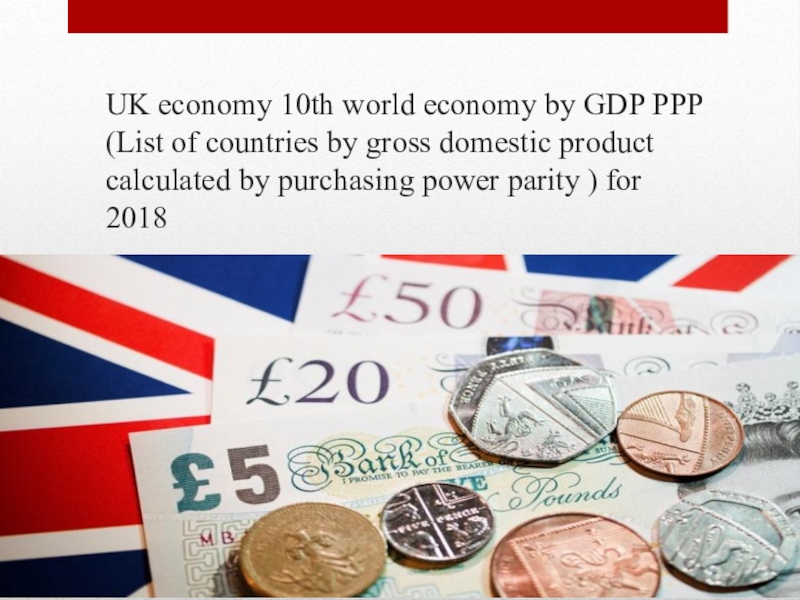
UK economy 10th world economy by GDP PPP (List of countries by gross domestic product calculated by purchasing power parity ) for 2018
Слайд 2UK economy 10th world economy by GDP PPP (List of countries
by gross domestic product calculated by purchasing power parity ) for 2018
Слайд 3industry structure of the UK economy
GDP structure:
agriculture-1,3%;
industry-24,2%;
services-74.5%.
The UK produces about
3.1% of global GDP. The share of great Britain in global exports of goods and services is 4.5%, and in imports — 5.1 %.In the UK industry, the extractive industries play an important role. In the manufacturing industry, priority is given to the following industries:
transport engineering (12.4% of all industrial production), where the automotive industry (national companies and branches of foreign companies Rover, Ford, Jaguar, Honda, Nissan, Toyota), shipbuilding (including the production of marine equipment and the construction of drilling platforms), aerospace industry-the third in the world after the United States and France, producing civil and military aircraft, helicopters, aircraft engines " rolls-Royce»
food industry (12.5% of total production), including the production of famous Scotch whiskey, gin and milk;
General engineering: production of agricultural machinery and machine tools, including the production of textile machinery (UK-the world's seventh largest manufacturer of machine tools);
electronics and electrical engineering: computers (including manufacturers such as IBM and Compaq); software, telecommunications (fiber optics, radars, etc.); medical equipment; household appliances;
chemical industry: pharmaceuticals (the UK is the world's fourth largest producer of medicines); Agrochemistry; perfumery; new materials and biotechnologies;
transport engineering (12.4% of all industrial production), where the automotive industry (national companies and branches of foreign companies Rover, Ford, Jaguar, Honda, Nissan, Toyota), shipbuilding (including the production of marine equipment and the construction of drilling platforms), aerospace industry-the third in the world after the United States and France, producing civil and military aircraft, helicopters, aircraft engines " rolls-Royce»
food industry (12.5% of total production), including the production of famous Scotch whiskey, gin and milk;
General engineering: production of agricultural machinery and machine tools, including the production of textile machinery (UK-the world's seventh largest manufacturer of machine tools);
electronics and electrical engineering: computers (including manufacturers such as IBM and Compaq); software, telecommunications (fiber optics, radars, etc.); medical equipment; household appliances;
chemical industry: pharmaceuticals (the UK is the world's fourth largest producer of medicines); Agrochemistry; perfumery; new materials and biotechnologies;
Слайд 4
The development of modern industry in the UK is determined
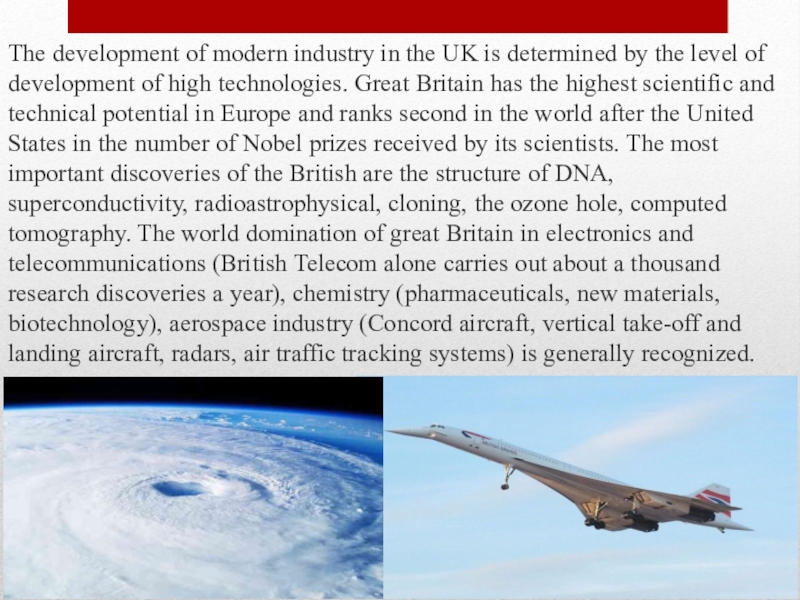
by the level of development of high technologies. Great Britain has the highest scientific and technical potential in Europe and ranks second in the world after the United States in the number of Nobel prizes received by its scientists. The most important discoveries of the British are the structure of DNA, superconductivity, radioastrophysical, cloning, the ozone hole, computed tomography. The world domination of great Britain in electronics and telecommunications (British Telecom alone carries out about a thousand research discoveries a year), chemistry (pharmaceuticals, new materials, biotechnology), aerospace industry (Concord aircraft, vertical take-off and landing aircraft, radars, air traffic tracking systems) is generally recognized.
Слайд 5Services sector
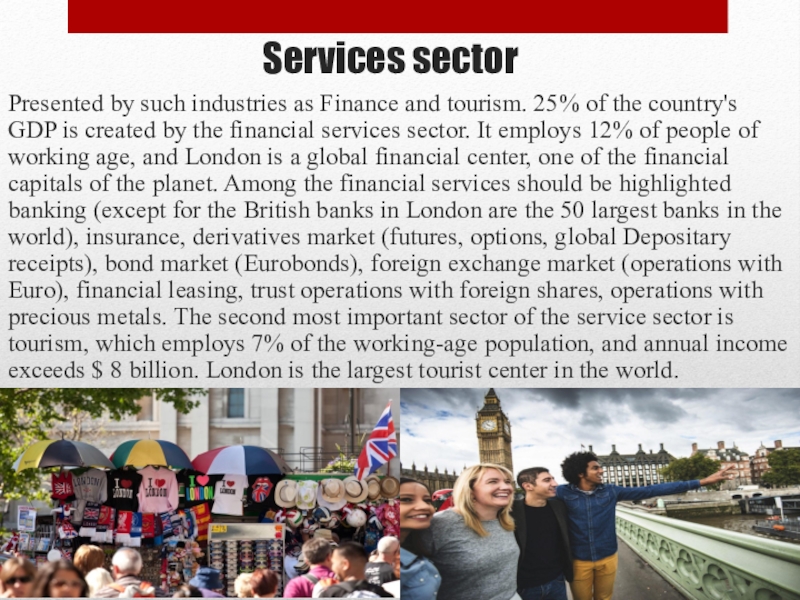
Presented by such industries as Finance and tourism. 25% of
the country's GDP is created by the financial services sector. It employs 12% of people of working age, and London is a global financial center, one of the financial capitals of the planet. Among the financial services should be highlighted banking (except for the British banks in London are the 50 largest banks in the world), insurance, derivatives market (futures, options, global Depositary receipts), bond market (Eurobonds), foreign exchange market (operations with Euro), financial leasing, trust operations with foreign shares, operations with precious metals. The second most important sector of the service sector is tourism, which employs 7% of the working-age population, and annual income exceeds $ 8 billion. London is the largest tourist center in the world.
Слайд 6Agriculture
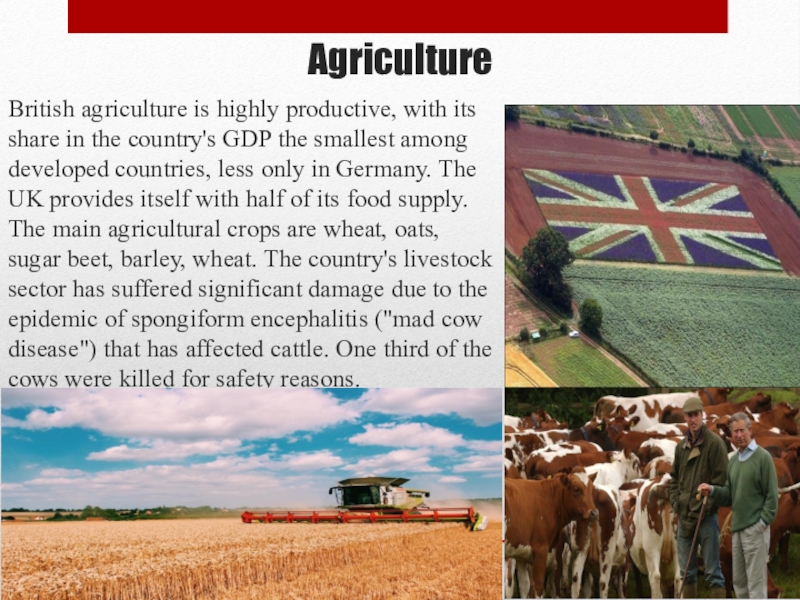
British agriculture is highly productive, with its share in the country's
GDP the smallest among developed countries, less only in Germany. The UK provides itself with half of its food supply. The main agricultural crops are wheat, oats, sugar beet, barley, wheat. The country's livestock sector has suffered significant damage due to the epidemic of spongiform encephalitis ("mad cow disease") that has affected cattle. One third of the cows were killed for safety reasons.
Слайд 7
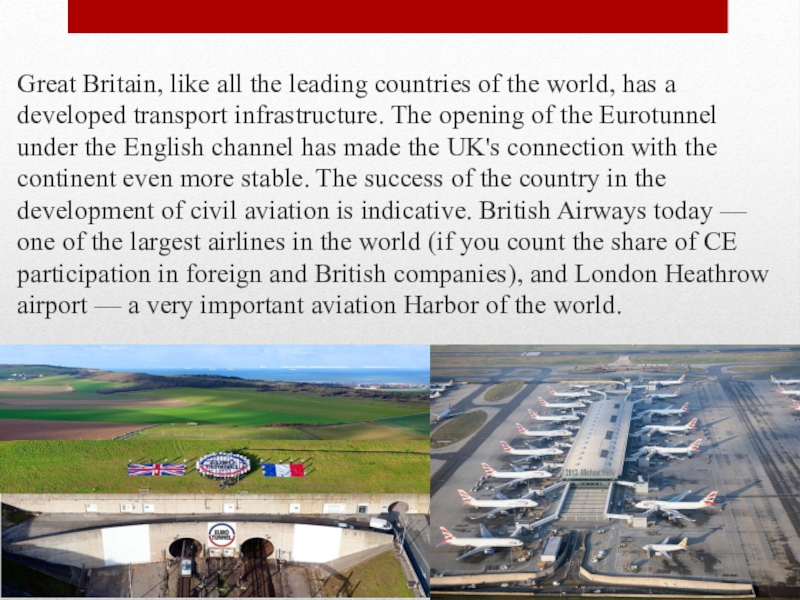
Great Britain, like all the leading countries of the world,
has a developed transport infrastructure. The opening of the Eurotunnel under the English channel has made the UK's connection with the continent even more stable. The success of the country in the development of civil aviation is indicative. British Airways today — one of the largest airlines in the world (if you count the share of CE participation in foreign and British companies), and London Heathrow airport — a very important aviation Harbor of the world.
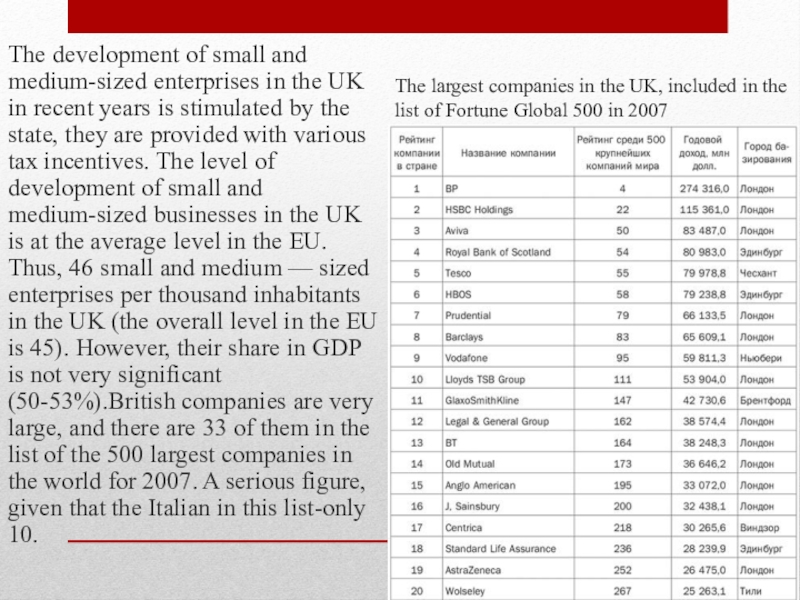
Слайд 8The largest companies in the UK, included in the list of
Fortune Global 500 in 2007
The development of small and medium-sized enterprises in the UK in recent years is stimulated by the state, they are provided with various tax incentives. The level of development of small and medium-sized businesses in the UK is at the average level in the EU. Thus, 46 small and medium — sized enterprises per thousand inhabitants in the UK (the overall level in the EU is 45). However, their share in GDP is not very significant (50-53%).British companies are very large, and there are 33 of them in the list of the 500 largest companies in the world for 2007. A serious figure, given that the Italian in this list-only 10.
Слайд 9Features of economic policy and the main economic problems
Although the UK
has been a member of the EEC since 1973, it has traditionally been geopolitically and economically more inclined to the United States than to Europe for a long time. The lion's share of British investment is not in the Old World, but in the United States and the Commonwealth, including Canada, Australia and the former colonies of the British crown. The UK is a country with a highly developed, strong and independent economy. But today, attention is drawn to the discrepancy between the seriously undermined positions of the country in industrial production, international trade and the currency sector, on the one hand, and the weakening, but still very strong positions in the export of capital, as well as the continuing role of London as one of the leading financial and commodity exchange centers-on the other hand. If until the early 70-ies of XX century. Britain distanced itself from the EU, then from that time on the background of "development of integration processes in the region" Britain begins to cooperate more closely with the countries of Western Europe, seeing them not as competitors, as before, and mutually beneficial partners. It should be noted the peculiar culture of the UK-the customs and traditions of the British influence politics, economy, holidays and everyday life of the British.
Слайд 10
Over the past 20 years, the following transformations have been
carried out in the English economy: 1) the public sector has been reduced (such giants of the British economy as British Telecom, British Coal have been sold); 2) tax rates have been reduced from individuals and legal entities; 3) the economy has been deregulated (with a simultaneous decrease in public spending); 4) some tightening of the social security system has been carried out.
Слайд 11
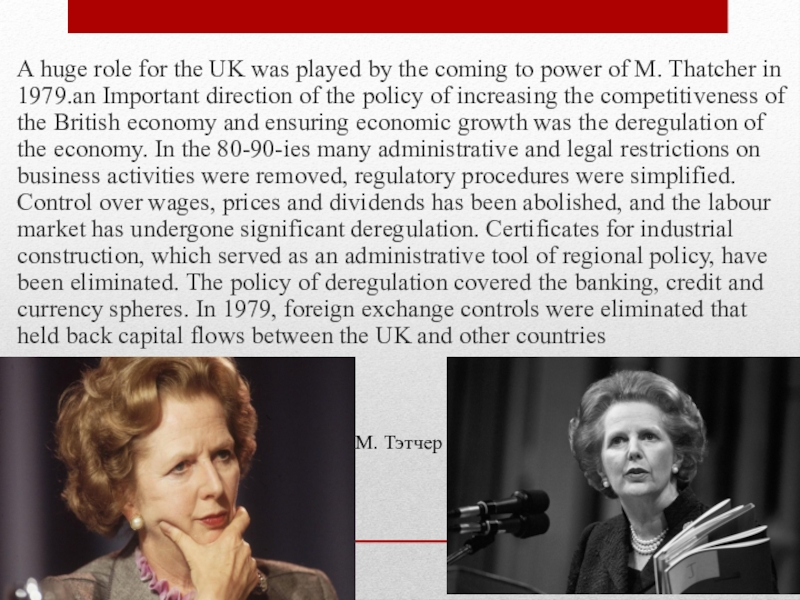
A huge role for the UK was played by the
coming to power of M. Thatcher in 1979.an Important direction of the policy of increasing the competitiveness of the British economy and ensuring economic growth was the deregulation of the economy. In the 80-90-ies many administrative and legal restrictions on business activities were removed, regulatory procedures were simplified. Control over wages, prices and dividends has been abolished, and the labour market has undergone significant deregulation. Certificates for industrial construction, which served as an administrative tool of regional policy, have been eliminated. The policy of deregulation covered the banking, credit and currency spheres. In 1979, foreign exchange controls were eliminated that held back capital flows between the UK and other countries
М. Тэтчер
Слайд 12Economic problems of the UK
In recent years, the inflow of labor
to the UK has increased significantly. Sometimes this leads to inter-ethnic clashes. In Britain, there are 700 madrasahs, where, by analogy with Christian Sunday schools, after classes in ordinary schools, about 100 thousand children study. The enlargement of the EU has also led to a significant increase in white immigration.The indicators of population growth in the country were also uneven. In England, which is home to more than 80% of United Kingdom citizens, the population growth rate in 1991-2003 exceeded 4%, but if in London this figure was higher than 8%, the number of residents in the North-East of the region fell by 1.8%.
Слайд 13Policy of joining the Euro
The attitude of the British government to
the Euro as a national currency, voiced by the Minister of Finance in his official report to Parliament in October 1997, is positive. The determining factor for such accession should be the national economic interest, assessed by a set of five above-mentioned economic criteria. According to the findings of recent studies published in June 2003, the UK has made significant progress since 1997 in creating the conditions for entry into the Euro area. However, despite the evidence of increased investment and trade, increased financial services, employment and the economy as a whole, the government concluded that the national economy would not be able to respond adequately to the negative developments in the European monetary Union, since only the fourth of the five criteria relating to the financial services market had been met.