- Главная
- Разное
- Образование
- Спорт
- Естествознание
- Природоведение
- Религиоведение
- Французский язык
- Черчение
- Английский язык
- Астрономия
- Алгебра
- Биология
- География
- Геометрия
- Детские презентации
- Информатика
- История
- Литература
- Математика
- Музыка
- МХК
- Немецкий язык
- ОБЖ
- Обществознание
- Окружающий мир
- Педагогика
- Русский язык
- Технология
- Физика
- Философия
- Химия
- Шаблоны, фоны, картинки для презентаций
- Экология
- Экономика
Презентация, доклад на тему Bank of England
Содержание
Bank of England The Bank of England, formally the Governor and Company of the Bank of England, is the central bank of the United Kingdom and the model on which most modern central banks have been based.
Слайд 2Bank of England
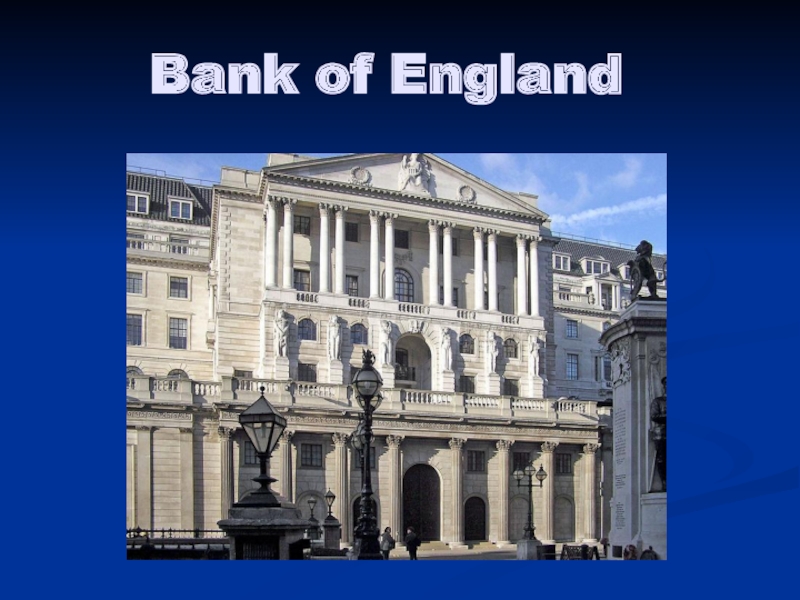
The Bank of England, formally the Governor and Company
of the Bank of England, is the central bank of the United Kingdom and the model on which most modern central banks have been based. Established in 1694, it is the second oldest central bank in the world, after the Sveriges Riksbank, and the world's 8th oldest bank. It was established to act as the English Government's banker, and is still the banker for HM Government.
The Bank is one of eight banks authorised to issue banknotes in the United Kingdom, but has a monopoly on the issue of banknotes in England and Wales and regulates the issue of banknotes by commercial banks in Scotland and Northern Ireland.
Mark Carney assumed the post of The Governor of the Bank of England on 1 July 2013. He succeeded Mervyn King, who took over on 30 June 2003. Carney, a Canadian, will serve an initial five-year term rather than the typical eight, and will seek UK citizenship. He is the first non-Briton to hold the post. As of January 2014, the Bank also has three Deputy Governors.
The Bank is one of eight banks authorised to issue banknotes in the United Kingdom, but has a monopoly on the issue of banknotes in England and Wales and regulates the issue of banknotes by commercial banks in Scotland and Northern Ireland.
Mark Carney assumed the post of The Governor of the Bank of England on 1 July 2013. He succeeded Mervyn King, who took over on 30 June 2003. Carney, a Canadian, will serve an initial five-year term rather than the typical eight, and will seek UK citizenship. He is the first non-Briton to hold the post. As of January 2014, the Bank also has three Deputy Governors.
Слайд 3Functions of the Bank
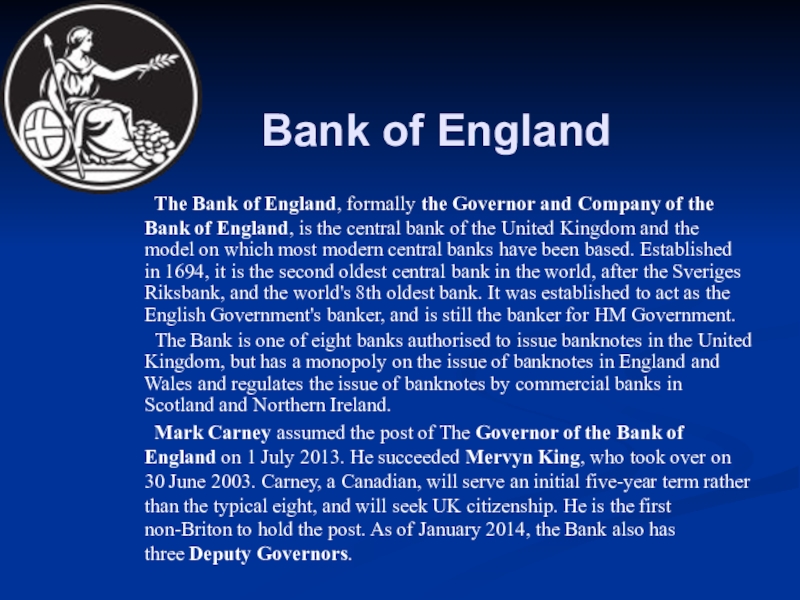
The Bank performs all the functions of a
central bank. The most important of these is supposed to be maintaining price stability and supporting the economic policies of the Government, thus promoting economic growth.
There are two main areas which are tackled by the Bank to ensure it carries out these functions efficiently:
There are two main areas which are tackled by the Bank to ensure it carries out these functions efficiently:
Слайд 4Functions of the Bank
Monetary stability
Stable prices and confidence in the currency
are the two main criteria for monetary stability. Stable prices are maintained by making sure price increases meet the Government's inflation target. The Bank aims to meet this target by adjusting the base interest rate, which is decided by the Monetary Policy Committee, and through its communications strategy, such as publishing yield curves.
Financial stability
Maintaining financial stability involves protecting against threats to the whole financial system. Threats are detected by the Bank's surveillance and market intelligence functions. The threats are then dealt with through financial and other operations, both at home and abroad. In exceptional circumstances, the Bank may act as the lender of last resort by extending credit when no other institution will.
Asset purchase facility
The Bank has operated, since January 2009, an Asset Purchase Facility (APF) to buy "high-quality assets financed by the issue of Treasury bills and the DMOs cash management operations" and thereby improve liquidity in the credit markets.It has, since March 2009, also provided the mechanism by which the Bank's policy of quantitative easing (QE) is achieved, under the auspices of the MPC. Along with the managing the £200 billion of QE funds, the APF continues to operate its corporate facilities. Both are undertaken by a subsidiary company of the Bank of England, the Bank of England Asset Purchase Facility Fund Limited (BEAPFF)
Financial stability
Maintaining financial stability involves protecting against threats to the whole financial system. Threats are detected by the Bank's surveillance and market intelligence functions. The threats are then dealt with through financial and other operations, both at home and abroad. In exceptional circumstances, the Bank may act as the lender of last resort by extending credit when no other institution will.
Asset purchase facility
The Bank has operated, since January 2009, an Asset Purchase Facility (APF) to buy "high-quality assets financed by the issue of Treasury bills and the DMOs cash management operations" and thereby improve liquidity in the credit markets.It has, since March 2009, also provided the mechanism by which the Bank's policy of quantitative easing (QE) is achieved, under the auspices of the MPC. Along with the managing the £200 billion of QE funds, the APF continues to operate its corporate facilities. Both are undertaken by a subsidiary company of the Bank of England, the Bank of England Asset Purchase Facility Fund Limited (BEAPFF)
Слайд 5Banknote issues
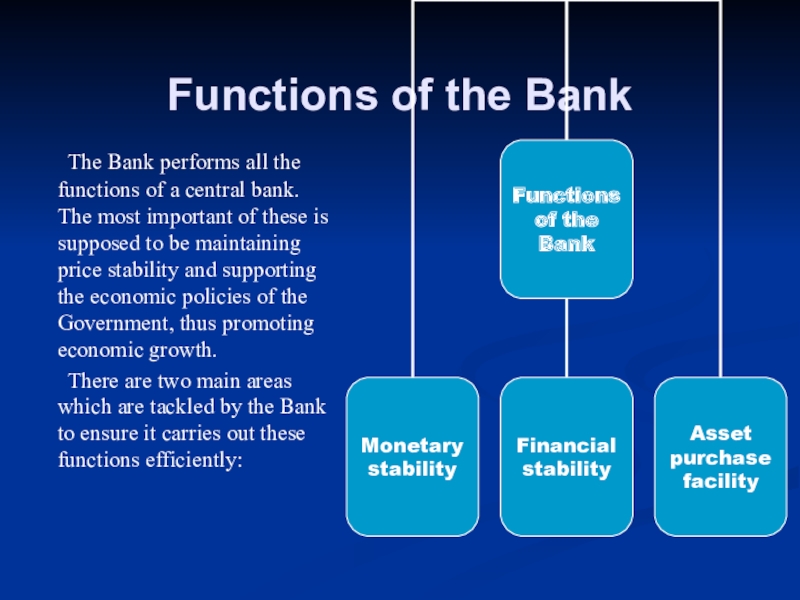
The Bank has issued banknotes since 1694. Notes were originally
hand-written; although they were partially printed from 1725 onwards, cashiers still had to sign each note and make them payable to someone. Notes were fully printed from 1855. Until 1928 all notes were "White Notes", printed in black and with a blank reverse. In the 18th and 19th centuries White Notes were issued in £1 and £2 denominations. During the 20th century White Notes were issued in denominations between £5 and £1000.
The vault
The Bank is custodian to the official gold reserves of the United Kingdom and many other countries. The vault, beneath the City of London, covers a floor space greater than that of the second-tallest building in the City, Tower 42, and needs keys that are three feet long to open. The Bank is the 15th-largest custodian of gold reserves, holding around 4600 tonnes. These gold deposits were estimated in February 2012 to have a current market value of £156,000,000,000.
The vault
The Bank is custodian to the official gold reserves of the United Kingdom and many other countries. The vault, beneath the City of London, covers a floor space greater than that of the second-tallest building in the City, Tower 42, and needs keys that are three feet long to open. The Bank is the 15th-largest custodian of gold reserves, holding around 4600 tonnes. These gold deposits were estimated in February 2012 to have a current market value of £156,000,000,000.