- Главная
- Разное
- Образование
- Спорт
- Естествознание
- Природоведение
- Религиоведение
- Французский язык
- Черчение
- Английский язык
- Астрономия
- Алгебра
- Биология
- География
- Геометрия
- Детские презентации
- Информатика
- История
- Литература
- Математика
- Музыка
- МХК
- Немецкий язык
- ОБЖ
- Обществознание
- Окружающий мир
- Педагогика
- Русский язык
- Технология
- Физика
- Философия
- Химия
- Шаблоны, фоны, картинки для презентаций
- Экология
- Экономика
Презентация, доклад на тему А. Флемминг Их знает весь мир
Содержание
- 1. А. Флемминг Их знает весь мир
- 2. the creation of penicillin, the first antibiotic,
- 3. Alexander Fleming's ChildhoodAlexander Fleming was born on
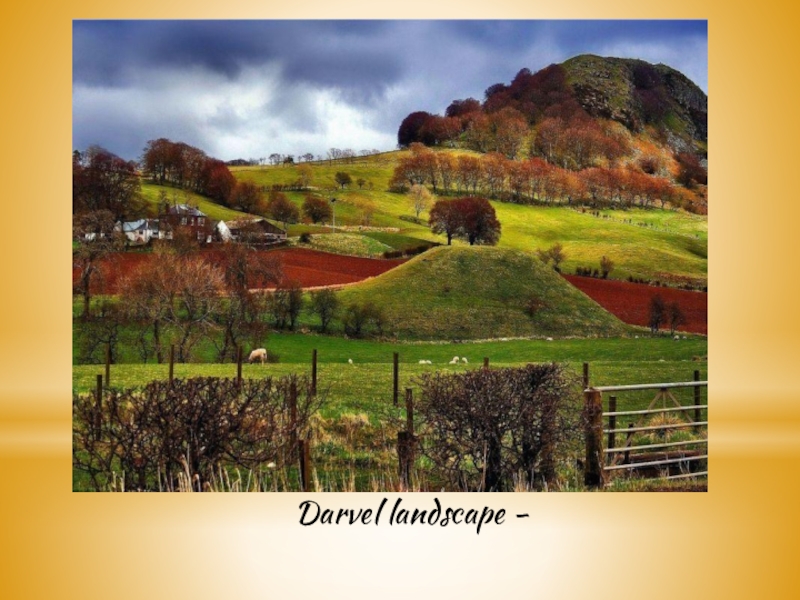
- 4. Darvel landscape -
- 5. The difficulties only strengthened Alec's thirst for
- 6. in 1901, he applied for a national
- 7. in 1906, Professor of pathology Almroth Wright,
- 8. Returning from a short vacation in 1928,
- 9. n 1943, at the height of world
- 10. Слайд 10
- 11. On 11 March 1955, at 74, Alexander
- 12. Слайд 12
- 13. the end
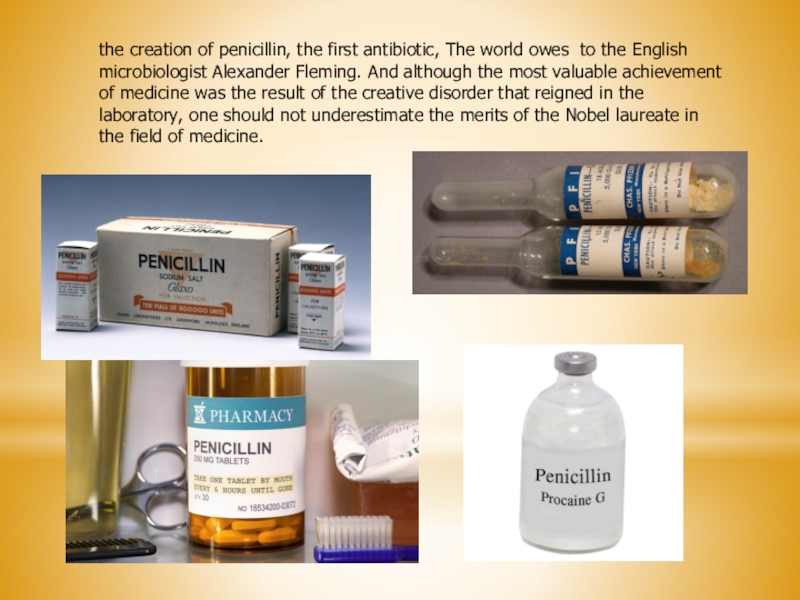
the creation of penicillin, the first antibiotic, The world owes to the English microbiologist Alexander Fleming. And although the most valuable achievement of medicine was the result of the creative disorder that reigned in the laboratory,
Слайд 2the creation of penicillin, the first antibiotic, The world owes to
the English microbiologist Alexander Fleming. And although the most valuable achievement of medicine was the result of the creative disorder that reigned in the laboratory, one should not underestimate the merits of the Nobel laureate in the field of medicine.
Слайд 3Alexander Fleming's Childhood
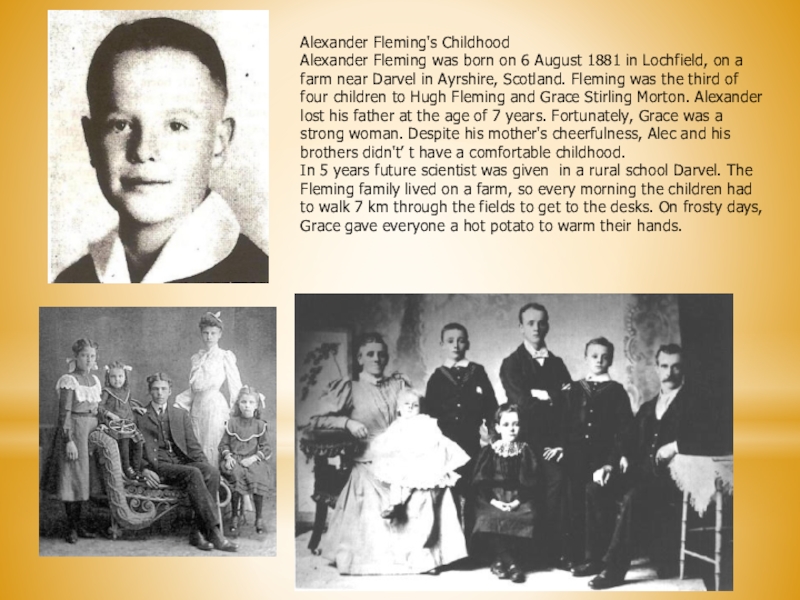
Alexander Fleming was born on 6 August 1881 in
Lochfield, on a farm near Darvel in Ayrshire, Scotland. Fleming was the third of four children to Hugh Fleming and Grace Stirling Morton. Alexander lost his father at the age of 7 years. Fortunately, Grace was a strong woman. Despite his mother's cheerfulness, Alec and his brothers didn't’ t have a comfortable childhood.
In 5 years future scientist was given in a rural school Darvel. The Fleming family lived on a farm, so every morning the children had to walk 7 km through the fields to get to the desks. On frosty days, Grace gave everyone a hot potato to warm their hands.
In 5 years future scientist was given in a rural school Darvel. The Fleming family lived on a farm, so every morning the children had to walk 7 km through the fields to get to the desks. On frosty days, Grace gave everyone a hot potato to warm their hands.
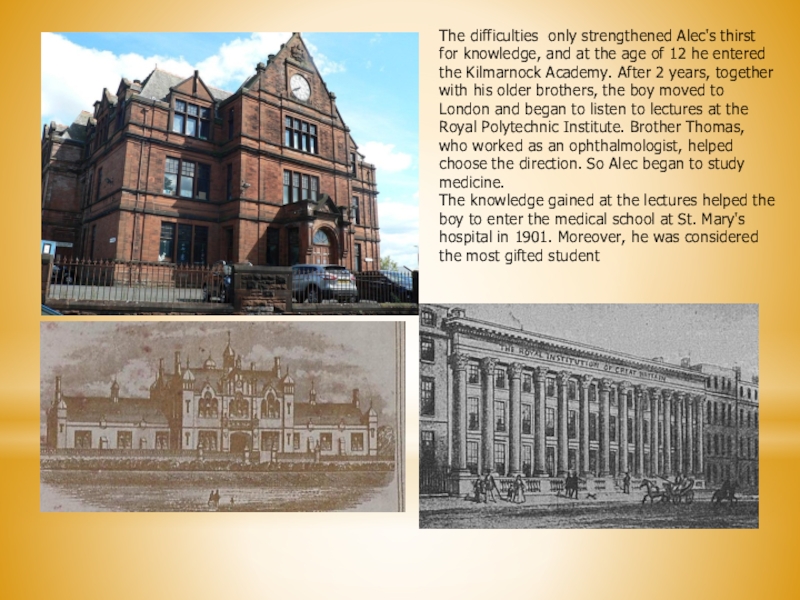
Слайд 5The difficulties only strengthened Alec's thirst for knowledge, and at the
age of 12 he entered the Kilmarnock Academy. After 2 years, together with his older brothers, the boy moved to London and began to listen to lectures at the Royal Polytechnic Institute. Brother Thomas, who worked as an ophthalmologist, helped choose the direction. So Alec began to study medicine.
The knowledge gained at the lectures helped the boy to enter the medical school at St. Mary's hospital in 1901. Moreover, he was considered the most gifted student
The knowledge gained at the lectures helped the boy to enter the medical school at St. Mary's hospital in 1901. Moreover, he was considered the most gifted student
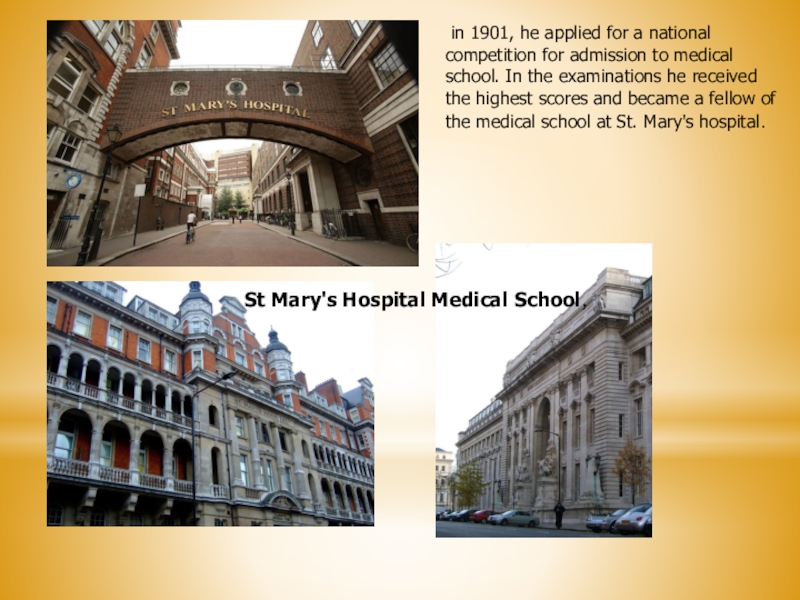
Слайд 6 in 1901, he applied for a national competition for admission to
medical school. In the examinations he received the highest scores and became a fellow of the medical school at St. Mary's hospital.
St Mary's Hospital Medical School,
Слайд 7in 1906, Professor of pathology Almroth Wright, who created a cure
for typhoid fever, invited Fleming to work in the Department of bacteriology established at St. Mary's hospital. At that moment, the scientist and three students were looking for a way to make antibodies fight the infection that infected the body.
During world war I, Almroth Wright was asked to set up a laboratory in France to study infectious diseases that killed soldiers. The Professor invited Fleming with him.
The study showed that antiseptics, which were used at the time to disinfect wounds, only made the situation worse.
During world war I, Almroth Wright was asked to set up a laboratory in France to study infectious diseases that killed soldiers. The Professor invited Fleming with him.
The study showed that antiseptics, which were used at the time to disinfect wounds, only made the situation worse.
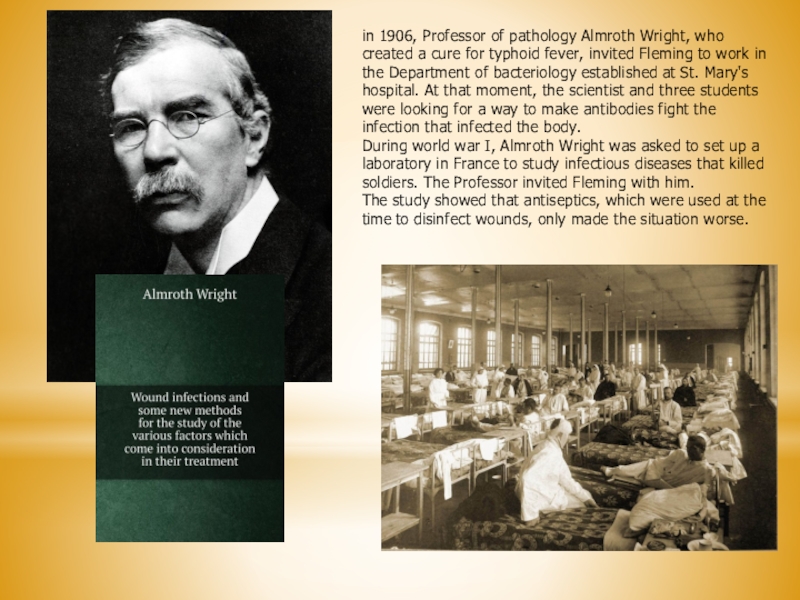
Слайд 8Returning from a short vacation in 1928, Fleming found a fungus
in one of the Petri dishes. The growth destroyed the dangerous microbes stored in the Cup. For several days the scientist did not get out from behind the books and found that before him Penicillium chrysogenum, "Penicillium Golden."
Fleming realized that it was a powerful antibiotic that could treat deadly diseases.
Fleming realized that it was a powerful antibiotic that could treat deadly diseases.
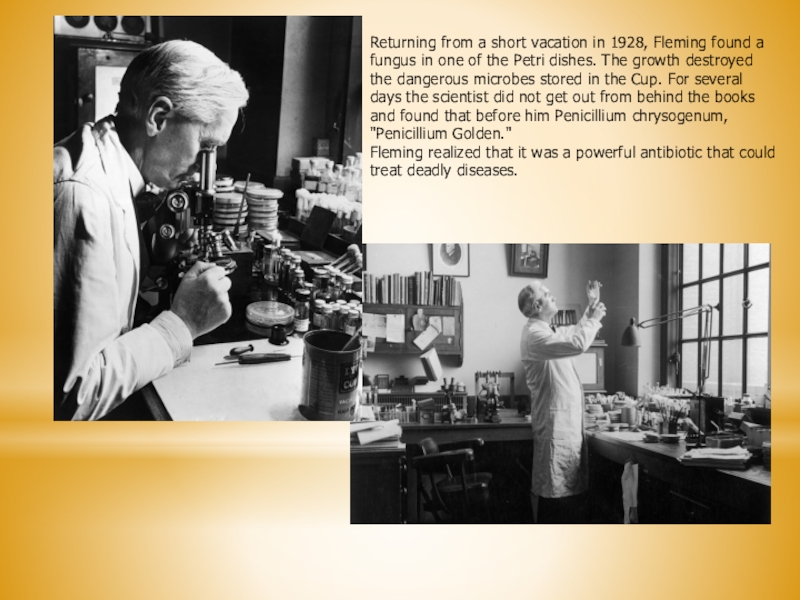
Слайд 9n 1943, at the height of world war II, the pharmacological
factories established mass production of penicillin. Thanks to the drug, wounded soldiers were cured of terrible wounds and returned to the front.
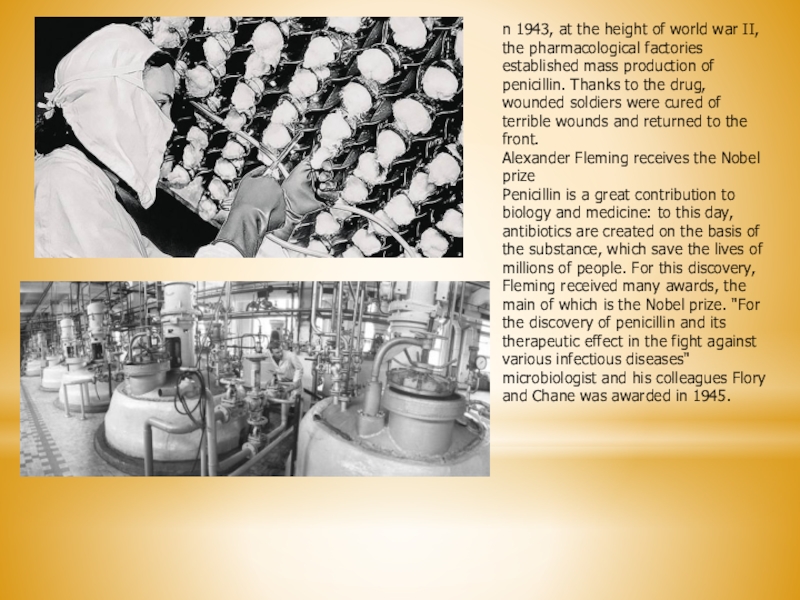
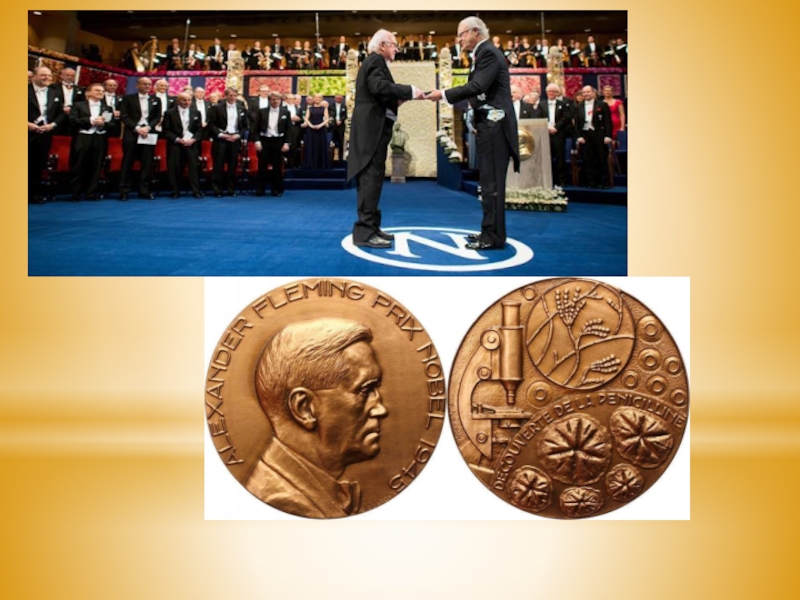
Alexander Fleming receives the Nobel prize
Penicillin is a great contribution to biology and medicine: to this day, antibiotics are created on the basis of the substance, which save the lives of millions of people. For this discovery, Fleming received many awards, the main of which is the Nobel prize. "For the discovery of penicillin and its therapeutic effect in the fight against various infectious diseases" microbiologist and his colleagues Flory and Chane was awarded in 1945.
Alexander Fleming receives the Nobel prize
Penicillin is a great contribution to biology and medicine: to this day, antibiotics are created on the basis of the substance, which save the lives of millions of people. For this discovery, Fleming received many awards, the main of which is the Nobel prize. "For the discovery of penicillin and its therapeutic effect in the fight against various infectious diseases" microbiologist and his colleagues Flory and Chane was awarded in 1945.
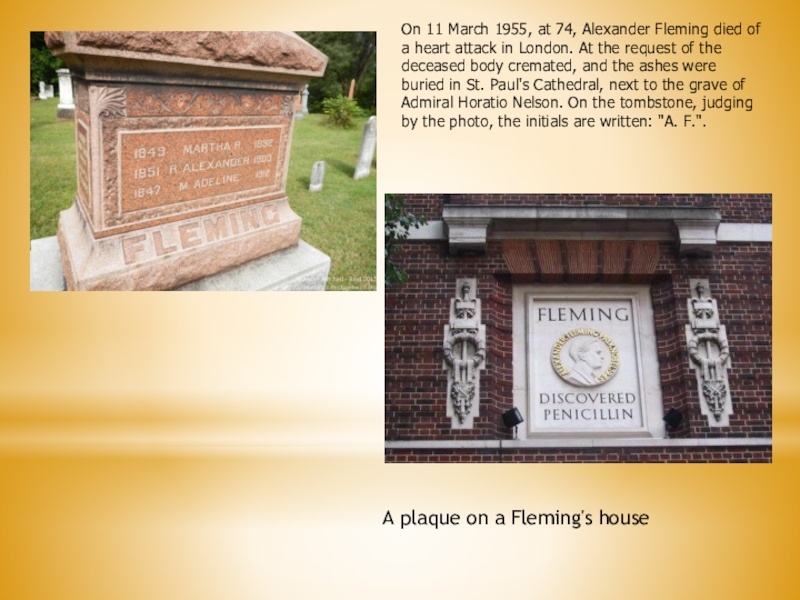
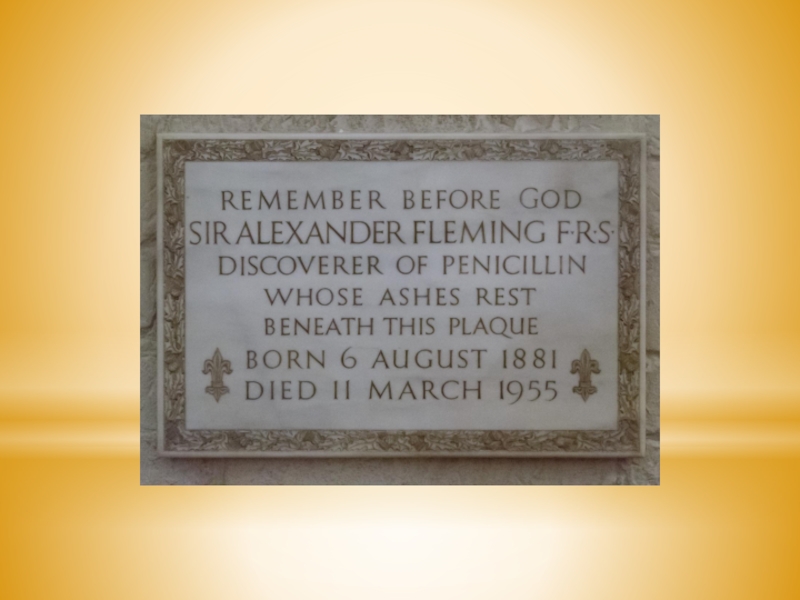
Слайд 11On 11 March 1955, at 74, Alexander Fleming died of a
heart attack in London. At the request of the deceased body cremated, and the ashes were buried in St. Paul's Cathedral, next to the grave of Admiral Horatio Nelson. On the tombstone, judging by the photo, the initials are written: "A. F.".
A plaque on a Fleming's house