- Главная
- Разное
- Образование
- Спорт
- Естествознание
- Природоведение
- Религиоведение
- Французский язык
- Черчение
- Английский язык
- Астрономия
- Алгебра
- Биология
- География
- Геометрия
- Детские презентации
- Информатика
- История
- Литература
- Математика
- Музыка
- МХК
- Немецкий язык
- ОБЖ
- Обществознание
- Окружающий мир
- Педагогика
- Русский язык
- Технология
- Физика
- Философия
- Химия
- Шаблоны, фоны, картинки для презентаций
- Экология
- Экономика
Презентация, доклад на тему Why Shakespeare?
Содержание
- 1. Why Shakespeare?
- 2. FOCUS QUESTIONSWhy study ShakespeareObscure biographyCreative work: periodsThe Authorship question Greatness
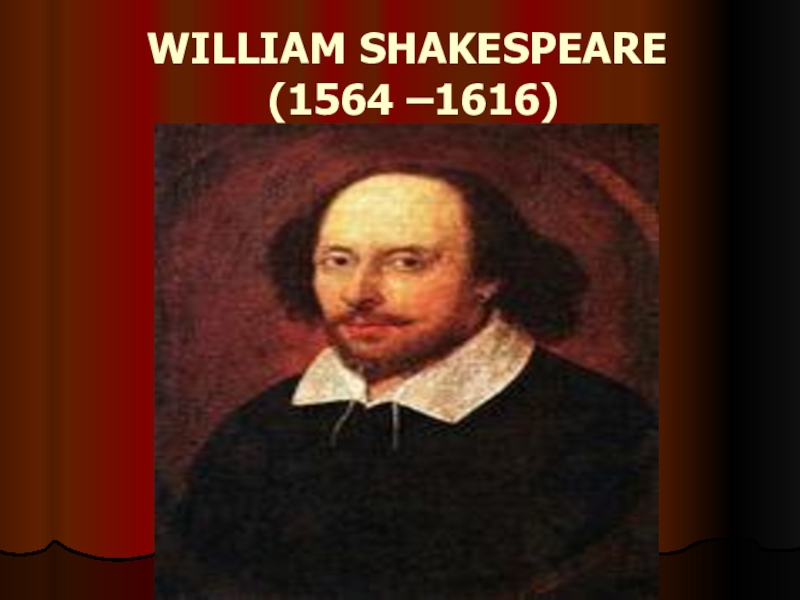
- 3. WILLIAM SHAKESPEARE (1564 –1616)
- 4. WHY STUDY SHAKESPEARE?
- 5. People who have studied Shakespeare:Have a broader
- 6. Why Shakespeare?“Someone that would ask, "Why do
- 7. Great Man English Renaissance is the Age of
- 8. Answer the question How is it then that
- 9. The answer as a rule given is
- 10. He was a magnificent poet a great
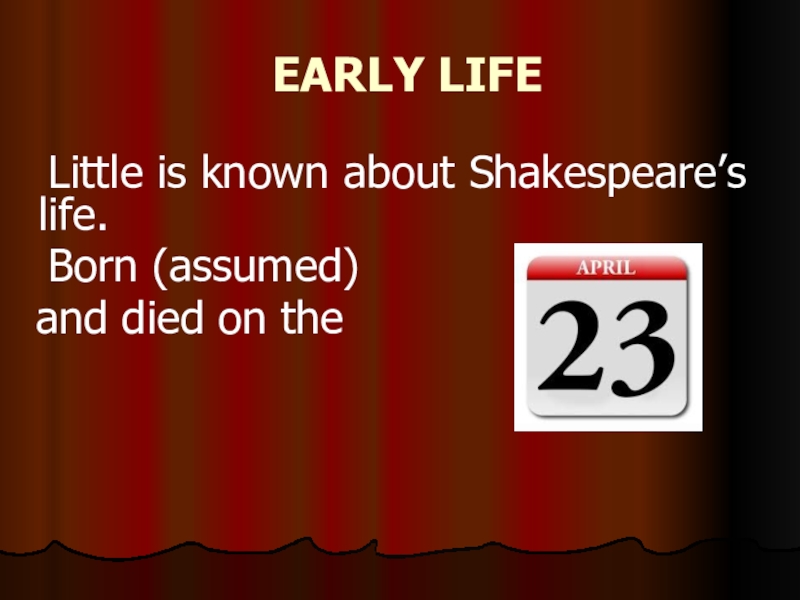
- 11. EARLY LIFE Little is known about Shakespeare’s life. Born (assumed) and died on the
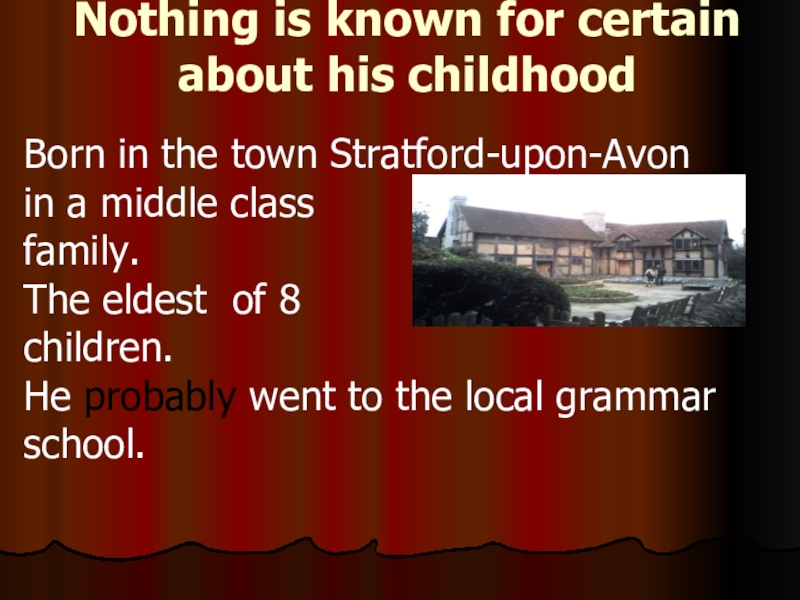
- 12. Nothing is known for certain about his
- 13. At the age of 18 he married. Shakespeare
- 14. LIFE STORY At the age of 21
- 15. Слайд 15
- 16. He spent most of his career in
- 17. There are more than 80 variations recorded
- 18. LATER YEARSShakespeare bought property at Stratford where
- 19. Inscription on Shakespeare’s grave A stone slab
- 20. Слайд 20
- 21. CREATIVE WORK: Historical Background The young dramatist
- 22. Freedom for thought to express itself, variety
- 23. Creative Work Shakespeare’s plays are usually described as
- 24. 3 Periods (? ) of His Creative
- 25. King Henry YIThe Tragedy of King
- 26. The 1-st PeriodIn the first period he
- 27. 9 Comedies:The Comedy of ErrorsThe Taming of the ShrewThe Two Gentlemen of VeronaLove’s Labour’s Lost
- 28. A Midsummer Night’s DreamMuch Ado About NothingThe
- 29. Julius Caesar showed that Shakespeare’s approval to
- 30. The 2-nd Period The second period between 1601-1608
- 31. Слайд 31
- 32. In his tragedies he touched upon
- 33. The play, which is an exception
- 34. The 3-rd Period The plays of the third
- 35. now he suggested utopian solutions to
- 36. Слайд 36
- 37. William Shakespeare is the author of 2
- 38. Shakespeare’s plays were first printed 7 years
- 39. For four hundred years, doubts have been
- 40. Around 150 years after Shakespeare's death, doubts
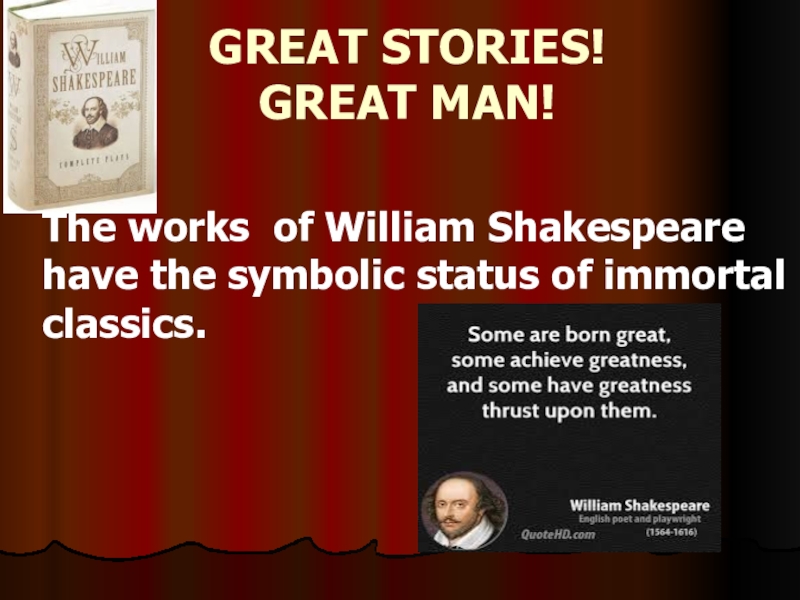
- 41. GREAT STORIES! GREAT MAN!The works of William Shakespeare have the symbolic status of immortal classics.
FOCUS QUESTIONSWhy study ShakespeareObscure biographyCreative work: periodsThe Authorship question Greatness
Слайд 2FOCUS QUESTIONS
Why study Shakespeare
Obscure biography
Creative work: periods
The Authorship question
Greatness
Слайд 5People who have studied Shakespeare:
Have a broader view of the world
in general.
Have a greater understanding of human nature (greed, faithfulness, love, power, gentleness, poor choices, honesty, integrity, popularity, danger, patriotism, selfishness, self-sacrifice, etc.).
Have a greater understanding of human nature (greed, faithfulness, love, power, gentleness, poor choices, honesty, integrity, popularity, danger, patriotism, selfishness, self-sacrifice, etc.).
Слайд 6Why Shakespeare?
“Someone that would ask, "Why do you study Shakespeare?" hasn't
really taken the time to know him. Once you give yourself the patience to get into Shakespeare YOU ARE HOOKED and other literature pales.“
Слайд 7Great Man
English Renaissance is the Age of William Shakespeare. But the
age knew many brilliant men. What makes him the greatest of the great?
Слайд 8Answer the question
How is it then that a playwright had such
a powerful appeal to later generations and is still popular today?
?
?
Слайд 9 The answer as a rule given is that
Shakespeare understood
human affairs in their essential aspects and explored them in a way, which was both individual and universal at one and the same time.
Слайд 10 He was
a magnificent poet
a great dramatist
a psychologist
a philosopher.
So many aspects of his genius!
So many aspects of his genius!
Слайд 12Nothing is known for certain about his childhood
Born in the town
Stratford-upon-Avon
in a middle class
family.
The eldest of 8
children.
He probably went to the local grammar school.
in a middle class
family.
The eldest of 8
children.
He probably went to the local grammar school.
Слайд 13 At the age of 18 he married.
Shakespeare and Anne Hathaway had
three children – a son, Hamnet (died in 1596), and two daughters, Susanna and Judith. His only granddaughter Elizabeth died childless in 1670.
Shakespeare therefore has no
direct descendants.
Shakespeare therefore has no
direct descendants.
Слайд 14LIFE STORY
At the age of 21 he left Stratford. The next
7 years are often called “the lost years” because no one knows for sure what Shakespeare did during this time.
But in 1592 his first work was printed and at that time he lived in London.
But in 1592 his first work was printed and at that time he lived in London.
Слайд 16He spent most of his career in London as an actor,
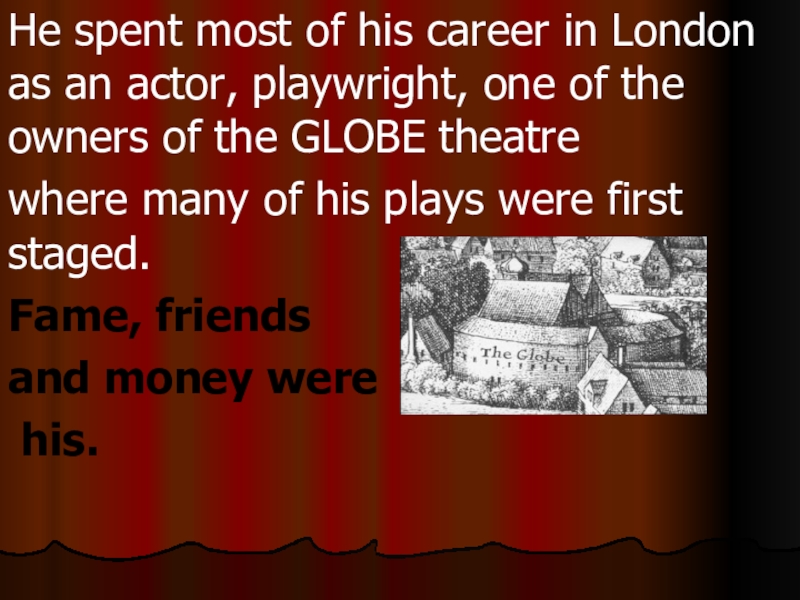
playwright, one of the owners of the GLOBE theatre
where many of his plays were first staged.
Fame, friends
and money were
his.
where many of his plays were first staged.
Fame, friends
and money were
his.
Слайд 17There are more than 80 variations recorded for the spelling of
Shakespeare’s name. He spelt his name “Willm Shaksp,” “William Shakespe,” “Wm Shakspe,” “William Shakspere,” ”Willm Shakspere,” and “William Shakspeare”.
There are no records of him ever having spelt it “William Shakespeare”, as we know him today.
There are no records of him ever having spelt it “William Shakespeare”, as we know him today.
Слайд 18LATER YEARS
Shakespeare bought property at Stratford where his family lived. In
1611 he returned to his native town and spent his last days there. Died in 1616 and was buried in the church of Stratford.
Слайд 19Inscription on Shakespeare’s grave
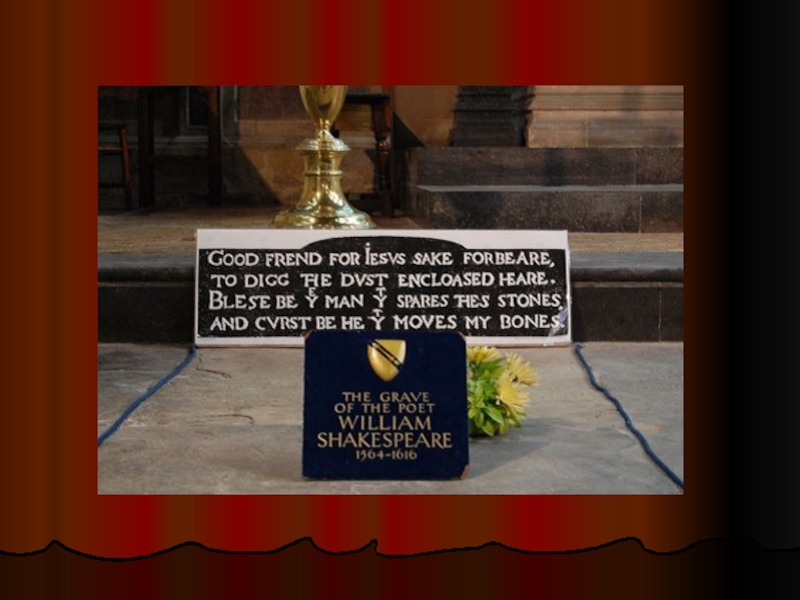
A stone slab covering his grave is inscribed
with a curse against moving his bones
Good frend for Iesvs sake forbeare,To digg the dvst encloased heare.Blest be ye man yt spares thes stones,And cvrst be he yt moves my bones.
Good frend for Iesvs sake forbeare,To digg the dvst encloased heare.Blest be ye man yt spares thes stones,And cvrst be he yt moves my bones.
Слайд 21CREATIVE WORK:
Historical Background
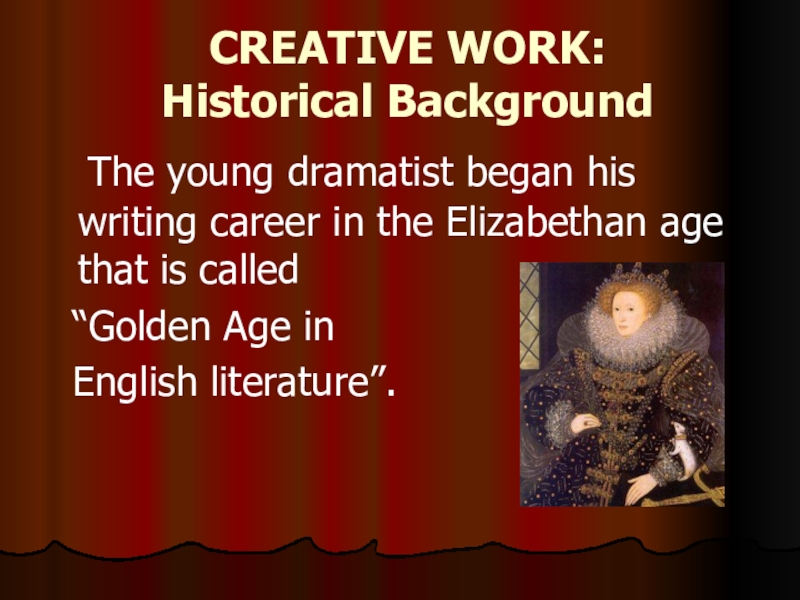
The young dramatist began his writing career in
the Elizabethan age that is called
“Golden Age in
English literature”.
“Golden Age in
English literature”.
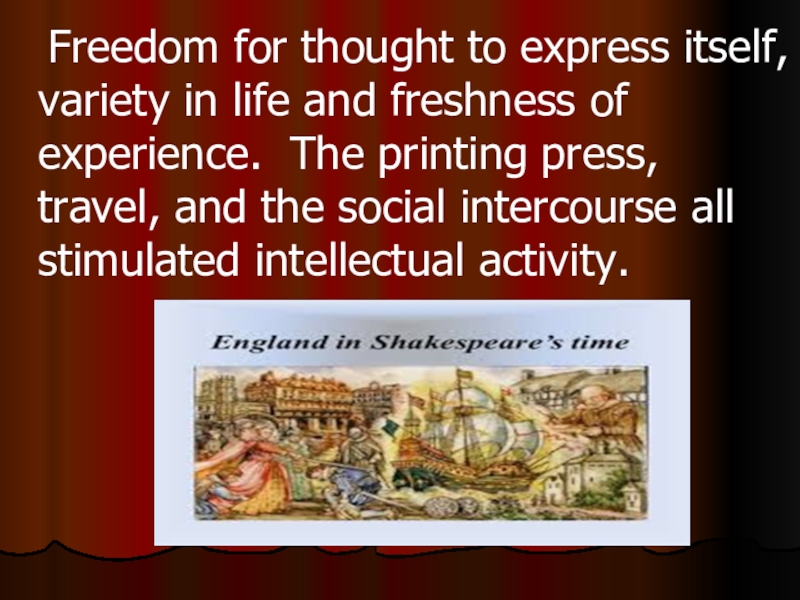
Слайд 22 Freedom for thought to express itself, variety in life and freshness
of experience. The printing press, travel, and the social intercourse all stimulated intellectual activity.
Слайд 23Creative Work
Shakespeare’s plays are usually described as comedies, tragedies and histories,
but this is an oversimplification as many of them do not fall precisely into any one category.
Слайд 24 3 Periods (? ) of His Creative Work
In the first
period - history plays. The main subject of his historical chronicles is history and political life of the time. They cover a period of more than 3 hundred years of English history (12th-16th centuries).
Слайд 25 King Henry YI
The Tragedy of King Richard III
The Tragedy of
King Richard II
The Life And Death of King John
The Life And Death of King John
Слайд 26The 1-st Period
In the first period he wrote 9 brilliant comedies
full of humanist love for people.
The drama The Merchant of Venice & the two early tragedies Romeo and Juliet and …
The drama The Merchant of Venice & the two early tragedies Romeo and Juliet and …
Слайд 279 Comedies:
The Comedy of Errors
The Taming of the Shrew
The Two Gentlemen
of Verona
Love’s Labour’s Lost
Love’s Labour’s Lost
Слайд 28A Midsummer Night’s Dream
Much Ado About Nothing
The Merry Wives of Windsor
As
You Like It
Twelfth Night; Or What You Will
Twelfth Night; Or What You Will
Слайд 29 Julius Caesar showed that Shakespeare’s approval to reality became more pessimistic
and his plays became more serious as time went on.
During this period Shakespeare was becoming better and
better at writing, but not yet
at his peak.
During this period Shakespeare was becoming better and
better at writing, but not yet
at his peak.
Слайд 30The 2-nd Period
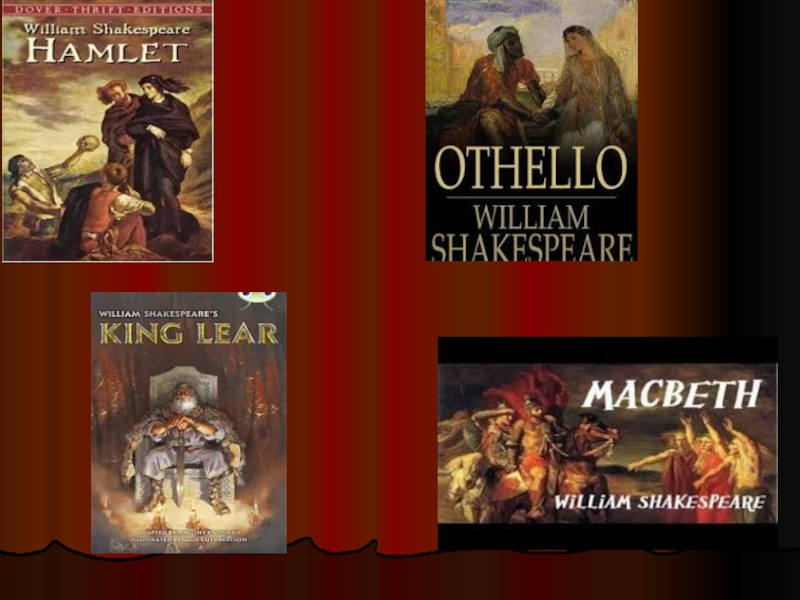
The second period between 1601-1608 is the period of
the greatest Shakespeare’s dramatic achievement as he wrote his 4 great tragedies.
Слайд 32
In his tragedies he touched upon the moral problems of
universal significance – honesty, cruelty, kindness, love that made them to be of great interest to every new generation.
Слайд 33
The play, which is an exception to the dark, serious,
tragic matters of evil and death, is All’s Well That Ends Well. Perhaps it was something that Shakespeare wrote very quickly for a special occasion.
Слайд 34The 3-rd Period
The plays of the third period –1609-1612 differ from
everything written by Shakespeare before. He still touched upon important social and moral problems, but
Слайд 35
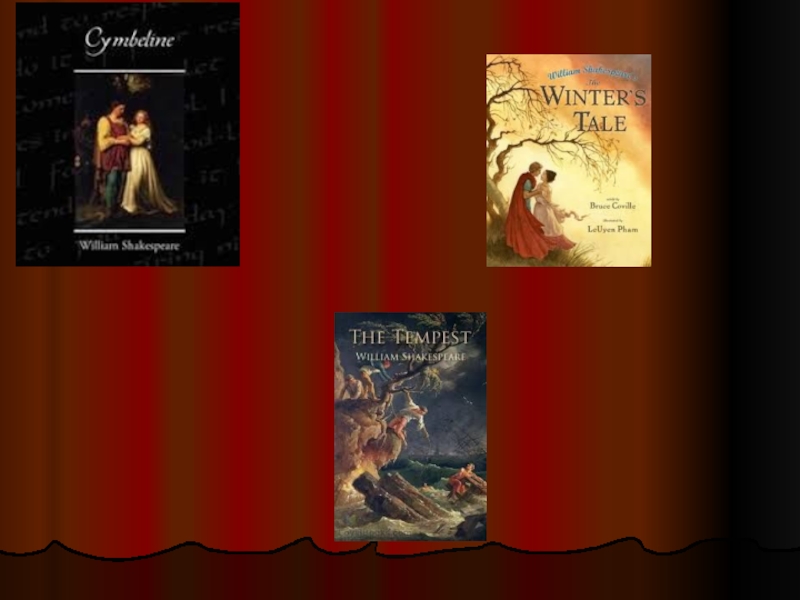
now he suggested utopian solutions to them. He introduced romantic
and fantastic elements due to which the works of this period are called romantic dramas.
Слайд 37William Shakespeare is the author of 2 poems,
37 plays,
and 154 sonnets.
In his sonnets he showed his extraordinary powers of expression and his depth of emotional understanding.
Слайд 38 Shakespeare’s plays were first printed 7 years after his death.
Ben
Jonson wrote such lines, which have only, become more true as the centuries have passed,
”He was not of an age, but for all time”.
”He was not of an age, but for all time”.
Слайд 39
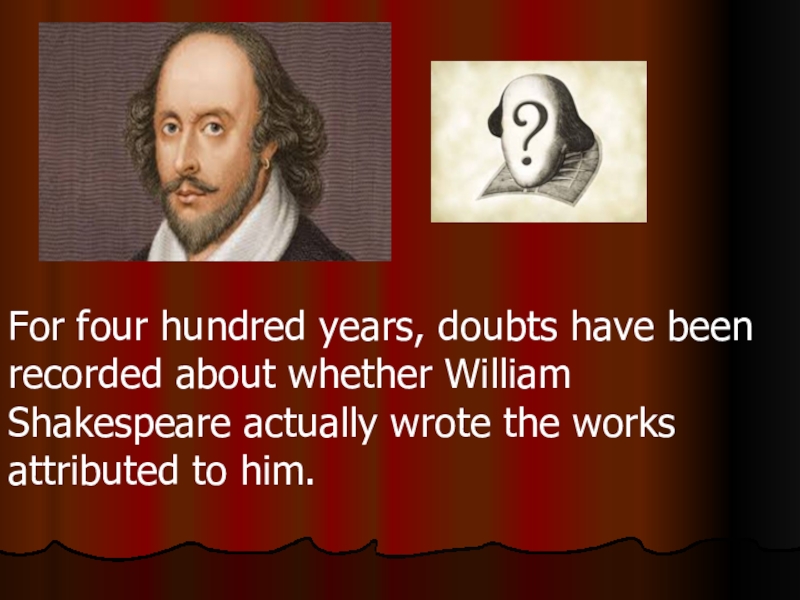
For four hundred years, doubts have been recorded about whether William
Shakespeare actually wrote the works attributed to him.
Слайд 40Around 150 years after Shakespeare's death, doubts began to emerge about
the authorship of Shakespeare's works. Alternative most notable candidates
proposed include Francis Bacon proposed include Francis Bacon, Christopher Marlowe proposed include Francis Bacon, Christopher Marlowe, and Edward de Vere, the Earl of Oxford. Popular interest in the subject has continued into the 21st century.
proposed include Francis Bacon proposed include Francis Bacon, Christopher Marlowe proposed include Francis Bacon, Christopher Marlowe, and Edward de Vere, the Earl of Oxford. Popular interest in the subject has continued into the 21st century.
Слайд 41GREAT STORIES!
GREAT MAN!
The works of William Shakespeare have the symbolic status
of immortal classics.