- Главная
- Разное
- Образование
- Спорт
- Естествознание
- Природоведение
- Религиоведение
- Французский язык
- Черчение
- Английский язык
- Астрономия
- Алгебра
- Биология
- География
- Геометрия
- Детские презентации
- Информатика
- История
- Литература
- Математика
- Музыка
- МХК
- Немецкий язык
- ОБЖ
- Обществознание
- Окружающий мир
- Педагогика
- Русский язык
- Технология
- Физика
- Философия
- Химия
- Шаблоны, фоны, картинки для презентаций
- Экология
- Экономика
Презентация, доклад на тему Урок - презентация по английскому языку Stories about plants, grade 7
Содержание
- 1. Урок - презентация по английскому языку Stories about plants, grade 7
- 2. Theme: Stories about plantsDate: Grade: 7Objectives (aims):
- 3. The stages of the lessonOrganization moment
- 4. Check the homework1. Write the missing letters.Pl-nt,
- 5. Key to the test. Plant, flower,
- 6. 2.Add the words to each list.Rose,____,____,______,_____,____,____ .Daisies,____,____,_____,_____,____,___ .
- 7. 3. Match the English words with their
- 8. Key to the test.Plant - растениеFlowers -
- 9. Aims and objectives of teaching
- 10. Introduction
- 11. " I'm a part of the
- 12. Narration of the teacher about
- 13. Warm upReorder the letters below. Example:
- 14. Presentation - P1
- 15. Conversation.T >Class ( Teacher addresses the whole
- 16. Grammar: Глаголы в The Present Simple в
- 17. Asel’s story.The rose grows in the garden.
- 18. Practice - P2
- 19. Answer the questionsWho is she?Has she a
- 20. Interview your partner. S=S (Pair work)
- 21. Read the chart and complete it.Ex.3,p.46
- 22. Физкультминутка. The pupils should do physical
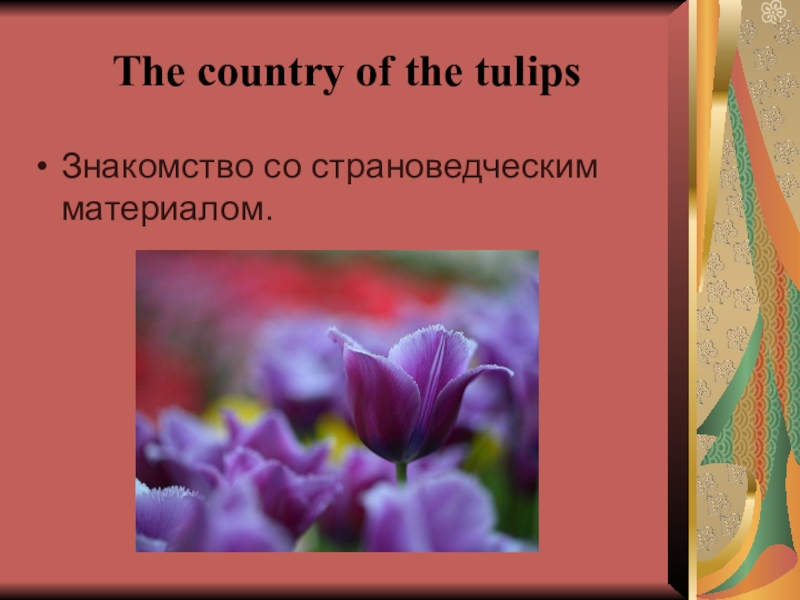
- 23. The country of the tulipsЗнакомство со страноведческим материалом.
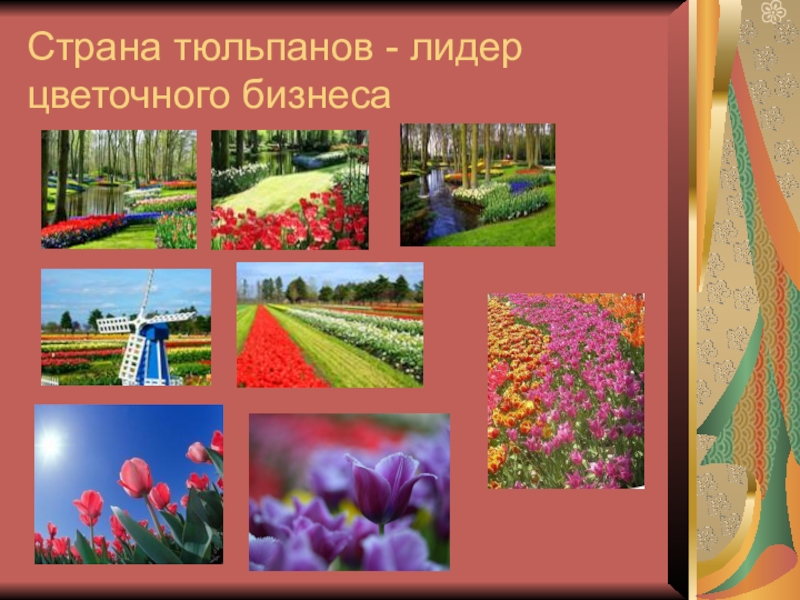
- 24. Страна тюльпанов - лидер цветочного бизнеса
- 25. Страна тюльпанов - лидер цветочного бизнеса Самым
- 26. Game: “Snowball” Речевая разминка «Снежный ком»-Let’s play
- 27. Flowers -symbolsThe national emblem (symbol) of England
- 28. Слайд 28
- 29. Production-3
- 30. Test1.What country is famous for its tulips?
- 31. 2. What is the national symbol of
- 32. 3.What is the national symbol of England?
- 33. 4.What is the national symbol of Wales?
- 34. 5.What is the national symbol of Scotland?
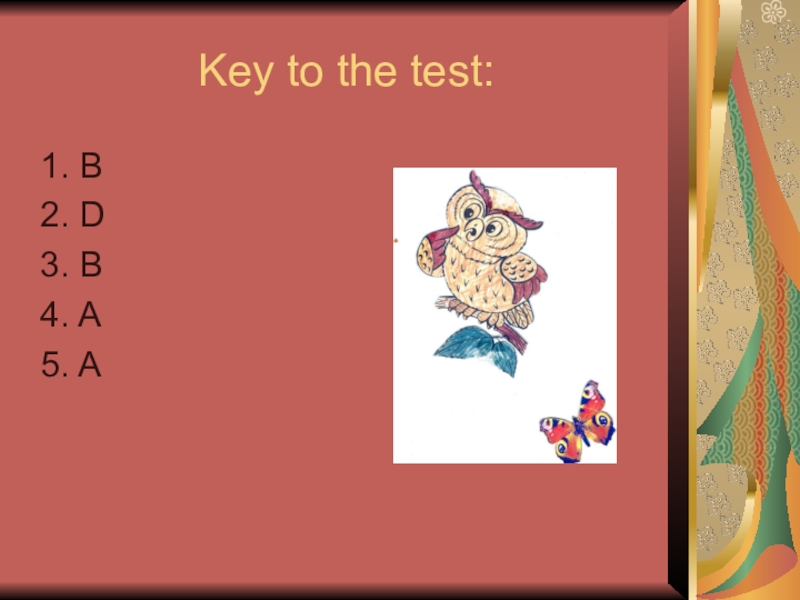
- 35. Key to the test: 1. B 2. D 3. B 4. A 5. A
- 36. AssessmentTeacher should assess knowledge of the pupils.-What
- 37. HomeworkWrite down a story “My favourite flower”.
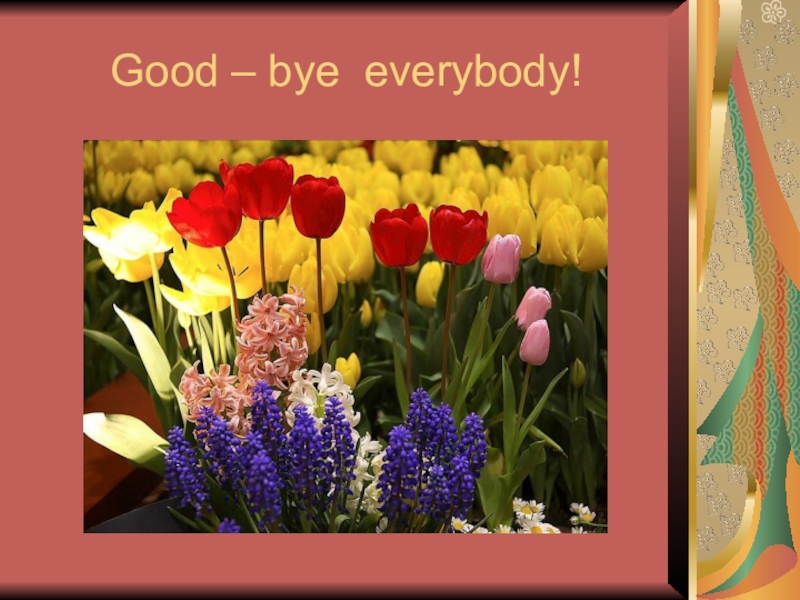
- 38. Good – bye everybody!
- 39. Happy holidays! I wish you success, luck, good health, happiness!
Theme: Stories about plantsDate: Grade: 7Objectives (aims): to check pupils’ knowledge; to teach to make up a story on a topic ; to develop the oral language, to equip with knowledge, skills, habits; to equip
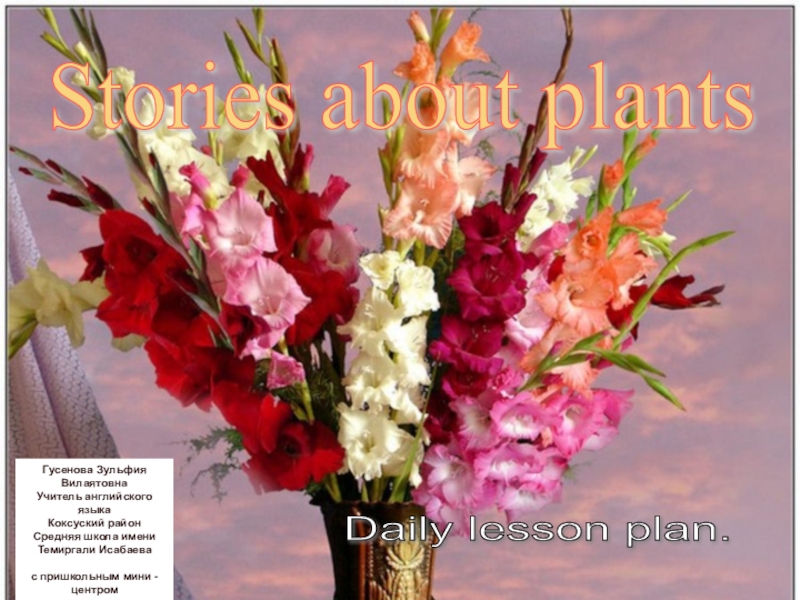
Слайд 1Stories about plants
Daily lesson plan.
Гусенова Зульфия Вилаятовна
Учитель английского языка
Коксуский район
Средняя школа имени Темиргали Исабаева
с пришкольным мини - центром
Слайд 2Theme: Stories about plants
Date:
Grade: 7
Objectives (aims): to check pupils’ knowledge;
to teach to make up a story on a topic ; to develop the oral language, to equip with knowledge, skills, habits; to equip pupils with correct techniques of independent study/seat/solitary work; to stimulate interest, to develop memory, intellect, creative thinking ; to broaden pupils’ outlook; to narrate about the country of the tulips; to foster a love for the beautiful, for nature.
Methods of teaching: conversation , creative method, visual teaching , method of the repetition, active method
Type of the lesson: revision and consolidation of the material covered. Повторение и закрепление пройденного материала.
Grammar: The Present Simple Tense
Materials: tables, pictures, cards.
Methods of teaching: conversation , creative method, visual teaching , method of the repetition, active method
Type of the lesson: revision and consolidation of the material covered. Повторение и закрепление пройденного материала.
Grammar: The Present Simple Tense
Materials: tables, pictures, cards.
Слайд 4Check the homework
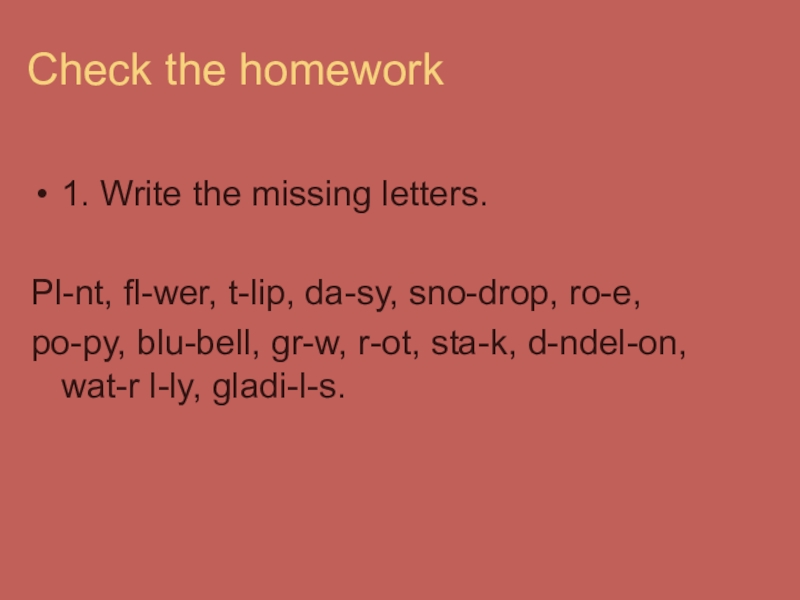
1. Write the missing letters.
Pl-nt, fl-wer, t-lip, da-sy, sno-drop,
ro-e,
po-py, blu-bell, gr-w, r-ot, sta-k, d-ndel-on, wat-r l-ly, gladi-l-s.
po-py, blu-bell, gr-w, r-ot, sta-k, d-ndel-on, wat-r l-ly, gladi-l-s.
Слайд 5Key to the test.
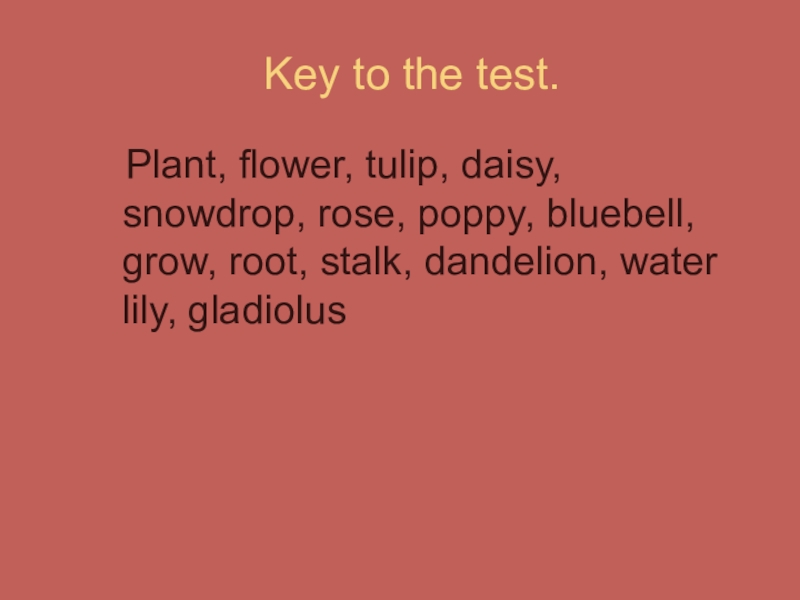
Plant, flower, tulip, daisy, snowdrop, rose,
poppy, bluebell, grow, root, stalk, dandelion, water lily, gladiolus
Слайд 6 2.Add the words to each list.
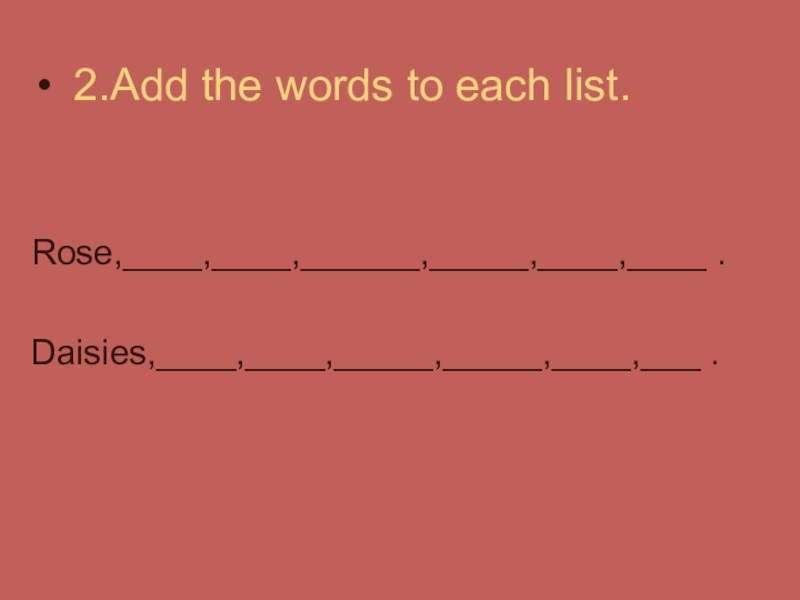
Rose,____,____,______,_____,____,____ .
Daisies,____,____,_____,_____,____,___ .
Слайд 73. Match the English words with their Russian equivalents.
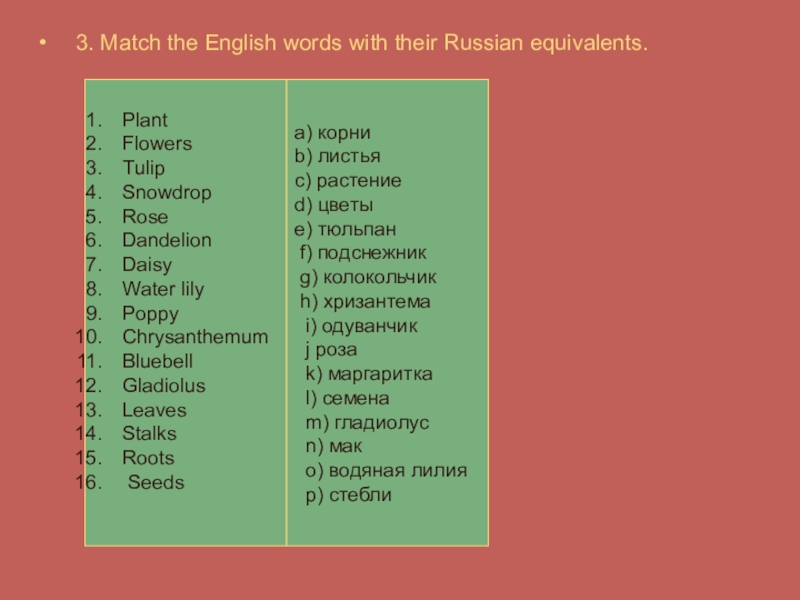
Plant
Flowers
Tulip
Snowdrop
Rose
Dandelion
Daisy
Water lily
Poppy
Chrysanthemum
Bluebell
Gladiolus
Leaves
Stalks
Roots
Seeds
a) корни
b) листья
c) растение
d) цветы
e) тюльпан
f) подснежник
g) колокольчик
h) хризантема
i) одуванчик
j роза
k) маргаритка
l) семена
m) гладиолус
n) мак
o) водяная лилия
p) стебли
Слайд 8Key to the test.
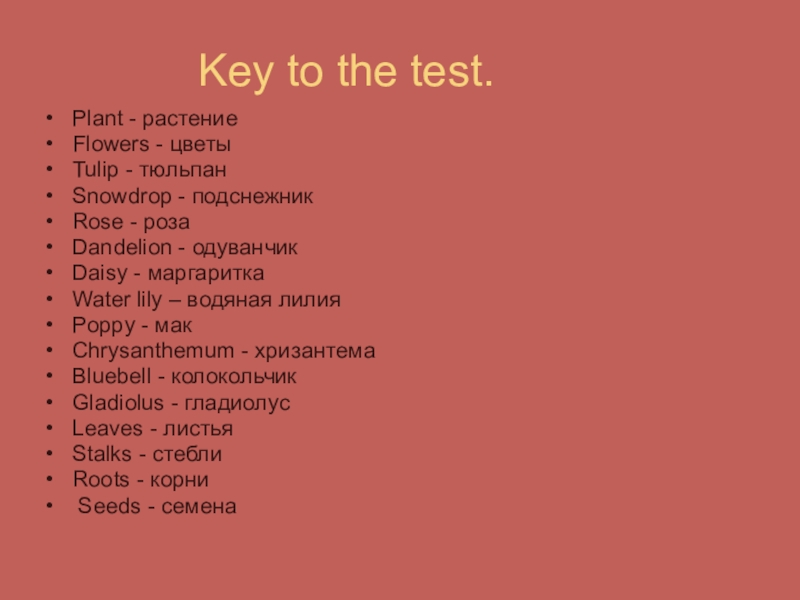
Plant - растение
Flowers - цветы
Tulip - тюльпан
Snowdrop -
подснежник
Rose - роза
Dandelion - одуванчик
Daisy - маргаритка
Water lily – водяная лилия
Poppy - мак
Chrysanthemum - хризантема
Bluebell - колокольчик
Gladiolus - гладиолус
Leaves - листья
Stalks - стебли
Roots - корни
Seeds - семена
Rose - роза
Dandelion - одуванчик
Daisy - маргаритка
Water lily – водяная лилия
Poppy - мак
Chrysanthemum - хризантема
Bluebell - колокольчик
Gladiolus - гладиолус
Leaves - листья
Stalks - стебли
Roots - корни
Seeds - семена


Слайд 12Narration of the teacher about flowers
Волшебный
дар цветов и их красота творят чудеса. Общаясь с этими прекрасными творениями природы, человек становится добрее, нежнее, духовно богаче. Цветы лучшие посредники в общении между людьми. Цветы сопутствуют нам постоянно в течение жизни,
дарят радость, олицетворяют любовь и внимание. Люди часто прибегали к их нежному доверительному, романтическому языку, чтобы объясниться без слов.
дарят радость, олицетворяют любовь и внимание. Люди часто прибегали к их нежному доверительному, романтическому языку, чтобы объясниться без слов.
Слайд 13Warm up
Reorder the letters below.
Example: sore …rose…
1. liptus ………
2. dropssnow …….
3. sydai ………
4. deliondan ……………
5. pppoy ……….
2. dropssnow …….
3. sydai ………
4. deliondan ……………
5. pppoy ……….

Слайд 15Conversation.
T >Class ( Teacher addresses the whole class).
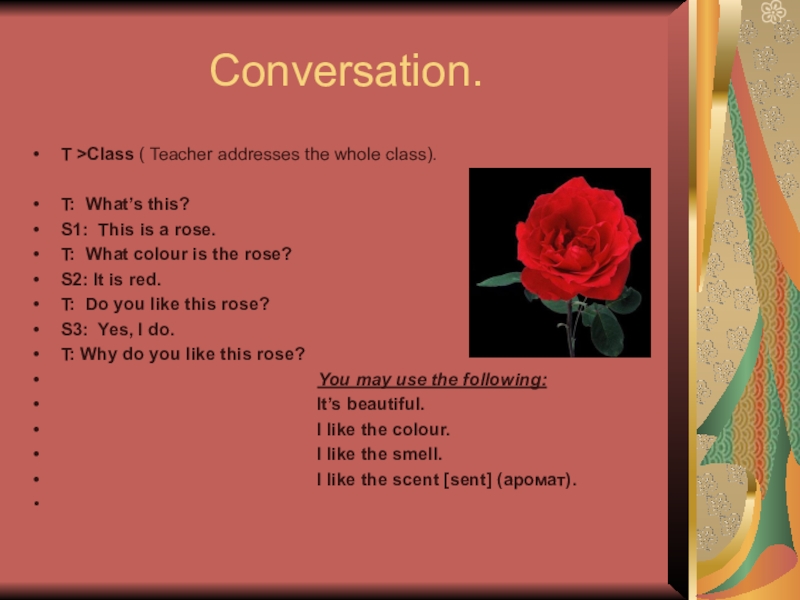
T: What’s this?
S1: This is a rose.
T: What colour is the rose?
S2: It is red.
T: Do you like this rose?
S3: Yes, I do.
T: Why do you like this rose?
You may use the following:
It’s beautiful.
I like the colour.
I like the smell.
I like the scent [sent] (аромат).
Слайд 16Grammar: Глаголы в The Present Simple в 3 лице единственного числа
получают окончание – s.
He likes
She likes
It likes
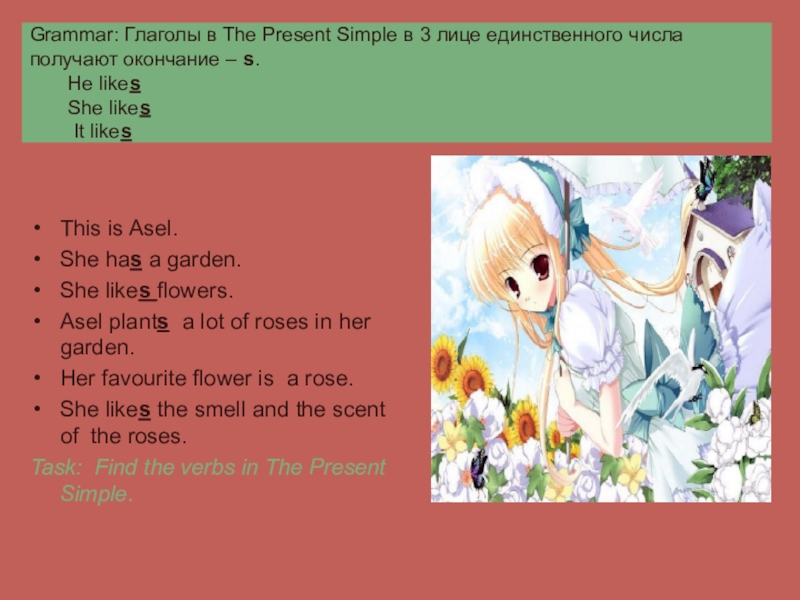
This is Asel.
She has a garden.
She likes flowers.
Asel plants a lot of roses in her garden.
Her favourite flower is a rose.
She likes the smell and the scent of the roses.
Task: Find the verbs in The Present Simple.
Слайд 17Asel’s story.
The rose grows in the garden.
It grows in spring
and summer.
It’s white, red, purple, pink.
It looks beautiful.
It’s my favourite flower.
It smells good.
It’s beautiful.
I like the colour.
I like the smell.
I like the scent [ sent] (аромат).
It’s white, red, purple, pink.
It looks beautiful.
It’s my favourite flower.
It smells good.
It’s beautiful.
I like the colour.
I like the smell.
I like the scent [ sent] (аромат).
Read the story.
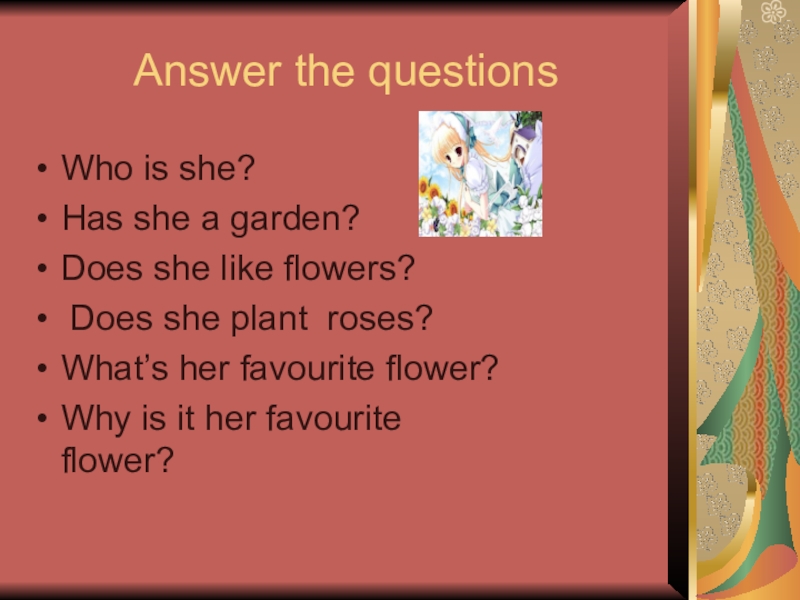
Слайд 19Answer the questions
Who is she?
Has she a garden?
Does she like flowers?
Does she plant roses?
What’s her favourite flower?
Why is it her favourite flower?
What’s her favourite flower?
Why is it her favourite flower?
Слайд 20Interview your partner.
S=S (Pair work)
Do you plant flowers?
When do you
usually plant flowers?
Where do you usually plant flowers?
What’s your favourite flower?
Why is it your favourite flower?
Do you have a pot flower at home?
Do you water it?
How often do you water it?
Where do you usually plant flowers?
What’s your favourite flower?
Why is it your favourite flower?
Do you have a pot flower at home?
Do you water it?
How often do you water it?
Слайд 22Физкультминутка.
The pupils should do physical exercises.
One, two, three,
Do the actions
with me!
Red, red, touch your head,
Black, black, touch your back,
Blue, blue, touch your shoe.
Green, green, touch your chin.
Brown, brown, touch the ground.
Cars are running in the town
Up and down, up and down.
Now and then a three-eyed cop
Tell them straightly “go” and “stop”.
Red, red, touch your head,
Black, black, touch your back,
Blue, blue, touch your shoe.
Green, green, touch your chin.
Brown, brown, touch the ground.
Cars are running in the town
Up and down, up and down.
Now and then a three-eyed cop
Tell them straightly “go” and “stop”.
Слайд 25Страна тюльпанов - лидер цветочного бизнеса
Самым крупным производителем срезанных цветов и
горшечных растений является Голландия. Еще бы, ведь у нее такие старые традиции в сфере выращивания цветов! Началось все в XVII веке с разведения тюльпанов. Родина тюльпанов – Памир и Тянь-Шань. Там до сих пор в изобилии цветут дикорастущие тюльпаны, предки 40% известных нам сортов. В Азии и на Ближнем Востоке издавна тюльпаны пользовались почетом и любовью, и обильно произрастали в садах богачей. Крестоносцы привезли их в средневековую Европу, постепенно слава их докатилась и до Голландии. Тут к их услугам были благодатнейшие почвы – не даром официальное название Голландии – Нидерланды, «низинные земли». Две пятых территории страны лежит ниже уровня моря, что обеспечивает высокое залегание грунтовых вод. К тому же, здесь выпадает большое количество осадков. Тюльпаны прижились. Их стали выращивать абсолютно все – от трубочиста до банкира. Садоводы тогда еще не имели понятия о гибридизации, поэтому новые сорта появлялись на свет путем случайного скрещивания. Но стоили они баснословно дорого!
Тюльпанный бум обеспечил голландцам славу умелых цветоводов. Эта слава живет на протяжении трех веков, и не собирается угасать. Сейчас цветочные поставки из Голландии слывут самыми дорогими, но и самыми качественными.
Тюльпанный бум обеспечил голландцам славу умелых цветоводов. Эта слава живет на протяжении трех веков, и не собирается угасать. Сейчас цветочные поставки из Голландии слывут самыми дорогими, но и самыми качественными.
Слайд 26Game: “Snowball”
Речевая разминка «Снежный ком»
-Let’s play a “Snowball” game.
So, you must
complete the list of flowers. Let’s repeat the words.
Учитель предлагает вспомнить название цветов и составить из них цепочку слов. Ученик, повторяющий цепочку слов , добавляет и своё слово. Побеждает ученик , сумевший повторить самую длинную цепочку слов.
Учитель предлагает вспомнить название цветов и составить из них цепочку слов. Ученик, повторяющий цепочку слов , добавляет и своё слово. Побеждает ученик , сумевший повторить самую длинную цепочку слов.
Tulip, Snowdrop, Rose, Dandelion, Daisy, Water lily,
Poppy, Chrysanthemum, Bluebell, Gladiolus ……….
Слайд 27Flowers -symbols
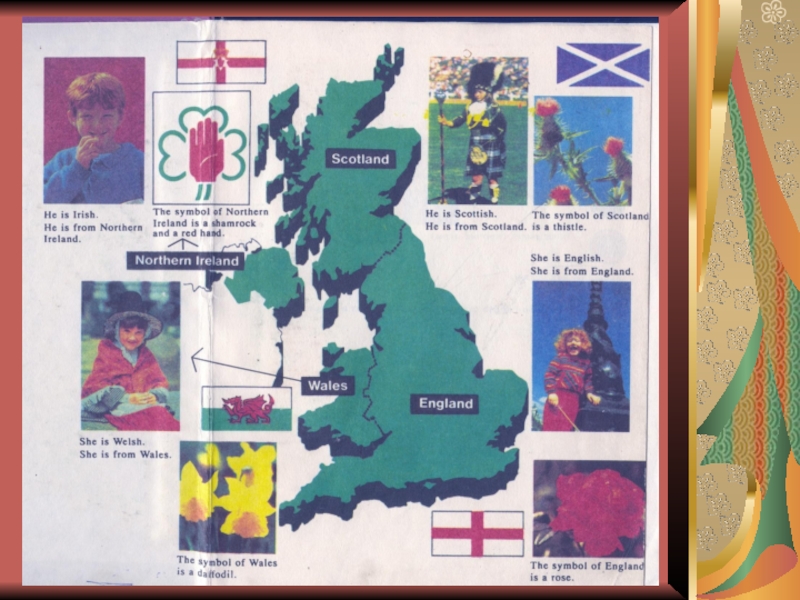
The national emblem (symbol) of England is a rose.
The national
emblem (symbol) of Scotland is a thistle (чертополох).
The national (symbol) emblem of Wales is a daffodil (нарцисс).
The national (symbol) emblem of Northern Ireland is a shamrock (кислица) and a red hand.
The national (symbol) emblem of America is the Bald eagle. It has an olive branch (a symbol of peace) and arrows ( стрелы) ( a symbol of strength (силы и прочности).
The national (symbol) emblem of Wales is a daffodil (нарцисс).
The national (symbol) emblem of Northern Ireland is a shamrock (кислица) and a red hand.
The national (symbol) emblem of America is the Bald eagle. It has an olive branch (a symbol of peace) and arrows ( стрелы) ( a symbol of strength (силы и прочности).

Слайд 30Test
1.What country is famous for its tulips?
A) the U.K.
B)
Holland
C) Canada
D) Brazil
E) the U.S.A.
C) Canada
D) Brazil
E) the U.S.A.
Слайд 312. What is the national symbol of America?
A) the moon
B) the rose
C) the shamrock
D) the Bald eagle
E) the sun
C) the shamrock
D) the Bald eagle
E) the sun
Слайд 32
3.What is the national symbol of England?
A) the bluebell
B)
the rose
C) the tulip
D) the poppy
E) the daisy
C) the tulip
D) the poppy
E) the daisy
Слайд 334.What is the national symbol of Wales?
A) the daffodil
B)
the rose
C) the daisy
D) the dandelion
E) the poppy
C) the daisy
D) the dandelion
E) the poppy
Слайд 345.What is the national symbol of Scotland?
A) the thistle
B)
the snowdrop
C) the bluebell
D) the water lily
E) the daisy
C) the bluebell
D) the water lily
E) the daisy
Слайд 36Assessment
Teacher should assess knowledge of the pupils.
-What new words do you
know?
-What did we do today?
-Who is number one today?
-Today I like your work.
-Give me your record – books.
-What did we do today?
-Who is number one today?
-Today I like your work.
-Give me your record – books.