Слайд 1ГКОУ СО ЕШИ «Эверест»
Учебный информационный проект
по английскому языку
История Англии:
завоевание Британии
римлянами
Выполнил: ученик 8 класса Павлов Артём
Руководитель: Берлет И. В.
Екатеринбург, 2016
Слайд 2The history of England
By Pavlov Artyom
Teacher: Berlet I. V.
Ekaterinburg, 2016
Britain conquered
by the Romans
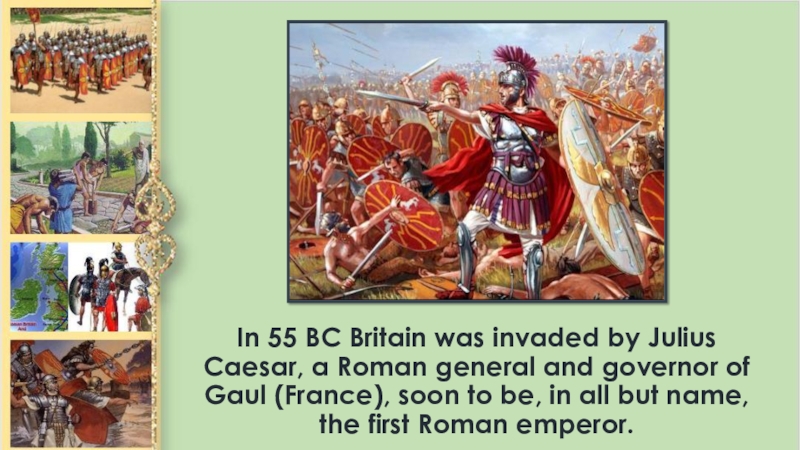
Слайд 3In 55 ВС Britain was invaded by Julius Caesar, а Roman
general and governor of Gaul (France), soon to be, in all but name, the first Roman emperor.
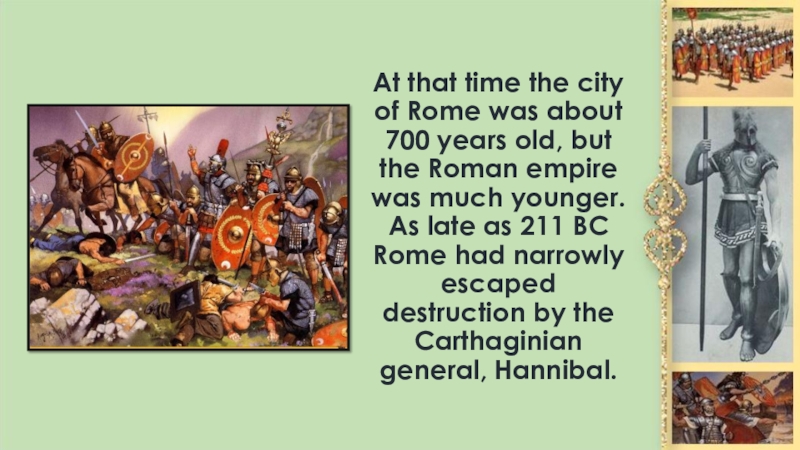
Слайд 4At that time the city of Rome was about 700 years
old, but the Roman empire was much younger. As late as 211 ВС Rome had narrowly escaped destruction by the Carthaginian general, Hannibal.
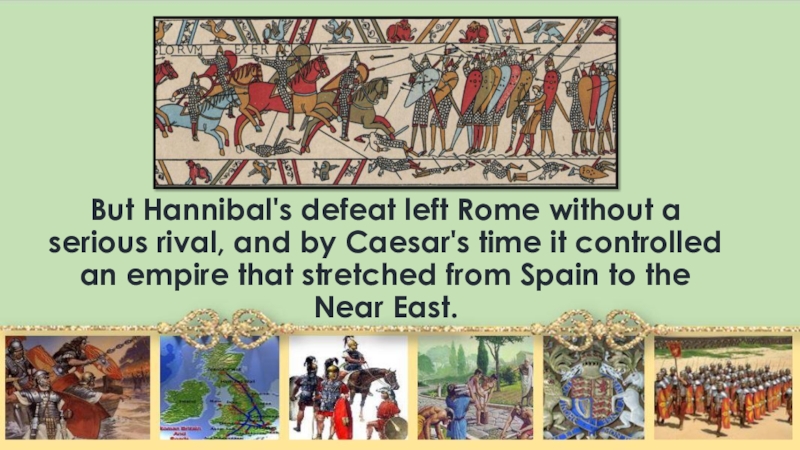
Слайд 5But Hannibal's defeat left Rome without а serious rival, and by
Caesar's time it controlled an empire that stretched from Spain to the Near East.
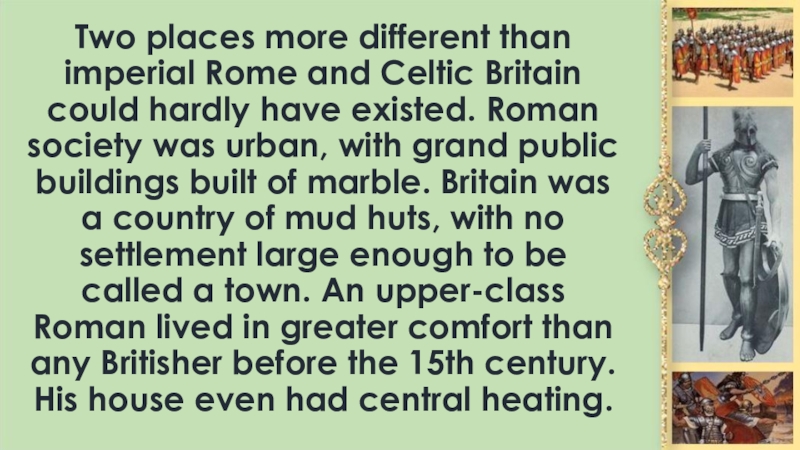
Слайд 6Two places more different than imperial Rome and Celtic Britain could
hardly have existed. Roman society was urban, with grand public buildings built of marble. Britain was а country of mud huts, with no settlement large enough to be called а town. An upper-class Roman lived in greater comfort than any Britisher before the 15th century. His house even had central heating.
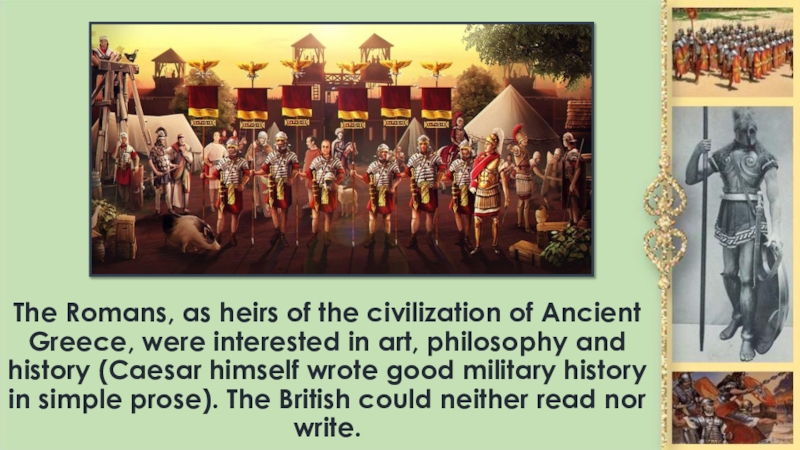
Слайд 7The Romans, as heirs of the civilization of Ancient Greece, were
interested in art, philosophy and history (Caesar himself wrote good military history in simple prose). The British could neither read nor write.
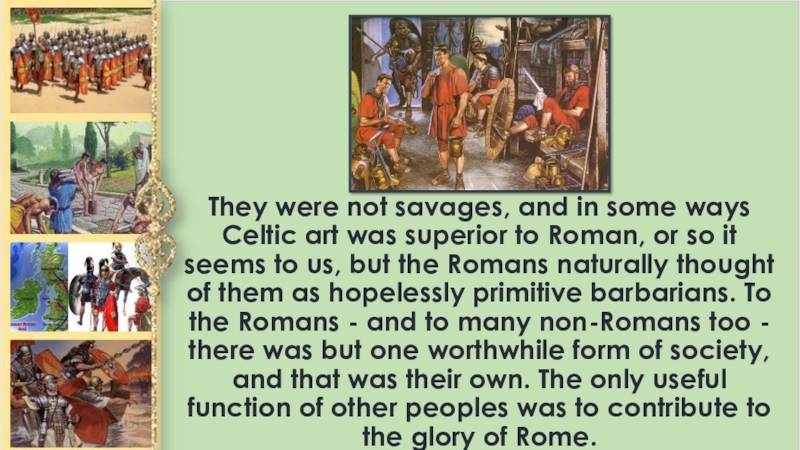
Слайд 8They were not savages, and in some ways Celtic art was
superior to Roman, or so it seems to us, but the Romans naturally thought of them as hopelessly primitive barbarians. То the Romans - and to many non-Romans too - there was but one worthwhile form of society, and that was their own. The only useful function of other peoples was to contribute to the glory of Rome.
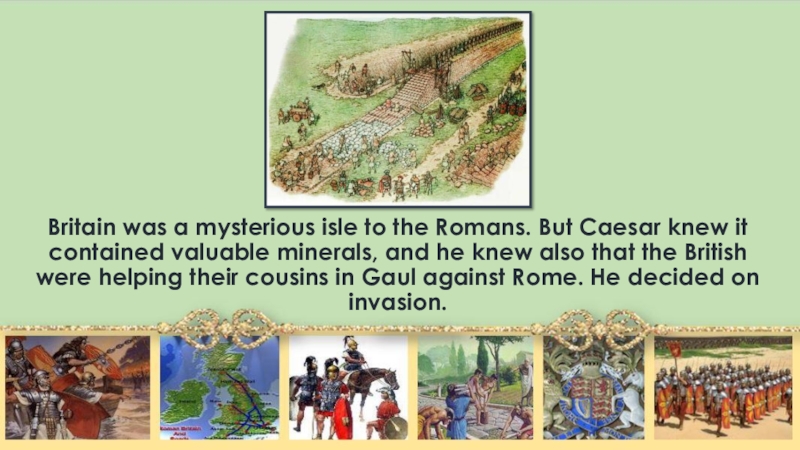
Слайд 9Britain was а mysterious isle to the Romans. But Caesar knew
it contained valuable minerals, and he knew also that the British were helping their cousins in Gaul against Rome. Не decided on invasion.
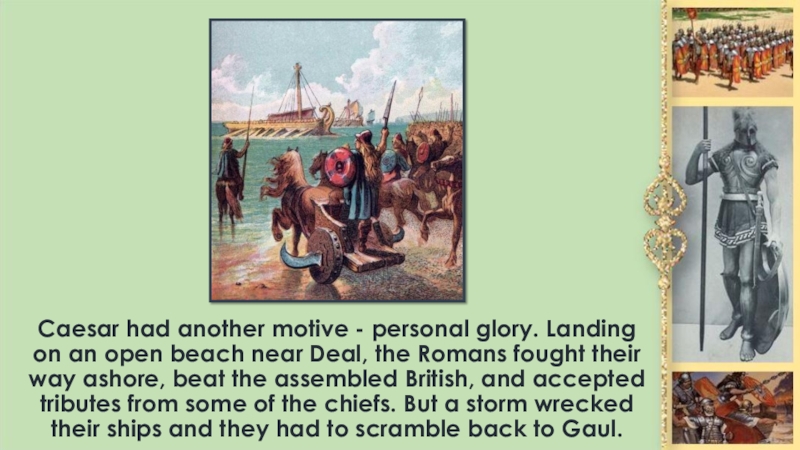
Слайд 10Caesar had another motive - personal glory. Landing on an open
beach near Deal, the Romans fought their way ashore, beat the assembled British, and accepted tributes from some of the chiefs. But а storm wrecked their ships and they had to scramble back to Gaul.
Слайд 11Next year Caesar came again, this time with а much larger
expedition - five legions and 800 ships. The British tribes sank their differences, uniting under the leadership of Cassivellaunus, and it took some time for Caesar to work out а way of dealing with the British chariots. The Romans were not used to this form of warfare, as chariots were obsolete in Gaul.
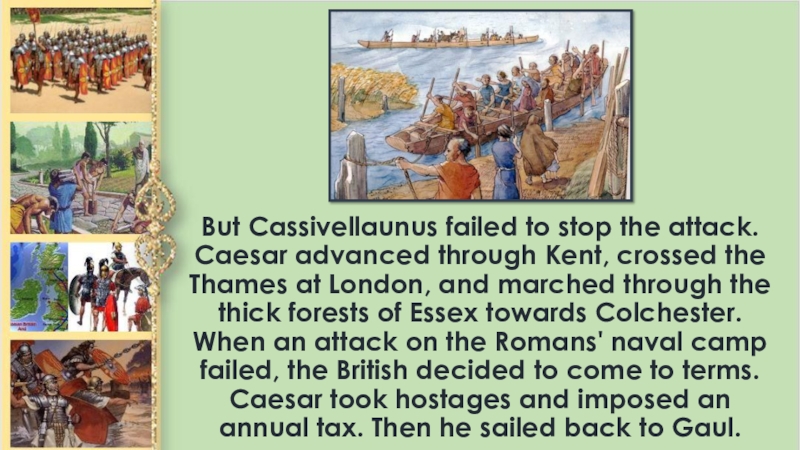
Слайд 12But Cassivellaunus failed to stop the attack. Caesar advanced through Kent,
crossed the Thames at London, and marched through the thick forests of Essex towards Colchester. When an attack on the Romans' naval camp failed, the British decided to come to terms. Caesar took hostages and imposed an annual tax. Then he sailed back to Gaul.
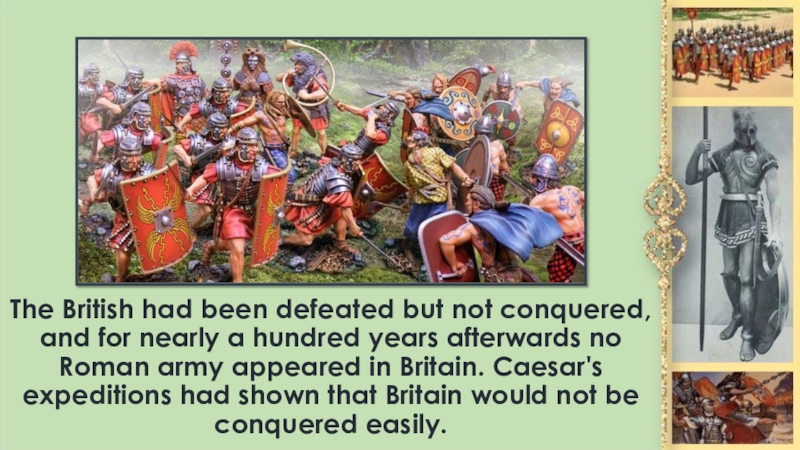
Слайд 13The British had been defeated but not conquered, and for nearly
а hundred years afterwards no Roman army appeared in Britain. Caesar's expeditions had shown that Britain would not be conquered easily.
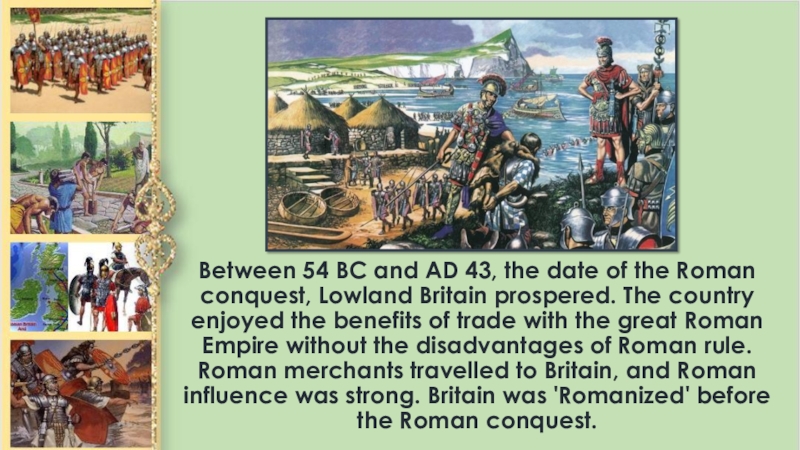
Слайд 14Between 54 BC and AD 43, the date of the Roman
conquest, Lowland Britain prospered. The country enjoyed the benefits of trade with the great Roman Empire without the disadvantages of Roman rule. Roman merchants travelled to Britain, and Roman influence was strong. Britain was 'Romanized' before the Roman conquest.
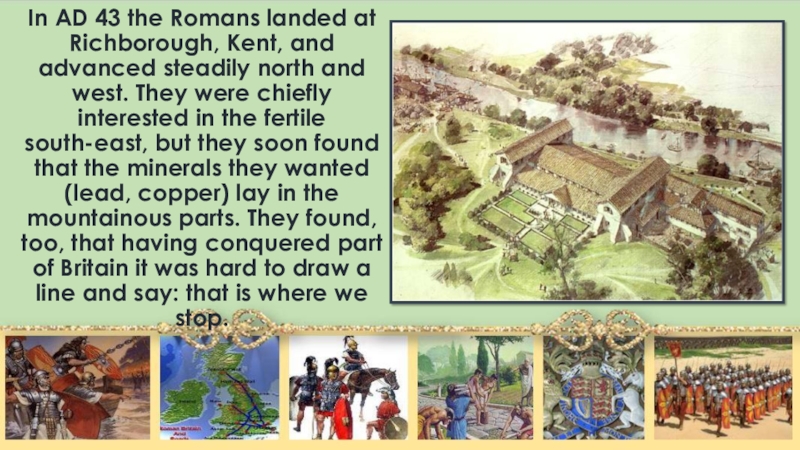
Слайд 15In AD 43 the Romans landed at Richborough, Kent, and advanced
steadily north and west. They were chiefly interested in the fertile south-east, but they soon found that the minerals they wanted (lead, copper) lау in the mountainous parts. They found, too, that having conquered part of Britain it was hard to draw а line and say: that is where we stop.
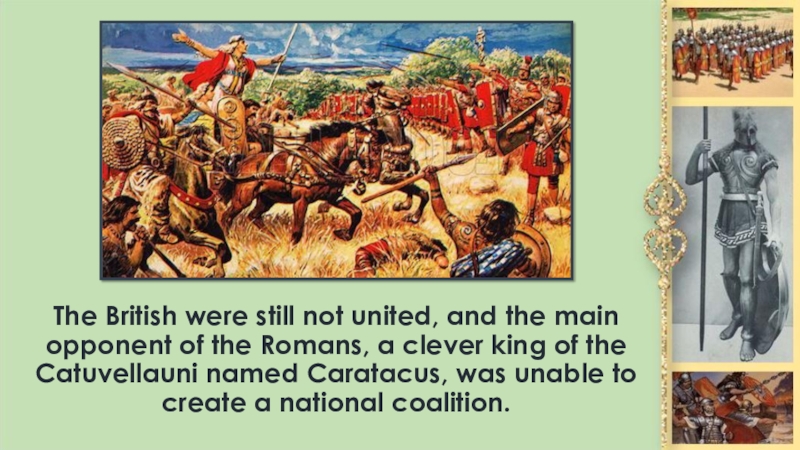
Слайд 16The British were still not united, and the main opponent of
the Romans, а clever king of the Catuvellauni named Caratacus, was unable to create а national coalition.
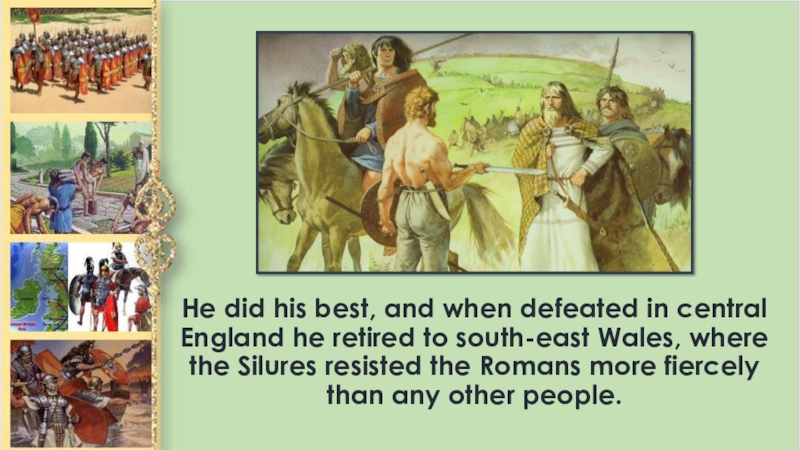
Слайд 17Не did his best, and when defeated in central England he
retired to south-east Wales, where the Silures resisted the Romans more fiercely than any other people.
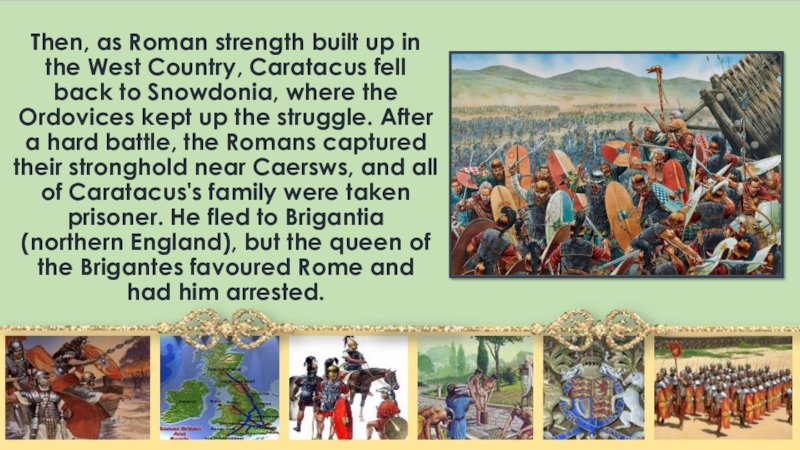
Слайд 18Then, as Roman strength built up in the West Country, Caratacus
fell back to Snowdonia, where the Ordovices kept up the struggle. After а hard battle, the Romans captured their stronghold near Caersws, and all of Caratacus's family were taken prisoner. Не fled to Brigantia (northern England), but the queen of the Brigantes favoured Rome and had him arrested.
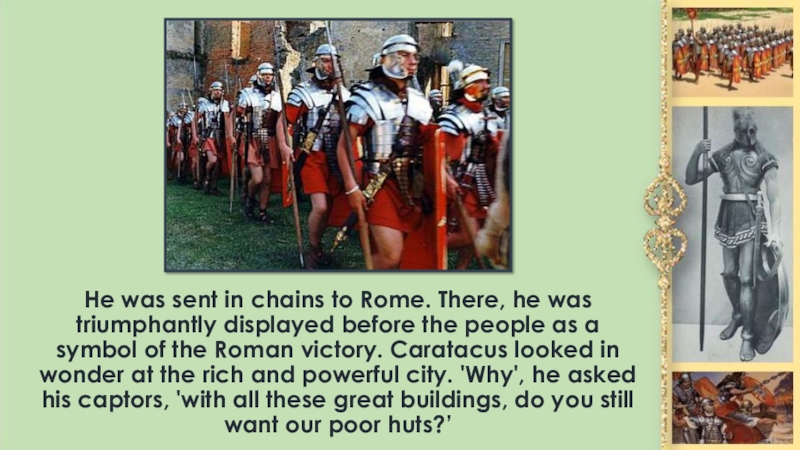
Слайд 19Не was sent in chains to Rome. There, he was triumphantly
displayed before the people as а symbol of the Roman victory. Caratacus looked in wonder at the rich and powerful city. 'Why', he asked his captors, 'with all these great buildings, do you still want our poor huts?’
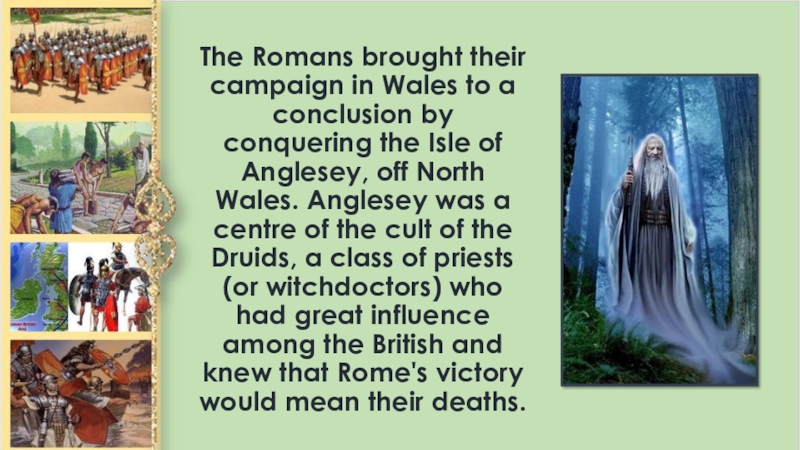
Слайд 20The Romans brought their campaign in Wales to а conclusion by
conquering the Isle of Anglesey, off North Wales. Anglesey was а centre of the cult of the Druids, а class of priests (or witchdoctors) who had great influence among the British and knew that Rome's victory would mean their deaths.
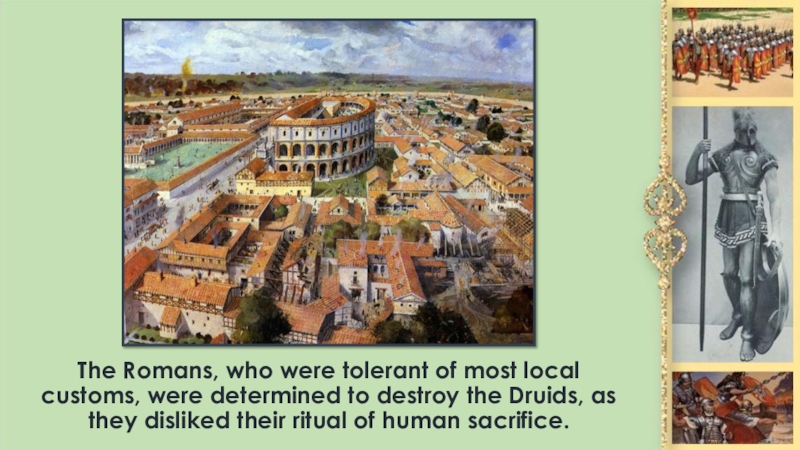
Слайд 21The Romans, who were tolerant of most local customs, were determined
to destroy the Druids, as they disliked their ritual of human sacrifice.
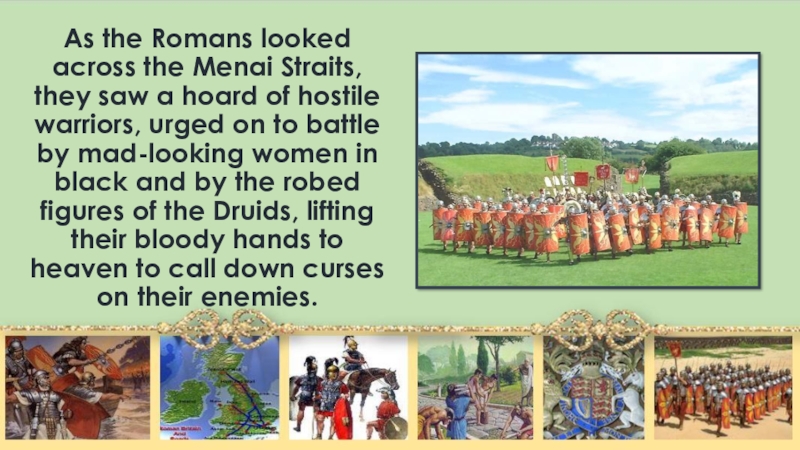
Слайд 22As the Romans looked across the Menai Straits, they saw а
hoard of hostile warriors, urged on to battle by mad-looking women in black and by the robed figures of the Druids, lifting their bloody hands to heaven to сall down curses on their enemies.
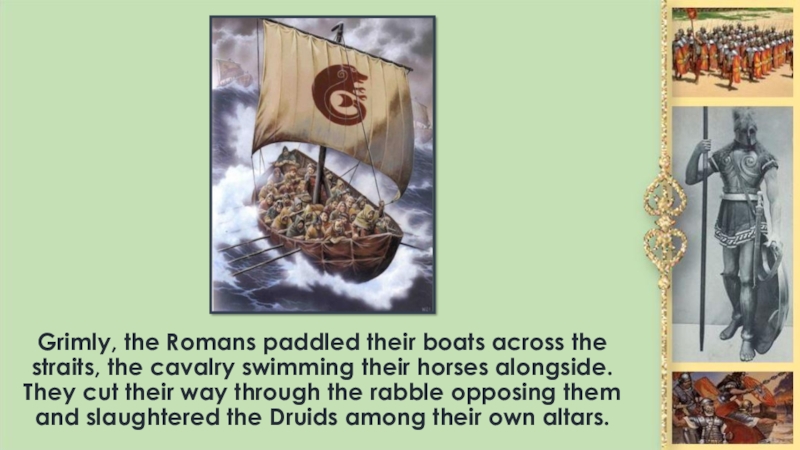
Слайд 23Grimly, the Romans paddled their boats across the straits, the cavalry
swimming their horses alongside. They cut their way through the rabble opposing them and slaughtered the Druids among their own altars.
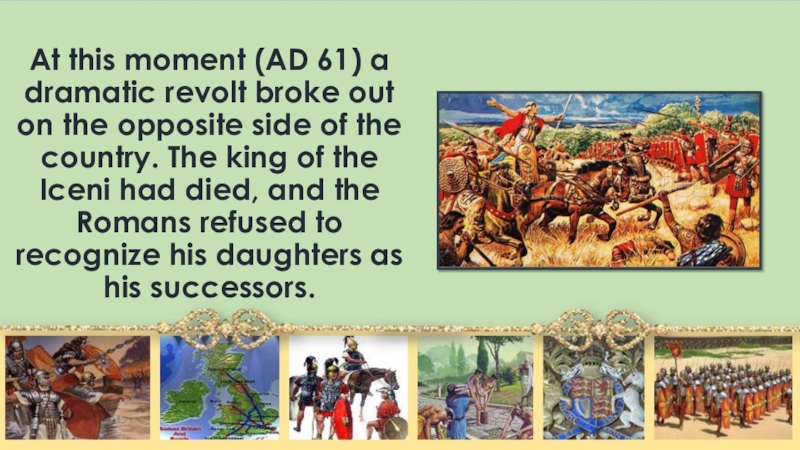
Слайд 24At this moment (AD 61) а dramatic revolt broke out on
the opposite side of the country. The king of the Iceni had died, and the Romans refused to recognize his daughters as his successors.
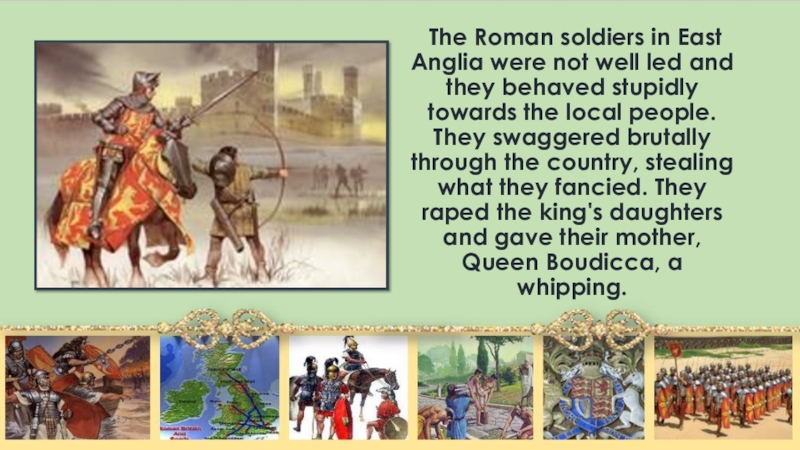
Слайд 25 The Roman soldiers in East Anglia were not well led
and they behaved stupidly towards the local people. They swaggered brutally through the country, stealing what they fancied. They raped the king's daughters and gave their mother, Queen Boudicca, а whipping.
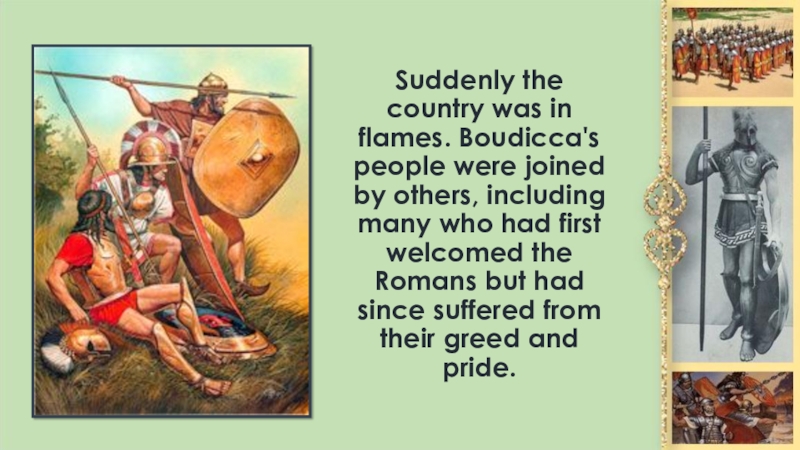
Слайд 26Suddenly the country was in flames. Boudicca's people were joined by
others, including many who had first welcomed the Romans but had since suffered from their greed and pride.
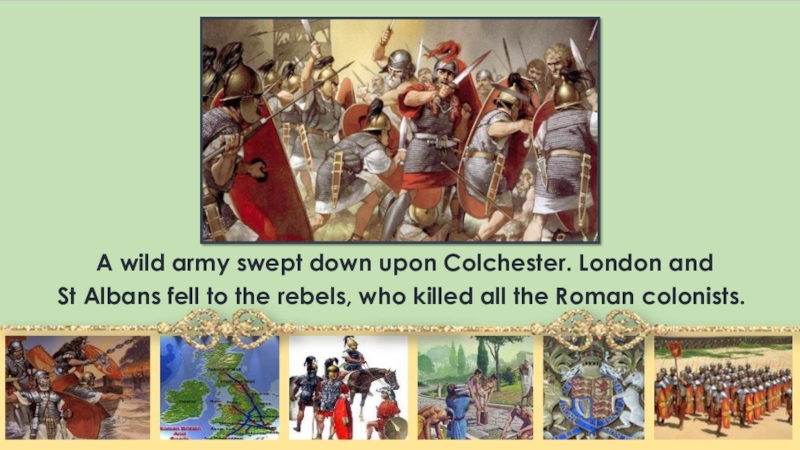
Слайд 27 А wild army swept down upon Colchester. London and
St
Albans fеll to the rebels, who killed all the Roman colonists.
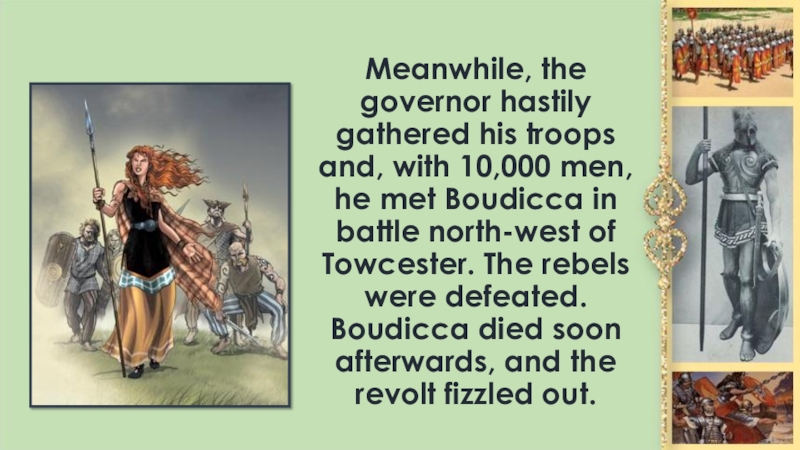
Слайд 28Meanwhile, the governor hastily gathered his troops and, with 10,000 men,
he met Boudicca in battle north-west of Towcester. The rebels were defeated. Boudicca died soon afterwards, and the revolt fizzled out.
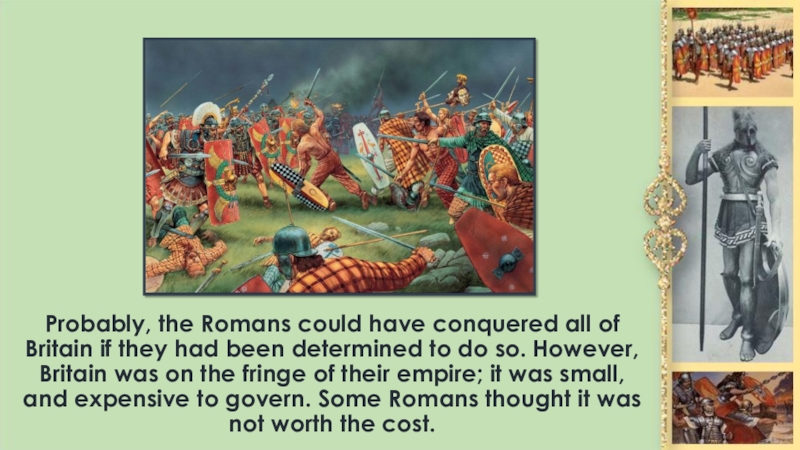
Слайд 29Probably, the Romans could have conquered all of Britain if they
had been determined to do so. However, Britain was on the fringe of their empire; it was small, and expensive to govern. Some Romans thought it was not worth the cost.
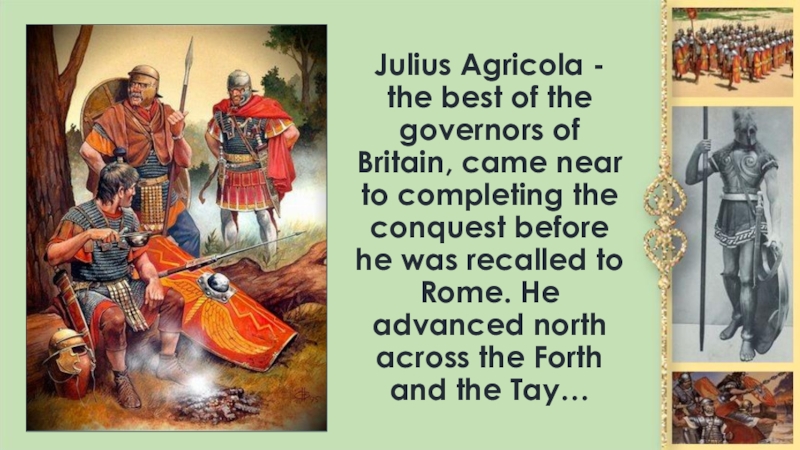
Слайд 30Julius Agricola - the best of the governors of Britain, came
near to completing the conquest before he was recalled to Rome. Не advanced north across the Forth and the Тау…
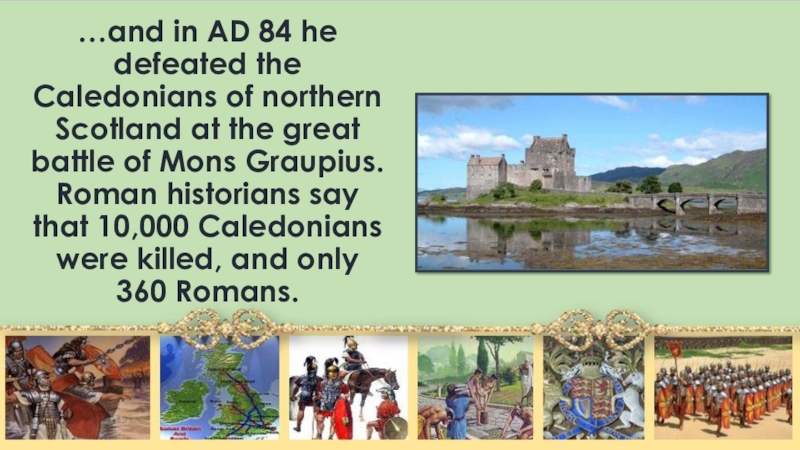
Слайд 31…and in AD 84 he defeated the Caledonians of northern Scotland
at the great battle of Mons Graupius. Roman historians say that 10,000 Caledonians were killed, and only 360 Romans.
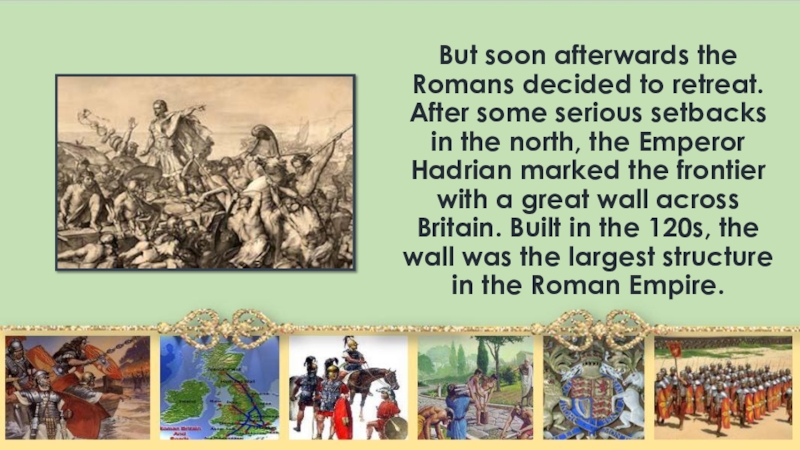
Слайд 32But soon afterwards the Romans decided to retreat. After some serious
setbacks in the north, the Emperor Hadrian marked the frontier with а great wall across Britain. Built in the 120s, the wall was the largest structure in the Roman Empire.
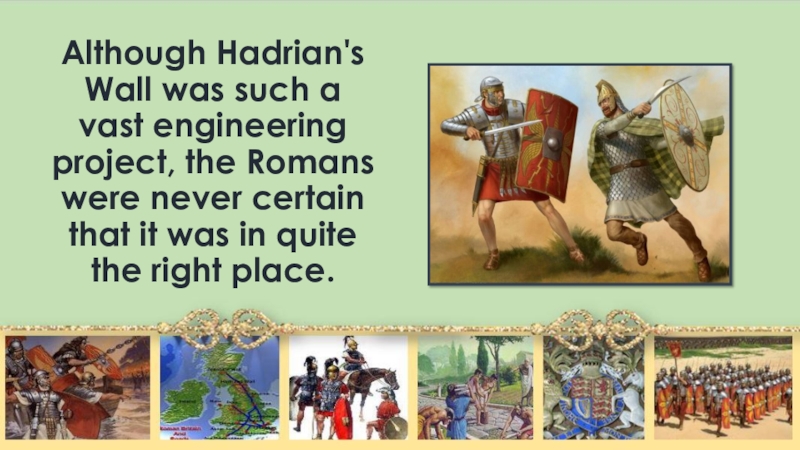
Слайд 33Although Hadrian's Wall was such а vast engineering project, the Romans
were never certain that it was in quite the right place.
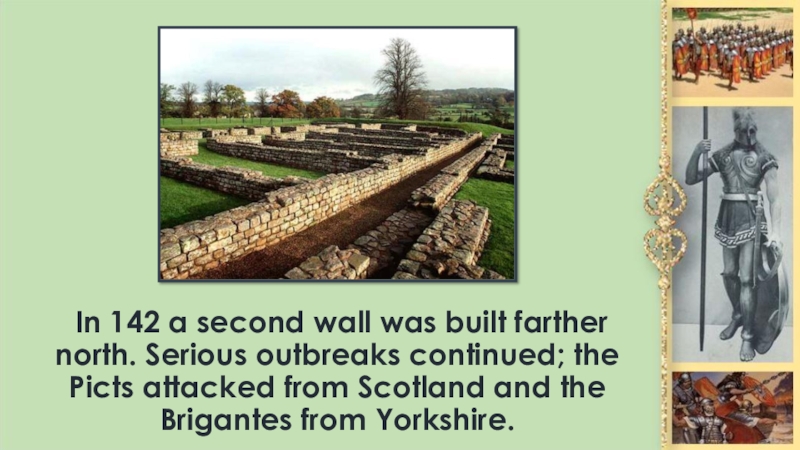
Слайд 34 In 142 а second wall was built farther north. Serious
outbreaks continued; the Picts attacked from Scotland and the Brigantes from Yorkshire.
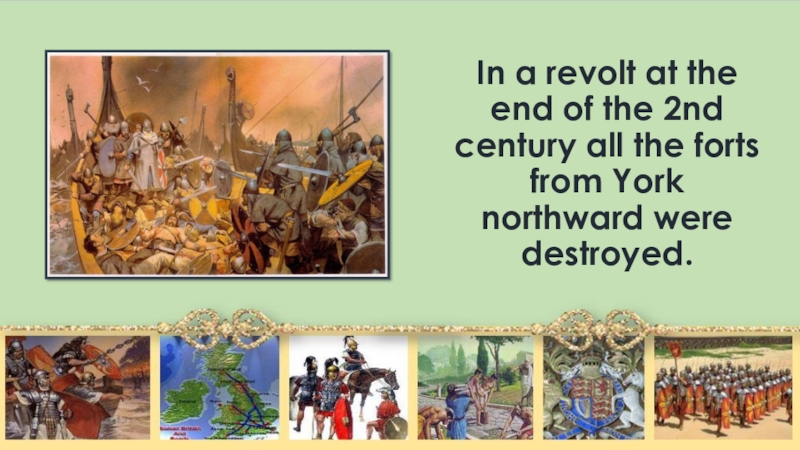
Слайд 35In а revolt at the end of the 2nd century all
the forts from York northward were destroyed.
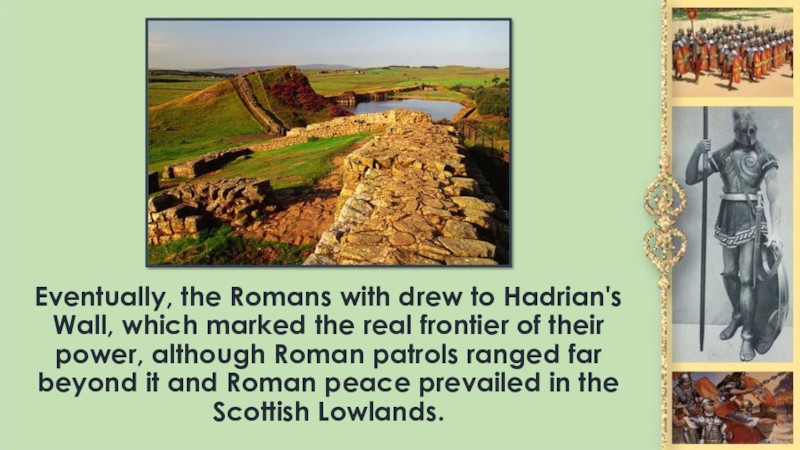
Слайд 36Eventually, the Romans with drew to Hadrian's Wall, which marked the
real frontier of their power, although Roman patrols ranged far beyond it and Roman peace prevailed in the Scottish Lowlands.
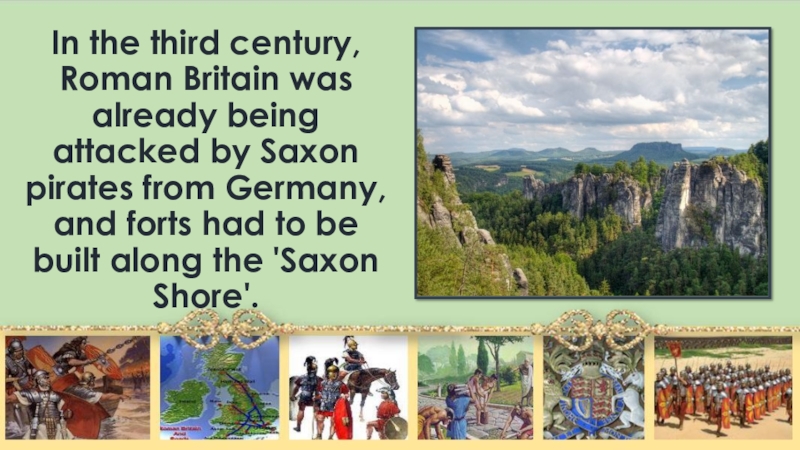
Слайд 37In the third century, Roman Britain was already being attacked by
Saxon pirates from Germany, and forts had to be built along the 'Saxon Shore'.
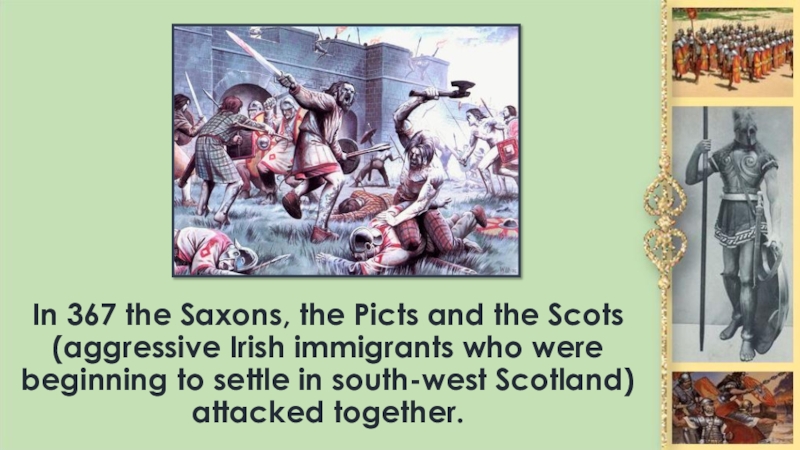
Слайд 38In 367 the Saxons, the Picts and the Scots (aggressive Irish
immigrants who were beginning to settle in south-west Scotland) attacked together.
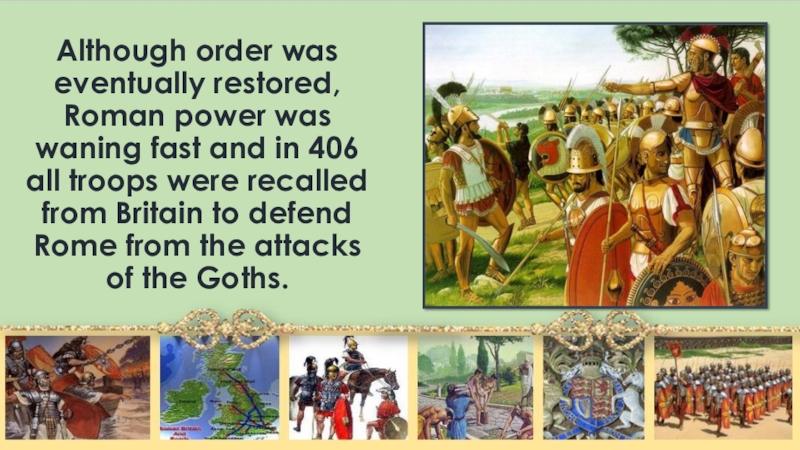
Слайд 39Although order was eventually restored, Roman power was waning fast and
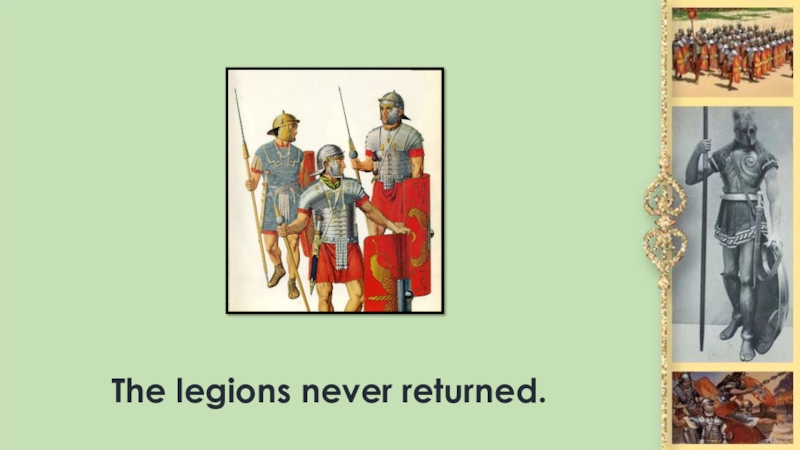
in 406 all troops were recalled from Britain to defend Rome from the attacks of the Goths.
Слайд 42http://i.ucrazy.ru/files/i/2008.10.11/1223723324_07.jpg
http://www.history-for-kids.com/images/boudica-warrior-queen.jpg
http://4flaga.ru/105-britain-conquered-by-the-romans.html
http://img-fotki.yandex.ru/get/6619/137106206.195/0_990a3_23bd9580_orig.jpg
http://www.tourprom.ru/site_media/images/countries/angliya-istoriya_26082013185120.jpg
http://4flaga.ru/picterra/hb_romans.jpg
http://4flaga.ru/picterra/hb_romebrit.jpg
http://ichef.bbci.co.uk/images/ic/1200x675/p01gn3h5.jpg
http://img1.joyreactor.cc/pics/comment/full/%D0%A0%D0%B8%D0%BC-angus-mcbride-%D0%98%D1%81%D1%82%D0%BE%D1%80%D0%B8%D1%8F-%D0%B2%D0%BE%D0%B8%D0%BD%D1%8B-1602577.jpeg
http://1.bp.blogspot.com/-H-Xmim0tMUM/UqHhz2WM8tI/AAAAAAAACSo/CZTLn8_a7VU/s1600/3099735_com_roman_invasion_of_britain2.jpg
http://dazpix.co.uk/wp-content/uploads/portfolio_content/2014_rotlp/1_calleva_atrebatum_master.jpg
http://images-mediawiki-sites.thefullwiki.org/02/1/8/1/95334821664749612.png
http://www.saieditor.com/falco/images/londinium.jpg
http://goforproxy.appspot.com/4flaga.ru/im/history-of-britain.jpg
Sources
http://pbs.twimg.com/media/B_QwyC-W8AECa1v.jpg:large
http://www.luciuscorneliussylla.fr/image/guerrecivile2.jpg
http://i1296.photobucket.com/albums/ag18/limsloon/RomeSplash_zps9c3d05ce.jpg
http://www.temporamagazine.com/wp-content/uploads/LEGIONES-ROMANAS0004-1.jpg
http://barbgallo.com/1/roman-britain-map-68.jpg
http://ciwar.ru/wp-content/uploads/2012/03/val_antonina.jpg
http://www.northern-heritage.co.uk/phpmedia/products/orgs/4df2cbf6cddb251a4812c65722a047e4.jpg
http://www.archipictor.com/wp-content/uploads/2015/11/embleton_hadrian2.jpg
http://www.milindajay.com/wp-content/uploads/2012/10/building-portris-dubris.jpg
http://www.english-heritage.org.uk/remote/www.english-heritage.org.uk/content/properties/birdoswald-roman-fort-hadrians-wall/gallery-for-birdoswald-roman-fort-hadrians-wall/galleryj050053.jpg?quality=60
http://xmnicol.blogaliza.org/files/2012/10/Villaromana11.jpg
http://images.fineartamerica.com/images-medium-5/the-departure-of-the-romans-henry-a-payne.jpg
http://ciwar.ru/wp-content/uploads/2013/08/rimliane_v_britanii.jpg
http://m.cdn.blog.hu/le/lemil/image/Fredddy/tumblr_m9l08nbw1L1ree52ho1_1280.jpg