- Главная
- Разное
- Образование
- Спорт
- Естествознание
- Природоведение
- Религиоведение
- Французский язык
- Черчение
- Английский язык
- Астрономия
- Алгебра
- Биология
- География
- Геометрия
- Детские презентации
- Информатика
- История
- Литература
- Математика
- Музыка
- МХК
- Немецкий язык
- ОБЖ
- Обществознание
- Окружающий мир
- Педагогика
- Русский язык
- Технология
- Физика
- Философия
- Химия
- Шаблоны, фоны, картинки для презентаций
- Экология
- Экономика
Презентация, доклад на тему The political system of Great Britain
Содержание
- 1. The political system of Great Britain
- 2. The United Kingdom of Great Britain and
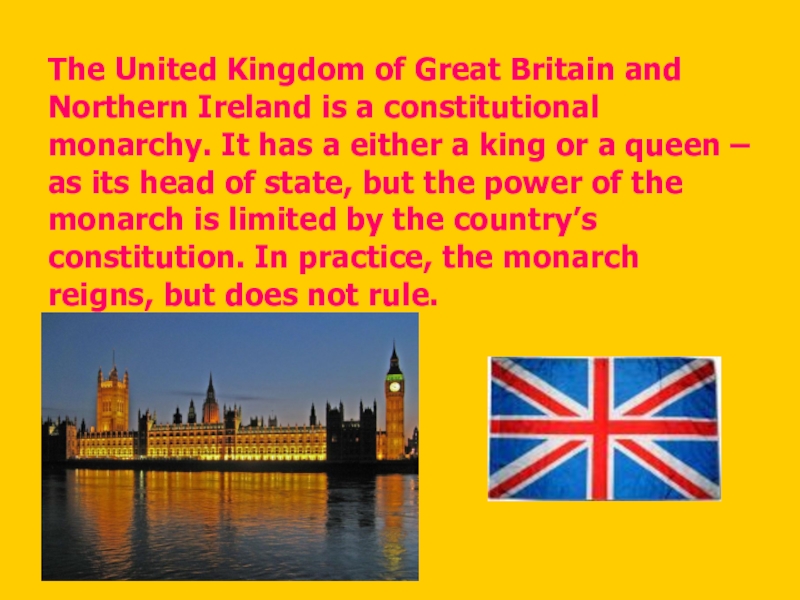
- 3. The present Sovereign of the UK is Queen Elizabeth II.
- 4. Elizabeth II was born in 1926, was
- 5. As Head of State, the Queen is
- 6. The legal authority (the passing of acts)
- 7. Nowadays the main functions of Parliament are
- 8. Bill and Law. In the British Parliament
- 9. The House of Commons, the lower house
- 10. The Speaker is elected at the beginning
- 11. The House of Lords, the upper house
- 12. The Lord Chancellor is the Speaker of
- 13. In front of the Throne is the
- 14. The UK is governed by
- 15. The Prime Minister, the leader of the
- 16. Tony Blair
- 17. Gordon Brown
- 18. Margaret Thatcher (born 1925) was the longest
- 19. Winston Churchill (1874-1965) became a major political
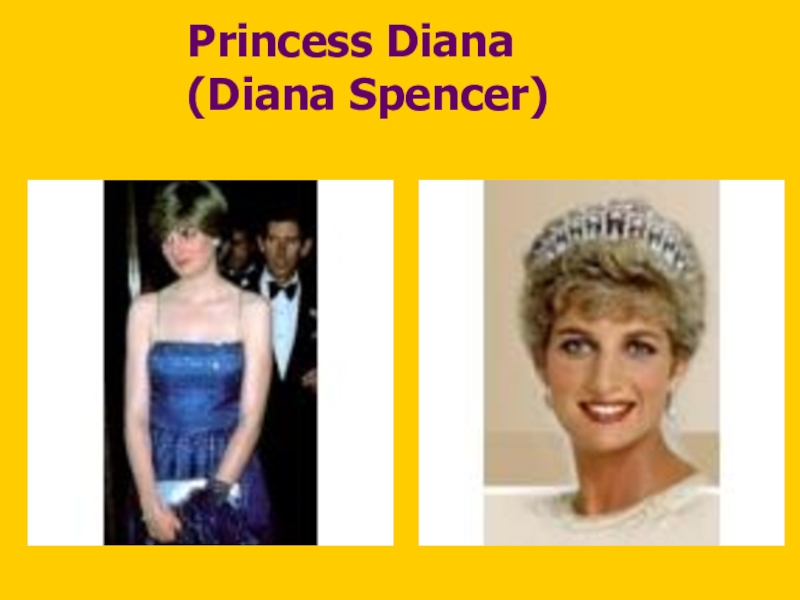
- 20. Princess Diana (Diana Spencer)
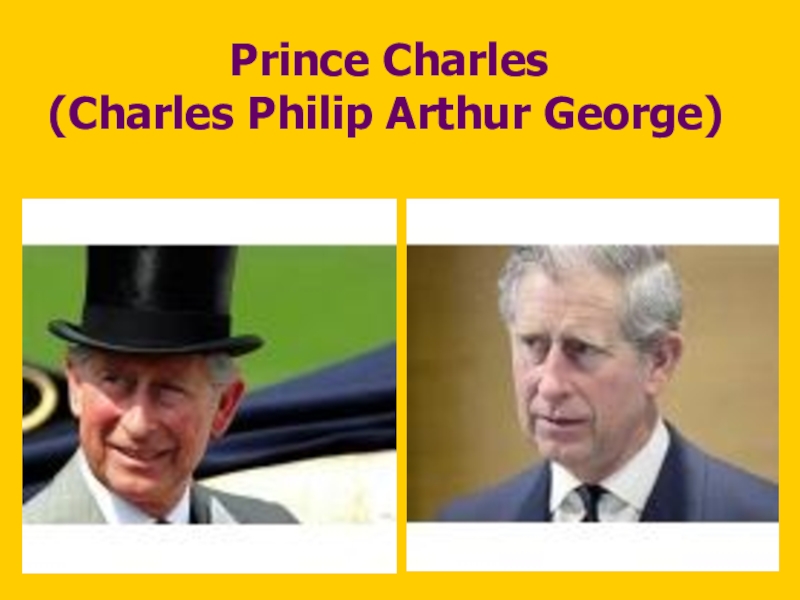
- 21. Prince Charles (Charles Philip Arthur George)
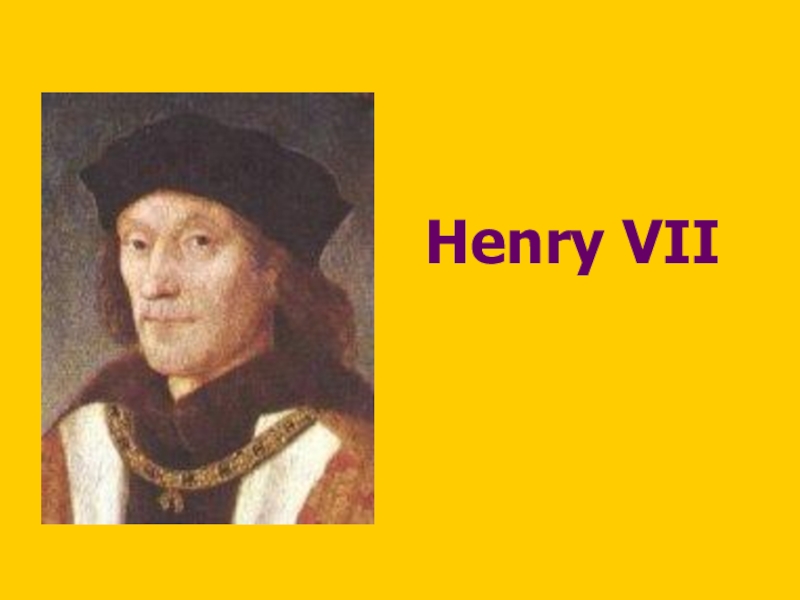
- 22. Henry VII
- 23. Henry VIII
- 24. Victoria
- 25. Elizabeth I
The United Kingdom of Great Britain and Northern Ireland is a constitutional monarchy. It has a either a king or a queen – as its head of state, but the power of the monarch is limited
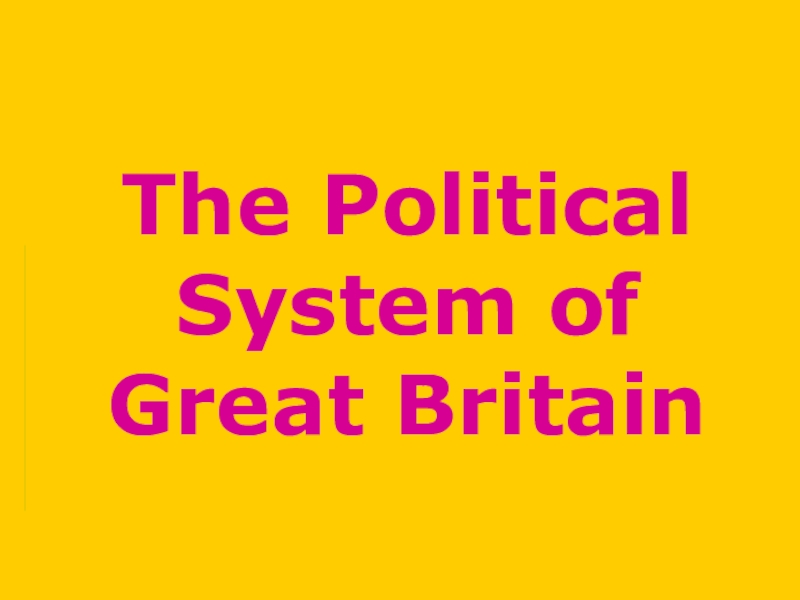
Слайд 2The United Kingdom of Great Britain and Northern Ireland is a
constitutional monarchy. It has a either a king or a queen – as its head of state, but the power of the monarch is limited by the country’s constitution. In practice, the monarch reigns, but does not rule.
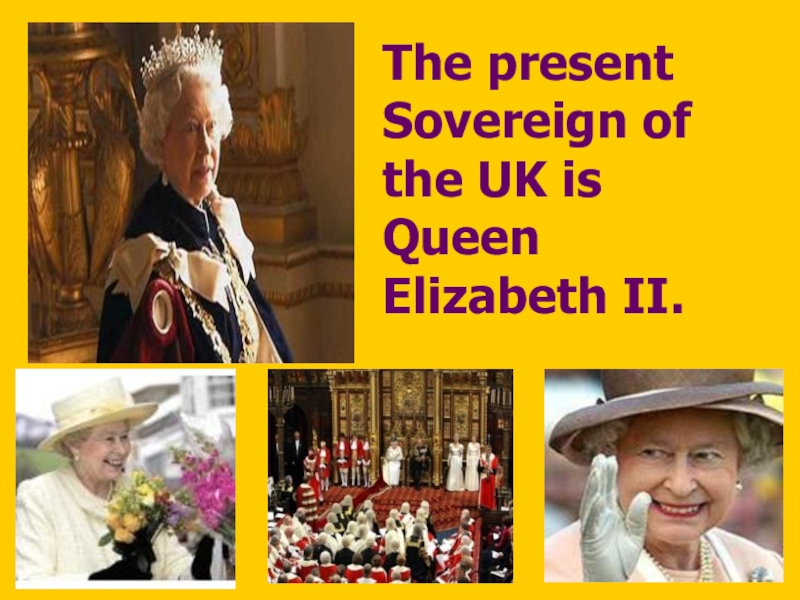
Слайд 4Elizabeth II was born in 1926, was ascended the throne on
6th February 1952, was crowned on 2nd June 1953.
Her official title in UK is: “Elizabeth the Second, by the Grace of God of the United Kingdom of Great Britain and Northern Ireland and of Her other Realms and territories Queen, head of the Commonwealth, Defender of the Faith.”

Слайд 5As Head of State, the Queen is informed and consulted on
every aspect of national life, on the advice of her Ministers, she performs certain important acts of government. She is the centre of much of the nation’s ceremonial and, by ancient tradition, the leader of society. The Queen is the Head of the Church of England. She is Commander-in-chief of the armed forces. She makes treaties and declares war and peace. In international affaires the Queen, as the Head of State, has the power to recognize foreign states and governments.
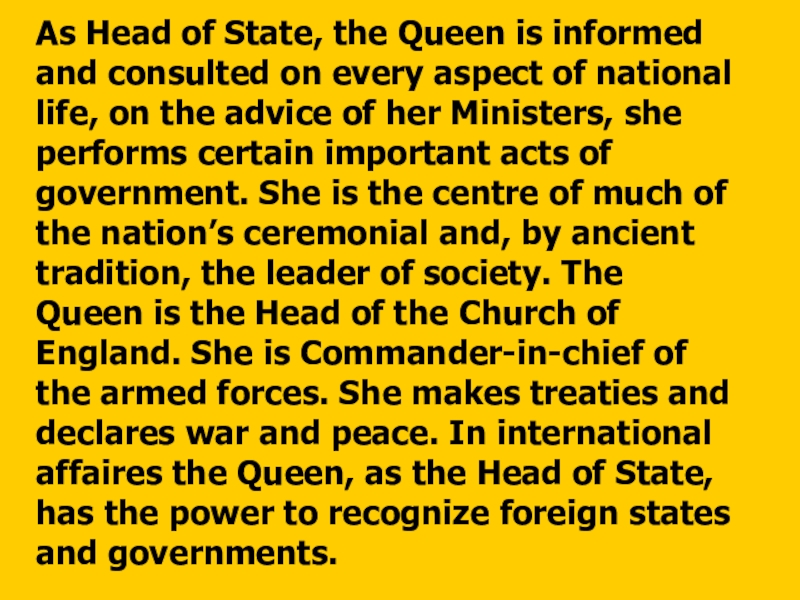
Слайд 6The legal authority (the passing of acts) is given to Parliament
and executive authority (the carrying out of laws) to the government. All real power lies with Parliament and the existing government.
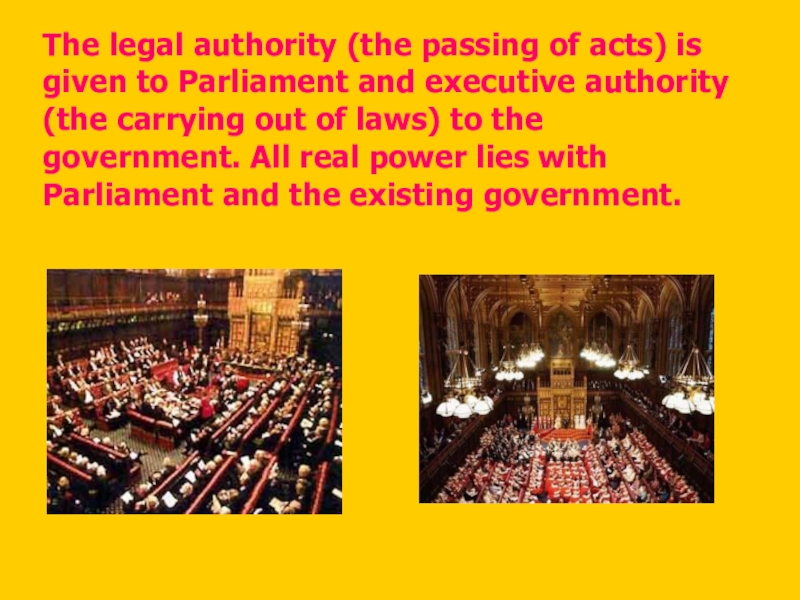
Слайд 7Nowadays the main functions of Parliament are to pass laws regulating
the life of the country and to scrutinize government policy and administration.
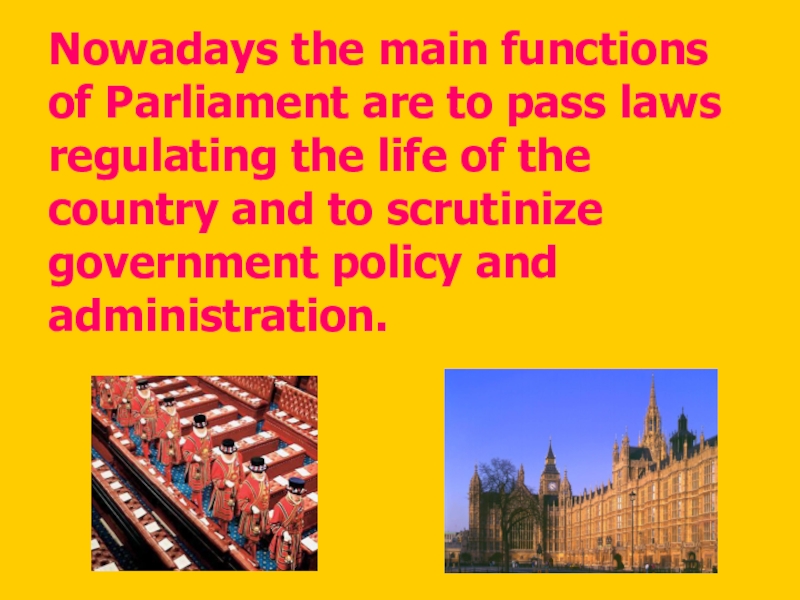
Слайд 8Bill and Law. In the British Parliament a bill is usually
produced by the Government, and discussed in the House of Commons. Then it goes to the House of Lords. Finally, it receives the Royal assent (it is signed by the Queen) and becomes law.
House of Commons Royal Assent
Bill Law
House of Lords
Слайд 9The House of Commons, the lower house of the British Parliament,
consists of 650 elected MPs:
523 for England
72 for Scotland
38 for Wales
17 for Northern Ireland.
The main purpose of the House of Commons is to make laws of the land by passing various Acts (of Parliament), as well as to discuss current political issues.
All speeches in the House of Commons are addressed to the Speaker.
The debates take place in accordance with a programme previously arranged. It often concerns a broad issue of foreign or home policy, or it may be the examination of the contents of a bill. At the end of a debate the members express their approval or disapproval of the debate bill by voting.
During the debates members are called to speak by the Speaker. An MP must stand when speaking and must refer to fellow members by their appropriate titles. And no member, on pain of disciplinary action by the Speaker, may use “unparliamentary language”. No rude or insulting words can be uttered.
The strength of the House of Commons is that it possesses the right to argue for or against any proposal, the right to question, to debate and to speak out.
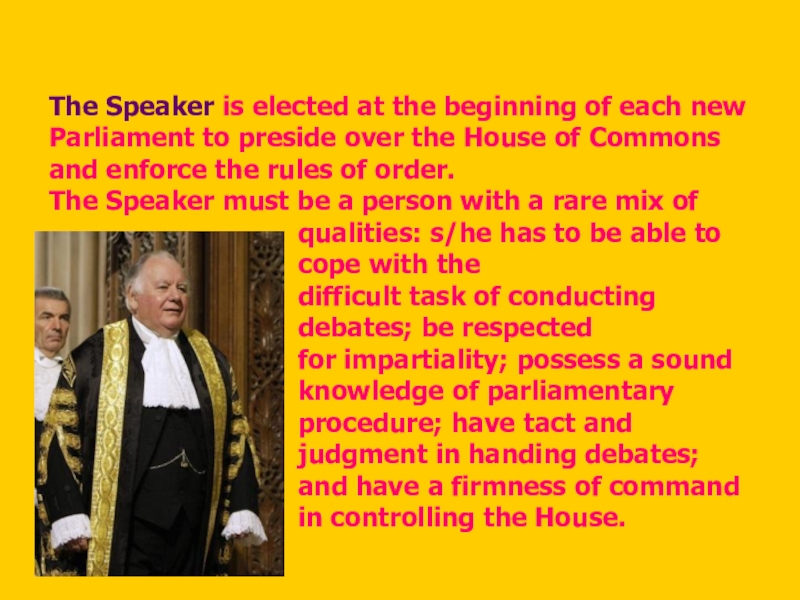
Слайд 10The Speaker is elected at the beginning of each new Parliament
to preside over the House of Commons and enforce the rules of order.
The Speaker must be a person with a rare mix of
qualities: s/he has to be able to
cope with the
difficult task of conducting
debates; be respected
for impartiality; possess a sound
knowledge of parliamentary
procedure; have tact and
judgment in handing debates;
and have a firmness of command
in controlling the House.
Слайд 11The House of Lords, the upper house of the British Parliament,
consists of over 1000 non-elected members:
1.All peers and peeresses who have inherited their titles, and distinguished men and women who have been made peers or peeresses for their life-time and whose titles cannot be inherited.
2.Certain clergy of the Church of England.
3.Some judges (called “the Law Lords”).
The work of the House of Lords is largely complementary to that of the House of Commons, and includes examining and revising bills from the Commons, and discussing important matters which the commons cannot find time to debate. The House of Lords does not have the same power as the House of Commons.
It can:
- pass Bills sent from it the House of Commons;
- amend Bills and send them back to the Commons for approval;
- delay Bills for a limited time;
- start it own Bills, but it must send them to the Commons for approval.
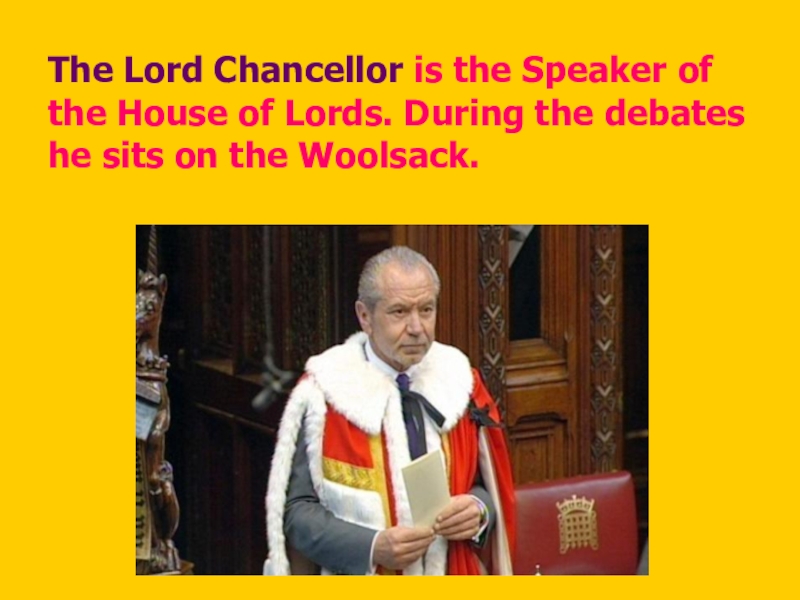
Слайд 12The Lord Chancellor is the Speaker of the House of Lords.
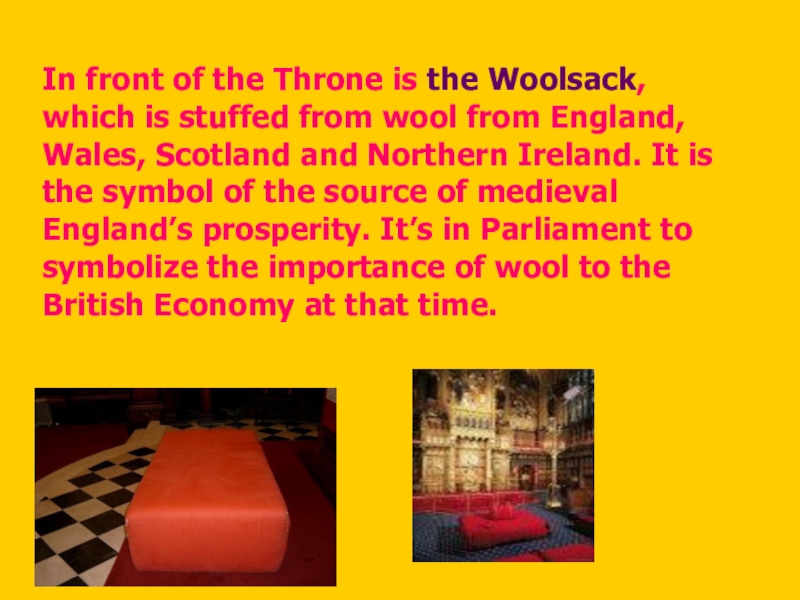
During the debates he sits on the Woolsack.
Слайд 13In front of the Throne is the Woolsack, which is stuffed
from wool from England, Wales, Scotland and Northern Ireland. It is the symbol of the source of medieval England’s prosperity. It’s in Parliament to symbolize the importance of wool to the British Economy at that time.
Слайд 14 The UK is governed by the Government – a
body of ministers who are responsible for the administration of national affairs. The ministers are the leading members of the political party which wins a majority of seats in Parliament. The party which wins the second largest number of seats in Parliament becomes the official Opposition.
The most senior Ministers (usually about 20 in number) compose the Cabinet, which meets regularly (once or twice a week) under the chairmanship of the Prime Minister to decide government policy on major issues, exercise supreme control of government and co-ordinate government departments.
Ministers are responsible collectively to Parliament for all Cabinet decisions; individual ministers are responsible to Parliament for the work of their departments.
The opposition party, which is not currently in power, under the direction of its leader forms the “Shadow Cabinet”. The ministers in the Shadow cabinet deal with the same matters as the Cabinet of Ministers in the current government.
Слайд 15The Prime Minister, the leader of the party with a majority,
is appointed be the Queen. (The Queen appoints, but does not select the Prime Minister. She has no choice.) All other Ministers are appointed by the Queen on the recommendation of the Prime Minister.
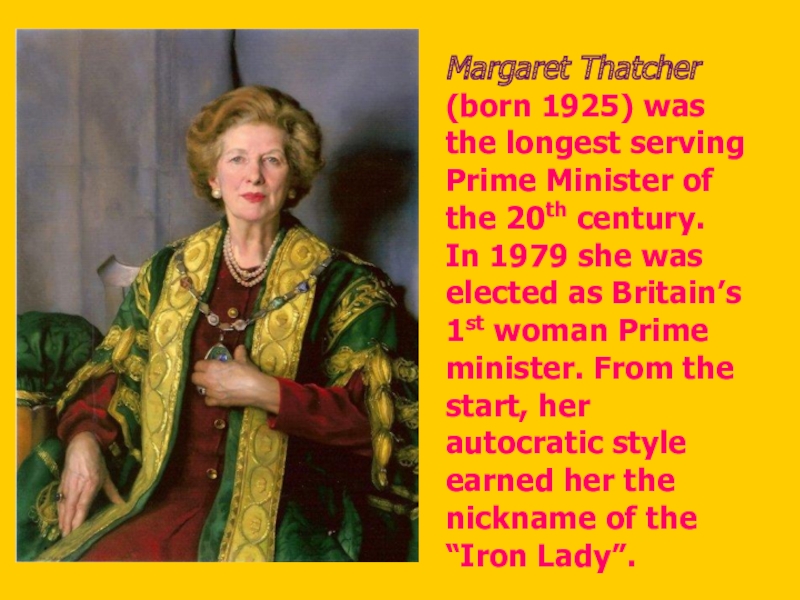
Слайд 18Margaret Thatcher (born 1925) was the longest serving Prime Minister of
the 20th century. In 1979 she was elected as Britain’s 1st woman Prime minister. From the start, her autocratic style earned her the nickname of the “Iron Lady”.
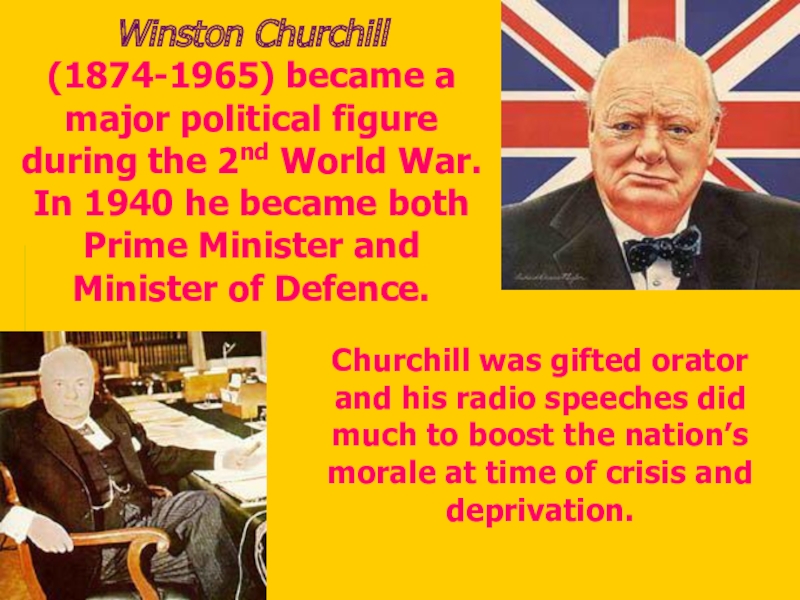
Слайд 19Winston Churchill (1874-1965) became a major political figure during the 2nd
World War. In 1940 he became both Prime Minister and Minister of Defence.
Churchill was gifted orator and his radio speeches did much to boost the nation’s morale at time of crisis and deprivation.