способ творческого развития учащихся на уроках английского языка»
- Главная
- Разное
- Образование
- Спорт
- Естествознание
- Природоведение
- Религиоведение
- Французский язык
- Черчение
- Английский язык
- Астрономия
- Алгебра
- Биология
- География
- Геометрия
- Детские презентации
- Информатика
- История
- Литература
- Математика
- Музыка
- МХК
- Немецкий язык
- ОБЖ
- Обществознание
- Окружающий мир
- Педагогика
- Русский язык
- Технология
- Физика
- Философия
- Химия
- Шаблоны, фоны, картинки для презентаций
- Экология
- Экономика
Презентация, доклад на тему Проектная технология как способ творческого развития учащихся на уроках английского языка
Содержание
- 1. Проектная технология как способ творческого развития учащихся на уроках английского языка
- 2. Одним из наиболее прогрессивных на сегодняшний день
- 3. С выполнением проектов учащиеся начинают знакомиться уже
- 4. Учитель должен та работать с учеником, чтобы
- 5. В проектной методике используются все лучшие идеи
- 6. В данной
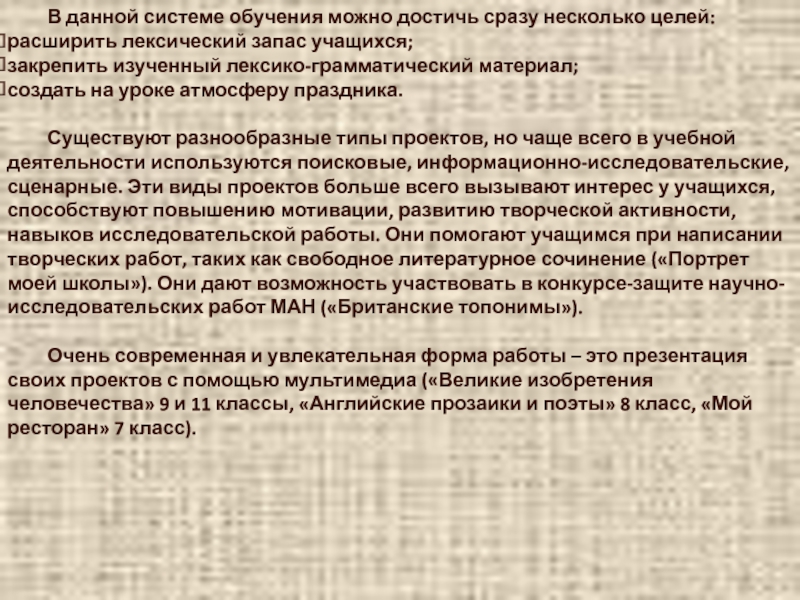
- 7. Food and CookingEat at pleasure, drink with measure and enjoy life as it is.
- 8. Answer the questions:What do you usually have
- 9. Match the English proverbs with their equivalents1)
- 10. Sort out the words into appropriate columnsHoney,
- 11. Right answers
- 12. Match the 2 halves of each sentence
- 13. Right answers1) Many people are fond of
- 14. Find the odd word and cross it
- 15. Right answers1) Bacon, beef, turkey, pork, lamb2)
- 16. Listening. Dialogue “In a café”. Complete the
- 17. Right answersVisitor: What can you recommend for
- 18. Слайд 18
- 19. Fruit Salad
- 20. Coke, Sprite $ 1.00 Milk
- 21. Ice-cream (chocolate, vanilla, strawberry) $
- 22. Try our apple pie! You’ll love it!
- 23. Firm recipe of “Larry’s Café”:Vegetable Soup.1) Peel
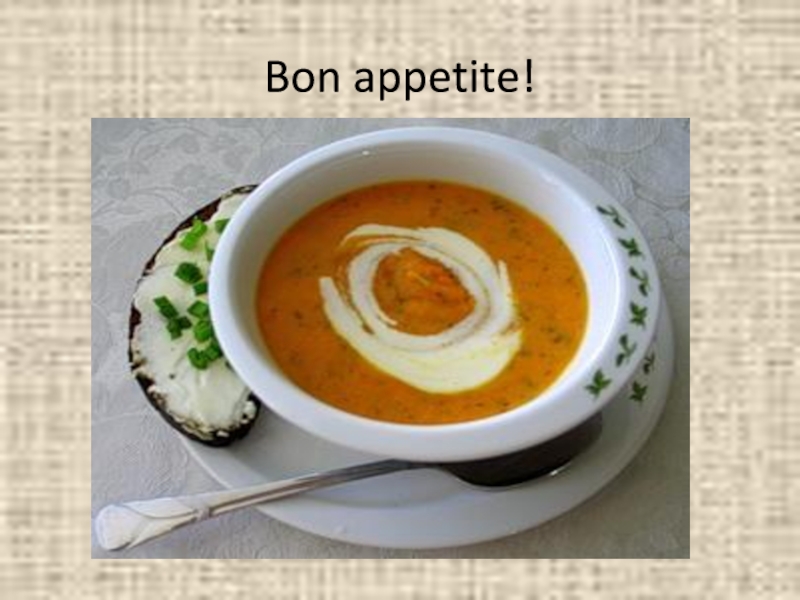
- 24. Bon appetite!
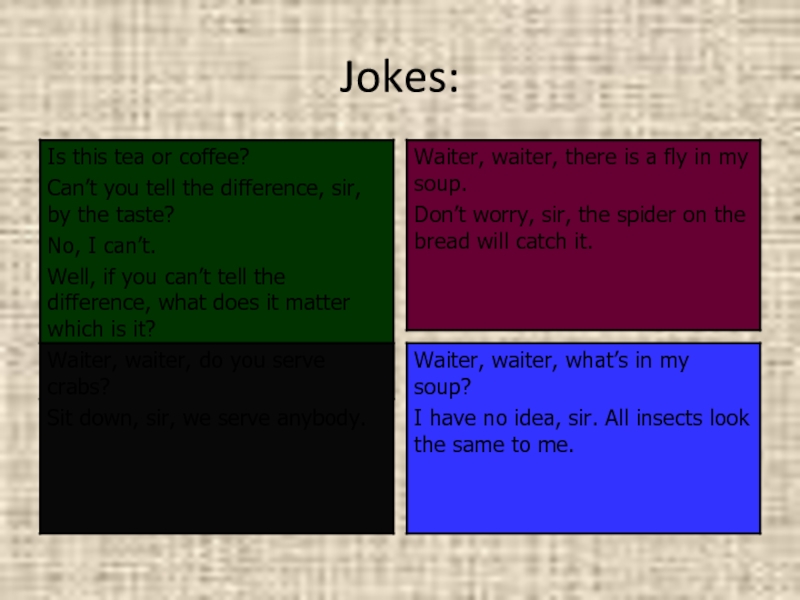
- 25. Jokes:
- 26. This is the end. Good luck!
- 27. MODERN INVENTIONS IN OUR LIFE
- 28. The motto of the lesson“Necessity is the mother of the inventions”“Experience is the mother of wisdom”
- 29. Ten Great Inventors and their InventionsHenry Ford
- 30. Ten Great Inventors and their InventionsValdemar Poulsen
- 31. Ten Great Inventors and their InventionsAlexander Graham
- 32. Ten Great Inventors and their InventionsThe Wright
- 33. Ten Great Inventors and their InventionsJohn Logie
- 34. Ten Great Inventors and their InventionsSergey Pavlovich
- 35. Ten Great Inventors and their InventionsMichael Faraday,
- 36. Ten Great Inventors and their InventionsThomas Alva
- 37. Ten Great Inventors and their InventionsSir Isaac
- 38. Ten Great Inventors and their InventionsAlfred Bernhard
- 39. The Keys1. E 6. D2. F 7. H3. C 8. A4. G 9. B5. I 10. J
- 40. N I E L T I O S V E
- 41. TELEVISIONJohn Logie Baird
- 42. Слайд 42
- 43. Television in Our LifeThe first commercial television
- 44. Advantages and Disadvantages of TelevisionTelevision is one
- 45. The End
- 46. Содержание любого метода раскрывается через его принципы.
- 47. Исходя из предъявленных принципов и требований,
- 48. Исходя из опыта работы над этой проблемой,
- 49. Проектная технология предоставляет новые возможности решения традиционных
Одним из наиболее прогрессивных на сегодняшний день методов обучения учащихся является метод проектов. Основная цель метода проектов- развитие творческих способностей учащихся на уроках английского языка. Основная идея данной технологии- создать условия для активной совместной деятельности учащихся в разных
Слайд 1Презентация опыта работы учителя
английского языка Донецкого УВК №1
Кузнецовой И.А.
«Проектная технология как
Слайд 2 Одним из наиболее прогрессивных на сегодняшний день методов обучения учащихся является
метод проектов.
Основная цель метода проектов- развитие творческих способностей учащихся на уроках английского языка.
Основная идея данной технологии- создать условия для активной совместной деятельности учащихся в разных учебных ситуациях, в которых каждый отвечает не только за результат своей работы, но и за результат работы всей группы.
Применительно к уроку иностранного языка, проект- это специально организованный учителем и и самостоятельно выполняемый учащимися комплекс действий, завершающихся созданием творческого продукта.
Проект важен и ценен тем, что в ходе его выполнения, учащиеся учатся самостоятельно приобретать знания, получать опыт познавательной и учебной деятельности.
Основная цель метода проектов- развитие творческих способностей учащихся на уроках английского языка.
Основная идея данной технологии- создать условия для активной совместной деятельности учащихся в разных учебных ситуациях, в которых каждый отвечает не только за результат своей работы, но и за результат работы всей группы.
Применительно к уроку иностранного языка, проект- это специально организованный учителем и и самостоятельно выполняемый учащимися комплекс действий, завершающихся созданием творческого продукта.
Проект важен и ценен тем, что в ходе его выполнения, учащиеся учатся самостоятельно приобретать знания, получать опыт познавательной и учебной деятельности.
Проектная методика характеризуется высокой коммуникативностью и предполагает выражение учащимися своих собственных мнений, чувств, активное включение в реальную деятельность, принятие личной ответственности за продвижение в обучении.
Главные цели введения в школьную практику метода проектов:
Показать умения отдельного ученика или группы учеников использовать приобретенный в школе исследовательский опыт.
Реализовать свой интерес к предмету исследования, приумножить знания о нем.
Продемонстрировать уровень обученности иностранному языку.
Подняться на более высокую ступень образованности, развития социальной деятельности.
Слайд 3 С выполнением проектов учащиеся начинают знакомиться уже в начальной школе. Проектирование
– это особый творческий вид деятельности, который нравится школьникам и, следовательно, помогает им реально раскрыть свои творческие возможности, заложенные природой.
Можно сказать, что девизом учителя, осуществляющего управление проектной деятельностью, могут стать слова: «Выясните, что каждый ученик может делать и используйте эту его способность». Общеизвестно, что многие учащиеся успевают в одних предметах больше, чем в других. В предмете английский язык есть дети, которые слабо мотивированы или считают английский трудным, но сильны в рисовании, музыке, математике, работе на компьютере.
Следует выяснить как можно больше об этих «талантах», интересах и «эксплуатировать» их на проектных уроках и во внеклассной работе по предмету (например, в рамках предметной недели).
Отсюда следует вывод, что проектная работа особенно приемлема для учащихся разных способностей, так как позволяет каждому из них работать в своем собственном темпе, на своем уровне подготовки.
Метод проекта позволяет учащимся, имеющим средние способности к английскому языку, спланировать свою работу так, чтобы получить хороший результат.
Можно сказать, что девизом учителя, осуществляющего управление проектной деятельностью, могут стать слова: «Выясните, что каждый ученик может делать и используйте эту его способность». Общеизвестно, что многие учащиеся успевают в одних предметах больше, чем в других. В предмете английский язык есть дети, которые слабо мотивированы или считают английский трудным, но сильны в рисовании, музыке, математике, работе на компьютере.
Следует выяснить как можно больше об этих «талантах», интересах и «эксплуатировать» их на проектных уроках и во внеклассной работе по предмету (например, в рамках предметной недели).
Отсюда следует вывод, что проектная работа особенно приемлема для учащихся разных способностей, так как позволяет каждому из них работать в своем собственном темпе, на своем уровне подготовки.
Метод проекта позволяет учащимся, имеющим средние способности к английскому языку, спланировать свою работу так, чтобы получить хороший результат.
Слайд 4Учитель должен та работать с учеником, чтобы на проектных занятиях он
мог:
в процессе проектной деятельности продемонстрировать применение знаний и умений, полученных им за предшествующий период обучения;
показать умение использовать имеющийся у него личный опыт в практической деятельности;
научиться и суметь применить основные принципы творческой деятельности – от появления идеи замысла до воплощения задуманного.
Организуя работу над проектом, необходимо соблюсти некоторые условия:
Выбор темы. Она может быть связана как со страной изучаемого языка, так и со страной проживания.
Постановка проблемы. Проблема формулируется так, чтобы ориентировать учащихся проводить сбор необходимых теоретических сведений по проекту, используя межпредметные связи и разнообразные источники информации (справочники, журналы, Интернет).
Участие в работе. Все учащиеся должны быть вовлечены в работу с учетом уровня их языковой подготовки, наклонностей и способностей.
Метод проектов предполагает по сути своей использование проблемных, исследовательских, поисковых методов, ориентированных на реальных практический результат, значимый для ученика, с одной стороны, а с другой, разработку проблемы целостно с учетом различных факторов и условий ее решения и реализации результатов.
в процессе проектной деятельности продемонстрировать применение знаний и умений, полученных им за предшествующий период обучения;
показать умение использовать имеющийся у него личный опыт в практической деятельности;
научиться и суметь применить основные принципы творческой деятельности – от появления идеи замысла до воплощения задуманного.
Организуя работу над проектом, необходимо соблюсти некоторые условия:
Выбор темы. Она может быть связана как со страной изучаемого языка, так и со страной проживания.
Постановка проблемы. Проблема формулируется так, чтобы ориентировать учащихся проводить сбор необходимых теоретических сведений по проекту, используя межпредметные связи и разнообразные источники информации (справочники, журналы, Интернет).
Участие в работе. Все учащиеся должны быть вовлечены в работу с учетом уровня их языковой подготовки, наклонностей и способностей.
Метод проектов предполагает по сути своей использование проблемных, исследовательских, поисковых методов, ориентированных на реальных практический результат, значимый для ученика, с одной стороны, а с другой, разработку проблемы целостно с учетом различных факторов и условий ее решения и реализации результатов.
Слайд 5 В проектной методике используются все лучшие идеи традиционной и современной методик
преподавания английского языка.
Во-первых, разнообразие, которое способствует поддержанию интереса к учебе (различные темы, типы текстов, диалог, монологи, письма); формы учебной деятельности (индивидуальная, парная, групповая); типы упражнений.
Во-вторых, проблемность, т. е. ученики используют язык как для выполнения заданий, которые характеризуются новизной результата, так и новыми способами его достижения. Подросток обучается, думая, мысля. Проблемный подросток имеет место при обучении грамматике, при выполнении коммуникативных заданий.
В-третьих, это повышение качества обучения, потому что этот метод личностно ориентирован. Проектный метод использует много дидактических подходов, позволяет учиться на собственном опыте, приносит удовлетворение ученикам, так как они видят плоды своего труда.
Новизна этого метода в том, что учащимся дается самим конструировать содержание общения, начиная с первого занятия; этот метод может использоваться в рамках программного материала практически по любой теме.
Во-первых, разнообразие, которое способствует поддержанию интереса к учебе (различные темы, типы текстов, диалог, монологи, письма); формы учебной деятельности (индивидуальная, парная, групповая); типы упражнений.
Во-вторых, проблемность, т. е. ученики используют язык как для выполнения заданий, которые характеризуются новизной результата, так и новыми способами его достижения. Подросток обучается, думая, мысля. Проблемный подросток имеет место при обучении грамматике, при выполнении коммуникативных заданий.
В-третьих, это повышение качества обучения, потому что этот метод личностно ориентирован. Проектный метод использует много дидактических подходов, позволяет учиться на собственном опыте, приносит удовлетворение ученикам, так как они видят плоды своего труда.
Новизна этого метода в том, что учащимся дается самим конструировать содержание общения, начиная с первого занятия; этот метод может использоваться в рамках программного материала практически по любой теме.
Слайд 6
В данной системе обучения можно достичь
сразу несколько целей:
расширить лексический запас учащихся;
закрепить изученный лексико-грамматический материал;
создать на уроке атмосферу праздника.
Существуют разнообразные типы проектов, но чаще всего в учебной деятельности используются поисковые, информационно-исследовательские, сценарные. Эти виды проектов больше всего вызывают интерес у учащихся, способствуют повышению мотивации, развитию творческой активности, навыков исследовательской работы. Они помогают учащимся при написании творческих работ, таких как свободное литературное сочинение («Портрет моей школы»). Они дают возможность участвовать в конкурсе-защите научно-исследовательских работ МАН («Британские топонимы»).
Очень современная и увлекательная форма работы – это презентация своих проектов с помощью мультимедиа («Великие изобретения человечества» 9 и 11 классы, «Английские прозаики и поэты» 8 класс, «Мой ресторан» 7 класс).
расширить лексический запас учащихся;
закрепить изученный лексико-грамматический материал;
создать на уроке атмосферу праздника.
Существуют разнообразные типы проектов, но чаще всего в учебной деятельности используются поисковые, информационно-исследовательские, сценарные. Эти виды проектов больше всего вызывают интерес у учащихся, способствуют повышению мотивации, развитию творческой активности, навыков исследовательской работы. Они помогают учащимся при написании творческих работ, таких как свободное литературное сочинение («Портрет моей школы»). Они дают возможность участвовать в конкурсе-защите научно-исследовательских работ МАН («Британские топонимы»).
Очень современная и увлекательная форма работы – это презентация своих проектов с помощью мультимедиа («Великие изобретения человечества» 9 и 11 классы, «Английские прозаики и поэты» 8 класс, «Мой ресторан» 7 класс).
Слайд 8Answer the questions:
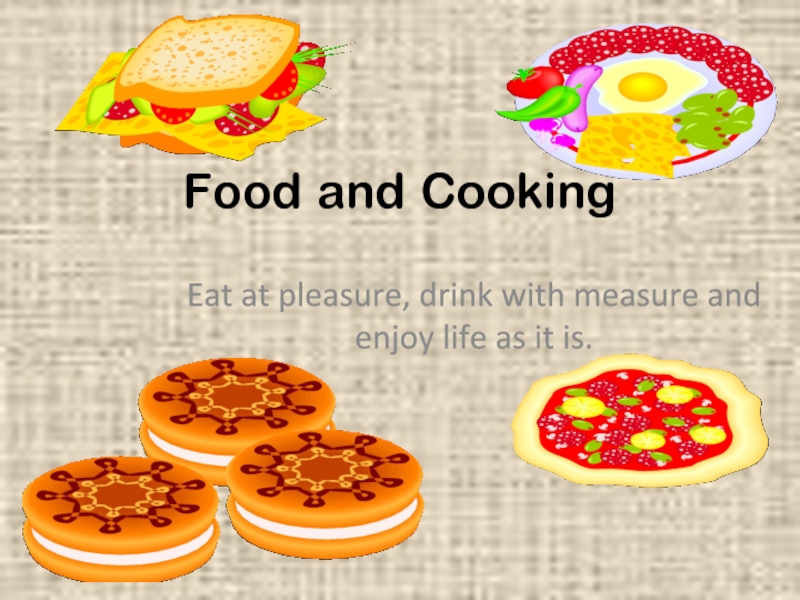
What do you usually have for breakfast?
What meals do
you have every day?
What kind of soup do you prefer?
What is your favourite second course?
What dessert do you like best?
Do you help your mother to cook meals?
Have you ever been to any bar or café? What did you have there?
Do you want to have your own café or restaurant?
What kind of soup do you prefer?
What is your favourite second course?
What dessert do you like best?
Do you help your mother to cook meals?
Have you ever been to any bar or café? What did you have there?
Do you want to have your own café or restaurant?
Слайд 9Match the English proverbs with their equivalents
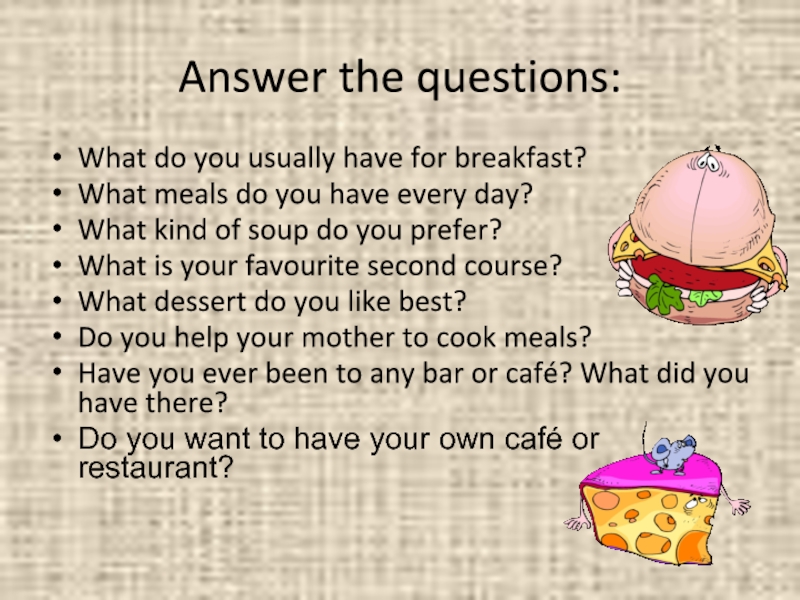
1) The appetite comes with
eating. a) О вкусах не спорят.
2) After dinner sleep a while, b) Яблоко в день и не знай
after supper walk a mile. врачей.
3) An apple a day keeps c) Аппетит приходит во
the doctor away. время еды.
4) Don’t live to eat, but eat to live. d) После обеда поспи
немного, после ужина
прогуляйся с милю.
5) Tastes differ. e) Не жить, чтобы есть,
а есть, чтобы жить.
2) After dinner sleep a while, b) Яблоко в день и не знай
after supper walk a mile. врачей.
3) An apple a day keeps c) Аппетит приходит во
the doctor away. время еды.
4) Don’t live to eat, but eat to live. d) После обеда поспи
немного, после ужина
прогуляйся с милю.
5) Tastes differ. e) Не жить, чтобы есть,
а есть, чтобы жить.
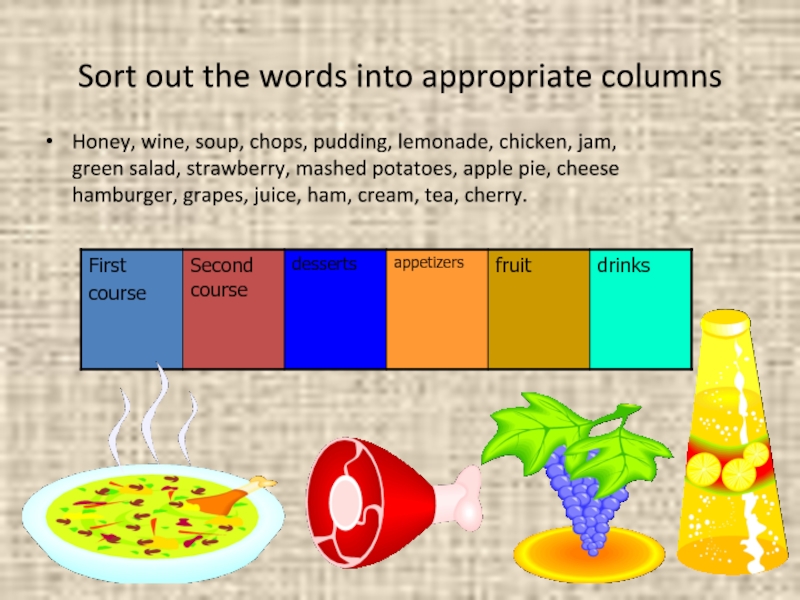
Слайд 10Sort out the words into appropriate columns
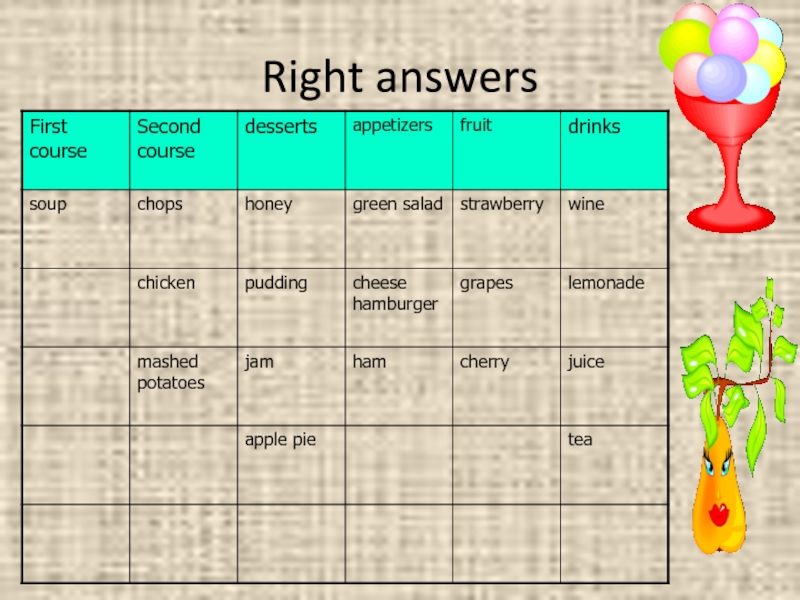
Honey, wine, soup, chops, pudding,
lemonade, chicken, jam, green salad, strawberry, mashed potatoes, apple pie, cheese hamburger, grapes, juice, ham, cream, tea, cherry.
Слайд 13Right answers
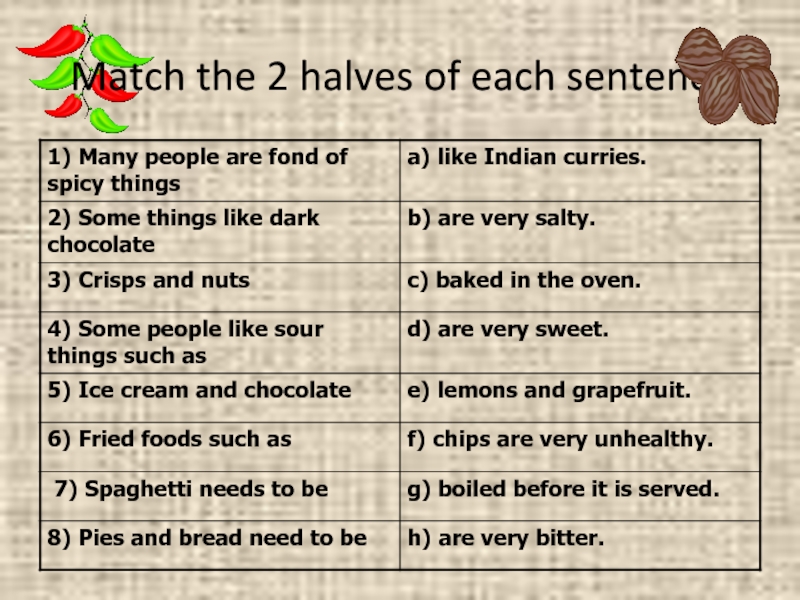
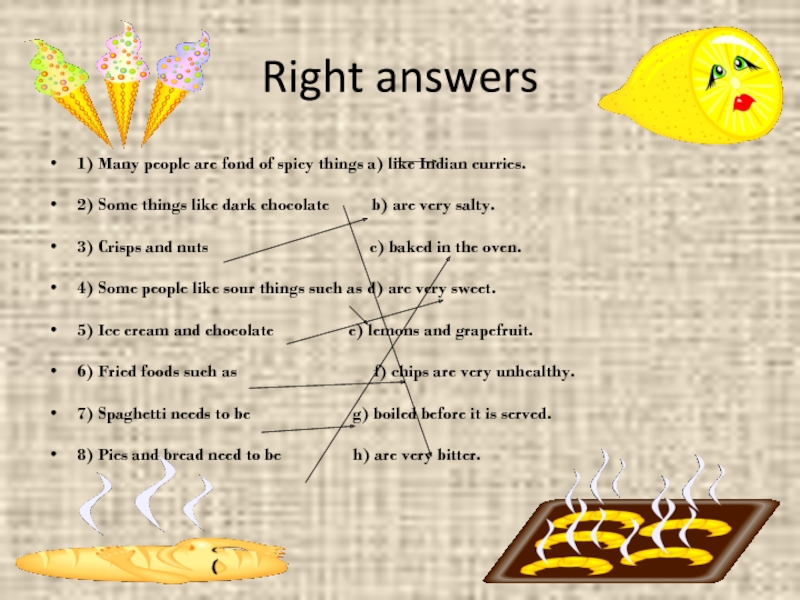
1) Many people are fond of spicy things a) like Indian
curries.
2) Some things like dark chocolate b) are very salty.
3) Crisps and nuts c) baked in the oven.
4) Some people like sour things such as d) are very sweet.
5) Ice cream and chocolate e) lemons and grapefruit.
6) Fried foods such as f) chips are very unhealthy.
7) Spaghetti needs to be g) boiled before it is served.
8) Pies and bread need to be h) are very bitter.
2) Some things like dark chocolate b) are very salty.
3) Crisps and nuts c) baked in the oven.
4) Some people like sour things such as d) are very sweet.
5) Ice cream and chocolate e) lemons and grapefruit.
6) Fried foods such as f) chips are very unhealthy.
7) Spaghetti needs to be g) boiled before it is served.
8) Pies and bread need to be h) are very bitter.
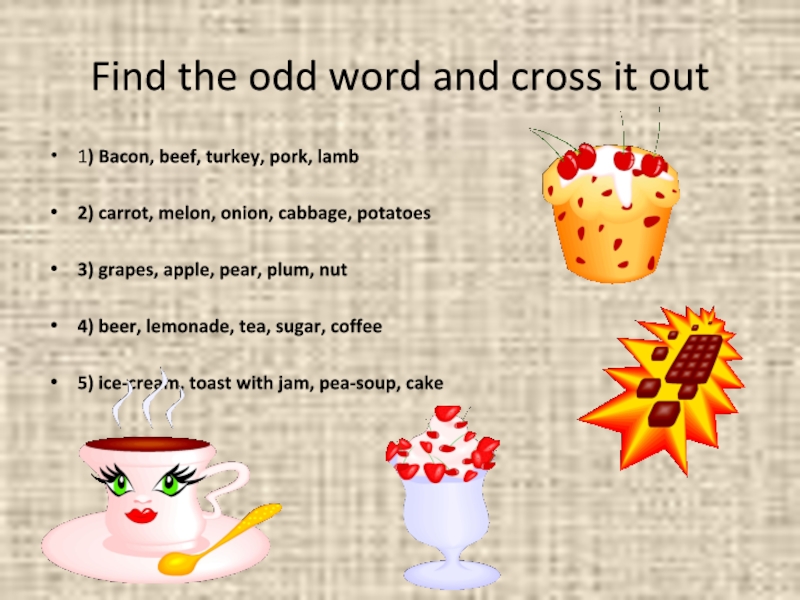
Слайд 14Find the odd word and cross it out
1) Bacon, beef, turkey,
pork, lamb
2) carrot, melon, onion, cabbage, potatoes
3) grapes, apple, pear, plum, nut
4) beer, lemonade, tea, sugar, coffee
5) ice-cream, toast with jam, pea-soup, cake
2) carrot, melon, onion, cabbage, potatoes
3) grapes, apple, pear, plum, nut
4) beer, lemonade, tea, sugar, coffee
5) ice-cream, toast with jam, pea-soup, cake
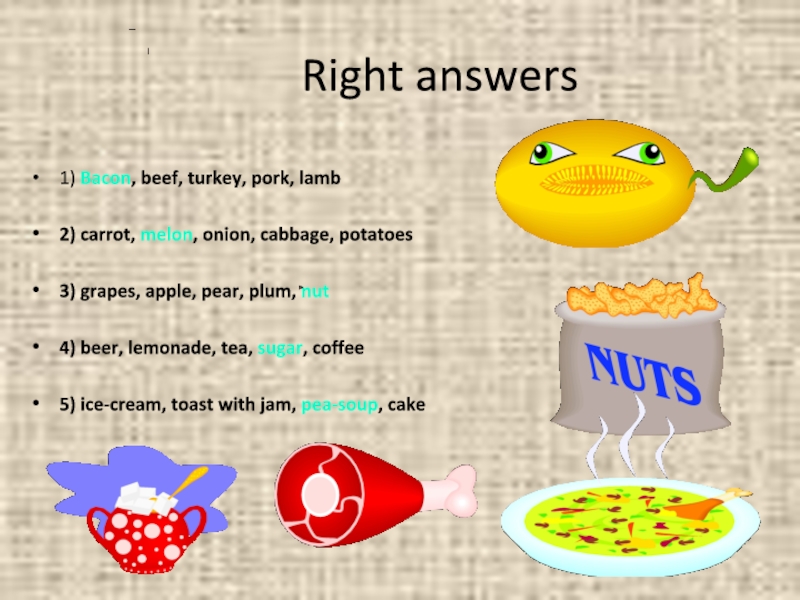
Слайд 15Right answers
1) Bacon, beef, turkey, pork, lamb
2) carrot, melon, onion, cabbage,
potatoes
3) grapes, apple, pear, plum, nut
4) beer, lemonade, tea, sugar, coffee
5) ice-cream, toast with jam, pea-soup, cake
3) grapes, apple, pear, plum, nut
4) beer, lemonade, tea, sugar, coffee
5) ice-cream, toast with jam, pea-soup, cake
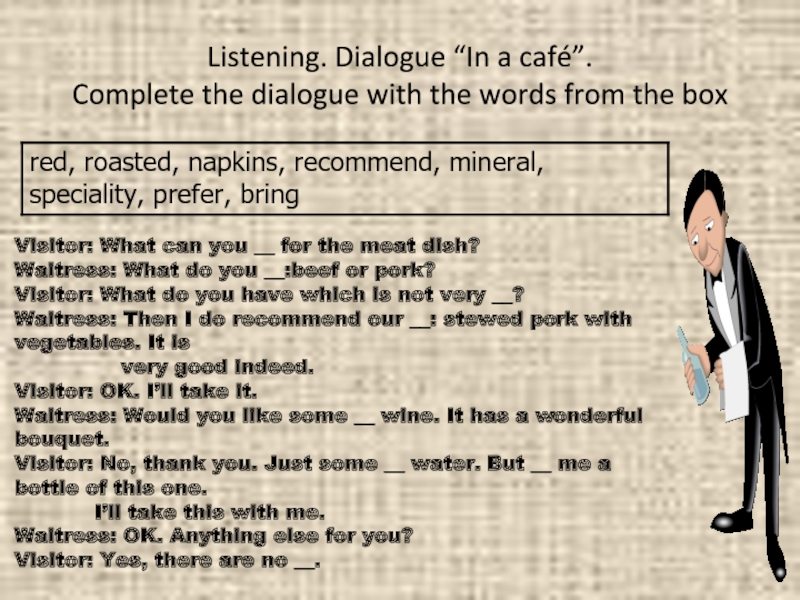
Слайд 16Listening. Dialogue “In a café”. Complete the dialogue with the words from
the box
Visitor: What can you __ for the meat dish?
Waitress: What do you __:beef or pork?
Visitor: What do you have which is not very __?
Waitress: Then I do recommend our __: stewed pork with vegetables. It is
very good indeed.
Visitor: OK. I’ll take it.
Waitress: Would you like some __ wine. It has a wonderful bouquet.
Visitor: No, thank you. Just some __ water. But __ me a bottle of this one.
I’ll take this with me.
Waitress: OK. Anything else for you?
Visitor: Yes, there are no __.
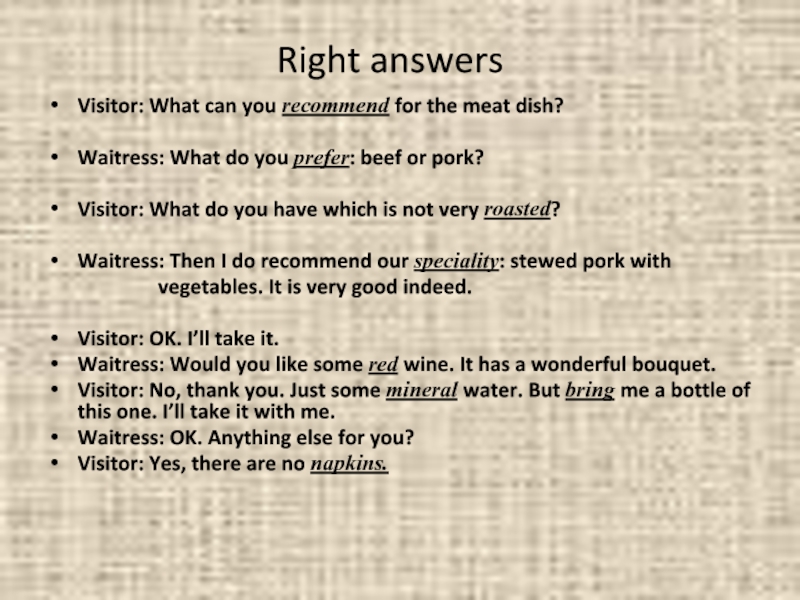
Слайд 17Right answers
Visitor: What can you recommend for the meat dish?
Waitress: What
do you prefer: beef or pork?
Visitor: What do you have which is not very roasted?
Waitress: Then I do recommend our speciality: stewed pork with
vegetables. It is very good indeed.
Visitor: OK. I’ll take it.
Waitress: Would you like some red wine. It has a wonderful bouquet.
Visitor: No, thank you. Just some mineral water. But bring me a bottle of this one. I’ll take it with me.
Waitress: OK. Anything else for you?
Visitor: Yes, there are no napkins.
Visitor: What do you have which is not very roasted?
Waitress: Then I do recommend our speciality: stewed pork with
vegetables. It is very good indeed.
Visitor: OK. I’ll take it.
Waitress: Would you like some red wine. It has a wonderful bouquet.
Visitor: No, thank you. Just some mineral water. But bring me a bottle of this one. I’ll take it with me.
Waitress: OK. Anything else for you?
Visitor: Yes, there are no napkins.
Слайд 18
Larry's Cafe
The best food in town.
Main dishes
Hamburger $ 2.00
Cheeseburger $ 2.5
Chicken sandwich $ 3.00
Steak $ 4.00
All main dishes include mashed potatoes or French Fries, Beans and Pie.

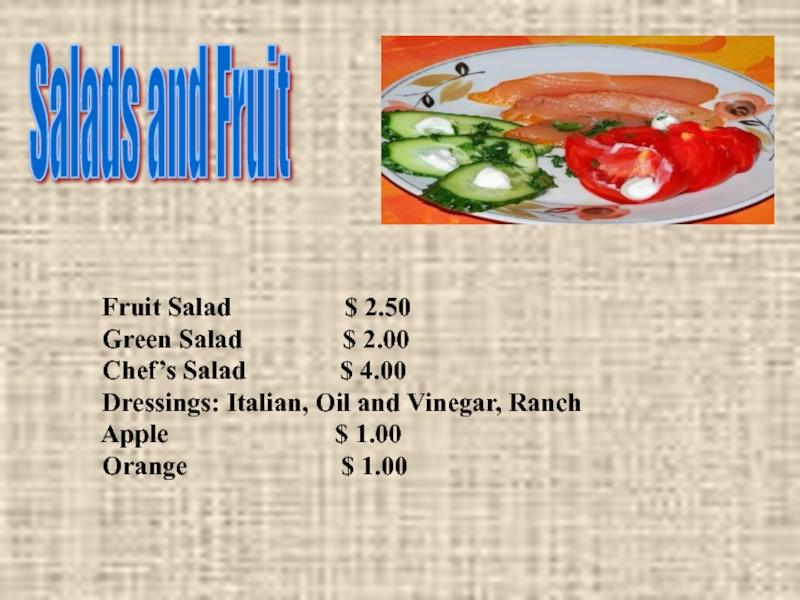
Слайд 19 Fruit Salad
$ 2.50
Green Salad $ 2.00
Chef’s Salad $ 4.00
Dressings: Italian, Oil and Vinegar, Ranch
Apple $ 1.00
Orange $ 1.00
Salads and Fruit
Слайд 20Coke, Sprite $ 1.00 Milk
$ 0.75
Bottled Water $ 1.00
Coffee $ 1.00
Tea $ 0.75
Orange Juice $ 1.50
Drinks

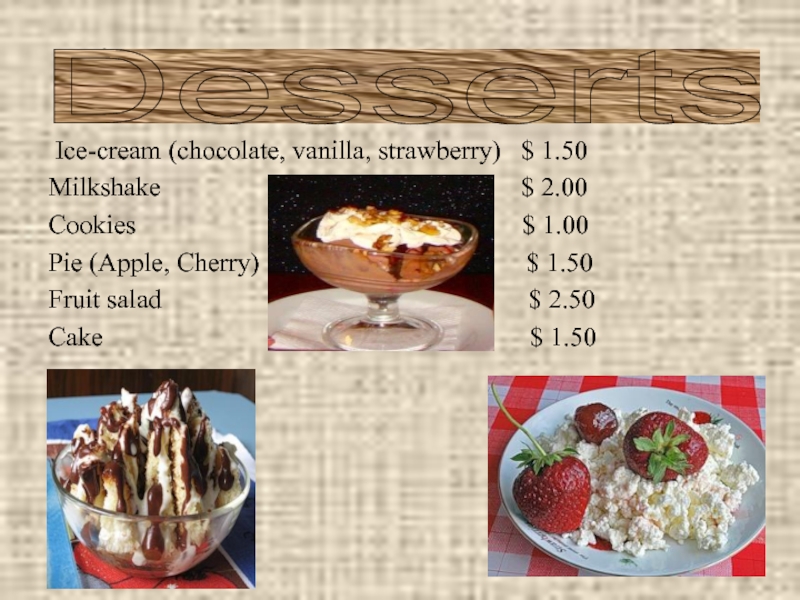
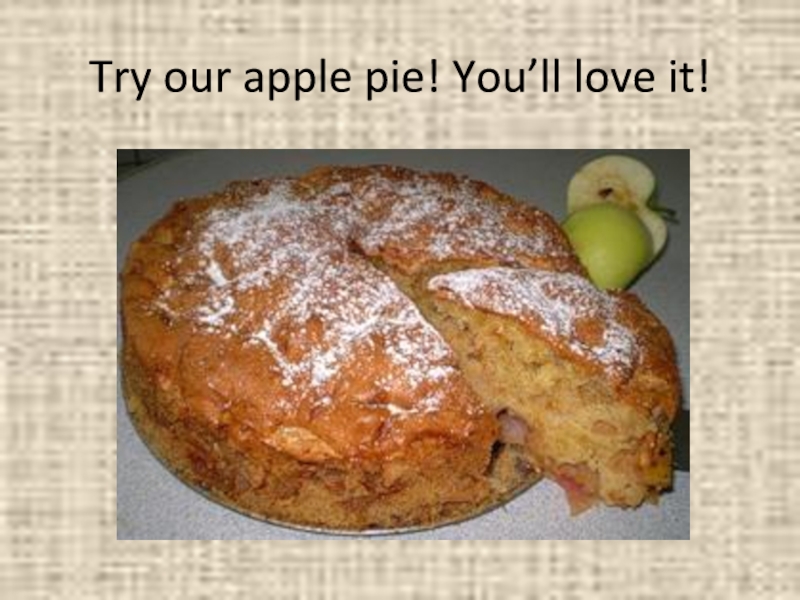
Слайд 21 Ice-cream (chocolate, vanilla, strawberry) $ 1.50
Milkshake
$ 2.00
Cookies $ 1.00
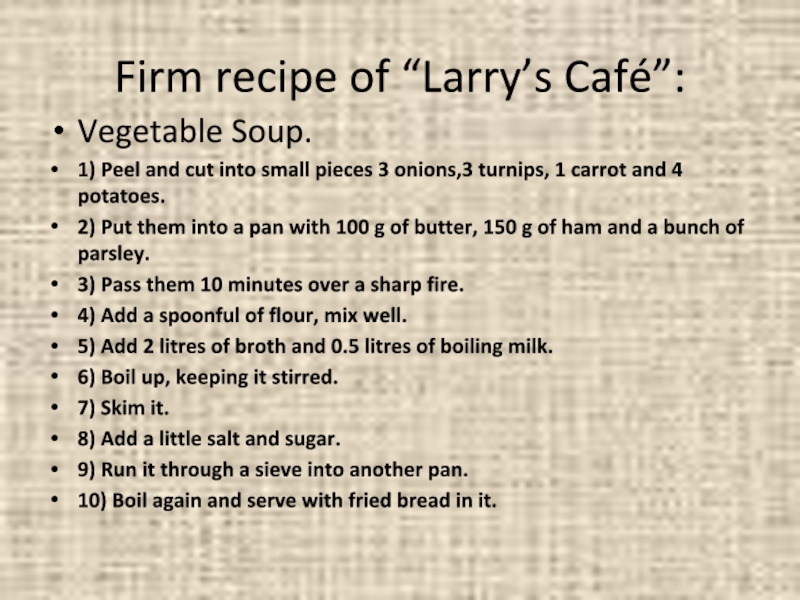
Pie (Apple, Cherry) $ 1.50
Fruit salad $ 2.50
Cake $ 1.50
Cookies $ 1.00
Pie (Apple, Cherry) $ 1.50
Fruit salad $ 2.50
Cake $ 1.50
Desserts
Слайд 23Firm recipe of “Larry’s Café”:
Vegetable Soup.
1) Peel and cut into small
pieces 3 onions,3 turnips, 1 carrot and 4 potatoes.
2) Put them into a pan with 100 g of butter, 150 g of ham and a bunch of parsley.
3) Pass them 10 minutes over a sharp fire.
4) Add a spoonful of flour, mix well.
5) Add 2 litres of broth and 0.5 litres of boiling milk.
6) Boil up, keeping it stirred.
7) Skim it.
8) Add a little salt and sugar.
9) Run it through a sieve into another pan.
10) Boil again and serve with fried bread in it.
2) Put them into a pan with 100 g of butter, 150 g of ham and a bunch of parsley.
3) Pass them 10 minutes over a sharp fire.
4) Add a spoonful of flour, mix well.
5) Add 2 litres of broth and 0.5 litres of boiling milk.
6) Boil up, keeping it stirred.
7) Skim it.
8) Add a little salt and sugar.
9) Run it through a sieve into another pan.
10) Boil again and serve with fried bread in it.

Слайд 28The motto of the lesson
“Necessity is the mother of the inventions”
“Experience
is the mother of wisdom”
Слайд 29Ten Great Inventors and their Inventions
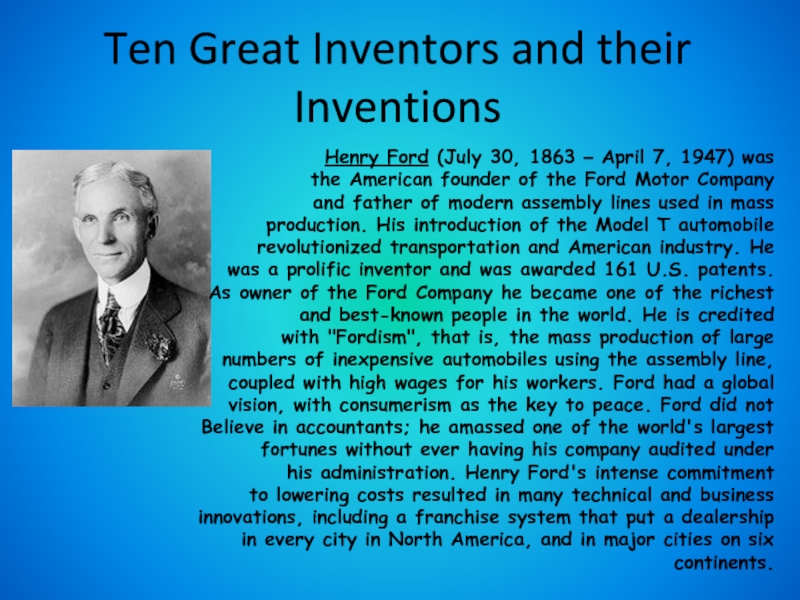
Henry Ford (July 30, 1863 –
April 7, 1947) was
the American founder of the Ford Motor Company
and father of modern assembly lines used in mass
production. His introduction of the Model T automobile
revolutionized transportation and American industry. He
was a prolific inventor and was awarded 161 U.S. patents.
As owner of the Ford Company he became one of the richest
and best-known people in the world. He is credited
with "Fordism", that is, the mass production of large
numbers of inexpensive automobiles using the assembly line,
coupled with high wages for his workers. Ford had a global
vision, with consumerism as the key to peace. Ford did not
Believe in accountants; he amassed one of the world's largest
fortunes without ever having his company audited under
his administration. Henry Ford's intense commitment
to lowering costs resulted in many technical and business
innovations, including a franchise system that put a dealership
in every city in North America, and in major cities on six
continents.
the American founder of the Ford Motor Company
and father of modern assembly lines used in mass
production. His introduction of the Model T automobile
revolutionized transportation and American industry. He
was a prolific inventor and was awarded 161 U.S. patents.
As owner of the Ford Company he became one of the richest
and best-known people in the world. He is credited
with "Fordism", that is, the mass production of large
numbers of inexpensive automobiles using the assembly line,
coupled with high wages for his workers. Ford had a global
vision, with consumerism as the key to peace. Ford did not
Believe in accountants; he amassed one of the world's largest
fortunes without ever having his company audited under
his administration. Henry Ford's intense commitment
to lowering costs resulted in many technical and business
innovations, including a franchise system that put a dealership
in every city in North America, and in major cities on six
continents.
Слайд 30Ten Great Inventors and their Inventions
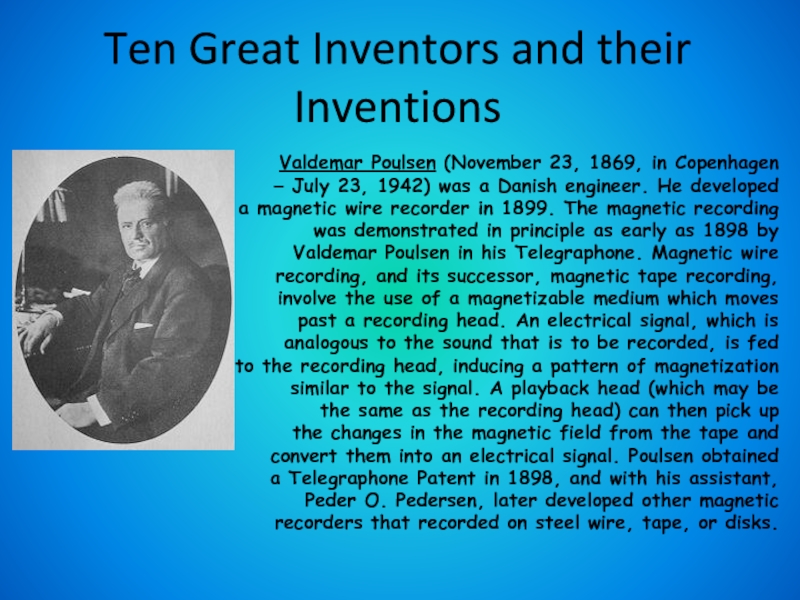
Valdemar Poulsen (November 23, 1869, in
Copenhagen
– July 23, 1942) was a Danish engineer. He developed
a magnetic wire recorder in 1899. The magnetic recording
was demonstrated in principle as early as 1898 by
Valdemar Poulsen in his Telegraphone. Magnetic wire
recording, and its successor, magnetic tape recording,
involve the use of a magnetizable medium which moves
past a recording head. An electrical signal, which is
analogous to the sound that is to be recorded, is fed
to the recording head, inducing a pattern of magnetization
similar to the signal. A playback head (which may be
the same as the recording head) can then pick up
the changes in the magnetic field from the tape and
convert them into an electrical signal. Poulsen obtained
a Telegraphone Patent in 1898, and with his assistant,
Peder O. Pedersen, later developed other magnetic
recorders that recorded on steel wire, tape, or disks.
– July 23, 1942) was a Danish engineer. He developed
a magnetic wire recorder in 1899. The magnetic recording
was demonstrated in principle as early as 1898 by
Valdemar Poulsen in his Telegraphone. Magnetic wire
recording, and its successor, magnetic tape recording,
involve the use of a magnetizable medium which moves
past a recording head. An electrical signal, which is
analogous to the sound that is to be recorded, is fed
to the recording head, inducing a pattern of magnetization
similar to the signal. A playback head (which may be
the same as the recording head) can then pick up
the changes in the magnetic field from the tape and
convert them into an electrical signal. Poulsen obtained
a Telegraphone Patent in 1898, and with his assistant,
Peder O. Pedersen, later developed other magnetic
recorders that recorded on steel wire, tape, or disks.
Слайд 31Ten Great Inventors and their Inventions
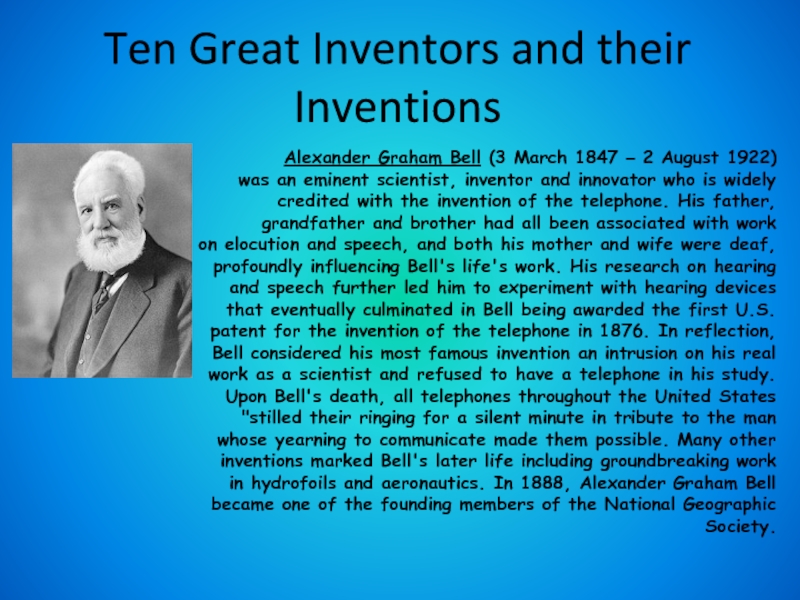
Alexander Graham Bell (3 March 1847
– 2 August 1922)
was an eminent scientist, inventor and innovator who is widely
credited with the invention of the telephone. His father,
grandfather and brother had all been associated with work
on elocution and speech, and both his mother and wife were deaf,
profoundly influencing Bell's life's work. His research on hearing
and speech further led him to experiment with hearing devices
that eventually culminated in Bell being awarded the first U.S.
patent for the invention of the telephone in 1876. In reflection,
Bell considered his most famous invention an intrusion on his real
work as a scientist and refused to have a telephone in his study.
Upon Bell's death, all telephones throughout the United States
"stilled their ringing for a silent minute in tribute to the man
whose yearning to communicate made them possible. Many other
inventions marked Bell's later life including groundbreaking work
in hydrofoils and aeronautics. In 1888, Alexander Graham Bell
became one of the founding members of the National Geographic
Society.
was an eminent scientist, inventor and innovator who is widely
credited with the invention of the telephone. His father,
grandfather and brother had all been associated with work
on elocution and speech, and both his mother and wife were deaf,
profoundly influencing Bell's life's work. His research on hearing
and speech further led him to experiment with hearing devices
that eventually culminated in Bell being awarded the first U.S.
patent for the invention of the telephone in 1876. In reflection,
Bell considered his most famous invention an intrusion on his real
work as a scientist and refused to have a telephone in his study.
Upon Bell's death, all telephones throughout the United States
"stilled their ringing for a silent minute in tribute to the man
whose yearning to communicate made them possible. Many other
inventions marked Bell's later life including groundbreaking work
in hydrofoils and aeronautics. In 1888, Alexander Graham Bell
became one of the founding members of the National Geographic
Society.
Слайд 32Ten Great Inventors and their Inventions
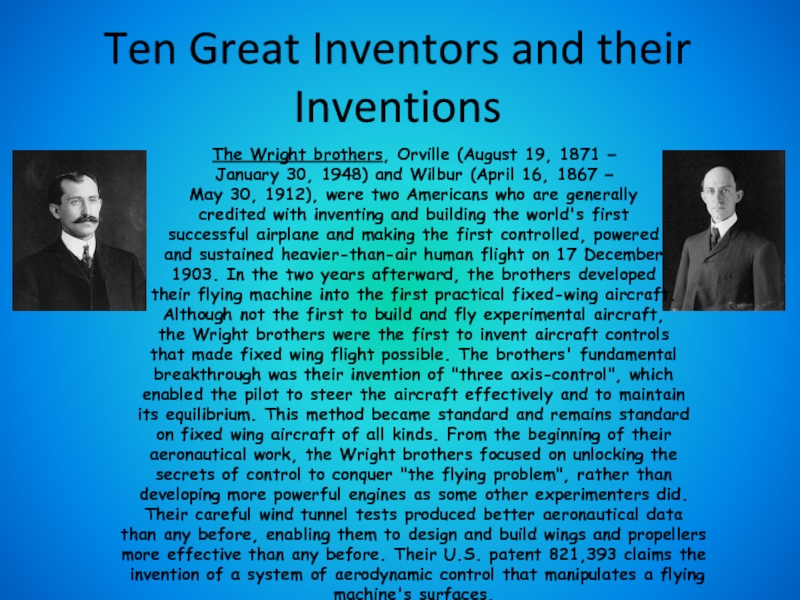
The Wright brothers, Orville (August 19,
1871 –
January 30, 1948) and Wilbur (April 16, 1867 –
May 30, 1912), were two Americans who are generally
credited with inventing and building the world's first
successful airplane and making the first controlled, powered
and sustained heavier-than-air human flight on 17 December
1903. In the two years afterward, the brothers developed
their flying machine into the first practical fixed-wing aircraft.
Although not the first to build and fly experimental aircraft,
the Wright brothers were the first to invent aircraft controls
that made fixed wing flight possible. The brothers' fundamental
breakthrough was their invention of "three axis-control", which
enabled the pilot to steer the aircraft effectively and to maintain
its equilibrium. This method became standard and remains standard
on fixed wing aircraft of all kinds. From the beginning of their
aeronautical work, the Wright brothers focused on unlocking the
secrets of control to conquer "the flying problem", rather than
developing more powerful engines as some other experimenters did.
Their careful wind tunnel tests produced better aeronautical data
than any before, enabling them to design and build wings and propellers
more effective than any before. Their U.S. patent 821,393 claims the
invention of a system of aerodynamic control that manipulates a flying
machine's surfaces.
January 30, 1948) and Wilbur (April 16, 1867 –
May 30, 1912), were two Americans who are generally
credited with inventing and building the world's first
successful airplane and making the first controlled, powered
and sustained heavier-than-air human flight on 17 December
1903. In the two years afterward, the brothers developed
their flying machine into the first practical fixed-wing aircraft.
Although not the first to build and fly experimental aircraft,
the Wright brothers were the first to invent aircraft controls
that made fixed wing flight possible. The brothers' fundamental
breakthrough was their invention of "three axis-control", which
enabled the pilot to steer the aircraft effectively and to maintain
its equilibrium. This method became standard and remains standard
on fixed wing aircraft of all kinds. From the beginning of their
aeronautical work, the Wright brothers focused on unlocking the
secrets of control to conquer "the flying problem", rather than
developing more powerful engines as some other experimenters did.
Their careful wind tunnel tests produced better aeronautical data
than any before, enabling them to design and build wings and propellers
more effective than any before. Their U.S. patent 821,393 claims the
invention of a system of aerodynamic control that manipulates a flying
machine's surfaces.
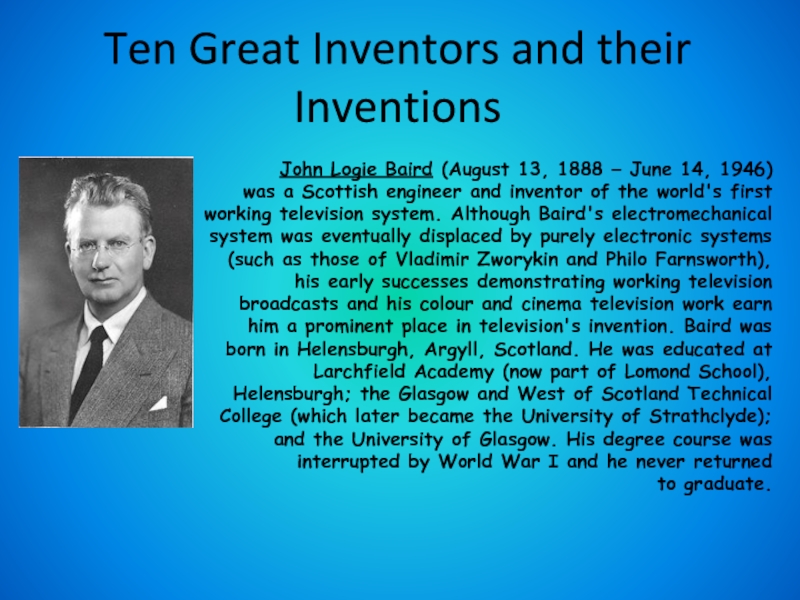
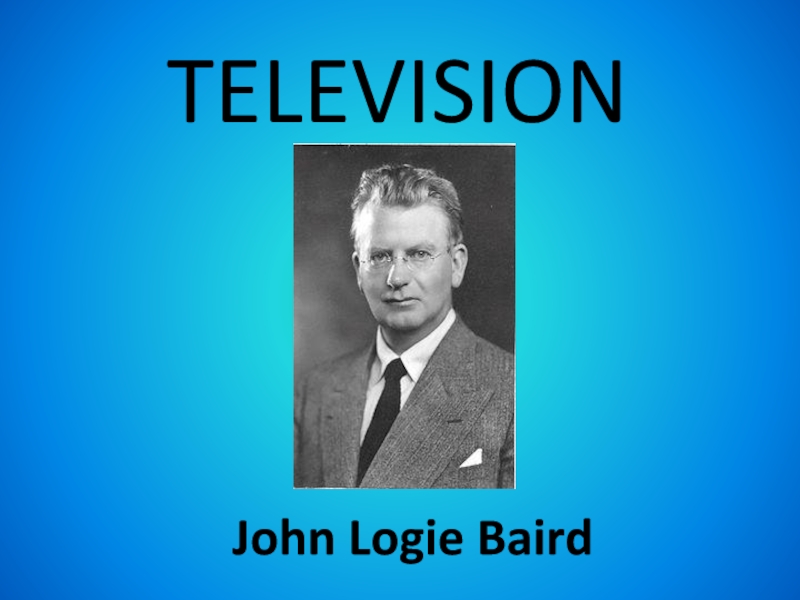
Слайд 33Ten Great Inventors and their Inventions
John Logie Baird (August 13, 1888
– June 14, 1946)
was a Scottish engineer and inventor of the world's first
working television system. Although Baird's electromechanical
system was eventually displaced by purely electronic systems
(such as those of Vladimir Zworykin and Philo Farnsworth),
his early successes demonstrating working television
broadcasts and his colour and cinema television work earn
him a prominent place in television's invention. Baird was
born in Helensburgh, Argyll, Scotland. He was educated at
Larchfield Academy (now part of Lomond School),
Helensburgh; the Glasgow and West of Scotland Technical
College (which later became the University of Strathclyde);
and the University of Glasgow. His degree course was
interrupted by World War I and he never returned
to graduate.
was a Scottish engineer and inventor of the world's first
working television system. Although Baird's electromechanical
system was eventually displaced by purely electronic systems
(such as those of Vladimir Zworykin and Philo Farnsworth),
his early successes demonstrating working television
broadcasts and his colour and cinema television work earn
him a prominent place in television's invention. Baird was
born in Helensburgh, Argyll, Scotland. He was educated at
Larchfield Academy (now part of Lomond School),
Helensburgh; the Glasgow and West of Scotland Technical
College (which later became the University of Strathclyde);
and the University of Glasgow. His degree course was
interrupted by World War I and he never returned
to graduate.
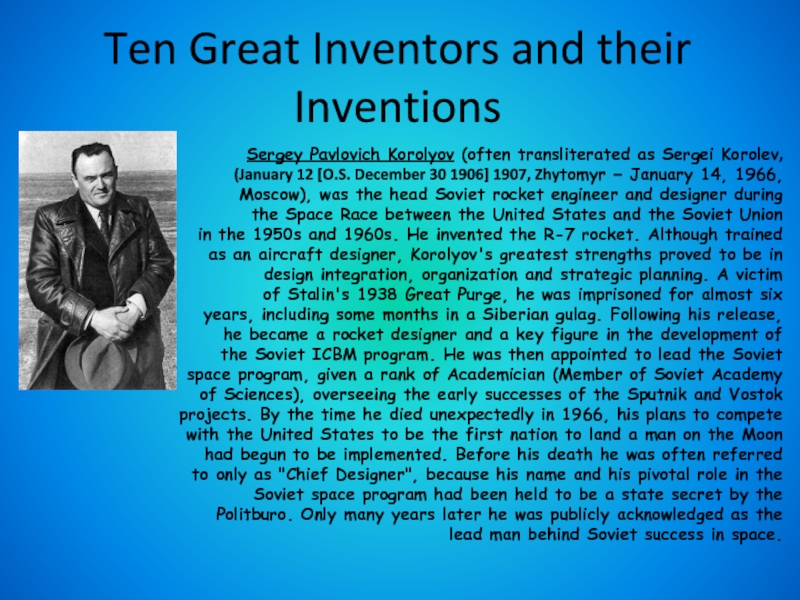
Слайд 34Ten Great Inventors and their Inventions
Sergey Pavlovich Korolyov (often transliterated as
Sergei Korolev,
(January 12 [O.S. December 30 1906] 1907, Zhytomyr – January 14, 1966,
Moscow), was the head Soviet rocket engineer and designer during
the Space Race between the United States and the Soviet Union
in the 1950s and 1960s. He invented the R-7 rocket. Although trained
as an aircraft designer, Korolyov's greatest strengths proved to be in
design integration, organization and strategic planning. A victim
of Stalin's 1938 Great Purge, he was imprisoned for almost six
years, including some months in a Siberian gulag. Following his release,
he became a rocket designer and a key figure in the development of
the Soviet ICBM program. He was then appointed to lead the Soviet
space program, given a rank of Academician (Member of Soviet Academy
of Sciences), overseeing the early successes of the Sputnik and Vostok
projects. By the time he died unexpectedly in 1966, his plans to compete
with the United States to be the first nation to land a man on the Moon
had begun to be implemented. Before his death he was often referred
to only as "Chief Designer", because his name and his pivotal role in the
Soviet space program had been held to be a state secret by the
Politburo. Only many years later he was publicly acknowledged as the
lead man behind Soviet success in space.
(January 12 [O.S. December 30 1906] 1907, Zhytomyr – January 14, 1966,
Moscow), was the head Soviet rocket engineer and designer during
the Space Race between the United States and the Soviet Union
in the 1950s and 1960s. He invented the R-7 rocket. Although trained
as an aircraft designer, Korolyov's greatest strengths proved to be in
design integration, organization and strategic planning. A victim
of Stalin's 1938 Great Purge, he was imprisoned for almost six
years, including some months in a Siberian gulag. Following his release,
he became a rocket designer and a key figure in the development of
the Soviet ICBM program. He was then appointed to lead the Soviet
space program, given a rank of Academician (Member of Soviet Academy
of Sciences), overseeing the early successes of the Sputnik and Vostok
projects. By the time he died unexpectedly in 1966, his plans to compete
with the United States to be the first nation to land a man on the Moon
had begun to be implemented. Before his death he was often referred
to only as "Chief Designer", because his name and his pivotal role in the
Soviet space program had been held to be a state secret by the
Politburo. Only many years later he was publicly acknowledged as the
lead man behind Soviet success in space.
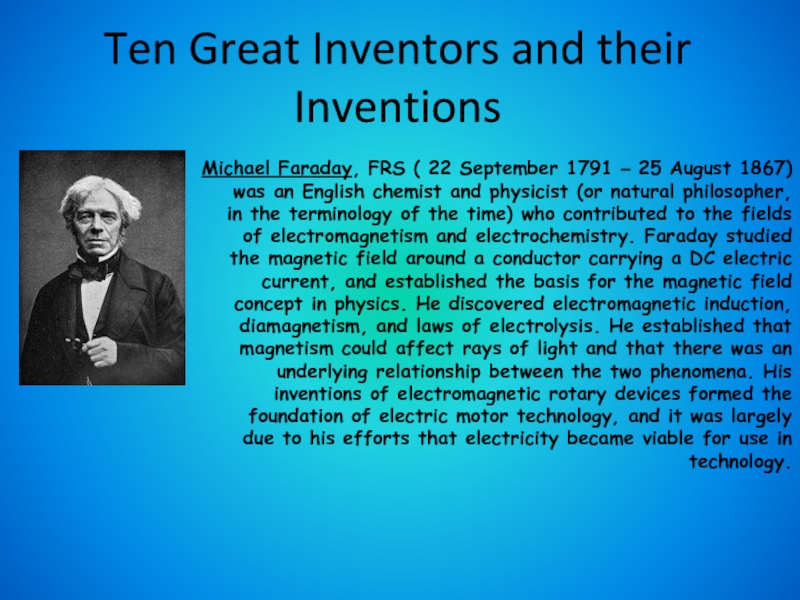
Слайд 35Ten Great Inventors and their Inventions
Michael Faraday, FRS ( 22 September
1791 – 25 August 1867)
was an English chemist and physicist (or natural philosopher,
in the terminology of the time) who contributed to the fields
of electromagnetism and electrochemistry. Faraday studied
the magnetic field around a conductor carrying a DC electric
current, and established the basis for the magnetic field
concept in physics. He discovered electromagnetic induction,
diamagnetism, and laws of electrolysis. He established that
magnetism could affect rays of light and that there was an
underlying relationship between the two phenomena. His
inventions of electromagnetic rotary devices formed the
foundation of electric motor technology, and it was largely
due to his efforts that electricity became viable for use in
technology.
was an English chemist and physicist (or natural philosopher,
in the terminology of the time) who contributed to the fields
of electromagnetism and electrochemistry. Faraday studied
the magnetic field around a conductor carrying a DC electric
current, and established the basis for the magnetic field
concept in physics. He discovered electromagnetic induction,
diamagnetism, and laws of electrolysis. He established that
magnetism could affect rays of light and that there was an
underlying relationship between the two phenomena. His
inventions of electromagnetic rotary devices formed the
foundation of electric motor technology, and it was largely
due to his efforts that electricity became viable for use in
technology.
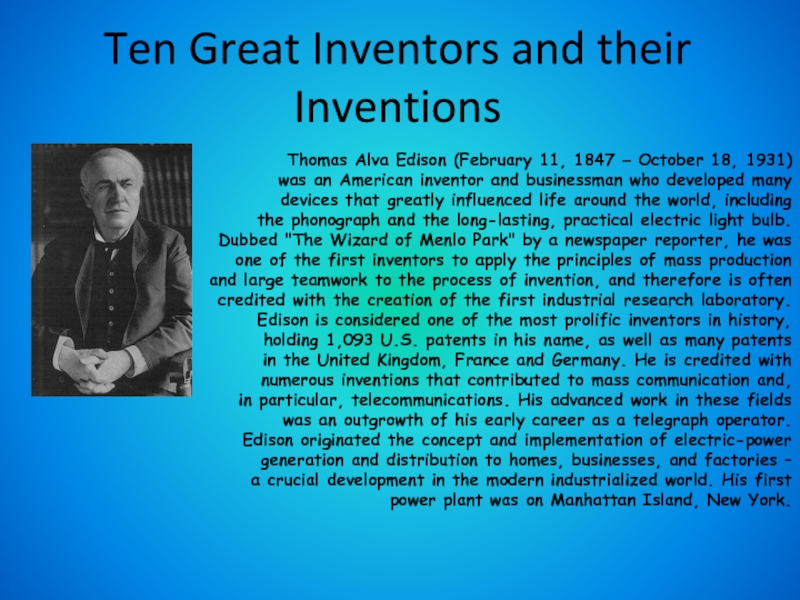
Слайд 36Ten Great Inventors and their Inventions
Thomas Alva Edison (February 11, 1847
– October 18, 1931)
was an American inventor and businessman who developed many
devices that greatly influenced life around the world, including
the phonograph and the long-lasting, practical electric light bulb.
Dubbed "The Wizard of Menlo Park" by a newspaper reporter, he was
one of the first inventors to apply the principles of mass production
and large teamwork to the process of invention, and therefore is often
credited with the creation of the first industrial research laboratory.
Edison is considered one of the most prolific inventors in history,
holding 1,093 U.S. patents in his name, as well as many patents
in the United Kingdom, France and Germany. He is credited with
numerous inventions that contributed to mass communication and,
in particular, telecommunications. His advanced work in these fields
was an outgrowth of his early career as a telegraph operator.
Edison originated the concept and implementation of electric-power
generation and distribution to homes, businesses, and factories –
a crucial development in the modern industrialized world. His first
power plant was on Manhattan Island, New York.
was an American inventor and businessman who developed many
devices that greatly influenced life around the world, including
the phonograph and the long-lasting, practical electric light bulb.
Dubbed "The Wizard of Menlo Park" by a newspaper reporter, he was
one of the first inventors to apply the principles of mass production
and large teamwork to the process of invention, and therefore is often
credited with the creation of the first industrial research laboratory.
Edison is considered one of the most prolific inventors in history,
holding 1,093 U.S. patents in his name, as well as many patents
in the United Kingdom, France and Germany. He is credited with
numerous inventions that contributed to mass communication and,
in particular, telecommunications. His advanced work in these fields
was an outgrowth of his early career as a telegraph operator.
Edison originated the concept and implementation of electric-power
generation and distribution to homes, businesses, and factories –
a crucial development in the modern industrialized world. His first
power plant was on Manhattan Island, New York.
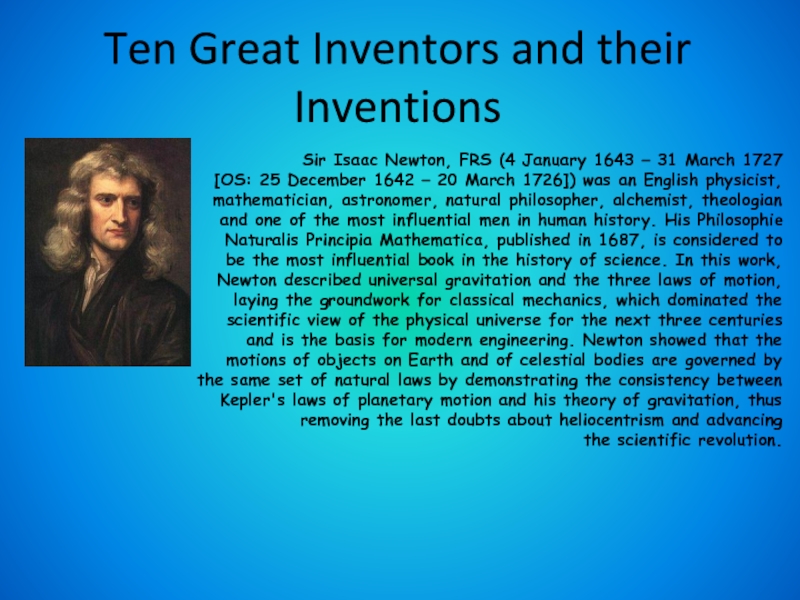
Слайд 37Ten Great Inventors and their Inventions
Sir Isaac Newton, FRS (4 January
1643 – 31 March 1727
[OS: 25 December 1642 – 20 March 1726]) was an English physicist,
mathematician, astronomer, natural philosopher, alchemist, theologian
and one of the most influential men in human history. His Philosophie
Naturalis Principia Mathematica, published in 1687, is considered to
be the most influential book in the history of science. In this work,
Newton described universal gravitation and the three laws of motion,
laying the groundwork for classical mechanics, which dominated the
scientific view of the physical universe for the next three centuries
and is the basis for modern engineering. Newton showed that the
motions of objects on Earth and of celestial bodies are governed by
the same set of natural laws by demonstrating the consistency between
Kepler's laws of planetary motion and his theory of gravitation, thus
removing the last doubts about heliocentrism and advancing
the scientific revolution.
[OS: 25 December 1642 – 20 March 1726]) was an English physicist,
mathematician, astronomer, natural philosopher, alchemist, theologian
and one of the most influential men in human history. His Philosophie
Naturalis Principia Mathematica, published in 1687, is considered to
be the most influential book in the history of science. In this work,
Newton described universal gravitation and the three laws of motion,
laying the groundwork for classical mechanics, which dominated the
scientific view of the physical universe for the next three centuries
and is the basis for modern engineering. Newton showed that the
motions of objects on Earth and of celestial bodies are governed by
the same set of natural laws by demonstrating the consistency between
Kepler's laws of planetary motion and his theory of gravitation, thus
removing the last doubts about heliocentrism and advancing
the scientific revolution.
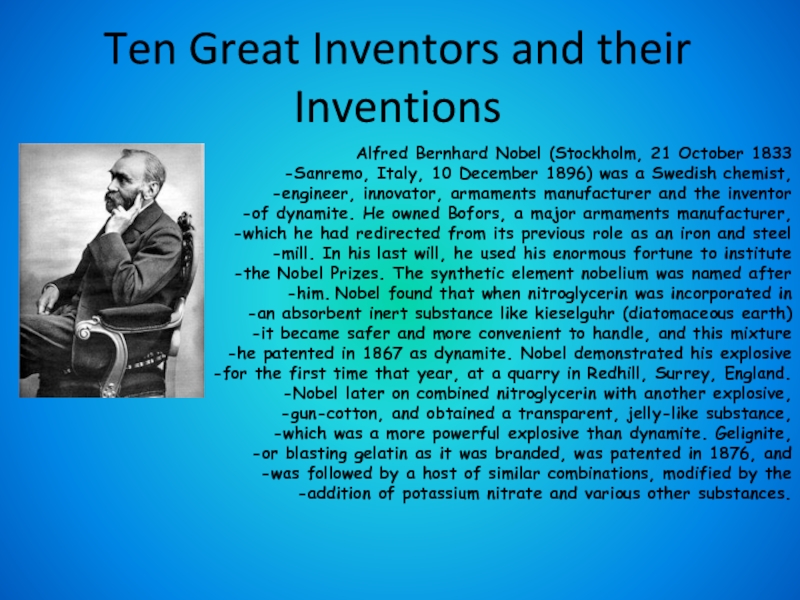
Слайд 38Ten Great Inventors and their Inventions
Alfred Bernhard Nobel (Stockholm, 21 October
1833
Sanremo, Italy, 10 December 1896) was a Swedish chemist,
engineer, innovator, armaments manufacturer and the inventor
of dynamite. He owned Bofors, a major armaments manufacturer,
which he had redirected from its previous role as an iron and steel
mill. In his last will, he used his enormous fortune to institute
the Nobel Prizes. The synthetic element nobelium was named after
him. Nobel found that when nitroglycerin was incorporated in
an absorbent inert substance like kieselguhr (diatomaceous earth)
it became safer and more convenient to handle, and this mixture
he patented in 1867 as dynamite. Nobel demonstrated his explosive
for the first time that year, at a quarry in Redhill, Surrey, England.
Nobel later on combined nitroglycerin with another explosive,
gun-cotton, and obtained a transparent, jelly-like substance,
which was a more powerful explosive than dynamite. Gelignite,
or blasting gelatin as it was branded, was patented in 1876, and
was followed by a host of similar combinations, modified by the
addition of potassium nitrate and various other substances.
Sanremo, Italy, 10 December 1896) was a Swedish chemist,
engineer, innovator, armaments manufacturer and the inventor
of dynamite. He owned Bofors, a major armaments manufacturer,
which he had redirected from its previous role as an iron and steel
mill. In his last will, he used his enormous fortune to institute
the Nobel Prizes. The synthetic element nobelium was named after
him. Nobel found that when nitroglycerin was incorporated in
an absorbent inert substance like kieselguhr (diatomaceous earth)
it became safer and more convenient to handle, and this mixture
he patented in 1867 as dynamite. Nobel demonstrated his explosive
for the first time that year, at a quarry in Redhill, Surrey, England.
Nobel later on combined nitroglycerin with another explosive,
gun-cotton, and obtained a transparent, jelly-like substance,
which was a more powerful explosive than dynamite. Gelignite,
or blasting gelatin as it was branded, was patented in 1876, and
was followed by a host of similar combinations, modified by the
addition of potassium nitrate and various other substances.

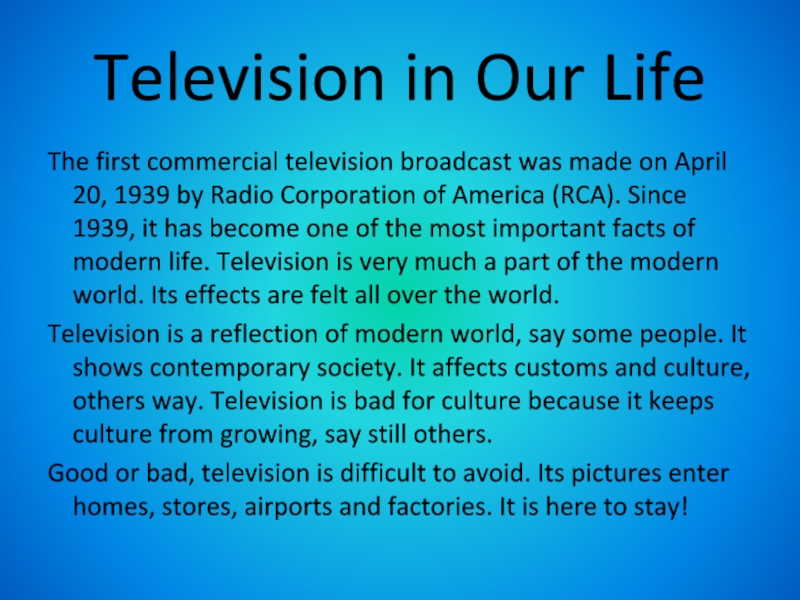
Слайд 43Television in Our Life
The first commercial television broadcast was made on
April 20, 1939 by Radio Corporation of America (RCA). Since 1939, it has become one of the most important facts of modern life. Television is very much a part of the modern world. Its effects are felt all over the world.
Television is a reflection of modern world, say some people. It shows contemporary society. It affects customs and culture, others way. Television is bad for culture because it keeps culture from growing, say still others.
Good or bad, television is difficult to avoid. Its pictures enter homes, stores, airports and factories. It is here to stay!
Television is a reflection of modern world, say some people. It shows contemporary society. It affects customs and culture, others way. Television is bad for culture because it keeps culture from growing, say still others.
Good or bad, television is difficult to avoid. Its pictures enter homes, stores, airports and factories. It is here to stay!
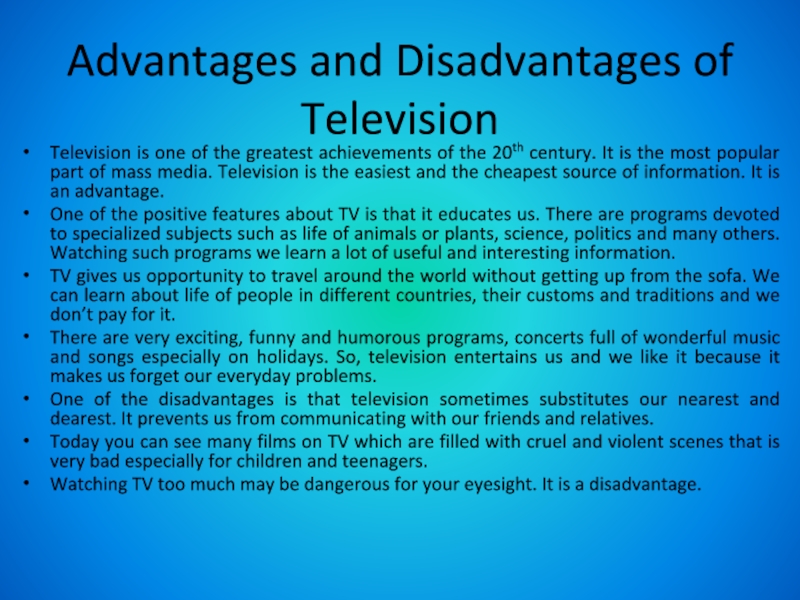
Слайд 44Advantages and Disadvantages of Television
Television is one of the greatest achievements
of the 20th century. It is the most popular part of mass media. Television is the easiest and the cheapest source of information. It is an advantage.
One of the positive features about TV is that it educates us. There are programs devoted to specialized subjects such as life of animals or plants, science, politics and many others. Watching such programs we learn a lot of useful and interesting information.
TV gives us opportunity to travel around the world without getting up from the sofa. We can learn about life of people in different countries, their customs and traditions and we don’t pay for it.
There are very exciting, funny and humorous programs, concerts full of wonderful music and songs especially on holidays. So, television entertains us and we like it because it makes us forget our everyday problems.
One of the disadvantages is that television sometimes substitutes our nearest and dearest. It prevents us from communicating with our friends and relatives.
Today you can see many films on TV which are filled with cruel and violent scenes that is very bad especially for children and teenagers.
Watching TV too much may be dangerous for your eyesight. It is a disadvantage.
One of the positive features about TV is that it educates us. There are programs devoted to specialized subjects such as life of animals or plants, science, politics and many others. Watching such programs we learn a lot of useful and interesting information.
TV gives us opportunity to travel around the world without getting up from the sofa. We can learn about life of people in different countries, their customs and traditions and we don’t pay for it.
There are very exciting, funny and humorous programs, concerts full of wonderful music and songs especially on holidays. So, television entertains us and we like it because it makes us forget our everyday problems.
One of the disadvantages is that television sometimes substitutes our nearest and dearest. It prevents us from communicating with our friends and relatives.
Today you can see many films on TV which are filled with cruel and violent scenes that is very bad especially for children and teenagers.
Watching TV too much may be dangerous for your eyesight. It is a disadvantage.

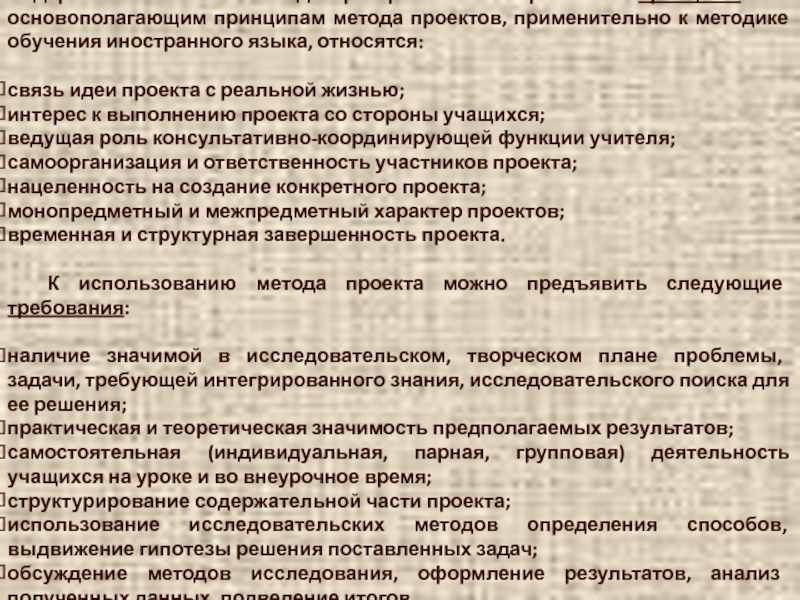
Слайд 46Содержание любого метода раскрывается через его принципы. К основополагающим принципам метода
проектов, применительно к методике обучения иностранного языка, относятся:
связь идеи проекта с реальной жизнью;
интерес к выполнению проекта со стороны учащихся;
ведущая роль консультативно-координирующей функции учителя;
самоорганизация и ответственность участников проекта;
нацеленность на создание конкретного проекта;
монопредметный и межпредметный характер проектов;
временная и структурная завершенность проекта.
К использованию метода проекта можно предъявить следующие требования:
наличие значимой в исследовательском, творческом плане проблемы, задачи, требующей интегрированного знания, исследовательского поиска для ее решения;
практическая и теоретическая значимость предполагаемых результатов;
самостоятельная (индивидуальная, парная, групповая) деятельность учащихся на уроке и во внеурочное время;
структурирование содержательной части проекта;
использование исследовательских методов определения способов, выдвижение гипотезы решения поставленных задач;
обсуждение методов исследования, оформление результатов, анализ полученных данных, подведение итогов.
связь идеи проекта с реальной жизнью;
интерес к выполнению проекта со стороны учащихся;
ведущая роль консультативно-координирующей функции учителя;
самоорганизация и ответственность участников проекта;
нацеленность на создание конкретного проекта;
монопредметный и межпредметный характер проектов;
временная и структурная завершенность проекта.
К использованию метода проекта можно предъявить следующие требования:
наличие значимой в исследовательском, творческом плане проблемы, задачи, требующей интегрированного знания, исследовательского поиска для ее решения;
практическая и теоретическая значимость предполагаемых результатов;
самостоятельная (индивидуальная, парная, групповая) деятельность учащихся на уроке и во внеурочное время;
структурирование содержательной части проекта;
использование исследовательских методов определения способов, выдвижение гипотезы решения поставленных задач;
обсуждение методов исследования, оформление результатов, анализ полученных данных, подведение итогов.
Слайд 47
Исходя из предъявленных принципов и требований, можно сформулировать критерии оценивания
проектных работ с точки зрения приобретенных интеллектуальных умений, таких как:
- умение анализировать;
- выделять главное;
- аргументировать мнение;
- участвовать в обсуждении;
- делать выводы.
Также по результатам выполнения проектной работы на заданную тему оценивается усвоение учащимися определенного учебного материала, эстетичность, оригинальность выполненной работы.
Проектная технология влияет на результаты и качество знаний учащихся. По результатам семестровых видов контроля (аудирование, чтение, говорение, письмо), проводимых в параллели 10 классов, можно сделать вывод, что учащиеся стали более грамотно пользоваться грамматическими структурами, значительно расширился запас, и в целом коммуникативные навыки. В ходе мониторинга этих видов контроля учащиеся показали умение извлекать информацию, понять и выделить главную мысль, обобщить данные.
- умение анализировать;
- выделять главное;
- аргументировать мнение;
- участвовать в обсуждении;
- делать выводы.
Также по результатам выполнения проектной работы на заданную тему оценивается усвоение учащимися определенного учебного материала, эстетичность, оригинальность выполненной работы.
Проектная технология влияет на результаты и качество знаний учащихся. По результатам семестровых видов контроля (аудирование, чтение, говорение, письмо), проводимых в параллели 10 классов, можно сделать вывод, что учащиеся стали более грамотно пользоваться грамматическими структурами, значительно расширился запас, и в целом коммуникативные навыки. В ходе мониторинга этих видов контроля учащиеся показали умение извлекать информацию, понять и выделить главную мысль, обобщить данные.
Слайд 48
Исходя из опыта работы над этой проблемой, можно отметить следующие преимущества
и достоинства метода проектов:
отсутствие готовых и однозначных решений;
развитие навыков самообразования и самоконтроля;
развитие навыков групповой деятельности;
повышение информационной культуры – развитие навыков поиска, сбора, обработки и представления информации, в том числе и с использованием ИКТ;
повышение мотивации;
развитие самостоятельности и инициативы, творческих способностей, способности учащихся к самооценке;
развитие межпредметных компетентностей учащихся.
Наряду с достоинствами метода проектов, необходимо отметить, что существуют некоторые проблемы в его использовании:
элементы субъективности при оценке творческой работы;
переоценка отдельными учащимися своих возможностей и попадание в стрессовую ситуацию (необходимость выполнения работы к сроку; недостаточность опыта публичных выступлений и т. п.);
проблемы технического порядка, которые могут повлиять как на процесс работы, так и на конечный результат.
отсутствие готовых и однозначных решений;
развитие навыков самообразования и самоконтроля;
развитие навыков групповой деятельности;
повышение информационной культуры – развитие навыков поиска, сбора, обработки и представления информации, в том числе и с использованием ИКТ;
повышение мотивации;
развитие самостоятельности и инициативы, творческих способностей, способности учащихся к самооценке;
развитие межпредметных компетентностей учащихся.
Наряду с достоинствами метода проектов, необходимо отметить, что существуют некоторые проблемы в его использовании:
элементы субъективности при оценке творческой работы;
переоценка отдельными учащимися своих возможностей и попадание в стрессовую ситуацию (необходимость выполнения работы к сроку; недостаточность опыта публичных выступлений и т. п.);
проблемы технического порядка, которые могут повлиять как на процесс работы, так и на конечный результат.
Слайд 49 Проектная технология предоставляет новые возможности решения традиционных методических задач:
чтобы по-новому
сформировать у учащихся необходимые умения и навыки в том или ином виде речевой деятельности, а также лингвистическую копмпетентность на уровне, определенном программой и государственным стандартом, необходима активная устная практика речи для каждого ученика группы;
чтобы сформировать коммуникативную компетентность вне языкового окружения, важно представить учащимся возможность мыслить, решать проблемы, рассуждать над возможными путями решения этих проблем с тем, чтобы дети акцентировали внимание на содержание своего высказывания, а язык выступал в своей прямой функции – формирование и формулирование этих высказываний;
чтобы учащиеся воспринимали язык как средство межкультурного взаимодействия, необходимо не только знакомить их со страноведческой тематикой, но и искать способы включения их в активный диалог культур, чтобы они на практике могли познавать особенности функционирования языка в новой дл них культуре.
Применение в информационно-коммуникативной среде проектной методики является эффективным фактором развития мотивации и самостоятельности в процессе изучения английского языка, в познавательном процессе.
чтобы сформировать коммуникативную компетентность вне языкового окружения, важно представить учащимся возможность мыслить, решать проблемы, рассуждать над возможными путями решения этих проблем с тем, чтобы дети акцентировали внимание на содержание своего высказывания, а язык выступал в своей прямой функции – формирование и формулирование этих высказываний;
чтобы учащиеся воспринимали язык как средство межкультурного взаимодействия, необходимо не только знакомить их со страноведческой тематикой, но и искать способы включения их в активный диалог культур, чтобы они на практике могли познавать особенности функционирования языка в новой дл них культуре.
Применение в информационно-коммуникативной среде проектной методики является эффективным фактором развития мотивации и самостоятельности в процессе изучения английского языка, в познавательном процессе.
Выводы: