- Главная
- Разное
- Образование
- Спорт
- Естествознание
- Природоведение
- Религиоведение
- Французский язык
- Черчение
- Английский язык
- Астрономия
- Алгебра
- Биология
- География
- Геометрия
- Детские презентации
- Информатика
- История
- Литература
- Математика
- Музыка
- МХК
- Немецкий язык
- ОБЖ
- Обществознание
- Окружающий мир
- Педагогика
- Русский язык
- Технология
- Физика
- Философия
- Химия
- Шаблоны, фоны, картинки для презентаций
- Экология
- Экономика
Презентация, доклад на тему Проектная работа (презентация) по теме Ashford School
Содержание
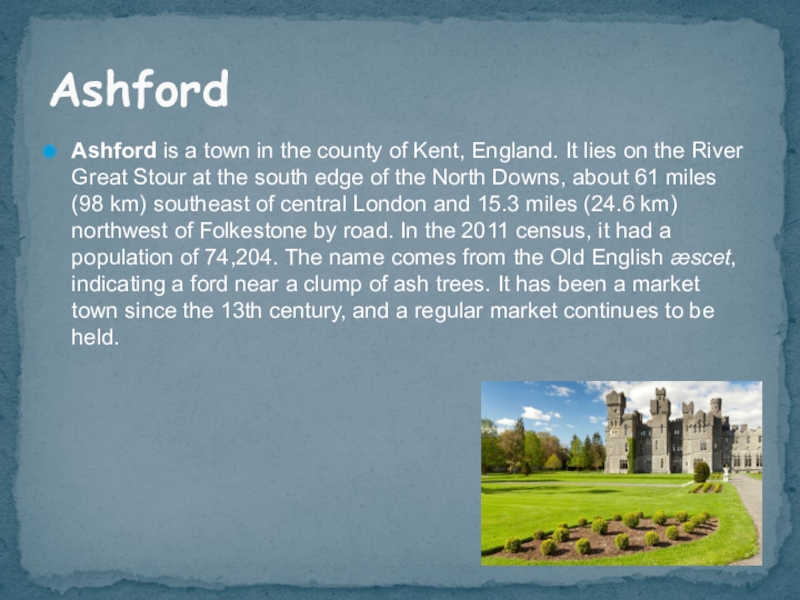
Ashford is a town in the county of Kent, England. It lies on the River Great Stour at the south edge of the North Downs, about 61 miles (98 km) southeast of central London and 15.3 miles (24.6 km) northwest of Folkestone by road. In

Слайд 2Ashford is a town in the county of Kent, England. It lies on
the River Great Stour at the south edge of the North Downs, about 61 miles (98 km) southeast of central London and 15.3 miles (24.6 km) northwest of Folkestone by road. In the 2011 census, it had a population of 74,204. The name comes from the Old English æscet, indicating a ford near a clump of ash trees. It has been a market town since the 13th century, and a regular market continues to be held.
Ashford
Слайд 3There has been evidence of human habitation around Ashford since the Iron
Age, with a barrow on what is now Barrow Hill dating back to 1500 BC. Two axes from the Lower Paleolithic period have been found near Ashford. During the construction of the Park Farm estate in the late 1990s, excavation in the area revealed tools from the Upper Palaeolithicand Mesolithic period dating back to the 7th century BC. A number of other Mesolithic tools were discovered during construction of the Channel Tunnel Rail Link through Ashford.
During Roman Britain, iron ore was mined in the Weald and transported to Ashford where two ironworks processed the ore into a workable metal. Archaeological studies have revealed the existence of a Roman town to the north of the current centre, roughly at the junction of Albert Road and Wall Road.
The present town originates from an original settlement established in 893 AD by inhabitants escaping a Danish Viking raid, who were granted land by a Saxon Lord for their resistance. The name comes from the Old English æscet, indicating a ford near a clump of ash trees. At the time of the Domesday Book of 1086 it was still known by its original Saxon name of Essetesford (or Eshetisford, Esselesford, Asshatisforde, Essheford). The manor was owned by Hugh de Montford, Constable of England, and had a church, two mills and a value of 150 shillings (£7.50) at the time. One of the earliest houses in the area still in existence is Lake House at Eastwell Park to the north of the town, which contains the grave of Richard Plantagenet.
During Roman Britain, iron ore was mined in the Weald and transported to Ashford where two ironworks processed the ore into a workable metal. Archaeological studies have revealed the existence of a Roman town to the north of the current centre, roughly at the junction of Albert Road and Wall Road.
The present town originates from an original settlement established in 893 AD by inhabitants escaping a Danish Viking raid, who were granted land by a Saxon Lord for their resistance. The name comes from the Old English æscet, indicating a ford near a clump of ash trees. At the time of the Domesday Book of 1086 it was still known by its original Saxon name of Essetesford (or Eshetisford, Esselesford, Asshatisforde, Essheford). The manor was owned by Hugh de Montford, Constable of England, and had a church, two mills and a value of 150 shillings (£7.50) at the time. One of the earliest houses in the area still in existence is Lake House at Eastwell Park to the north of the town, which contains the grave of Richard Plantagenet.
History
Слайд 4Middle ages
Ashford's importance as an agricultural and market town grew in
the 13th century, and in 1243, King Henry III granted the town a charter to hold a market for livestock. The pottery industry expanded in the 13th and 14th centuries, with the main works based at what is now Potter's Corner, a few miles west of the town centre. Later evidence from examining waste suggests that production was on a large scale. The Kent Archaeological society have discovered sandy ware at this location dating from around 1125 – 1250.
Jack Cade, who led the Cade's Rebellion against corrupt Royal officials in 1450, is believed to be from Ashford. In William Shakespeare's Henry VI, Part 2, Cade is shown conversing with "Dick, the Butcher from Ashford".
Jack Cade, who led the Cade's Rebellion against corrupt Royal officials in 1450, is believed to be from Ashford. In William Shakespeare's Henry VI, Part 2, Cade is shown conversing with "Dick, the Butcher from Ashford".
In the 16th and 17th centuries, Ashford became known for nonconformism. A local resident, John Brown, was executed for heresy in 1511, and may have inspired the later namesake of the song "John Brown's Body". Thomas Smythe acquired the manor of Ashford as dowry from Queen Elizabeth I in the mid-16th century, and is buried in the parish church.
Dr John Wallis, the internationally recognised mathematician and one of Isaac Newton's main tutors was born in Ashford in 1616, but moved to Tenterden in 1625 to avoid the plague. He was a promising student, and subsequently graduated from Emmanuel College, Cambridge.
Слайд 6Modern developments
By the 1780s, local farmers had begun to hold informal
market days, and advertised the town's ideal location between London, Chatham and the Kent Coast. The market was held in the High Street until 1856, when local farmers and businessmen relocated to Elwick Road and formed a market company that is the oldest surviving registered company in England and Wales.There is still a regular street market in the town, but the market company relocated outside Ashford town centre after part of the 19th-century site was demolished to make way for the Channel Tunnel Rail Link. It is still used by around 5,000 farmers.