Prepared by the 3rd form pupils:
Dvirnyak L.
Dzincharadze G.
Sinelnikova I.
Khachatryan K
Consultant: Rodionova I.F,
English language teacher
2016-2017
- Главная
- Разное
- Образование
- Спорт
- Естествознание
- Природоведение
- Религиоведение
- Французский язык
- Черчение
- Английский язык
- Астрономия
- Алгебра
- Биология
- География
- Геометрия
- Детские презентации
- Информатика
- История
- Литература
- Математика
- Музыка
- МХК
- Немецкий язык
- ОБЖ
- Обществознание
- Окружающий мир
- Педагогика
- Русский язык
- Технология
- Физика
- Философия
- Химия
- Шаблоны, фоны, картинки для презентаций
- Экология
- Экономика
Презентация, доклад на тему Проектная работа на английском языке We live and study in the Green Cape
Содержание
- 1. Проектная работа на английском языке We live and study in the Green Cape
- 2. We live and study in Green Cape.
- 3. From space Green Cape is
- 4. This is Green Cape 15 years ago!
- 5. This is Green Cape now!The place has
- 6. So, we decided to learn more about
- 7. Then, we asked questions to the pupils
- 8. It was interesting to organize the competition
- 9. In conclusion, we want to present the
- 10. Thank you for your attention!Special thanks to
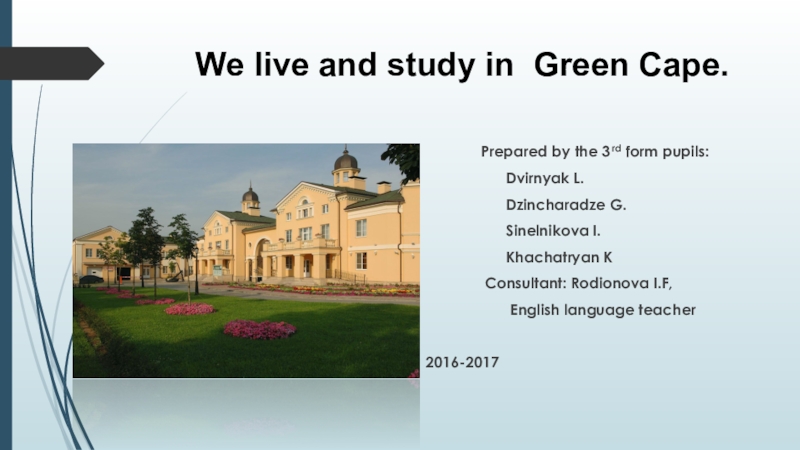
We live and study in Green Cape. This is our native place. We`d like to present a project about ecological problems in Green Cape. We have chosen this topic because we want to live in a
Слайд 2We live and study in Green Cape.
This is our native
place. We`d like to present a project about ecological problems in Green Cape.
We have chosen this topic because we want to live in a clean wonderful place.
We`d like to find answers to some ecological questions.
Look at what we have done so far!
We have chosen this topic because we want to live in a clean wonderful place.
We`d like to find answers to some ecological questions.
Look at what we have done so far!
Слайд 3
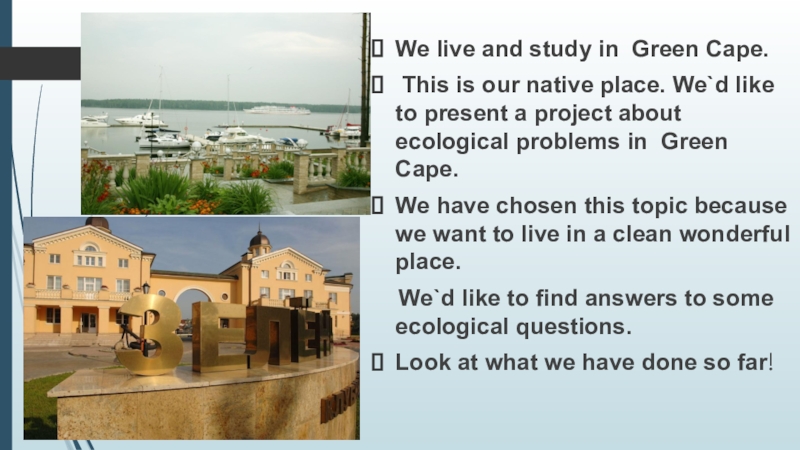
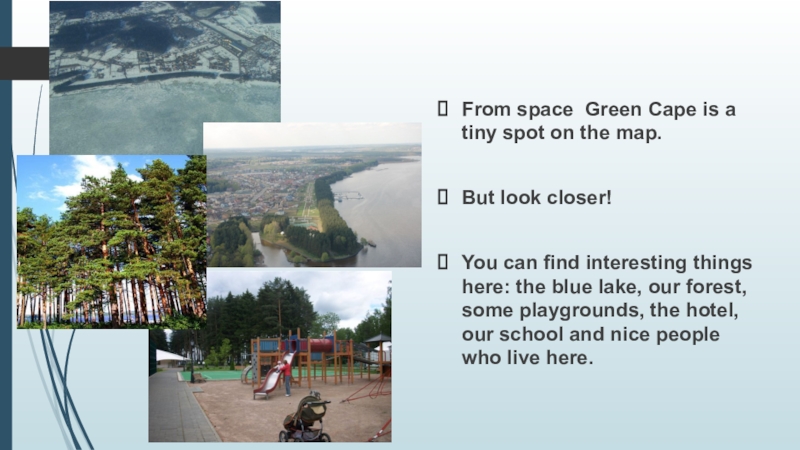
From space Green Cape is a tiny spot on the map.
But
look closer!
You can find interesting things here: the blue lake, our forest, some playgrounds, the hotel, our school and nice people who live here.
You can find interesting things here: the blue lake, our forest, some playgrounds, the hotel, our school and nice people who live here.
Слайд 4This is Green Cape 15 years ago!
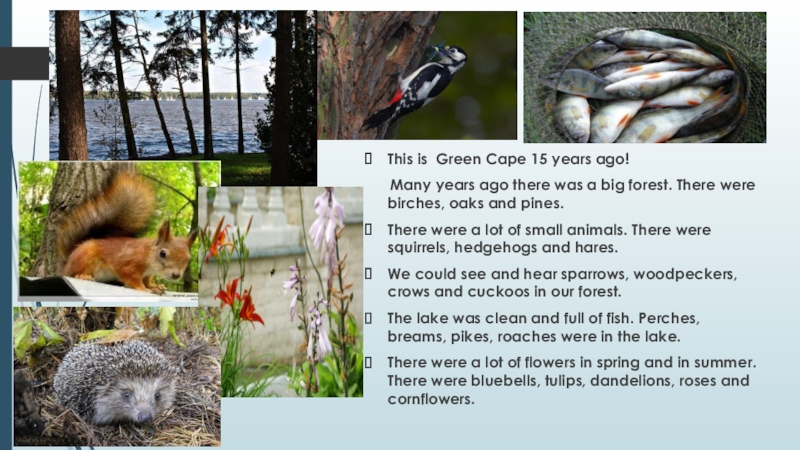
Many years
ago there was a big forest. There were birches, oaks and pines.
There were a lot of small animals. There were squirrels, hedgehogs and hares.
We could see and hear sparrows, woodpeckers, crows and cuckoos in our forest.
The lake was clean and full of fish. Perches, breams, pikes, roaches were in the lake.
There were a lot of flowers in spring and in summer. There were bluebells, tulips, dandelions, roses and cornflowers.
There were a lot of small animals. There were squirrels, hedgehogs and hares.
We could see and hear sparrows, woodpeckers, crows and cuckoos in our forest.
The lake was clean and full of fish. Perches, breams, pikes, roaches were in the lake.
There were a lot of flowers in spring and in summer. There were bluebells, tulips, dandelions, roses and cornflowers.
Слайд 5This is Green Cape now!
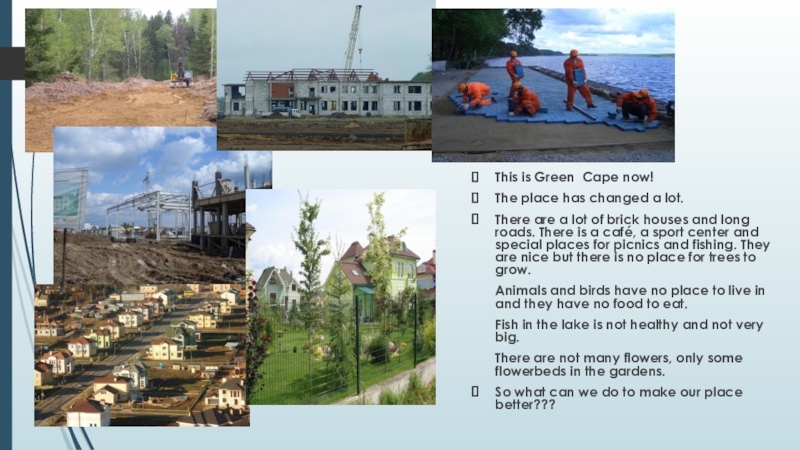
The place has changed a lot.
There are
a lot of brick houses and long roads. There is a café, a sport center and special places for picnics and fishing. They are nice but there is no place for trees to grow.
Animals and birds have no place to live in and they have no food to eat.
Fish in the lake is not healthy and not very big.
There are not many flowers, only some flowerbeds in the gardens.
So what can we do to make our place better???
Animals and birds have no place to live in and they have no food to eat.
Fish in the lake is not healthy and not very big.
There are not many flowers, only some flowerbeds in the gardens.
So what can we do to make our place better???
Слайд 6So, we decided to learn more about nature in our area.
First
of all, we asked some questions to our Biology teacher. She knows a lot about world around us and she helped us great. We translated the answers into English and we understood that nature in The Green Cape needs protection:
The trees are not healthy
The birds stay in the forest in winter but there in no food for them
Water in the lake is not very clean.
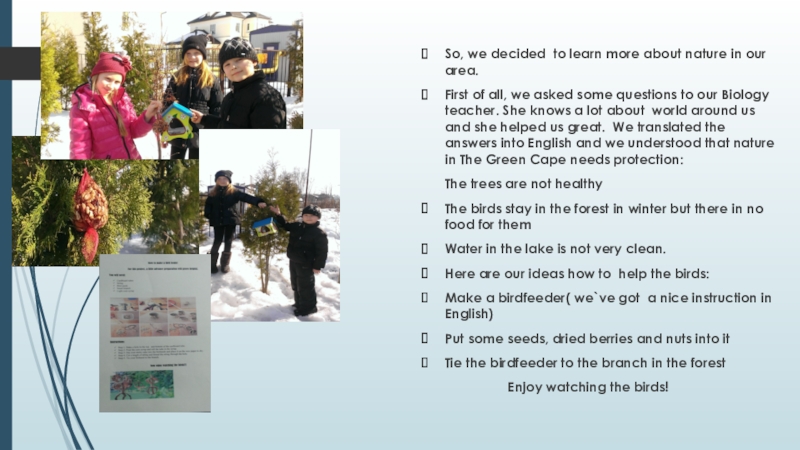
Here are our ideas how to help the birds:
Make a birdfeeder( we`ve got a nice instruction in English)
Put some seeds, dried berries and nuts into it
Tie the birdfeeder to the branch in the forest
Enjoy watching the birds!
The trees are not healthy
The birds stay in the forest in winter but there in no food for them
Water in the lake is not very clean.
Here are our ideas how to help the birds:
Make a birdfeeder( we`ve got a nice instruction in English)
Put some seeds, dried berries and nuts into it
Tie the birdfeeder to the branch in the forest
Enjoy watching the birds!
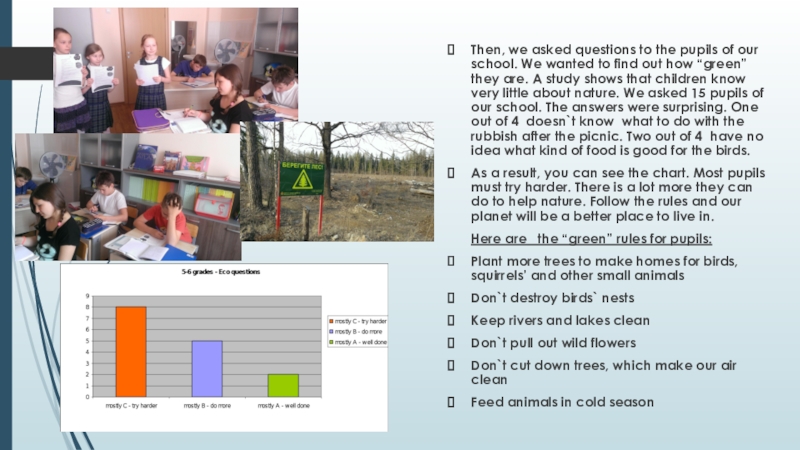
Слайд 7Then, we asked questions to the pupils of our school. We
wanted to find out how “green” they are. A study shows that children know very little about nature. We asked 15 pupils of our school. The answers were surprising. One out of 4 doesn`t know what to do with the rubbish after the picnic. Two out of 4 have no idea what kind of food is good for the birds.
As a result, you can see the chart. Most pupils must try harder. There is a lot more they can do to help nature. Follow the rules and our planet will be a better place to live in.
Here are the “green” rules for pupils:
Plant more trees to make homes for birds, squirrels’ and other small animals
Don`t destroy birds` nests
Keep rivers and lakes clean
Don`t pull out wild flowers
Don`t cut down trees, which make our air clean
Feed animals in cold season
As a result, you can see the chart. Most pupils must try harder. There is a lot more they can do to help nature. Follow the rules and our planet will be a better place to live in.
Here are the “green” rules for pupils:
Plant more trees to make homes for birds, squirrels’ and other small animals
Don`t destroy birds` nests
Keep rivers and lakes clean
Don`t pull out wild flowers
Don`t cut down trees, which make our air clean
Feed animals in cold season
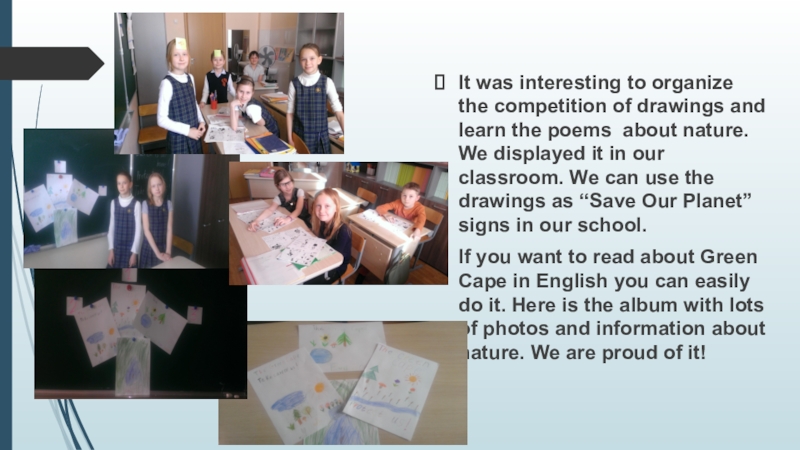
Слайд 8It was interesting to organize the competition of drawings and learn
the poems about nature. We displayed it in our classroom. We can use the drawings as “Save Our Planet” signs in our school.
If you want to read about Green Cape in English you can easily do it. Here is the album with lots of photos and information about nature. We are proud of it!
If you want to read about Green Cape in English you can easily do it. Here is the album with lots of photos and information about nature. We are proud of it!
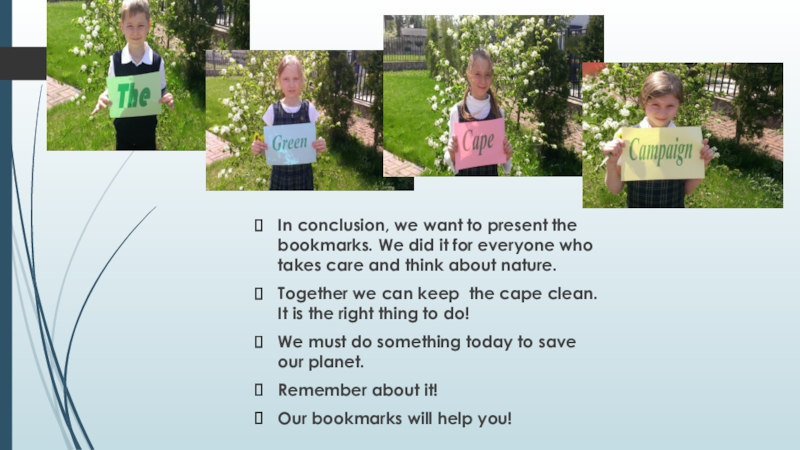
Слайд 9In conclusion, we want to present the bookmarks. We did it
for everyone who takes care and think about nature.
Together we can keep the cape clean. It is the right thing to do!
We must do something today to save our planet.
Remember about it!
Our bookmarks will help you!
Together we can keep the cape clean. It is the right thing to do!
We must do something today to save our planet.
Remember about it!
Our bookmarks will help you!
Слайд 10Thank you for your attention!
Special thanks to the teachers of our
school who helped us a lot:
Gvozdeva E.V
Podberyoznaya A.A
Pirogova M.U
Mikhailova P.A
Gvozdeva E.V
Podberyoznaya A.A
Pirogova M.U
Mikhailova P.A