Презентация, доклад Знаменитые Британцы к УМК Ю.А.Комарова 6 класс английский язык.

Содержание

Monarchs Politicians Writers Painters Actors Musicians

Слайд 1Famous Britains
Автор: ШишкинаИ.А.
Учитель английского языка МОУ СОШ №13

Famous Britains Автор: ШишкинаИ.А. Учитель английского языка МОУ СОШ №13

Слайд 2Monarchs Politicians Writers Painters Actors Musicians

Monarchs Politicians Writers Painters Actors Musicians

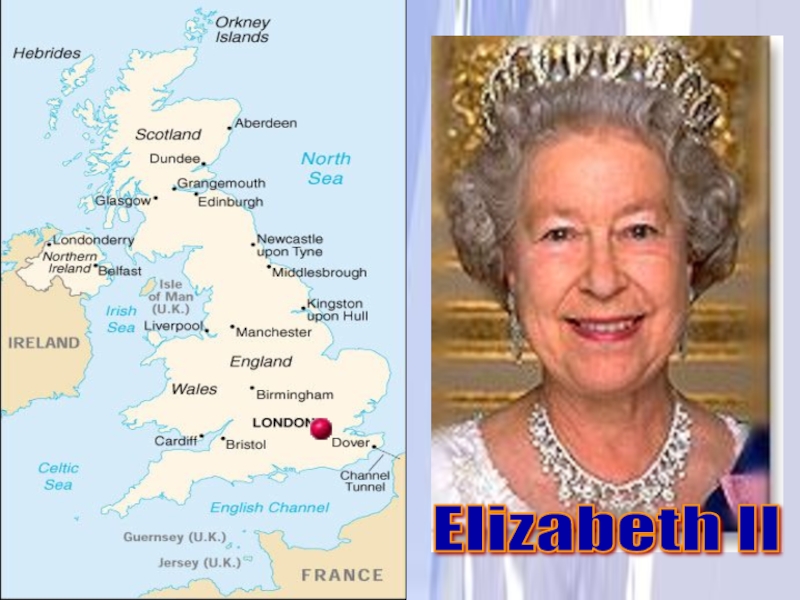
Слайд 3Elizabeth II

Elizabeth II

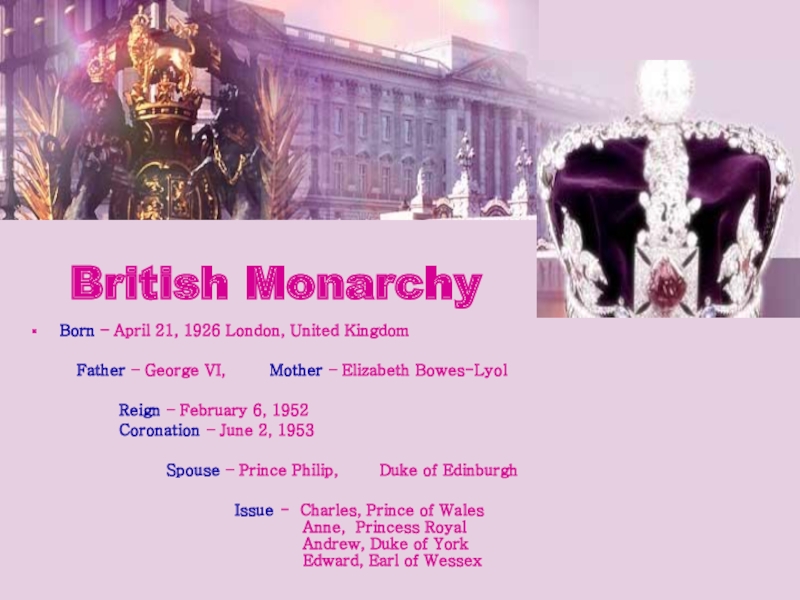
Слайд 5British Monarchy
Born – April 21, 1926 London, United Kingdom

Father – George VI, Mother – Elizabeth Bowes-Lyol

Reign – February 6, 1952
Coronation – June 2, 1953

Spouse – Prince Philip, Duke of Edinburgh

Issue - Charles, Prince of Wales Anne, Princess Royal Andrew, Duke of York Edward, Earl of Wessex

British MonarchyBorn – April 21, 1926 London, United Kingdom     Father – George VI,

Слайд 6
The Queen became the fifth longest serving British monarch on 21

June 2002. Only five other kings and queens in British history have reigned for 50 years or more.
These are: Victoria (63 years) • George III (59 years) • Henry III (56 years) • Edward III (50 years) • James VI of Scotland (James I of England) (58 years)
The Queen has received around 3 million items of correspondence during her reign.
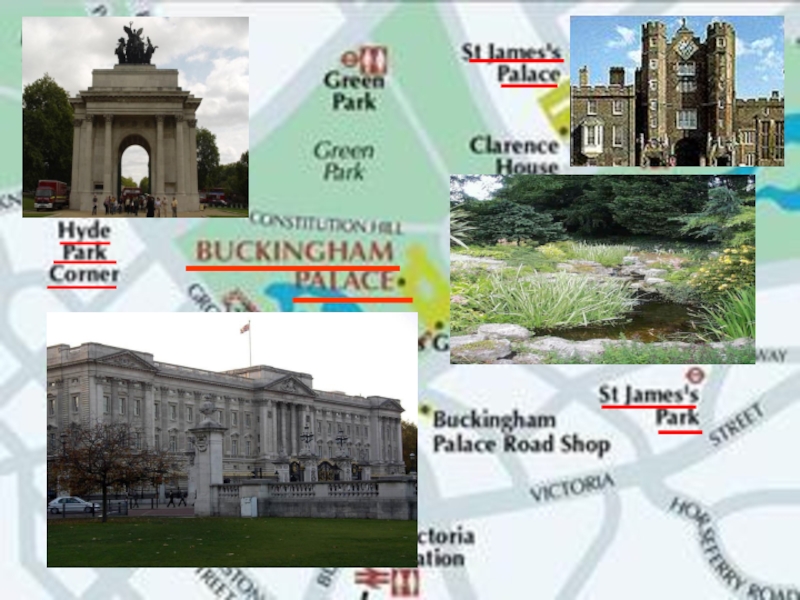
Over the course of the reign, well over a million people have attended garden parties at Buckingham Palace or the Palace of Holyroodhouse (The Queen ended Presentation Parties in 1958).
Over the reign, Her Majesty has given regular Tuesday evening audiences to 10 Prime Ministers
Tony Blair is the first Prime Minister to have been
born during The Queen's reign. He was born in early May 1953 - a month before the Coronation.
In 50 years, The Queen has undertaken over 250 official overseas visits to 128 different countries.  
The Queen is currently patron of over 620 charities and organisations
The Queen became the fifth longest serving British monarch on 21 June 2002. Only five other kings

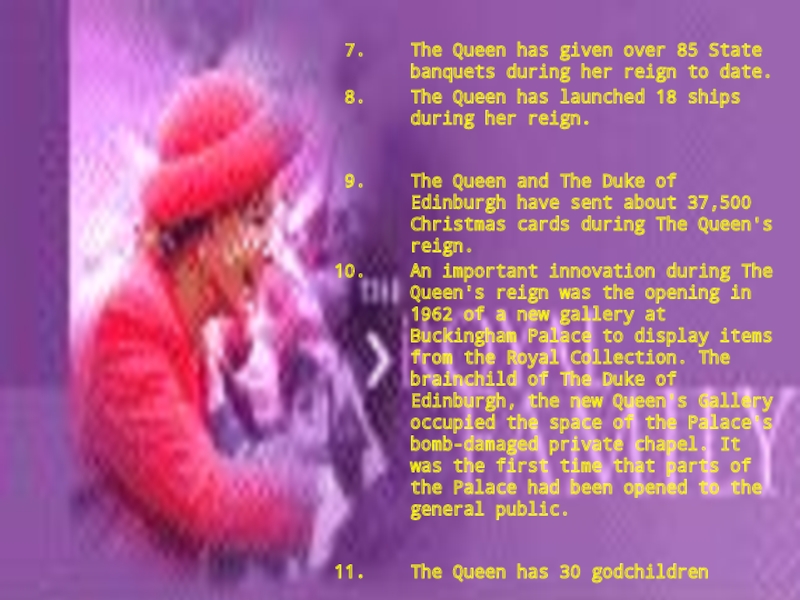
Слайд 7The Queen has given over 85 State banquets during her reign

to date.
The Queen has launched 18 ships during her reign.
The Queen and The Duke of Edinburgh have sent about 37,500 Christmas cards during The Queen's reign.
An important innovation during The Queen's reign was the opening in 1962 of a new gallery at Buckingham Palace to display items from the Royal Collection. The brainchild of The Duke of Edinburgh, the new Queen's Gallery occupied the space of the Palace's bomb-damaged private chapel. It was the first time that parts of the Palace had been opened to the general public.
The Queen has 30 godchildren
The Queen has given over 85 State banquets during her reign to date. The Queen has launched

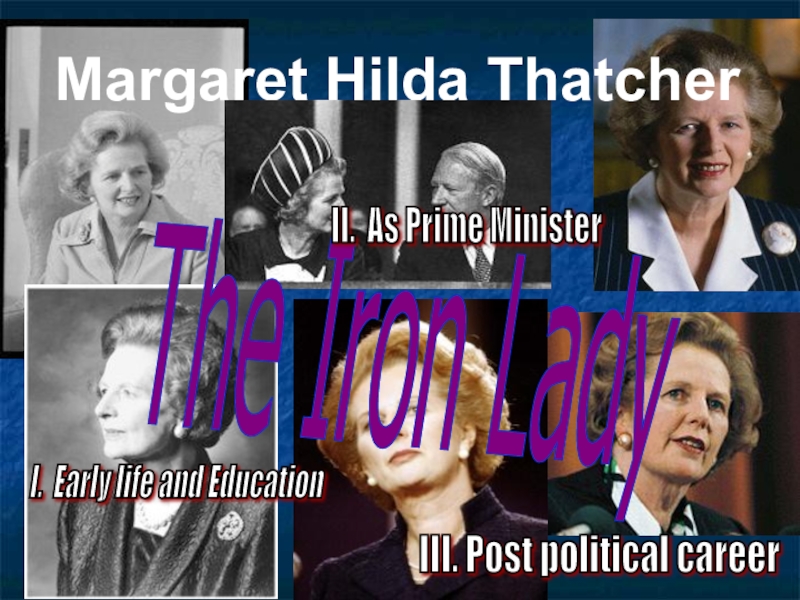
Слайд 8 Margaret Hilda Thatcher


The Iron Lady

I. Early life and Education

II. As Prime Minister

III. Post political career

Margaret Hilda Thatcher

Слайд 9I. Early Life and Education
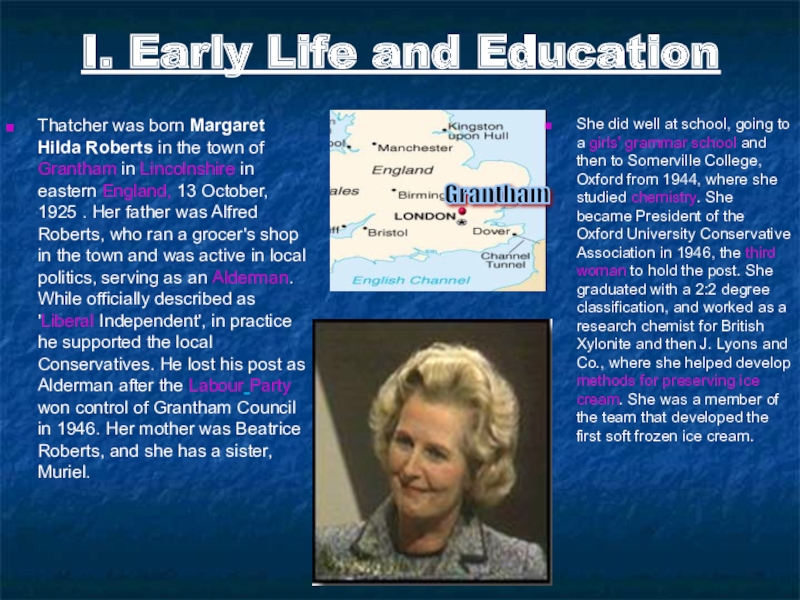
Thatcher was born Margaret Hilda Roberts in

the town of Grantham in Lincolnshire in eastern England, 13 October, 1925 . Her father was Alfred Roberts, who ran a grocer's shop in the town and was active in local politics, serving as an Alderman. While officially described as 'Liberal Independent', in practice he supported the local Conservatives. He lost his post as Alderman after the Labour Party won control of Grantham Council in 1946. Her mother was Beatrice Roberts, and she has a sister, Muriel.

She did well at school, going to a girls' grammar school and then to Somerville College, Oxford from 1944, where she studied chemistry. She became President of the Oxford University Conservative Association in 1946, the third woman to hold the post. She graduated with a 2:2 degree classification, and worked as a research chemist for British Xylonite and then J. Lyons and Co., where she helped develop methods for preserving ice cream. She was a member of the team that developed the first soft frozen ice cream.

Grantham

I. Early Life and EducationThatcher was born Margaret Hilda Roberts in the town of Grantham in Lincolnshire

Слайд 10
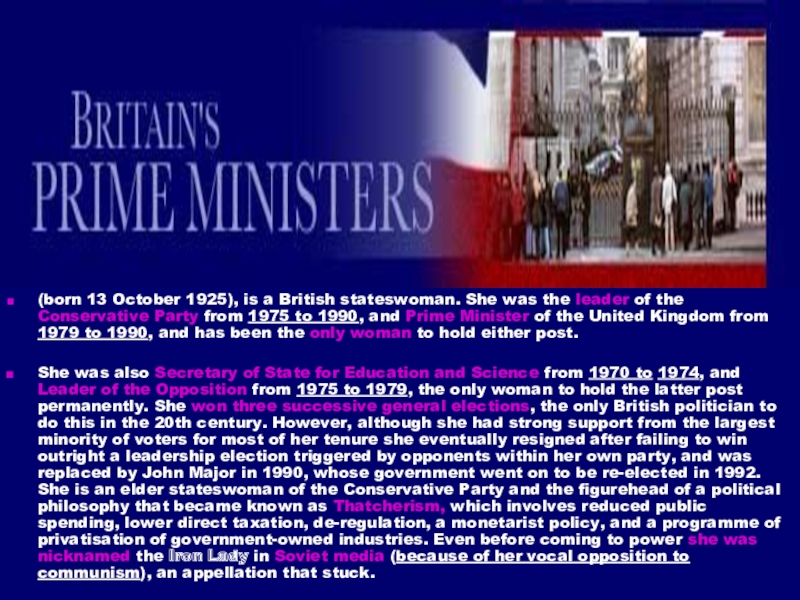
(born 13 October 1925), is a British stateswoman. She was the

leader of the Conservative Party from 1975 to 1990, and Prime Minister of the United Kingdom from 1979 to 1990, and has been the only woman to hold either post.

She was also Secretary of State for Education and Science from 1970 to 1974, and Leader of the Opposition from 1975 to 1979, the only woman to hold the latter post permanently. She won three successive general elections, the only British politician to do this in the 20th century. However, although she had strong support from the largest minority of voters for most of her tenure she eventually resigned after failing to win outright a leadership election triggered by opponents within her own party, and was replaced by John Major in 1990, whose government went on to be re-elected in 1992. She is an elder stateswoman of the Conservative Party and the figurehead of a political philosophy that became known as Thatcherism, which involves reduced public spending, lower direct taxation, de-regulation, a monetarist policy, and a programme of privatisation of government-owned industries. Even before coming to power she was nicknamed the Iron Lady in Soviet media (because of her vocal opposition to communism), an appellation that stuck.
(born 13 October 1925), is a British stateswoman. She was the leader of the Conservative Party from

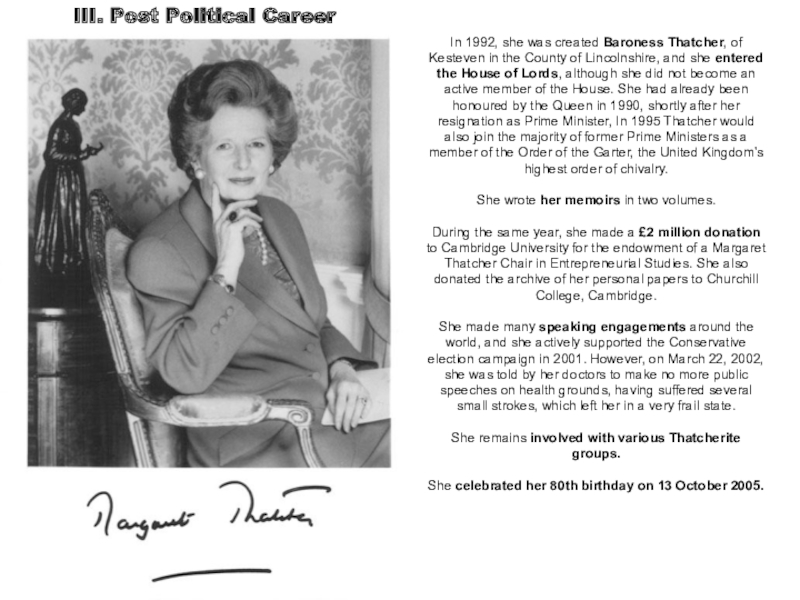
Слайд 11In 1992, she was created Baroness Thatcher, of Kesteven in the

County of Lincolnshire, and she entered the House of Lords, although she did not become an active member of the House. She had already been honoured by the Queen in 1990, shortly after her resignation as Prime Minister, In 1995 Thatcher would also join the majority of former Prime Ministers as a member of the Order of the Garter, the United Kingdom's highest order of chivalry. She wrote her memoirs in two volumes. During the same year, she made a £2 million donation to Cambridge University for the endowment of a Margaret Thatcher Chair in Entrepreneurial Studies. She also donated the archive of her personal papers to Churchill College, Cambridge. She made many speaking engagements around the world, and she actively supported the Conservative election campaign in 2001. However, on March 22, 2002, she was told by her doctors to make no more public speeches on health grounds, having suffered several small strokes, which left her in a very frail state. She remains involved with various Thatcherite groups. She celebrated her 80th birthday on 13 October 2005.

III. Post Political Career

In 1992, she was created Baroness Thatcher, of Kesteven in the County of Lincolnshire, and she entered

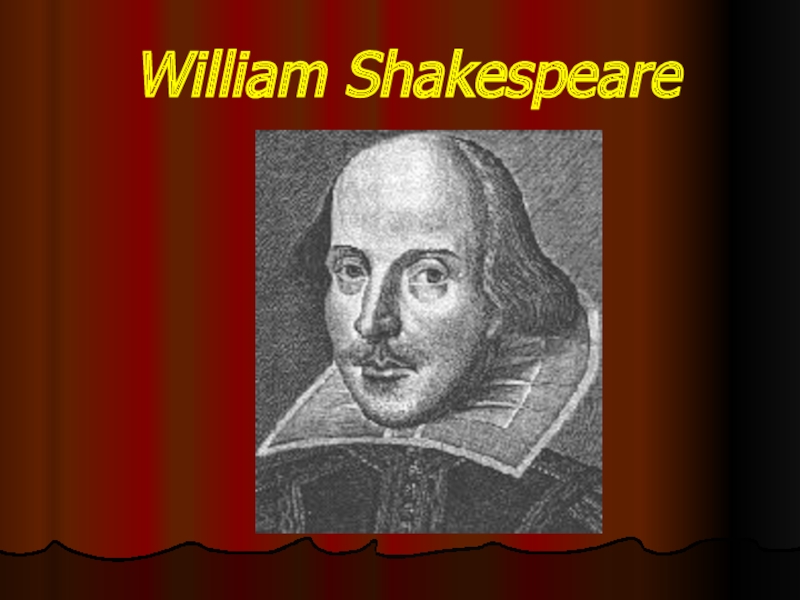
Слайд 12William Shakespeare

William Shakespeare

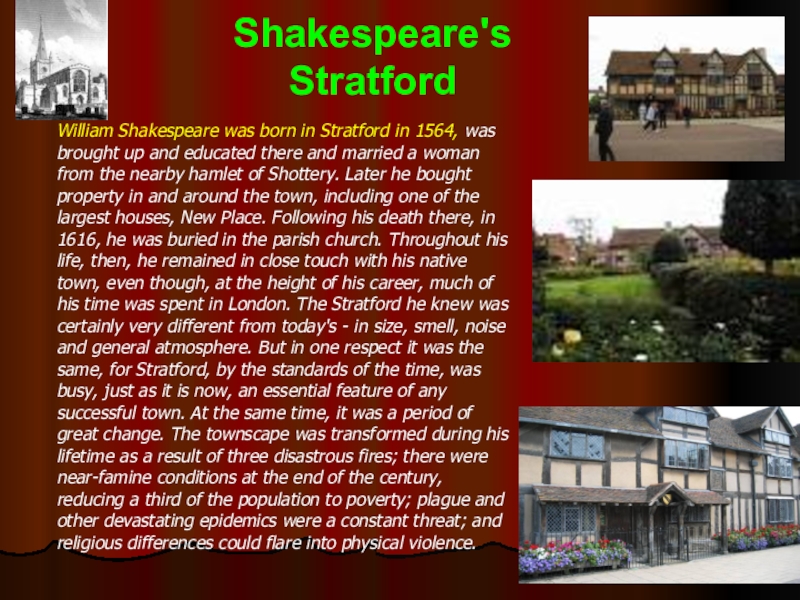
Слайд 13Shakespeare's Stratford
William Shakespeare was born in Stratford in 1564, was brought

up and educated there and married a woman from the nearby hamlet of Shottery. Later he bought property in and around the town, including one of the largest houses, New Place. Following his death there, in 1616, he was buried in the parish church. Throughout his life, then, he remained in close touch with his native town, even though, at the height of his career, much of his time was spent in London. The Stratford he knew was certainly very different from today's - in size, smell, noise and general atmosphere. But in one respect it was the same, for Stratford, by the standards of the time, was busy, just as it is now, an essential feature of any successful town. At the same time, it was a period of great change. The townscape was transformed during his lifetime as a result of three disastrous fires; there were near-famine conditions at the end of the century, reducing a third of the population to poverty; plague and other devastating epidemics were a constant threat; and religious differences could flare into physical violence.
Shakespeare's Stratford William Shakespeare was born in Stratford in 1564, was brought up and educated there and

Слайд 14To speak Shakespeare’s language
Many students having difficulty

understanding Shakespeare would be surprised to learn that he wrote in modern English. But, as can be seen in the earlier example of the Lord's Prayer, Elizabethan English has much more in common with our language today than it does with the language of Chaucer. Many familiar words and phrases were coined or first recorded by Shakespeare, some 2,000 words and countless catch-phrases are his. Newcomers to Shakespeare are often shocked at the number of cliches contained in his plays, until they realize that he coined them and they became cliches afterwards. "One fell swoop," "vanish into thin air," and "flesh and blood" are all Shakespeare's. Words he bequeathed to the language include "critical," "leapfrog," "majestic," "dwindle," and "pedant."

Shakespeare gave the English language many phrases and sayings, which English speakers still use every day.
Probably you know some of these
"To be or not to be..
"All the world's a stage."
"Love is blind."
"All's well that ends well."
His insight into human nature, and his gift for using words, make him possibly the most famous playwright of all time!
To speak Shakespeare’s language    Many students having difficulty understanding Shakespeare would be surprised to

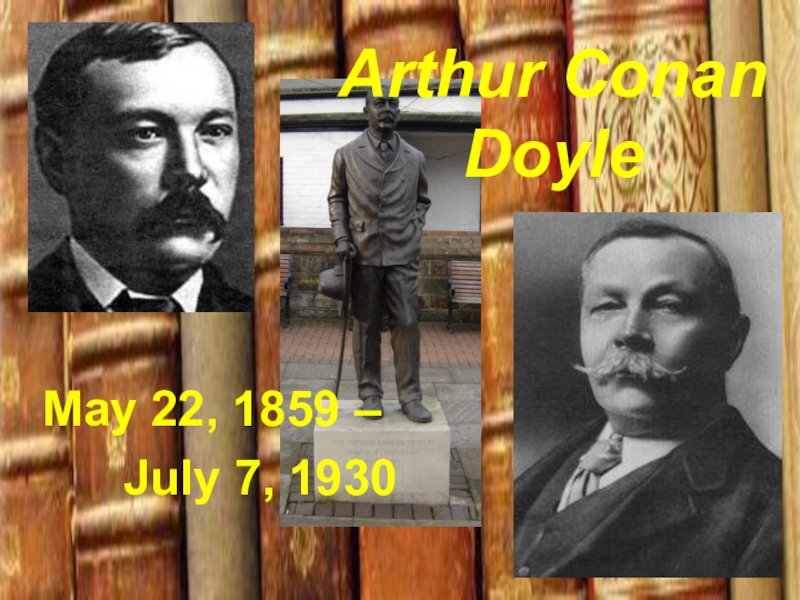
Слайд 15Arthur Conan Doyle
May 22, 1859 –
July 7, 1930

Arthur Conan Doyle May 22, 1859 –   July 7, 1930

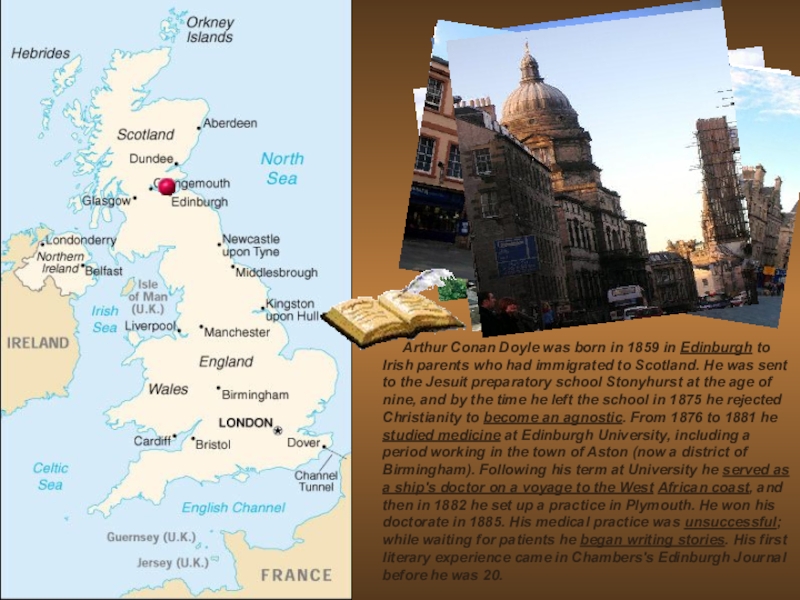
Слайд 16 Arthur Conan Doyle was born in 1859 in

Edinburgh to Irish parents who had immigrated to Scotland. He was sent to the Jesuit preparatory school Stonyhurst at the age of nine, and by the time he left the school in 1875 he rejected Christianity to become an agnostic. From 1876 to 1881 he studied medicine at Edinburgh University, including a period working in the town of Aston (now a district of Birmingham). Following his term at University he served as a ship's doctor on a voyage to the West African coast, and then in 1882 he set up a practice in Plymouth. He won his doctorate in 1885. His medical practice was unsuccessful; while waiting for patients he began writing stories. His first literary experience came in Chambers's Edinburgh Journal before he was 20.
Arthur Conan Doyle was born in 1859 in Edinburgh to Irish parents who had

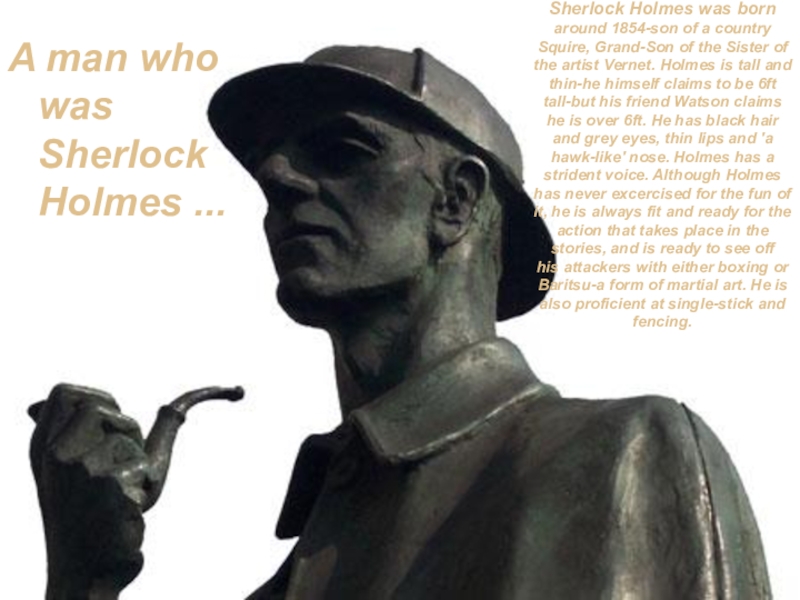
Слайд 17Sherlock Holmes was born around 1854-son of a country Squire, Grand-Son

of the Sister of the artist Vernet. Holmes is tall and thin-he himself claims to be 6ft tall-but his friend Watson claims he is over 6ft. He has black hair and grey eyes, thin lips and 'a hawk-like' nose. Holmes has a strident voice. Although Holmes has never excercised for the fun of it, he is always fit and ready for the action that takes place in the stories, and is ready to see off his attackers with either boxing or Baritsu-a form of martial art. He is also proficient at single-stick and fencing.

A man who was Sherlock Holmes ...

Sherlock Holmes was born around 1854-son of a country Squire, Grand-Son of the Sister of the artist

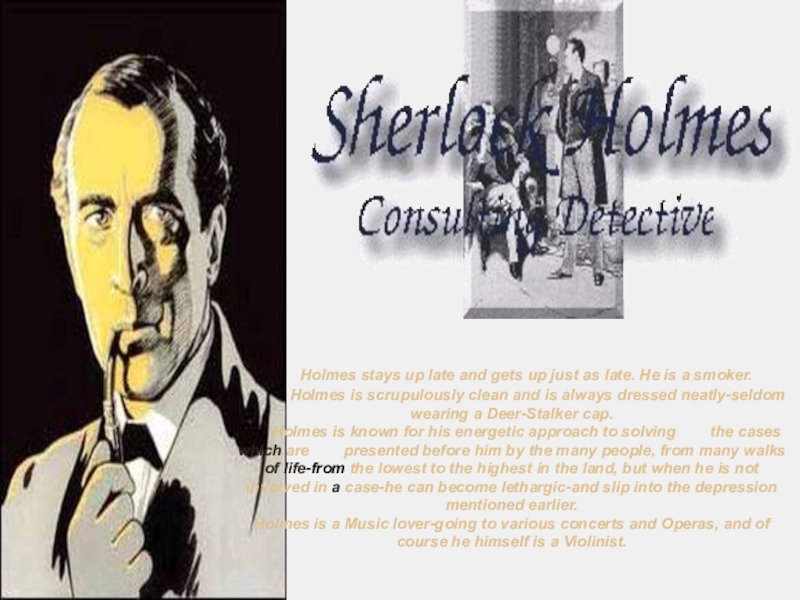
Слайд 18
Holmes stays up late

and gets up just as late. He is a smoker. Holmes is scrupulously clean and is always dressed neatly-seldom wearing a Deer-Stalker cap. Holmes is known for his energetic approach to solving the cases which are presented before him by the many people, from many walks of life-from the lowest to the highest in the land, but when he is not involved in a case-he can become lethargic-and slip into the depression mentioned earlier. Holmes is a Music lover-going to various concerts and Operas, and of course he himself is a Violinist.
Holmes stays up late and gets up just as late.

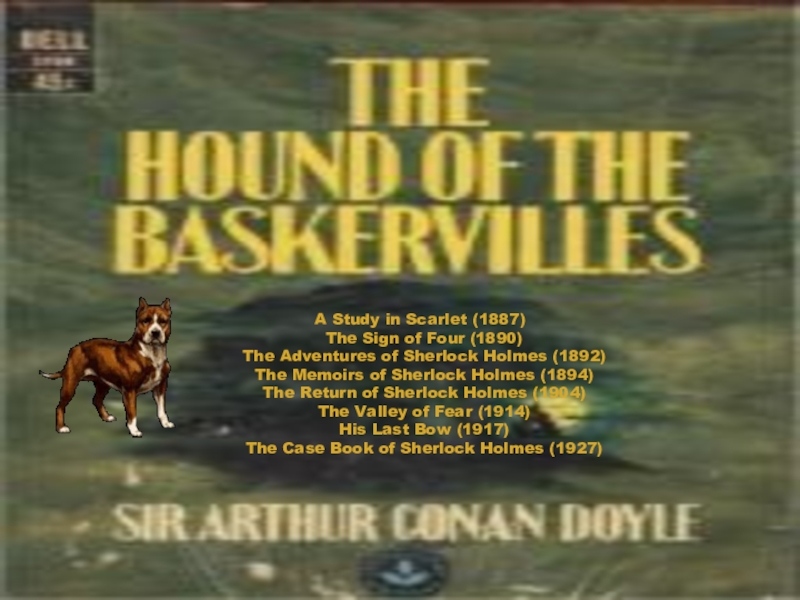
Слайд 19 A Study in Scarlet (1887) The Sign of

Four (1890) The Adventures of Sherlock Holmes (1892) The Memoirs of Sherlock Holmes (1894) The Return of Sherlock Holmes (1904) The Valley of Fear (1914) His Last Bow (1917) The Case Book of Sherlock Holmes (1927)
A Study in Scarlet (1887)  The Sign of Four (1890)  The Adventures

Слайд 20
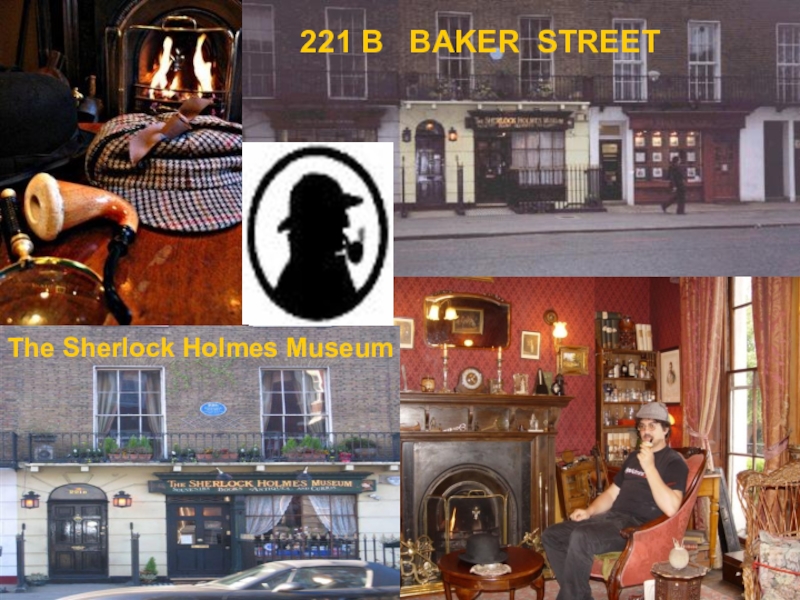
221 B BAKER STREET
The Sherlock Holmes Museum

221 B  BAKER STREET The Sherlock Holmes Museum

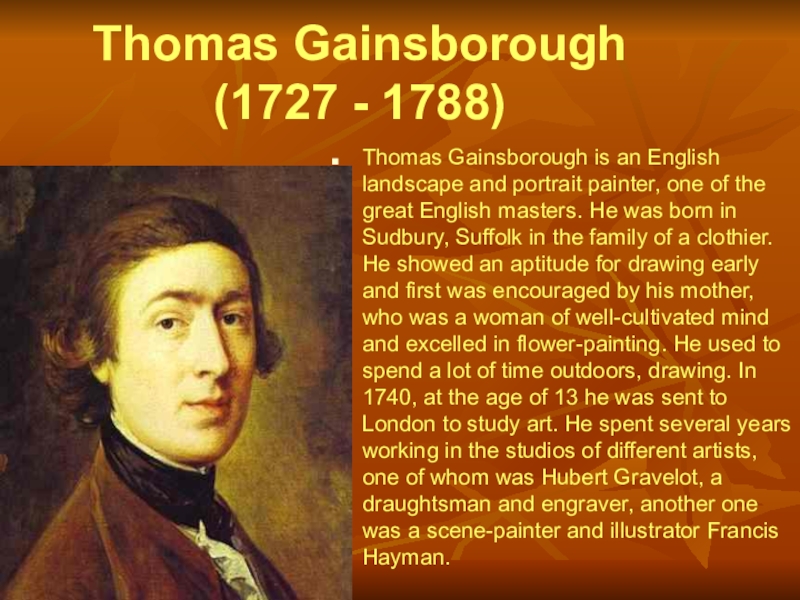
Слайд 21 Thomas Gainsborough (1727 - 1788)
Thomas Gainsborough is an English landscape and

portrait painter, one of the great English masters. He was born in Sudbury, Suffolk in the family of a clothier. He showed an aptitude for drawing early and first was encouraged by his mother, who was a woman of well-cultivated mind and excelled in flower-painting. He used to spend a lot of time outdoors, drawing. In 1740, at the age of 13 he was sent to London to study art. He spent several years working in the studios of different artists, one of whom was Hubert Gravelot, a draughtsman and engraver, another one was a scene-painter and illustrator Francis Hayman.       
Thomas Gainsborough (1727 - 1788)  Thomas Gainsborough is an English landscape and portrait painter, one

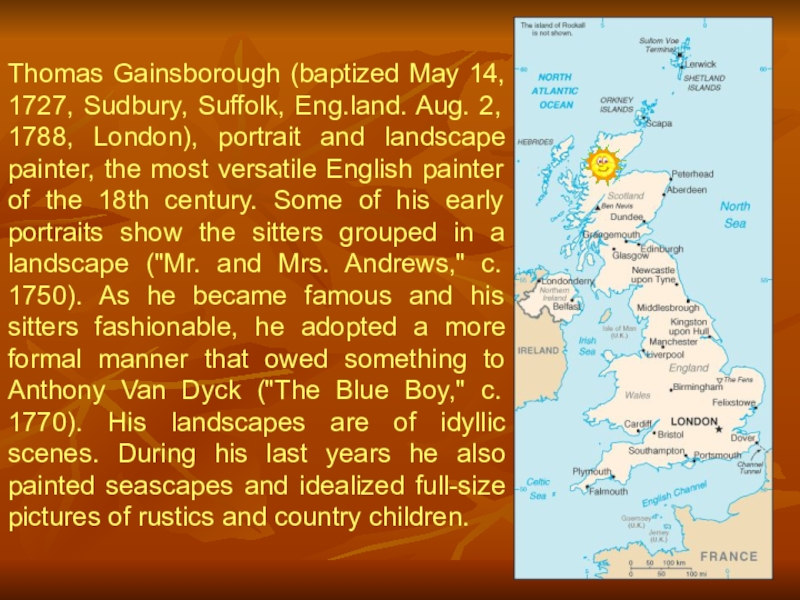
Слайд 22Thomas Gainsborough (baptized May 14, 1727, Sudbury, Suffolk, Eng.land. Aug. 2,

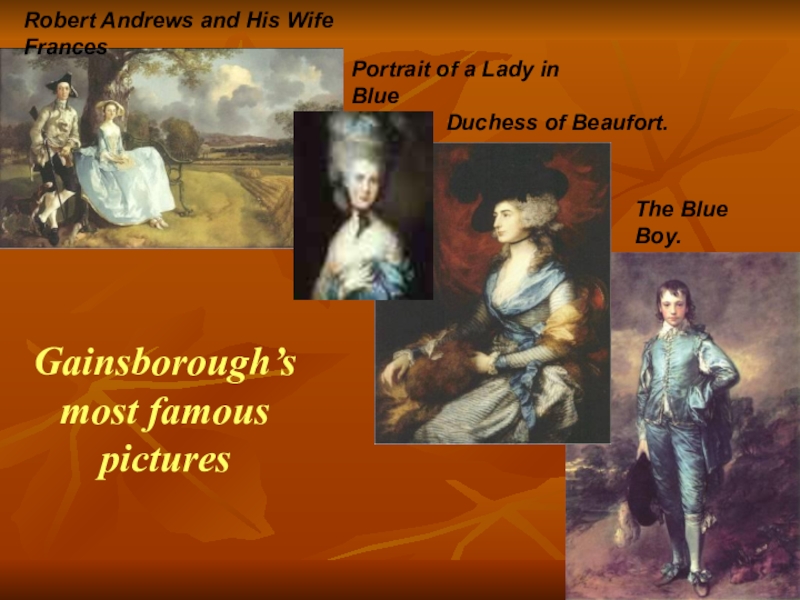
1788, London), portrait and landscape painter, the most versatile English painter of the 18th century. Some of his early portraits show the sitters grouped in a landscape ("Mr. and Mrs. Andrews," c. 1750). As he became famous and his sitters fashionable, he adopted a more formal manner that owed something to Anthony Van Dyck ("The Blue Boy," c. 1770). His landscapes are of idyllic scenes. During his last years he also painted seascapes and idealized full-size pictures of rustics and country children.
Thomas Gainsborough (baptized May 14, 1727, Sudbury, Suffolk, Eng.land. Aug. 2, 1788, London), portrait and landscape painter,

Слайд 23Gainsborough’s most famous pictures
Duchess of Beaufort.
The Blue Boy.
Robert Andrews

and His Wife Frances

Portrait of a Lady in Blue

Gainsborough’s most famous picturesDuchess of Beaufort. The Blue Boy. Robert Andrews and His Wife Frances Portrait of

Слайд 24Of all the 18th-century English painters, Thomas Gainsborough was the most

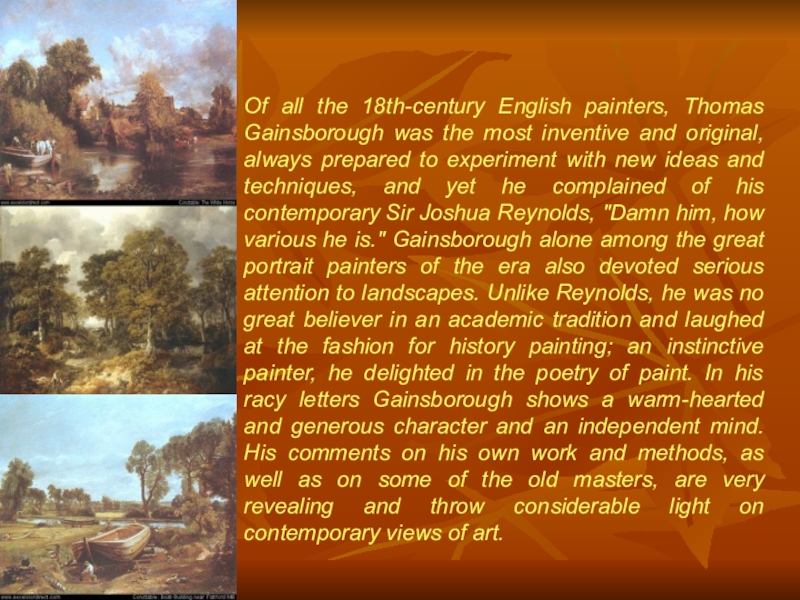
inventive and original, always prepared to experiment with new ideas and techniques, and yet he complained of his contemporary Sir Joshua Reynolds, "Damn him, how various he is." Gainsborough alone among the great portrait painters of the era also devoted serious attention to landscapes. Unlike Reynolds, he was no great believer in an academic tradition and laughed at the fashion for history painting; an instinctive painter, he delighted in the poetry of paint. In his racy letters Gainsborough shows a warm-hearted and generous character and an independent mind. His comments on his own work and methods, as well as on some of the old masters, are very revealing and throw considerable light on contemporary views of art.
Of all the 18th-century English painters, Thomas Gainsborough was the most inventive and original, always prepared to

Слайд 26

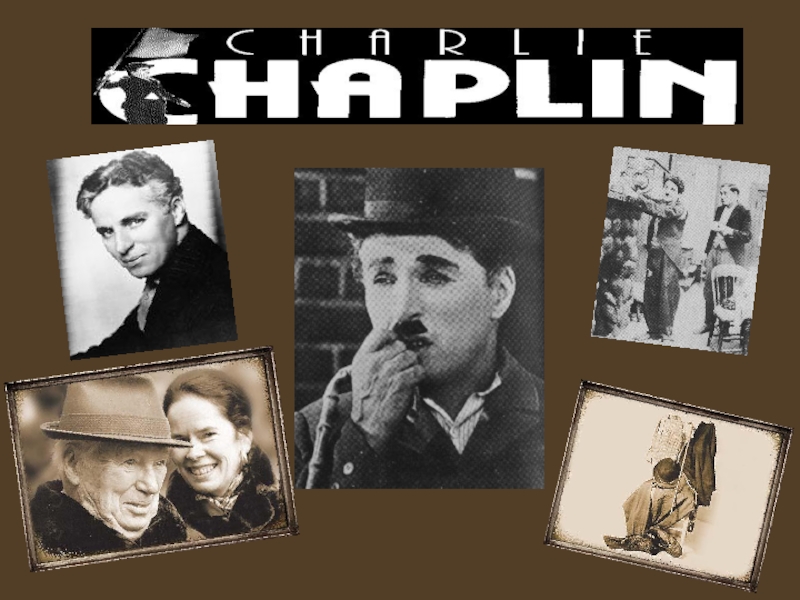
Chaplin was born in the family of music hall performers. About

a year after his birth, his parents separated. Chaplin’s childhood is as murky as his origins. Thomas Burke, the actor’s friend, writes: “…No man, even a man deliberately trying to hide himself, has hidden his early life as effectually as Charles.” Of all the stories Chaplin told about his childhood, none is more dramatic than his claim that he made his first appearance on the stage at the tender age of five after his mother suddenly lost her voice.


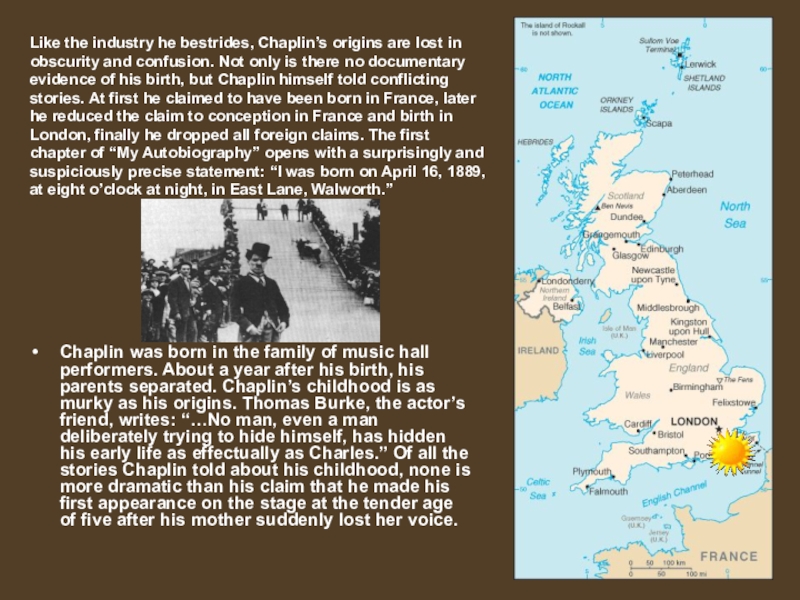
Like the industry he bestrides, Chaplin’s origins are lost in obscurity and confusion. Not only is there no documentary evidence of his birth, but Chaplin himself told conflicting stories. At first he claimed to have been born in France, later he reduced the claim to conception in France and birth in London, finally he dropped all foreign claims. The first chapter of “My Autobiography” opens with a surprisingly and suspiciously precise statement: “I was born on April 16, 1889, at eight o’clock at night, in East Lane, Walworth.”

Chaplin was born in the family of music hall performers. About a year after his birth, his

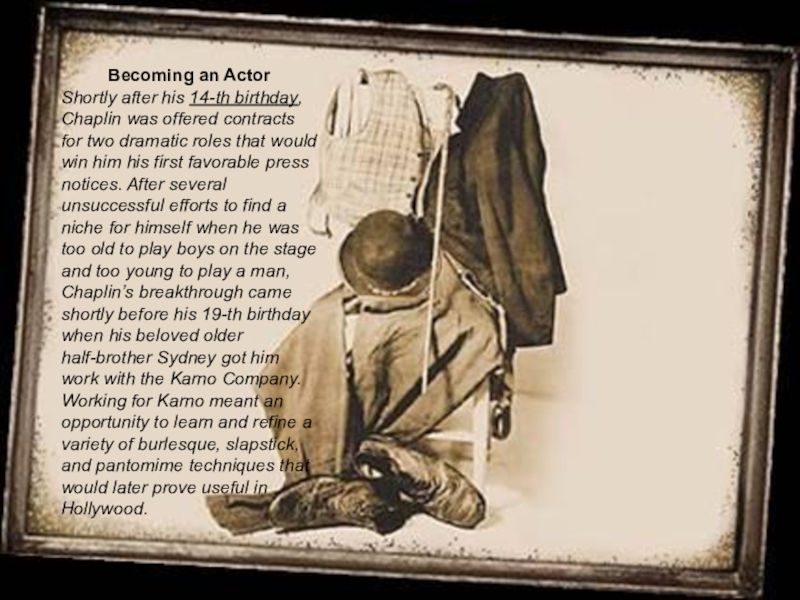
Слайд 27Becoming an Actor
Shortly after his 14-th birthday, Chaplin was offered contracts

for two dramatic roles that would win him his first favorable press notices. After several unsuccessful efforts to find a niche for himself when he was too old to play boys on the stage and too young to play a man, Chaplin’s breakthrough came shortly before his 19-th birthday when his beloved older half-brother Sydney got him work with the Karno Company. Working for Karno meant an opportunity to learn and refine a variety of burlesque, slapstick, and pantomime techniques that would later prove useful in Hollywood.
Becoming an ActorShortly after his 14-th birthday, Chaplin was offered contracts for two dramatic roles that would

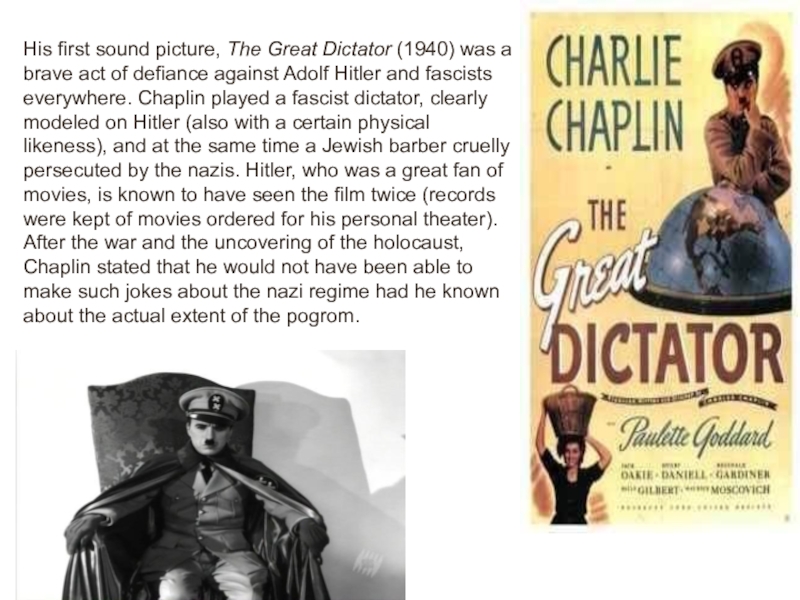
Слайд 28His first sound picture, The Great Dictator (1940) was a brave

act of defiance against Adolf Hitler and fascists everywhere. Chaplin played a fascist dictator, clearly modeled on Hitler (also with a certain physical likeness), and at the same time a Jewish barber cruelly persecuted by the nazis. Hitler, who was a great fan of movies, is known to have seen the film twice (records were kept of movies ordered for his personal theater). After the war and the uncovering of the holocaust, Chaplin stated that he would not have been able to make such jokes about the nazi regime had he known about the actual extent of the pogrom.
His first sound picture, The Great Dictator (1940) was a brave act of defiance against Adolf Hitler

Слайд 29
Chaplin's professional successes were repeatedly overshadowed by reports from his private

life. In 1918, 28 years old, he married the 16 year old Mildred Harris, followed by a divorce two years later. They had one child together, which died as an infant. In 1924 he fell in love with the 16 year old Lita Grey during the preparations for his movie Gold Rush. They married when she became pregnant, and had two sons together. They divorced in 1927. The publication of the court records with many intimate details led to a campaign against Chaplin. In 1936, Chaplin secretly married the actor Paulette Goddard. After a number of happy years, this marriage too ended in divorce in 1942. Shortly thereafter, he met Oona O'Neill, daughter of the dramatist Eugene O'Neill, and married her in 1943. This marriage was a long and happy one, with eight children.
On March 4, 1975, after many years of self-imposed exile from his native country, he was knighted by Queen Elizabeth II.

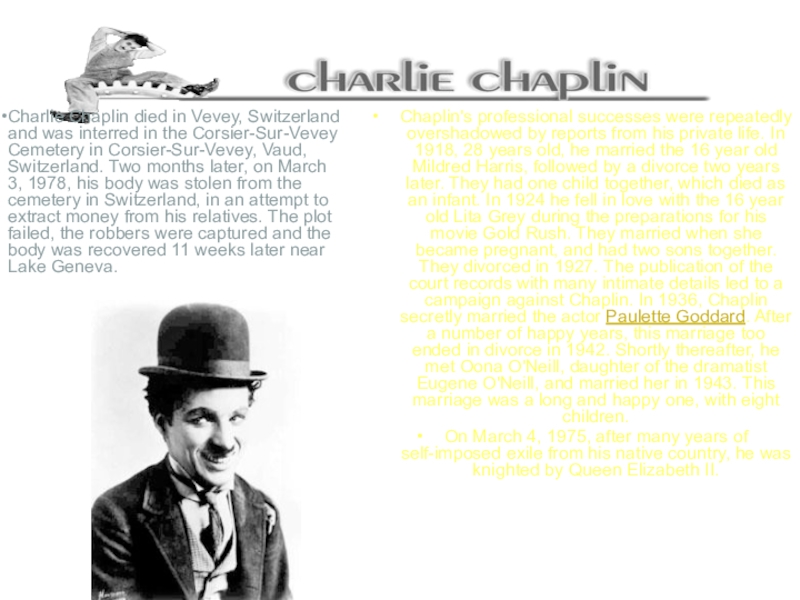
Charlie Chaplin died in Vevey, Switzerland and was interred in the Corsier-Sur-Vevey Cemetery in Corsier-Sur-Vevey, Vaud, Switzerland. Two months later, on March 3, 1978, his body was stolen from the cemetery in Switzerland, in an attempt to extract money from his relatives. The plot failed, the robbers were captured and the body was recovered 11 weeks later near Lake Geneva.

Chaplin's professional successes were repeatedly overshadowed by reports from his private life. In 1918, 28 years old,

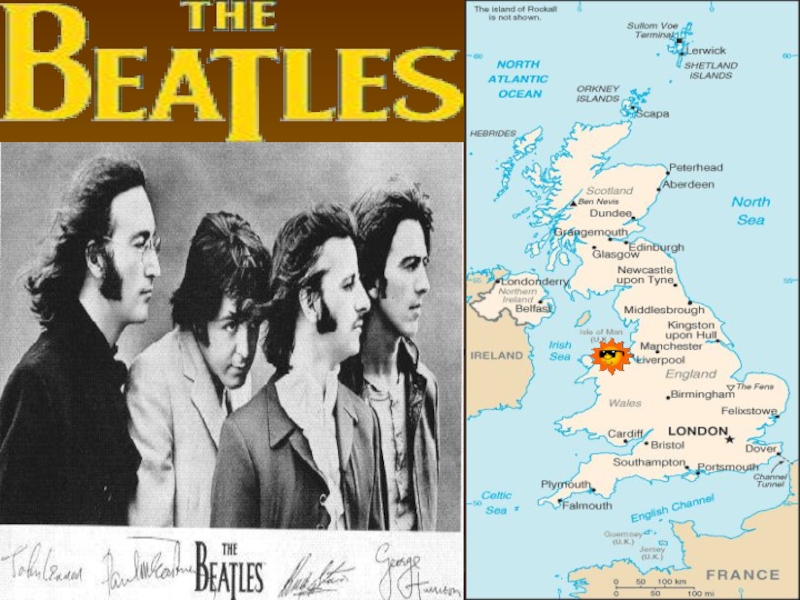
Слайд 32On Saturday, 6th July 1957, the historic first meeting of this

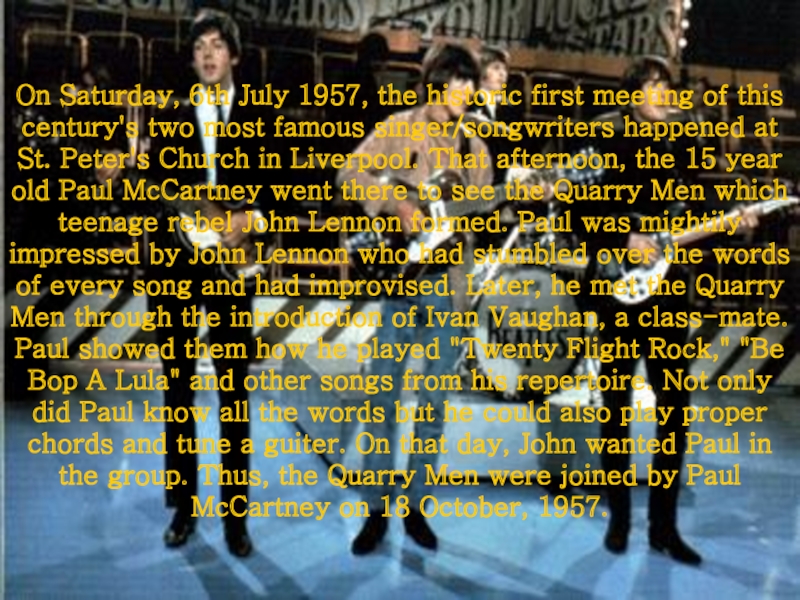
century's two most famous singer/songwriters happened at St. Peter's Church in Liverpool. That afternoon, the 15 year old Paul McCartney went there to see the Quarry Men which teenage rebel John Lennon formed. Paul was mightily impressed by John Lennon who had stumbled over the words of every song and had improvised. Later, he met the Quarry Men through the introduction of Ivan Vaughan, a class-mate. Paul showed them how he played "Twenty Flight Rock," "Be Bop A Lula" and other songs from his repertoire. Not only did Paul know all the words but he could also play proper chords and tune a guiter. On that day, John wanted Paul in the group. Thus, the Quarry Men were joined by Paul McCartney on 18 October, 1957.


On Saturday, 6th July 1957, the historic first meeting of this century's two most famous singer/songwriters happened

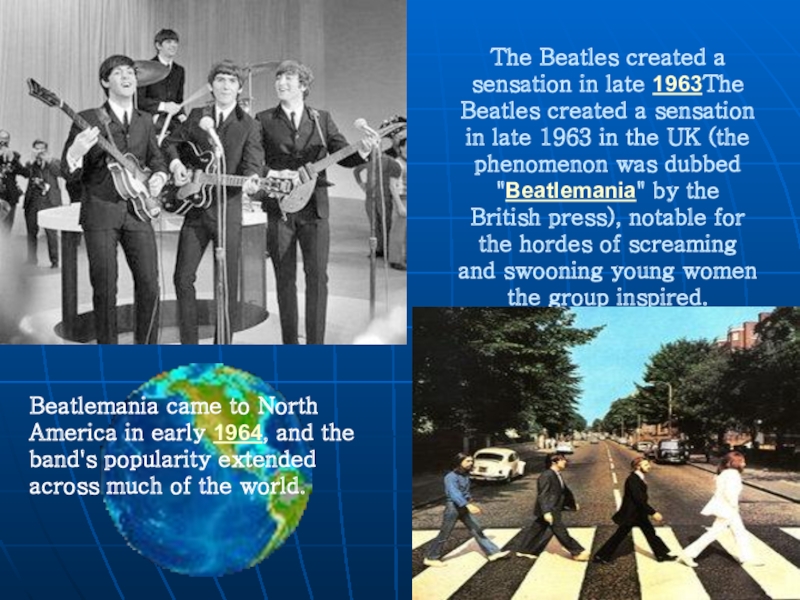
Слайд 33The Beatles created a sensation in late 1963The Beatles created a

sensation in late 1963 in the UK (the phenomenon was dubbed "Beatlemania" by the British press), notable for the hordes of screaming and swooning young women the group inspired.

Beatlemania came to North America in early 1964, and the band's popularity extended across much of the world.

The Beatles created a sensation in late 1963The Beatles created a sensation in late 1963 in the

Слайд 34
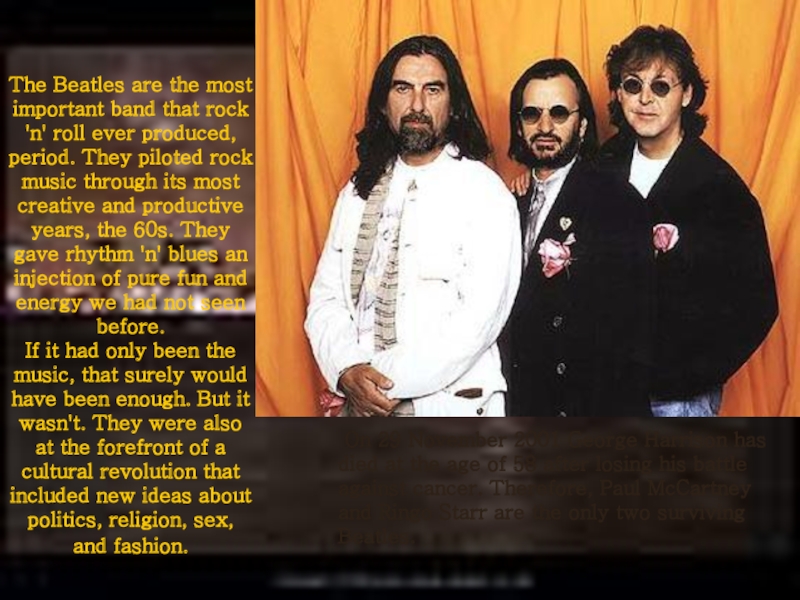
On 29 November 2001 George Harrison has died at the

age of 58 after losing his battle against cancer. Therefore, Paul McCartney and Ringo Starr are the only two surviving Beatles.


The Beatles are the most important band that rock 'n' roll ever produced, period. They piloted rock music through its most creative and productive years, the 60s. They gave rhythm 'n' blues an injection of pure fun and energy we had not seen before.
If it had only been the music, that surely would have been enough. But it wasn't. They were also at the forefront of a cultural revolution that included new ideas about politics, religion, sex, and fashion.

On 29 November 2001 George Harrison has died at the age of 58 after losing his

Слайд 35Yesterday
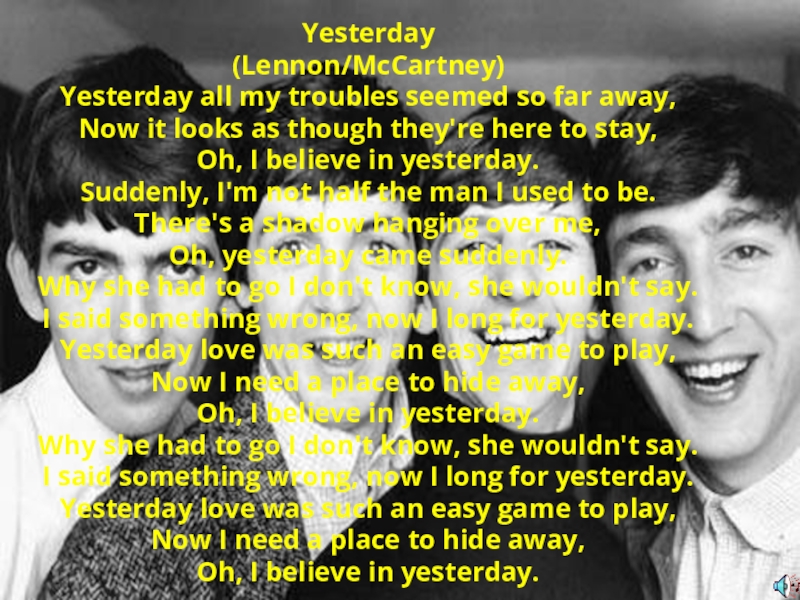
(Lennon/McCartney) Yesterday all my troubles seemed so far away,
Now it looks as

though they're here to stay,
Oh, I believe in yesterday.
Suddenly, I'm not half the man I used to be.
There's a shadow hanging over me,
Oh, yesterday came suddenly.
Why she had to go I don't know, she wouldn't say.
I said something wrong, now I long for yesterday.
Yesterday love was such an easy game to play,
Now I need a place to hide away,
Oh, I believe in yesterday.
Why she had to go I don't know, she wouldn't say.
I said something wrong, now I long for yesterday.
Yesterday love was such an easy game to play,
Now I need a place to hide away,
Oh, I believe in yesterday.
Yesterday(Lennon/McCartney) Yesterday all my troubles seemed so far away,Now it looks as though they're here to stay,Oh,

Слайд 36
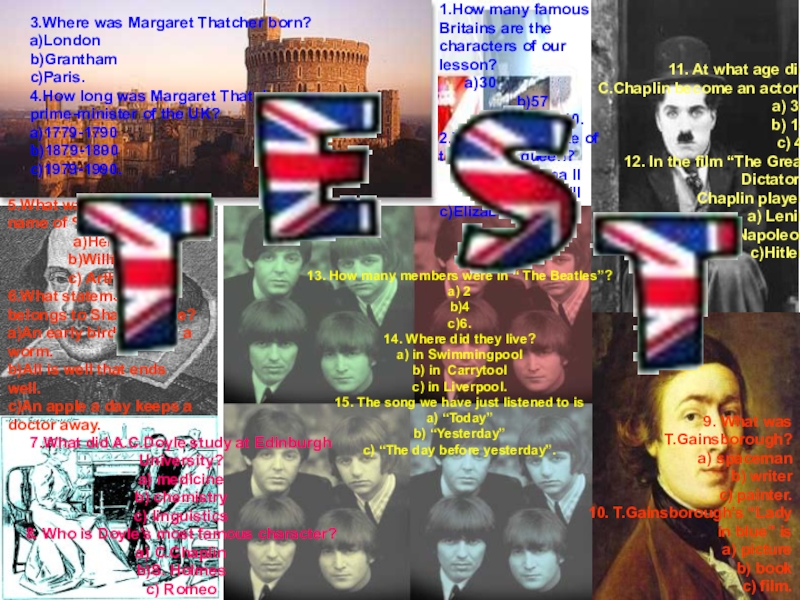
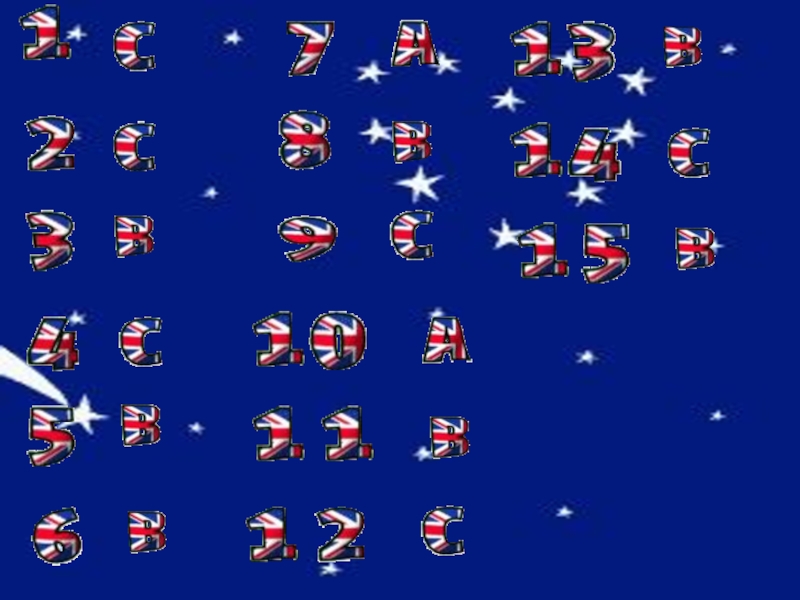
1.How many famous Britains are the characters of our lesson?

a)30
b)57
c)10.
2.What is the name of the British queen?
a)Evelina II
b)Catherine III
c)Elizabeth II.


3.Where was Margaret Thatcher born?
a)London
b)Grantham
c)Paris.
4.How long was Margaret Thatcher a prime-minister of the UK?
a)1779-1790
b)1879-1890
c)1979-1990.


5.What was the first name of Shakespeare?
a)Henry
b)William
c) Arthur.
6.What statement belongs to Shakespeare?
a)An early bird catches a worm.
b)All is well that ends well.
c)An apple a day keeps a doctor away.


7.What did A.C.Doyle study at Edinburgh University?
a) medicine
b) chemistry
c) linguistics
8. Who is Doyle’s most famous character?
a) C.Chaplin
b)S. Holmes
c) Romeo

9. What was T.Gainsborough?
a) spaceman
b) writer
c) painter.
10. T.Gainsborough’s “Lady in blue” is
a) picture
b) book
c) film.

11. At what age did
C.Chaplin become an actor?
a) 34
b) 14
c) 4.
12. In the film “The Great Dictator”
Chaplin played
a) Lenin
b)Napoleon
c)Hitler.

13. How many members were in “ The Beatles”?
a) 2
b)4
c)6.
14. Where did they live?
a) in Swimmingpool
b) in Carrytool
c) in Liverpool.
15. The song we have just listened to is
a) “Today”
b) “Yesterday”
c) “The day before yesterday”.

1.How many famous Britains are the characters of our lesson?   a)30b)57

Слайд 38http://www.royal.gov.ru/
http://www.kontorakuka.ru/
http://kuzelenkov.narod.ru/
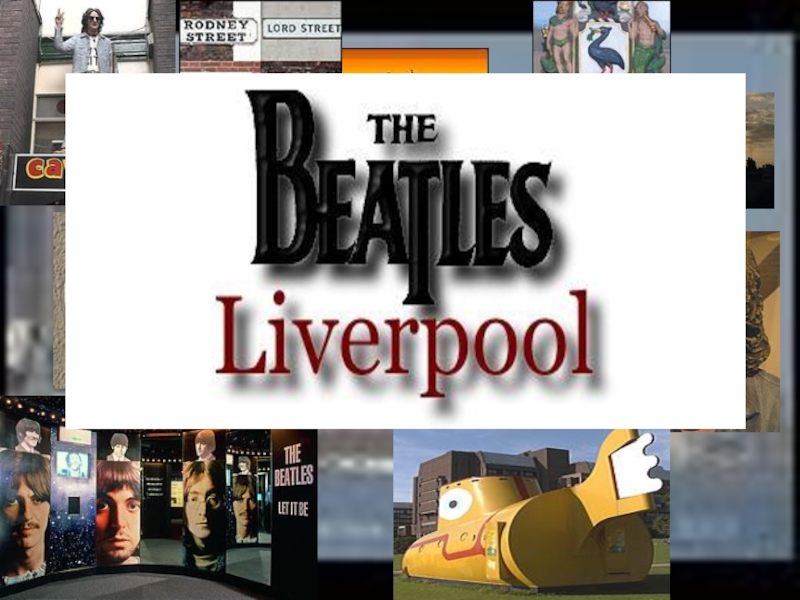
http://www.beatles.net/liverpool.html/
http://www.sherlockian.net/world/


Список ссылок

http://www.royal.gov.ru/http://www.kontorakuka.ru/http://kuzelenkov.narod.ru/http://www.beatles.net/liverpool.html/http://www.sherlockian.net/world/Список ссылок
Что такое shareslide.ru?

Это сайт презентаций, где можно хранить и обмениваться своими презентациями, докладами, проектами, шаблонами в формате PowerPoint с другими пользователями. Мы помогаем школьникам, студентам, учителям, преподавателям хранить и обмениваться учебными материалами.


Для правообладателей

Яндекс.Метрика

Обратная связь

Email: Нажмите что бы посмотреть