“People hate, as they love, unreasonably”
Made by Dokhuzeva F.A.
- Главная
- Разное
- Образование
- Спорт
- Естествознание
- Природоведение
- Религиоведение
- Французский язык
- Черчение
- Английский язык
- Астрономия
- Алгебра
- Биология
- География
- Геометрия
- Детские презентации
- Информатика
- История
- Литература
- Математика
- Музыка
- МХК
- Немецкий язык
- ОБЖ
- Обществознание
- Окружающий мир
- Педагогика
- Русский язык
- Технология
- Физика
- Философия
- Химия
- Шаблоны, фоны, картинки для презентаций
- Экология
- Экономика
Презентация, доклад William Thackerey для 11 класса
Содержание
- 1. Презентация William Thackerey для 11 класса
- 2. "Thackeray possesses great talent. Of all
- 3. Bust of William Thackeray at the age
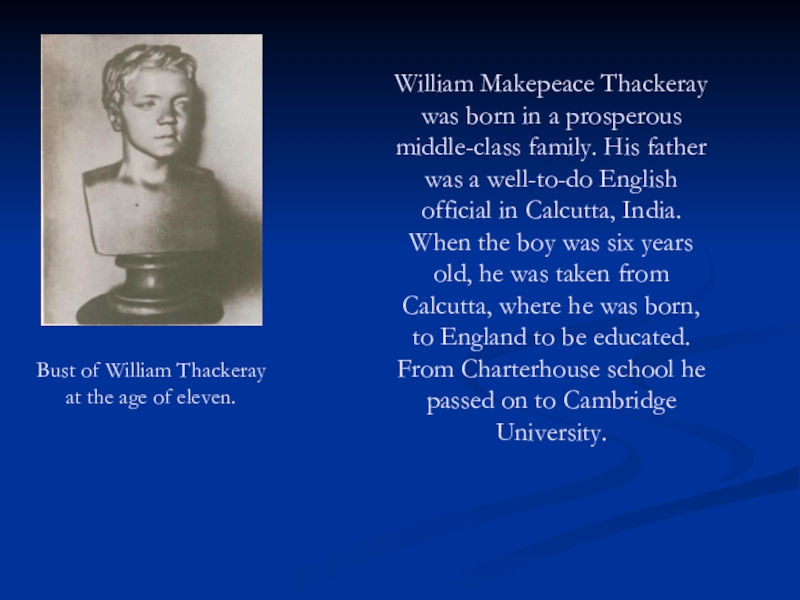
- 4. Richmond Thackeray, the writer’s fatherThe writer’s mother. Anne Becher Thackeray 1855.
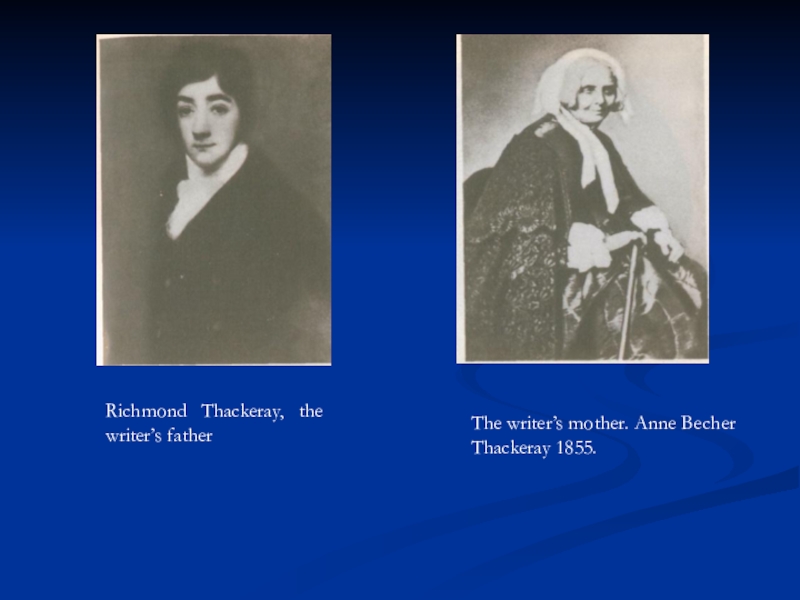
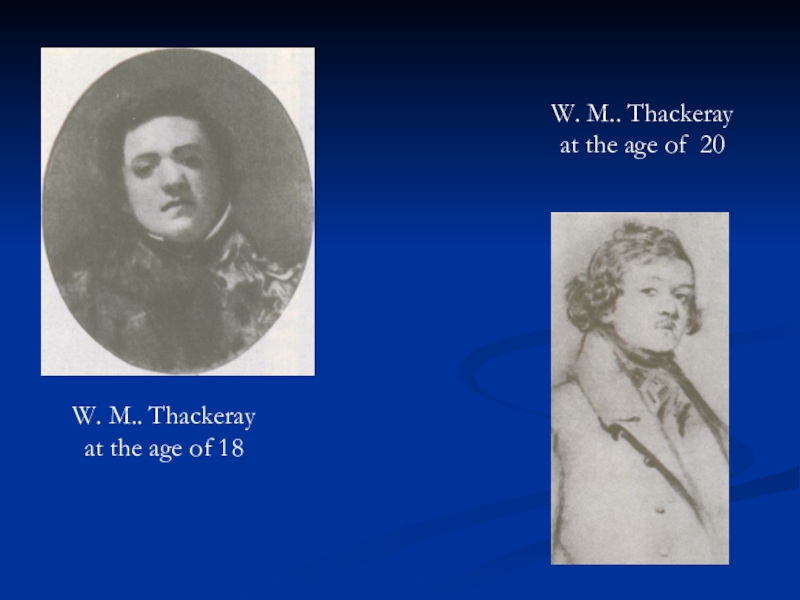
- 5. W. M.. Thackeray at the age of 18W. M.. Thackeray at the age of 20
- 6. W. M. Thackeray lived in this house 13, Great Coram StreetPalace Green. W.M. Thackeray’s Study
- 7. Caricature of Thackeray drawn by himselfWhile a
- 8. Isabella Shawe, Thackeray’s future wifeIsabella Shawe with her daughter in 1838
- 9. Anne Thackeray, the eldest daughterHarriet (Minni) Thackeray, the youngest daughter
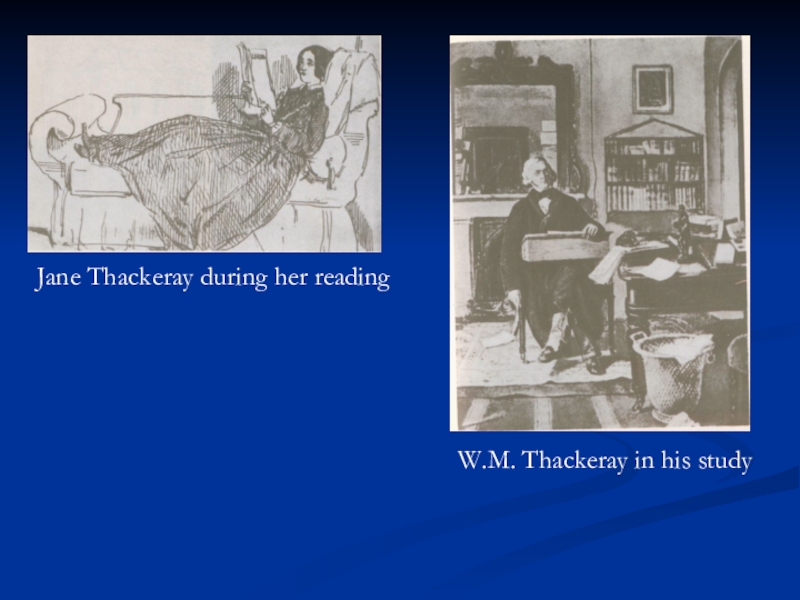
- 10. Jane Thackeray during her readingW.M. Thackeray in his study
- 11. 1837-38 The Yellowplush Correspondence in Fraser's. 1839-40
- 12. Thackeray's first notable work was The Book
- 13. A broad panorama of English life is
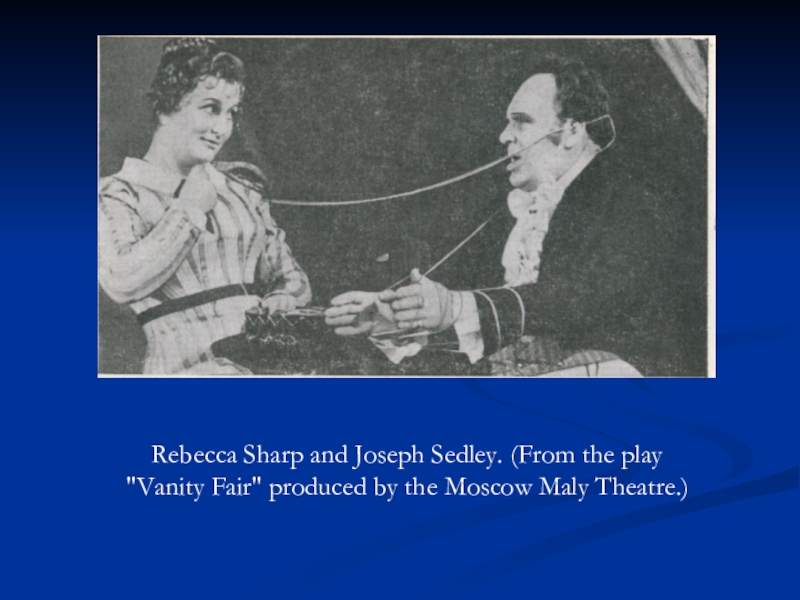
- 14. Rebecca Sharp and Joseph Sedley. (From the play "Vanity Fair" produced by the Moscow Maly Theatre.)
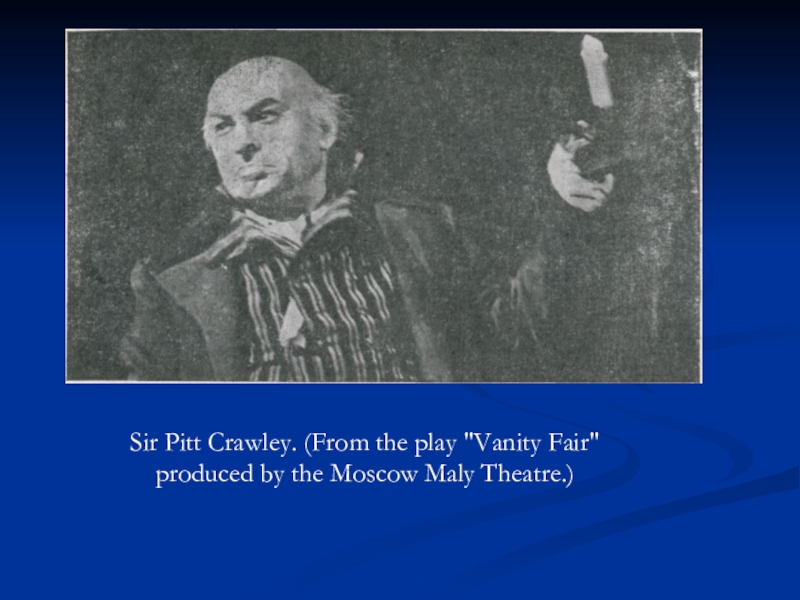
- 15. Sir Pitt Crawley. (From the play "Vanity Fair" produced by the Moscow Maly Theatre.)
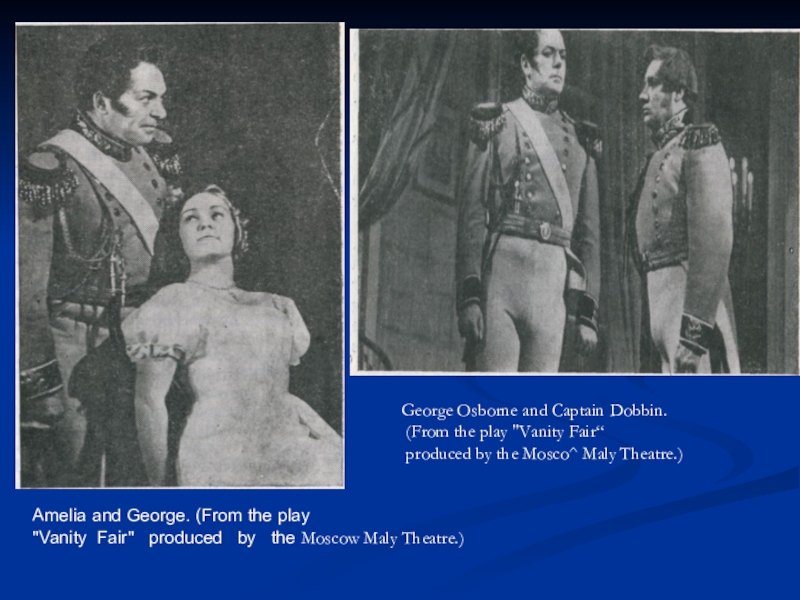
- 16. Amelia and George. (From the play"Vanity Fair"
- 17. Thackeray on Society at LargeThackeray divides society
- 18. We entered a new stage of development
- 19. We are shocked. When honest people, who
- 20. Stas Markelov was a well-known human rights
- 21. Nastya Baburova, the journalist of "Novaya Gazeta",
- 22. W.M. Thackeray, a leading representative of critical
"Thackeray possesses great talent. Of all the European writers of the present time Dickens alone can be placed on a level with the author of Vanity Fair. What a wealth of art, how precise and
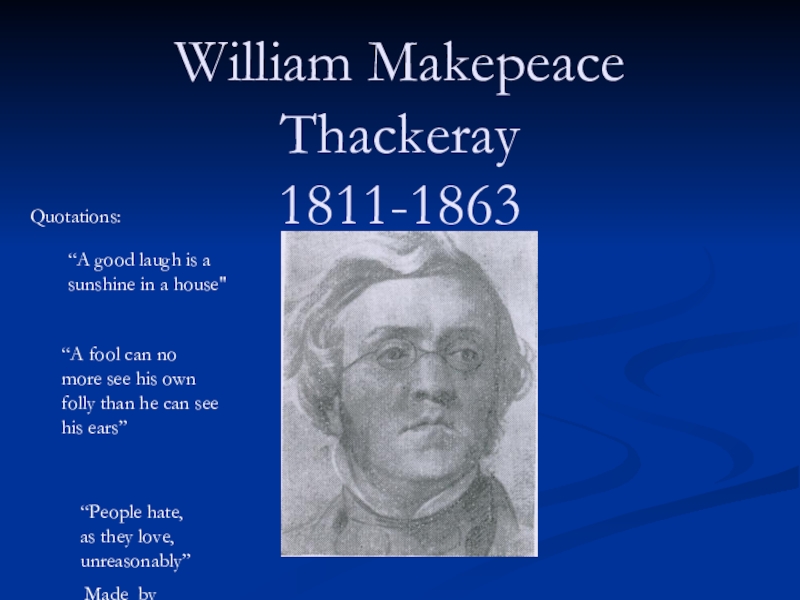
Слайд 1William Makepeace Thackeray
1811-1863
“A good laugh is a sunshine in a house"
Quotations:
“A
fool can no more see his own folly than he can see his ears”
Слайд 2 "Thackeray possesses great talent. Of all the European writers of
the present time Dickens alone can be placed on a level with the author of Vanity Fair. What a wealth of art, how precise and thorough are his observations, what a knowledge of life, of the human heart, what a bright and noble power of love, what a subtle humour, how precise and distinct are his depictions, how wonderfully charming his narration."
Chernyshevsky
Chernyshevsky
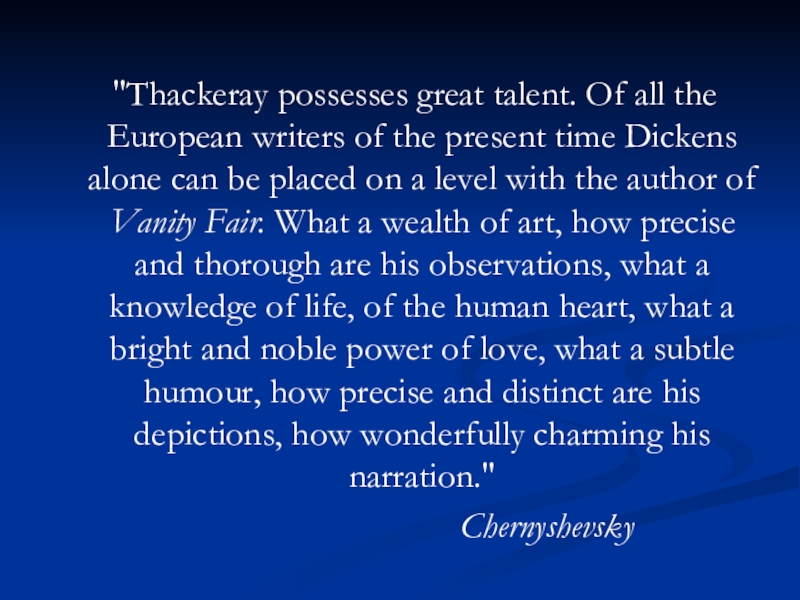
Слайд 3Bust of William Thackeray at the age of eleven.
William Makepeace Thackeray
was born in a prosperous middle-class family. His father was a well-to-do English official in Calcutta, India. When the boy was six years old, he was taken from Calcutta, where he was born, to England to be educated. From Charterhouse school he passed on to Cambridge University.
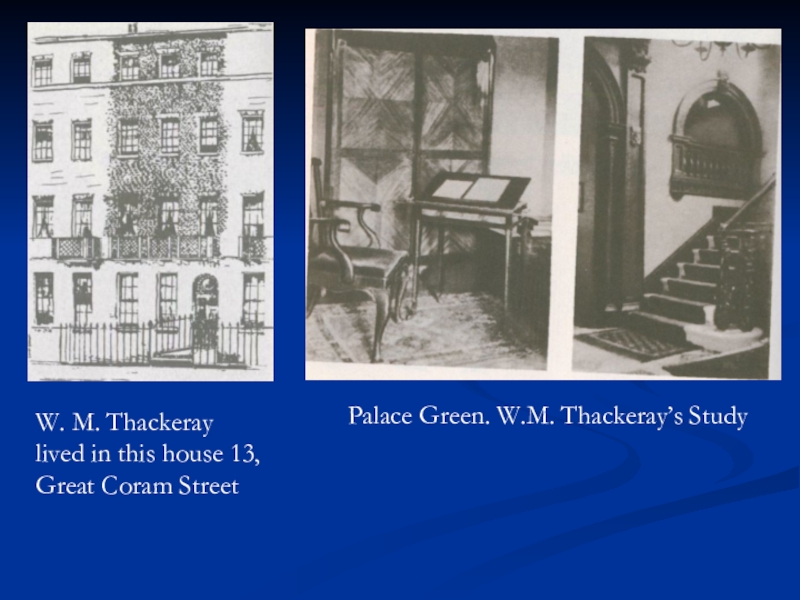
Слайд 6W. M. Thackeray lived in this house 13, Great Coram Street
Palace
Green. W.M. Thackeray’s Study
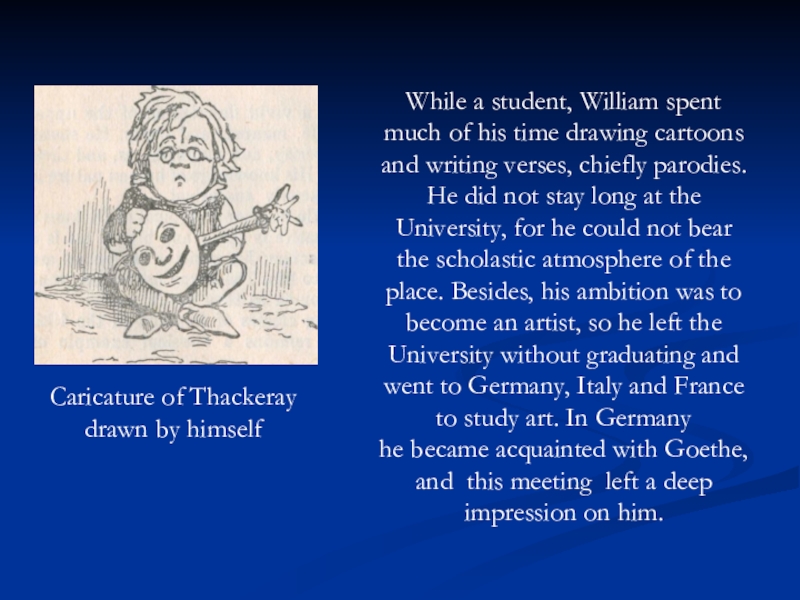
Слайд 7Caricature of Thackeray drawn by himself
While a student, William spent much
of his time drawing cartoons and writing verses, chiefly parodies. He did not stay long at the University, for he could not bear the scholastic atmosphere of the place. Besides, his ambition was to become an artist, so he left the University without graduating and went to Germany, Italy and France to study art. In Germany
he became acquainted with Goethe, and this meeting left a deep impression on him.
he became acquainted with Goethe, and this meeting left a deep impression on him.
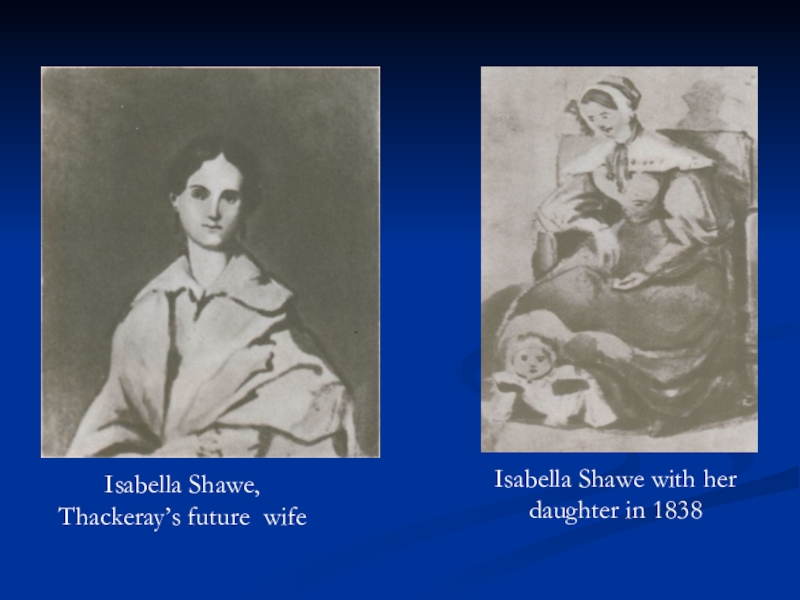
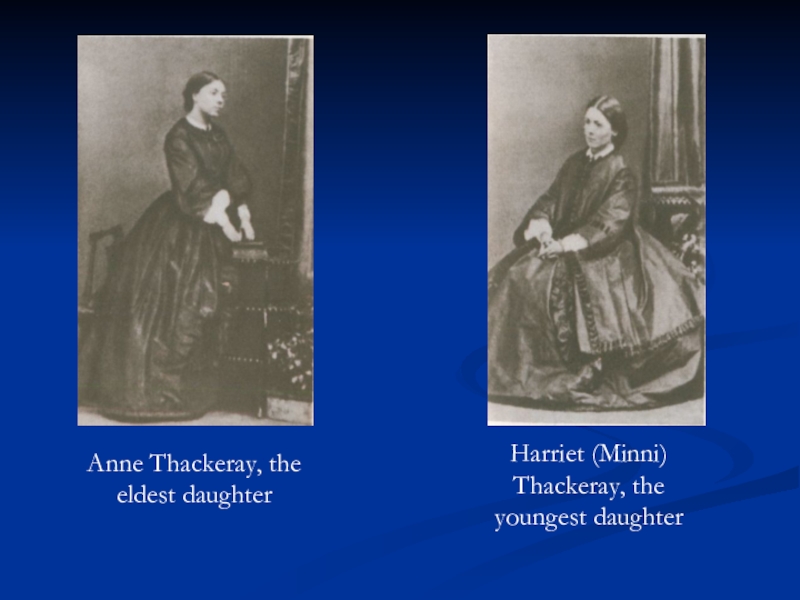
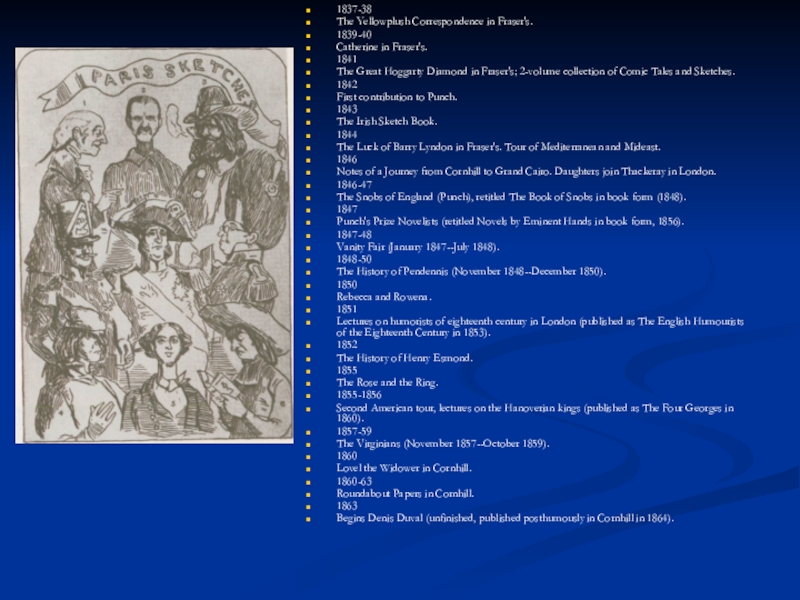
Слайд 111837-38
The Yellowplush Correspondence in Fraser's.
1839-40
Catherine in Fraser's.
1841
The Great Hoggarty Diamond in Fraser's; 2-volume collection of Comic Tales and Sketches.
1842
First contribution to Punch.
1843
The Irish Sketch Book.
1844
The Luck of Barry Lyndon in Fraser's. Tour of Mediterranean and Mideast.
1846
Notes of a Journey from Cornhill to Grand Cairo. Daughters join Thackeray in London.
1846-47
The Snobs of England (Punch), retitled The Book of Snobs in book form (1848).
1847
Punch's Prize Novelists (retitled Novels by Eminent Hands in book form, 1856).
1847-48
Vanity Fair (January 1847--July 1848).
1848-50
The History of Pendennis (November 1848--December 1850).
1850
Rebecca and Rowena.
1851
Lectures on humorists of eighteenth century in London (published as The English Humourists of the Eighteenth Century in 1853).
1852
The History of Henry Esmond.
1855
The Rose and the Ring.
1855-1856
Second American tour, lectures on the Hanoverian kings (published as The Four Georges in 1860).
1857-59
The Virginians (November 1857--October 1859).
1860
Lovel the Widower in Cornhill.
1860-63
Roundabout Papers in Cornhill.
1863
Begins Denis Duval (unfinished, published posthumously in Cornhill in 1864).
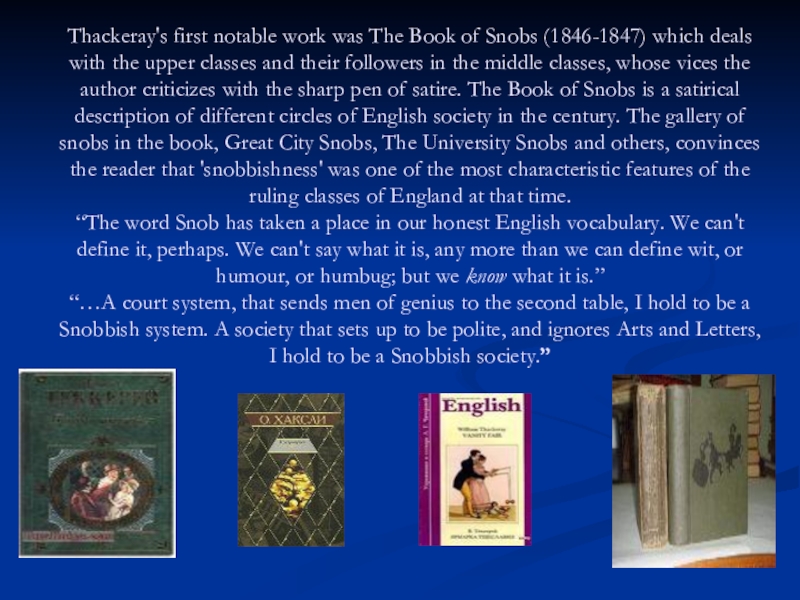
Слайд 12Thackeray's first notable work was The Book of Snobs (1846-1847) which
deals with the upper classes and their followers in the middle classes, whose vices the author criticizes with the sharp pen of satire. The Book of Snobs is a satirical description of different circles of English society in the century. The gallery of snobs in the book, Great City Snobs, The University Snobs and others, convinces the reader that 'snobbishness' was one of the most characteristic features of the ruling classes of England at that time.
“The word Snob has taken a place in our honest English vocabulary. We can't define it, perhaps. We can't say what it is, any more than we can define wit, or humour, or humbug; but we know what it is.”
“…A court system, that sends men of genius to the second table, I hold to be a Snobbish system. A society that sets up to be polite, and ignores Arts and Letters, I hold to be a Snobbish society.”
Слайд 13A broad panorama of English life is given by Thackeray in
three big novels:
'Vanity Fair. A Novel Without a Hero" (1848), "The History of Pendennis"
(1850), and :'The Newcomes. Memoirs of a Most Respectable Family" (1855).
'In "Vanity Fair" Thackeray's creative imagination is immense. He clearly
shows that the English society is nothing but a fair, buying and selling, which
dominates the lives of Thackeray's contemporaries. Thus, the author applies the
name of Vanity Fair to bourgeois-aristocratic England where everything can
be bought and sold.
'Vanity Fair. A Novel Without a Hero" (1848), "The History of Pendennis"
(1850), and :'The Newcomes. Memoirs of a Most Respectable Family" (1855).
'In "Vanity Fair" Thackeray's creative imagination is immense. He clearly
shows that the English society is nothing but a fair, buying and selling, which
dominates the lives of Thackeray's contemporaries. Thus, the author applies the
name of Vanity Fair to bourgeois-aristocratic England where everything can
be bought and sold.
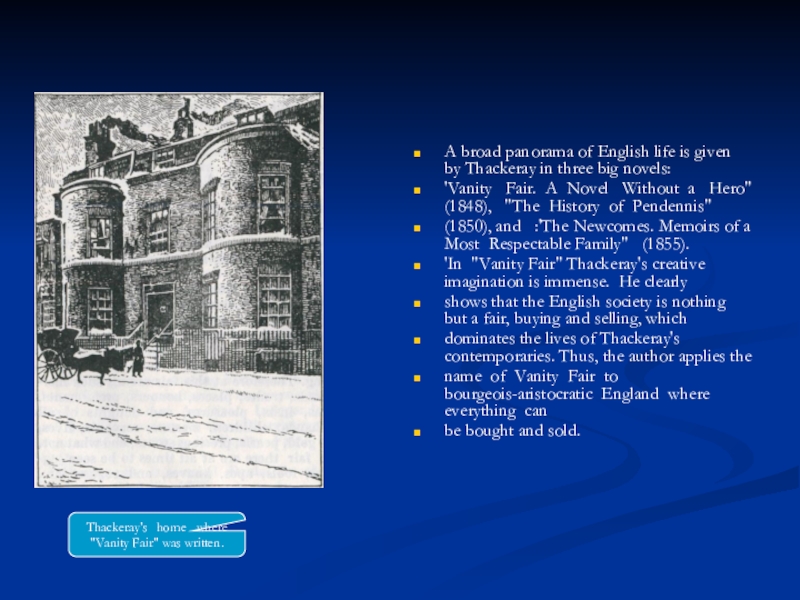
Thackeray's home where "Vanity Fair" was written.
Слайд 14Rebecca Sharp and Joseph Sedley. (From the play "Vanity Fair" produced
by the Moscow Maly Theatre.)
Слайд 16Amelia and George. (From the play
"Vanity Fair" produced by
the Moscow Maly Theatre.)
George Osborne and Captain Dobbin.
(From the play "Vanity Fair“
produced by the Mosco^ Maly Theatre.)
Слайд 17Thackeray on Society at Large
Thackeray divides society into 'rogues' and 'dupes'.
The characters are different, but their fates have much in common. They are victims of a society where evil rules the world. Shallow people . . . shallow lives . . . shallow interests .... The author compares his characters to puppets, and society as a whole to a puppet show.
"Ah! Vanitas Vanitatuml which of us is happy in this world? Which of us has his desire? or, having it, is satisfied?—come, children, let us shut up the box and the puppets, for our play is played out."
"Ah! Vanitas Vanitatuml which of us is happy in this world? Which of us has his desire? or, having it, is satisfied?—come, children, let us shut up the box and the puppets, for our play is played out."
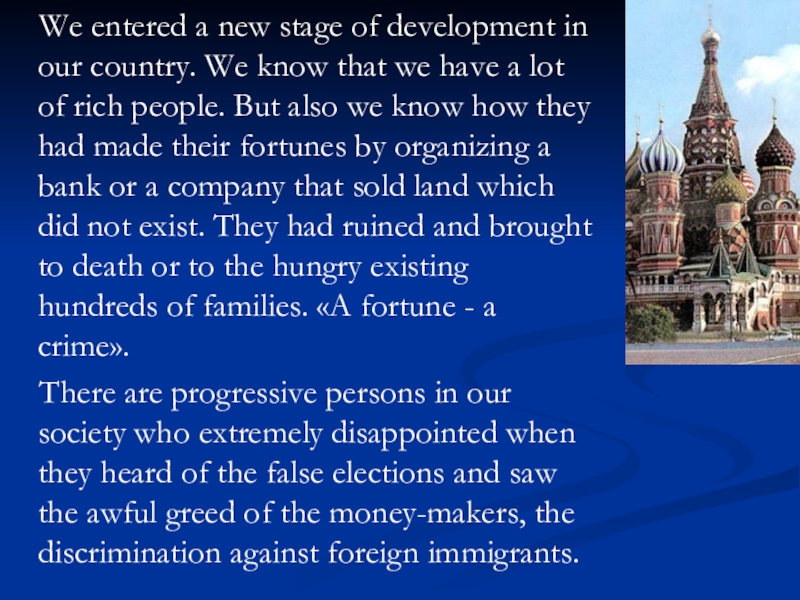
Слайд 18We entered a new stage of development in our country. We
know that we have a lot of rich people. But also we know how they had made their fortunes by organizing a bank or a company that sold land which did not exist. They had ruined and brought to death or to the hungry existing hundreds of families. «A fortune - a crime».
There are progressive persons in our society who extremely disappointed when they heard of the false elections and saw the awful greed of the money-makers, the discrimination against foreign immigrants.
There are progressive persons in our society who extremely disappointed when they heard of the false elections and saw the awful greed of the money-makers, the discrimination against foreign immigrants.
Слайд 19
We are shocked. When honest people, who are fighting for the
truth, are killed 100 meters away from the Kremlin in the very center of Moscow. Stas Markelov and Nastya Baburova were murdered on the 19 th of January -this is eternal disgrace.
They were remarkable for their fortitude. They never hesitated to take the wisest way and remain true to the principles of honour.
They were remarkable for their fortitude. They never hesitated to take the wisest way and remain true to the principles of honour.
Слайд 20
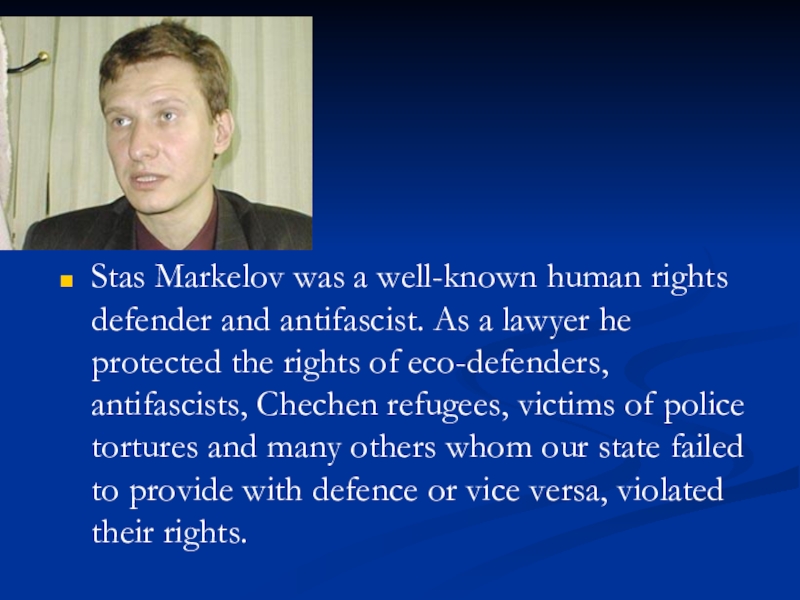
Stas Markelov was a well-known human rights defender and antifascist. As
a lawyer he protected the rights of eco-defenders, antifascists, Chechen refugees, victims of police tortures and many others whom our state failed to provide with defence or vice versa, violated their rights.
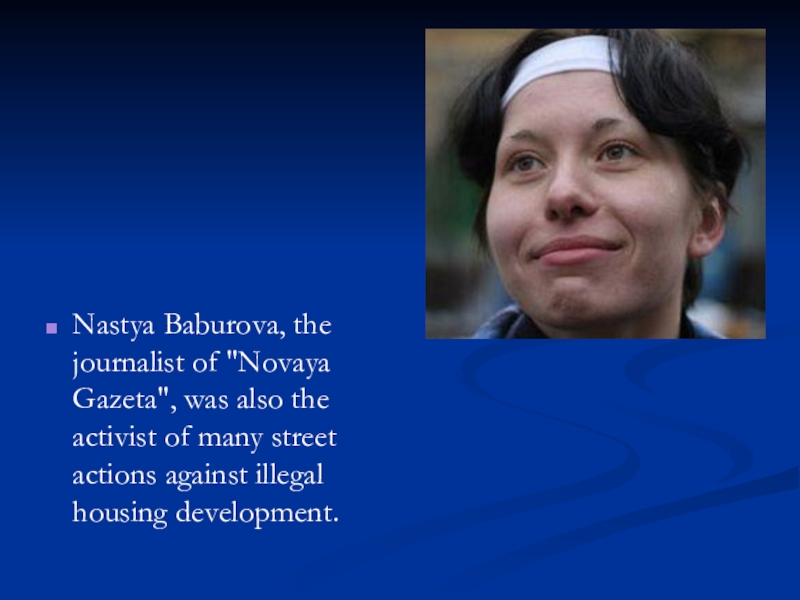
Слайд 21Nastya Baburova, the journalist of "Novaya Gazeta", was also the activist
of many street actions against illegal housing development.
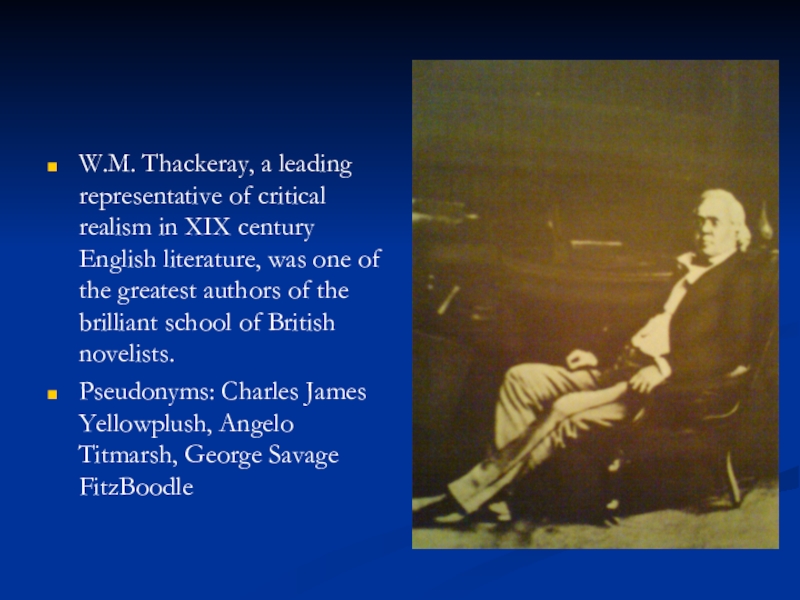
Слайд 22W.M. Thackeray, a leading representative of critical realism in XIX century
English literature, was one of the greatest authors of the brilliant school of British novelists.
Pseudonyms: Charles James Yellowplush, Angelo Titmarsh, George Savage FitzBoodle
Pseudonyms: Charles James Yellowplush, Angelo Titmarsh, George Savage FitzBoodle