- Главная
- Разное
- Образование
- Спорт
- Естествознание
- Природоведение
- Религиоведение
- Французский язык
- Черчение
- Английский язык
- Астрономия
- Алгебра
- Биология
- География
- Геометрия
- Детские презентации
- Информатика
- История
- Литература
- Математика
- Музыка
- МХК
- Немецкий язык
- ОБЖ
- Обществознание
- Окружающий мир
- Педагогика
- Русский язык
- Технология
- Физика
- Философия
- Химия
- Шаблоны, фоны, картинки для презентаций
- Экология
- Экономика
Презентация, доклад Welcome to Lake Baikal!
Содержание
- 1. Презентация Welcome to Lake Baikal!
- 2. Слайд 2
- 3. Слайд 3
- 4. Слайд 4
- 5. Gulls on Lake Baikal-The Yellowlegged Gull
- 6. Слайд 6
- 7. The Common Tern It's
- 8. Are all waterfowl birds the same?
- 9. The great crested grebe The
- 10. Green-winged Teal Green-winged Teal is
- 11. The MallardThe Mallard, which is the most
- 12. Common Sandpiper
- 13. Fish of Baikal Baikal omul a
- 14. The Baikal sturgeon The Baikal sturgeon –
- 15. Тhe black grayling.
- 16. Тhe white grayling. The White grayling
- 17. Endemics of Baikal The GobyThe Baikal sculpinThe Oil fish
- 18. It is the Epischura baicalensis which keeps Lake Baikal clean
- 19. Baikal seal (nerpa)The nerpa is a large
- 20. Baikal seals eat fish, particularly gobies,
- 21. Слайд 21
- 22. The Baikal seal, Lake Baikal seal, or nerpa, is a species of seal endemic to Lake Baikal in Siberia
- 23. Слайд 23
- 24. МБОУ Николаевская СОШКириленко Н. И.
- 25. Baikal’s Exploration Preservation of the lake, however,
- 26. Plants and mills Nowadays there are more
- 27. TouristsEvery year a lot of tourists from
- 28. МБОУ Николаевская СОШКириленко Н. И.
- 29. МБОУ Николаевская СОШКириленко Н. И.
- 30. МБОУ Николаевская СОШКириленко Н. И.карта
- 31. Thank You!
Gulls on Lake Baikal-The Yellowlegged Gull You know who this is, of course – it is the Yellowlegged Gull, one of the largest gulls on Lake Baikal. You can recognize it
Слайд 5Gulls on Lake Baikal-The Yellowlegged Gull
You
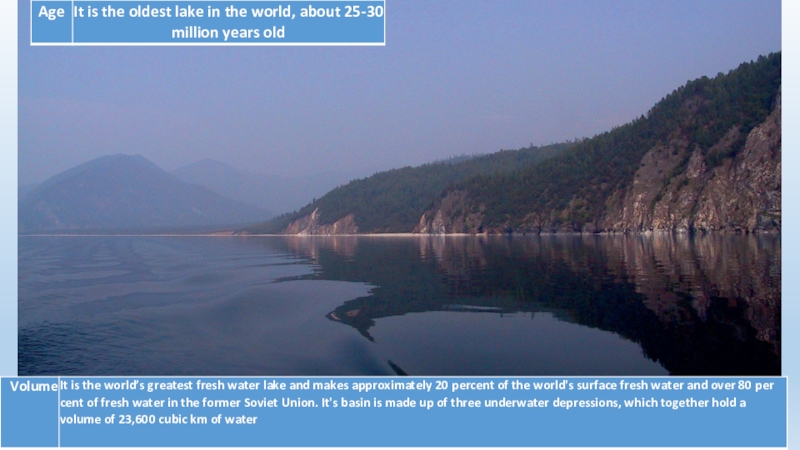
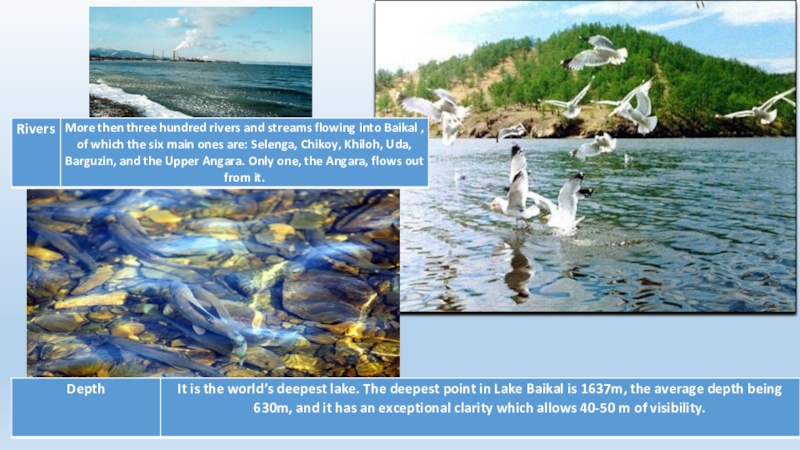
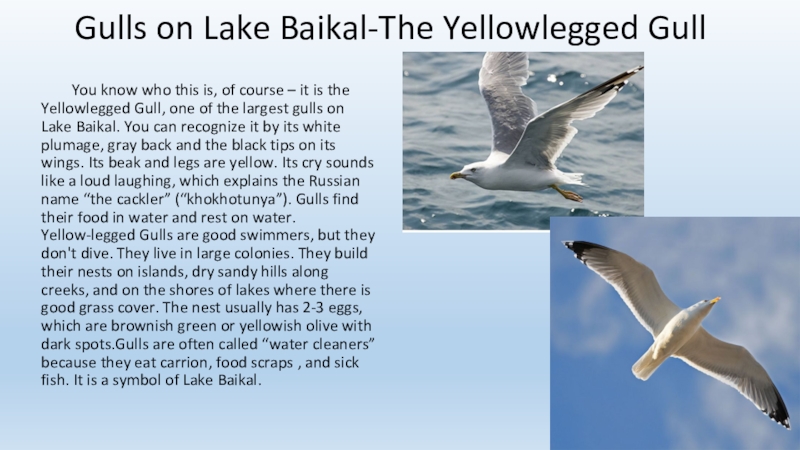
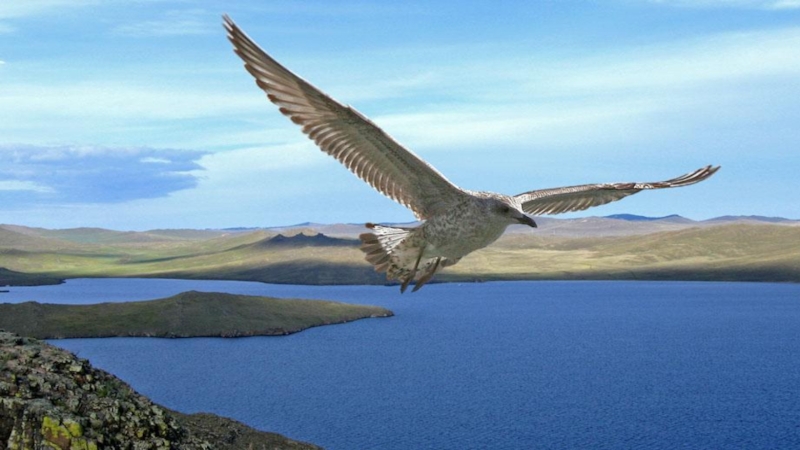
know who this is, of course – it is the Yellowlegged Gull, one of the largest gulls on Lake Baikal. You can recognize it by its white plumage, gray back and the black tips on its wings. Its beak and legs are yellow. Its cry sounds like a loud laughing, which explains the Russian name “the cackler” (“khokhotunya”). Gulls find their food in water and rest on water. Yellow-legged Gulls are good swimmers, but they don't dive. They live in large colonies. They build their nests on islands, dry sandy hills along creeks, and on the shores of lakes where there is good grass cover. The nest usually has 2-3 eggs, which are brownish green or yellowish olive with dark spots.Gulls are often called “water cleaners” because they eat carrion, food scraps , and sick fish. It is a symbol of Lake Baikal.
Слайд 7 The Common Tern
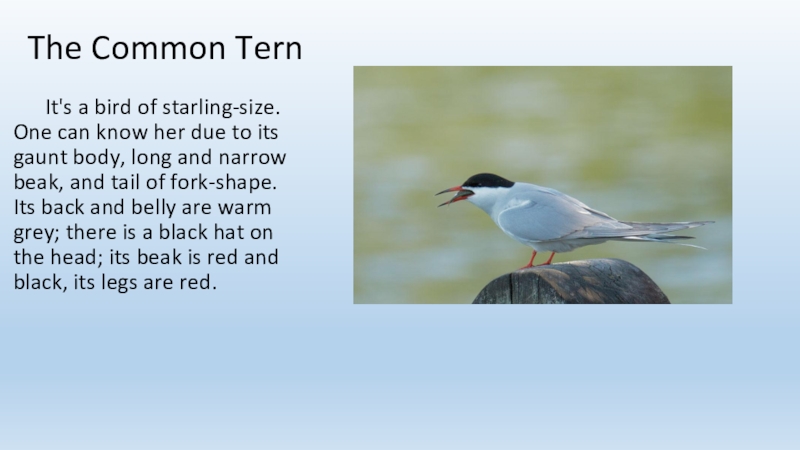
It's a bird of starling-size.
One can know her due to its gaunt body, long and narrow beak, and tail of fork-shape. Its back and belly are warm grey; there is a black hat on the head; its beak is red and black, its legs are red.
Слайд 8Are all waterfowl birds the same? Of course not. They differ
in size, color of plumage, how they nest and how they feed.
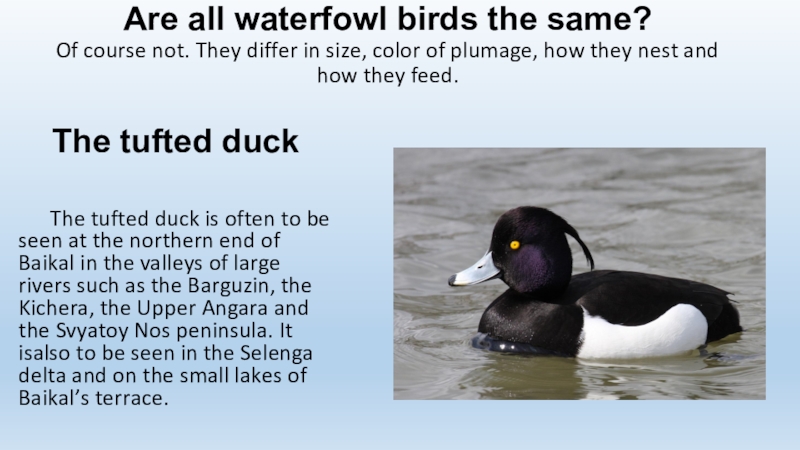
The tufted duck
The tufted duck is often to be seen at the northern end of Baikal in the valleys of large rivers such as the Barguzin, the Kichera, the Upper Angara and the Svyatoy Nos peninsula. It isalso to be seen in the Selenga delta and on the small lakes of Baikal’s terrace.
Слайд 9The great crested grebe
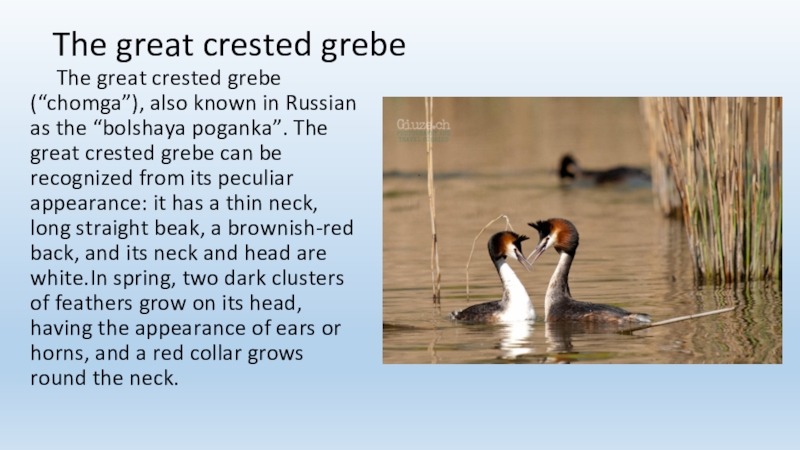
The great crested grebe
(“chomga”), also known in Russian as the “bolshaya poganka”. The great crested grebe can be recognized from its peculiar appearance: it has a thin neck, long straight beak, a brownish-red back, and its neck and head are white.In spring, two dark clusters of feathers grow on its head, having the appearance of ears or horns, and a red collar grows round the neck.
Слайд 10Green-winged Teal
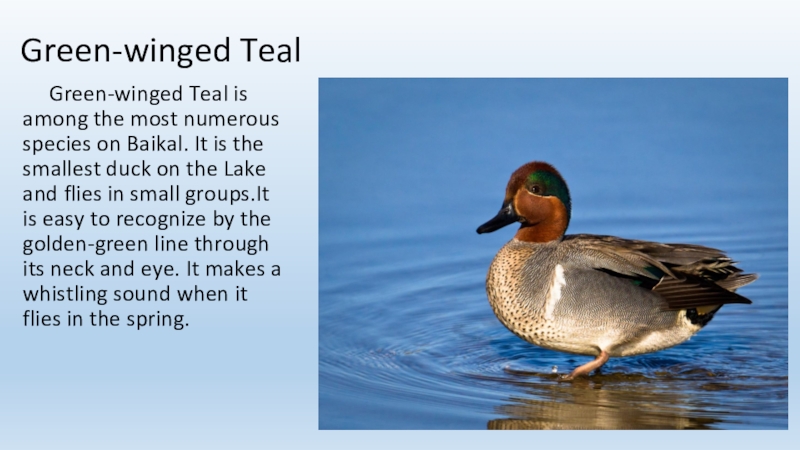
Green-winged Teal is among the most
numerous species on Baikal. It is the smallest duck on the Lake and flies in small groups.It is easy to recognize by the golden-green line through its neck and eye. It makes a whistling sound when it flies in the spring.
Слайд 11The Mallard
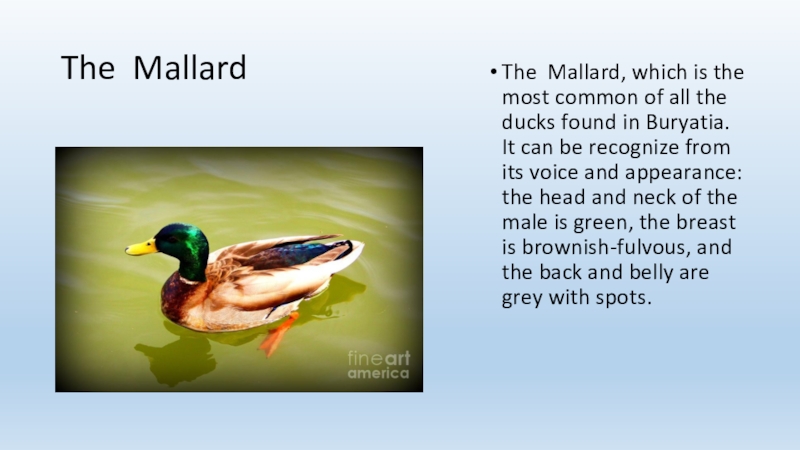
The Mallard, which is the most common of all the
ducks found in Buryatia. It can be recognize from its voice and appearance: the head and neck of the male is green, the breast is brownish-fulvous, and the back and belly are grey with spots.
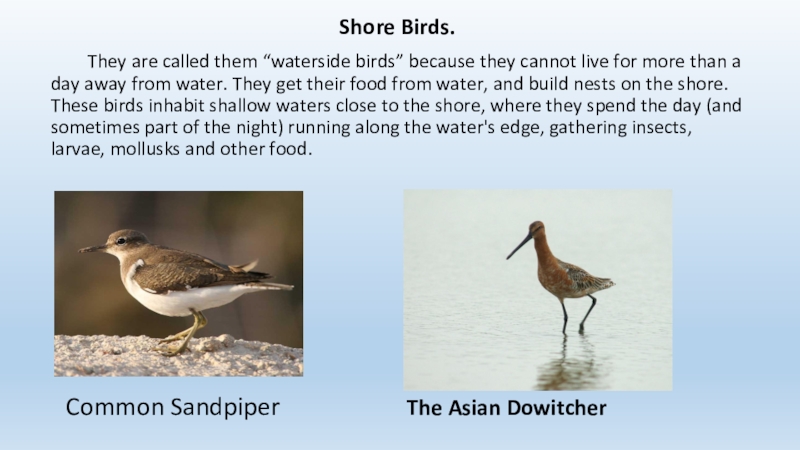
Слайд 12 Common Sandpiper
The Asian Dowitcher
Shore Birds.
They are called them “waterside birds” because they cannot live for more than a day away from water. They get their food from water, and build nests on the shore. These birds inhabit shallow waters close to the shore, where they spend the day (and sometimes part of the night) running along the water's edge, gathering insects, larvae, mollusks and other food.
Слайд 13Fish of Baikal
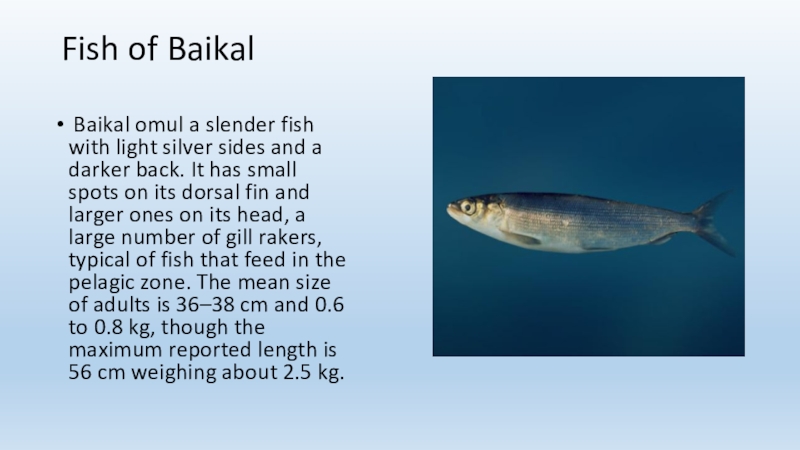
Baikal omul a slender fish with light silver
sides and a darker back. It has small spots on its dorsal fin and larger ones on its head, a large number of gill rakers, typical of fish that feed in the pelagic zone. The mean size of adults is 36–38 cm and 0.6 to 0.8 kg, though the maximum reported length is 56 cm weighing about 2.5 kg.
Слайд 14The Baikal sturgeon
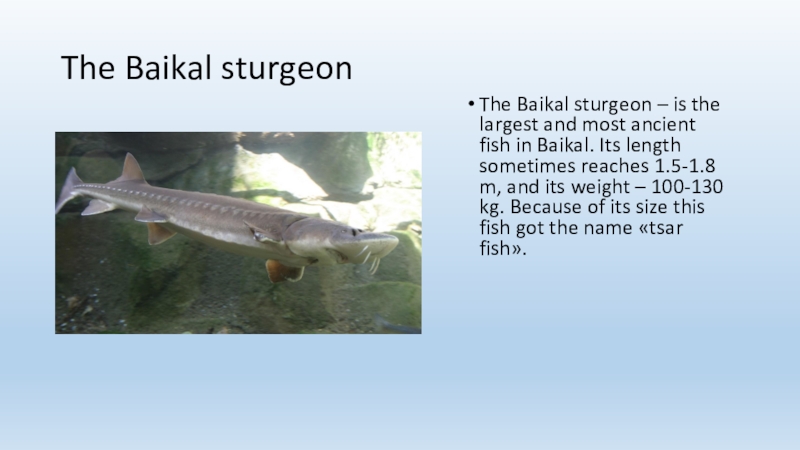
The Baikal sturgeon – is the largest and
most ancient fish in Baikal. Its length sometimes reaches 1.5-1.8 m, and its weight – 100-130 kg. Because of its size this fish got the name «tsar fish».
Слайд 15Тhe black grayling.
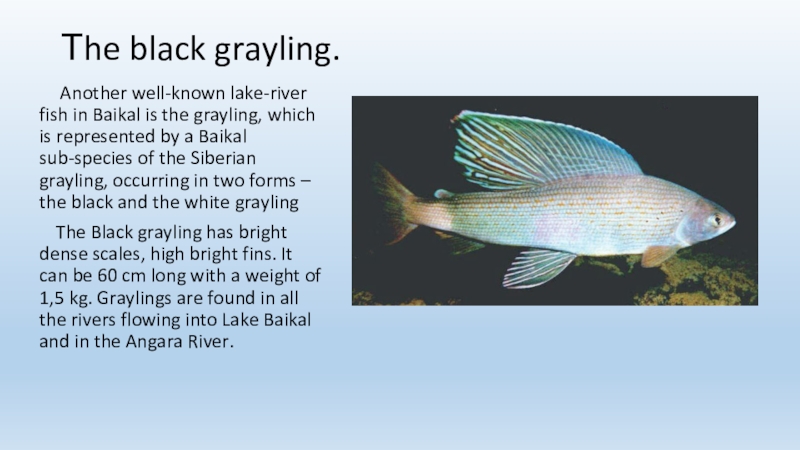
Another well-known lake-river fish
in Baikal is the grayling, which is represented by a Baikal sub-species of the Siberian grayling, occurring in two forms – the black and the white grayling
The Black grayling has bright dense scales, high bright fins. It can be 60 cm long with a weight of 1,5 kg. Graylings are found in all the rivers flowing into Lake Baikal and in the Angara River.
The Black grayling has bright dense scales, high bright fins. It can be 60 cm long with a weight of 1,5 kg. Graylings are found in all the rivers flowing into Lake Baikal and in the Angara River.
Слайд 16Тhe white grayling.
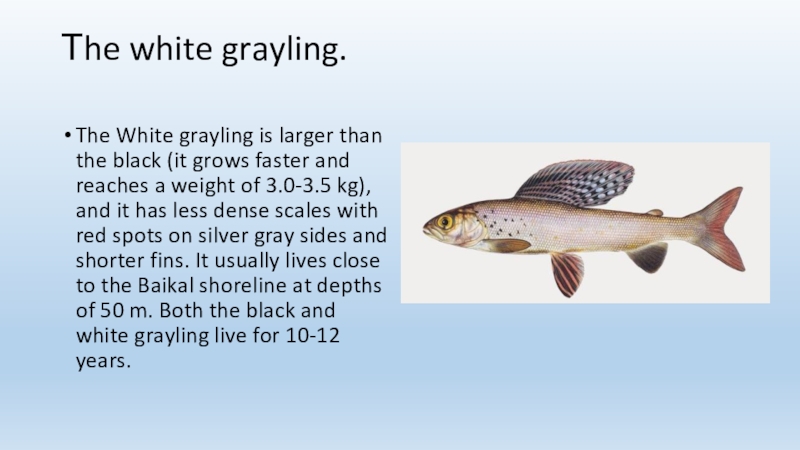
The White grayling is larger than the black
(it grows faster and reaches a weight of 3.0-3.5 kg), and it has less dense scales with red spots on silver gray sides and shorter fins. It usually lives close to the Baikal shoreline at depths of 50 m. Both the black and white grayling live for 10-12 years.
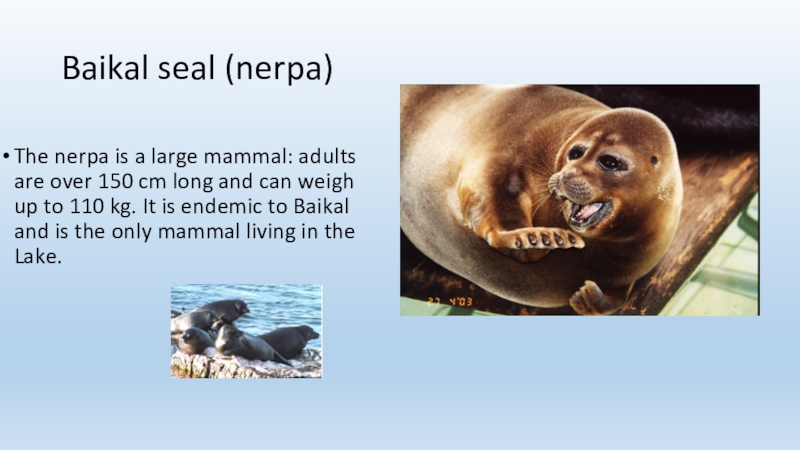
Слайд 19Baikal seal (nerpa)
The nerpa is a large mammal: adults are over
150 cm long and can weigh up to 110 kg. It is endemic to Baikal and is the only mammal living in the Lake.
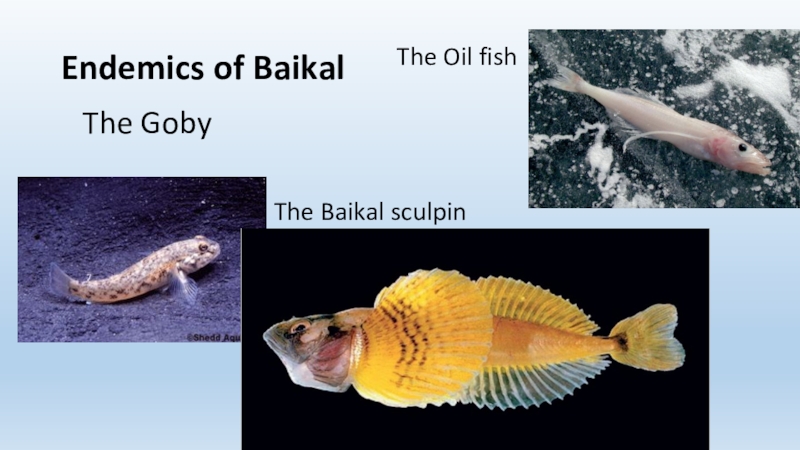
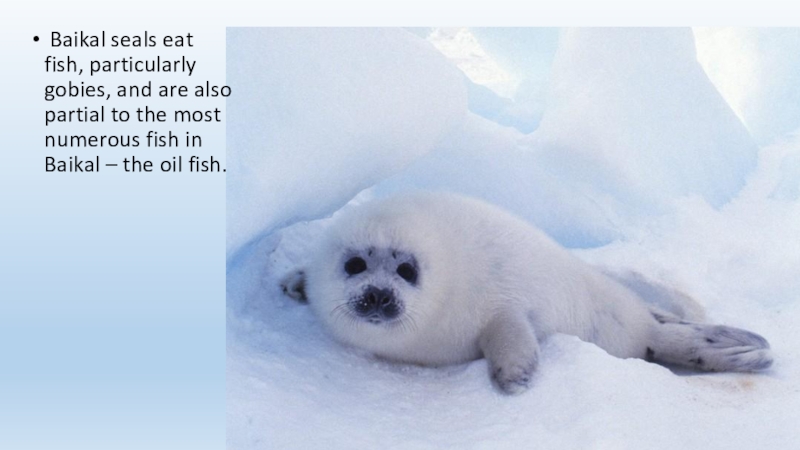
Слайд 20 Baikal seals eat fish, particularly gobies, and are also partial
to the most numerous fish in Baikal – the oil fish.
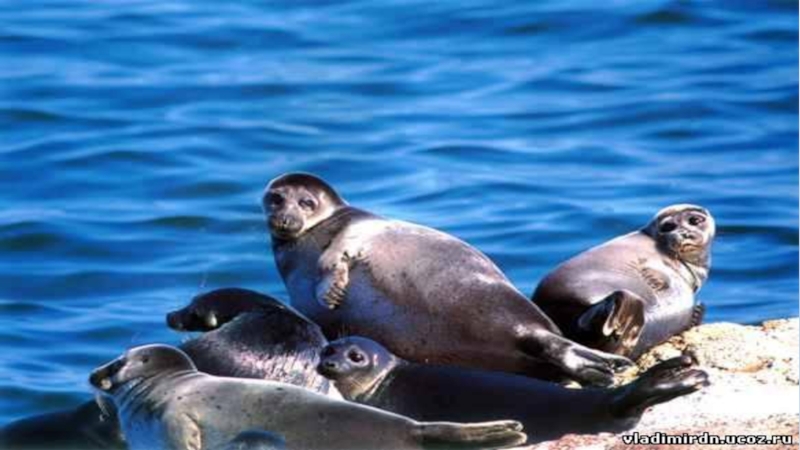
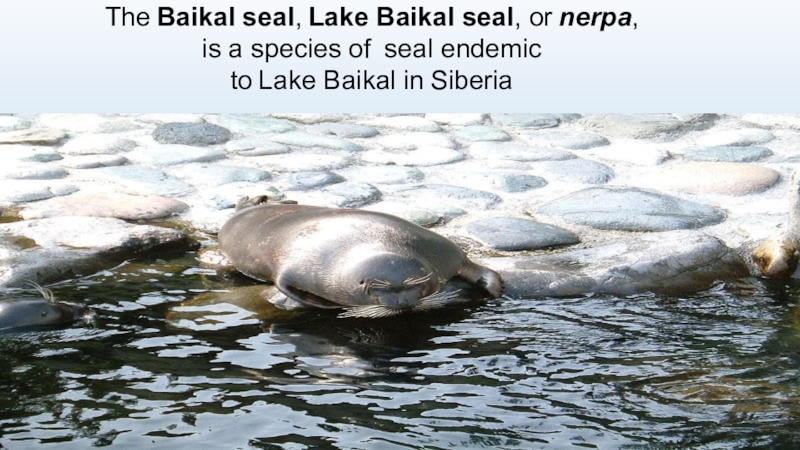
Слайд 22The Baikal seal, Lake Baikal seal, or nerpa,
is a species of seal endemic
to Lake
Baikal in Siberia
Слайд 25Baikal’s Exploration
Preservation of the lake, however, has recently come to
international attention.
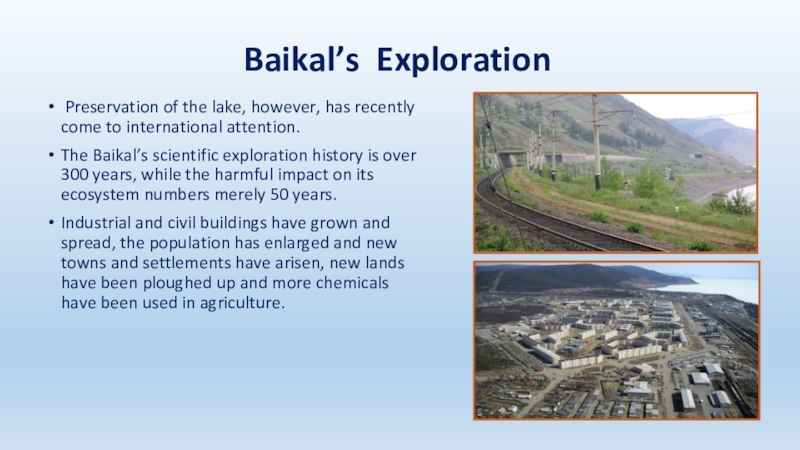
The Baikal’s scientific exploration history is over 300 years, while the harmful impact on its ecosystem numbers merely 50 years.
Industrial and civil buildings have grown and spread, the population has enlarged and new towns and settlements have arisen, new lands have been ploughed up and more chemicals have been used in agriculture.
The Baikal’s scientific exploration history is over 300 years, while the harmful impact on its ecosystem numbers merely 50 years.
Industrial and civil buildings have grown and spread, the population has enlarged and new towns and settlements have arisen, new lands have been ploughed up and more chemicals have been used in agriculture.
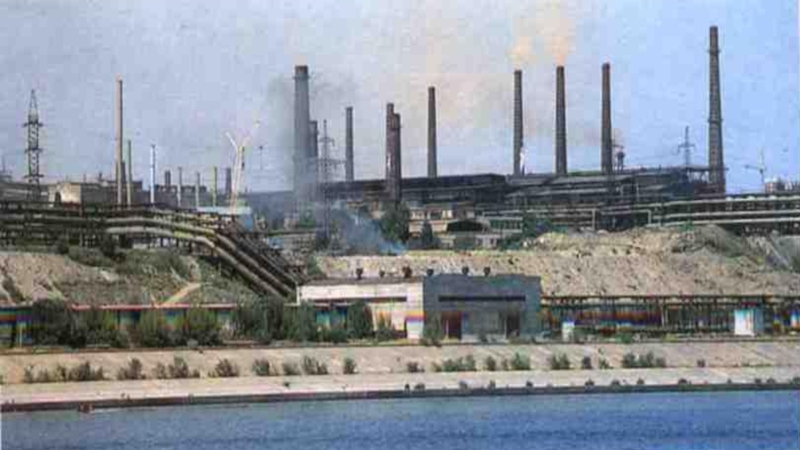
Слайд 26Plants and mills
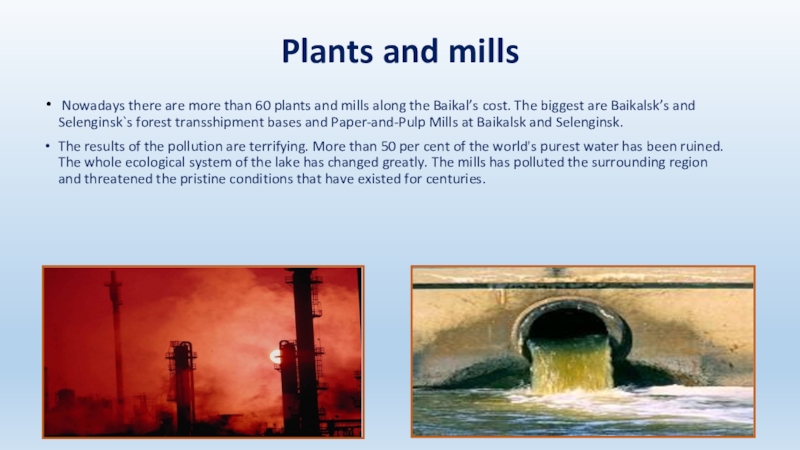
Nowadays there are more than 60 plants and
mills along the Baikal’s cost. The biggest are Baikalsk’s and Selenginsk`s forest transshipment bases and Paper-and-Pulp Mills at Baikalsk and Selenginsk.
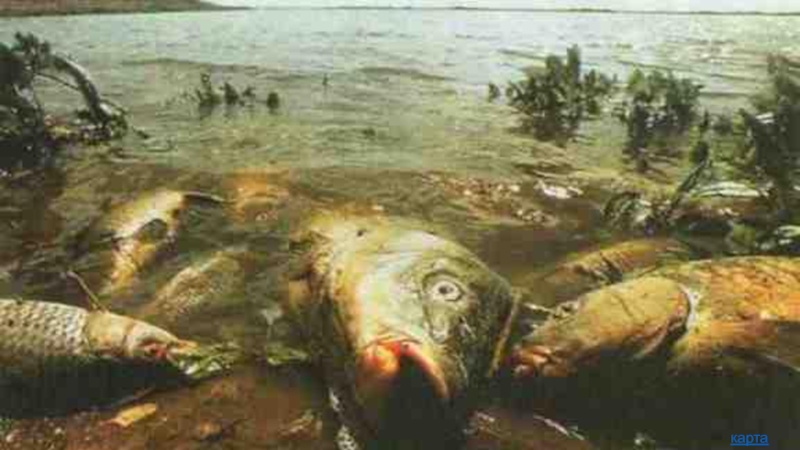
The results of the pollution are terrifying. More than 50 per cent of the world's purest water has been ruined. The whole ecological system of the lake has changed greatly. The mills has polluted the surrounding region and threatened the pristine conditions that have existed for centuries.
The results of the pollution are terrifying. More than 50 per cent of the world's purest water has been ruined. The whole ecological system of the lake has changed greatly. The mills has polluted the surrounding region and threatened the pristine conditions that have existed for centuries.
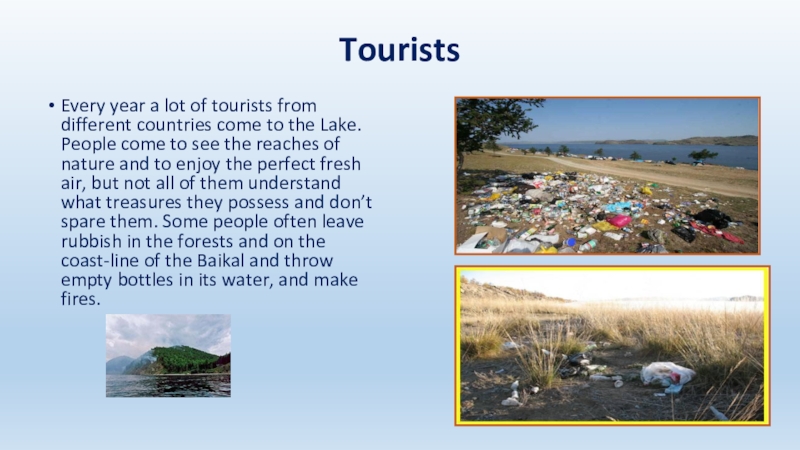
Слайд 27Tourists
Every year a lot of tourists from different countries come to
the Lake. People come to see the reaches of nature and to enjoy the perfect fresh air, but not all of them understand what treasures they possess and don’t spare them. Some people often leave rubbish in the forests and on the coast-line of the Baikal and throw empty bottles in its water, and make fires.