- Главная
- Разное
- Образование
- Спорт
- Естествознание
- Природоведение
- Религиоведение
- Французский язык
- Черчение
- Английский язык
- Астрономия
- Алгебра
- Биология
- География
- Геометрия
- Детские презентации
- Информатика
- История
- Литература
- Математика
- Музыка
- МХК
- Немецкий язык
- ОБЖ
- Обществознание
- Окружающий мир
- Педагогика
- Русский язык
- Технология
- Физика
- Философия
- Химия
- Шаблоны, фоны, картинки для презентаций
- Экология
- Экономика
Презентация, доклад по внеурочной деятельности на тему История Царского Села
Содержание
- 1. Презентация по внеурочной деятельности на тему История Царского Села
- 2. The city of Pushkin, named after the
- 3. A lot of memories of the days
- 4. Despite the fact that for two centuries
- 5. After the Swedes were expelled from the
- 6. In 1702, the retreating Swedes, were pursued
- 7. Since 1703, the Saarskaya manor belonged to
- 8. On June, 24, 1710, Peter I presented
- 9. During its history, the city has changed
- 10. Pushkin's Twin Cities• Valday district, Russia (2013)•
- 11. The End
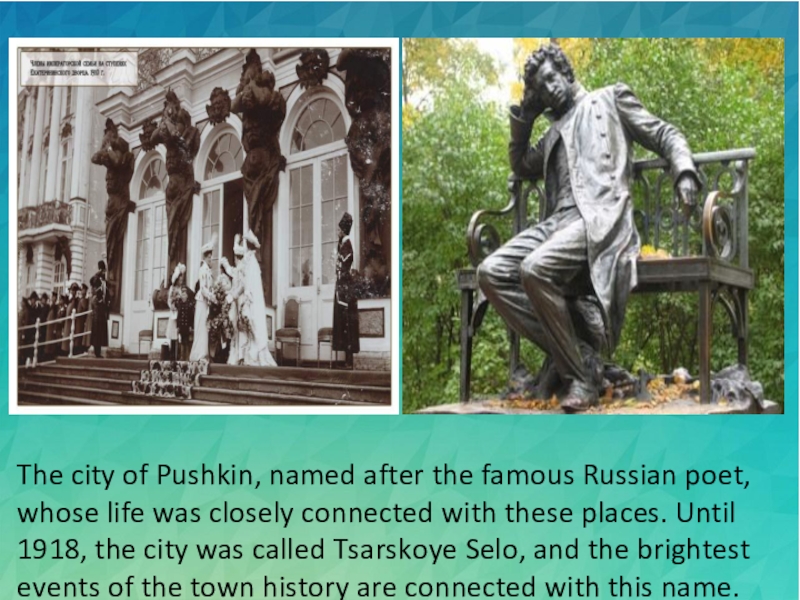
The city of Pushkin, named after the famous Russian poet, whose life was closely connected with these places. Until 1918, the city was called Tsarskoye Selo, and the brightest events of the town history are connected
Слайд 2The city of Pushkin, named after the famous Russian poet, whose
life was closely connected with these places. Until 1918, the city was called Tsarskoye Selo, and the brightest events of the town history are connected with this name.
Слайд 3
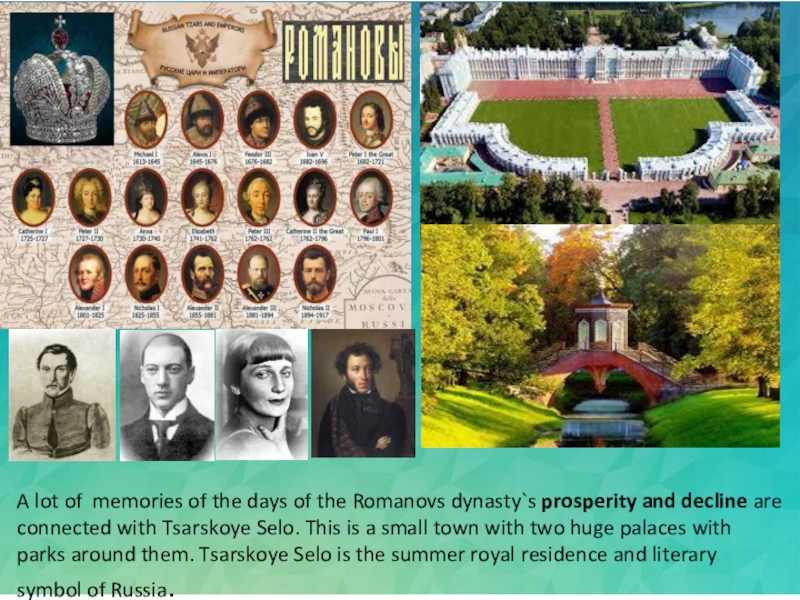
A lot of memories of the days of the Romanovs dynasty`s
prosperity and decline are connected with Tsarskoye Selo. This is a small town with two huge palaces with parks around them. Tsarskoye Selo is the summer royal residence and literary symbol of Russia.
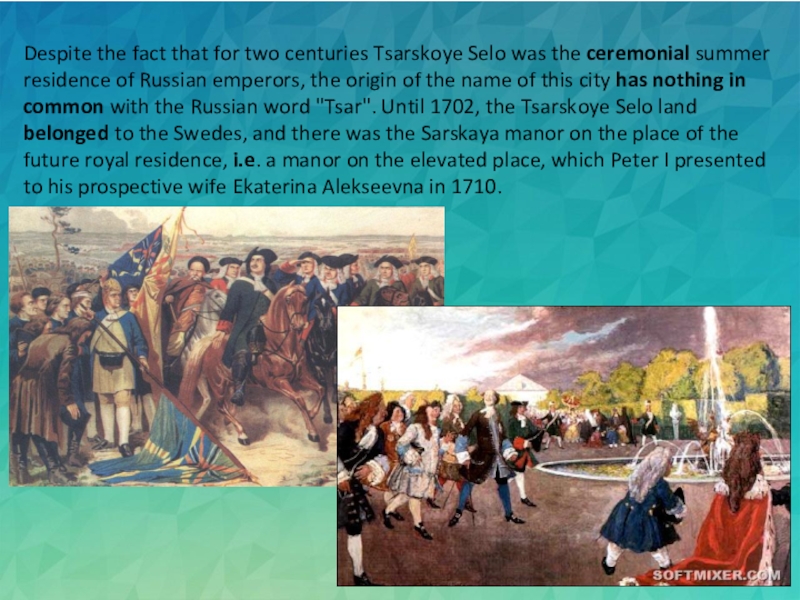
Слайд 4Despite the fact that for two centuries Tsarskoye Selo was the
ceremonial summer residence of Russian emperors, the origin of the name of this city has nothing in common with the Russian word "Tsar". Until 1702, the Tsarskoye Selo land belonged to the Swedes, and there was the Sarskaya manor on the place of the future royal residence, i.e. a manor on the elevated place, which Peter I presented to his prospective wife Ekaterina Alekseevna in 1710.
Слайд 5After the Swedes were expelled from the conquered territory, Saarskaya manor
became known as Saarskoye Selo. In 1717, the construction of a stone palace in Tsarskoye Selo began, and the Swidish name was changed. Over the years, the modest manor turned into a brilliant suburban residence of Russian autocrats, one of the most beautiful palace and park ensembles in Europe.
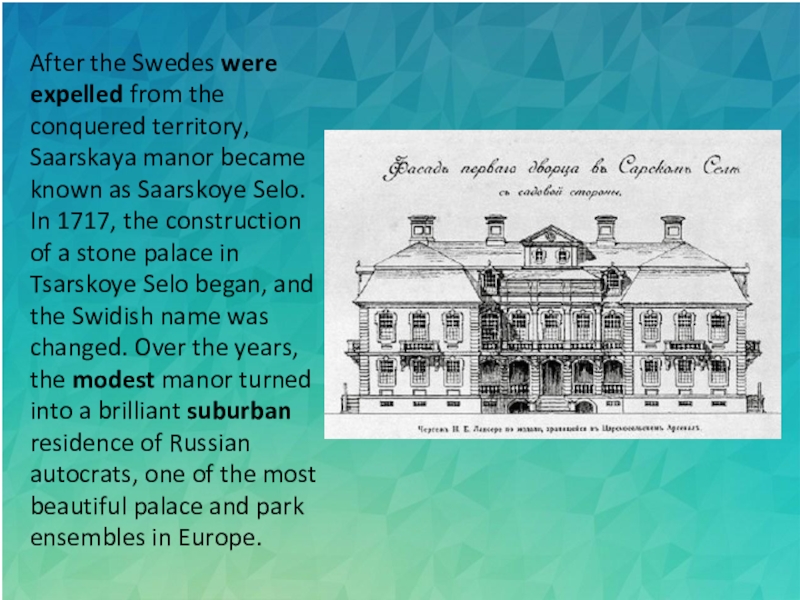
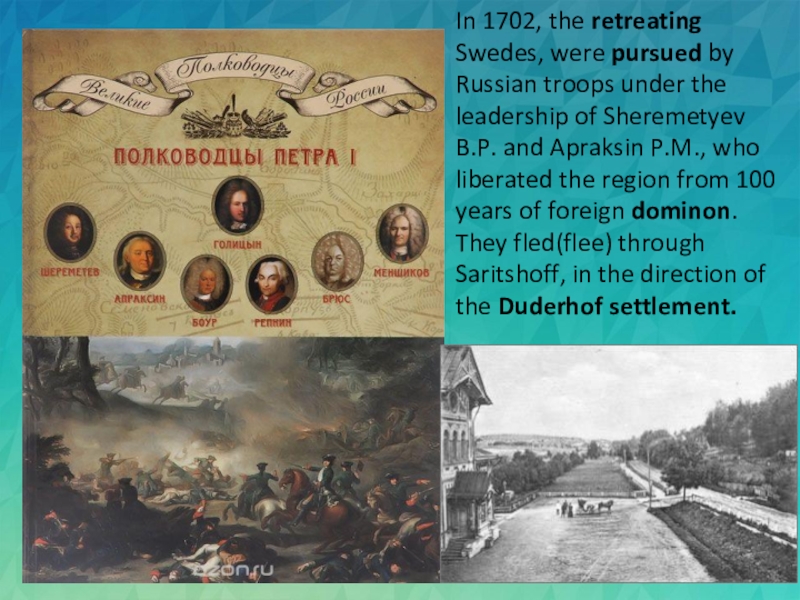
Слайд 6In 1702, the retreating Swedes, were pursued by Russian troops under
the leadership of Sheremetyev B.P. and Apraksin P.M., who liberated the region from 100 years of foreign dominon. They fled(flee) through Saritshoff, in the direction of the Duderhof settlement.
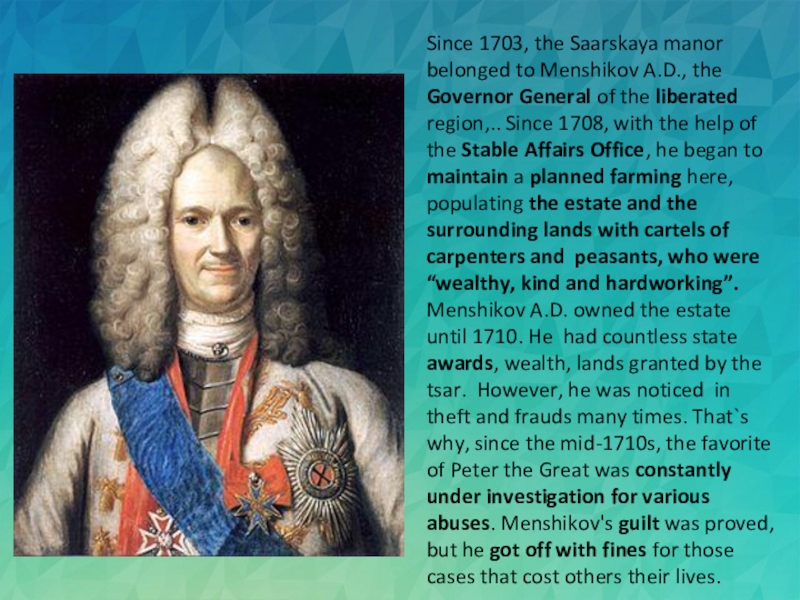
Слайд 7Since 1703, the Saarskaya manor belonged to Menshikov A.D., the Governor
General of the liberated region,.. Since 1708, with the help of the Stable Affairs Office, he began to maintain a planned farming here, populating the estate and the surrounding lands with cartels of carpenters and peasants, who were “wealthy, kind and hardworking”.
Menshikov A.D. owned the estate until 1710. He had countless state awards, wealth, lands granted by the tsar. However, he was noticed in theft and frauds many times. That`s why, since the mid-1710s, the favorite of Peter the Great was constantly under investigation for various abuses. Menshikov's guilt was proved, but he got off with fines for those cases that cost others their lives.
Menshikov A.D. owned the estate until 1710. He had countless state awards, wealth, lands granted by the tsar. However, he was noticed in theft and frauds many times. That`s why, since the mid-1710s, the favorite of Peter the Great was constantly under investigation for various abuses. Menshikov's guilt was proved, but he got off with fines for those cases that cost others their lives.
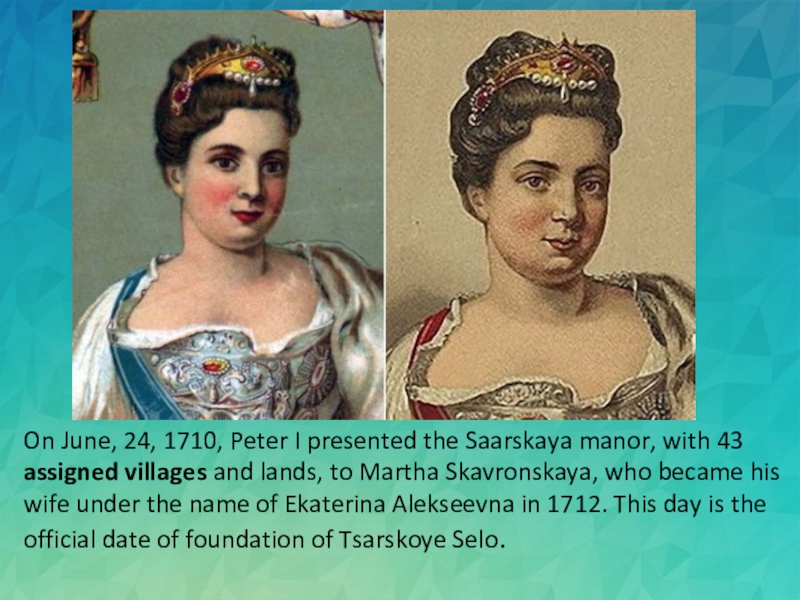
Слайд 8On June, 24, 1710, Peter I presented the Saarskaya manor, with
43 assigned villages and lands, to Martha Skavronskaya, who became his wife under the name of Ekaterina Alekseevna in 1712. This day is the official date of foundation of Tsarskoye Selo.
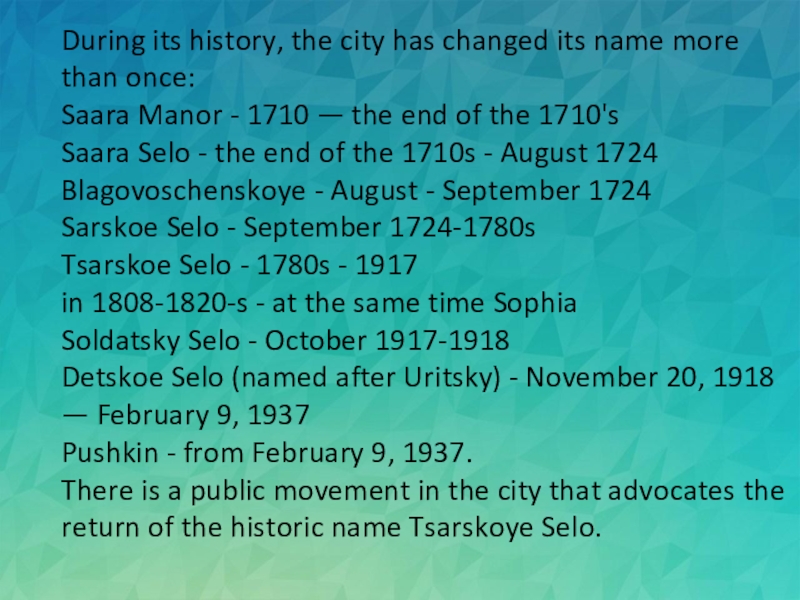
Слайд 9During its history, the city has changed its name more than
once:
Saara Manor - 1710 — the end of the 1710's
Saara Selo - the end of the 1710s - August 1724
Blagovoschenskoye - August - September 1724
Sarskoe Selo - September 1724-1780s
Tsarskoe Selo - 1780s - 1917
in 1808-1820-s - at the same time Sophia
Soldatsky Selo - October 1917-1918
Detskoe Selo (named after Uritsky) - November 20, 1918 — February 9, 1937
Pushkin - from February 9, 1937.
There is a public movement in the city that advocates the return of the historic name Tsarskoye Selo.
Saara Manor - 1710 — the end of the 1710's
Saara Selo - the end of the 1710s - August 1724
Blagovoschenskoye - August - September 1724
Sarskoe Selo - September 1724-1780s
Tsarskoe Selo - 1780s - 1917
in 1808-1820-s - at the same time Sophia
Soldatsky Selo - October 1917-1918
Detskoe Selo (named after Uritsky) - November 20, 1918 — February 9, 1937
Pushkin - from February 9, 1937.
There is a public movement in the city that advocates the return of the historic name Tsarskoye Selo.
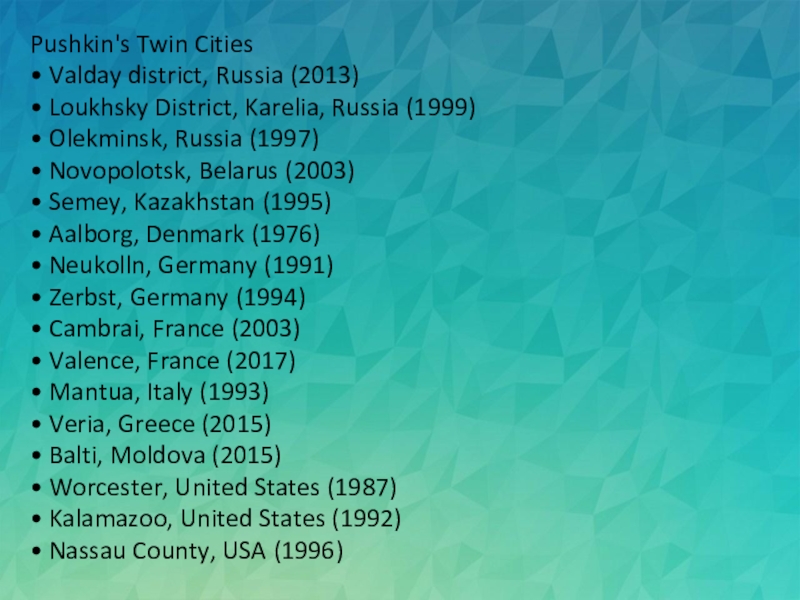
Слайд 10Pushkin's Twin Cities
• Valday district, Russia (2013)
• Loukhsky District, Karelia, Russia
(1999)
• Olekminsk, Russia (1997)
• Novopolotsk, Belarus (2003)
• Semey, Kazakhstan (1995)
• Aalborg, Denmark (1976)
• Neukolln, Germany (1991)
• Zerbst, Germany (1994)
• Cambrai, France (2003)
• Valence, France (2017)
• Mantua, Italy (1993)
• Veria, Greece (2015)
• Balti, Moldova (2015)
• Worcester, United States (1987)
• Kalamazoo, United States (1992)
• Nassau County, USA (1996)
• Olekminsk, Russia (1997)
• Novopolotsk, Belarus (2003)
• Semey, Kazakhstan (1995)
• Aalborg, Denmark (1976)
• Neukolln, Germany (1991)
• Zerbst, Germany (1994)
• Cambrai, France (2003)
• Valence, France (2017)
• Mantua, Italy (1993)
• Veria, Greece (2015)
• Balti, Moldova (2015)
• Worcester, United States (1987)
• Kalamazoo, United States (1992)
• Nassau County, USA (1996)