of the 10th class in 2013 at the elective course “Tourism and catering”
- Главная
- Разное
- Образование
- Спорт
- Естествознание
- Природоведение
- Религиоведение
- Французский язык
- Черчение
- Английский язык
- Астрономия
- Алгебра
- Биология
- География
- Геометрия
- Детские презентации
- Информатика
- История
- Литература
- Математика
- Музыка
- МХК
- Немецкий язык
- ОБЖ
- Обществознание
- Окружающий мир
- Педагогика
- Русский язык
- Технология
- Физика
- Философия
- Химия
- Шаблоны, фоны, картинки для презентаций
- Экология
- Экономика
Презентация, доклад по теме The festivals of the world
Содержание
- 1. Презентация по теме The festivals of the world
- 2. Holi festival
- 3. The Festival of ColorsObserved by Hindus mainly
- 4. The bonfires are lit in memory of
- 5. Children take special delight in the festival
- 6. Thai Pongal is a harvest festifal celebrated in South
- 7. Слайд 7
- 8. La Tomatina Festival
- 9. The story of the festival In July 1945,
- 10. The following year young people in the
- 11. La tomatina rules In 1959, the fight became
- 12. The Carnival of Venice is an annual
- 13. Festival treats monkey in Bangkok, Thailand.This annual
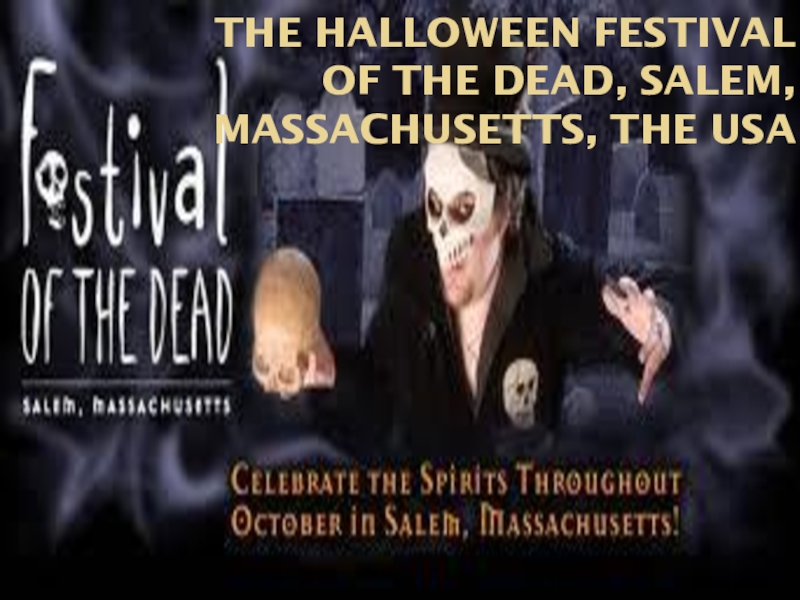
- 14. The Halloween Festival of the Dead, Salem, Massachusetts, the USA
- 15. Halloween or Hallowe'en (a contraction of "All
- 16. The main Halloween activity for children is
- 17. Fairy tale Festival takes place in Berlin
- 18. Слайд 18
- 19. Tulip festival in MorgesThe festival was created
- 20. The traditional Tulip Festival is held in
- 21. Firenze Gelato Festival
- 22. Italian cuisine is known throughout the world
- 23. This festival is held
- 24. From lemons and oranges they make beautiful
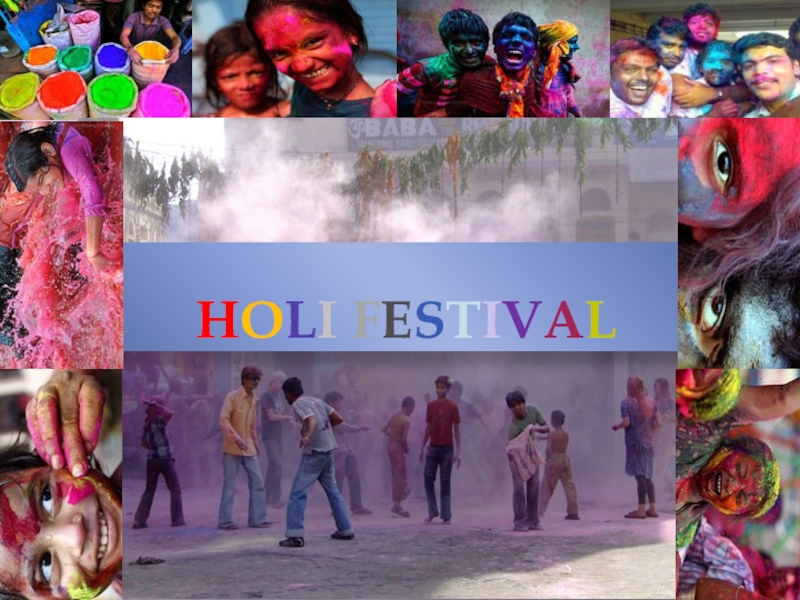
Holi festival
Слайд 3The Festival of Colors
Observed by Hindus mainly in India, Nepal
Begins Phalgun
Purnima or Pooranmashi (Full Moon)
Date February–March
2012 date March 8
2013 date March 27
Celebrations are for 3 – 16 days
Every year, thousands of Hindus participate in the Holi festival. The festival has many purposes. First and foremost, it celebrates the beginning of the new season, spring. Originally, it was a festival that commemorated good harvests and the fertile land. Hindus believe it is a time of enjoying spring's abundant colors and saying farewell to winter. It also has a religious purpose, commemorating events presented in Hindu mythology. Although it is the least religious holiday, it is probably one of the most exhilarating ones in existence. During this event, participants hold a bonfire, throw colored powder at each other, and celebrate wildly.
The main day, Holi, also known as Dhuli in Sanskrit, or Dhulheti, Dhulandi or Dhulendi, is celebrated by people throwing scented powder and perfume at each other. Bonfires are lit on the eve of the festival, also known as Holika Dahan (burning of Holika) or Chhoti Holi (little Holi), after which holika dahan prayers are said and praise is offered.
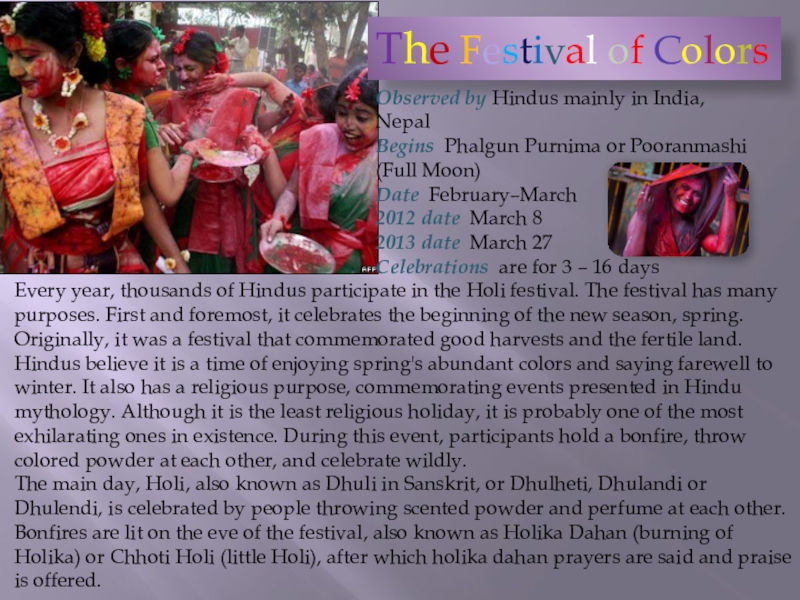
Слайд 4The bonfires are lit in memory of the miraculous escape that
young Prahlad accomplished when Demoness Holika, sister of Hiranyakashipu, carried him into the fire. Holika was burnt but Prahlad, a staunch devotee of god Vishnu, escaped without any injuries due to his devotion. Holika Dahan is referred to as Kama Dahanam in South India.
Traditional Holi
The spring season, during which the weather changes, is believed to cause viral fever and cold. The playful throwing of natural coloured powders has a medicinal significance: the colours are traditionally made of Neem, Kumkum, Haldi, Bilva, and other medicinal herbs prescribed by Āyurvedic doctors.
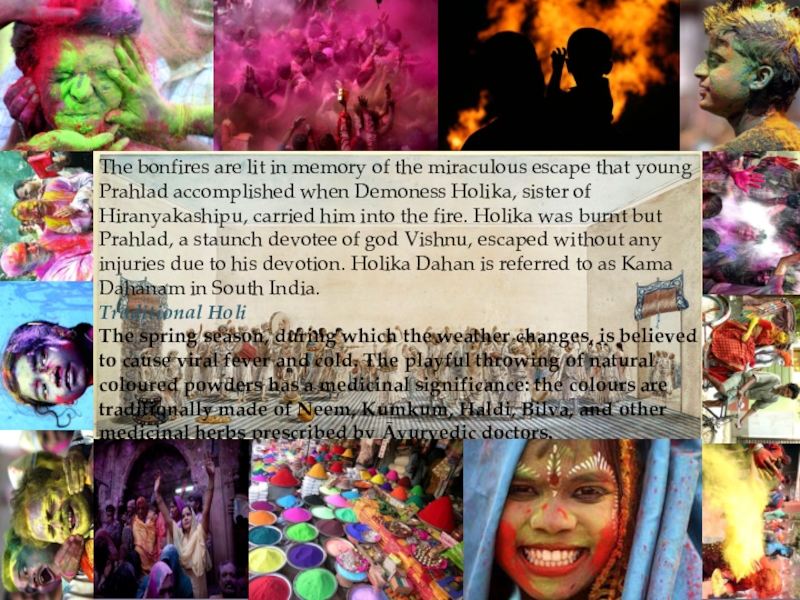
Слайд 5Children take special delight in the festival and demand every colour
in loads. They have so many plans in their mind. They have to be the first to apply colour to Mama, Papa, siblings and a big bunch of friends in their colony. Nobody could miss being coloured by them and of course, they need colour for that.
Whatever be the choice of colour, nobody remains in their original texture at the end of the play. And everybody takes delight looking of the festival is FUN.
Слайд 6
Thai Pongal is a harvest festifal celebrated in South India at the end of
the harvest season. It is one of the most important festivals celebrated by the Tamils in the Indian state of Tamil Nadu, the Indian Union Territory of Puducherry and Sri Lanka.
Pongal marks the beginning of the northward journey of the Sun from its southernmost-limit, a movement traditionally referred to as uttarayana. It coincides with the festival Makara Sankranthi celebrated throughout India as the winter harvest, and is usually held from January 13–16 in the Gregorian calendar i.e. from the last day of the Tamil month Maargazhi to the third day of Thai. The second of the four days or the first day of month Thai is the main day of the festival which is known as Pongal or Thai Pongal
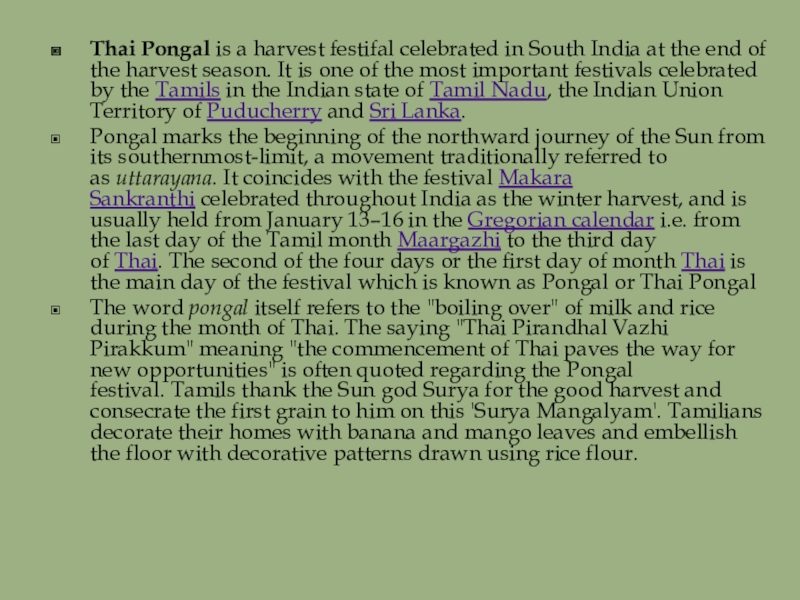
The word pongal itself refers to the "boiling over" of milk and rice during the month of Thai. The saying "Thai Pirandhal Vazhi Pirakkum" meaning "the commencement of Thai paves the way for new opportunities" is often quoted regarding the Pongal festival. Tamils thank the Sun god Surya for the good harvest and consecrate the first grain to him on this 'Surya Mangalyam'. Tamilians decorate their homes with banana and mango leaves and embellish the floor with decorative patterns drawn using rice flour.
Pongal marks the beginning of the northward journey of the Sun from its southernmost-limit, a movement traditionally referred to as uttarayana. It coincides with the festival Makara Sankranthi celebrated throughout India as the winter harvest, and is usually held from January 13–16 in the Gregorian calendar i.e. from the last day of the Tamil month Maargazhi to the third day of Thai. The second of the four days or the first day of month Thai is the main day of the festival which is known as Pongal or Thai Pongal
The word pongal itself refers to the "boiling over" of milk and rice during the month of Thai. The saying "Thai Pirandhal Vazhi Pirakkum" meaning "the commencement of Thai paves the way for new opportunities" is often quoted regarding the Pongal festival. Tamils thank the Sun god Surya for the good harvest and consecrate the first grain to him on this 'Surya Mangalyam'. Tamilians decorate their homes with banana and mango leaves and embellish the floor with decorative patterns drawn using rice flour.
Слайд 9The story of the festival
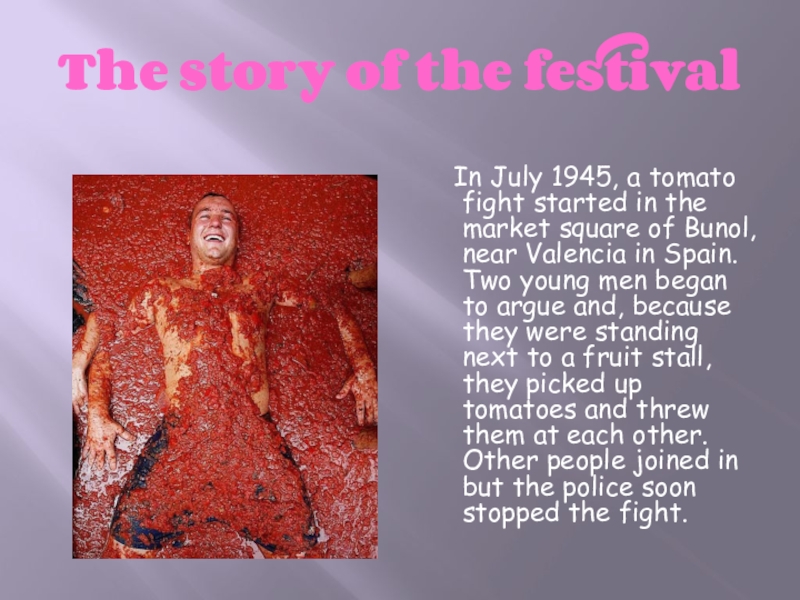
In July 1945, a tomato fight started
in the market square of Bunol, near Valencia in Spain. Two young men began to argue and, because they were standing next to а fruit stall, they picked up tomatoes and threw them at еаch other. Other people joined in but the police soon stopped the fight.
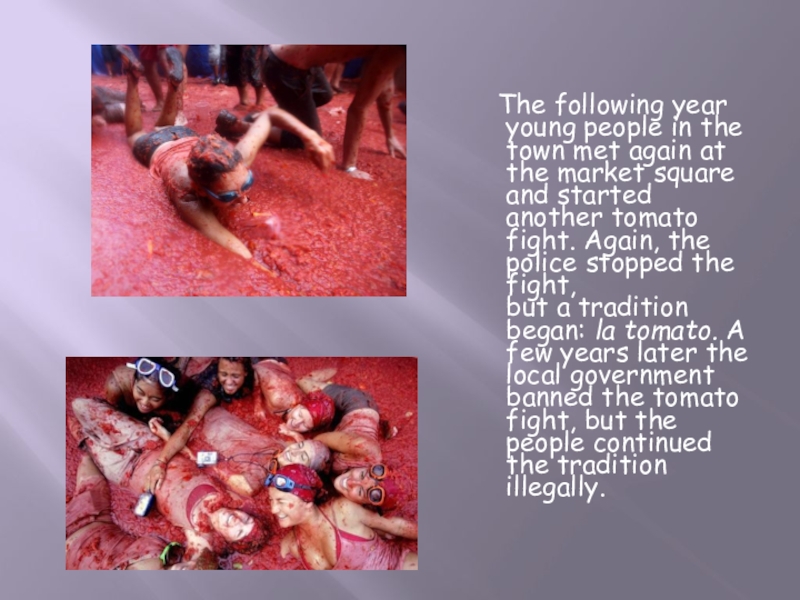
Слайд 10 The following year young people in the town met again at
the market square
and started another tomato fight. Again, the police stopped the fight,
but а tradition began: la tomato. А few years later the local government
banned the tomato fight, but the people continued the tradition illegally.
Слайд 11La tomatina rules
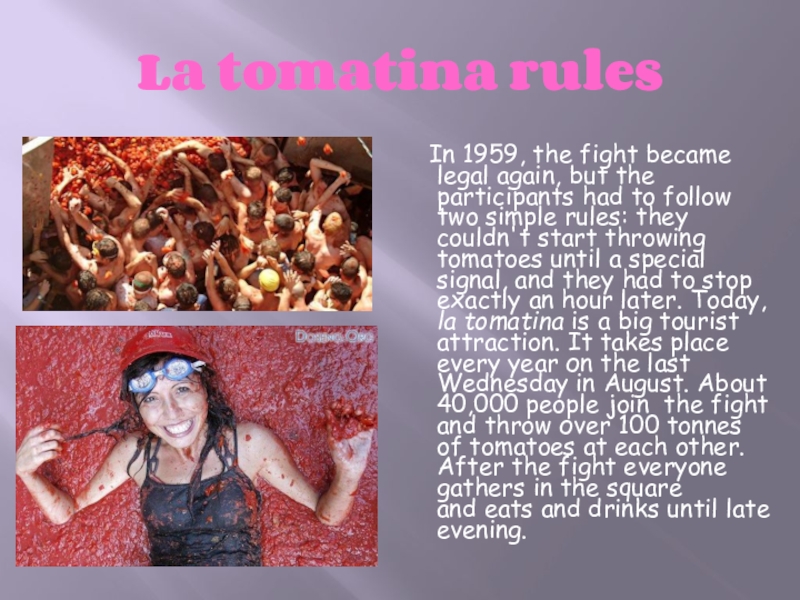
In 1959, the fight became legal again, but the
participants had to follow two simple rules: they couldn't start throwing tomatoes until а special
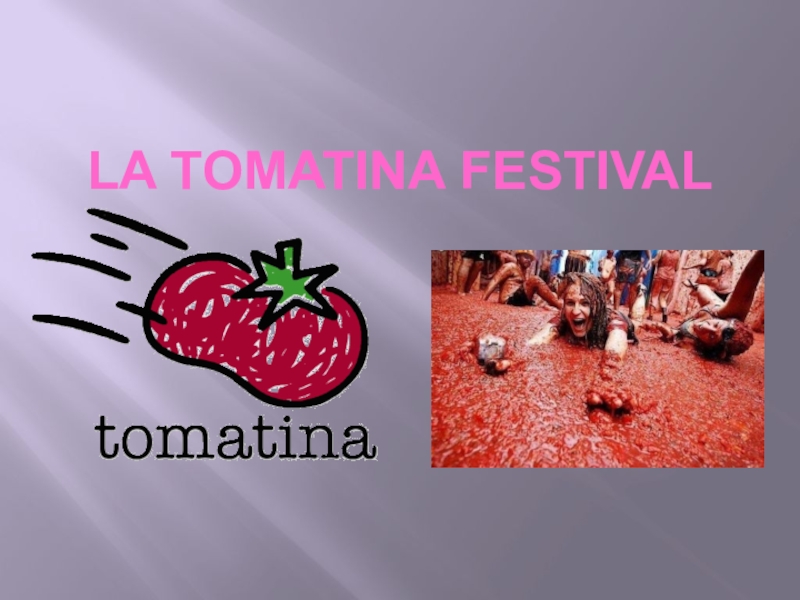
signal, and they had to stop exactly an hour later. Today, la tomatina is а big tourist attraction. It takes place еvеrу year оn the last Wednesday in August. About 40,000 people join the fight and throw оvеr 100 tonnes of tomatoes at each other. After the fight everyone gathers in the square
and eats and drinks until late evening.
Слайд 12The Carnival of Venice is an annual festival, held in Venice,
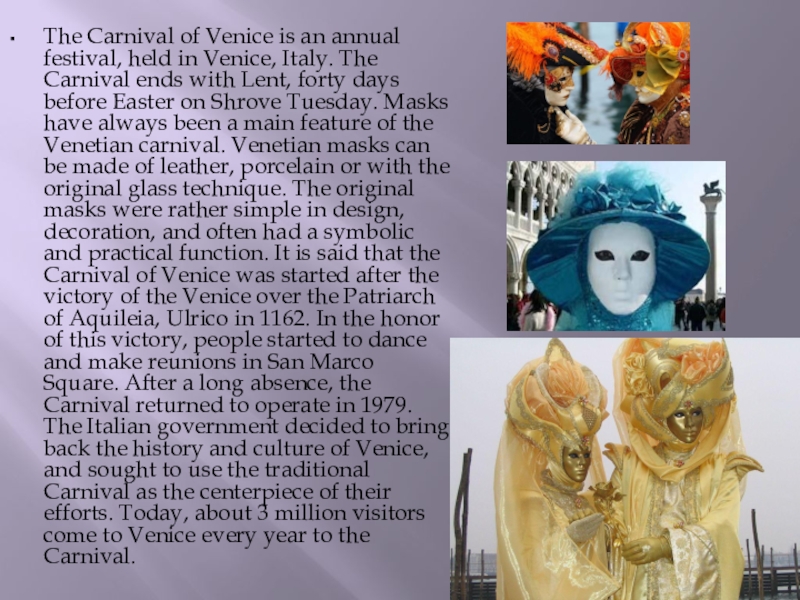
Italy. The Carnival ends with Lent, forty days before Easter on Shrove Tuesday. Masks have always been a main feature of the Venetian carnival. Venetian masks can be made of leather, porcelain or with the original glass technique. The original masks were rather simple in design, decoration, and often had a symbolic and practical function. It is said that the Carnival of Venice was started after the victory of the Venice over the Patriarch of Aquileia, Ulrico in 1162. In the honor of this victory, people started to dance and make reunions in San Marco Square. After a long absence, the Carnival returned to operate in 1979. The Italian government decided to bring back the history and culture of Venice, and sought to use the traditional Carnival as the centerpiece of their efforts. Today, about 3 million visitors come to Venice every year to the Carnival.
Слайд 13Festival treats monkey in Bangkok, Thailand.
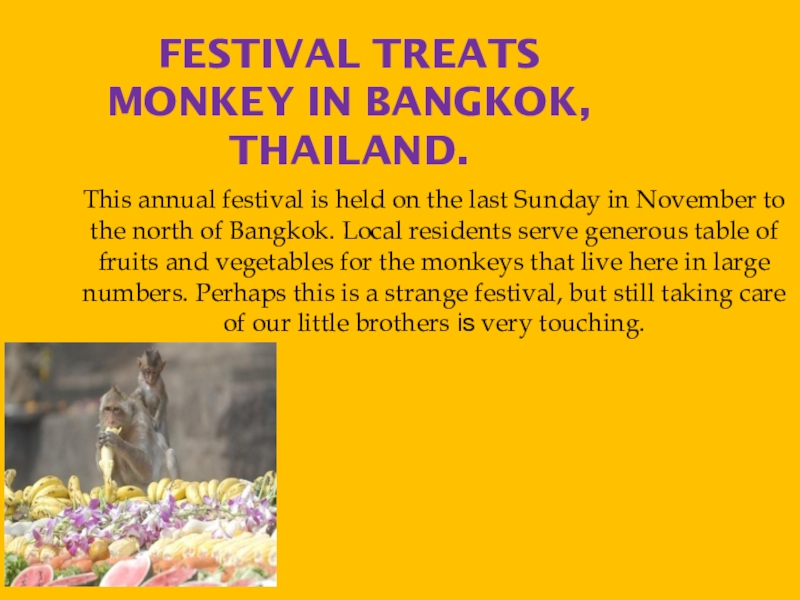
This annual festival is held on
the last Sunday in November to the north of Bangkok. Local residents serve generous table of fruits and vegetables for the monkeys that live here in large numbers. Perhaps this is a strange festival, but still taking care of our little brothers is very touching.
Слайд 15 Halloween or Hallowe'en (a contraction of "All Hallows' Evening"), also known
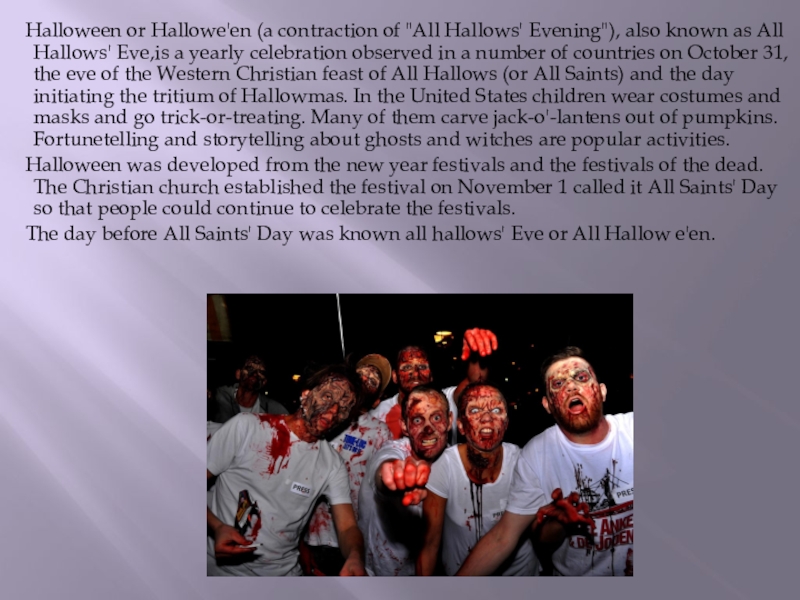
as All Hallows' Eve,is a yearly celebration observed in a number of countries on October 31, the eve of the Western Christian feast of All Hallows (or All Saints) and the day initiating the tritium of Hallowmas. In the United States children wear costumes and masks and go trick-or-treating. Many of them carve jack-o'-lantens out of pumpkins. Fortunetelling and storytelling about ghosts and witches are popular activities.
Halloween was developed from the new year festivals and the festivals of the dead. The Christian church established the festival on November 1 called it All Saints' Day so that people could continue to celebrate the festivals.
The day before All Saints' Day was known all hallows' Eve or All Hallow e'en.
Halloween was developed from the new year festivals and the festivals of the dead. The Christian church established the festival on November 1 called it All Saints' Day so that people could continue to celebrate the festivals.
The day before All Saints' Day was known all hallows' Eve or All Hallow e'en.
Слайд 16The main Halloween activity for children is trick-or-treating. Children dress in
costumes and masks and go from door to door saying "trick or treat". The neighbours give children such treats as candies, fruit and pennies so that children do not play tricks on them.
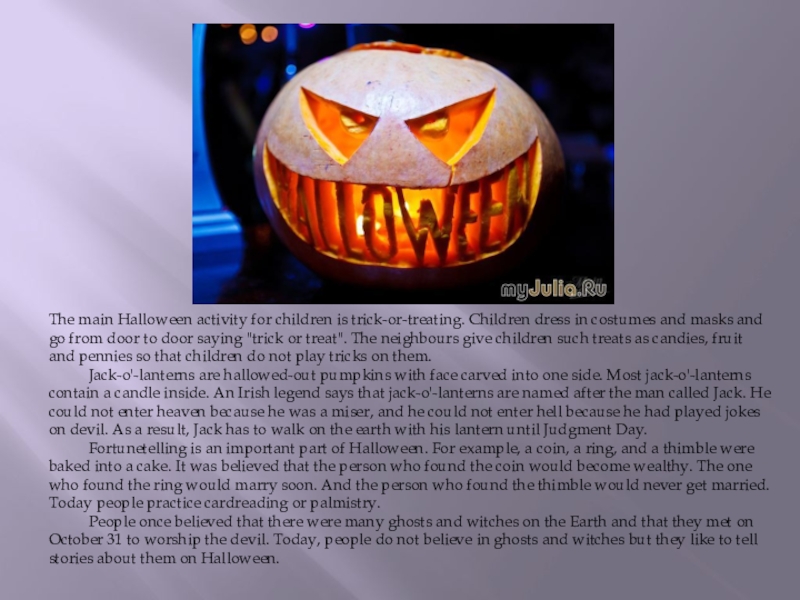
Jack-o'-lanterns are hallowed-out pumpkins with face carved into one side. Most jack-o'-lanterns contain a candle inside. An Irish legend says that jack-o'-lanterns are named after the man called Jack. He could not enter heaven because he was a miser, and he could not enter hell because he had played jokes on devil. As a result, Jack has to walk on the earth with his lantern until Judgment Day.
Fortunetelling is an important part of Halloween. For example, a coin, a ring, and a thimble were baked into a cake. It was believed that the person who found the coin would become wealthy. The one who found the ring would marry soon. And the person who found the thimble would never get married. Today people practice cardreading or palmistry.
People once believed that there were many ghosts and witches on the Earth and that they met on October 31 to worship the devil. Today, people do not believe in ghosts and witches but they like to tell stories about them on Halloween.
Jack-o'-lanterns are hallowed-out pumpkins with face carved into one side. Most jack-o'-lanterns contain a candle inside. An Irish legend says that jack-o'-lanterns are named after the man called Jack. He could not enter heaven because he was a miser, and he could not enter hell because he had played jokes on devil. As a result, Jack has to walk on the earth with his lantern until Judgment Day.
Fortunetelling is an important part of Halloween. For example, a coin, a ring, and a thimble were baked into a cake. It was believed that the person who found the coin would become wealthy. The one who found the ring would marry soon. And the person who found the thimble would never get married. Today people practice cardreading or palmistry.
People once believed that there were many ghosts and witches on the Earth and that they met on October 31 to worship the devil. Today, people do not believe in ghosts and witches but they like to tell stories about them on Halloween.
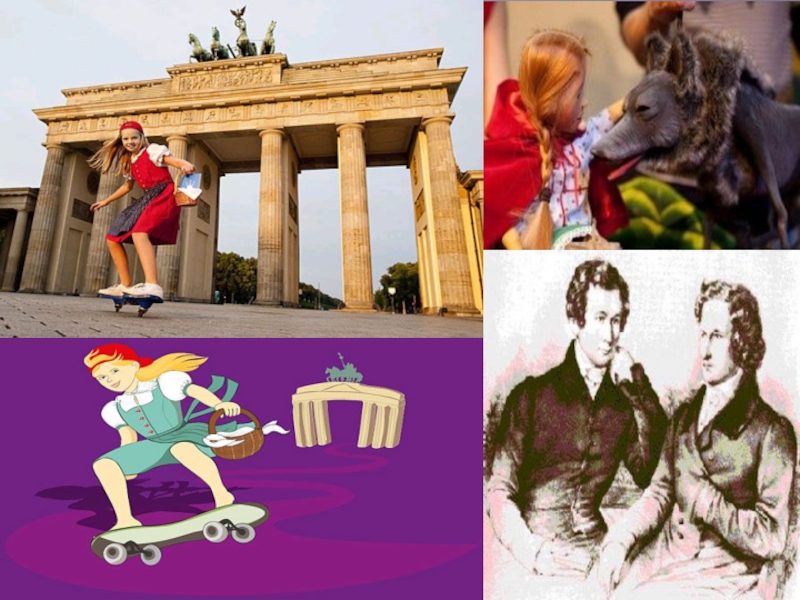
Слайд 17Fairy tale Festival takes place in Berlin from 3 to 20
November. It was founded in 1989 . 200 artists and authors at 200 sites in all 12 districts of Berlin tell tales. The Festival began on 8 November and already for 23 times the place is chosen by the German capital. Тhe purpose of this extraordinary Festival is the maintenance and growth of cultural heritage in the form of fairy tales, stories and legends. The Festival is attended by over 350 libraries, theaters and cultural institutions of the city.
Festival of fairy tales in Berlin
Слайд 19Tulip festival in Morges
The festival was created to celebrate the 50th
anniversary of the Horticultural Society in 1971.
Слайд 20The traditional Tulip Festival is held in the Swiss town of
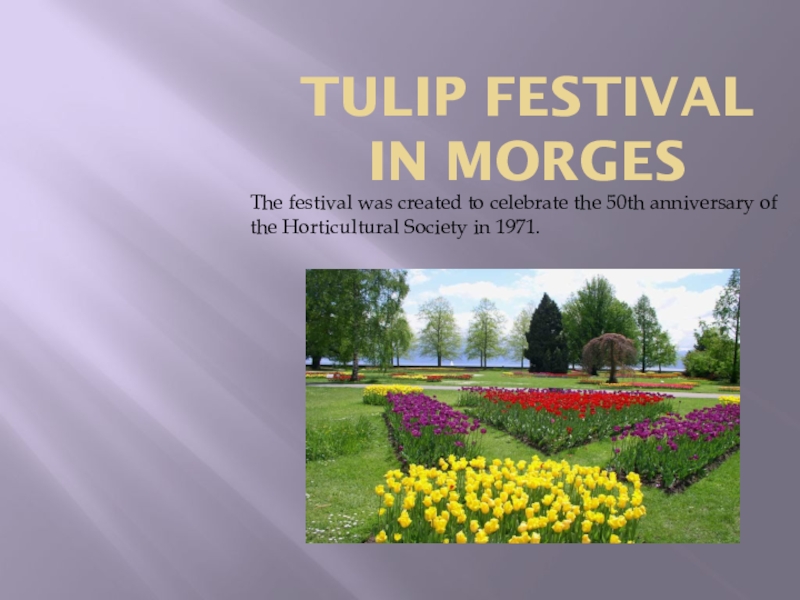
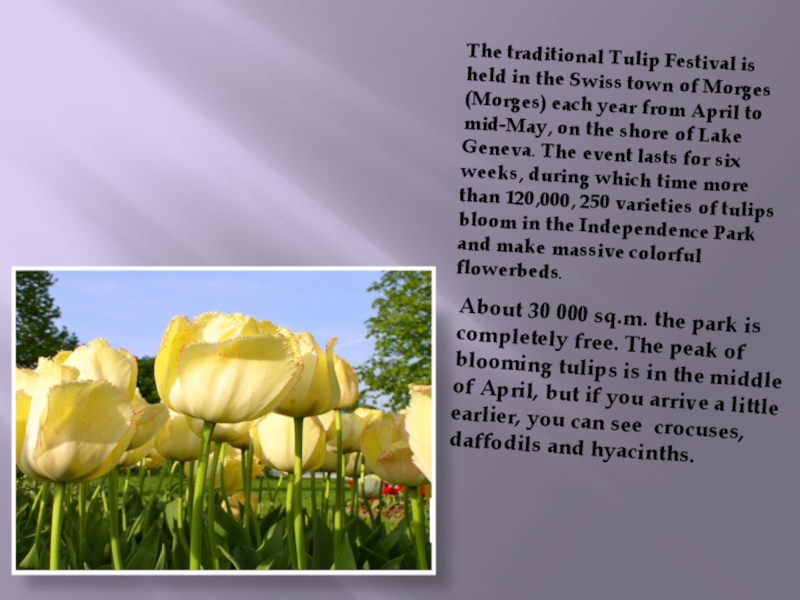
Morges (Morges) each year from April to mid-May, on the shore of Lake Geneva. The event lasts for six weeks, during which time more than 120,000, 250 varieties of tulips bloom in the Independence Park and make massive colorful flowerbeds.
About 30 000 sq.m. the park is completely free. The peak of blooming tulips is in the middle of April, but if you arrive a little earlier, you can see crocuses, daffodils and hyacinths.
Слайд 22Italian cuisine is known throughout the world as one of the
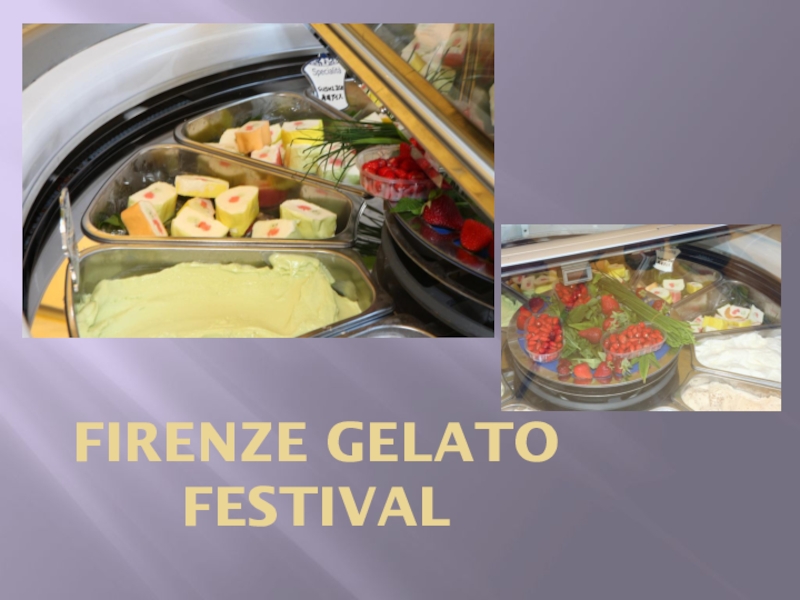
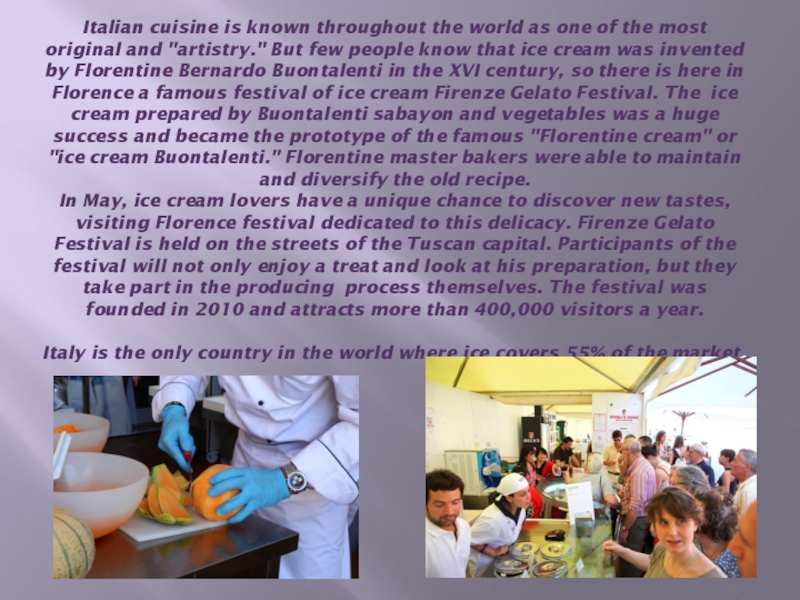
most original and "artistry." But few people know that ice cream was invented by Florentine Bernardo Buontalenti in the XVI century, so there is here in Florence a famous festival of ice cream Firenze Gelato Festival. The ice cream prepared by Buontalenti sabayon and vegetables was a huge success and became the prototype of the famous "Florentine cream" or "ice cream Buontalenti." Florentine master bakers were able to maintain and diversify the old recipe.
In May, ice cream lovers have a unique chance to discover new tastes, visiting Florence festival dedicated to this delicacy. Firenze Gelato Festival is held on the streets of the Tuscan capital. Participants of the festival will not only enjoy a treat and look at his preparation, but they take part in the producing process themselves. The festival was founded in 2010 and attracts more than 400,000 visitors a year.
Italy is the only country in the world where ice covers 55% of the market.
Слайд 23
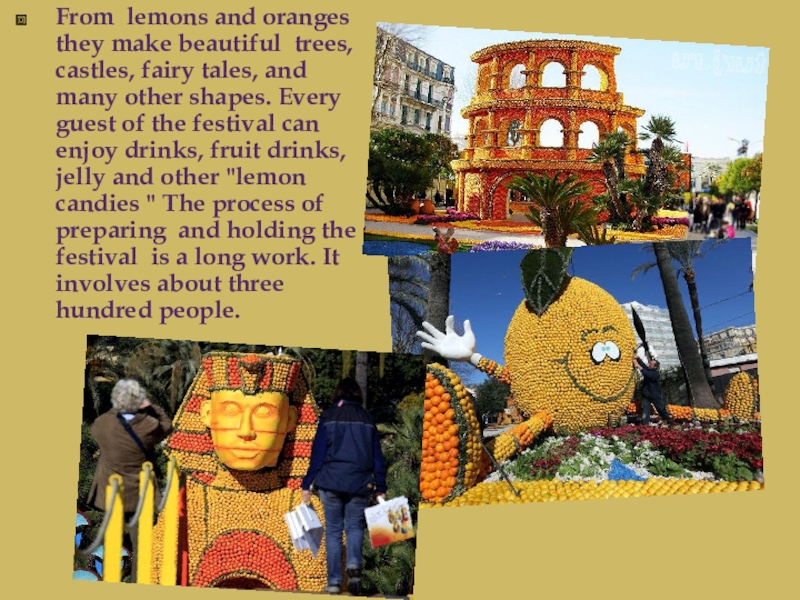
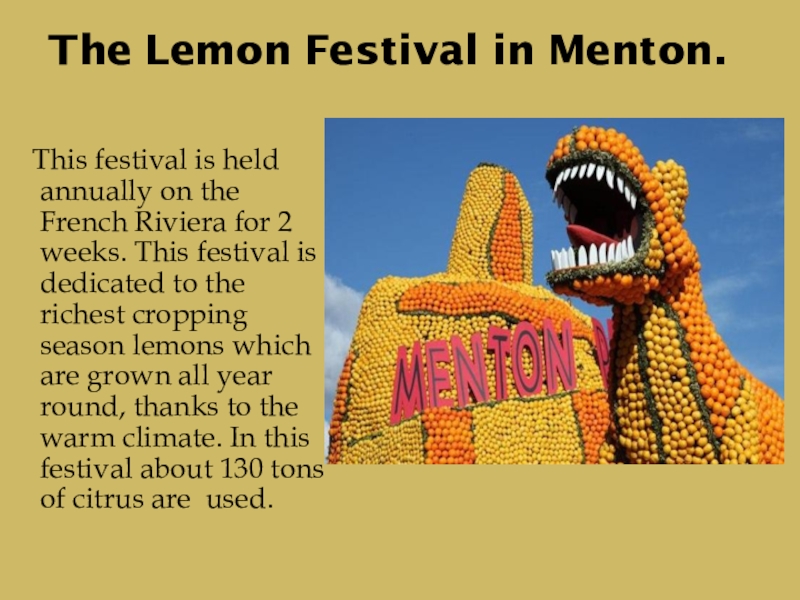
This festival is held annually on the French Riviera
for 2 weeks. This festival is dedicated to the richest cropping season lemons which are grown all year round, thanks to the warm climate. In this festival about 130 tons of citrus are used.
The Lemon Festival in Menton.
Слайд 24From lemons and oranges they make beautiful trees, castles, fairy tales,
and many other shapes. Every guest of the festival can enjoy drinks, fruit drinks, jelly and other "lemon candies " The process of preparing and holding the festival is a long work. It involves about three hundred people.