Презентация, доклад по теме Реализация проблемного подхода в обучении говорению

Содержание

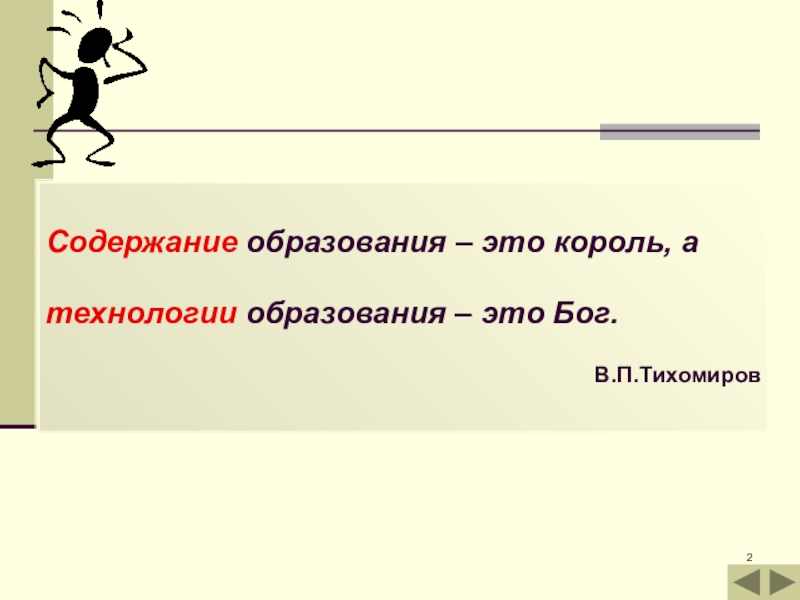
Содержание образования – это король, а технологии образования – это Бог. В.П.Тихомиров

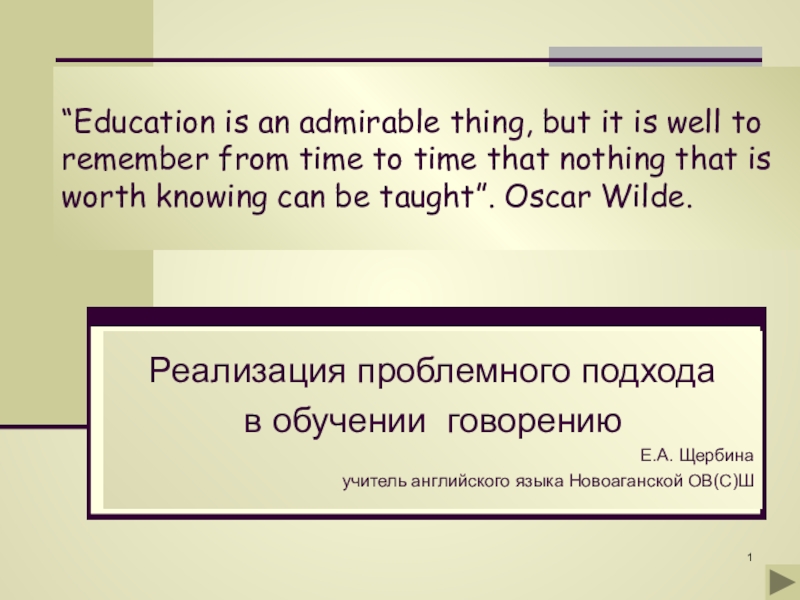
Слайд 1“Education is an admirable thing, but it is well to remember

from time to time that nothing that is worth knowing can be taught”. Oscar Wilde.


Реализация проблемного подхода
в обучении говорению
Е.А. Щербина
учитель английского языка Новоаганской ОВ(С)Ш
“Education is an admirable thing, but it is well to remember from time to time that nothing

Слайд 2
Содержание образования – это король, а

технологии образования –

это Бог.

В.П.Тихомиров


Содержание образования – это король, а технологии образования – это Бог.  В.П.Тихомиров

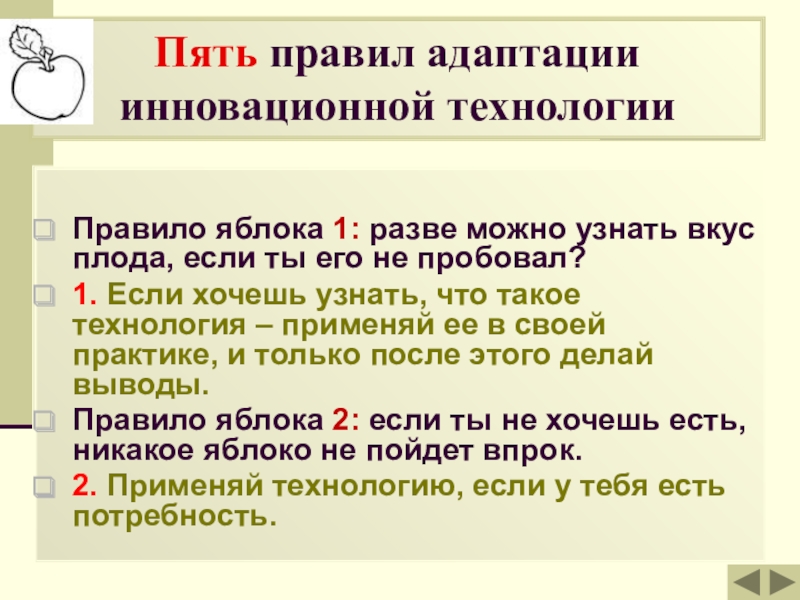
Слайд 3 Пять правил адаптации инновационной технологии

Правило яблока 1: разве можно

узнать вкус плода, если ты его не пробовал?
1. Если хочешь узнать, что такое технология – применяй ее в своей практике, и только после этого делай выводы.
Правило яблока 2: если ты не хочешь есть, никакое яблоко не пойдет впрок.
2. Применяй технологию, если у тебя есть потребность.


Пять правил адаптации инновационной технологии   Правило яблока 1: разве можно узнать вкус плода, если

Слайд 4 Пять правил адаптации инновационной технологии
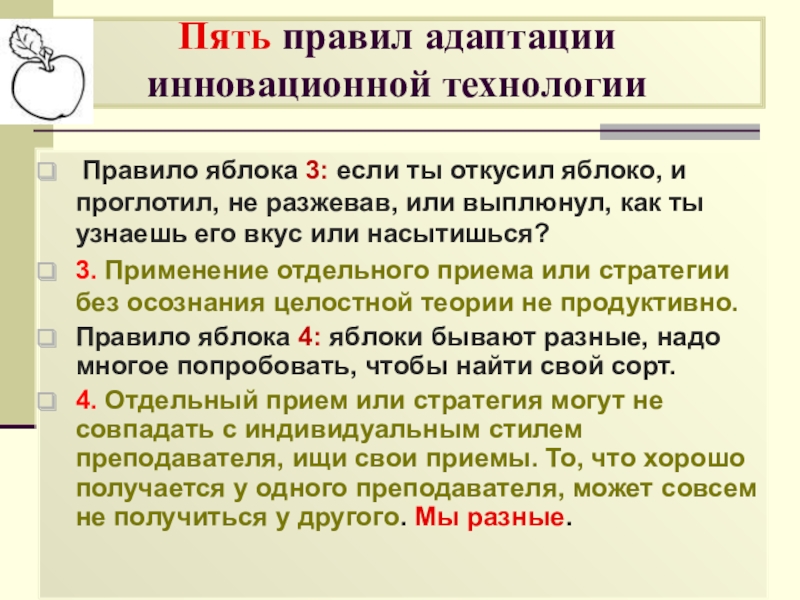
Правило яблока 3: если ты

откусил яблоко, и проглотил, не разжевав, или выплюнул, как ты узнаешь его вкус или насытишься?
3. Применение отдельного приема или стратегии без осознания целостной теории не продуктивно.
Правило яблока 4: яблоки бывают разные, надо многое попробовать, чтобы найти свой сорт.
4. Отдельный прием или стратегия могут не совпадать с индивидуальным стилем преподавателя, ищи свои приемы. То, что хорошо получается у одного преподавателя, может совсем не получиться у другого. Мы разные.


Пять правил адаптации инновационной технологии   Правило яблока 3: если ты откусил яблоко, и проглотил,

Слайд 5 Пять правил адаптации инновационной технологии

Правило яблока 5: если

ты не вырастил не одной яблони, разве ты можешь быть Мичуриным?
Помни, что преподавание требует меры, меры между репродукцией и творчеством. Освой технологию сначала на репродуктивном уровне, а затем твори.


Пять правил адаптации инновационной технологии    Правило яблока 5: если ты не вырастил не

Слайд 6Что такое проблемное обучение?
Проблемное обучение нацелено на развитие творческого
мышления, творческих

межличностных отношений,
творческой личности в процессе творческой деятельности
по постановке и решению проблем на различных уровнях
проблемности. В его основе лежит понимание творческого
мышления, как мышления основанное на решении
проблемной ситуации.


Что такое проблемное обучение?Проблемное обучение нацелено на развитие творческого мышления, творческих межличностных отношений, творческой личности в процессе

Слайд 7 ПРОБЛЕМА

это осознание субъектом невозможности разрешить трудности и

противоречия, возникшие в данной ситуации, средствами наличного знания и опыта.

ПРОБЛЕМА    это осознание субъектом невозможности разрешить трудности и противоречия, возникшие в данной ситуации,

Слайд 8Принципом проблемного обучения является отсутствие знаний для решения определенной проблемы в

готовом виде, что и создает необходимость в их добывании.


Принципом проблемного обучения является отсутствие знаний для решения определенной проблемы в готовом виде, что и создает необходимость

Слайд 9У учащихся должно возникнуть психическое состояние интеллектуального затруднения и чувство неудовлетворенности

имеющимися представлениями и знаниями.


У учащихся должно возникнуть психическое состояние интеллектуального затруднения и чувство неудовлетворенности имеющимися представлениями и знаниями.

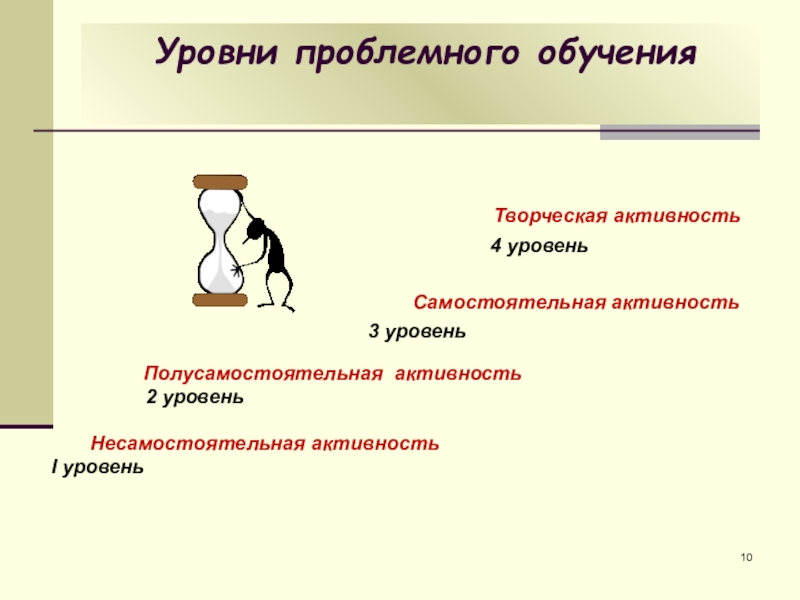
Слайд 10 Уровни проблемного обучения


Полусамостоятельная активность
2 уровень

Несамостоятельная активность
I уровень


Творческая активность
4 уровень

Самостоятельная активность
3 уровень
Уровни проблемного обучения

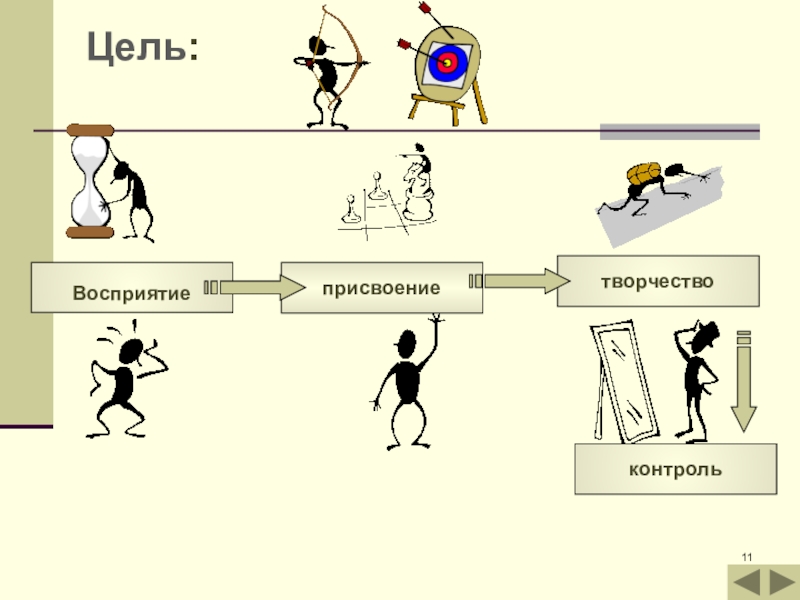
Слайд 11

Восприятие


присвоение
творчество


контроль

Цель:

Восприятиеприсвоениетворчествоконтроль Цель:

Слайд 12

Theme: Phone Conversation Aim: 1. Develop language skills

in listening, reading, speaking, through problem solving tasks 2. Develop mental abilities through solving communication problems by comparing, analyzing, logical thinking and evaluating. 3. Develop communication culture. Уровень: полусамостоятельной и самостоятельной активности I. Принятие цели и задачи урока учащимися через проблемное изложение материала. Проблематизировать, значит вскрыть «невидимую» проблему. The problems can be: a. Cultural b. Language c. Situational.
Theme: Phone Conversation  Aim:  1.    Develop language skills in listening, reading, speaking,

Слайд 13

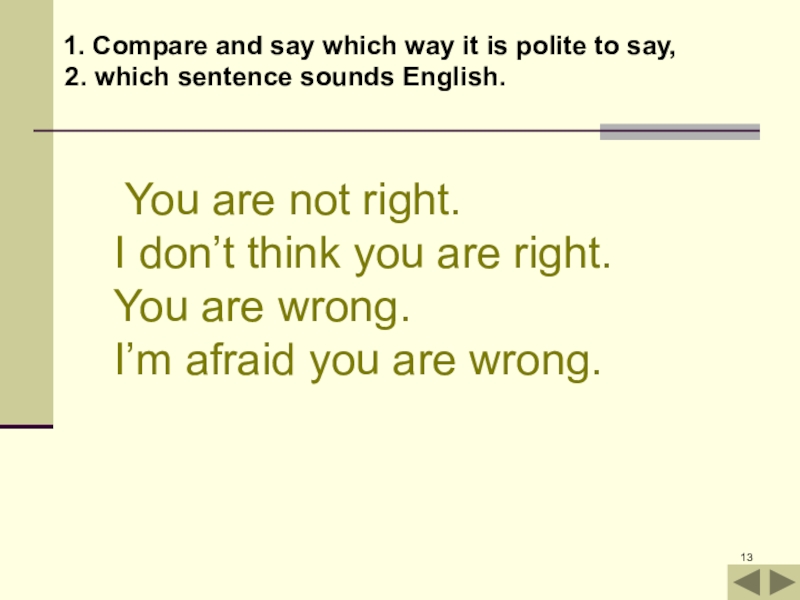
You are not right.
I don’t think you are right.
You are

wrong.
I’m afraid you are wrong.

1. Compare and say which way it is polite to say,
2. which sentence sounds English.
You are not right.I don’t think you are right.You are wrong.I’m afraid you are wrong. 1.

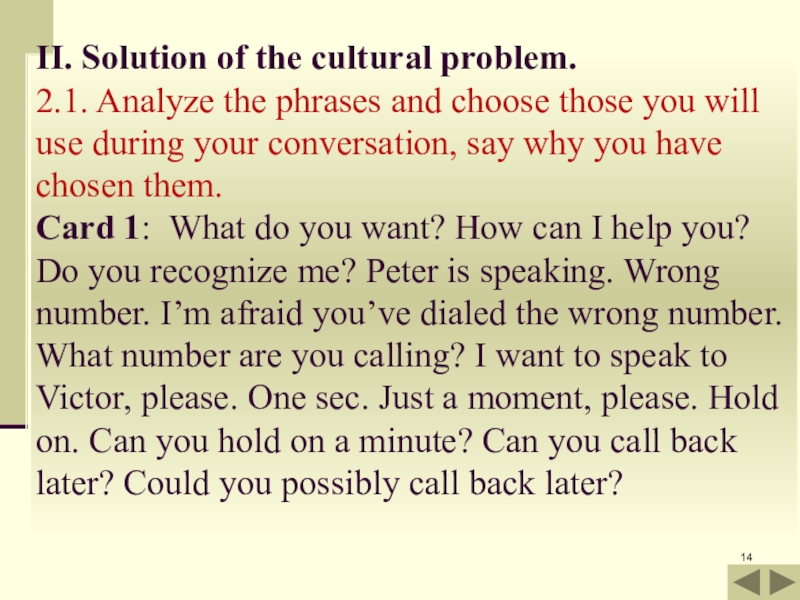
Слайд 14II. Solution of the cultural problem. 2.1. Analyze the phrases and choose

those you will use during your conversation, say why you have chosen them. Card 1:  What do you want? How can I help you? Do you recognize me? Peter is speaking. Wrong number. I’m afraid you’ve dialed the wrong number. What number are you calling? I want to speak to Victor, please. One sec. Just a moment, please. Hold on. Can you hold on a minute? Can you call back later? Could you possibly call back later?


II. Solution of the cultural problem. 2.1. Analyze the phrases and choose those you will use during

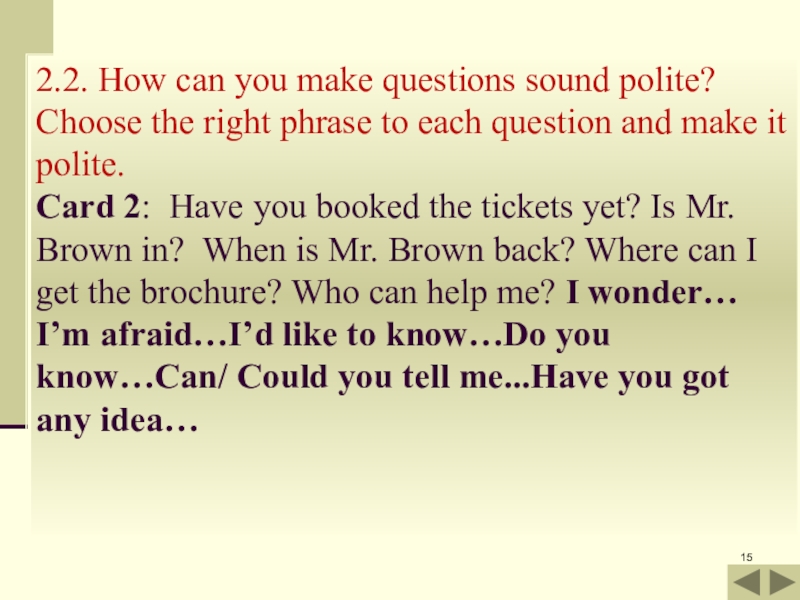
Слайд 152.2. How can you make questions sound polite? Choose the right

phrase to each question and make it polite. Card 2:  Have you booked the tickets yet? Is Mr. Brown in?  When is Mr. Brown back? Where can I get the brochure? Who can help me? I wonder… I’m afraid…I’d like to know…Do you know…Can/ Could you tell me...Have you got any idea…


2.2. How can you make questions sound polite? Choose the right phrase to each question and make

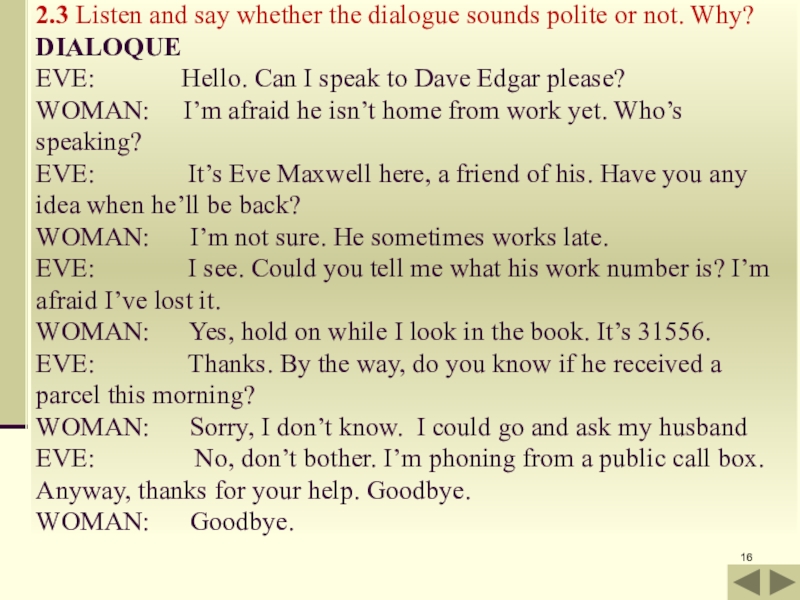
Слайд 16 2.3 Listen and say whether the dialogue sounds polite or not.

Why? DIALOQUE EVE:             Hello. Can I speak to Dave Edgar please? WOMAN:     I’m afraid he isn’t home from work yet. Who’s speaking? EVE:              It’s Eve Maxwell here, a friend of his. Have you any idea when he’ll be back? WOMAN:      I’m not sure. He sometimes works late. EVE:              I see. Could you tell me what his work number is? I’m afraid I’ve lost it. WOMAN:      Yes, hold on while I look in the book. It’s 31556. EVE:              Thanks. By the way, do you know if he received a parcel this morning? WOMAN:      Sorry, I don’t know. I could go and ask my husband EVE:         No, don’t bother. I’m phoning from a public call box. Anyway, thanks for your help. Goodbye. WOMAN:      Goodbye.


2.3 Listen and say whether the dialogue sounds polite or not. Why?

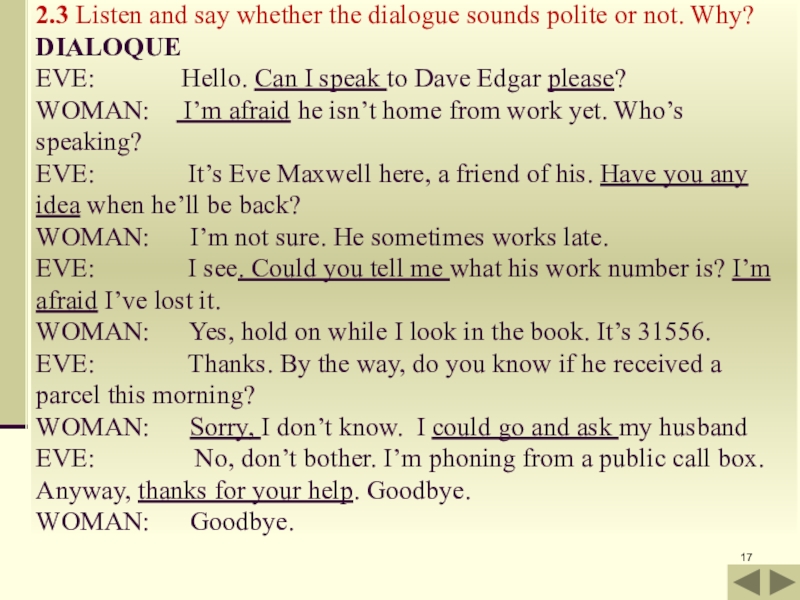
Слайд 17 2.3 Listen and say whether the dialogue sounds polite or not.

Why? DIALOQUE EVE:             Hello. Can I speak to Dave Edgar please? WOMAN:     I’m afraid he isn’t home from work yet. Who’s speaking? EVE:              It’s Eve Maxwell here, a friend of his. Have you any idea when he’ll be back? WOMAN:      I’m not sure. He sometimes works late. EVE:              I see. Could you tell me what his work number is? I’m afraid I’ve lost it. WOMAN:      Yes, hold on while I look in the book. It’s 31556. EVE:              Thanks. By the way, do you know if he received a parcel this morning? WOMAN:      Sorry, I don’t know. I could go and ask my husband EVE:         No, don’t bother. I’m phoning from a public call box. Anyway, thanks for your help. Goodbye. WOMAN:      Goodbye.


2.3 Listen and say whether the dialogue sounds polite or not. Why?

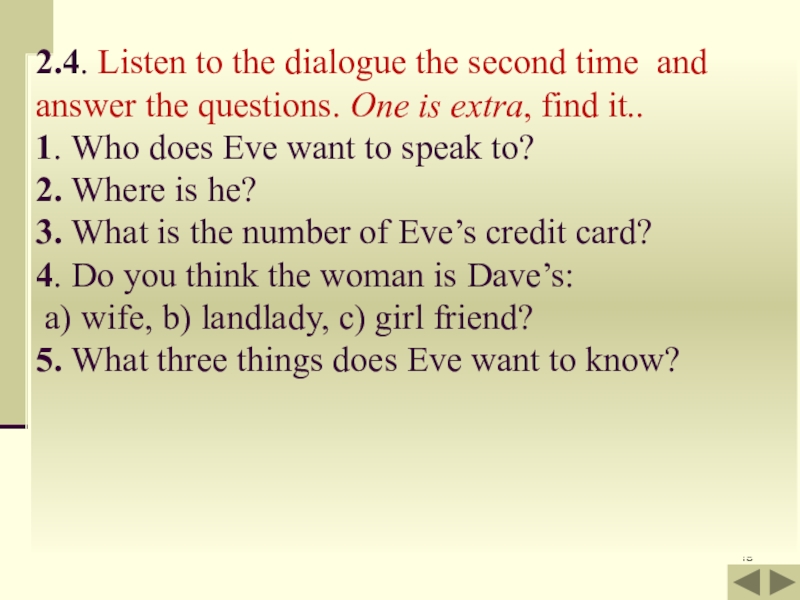
Слайд 182.4. Listen to the dialogue the second time and answer the

questions. One is extra, find it.. 1. Who does Eve want to speak to? 2. Where is he? 3. What is the number of Eve’s credit card? 4. Do you think the woman is Dave’s: a) wife, b) landlady, c) girl friend? 5. What three things does Eve want to know?


2.4. Listen to the dialogue the second time and answer the questions. One is extra, find it..

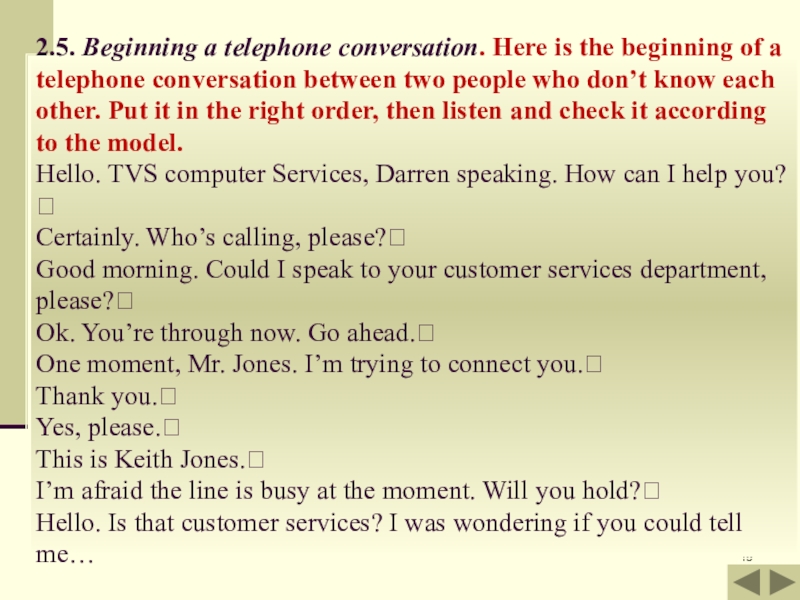
Слайд 19 2.5. Beginning a telephone conversation. Here is the beginning of a

telephone conversation between two people who don’t know each other. Put it in the right order, then listen and check it according to the model. Hello. TVS computer Services, Darren speaking. How can I help you? Certainly. Who’s calling, please? Good morning. Could I speak to your customer services department, please? Ok. You’re through now. Go ahead. One moment, Mr. Jones. I’m trying to connect you. Thank you. Yes, please. This is Keith Jones. I’m afraid the line is busy at the moment. Will you hold? Hello. Is that customer services? I was wondering if you could tell me…


2.5. Beginning a telephone conversation. Here is the beginning of

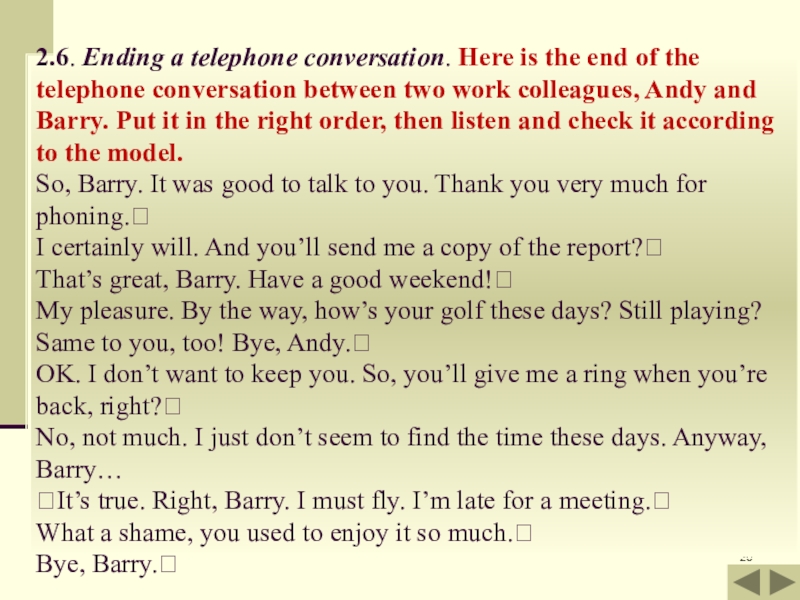
Слайд 20 2.6. Ending a telephone conversation. Here is the end of

the telephone conversation between two work colleagues, Andy and Barry. Put it in the right order, then listen and check it according to the model. So, Barry. It was good to talk to you. Thank you very much for phoning. I certainly will. And you’ll send me a copy of the report? That’s great, Barry. Have a good weekend! My pleasure. By the way, how’s your golf these days? Still playing? Same to you, too! Bye, Andy. OK. I don’t want to keep you. So, you’ll give me a ring when you’re back, right? No, not much. I just don’t seem to find the time these days. Anyway, Barry… It’s true. Right, Barry. I must fly. I’m late for a meeting. What a shame, you used to enjoy it so much. Bye, Barry.


2.6. Ending a

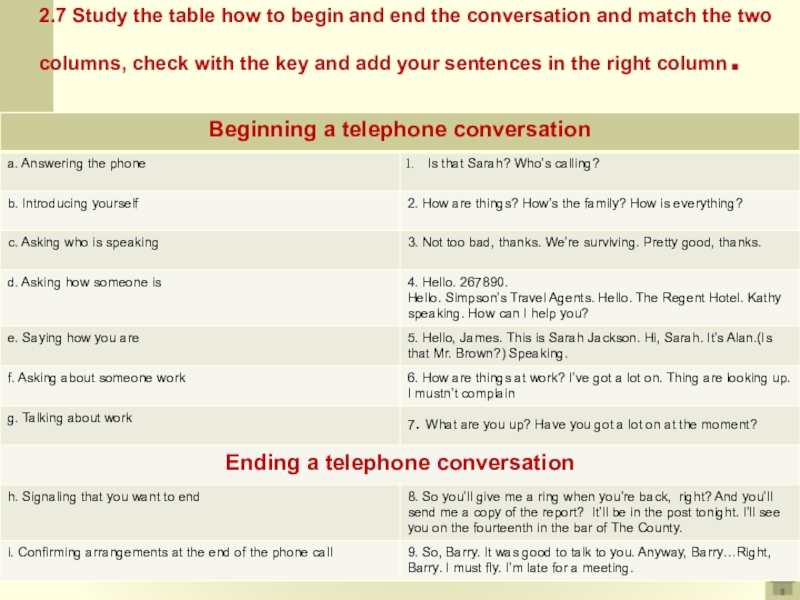
Слайд 21

2.7 Study the table how to begin and end the conversation

and match the two columns, check with the key and add your sentences in the right column.
2.7 Study the table how to begin and end the conversation and match the two columns, check

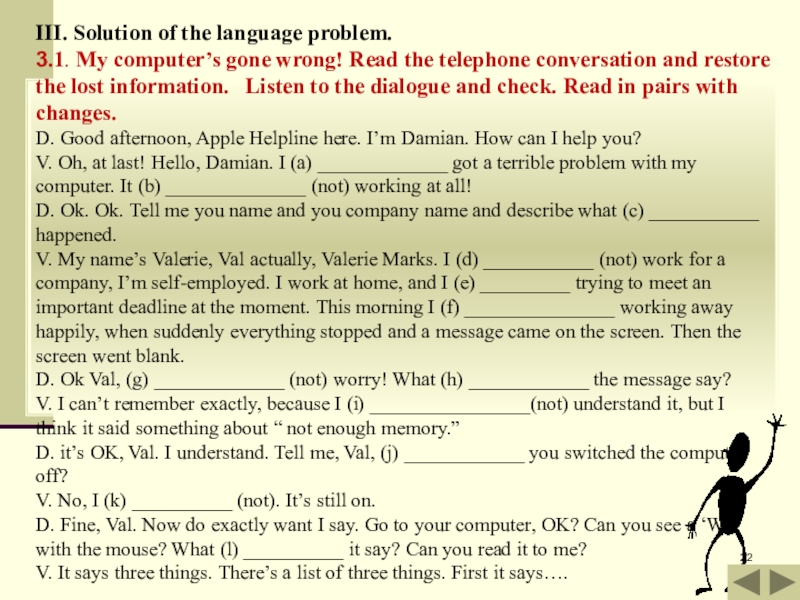
Слайд 22 III. Solution of the language problem. 3.1. My computer’s gone wrong!

Read the telephone conversation and restore the lost information. Listen to the dialogue and check. Read in pairs with changes. D. Good afternoon, Apple Helpline here. I’m Damian. How can I help you? V. Oh, at last! Hello, Damian. I (a) _____________ got a terrible problem with my computer. It (b) ______________ (not) working at all! D. Ok. Ok. Tell me you name and you company name and describe what (c) ___________ happened. V. My name’s Valerie, Val actually, Valerie Marks. I (d) ___________ (not) work for a company, I’m self-employed. I work at home, and I (e) _________ trying to meet an important deadline at the moment. This morning I (f) _______________ working away happily, when suddenly everything stopped and a message came on the screen. Then the screen went blank. D. Ok Val, (g) _____________ (not) worry! What (h) ____________ the message say? V. I can’t remember exactly, because I (i) ________________(not) understand it, but I think it said something about “ not enough memory.” D. it’s OK, Val. I understand. Tell me, Val, (j) ____________ you switched the computer off? V. No, I (k) __________ (not). It’s still on. D. Fine, Val. Now do exactly want I say. Go to your computer, OK? Can you see a ‘W’ with the mouse? What (l) __________ it say? Can you read it to me? V. It says three things. There’s a list of three things. First it says….


III. Solution of the language problem.  3.1. My computer’s gone wrong!

Слайд 23

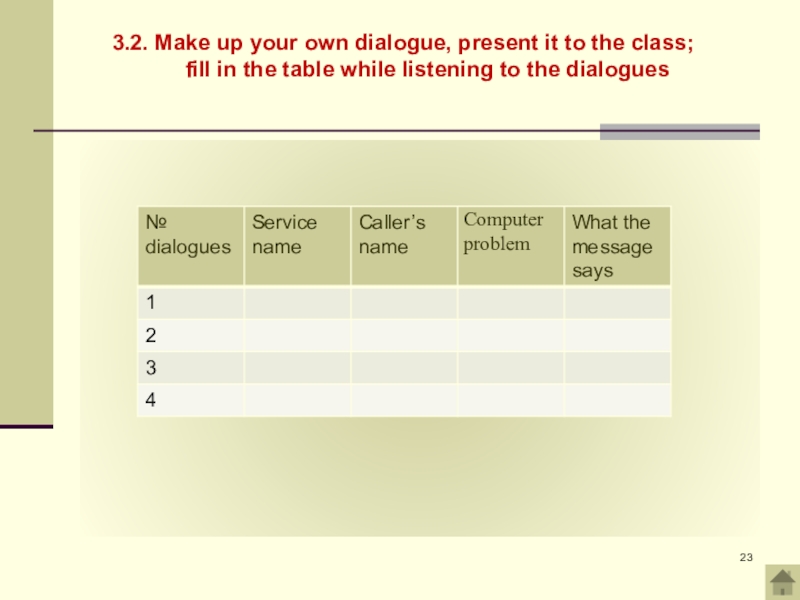
3.2. Make up your own dialogue, present it to the class;


fill in the table while listening to the dialogues
3.2. Make up your own dialogue, present it to the class;     fill in

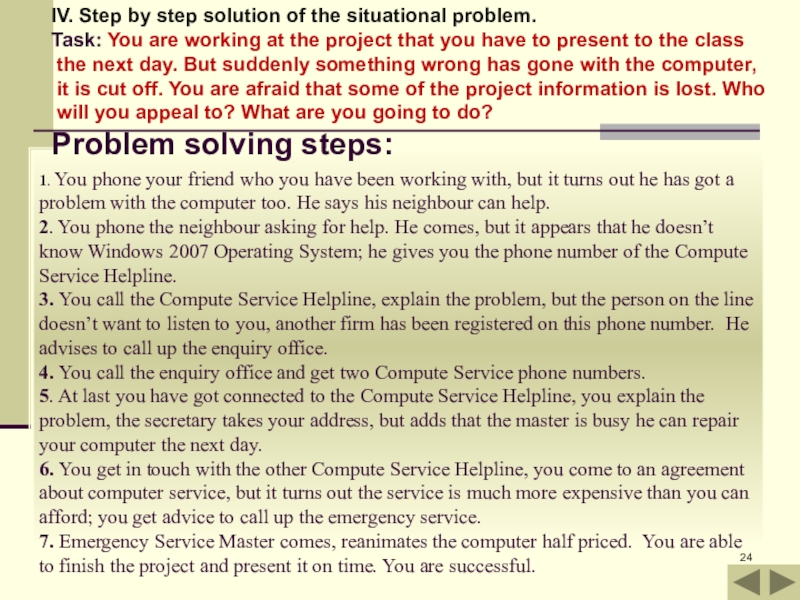
Слайд 24 1. You phone your friend who you have been working with,

but it turns out he has got a problem with the computer too. He says his neighbour can help. 2. You phone the neighbour asking for help. He comes, but it appears that he doesn’t know Windows 2007 Operating System; he gives you the phone number of the Compute Service Helpline. 3. You call the Compute Service Helpline, explain the problem, but the person on the line doesn’t want to listen to you, another firm has been registered on this phone number. He advises to call up the enquiry office. 4. You call the enquiry office and get two Compute Service phone numbers. 5. At last you have got connected to the Compute Service Helpline, you explain the problem, the secretary takes your address, but adds that the master is busy he can repair your computer the next day. 6. You get in touch with the other Compute Service Helpline, you come to an agreement about computer service, but it turns out the service is much more expensive than you can afford; you get advice to call up the emergency service. 7. Emergency Service Master comes, reanimates the computer half priced. You are able to finish the project and present it on time. You are successful.


IV. Step by step solution of the situational problem. Task: You are working at the project that you have to present to the class
the next day. But suddenly something wrong has gone with the computer,
it is cut off. You are afraid that some of the project information is lost. Who
will you appeal to? What are you going to do? Problem solving steps:
1. You

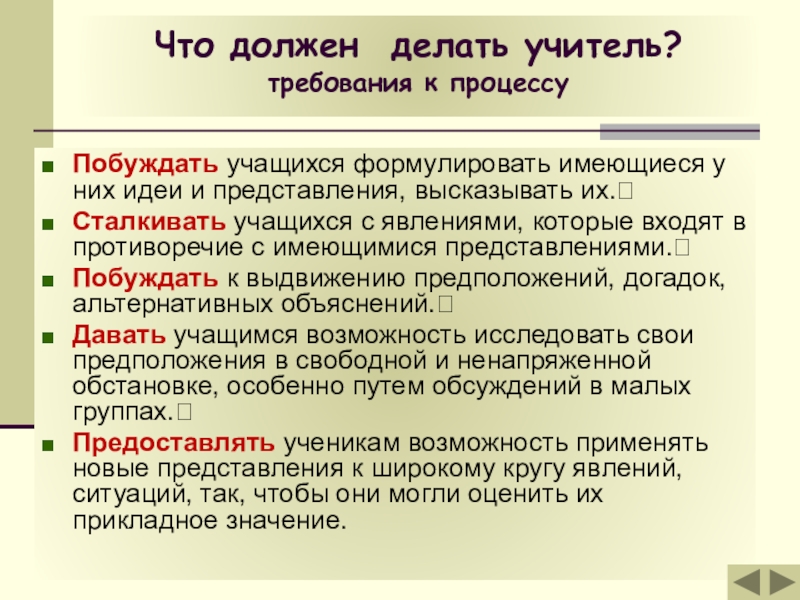
Слайд 25 Что должен  делать учитель? требования к процессу
Побуждать учащихся формулировать имеющиеся

у них идеи и представления, высказывать их.
Сталкивать учащихся с явлениями, которые входят в противоречие с имеющимися представлениями.
Побуждать к выдвижению предположений, догадок, альтернативных объяснений.
Давать учащимся возможность исследовать свои предположения в свободной и ненапряженной обстановке, особенно путем обсуждений в малых группах.
Предоставлять ученикам возможность применять новые представления к широкому кругу явлений, ситуаций, так, чтобы они могли оценить их прикладное значение.


Что должен  делать учитель? требования к процессу   Побуждать учащихся формулировать имеющиеся у них

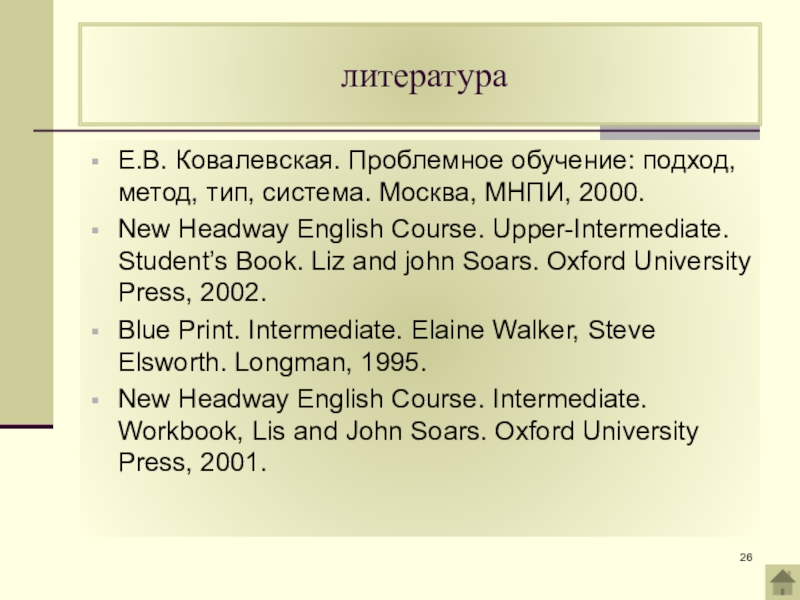
Слайд 26 литература
Е.В. Ковалевская. Проблемное обучение: подход, метод, тип, система. Москва, МНПИ,

2000.
New Headway English Course. Upper-Intermediate. Student’s Book. Liz and john Soars. Oxford University Press, 2002.
Blue Print. Intermediate. Elaine Walker, Steve Elsworth. Longman, 1995.
New Headway English Course. Intermediate. Workbook, Lis and John Soars. Oxford University Press, 2001.


литератураЕ.В. Ковалевская. Проблемное обучение: подход, метод, тип, система. Москва, МНПИ, 2000.New Headway English Course. Upper-Intermediate. Student’s

Что такое shareslide.ru?

Это сайт презентаций, где можно хранить и обмениваться своими презентациями, докладами, проектами, шаблонами в формате PowerPoint с другими пользователями. Мы помогаем школьникам, студентам, учителям, преподавателям хранить и обмениваться учебными материалами.


Для правообладателей

Яндекс.Метрика

Обратная связь

Email: Нажмите что бы посмотреть