Слайд 1Trudneva Olga Georgievna,
the English teacher of the highest category
The
mystery
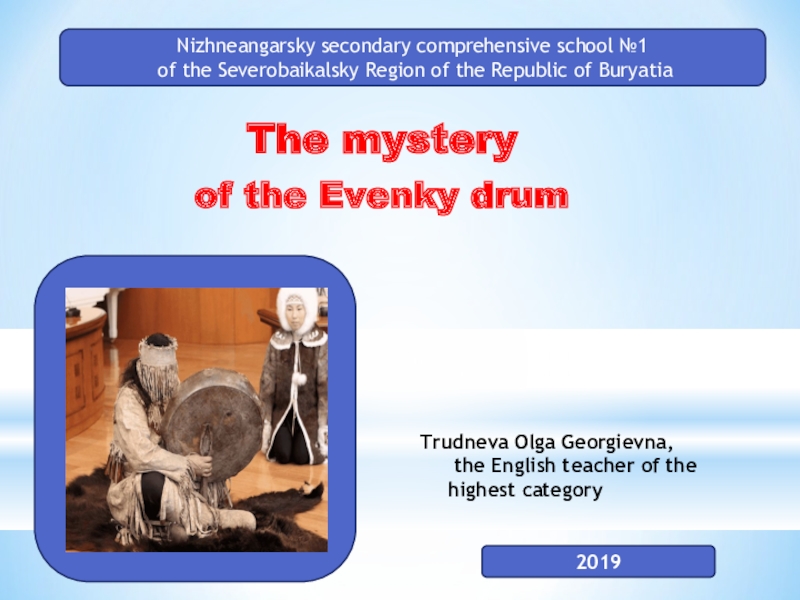
of the Evenky drum
Nizhneangarsky secondary comprehensive school №1
of the Severobaikalsky Region of the Republic of Buryatia
2019
Слайд 3Evenks
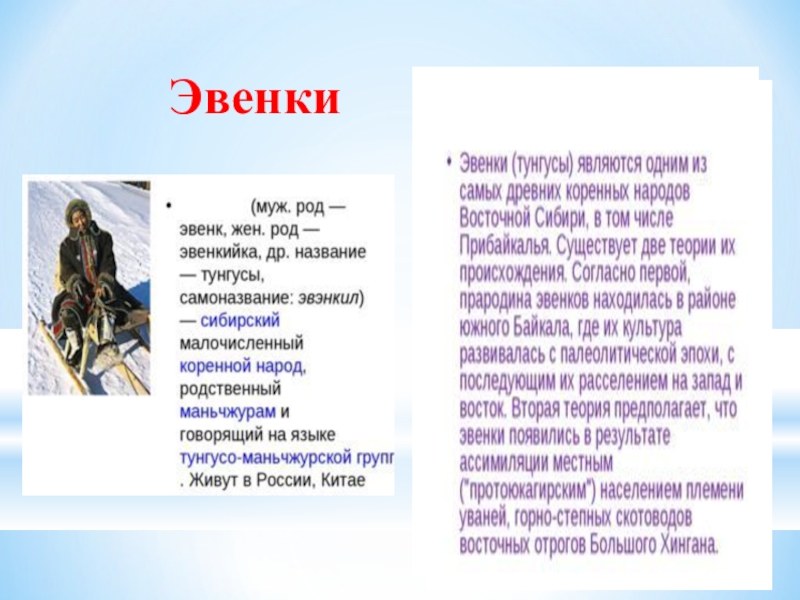
Evenks (Tungus) is one of the oldest indigenous peoples of Eastern
Siberia, including the Baikal region.
There are 2 theories of their origin. According to the first, the ancestral home of the Evenks was in the area of southern Baikal, where their culture developed from the Paleolithic era, followed by their resettlement to the West and East. The second theory suggests that they were the result of assimilation of local ("protoanalysis") population of the tribe uwana, mountain-steppe pastoralists of the Eastern spurs of the Great Khingan.
Siberian small number of indigenous people related to manchurians and speaking the language of the Tungus-Manchurian group
Слайд 4 ЭВЕ́НКИ
Всего в Российской Федерации 35,5 тысяч человек (2002).
На обширной
территории Сибири и Дальнего Востока, в том числе в Якутии 18,2 тыс. чел., коренное население Эвенкийского округа Красноярского края (3,8 тыс. чел.) .
35 тысяч эвенков живут на северо-западе Китая (1992). Верующие — приверженцы традиционных верований, православные.
2974 эвенка проживает на территории Бурятии в Баунтовском, Северобайкальском, Баргузинском и Курумканском районах.
Слайд 5Evenks
Total in the Russian Federation 35.5 thousand people live (2002).
On the
vast territory of Siberia and the Far East, including Yakutia 18.2 thousand people live, the indigenous population of the Evenk district of Krasnoyarsk territory is 3.8 thousand people.
35 thousand of Evenks live in the North-West of China (1992). Believers — adherents of traditional beliefs, Orthodox.
2974 Evenks live in the territory of Buryatia in Bauntovskiy, Severobaikalsky, Barguzinsky and Kurumkansky regions.
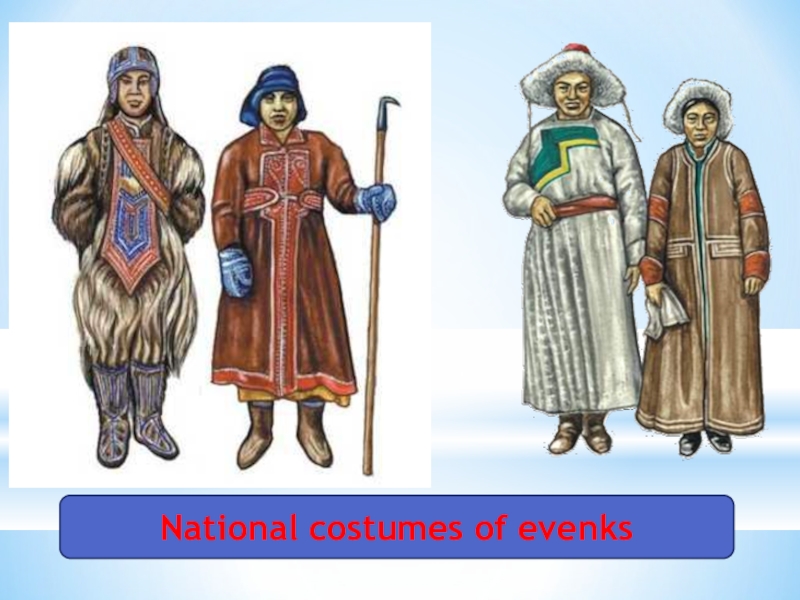
Слайд 6Национальные костюмы эвенков
National costumes of evenks
Слайд 8
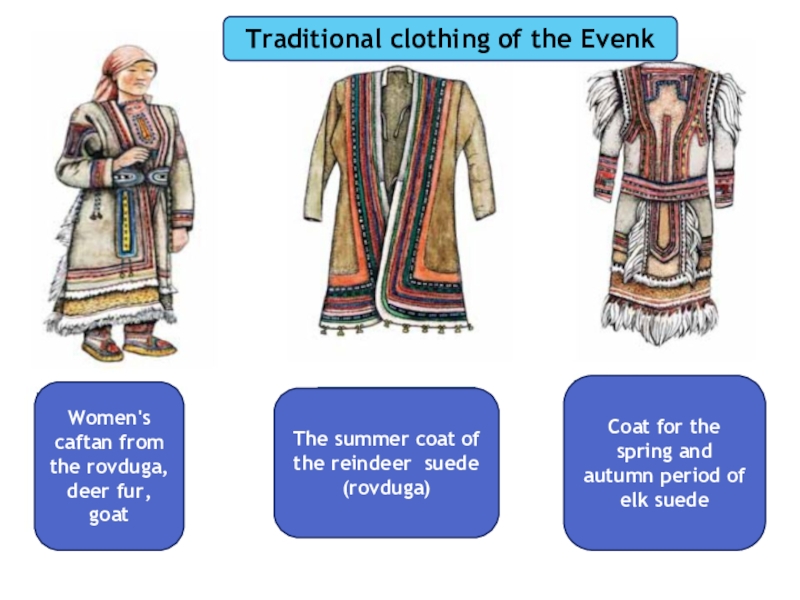
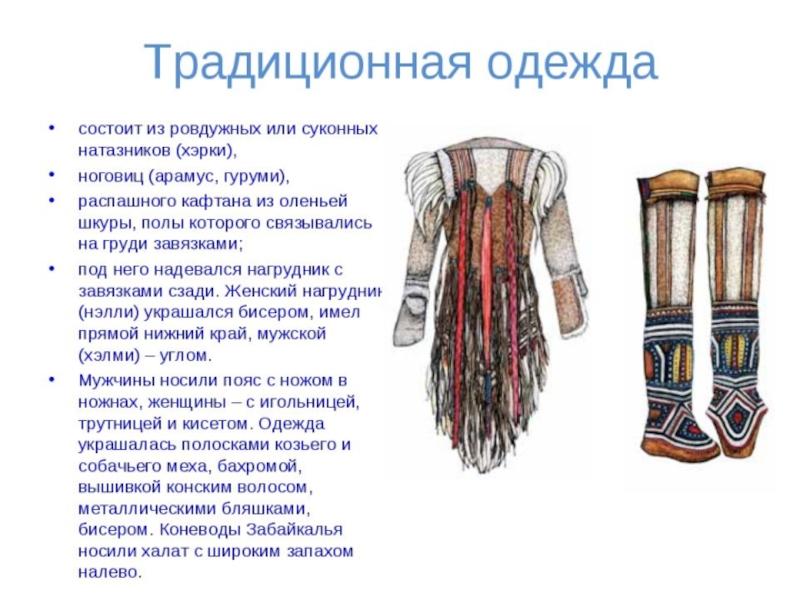
Traditional clothing of the Evenk
Women's caftan from the rovduga, deer fur,
goat
The summer coat of the reindeer suede
(rovduga)
Coat for the spring and autumn period of elk suede
Слайд 9
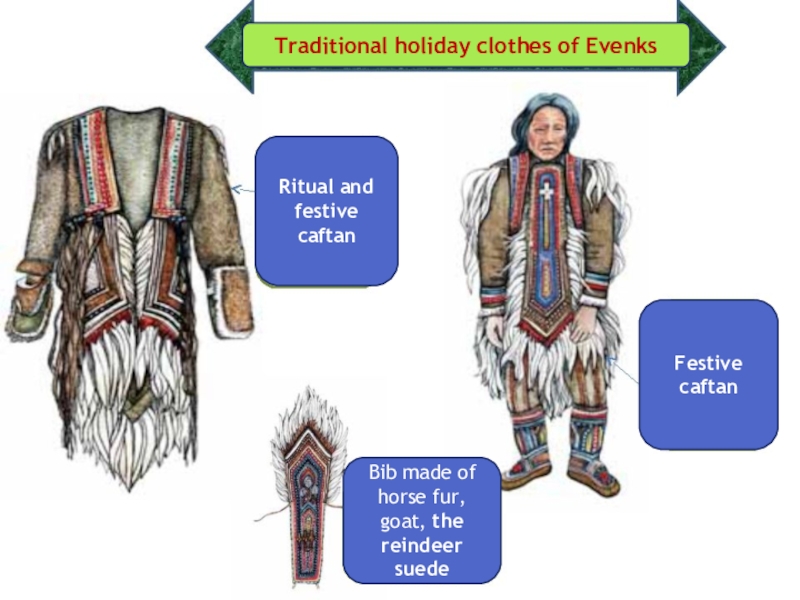
Traditional holiday clothes of Evenks
Ritual and festive caftan
Festive caftan
Bib made of
horse fur, goat, the reindeer suede
Слайд 10
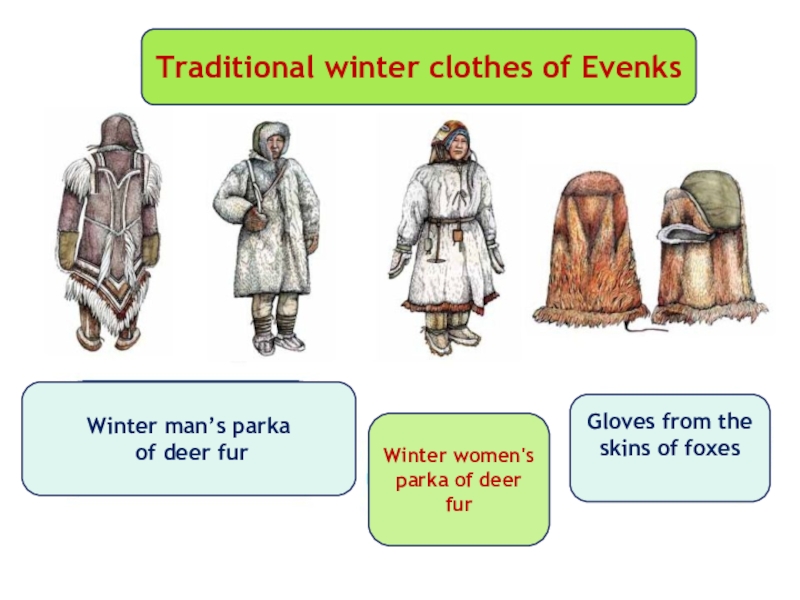
Traditional winter clothes of Evenks
Winter man’s parka
of deer fur
Winter
women's parka of deer fur
Gloves from the skins of foxes
Слайд 11
The main occupation of the Evenks is hunting elk, bear, deer,
lynx and other animals.
Deer are bred for transportation of goods and for riding.
Unlike the peoples living in the Arctic, herds which account for a thousand goals or more, they are holding on the 25th of deer.
Слайд 12
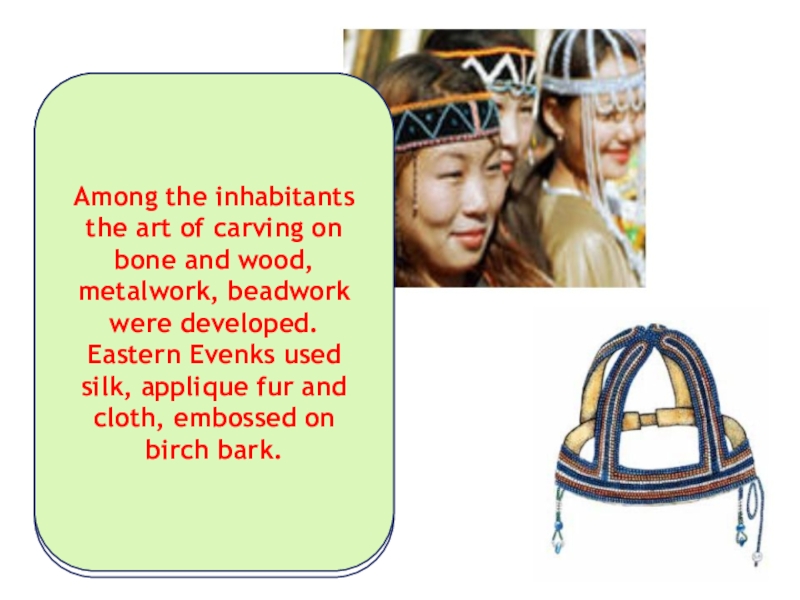
Among the inhabitants developed the art of carving on bone and
wood, metalwork, beadwork, Eastern Evenki silk, applique fur and cloth, embossed on birch bark.
Among the inhabitants the art of carving on bone and wood, metalwork, beadwork were developed. Eastern Evenks used silk, applique fur and cloth, embossed on birch bark.
Слайд 13
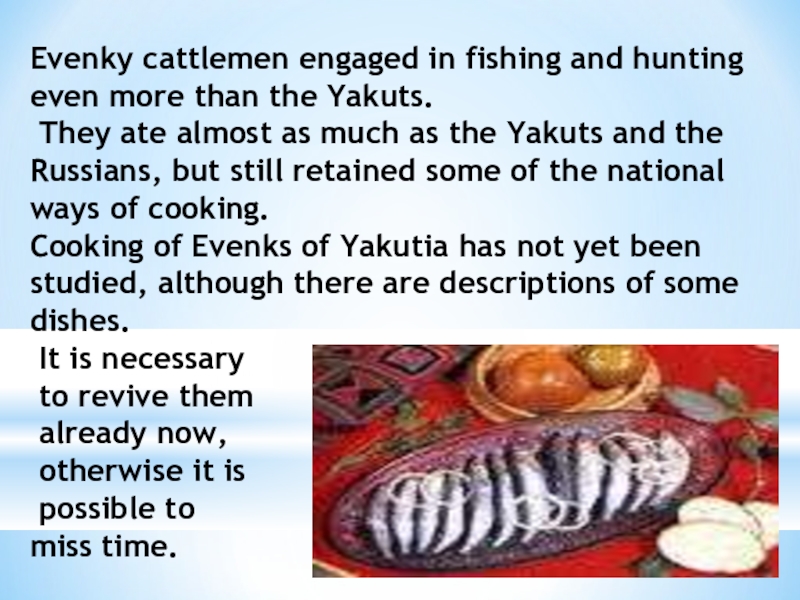
Evenky cattlemen engaged in fishing and hunting even more than the
Yakuts.
They ate almost as much as the Yakuts and the Russians, but still retained some of the national ways of cooking.
Cooking of Evenks of Yakutia has not yet been studied, although there are descriptions of some dishes.
It is necessary
to revive them
already now,
otherwise it is
possible to
miss time.
Слайд 14
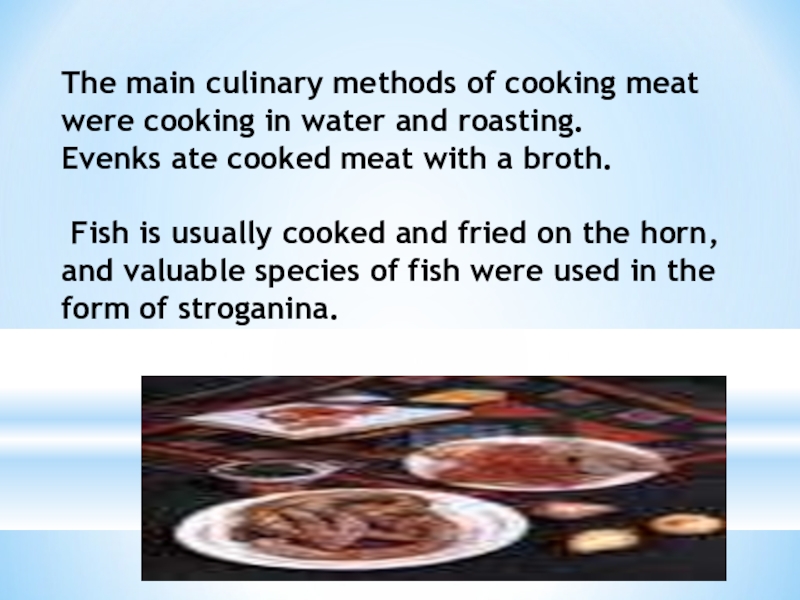
The main culinary methods of cooking meat were cooking in water
and roasting.
Evenks ate cooked meat with a broth.
Fish is usually cooked and fried on the horn, and valuable species of fish were used in the form of stroganina.
Слайд 15
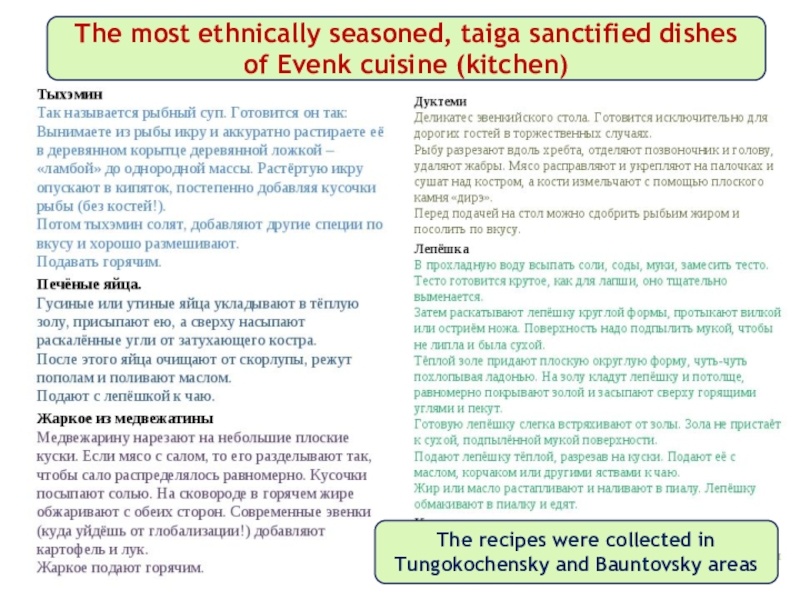
The most ethnically seasoned, taiga sanctified dishes
of Evenk cuisine (kitchen)
The
recipes were collected in Tungokochensky and Bauntovsky areas
Слайд 16
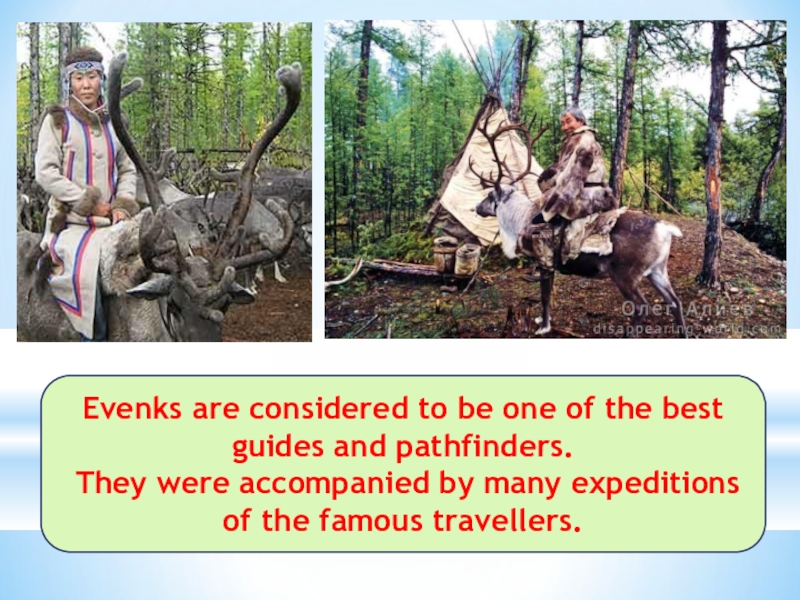
Evenks are considered to be one of the best guides and
pathfinders.
They were accompanied by many expeditions of the famous travellers.
Слайд 17Эвенки – дети природы. Игры и танцы – это подражание живой
природе.
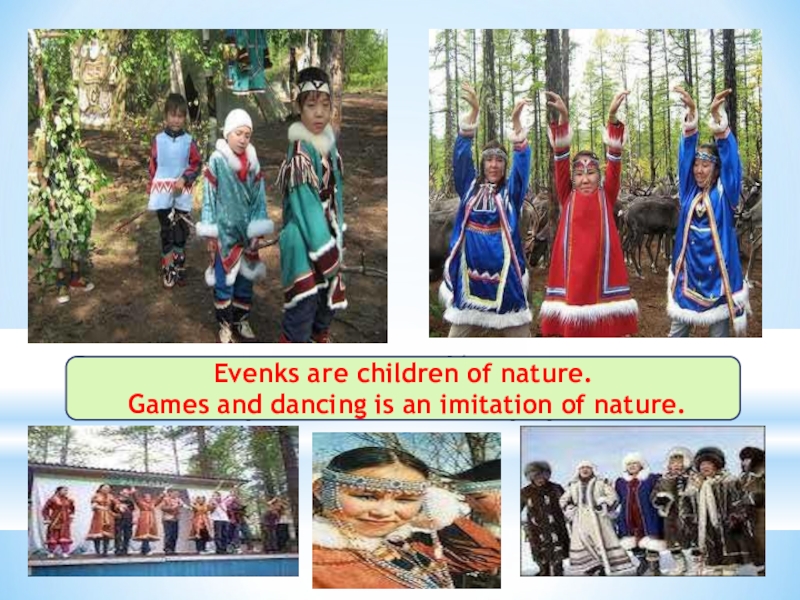
Evenks are children of nature.
Games and dancing is an imitation of nature.
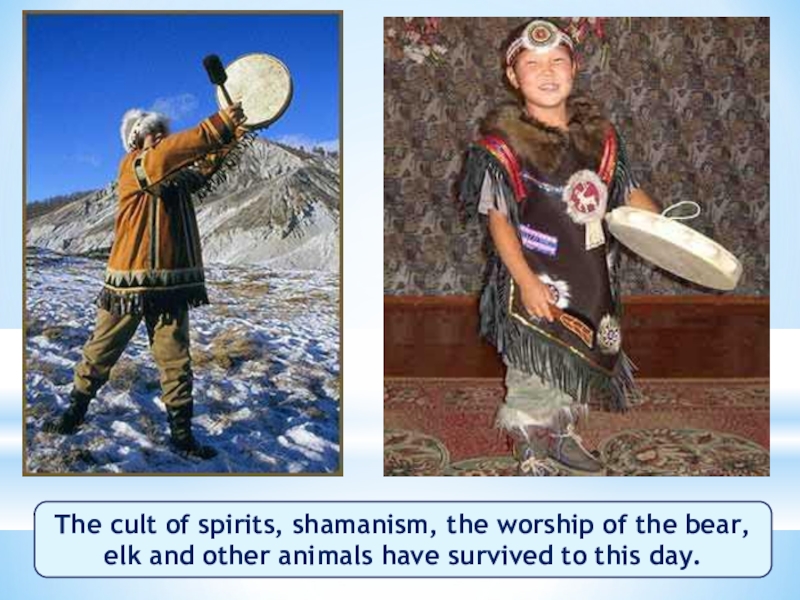
Слайд 18The cult of spirits, shamanism, the worship of the bear, elk
and other animals have survived to this day.
Слайд 20About shamans
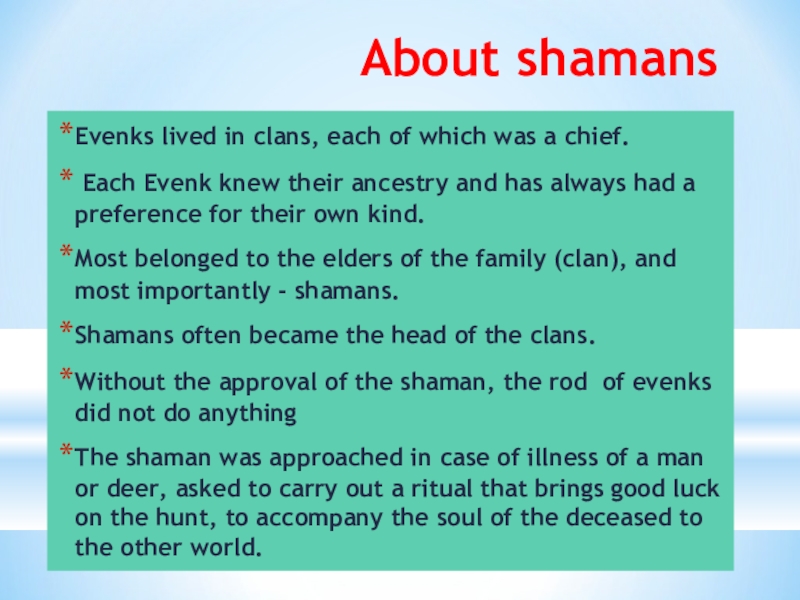
Evenks lived in clans, each of which was a chief.
Each Evenk knew their ancestry and has always had a preference for their own kind.
Most belonged to the elders of the family (clan), and most importantly - shamans.
Shamans often became the head of the clans.
Without the approval of the shaman, the rod of evenks did not do anything
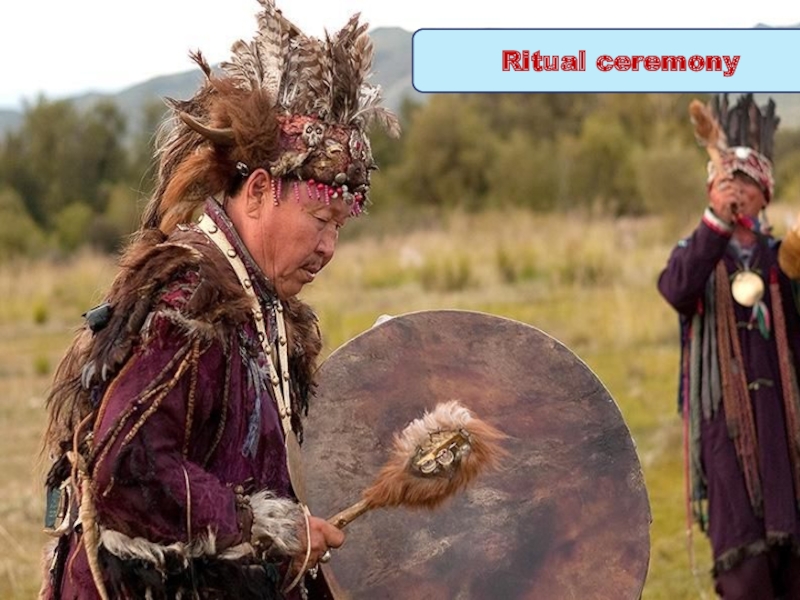
The shaman was approached in case of illness of a man or deer, asked to carry out a ritual that brings good luck on the hunt, to accompany the soul of the deceased to the other world.
Слайд 21
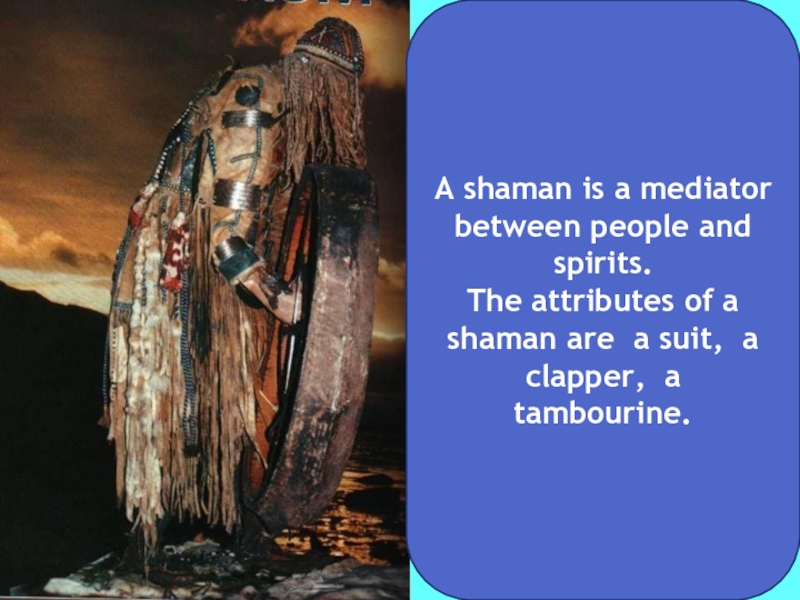
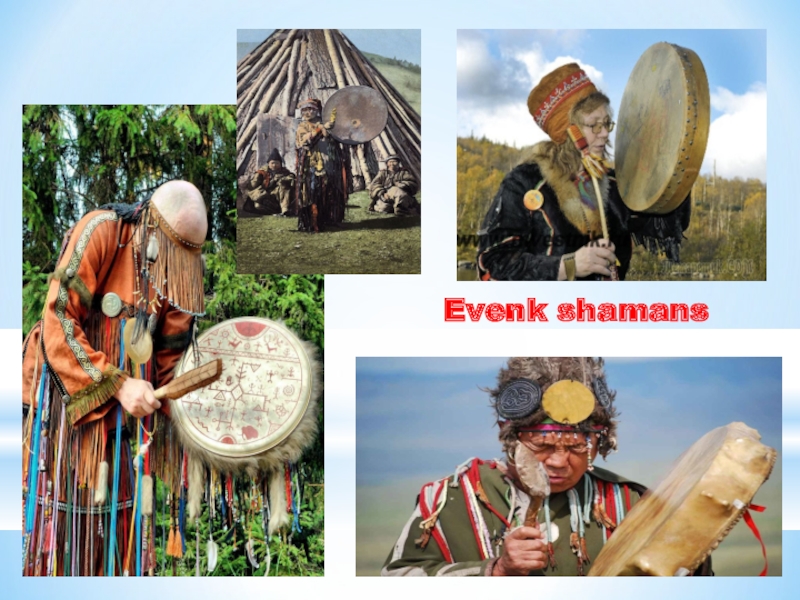
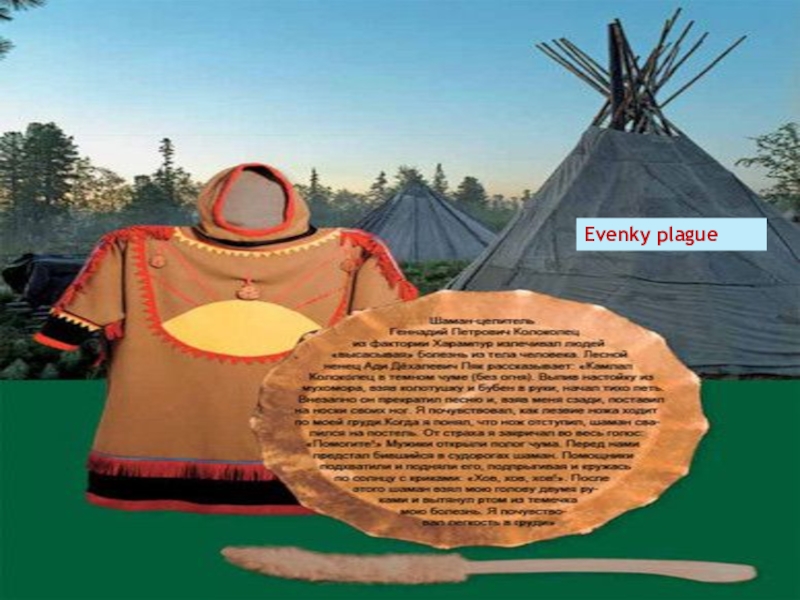
A shaman is a mediator between people and spirits.
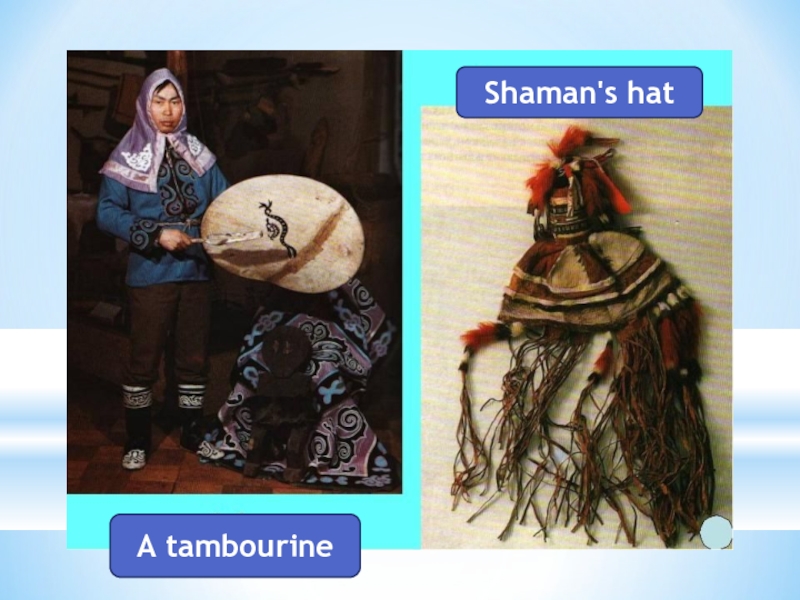
The attributes of
a shaman are a suit, a clapper, a tambourine.
Слайд 23
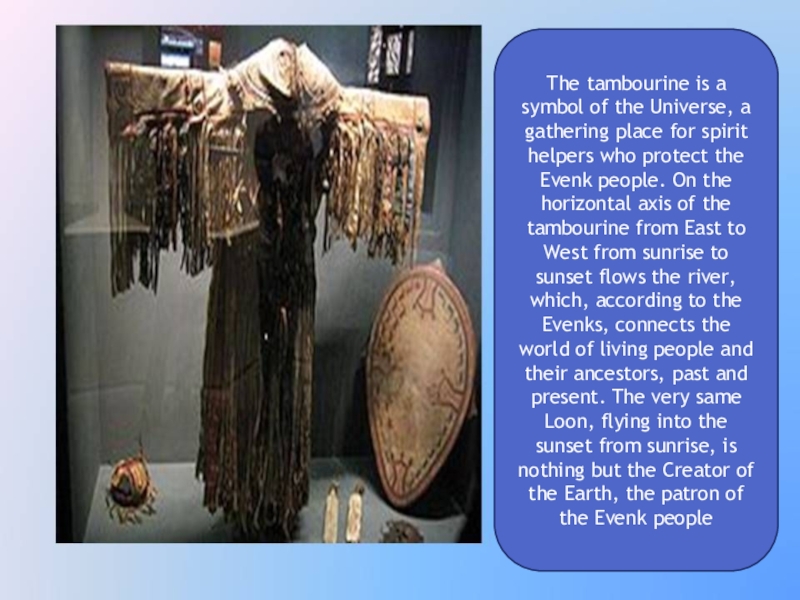
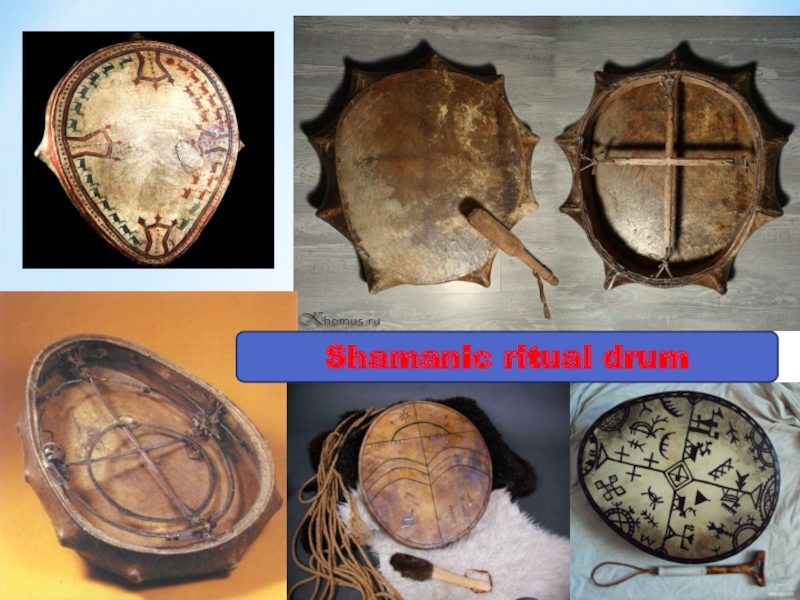
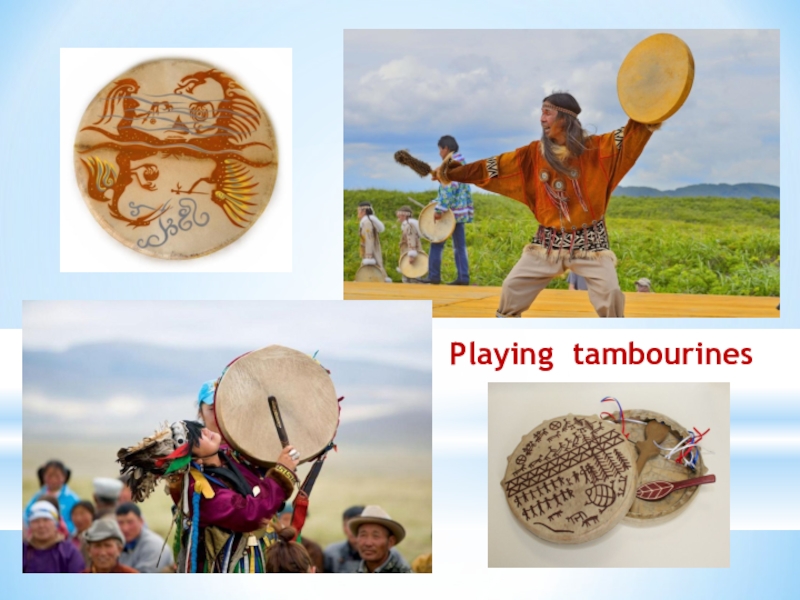
The tambourine is a symbol of the Universe, a gathering place
for spirit helpers who protect the Evenk people. On the horizontal axis of the tambourine from East to West from sunrise to sunset flows the river, which, according to the Evenks, connects the world of living people and their ancestors, past and present. The very same Loon, flying into the sunset from sunrise, is nothing but the Creator of the Earth, the patron of the Evenk people
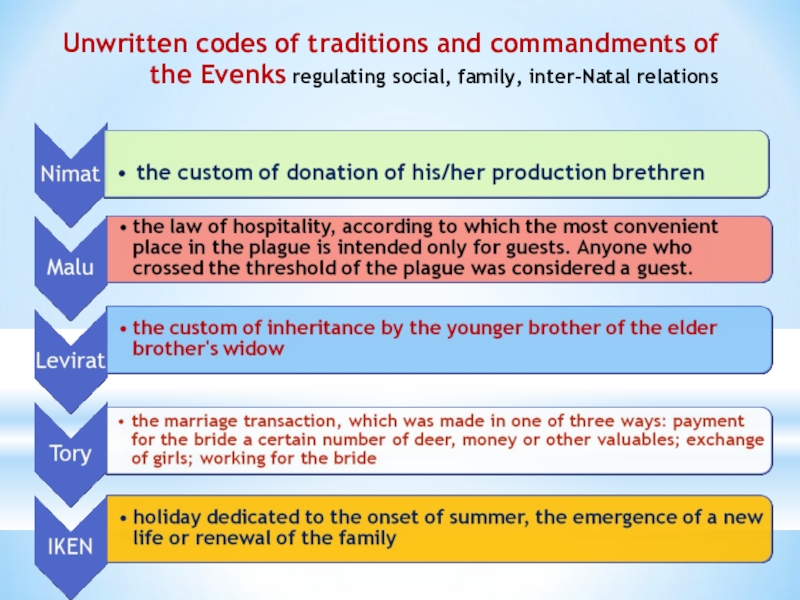
Слайд 29Unwritten codes of traditions and commandments of the Evenks regulating social,
family, inter-Natal relations
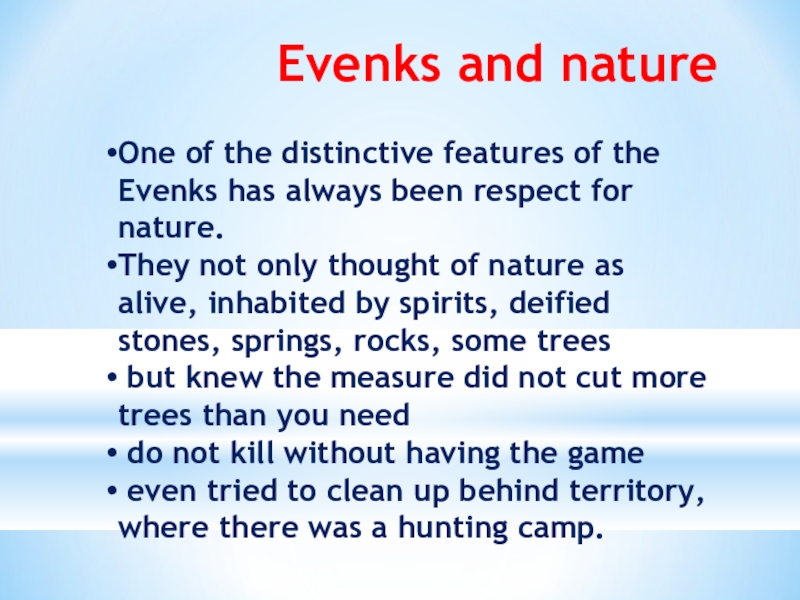
Слайд 30Evenks and nature
One of the distinctive features of the Evenks has
always been respect for nature.
They not only thought of nature as alive, inhabited by spirits, deified stones, springs, rocks, some trees
but knew the measure did not cut more trees than you need
do not kill without having the game
even tried to clean up behind territory, where there was a hunting camp.
Слайд 31Outstanding Evenks of Russia
Bombogor - the leader of the Union of
Evenk tribes on the Amur river, the organizer of the fighting against the Manchurian campaigns(1640)
Oyogir Nikolai Konstantinovich -an Evenk writer, poet (1988)
Nemtushkin Oliget Nikolaevich - an Evenk writer (1939-2006)
Tshapogir Oleg Vasiljevich – an Evenk composer
Tshepalova Yulia Anatoljevna – a Russian cross-country skier, Olympic champion (1998, 2002, 2006)
Слайд 32
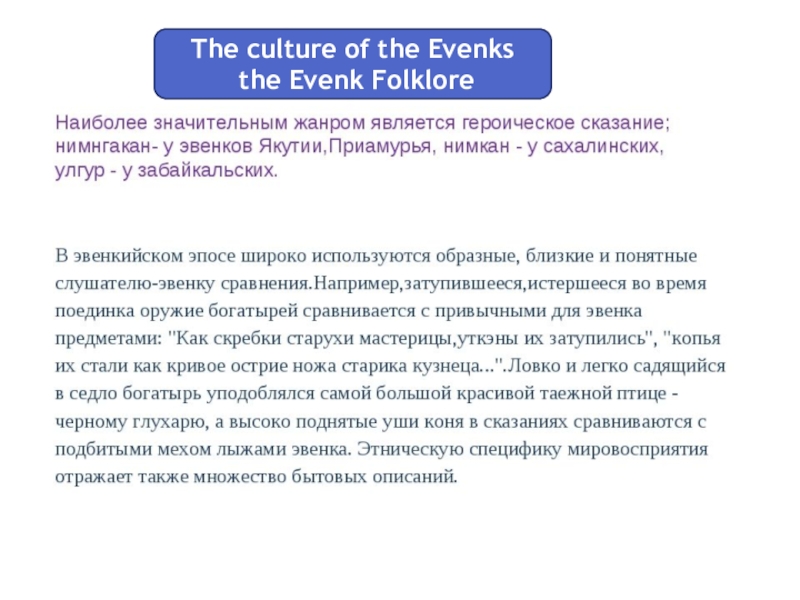
The culture of the Evenks
the Evenk Folklore