- Главная
- Разное
- Образование
- Спорт
- Естествознание
- Природоведение
- Религиоведение
- Французский язык
- Черчение
- Английский язык
- Астрономия
- Алгебра
- Биология
- География
- Геометрия
- Детские презентации
- Информатика
- История
- Литература
- Математика
- Музыка
- МХК
- Немецкий язык
- ОБЖ
- Обществознание
- Окружающий мир
- Педагогика
- Русский язык
- Технология
- Физика
- Философия
- Химия
- Шаблоны, фоны, картинки для презентаций
- Экология
- Экономика
Презентация, доклад по теме Королевская семья
Содержание
- 1. Презентация по теме Королевская семья
- 2. The story of the royal family For more
- 3. The British Royal Family is the group
- 4. Members and relatives of the British Royal
- 5. Слайд 5
- 6. This is a list of current members
- 7. The Earl of Harewood is a female-line
- 8. Family story When Elizabeth was born nobody
- 9. War times, marriage and future Bertie became
- 10. After Diana’s die many people asked if
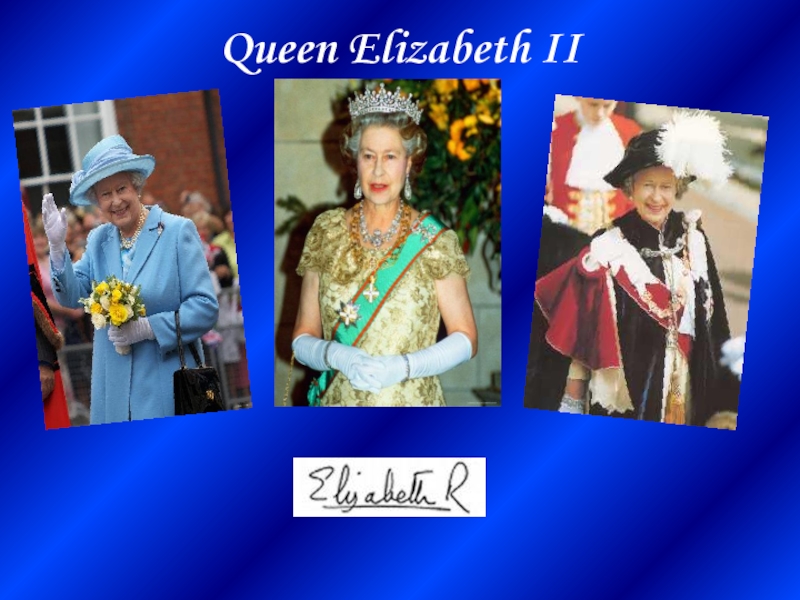
- 11. Queen Elizabeth II
- 12. Name: Queen Elizabeth IIFull Name: Elizabeth Alexandra
- 13. The reign of Queen Elizabeth II since
- 14. Elizabeth II is now the
- 15. Members of the Royal
- 16. Funding Monies to support the
- 17. The Duke of York: £249,000 per annum
- 18. Though always voluntarily subject to
- 19. Royal styles and titles Members of
- 20. The style His Majesty or
- 21. Under these conventions, The Queen's
- 22. Women marrying sons and male-line grandsons
- 23. There has been one exception
- 24. Born a Prince of Greece and Denmark,
- 25. Thanks for attention! Источники информации:Иностранные языки в школе// № 2005http://upload/wikipedia/royal_family
The story of the royal family For more than a thousand years Britain has always had kings or queens except for the ten years between 1649 and 1659. In the past, kings had great power and they
Слайд 2The story of the royal family
For more than a thousand years
Britain has always had kings or queens except for the ten years between 1649 and 1659. In the past, kings had great power and they really helped to make history. They started wars, made lows, and did things in their own way. But gradually more and more power went to Parliament.

Слайд 3The British Royal Family is the group of close relatives of
the monarch of the United Kingdom. The term is also commonly applied to the same group of people as the relations of the monarch in his or her role as sovereign of any of the other Commonwealth realms, thus sometimes at variance with official national terms for the family.Members of the royal family belong to, or are married into, the House of Windsor, since 1917, when George V changed the name of the royal house from Saxe-Coburg and Gotha.
Although in the United Kingdom there is no strict legal or formal definition of who is or is not a member of the Royal Family, and different lists will include different people, those carrying the style His or Her Majesty (HM), or His or Her Royal Highness (HRH) are always considered members, which usually results in the application of the term to the monarch, the consort of the monarch, the widowed consorts of previous monarchs, the children of the monarch, the male-line grandchildren of the monarch, and the spouses and the widowed spouses of a monarch's son and male-line grandsons.
Слайд 4Members and relatives of the British Royal Family historically represented the
monarch in various places throughout the British Empire, sometimes for extended periods as viceroys, or for specific ceremonies or events. Today, they often perform ceremonial and social duties throughout the United Kingdom and abroad on behalf of the UK, but, aside from the monarch, have no constitutional role in the affairs of government. This is the same for the other realms of the Commonwealth though the family there acts on behalf of, is funded by, and represents the sovereign of that particular state, and not Britain.
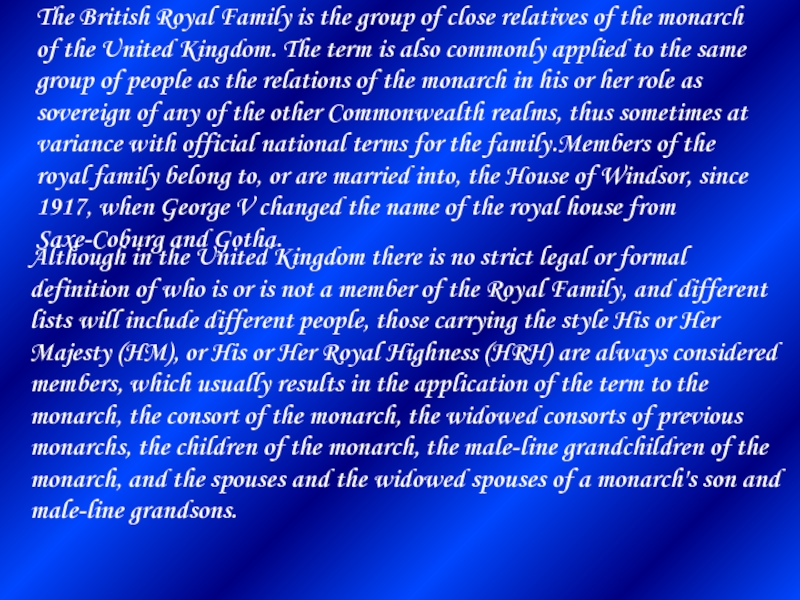
Members of the Royal Family gathered for a dinner celebrating the 60th wedding anniversary of Queen Elizabeth II and the Duke of Edinburgh (The Duchess of Kent was not present; The Lady Louise Windsor was either not present or not photographed; and the Viscount Severn was born after this photograph was taken. Click on a face to reach that person's article)


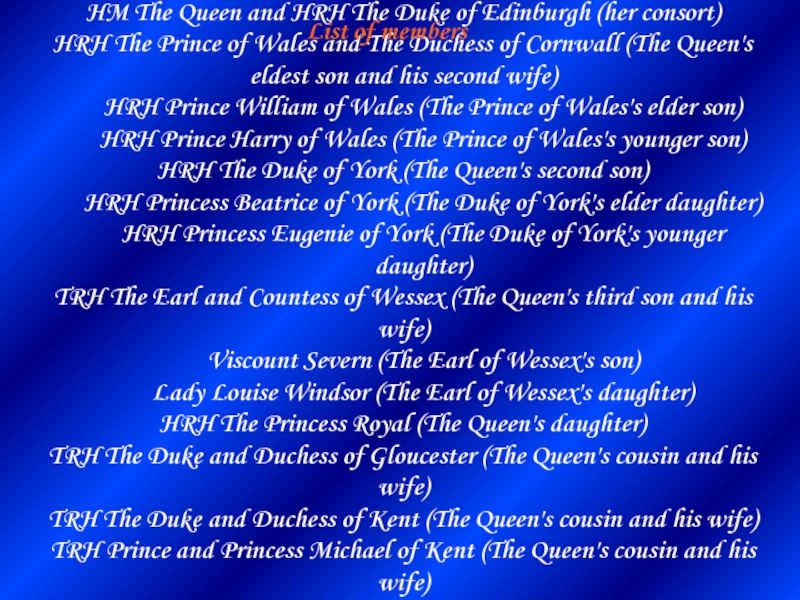
Слайд 6This is a list of current members of the Royal Family:
HM
The Queen and HRH The Duke of Edinburgh (her consort)
HRH The Prince of Wales and The Duchess of Cornwall (The Queen's eldest son and his second wife)
HRH Prince William of Wales (The Prince of Wales's elder son)
HRH Prince Harry of Wales (The Prince of Wales's younger son)
HRH The Duke of York (The Queen's second son)
HRH Princess Beatrice of York (The Duke of York's elder daughter)
HRH Princess Eugenie of York (The Duke of York's younger daughter)
TRH The Earl and Countess of Wessex (The Queen's third son and his wife)
Viscount Severn (The Earl of Wessex's son)
Lady Louise Windsor (The Earl of Wessex's daughter)
HRH The Princess Royal (The Queen's daughter)
TRH The Duke and Duchess of Gloucester (The Queen's cousin and his wife)
TRH The Duke and Duchess of Kent (The Queen's cousin and his wife)
TRH Prince and Princess Michael of Kent (The Queen's cousin and his wife)
HRH Princess Alexandra, The Honourable Lady Ogilvy (The Queen's cousin)
HRH The Prince of Wales and The Duchess of Cornwall (The Queen's eldest son and his second wife)
HRH Prince William of Wales (The Prince of Wales's elder son)
HRH Prince Harry of Wales (The Prince of Wales's younger son)
HRH The Duke of York (The Queen's second son)
HRH Princess Beatrice of York (The Duke of York's elder daughter)
HRH Princess Eugenie of York (The Duke of York's younger daughter)
TRH The Earl and Countess of Wessex (The Queen's third son and his wife)
Viscount Severn (The Earl of Wessex's son)
Lady Louise Windsor (The Earl of Wessex's daughter)
HRH The Princess Royal (The Queen's daughter)
TRH The Duke and Duchess of Gloucester (The Queen's cousin and his wife)
TRH The Duke and Duchess of Kent (The Queen's cousin and his wife)
TRH Prince and Princess Michael of Kent (The Queen's cousin and his wife)
HRH Princess Alexandra, The Honourable Lady Ogilvy (The Queen's cousin)
List of members
Слайд 7The Earl of Harewood is a female-line first cousin of the
Queen. The Duke of Fife, the Marquess of Milford Haven, the Countess Mountbatten of Burma, and the Lady Saltoun, and their respective families, as well as Lord Harewood's descendants, are so distant from the reigning sovereign that they are relatives of, rather than members of, the Royal Family.
None of these persons receive any monies from the State or undertake official engagements on behalf of the Queen. However, the Queen does invite them to private family functions and to participate in official royal occasions, such as the Trooping the Colour, the Golden Jubilee celebrations, and ceremonial or state funerals.
None of these persons receive any monies from the State or undertake official engagements on behalf of the Queen. However, the Queen does invite them to private family functions and to participate in official royal occasions, such as the Trooping the Colour, the Golden Jubilee celebrations, and ceremonial or state funerals.
Слайд 8Family story
When Elizabeth was born nobody knew she would be
queen. Her grandfather, King George V, had six children. His eldest son, Edward, was the next in line to be king and Elizabeth’s father, Albert, was only second child. Edward loved a good time. He enjoyed women, drink a lot, spent money, liked fashionable clothes. Albert, or Bertie, as his friend called him, was rather shy, he stammered, and all his life it was difficult for him to make speeches. As he did not expect to become king, he the Navy. When he took exams at naval College, he came only 68 th . It wasn’t very impressive since there were only 68 students in the class.
He married lady Elizabeth Bowes-Lyon- she is the Queen Mother now and this year she has celebrate her 100 th anniversary! -And they had two daughters, Elizabeth and Margaret.
The family lived in a house on Piccadilly. It was not a palace, but it was a nice place with twenty-five bedrooms, a library and a room for dance and parties. The girls had a private teacher, they also studied music, dancing and art. As a child Elizabeth was nicknamed Lilibet-because that was the way she pronounced her name. She was a serious, tidy little girl, but her governess said that Lilibet and Margaret could fight on occasions.
He married lady Elizabeth Bowes-Lyon- she is the Queen Mother now and this year she has celebrate her 100 th anniversary! -And they had two daughters, Elizabeth and Margaret.
The family lived in a house on Piccadilly. It was not a palace, but it was a nice place with twenty-five bedrooms, a library and a room for dance and parties. The girls had a private teacher, they also studied music, dancing and art. As a child Elizabeth was nicknamed Lilibet-because that was the way she pronounced her name. She was a serious, tidy little girl, but her governess said that Lilibet and Margaret could fight on occasions.
In 1936 King George died. When his coffin with the crown on top of it was carriage through the streets on a horse drawn carriage, the crown fell. Many people through it was a bad sign. Indeed, 1936 became “The year of the kings”. In January, after his father’s death, Edward became king. In December he refused from the throne and his younger brother Bertie took his place.

Слайд 9
War times, marriage and future
Bertie became King George. The family
moved into Buckingham Palace. During the war the family lived in Windsor. It was dangerous to stay in London because the city was often bombed especially East End.
When Elizabeth was 13 she met Prince Philip of Greece. He was six year older than her. Certainly at that time she was only schoolgirl, but later they fell in love and in 1947 they got married.
As we now after that was born a daughter, which name is Diana. In 1989 year Princes Diana got married with Prince Charles. They had two sons, William and Harry. The year part of Windsor Castle was badly damaged by a fire. The government refused to pay for the repairs. So the Queen opened Buckingham Palace to playing tourist to get the money. Later she decided that their favorite royal ship Britannia was too expensive and it had to go. Queen agreed to pay taxes.
When Elizabeth was 13 she met Prince Philip of Greece. He was six year older than her. Certainly at that time she was only schoolgirl, but later they fell in love and in 1947 they got married.
As we now after that was born a daughter, which name is Diana. In 1989 year Princes Diana got married with Prince Charles. They had two sons, William and Harry. The year part of Windsor Castle was badly damaged by a fire. The government refused to pay for the repairs. So the Queen opened Buckingham Palace to playing tourist to get the money. Later she decided that their favorite royal ship Britannia was too expensive and it had to go. Queen agreed to pay taxes.
Слайд 10After Diana’s die many people asked if Charles would be king
or the crown would go to his eldest son, William? Prince William is 18 now, he looks very much like his mother. He and Prince Harry are the royal family of the future. Both boys study at Eton, they spend a lot of time with their father and often visit their grandmother.
England has had kings and queens for a thousand years-probably they’ll have them for another thousand, and people believe in the Royal Family!
England has had kings and queens for a thousand years-probably they’ll have them for another thousand, and people believe in the Royal Family!
The British Royal Family is shared between the Commonwealth realms; this article focuses on the perspective of United Kingdom. For information on the Royal Family in the other realms, see In other Commonwealth realms
Слайд 12
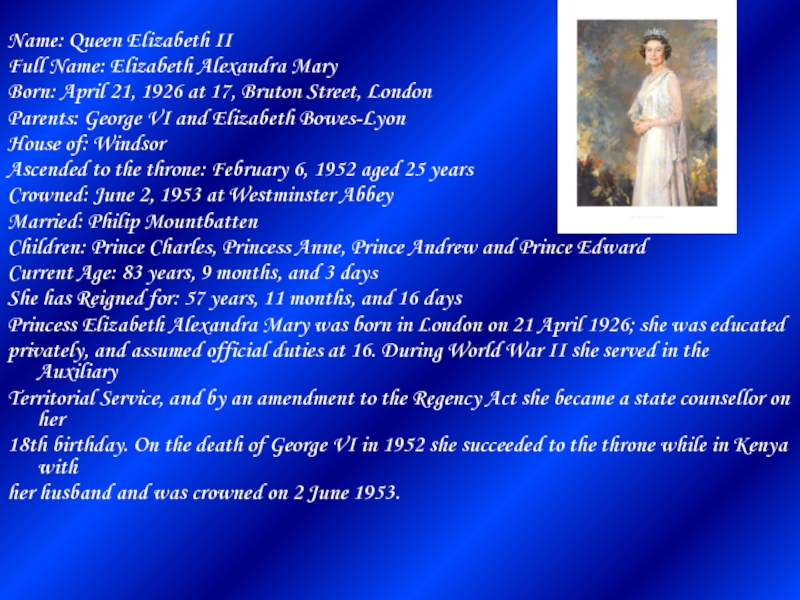
Name: Queen Elizabeth II
Full Name: Elizabeth Alexandra Mary
Born: April 21, 1926
at 17, Bruton Street, London
Parents: George VI and Elizabeth Bowes-Lyon
House of: Windsor
Ascended to the throne: February 6, 1952 aged 25 years
Crowned: June 2, 1953 at Westminster Abbey
Married: Philip Mountbatten
Children: Prince Charles, Princess Anne, Prince Andrew and Prince Edward
Current Age: 83 years, 9 months, and 3 days
She has Reigned for: 57 years, 11 months, and 16 days
Princess Elizabeth Alexandra Mary was born in London on 21 April 1926; she was educated
privately, and assumed official duties at 16. During World War II she served in the Auxiliary
Territorial Service, and by an amendment to the Regency Act she became a state counsellor on her
18th birthday. On the death of George VI in 1952 she succeeded to the throne while in Kenya with
her husband and was crowned on 2 June 1953.
Parents: George VI and Elizabeth Bowes-Lyon
House of: Windsor
Ascended to the throne: February 6, 1952 aged 25 years
Crowned: June 2, 1953 at Westminster Abbey
Married: Philip Mountbatten
Children: Prince Charles, Princess Anne, Prince Andrew and Prince Edward
Current Age: 83 years, 9 months, and 3 days
She has Reigned for: 57 years, 11 months, and 16 days
Princess Elizabeth Alexandra Mary was born in London on 21 April 1926; she was educated
privately, and assumed official duties at 16. During World War II she served in the Auxiliary
Territorial Service, and by an amendment to the Regency Act she became a state counsellor on her
18th birthday. On the death of George VI in 1952 she succeeded to the throne while in Kenya with
her husband and was crowned on 2 June 1953.
Слайд 13
The reign of Queen Elizabeth II since 1952 has spanned a
period of rapid and occasionally turbulent
change. Britain’s position in the world, her economy, and the very shape and structures of society
have all been
transformed and many traditional institutions have suffered in the process. Through all this, the
path of the Crown has been marked out by The Queen herself, in a prolonged display of unwavering
devotion to Duty and quiet pragmatism which has met a nationally-felt need, and has won her the
respect and affection of her peoples. As hereditary head of State for Great Britain and Northern
Ireland, and Head of the Commonwealth, she has
symbolic and formal functions and duties but no direct powers. She is an embodiment of national
identity and continuity and, with her family, performs countless formalities to mark events in the
lives of individuals and communities and provides valuable patronage for innumerable charities.
change. Britain’s position in the world, her economy, and the very shape and structures of society
have all been
transformed and many traditional institutions have suffered in the process. Through all this, the
path of the Crown has been marked out by The Queen herself, in a prolonged display of unwavering
devotion to Duty and quiet pragmatism which has met a nationally-felt need, and has won her the
respect and affection of her peoples. As hereditary head of State for Great Britain and Northern
Ireland, and Head of the Commonwealth, she has
symbolic and formal functions and duties but no direct powers. She is an embodiment of national
identity and continuity and, with her family, performs countless formalities to mark events in the
lives of individuals and communities and provides valuable patronage for innumerable charities.
Supported by Prince Philip, Duke of Edinburgh, to whom she was married on 20 November 1947, The Queen is head of a large family. The first child of the royal marriage and the current heir to the throne is Prince Charles, the Prince of Wales, who was born on 14 November 1948 and was invested as Prince of Wales at Caernarvon Castle on 1 July 1969. He married Lady Diana Spencer ( Princess Diana ) on 29 July 1981; two sons were born to the marriage, Prince William, born 21 June 1982 and Prince Henry (Harry), born 15 September 1984. However, the marriage broke down amid widely-publicised bitterness, and a divorce followed. These troubles, together with the divorces of Princess Anne and the Duke of York, were seen by some to diminish the monarchy in public esteem. The death of Diana, Princess of Wales on 31 August 1997 in a car crash in Paris unleashed a wave of hysteria stirred up by the media, and the family had to suffer relentless intrusion by the world's press into their lives.
Слайд 14 Elizabeth II is now the longest reigning British monarch
since Queen Victoria, and The Queen’s Golden Jubilee in 2002 was celebrated with enthusiasm and displays of loyalty. The Prince of Wales, after suffering a period of unpopularity, has shown resilience and willingness to meet the public half-way in its new mood. His long-established concern for the disadvantaged sections of society, and support of a ‘green’ environmental issues, has enabled him to meet on common ground many who might be put off by grandeur and pomp, while his evident devotion to his two sons Prince William and Prince Harry has won him a real measure of respect. Initially unpopular his wife Camilla has shown herself to be capable in her support. Prince Charles’s willingness to accept change is also reflected in the institution of the monarchy. This has altered significantly in recent times with The Queen’s decision to pay tax, changes being made to the Civil List, and the opening of Buckingham Palace to the public to help fund the restoration of Windsor Castle. Debate about the future of the monarchy continues, but the Royal Family has shown itself willing to contemplate evolutionary change, and the Crown of Britain has entered the second decade of the twenty-first century with renewed vigour and fresh purpose. Planning is in place for 2012 to celebrate both the Olympics in Britain and the Diamond Jubilee of the Queen’s 60 years on the throne.

Слайд 15 Members of the Royal Family engage in hundreds
of public engagements yearly, throughout the United Kingdom, as formally recorded in the Court Circular, to honour, encourage and learn about the achievements or endeavors of individuals, institutions and enterprises in a variety of areas of life. As representatives of the Queen, they often also join the nation in commemorating historical events, holidays, celebratory and tragic occurrences, and may also sponsor or participate in numerous charitable, cultural and social activities. Their travels abroad on behalf of the UK (called State Visits when the sovereign officially meets with other heads of state) draw public attention to amicable relations within and between the Commonwealth and other nations, to British goods and trade, and to Britain as a historical, vacation, and tourist destination. Their presence, activities and traditional roles constitute the apex of a modern "royal court," and provide a distinctly British and historical pageantry to ceremonies (e.g. Trooping the Colour) and flavour to public events (e.g. Garden Parties, Ascot).
In the United Kingdom
Public role and image
Слайд 16
Funding
Monies to support the Queen in the exercise
of her duties as head of state of the United Kingdom (the Head of State Expenditure) come from the Civil List. This is a return of a small portion of the revenue from the Crown Lands that are surrendered by the monarch to parliament at the beginning of each reign; all Crown Land being administered by The Crown Estates, an institution that is answerable to parliament. In the 2003-04 fiscal year, the amount surrendered was £176.9 million, where the Head of State Expenditure was £36 million. The Head of State Expenditure does not include the cost of security.
Only the Queen and Duke of Edinburgh receive funding from the Civil List. The Duke receives £359,000 per year.
Only some members of the Royal Family carry out public duties; these individuals receive an annual payment known as a Parliamentary Annuity, the funds being supplied to cover office costs.
Only the Queen and Duke of Edinburgh receive funding from the Civil List. The Duke receives £359,000 per year.
Only some members of the Royal Family carry out public duties; these individuals receive an annual payment known as a Parliamentary Annuity, the funds being supplied to cover office costs.
Слайд 17The Duke of York: £249,000 per annum
The Earl and Countess
of Wessex: £141,000 per annum
The Princess Royal: £228,000 per annum
The Duke and Duchess of Gloucester: £175,000 per annum
The Duke and Duchess of Kent: £236,000 per annum
Princess Alexandra £225,000 per annum
These amounts are repaid by The Queen from her private funds.
The Princess Royal: £228,000 per annum
The Duke and Duchess of Gloucester: £175,000 per annum
The Duke and Duchess of Kent: £236,000 per annum
Princess Alexandra £225,000 per annum
These amounts are repaid by The Queen from her private funds.
Слайд 18
Though always voluntarily subject to the Value Added Tax
and other indirect taxes, the Queen agreed to pay taxes on income and capital gains from 1992, although the details of this arrangement are both voluntary and secret. At the same time it was announced that only the Queen and Prince Philip would receive civil list payments. Since 1993 the Queen's personal income has been taxed as any other Briton. The Queen's private estate (eg shareholdings, personal jewellery, Sandringham House and Balmoral Castle) will be subject to Inheritance Tax, however bequests from Sovereign to Sovereign are exempt. In addition to the released costs, there are significant hidden costs such as security, exempt taxes and costs met by local councils during royal visits. The cost of the extensive security provided for the royal family is kept secret; it is argued that releasing the total security budget would in itself jeopardize the security of the royals.
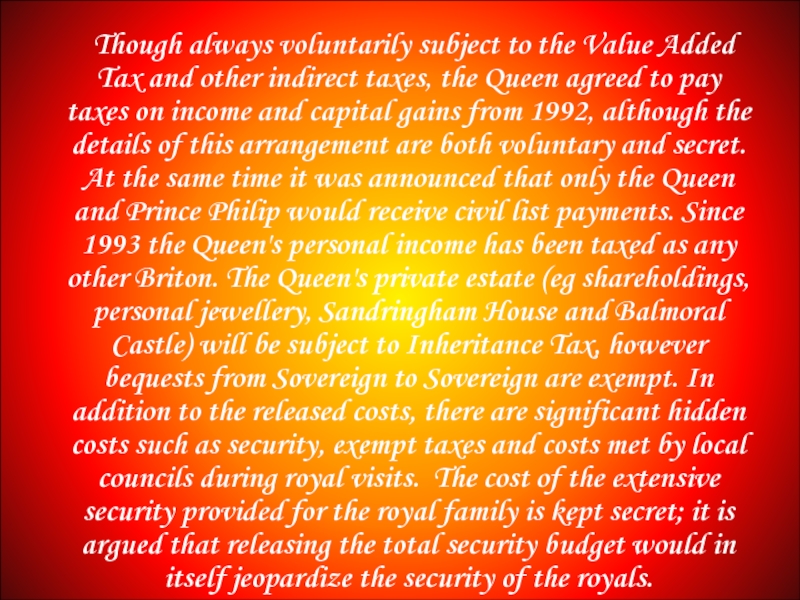
Слайд 19Royal styles and titles
Members of the Royal Family in
the Royal box at Westminster Abbey during the Coronation of Queen Elizabeth II
Слайд 20
The style His Majesty or Her Majesty (HM) is
enjoyed by a King, a Queen (regnant), a Queen consort, and a former Queen consort (a Queen Dowager or a Queen Mother). Use of the style His Royal Highness or Her Royal Highness (HRH) and the titular dignity of Prince or Princess are governed by Letters Patent issued by George V on 30 November 1917 and published in the London Gazette on 11 December 1917. These Letters Patent state that henceforth only the children of the Sovereign, the children of the sons of the Sovereign, and the eldest son of the eldest son of the Prince of Wales would "have and at all times hold and enjoy the style, title or attribute of Royal Highness with their titular dignity of Prince or Princess prefixed to their respective Christian names or with their other titles of honour." They further state, "the grandchildren of the sons of any such Sovereign in the direct male line (save only the eldest living son of the eldest son of the Prince of Wales) shall have the style and title enjoyed by the children of Dukes."
Слайд 21 Under these conventions, The Queen's children and the children
of The Prince of Wales, The Duke of York and The Earl of Wessex are titled Princes or Princesses and styled Royal Highness. However, upon Prince Edward's marriage in 1999, it was announced that his children would be styled as earl's children, but no Letters Patent were issued to deny them their princely status or HRH. The Duke of Gloucester, The Duke of Kent, Princess Alexandra, the Hon. Lady Ogilvy and Prince Michael of Kent enjoy the titular dignity of Prince or Princess and the style Royal Highness as male-line grandchildren of George V. However, none of their children has a royal title. For example, the children of Prince Michael of Kent are known as Lord Frederick Windsor and Lady Gabriella Windsor, the courtesy titles as children of dukes. They are not entitled to any royal title. The children of The Princess Royal, Princess Alexandra and Princess Margaret, Countess of Snowdon, are not entitled to any royal title since princesses do not transmit their titles to their children. An exception to this rule was when George VI issued Letters Patent such that his heiress presumptive, Princess Elizabeth, could transmit her title to her children. Princess Margaret's son enjoys the courtesy title Viscount Linley as the son and heir of the Earl of Snowdon, while her daughter enjoys the courtesy title Lady. The children of the Princess Royal and Princess Alexandra have no titles, because Mark Phillips and Sir Angus Ogilvy did not accept hereditary peerages upon marriage.
Слайд 22
Women marrying sons and male-line grandsons of a Sovereign are
normally styled Her Royal Highness followed by the feminised version of her husband's highest title. The wives of royal peers are known as "HRH The Duchess of ..." or " HRH The Countess of ..." Thus, the wives of the Duke of Kent, the Duke of Gloucester, and the Earl of Wessex are "HRH The Duchess of Kent," "HRH The Duchess of Gloucester," and "HRH The Countess of Wessex," respectively. Before her divorce, Diana, Princess of Wales enjoyed the title and style of "HRH The Princess of Wales." However, when a woman marries a prince who does not hold a peerage, she is known as HRH Princess [Her husband's Christian name], followed by whatever territorial or titular designation. For example, the former Baroness Marie-Christine von Reibnitz enjoys the title and style of "HRH Princess Michael of Kent," and not "HRH Princess Marie-Christine of Kent." Similarly, the former Birgitte Eva van Deurs was titled "HRH Princess Richard of Gloucester" from her wedding until her husband succeeded to his father's dukedom in 1974. The widows of princes remain HRH. However, under Queen Elizabeth II's 21 August 1996 Letters Patent, a divorced wife of a Prince of the United Kingdom of Great Britain and Northern Ireland "shall not be entitled to hold and enjoy the style, title or attribute of Royal Highness."

Слайд 23 There has been one exception to the convention that
wives of princes take their husband's rank. In Letters Patent dated 28 May 1937, King George VI specifically denied the style HRH to the wife of the Duke of Windsor, the former King Edward VIII. Therefore, the former Wallis Warfield Simpson was known as "Her Grace The Duchess of Windsor," not "Her Royal Highness The Duchess of Windsor."
It should also be noted due a reluctance by the public to universally support the second wife of The Prince of Wales, it has been announced by Clarence House that should The Prince of Wales become King, that his wife HRH The Duchess of Cornwall will not be known as HM The Queen but will take the lesser title of HRH The Princess Consort. Out of respect for Diana, Princess of Wales, it was also announced that HRH The Duchess of Cornwall would not be known as HRH The Princess of Wales.
The daughters and male-line granddaughters of the Sovereign do not lose their royal titles upon marriage. Men who marry the daughters and the male-line granddaughters of the Sovereign, however, do not acquire their wives' royal rank and the style HRH. The only exception to this convention is Prince Philip, who, as a then-future consort, was granted British titles in his own right (rather than in his wife's).
It should also be noted due a reluctance by the public to universally support the second wife of The Prince of Wales, it has been announced by Clarence House that should The Prince of Wales become King, that his wife HRH The Duchess of Cornwall will not be known as HM The Queen but will take the lesser title of HRH The Princess Consort. Out of respect for Diana, Princess of Wales, it was also announced that HRH The Duchess of Cornwall would not be known as HRH The Princess of Wales.
The daughters and male-line granddaughters of the Sovereign do not lose their royal titles upon marriage. Men who marry the daughters and the male-line granddaughters of the Sovereign, however, do not acquire their wives' royal rank and the style HRH. The only exception to this convention is Prince Philip, who, as a then-future consort, was granted British titles in his own right (rather than in his wife's).
Слайд 24
Born a Prince of Greece and Denmark, it was only after
his wartime service that he renounced the use of his title and became a naturalised British subject, as Lieutenant Philip Mountbatten RN (although he was already a British citizen as a descendant of the Electress Sophia). The day before his marriage he was created Duke of Edinburgh with the style HRH by King George VI's Letters Patent of 19 November 1947. The Duke of Edinburgh was not created a Prince of the United Kingdom of Great Britain and Northern Ireland until 22 February 1957. Since that date, his full title has been "HRH The Prince Philip, Duke of Edinburgh."
As grandchildren of the Sovereign through the female line, the children of the then Princess Elizabeth and The Duke of Edinburgh would not have been entitled to use HRH or Prince or Princess of the United Kingdom until their mother became Queen, had those titles and styles not been granted in Letters Patent of 22 October 1948. They could neither be styled HRH Prince or Princess of Greece and Denmark through their father, as the Duke of Edinburgh had renounced these use of these royal titles and styles. Their highest styles would therefore have been the Earl of Merioneth and Lady Anne Mountbatten.
As grandchildren of the Sovereign through the female line, the children of the then Princess Elizabeth and The Duke of Edinburgh would not have been entitled to use HRH or Prince or Princess of the United Kingdom until their mother became Queen, had those titles and styles not been granted in Letters Patent of 22 October 1948. They could neither be styled HRH Prince or Princess of Greece and Denmark through their father, as the Duke of Edinburgh had renounced these use of these royal titles and styles. Their highest styles would therefore have been the Earl of Merioneth and Lady Anne Mountbatten.
Слайд 25Thanks for attention!
Источники информации:
Иностранные языки в школе// № 2005
http://upload/wikipedia/royal_family