- Главная
- Разное
- Образование
- Спорт
- Естествознание
- Природоведение
- Религиоведение
- Французский язык
- Черчение
- Английский язык
- Астрономия
- Алгебра
- Биология
- География
- Геометрия
- Детские презентации
- Информатика
- История
- Литература
- Математика
- Музыка
- МХК
- Немецкий язык
- ОБЖ
- Обществознание
- Окружающий мир
- Педагогика
- Русский язык
- Технология
- Физика
- Философия
- Химия
- Шаблоны, фоны, картинки для презентаций
- Экология
- Экономика
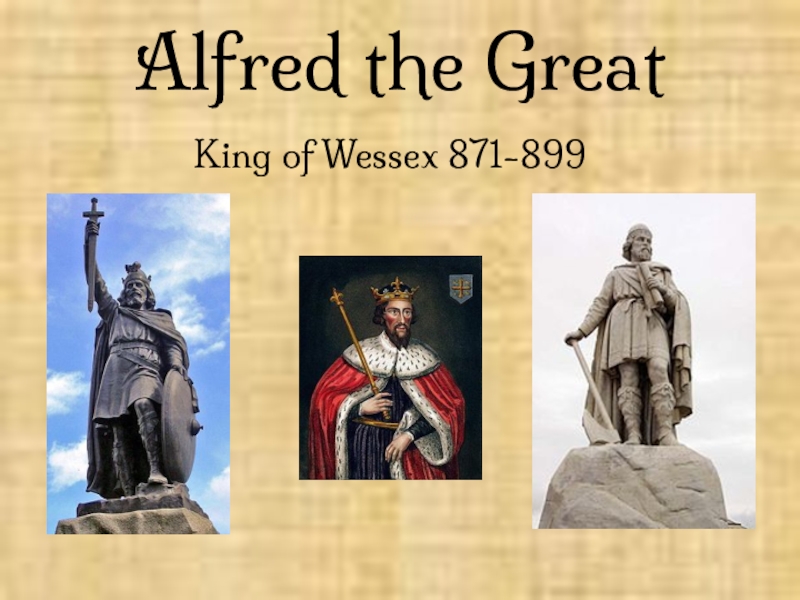
Презентация, доклад по теме Король Альфред
Содержание
- 1. Презентация по теме Король Альфред
- 2. Childhood and foundationsYoungest son of Ethelwulf of
- 3. Elevation to KingAlfred’s older brother King Ethelred
- 4. Early struggles and resistanceThe Danes (Vikings) were
- 5. Resistance and VictoryAlfred won a decisive victory
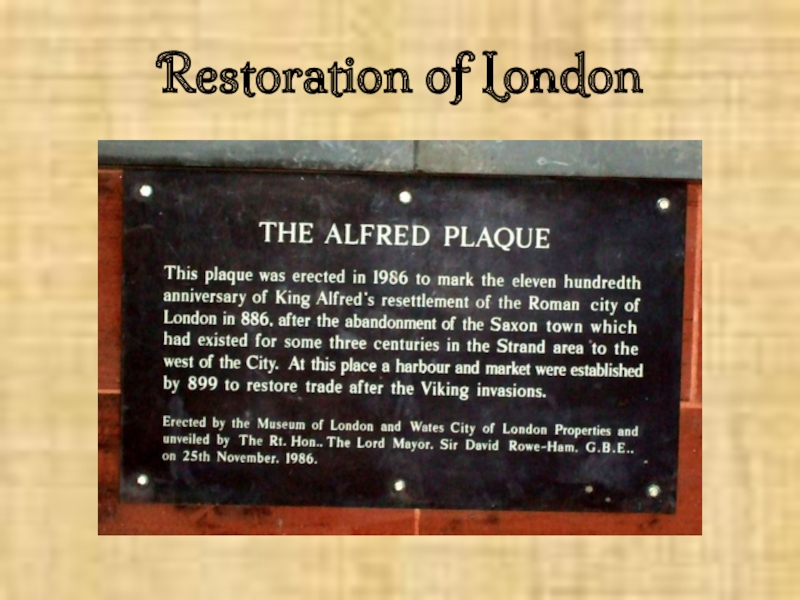
- 6. Restoration of London
- 7. Restoration of London (cont...)In 886AD, Alfred reoccupied
- 8. Military reorganisationFollowing the Anglo-Saxon victory at Ethandun,
- 9. Burghal or BurhFortified town or other defended
- 10. Fyrd – Militia to a Standing ArmyStrengthened
- 11. Naval development896, Alfred ordered the construction of
- 12. Legal reformIn the late 880s or early
- 13. Religion and cultureAlfred undertook no systematic reform
- 14. The Alfred Jewel: A piece of historyOld
- 15. EducationAlfred established a court school for the
Childhood and foundationsYoungest son of Ethelwulf of Wessex, from his first wife.853AD at the age of four, Alfred is sent to Rome where he was confirmed by Pope Leo IV and also anointed as a kingWhen
Слайд 2Childhood and foundations
Youngest son of Ethelwulf of Wessex, from his first
wife.
853AD at the age of four, Alfred is sent to Rome where he was confirmed by Pope Leo IV and also anointed as a king
When King Ethelwulf died in 858, Wessex was ruled by three of Alfred's brothers in succession, Ethelbald, Ethelbert and Ethelred
Evidence suggests he was not physically strong, and though not lacking in courage, he was more noted for his intellect than a warlike character.
853AD at the age of four, Alfred is sent to Rome where he was confirmed by Pope Leo IV and also anointed as a king
When King Ethelwulf died in 858, Wessex was ruled by three of Alfred's brothers in succession, Ethelbald, Ethelbert and Ethelred
Evidence suggests he was not physically strong, and though not lacking in courage, he was more noted for his intellect than a warlike character.
Слайд 3Elevation to King
Alfred’s older brother King Ethelred died in 871AD at
the Battle of Merton.
Alfred succeeds the throne of Wessex through an agreement with his brother.
The brothers had agreed that whichever of them outlived the other, they would inherit the personal property that King Ethelwulf in his will had left jointly to his sons.
Given the ongoing Danish invasion and the youth of his nephews, Alfred's succession probably went uncontested.
Alfred succeeds the throne of Wessex through an agreement with his brother.
The brothers had agreed that whichever of them outlived the other, they would inherit the personal property that King Ethelwulf in his will had left jointly to his sons.
Given the ongoing Danish invasion and the youth of his nephews, Alfred's succession probably went uncontested.
Слайд 4Early struggles and resistance
The Danes (Vikings) were defeating Saxon armies throughout
England
Alfred forced to make peace with the Danes
Vikings agreed to vacate the realm and made good their promise; the Viking army did withdraw from Reading in the autumn of 871 to take up winter quarters in Mercian London.
Dating around 878AD from his fort at Athelney, an island in the marshes near North Petherton, Alfred was able to mount an effective resistance movement, rallying the local militias from Somerset, Wiltshire and Hampshire.
Alfred forced to make peace with the Danes
Vikings agreed to vacate the realm and made good their promise; the Viking army did withdraw from Reading in the autumn of 871 to take up winter quarters in Mercian London.
Dating around 878AD from his fort at Athelney, an island in the marshes near North Petherton, Alfred was able to mount an effective resistance movement, rallying the local militias from Somerset, Wiltshire and Hampshire.
Слайд 5Resistance and Victory
Alfred won a decisive victory in the ensuing Battle
of Ethandun, which may have been fought near Westbury, Wiltshire.
The Danes surrendered at Chippenham - One of the terms of the surrender was that Guthrum convert to Christianity; and three weeks later the Danish king and 29 of his chief men were baptised at Alfred's court at Aller, near Athelney, with Alfred receiving Guthrum as his spiritual son.
The Treaty of Alfred and Guthrum (circa 880AD):
Divided up the kingdom of Mercia
Danelaw established as a new province or area controlled by Danes.
Alfred was to have control over the Mercian city of London.
The Danes surrendered at Chippenham - One of the terms of the surrender was that Guthrum convert to Christianity; and three weeks later the Danish king and 29 of his chief men were baptised at Alfred's court at Aller, near Athelney, with Alfred receiving Guthrum as his spiritual son.
The Treaty of Alfred and Guthrum (circa 880AD):
Divided up the kingdom of Mercia
Danelaw established as a new province or area controlled by Danes.
Alfred was to have control over the Mercian city of London.
Слайд 7Restoration of London (cont...)
In 886AD, Alfred reoccupied the city of London
and set out to make it habitable again.
Alfred entrusted the city to the care of his son-in law Ethelred, ealdorman of Mercia.
The restoration of London progressed through the later half of the 880s and included:
a new street plan,
added fortifications in addition to the existing Roman walls, and;
the construction of matching fortifications on the South bank of the River Thames
Alfred entrusted the city to the care of his son-in law Ethelred, ealdorman of Mercia.
The restoration of London progressed through the later half of the 880s and included:
a new street plan,
added fortifications in addition to the existing Roman walls, and;
the construction of matching fortifications on the South bank of the River Thames
Слайд 8Military reorganisation
Following the Anglo-Saxon victory at Ethandun, Alfred began an ambitious
restructuring of his kingdoms military, including three important elements;
The building of thirty fortified and garrisoned towns (burhs) along the rivers and Roman roads of Wessex;
The creation of a mobile (horsed) field force, consisting of his nobles and their warrior retainers, which was divided into two contingents, one of which was always in the field;
The enhancement of Wessex's sea power through the addition of larger ships to the existing royal fleet.
The building of thirty fortified and garrisoned towns (burhs) along the rivers and Roman roads of Wessex;
The creation of a mobile (horsed) field force, consisting of his nobles and their warrior retainers, which was divided into two contingents, one of which was always in the field;
The enhancement of Wessex's sea power through the addition of larger ships to the existing royal fleet.
Слайд 9Burghal or Burh
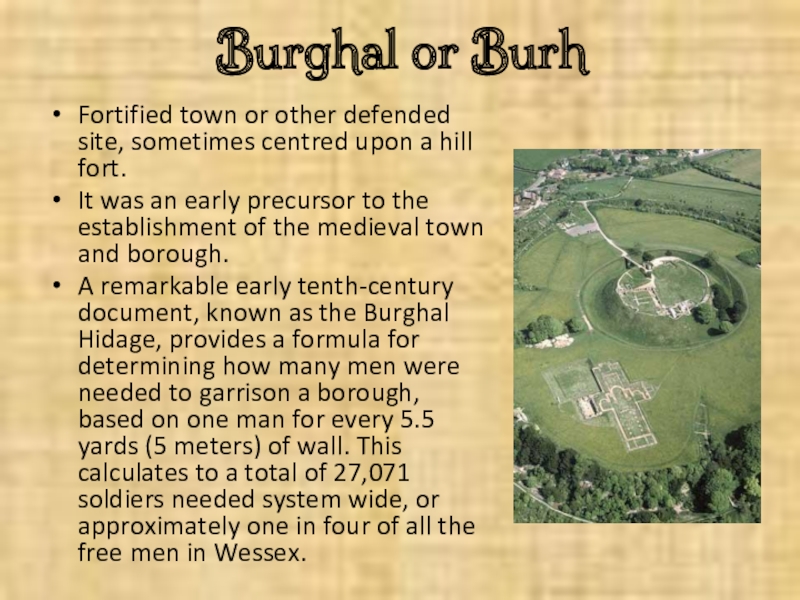
Fortified town or other defended site, sometimes centred upon
a hill fort.
It was an early precursor to the establishment of the medieval town and borough.
A remarkable early tenth-century document, known as the Burghal Hidage, provides a formula for determining how many men were needed to garrison a borough, based on one man for every 5.5 yards (5 meters) of wall. This calculates to a total of 27,071 soldiers needed system wide, or approximately one in four of all the free men in Wessex.
It was an early precursor to the establishment of the medieval town and borough.
A remarkable early tenth-century document, known as the Burghal Hidage, provides a formula for determining how many men were needed to garrison a borough, based on one man for every 5.5 yards (5 meters) of wall. This calculates to a total of 27,071 soldiers needed system wide, or approximately one in four of all the free men in Wessex.
Слайд 10Fyrd – Militia to a Standing Army
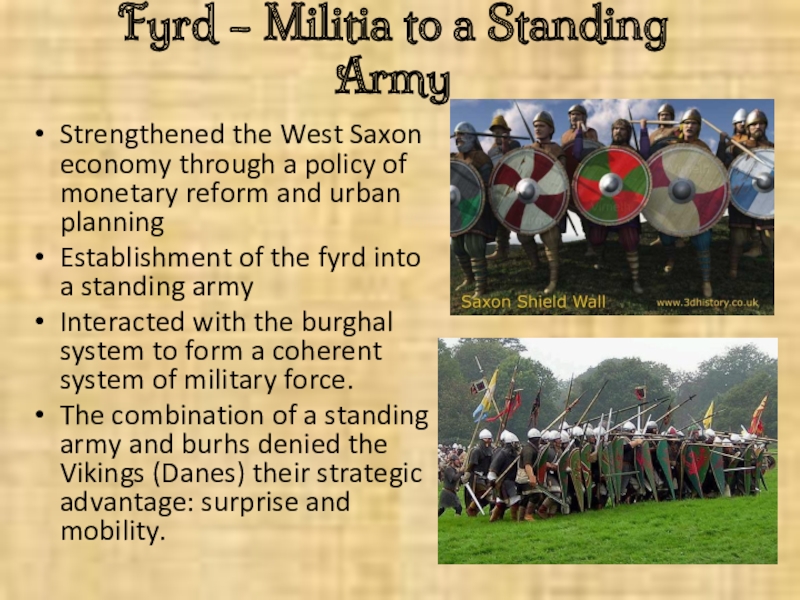
Strengthened the West Saxon economy
through a policy of monetary reform and urban planning
Establishment of the fyrd into a standing army
Interacted with the burghal system to form a coherent system of military force.
The combination of a standing army and burhs denied the Vikings (Danes) their strategic advantage: surprise and mobility.
Establishment of the fyrd into a standing army
Interacted with the burghal system to form a coherent system of military force.
The combination of a standing army and burhs denied the Vikings (Danes) their strategic advantage: surprise and mobility.
Слайд 11Naval development
896, Alfred ordered the construction of a small fleet, perhaps
a dozen or so longships, that, at 60 oars, were twice the size of Viking warships.
Alfred utilised the design of Greek and Roman warships, with high sides, designed for fighting rather than for navigation.
The warships of the time were not designed to be ship killers but troop carriers. A naval battle entailed a ship's coming alongside an enemy vessel, at which point the crew would lash the two ships together and board the enemy.
Alfred’s larger ships, although not faster or more agile than Viking ships, were able to deliver more manpower to the fight.
Alfred utilised the design of Greek and Roman warships, with high sides, designed for fighting rather than for navigation.
The warships of the time were not designed to be ship killers but troop carriers. A naval battle entailed a ship's coming alongside an enemy vessel, at which point the crew would lash the two ships together and board the enemy.
Alfred’s larger ships, although not faster or more agile than Viking ships, were able to deliver more manpower to the fight.
Слайд 12Legal reform
In the late 880s or early 890s Alfred issued a
domboc or law code consisting of his own laws.
‘Dom’ = comes from the Anglo-Saxon word meaning Judgement/Law
The domboc introduction is Alfred's meditation upon the meaning of Christian law – it traces the continuity between God's gift of Law to Moses to Alfred's own issuance of law to the West Saxon people. By doing so, it links the holy past to the historical present and represents Alfred's law-giving as a type of divine legislation
Alfred divided his code into precisely 120 chapters: 120 was the age at which Moses died and, in the number-symbolism of early medieval biblical interpretation, 120 stood for law.
Historian Patrick Wormald's explanation is that Alfred's law code should be understood not as a legal manual, but as an ideological manifesto of kingship, "designed more for symbolic impact than for practical direction.“
The most important law in the code may well be the very first: "We enjoin, what is most necessary, that each man keep carefully his oath and his pledge," which expresses a fundamental tenet of Anglo-Saxon law.
‘Dom’ = comes from the Anglo-Saxon word meaning Judgement/Law
The domboc introduction is Alfred's meditation upon the meaning of Christian law – it traces the continuity between God's gift of Law to Moses to Alfred's own issuance of law to the West Saxon people. By doing so, it links the holy past to the historical present and represents Alfred's law-giving as a type of divine legislation
Alfred divided his code into precisely 120 chapters: 120 was the age at which Moses died and, in the number-symbolism of early medieval biblical interpretation, 120 stood for law.
Historian Patrick Wormald's explanation is that Alfred's law code should be understood not as a legal manual, but as an ideological manifesto of kingship, "designed more for symbolic impact than for practical direction.“
The most important law in the code may well be the very first: "We enjoin, what is most necessary, that each man keep carefully his oath and his pledge," which expresses a fundamental tenet of Anglo-Saxon law.
Слайд 13Religion and culture
Alfred undertook no systematic reform of ecclesiastical institutions or
religious practices in Wessex.
The key to the kingdom's spiritual revival was to appoint pious, learned, and trustworthy bishops and abbots.
As king he saw himself as responsible for both the temporal and spiritual welfare of his subjects.
Alfred believed that God had entrusted him with the spiritual as well as physical welfare of his people.
The key to the kingdom's spiritual revival was to appoint pious, learned, and trustworthy bishops and abbots.
As king he saw himself as responsible for both the temporal and spiritual welfare of his subjects.
Alfred believed that God had entrusted him with the spiritual as well as physical welfare of his people.
Слайд 14The Alfred Jewel: A piece of history
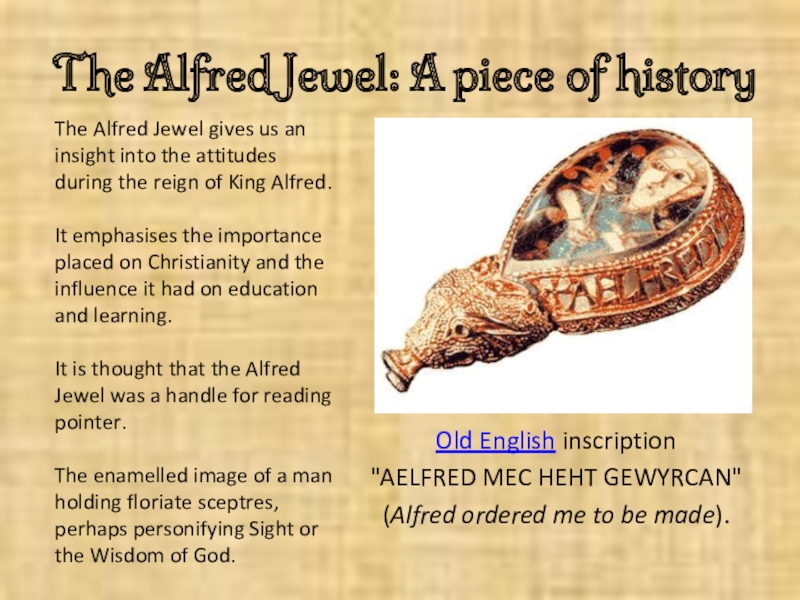
Old English inscription
"AELFRED MEC HEHT
GEWYRCAN"
(Alfred ordered me to be made).
(Alfred ordered me to be made).
The Alfred Jewel gives us an insight into the attitudes during the reign of King Alfred.
It emphasises the importance placed on Christianity and the influence it had on education and learning.
It is thought that the Alfred Jewel was a handle for reading pointer.
The enamelled image of a man holding floriate sceptres, perhaps personifying Sight or the Wisdom of God.
Слайд 15Education
Alfred established a court school for the education of his own
children, those of the nobility
Students studied books in both English and Latin, and learnt to write
Alfred proposed that primary education be taught in English; however, not many books of worth were written in English.
Alfred sought to remedy the lack of English books through an ambitious court-centred programme of translating books into English
Students studied books in both English and Latin, and learnt to write
Alfred proposed that primary education be taught in English; however, not many books of worth were written in English.
Alfred sought to remedy the lack of English books through an ambitious court-centred programme of translating books into English