- Главная
- Разное
- Образование
- Спорт
- Естествознание
- Природоведение
- Религиоведение
- Французский язык
- Черчение
- Английский язык
- Астрономия
- Алгебра
- Биология
- География
- Геометрия
- Детские презентации
- Информатика
- История
- Литература
- Математика
- Музыка
- МХК
- Немецкий язык
- ОБЖ
- Обществознание
- Окружающий мир
- Педагогика
- Русский язык
- Технология
- Физика
- Философия
- Химия
- Шаблоны, фоны, картинки для презентаций
- Экология
- Экономика
Презентация, доклад по литературе Англии Джордж Гордон Байрон, жизненный и творческий путь поэта
Содержание
- 1. Презентация по литературе Англии Джордж Гордон Байрон, жизненный и творческий путь поэта
- 2. Outline Early life.Literary Career.Don JuanByron’s poetry
- 3. George Gordon Byron1788-1824George Gordon Byron simply known
- 4. 1. Early LifeAttended Cambridge UniversityWas not very
- 5. After graduating the University, for the next
- 6. His speeches in the Parliament were a
- 7. 2. “Byronism”“Oriental Tales”-The Giaour (1813)-The Corsair (1814)-Lara
- 8. Byron differed from other Romantics in not
- 9. Left England in 1816, never to
- 10. 3. Don JuanOne of the greatest long
- 11. Don Juan is a “Byronic Hero”…
- 12. IV. SatiricLondon (Don Juan, Canto x. Stanzas
- 13. Main themes of “Don Juan” His first
- 14. “SHE WALKS IN BEAUTY”SHE walks in beauty,
- 15. She Walks in Beauty 1814 1814 by
- 16. When We Two Parted by George
- 17. Byron is said to have written this
- 18. Who was Lord Byron? Tell most interesting
- 19. 8. What were Byron’s ideal as to
- 20. “Always laugh when you can. It is cheap medicine.”- Lord Byron
Outline Early life.Literary Career.Don JuanByron’s poetry
Слайд 3George Gordon Byron
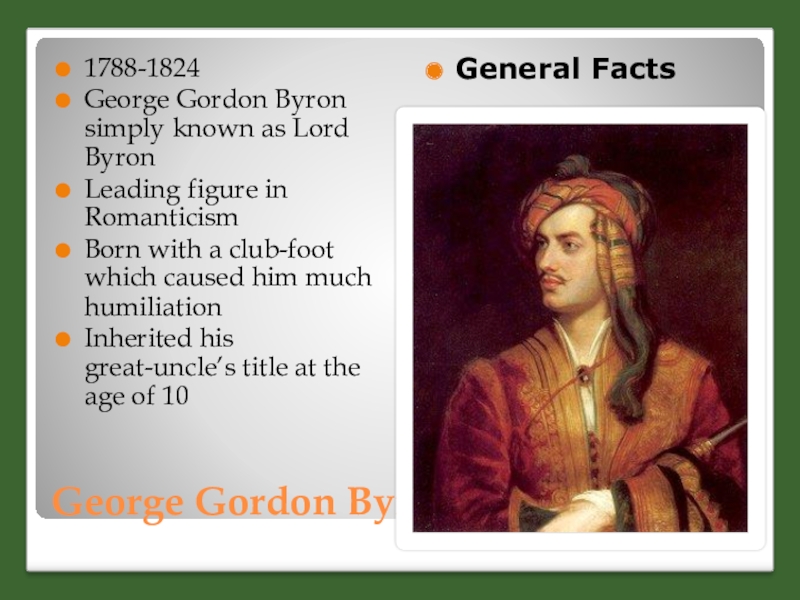
1788-1824
George Gordon Byron simply known as Lord Byron
Leading figure
in Romanticism
Born with a club-foot which caused him much humiliation
Inherited his great-uncle’s title at the age of 10
Born with a club-foot which caused him much humiliation
Inherited his great-uncle’s title at the age of 10
General Facts
Слайд 41. Early Life
Attended Cambridge University
Was not very rich, at the age
of 21 seated at the House of Lords
Intended to enter the House of Lords for a political career
Started writing poetry at University
In 1807 he published an unremarkable, slim volume of love lyrics and some fragments of translation from Latin and Greek poetry entitled Hours of Idleness
Intended to enter the House of Lords for a political career
Started writing poetry at University
In 1807 he published an unremarkable, slim volume of love lyrics and some fragments of translation from Latin and Greek poetry entitled Hours of Idleness
Слайд 5
After graduating the University, for the next years he toured Portugal,
Spain, Malta, Greece, Turkey and Albania.
On this excursion he gathered material for his “Child Harold’s Pilgrimage”, the first two cantos of which appeared in 1812.
Back in London in 1812, Byron entered the House of Lords. After “Child Harold's Pilgrimage” he suddenly became famous.
It took him 6 years to complete his poem.
On this excursion he gathered material for his “Child Harold’s Pilgrimage”, the first two cantos of which appeared in 1812.
Back in London in 1812, Byron entered the House of Lords. After “Child Harold's Pilgrimage” he suddenly became famous.
It took him 6 years to complete his poem.
Слайд 6
His speeches in the Parliament were a passionate defence of the
poorest classes of the society (Luddites, frame-breakers, who expressed their protest against exploitation by breaking machines, which, they thought, were the reason of their poverty and suffering)
He realized that the struggle between the evil and unjust forces of the society with a big gap between the romantic future and the cruelty of the world was a long and hard way for the workers to become free.
He realized that the struggle between the evil and unjust forces of the society with a big gap between the romantic future and the cruelty of the world was a long and hard way for the workers to become free.
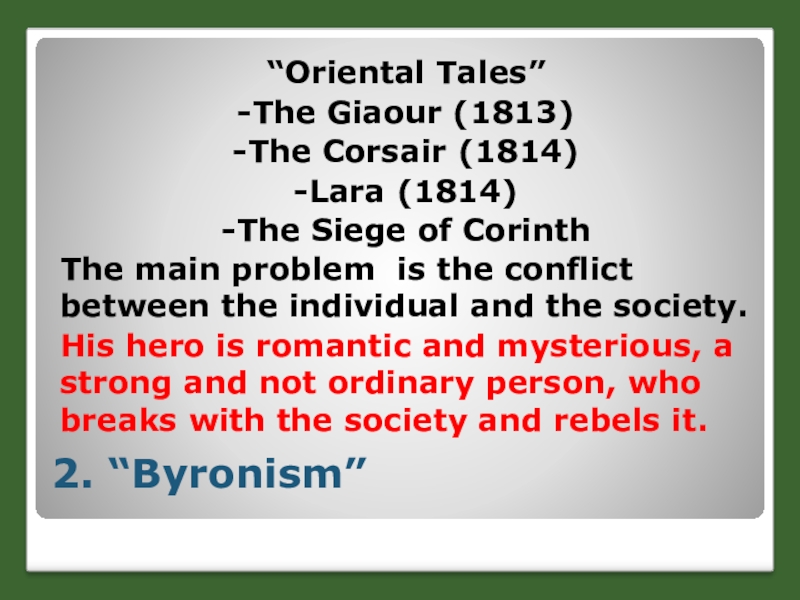
Слайд 72. “Byronism”
“Oriental Tales”
-The Giaour (1813)
-The Corsair (1814)
-Lara (1814)
-The Siege of Corinth
The main problem is the conflict between the individual and the society.
His hero is romantic and mysterious, a strong and not ordinary person, who breaks with the society and rebels it.
Слайд 8
Byron differed from other Romantics in not rebelling so violently against
the classical traditions of English poetry.
Was greatly disappointed with the results of the French Revolution
Remained true to the Enlighteners’ ideals of liberty and equality.
“They fight for freedom who were never free” says the poet in Child Harold.
Was greatly disappointed with the results of the French Revolution
Remained true to the Enlighteners’ ideals of liberty and equality.
“They fight for freedom who were never free” says the poet in Child Harold.
Слайд 9
Left England in 1816, never to return
He died in
Greece of a fever on 19 April 1824 at the age of 36.
Is the most glamorous figure in British literature
The Greeks considered him one of the national heroes
His death was mourned deeply by the progressive people throughout Europe
The poet’s heart was buried in Greece, and his body was taken and buried at Hucknall Church near Newstead. The government denied him the right to be buried at Westminster Abbey.
Is the most glamorous figure in British literature
The Greeks considered him one of the national heroes
His death was mourned deeply by the progressive people throughout Europe
The poet’s heart was buried in Greece, and his body was taken and buried at Hucknall Church near Newstead. The government denied him the right to be buried at Westminster Abbey.
Слайд 103. Don Juan
One of the greatest long English poems where humor,
adventure and pathos were linked together
Satiric poem based on the legend of Don Juan
Portraying Juan not as a womanizer but as someone easily seduced by women
Byron’s masterpiece
Social, political, literary, ideological levels
Two first cantos were published anonymously
He completed 16 cantos, leaving the 17th unfinished
Satiric poem based on the legend of Don Juan
Portraying Juan not as a womanizer but as someone easily seduced by women
Byron’s masterpiece
Social, political, literary, ideological levels
Two first cantos were published anonymously
He completed 16 cantos, leaving the 17th unfinished
Слайд 11 Don Juan is a “Byronic Hero”…
A distaste for social
institutions and norms
An exile, and a troubled past
Arrogant, Cynical, Disrespectful of rank and privilege
Emotionally conflicted, bipolar tendencies, or moodiness
High level of intelligence and perception
Mysterious, magnetic, and charismatic
Powers of seduction and attraction lead to social and sexual dominance
Self-destructive behavior, Self-critical and introspective
Sophisticated and well-educated…
An exile, and a troubled past
Arrogant, Cynical, Disrespectful of rank and privilege
Emotionally conflicted, bipolar tendencies, or moodiness
High level of intelligence and perception
Mysterious, magnetic, and charismatic
Powers of seduction and attraction lead to social and sexual dominance
Self-destructive behavior, Self-critical and introspective
Sophisticated and well-educated…
Слайд 12
IV. Satiric
London
(Don Juan, Canto x. Stanzas 81, 82.)
A mighty mass
of brick, and smoke, and shipping,
Dirty and dusky, but as wide as eye
Could reach, with here and there a sail just skippin
In sight, then lost amidst the forestry
Of masts; a wilderness of steeples peeping
On tiptoe through their sea-coal canopy;
A huge, dun cupola, like a foolscap crown
On a fool’s head—and there is London Town!
Dirty and dusky, but as wide as eye
Could reach, with here and there a sail just skippin
In sight, then lost amidst the forestry
Of masts; a wilderness of steeples peeping
On tiptoe through their sea-coal canopy;
A huge, dun cupola, like a foolscap crown
On a fool’s head—and there is London Town!
Слайд 13Main themes of “Don Juan”
His first sight impressions became the
pretext for a new digression on the power of money. “alas, how deeply is all payment”…
Hypocrisy of modern philanthropy and the task facing Don Juan:
“to mend the people’s absurdity”
“Unless you make their betters better”
“Tell them that youth once gone returns no more”, etc.
Hypocrisy of modern philanthropy and the task facing Don Juan:
“to mend the people’s absurdity”
“Unless you make their betters better”
“Tell them that youth once gone returns no more”, etc.
Слайд 14“SHE WALKS IN BEAUTY”
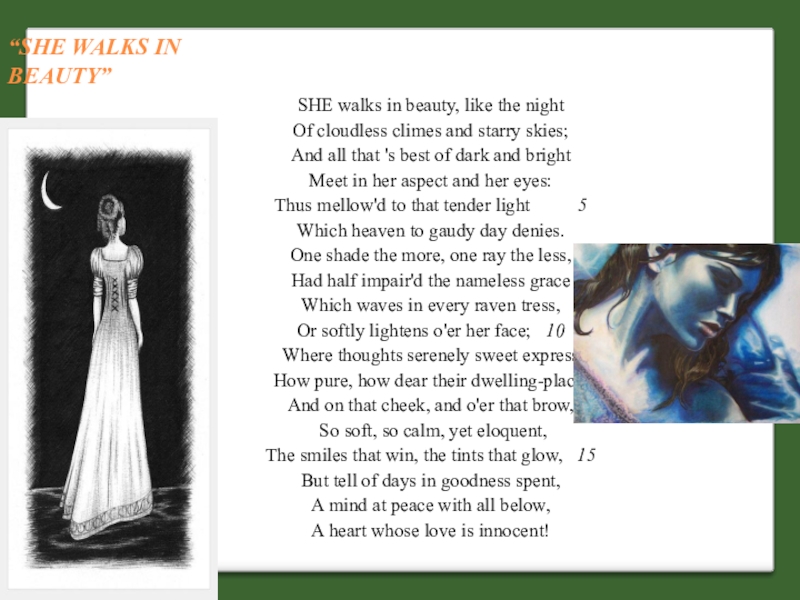
SHE walks in beauty, like the night
Of cloudless climes and starry skies;
And all that 's best of dark and bright
Meet in her aspect and her eyes:
Thus mellow'd to that tender light 5
Which heaven to gaudy day denies.
One shade the more, one ray the less,
Had half impair'd the nameless grace
Which waves in every raven tress,
Or softly lightens o'er her face; 10
Where thoughts serenely sweet express
How pure, how dear their dwelling-place.
And on that cheek, and o'er that brow,
So soft, so calm, yet eloquent,
The smiles that win, the tints that glow, 15
But tell of days in goodness spent,
A mind at peace with all below,
A heart whose love is innocent!
Слайд 15She Walks in Beauty 1814 1814 by Lord Byron.
not necessarily
a love poem, but a celebration of the subject's beauty.
Wrote this poem about his wife Harriet’s cousin
He met her at a funeral. (hence the allusions to darkness, with the light referring to her beauty)
he was taken aback. Nowhere in the poem does Byron mention or allude to love.
Wrote this poem about his wife Harriet’s cousin
He met her at a funeral. (hence the allusions to darkness, with the light referring to her beauty)
he was taken aback. Nowhere in the poem does Byron mention or allude to love.
Слайд 16When We Two Parted
by George Gordon Byron
When we two parted
In silence and tears,
Half broken-hearted
To sever for years,
Pale grew thy cheek and cold,
Colder thy kiss;
Truly that hour foretold
Sorrow to this.
The dew of the morning
Sunk chill on my brow--
It felt like the warning
Of what I feel now.
Thy vows are all broken,
And light is thy fame;
I hear thy name spoken,
And share in its shame.
They name thee before me,
A knell to mine ear;
A shudder comes o'er me--
Why wert thou so dear?
They know not I knew thee,
Who knew thee too well--
Long, long shall I rue thee,
Too deeply to tell.
In secret we met--
In silence I grieve,
That thy heart could forget,
Thy spirit deceive.
If I should meet thee
After long years,
How should I greet thee?--
With silence and tears.
Слайд 17
Byron is said to have written this poem on his split
with Lady Frances.
When We Two Parted is a short lyric of four eight-line stanzas in which the speaker mourns the loss of a romantic relationship. The prominent theme of the poem is betrayal.
When We Two Parted is known for the strong feelings it is able to convey and, being a poem about a vastly relatable topic of lost love, it continues to be highly popular.
When We Two Parted is a short lyric of four eight-line stanzas in which the speaker mourns the loss of a romantic relationship. The prominent theme of the poem is betrayal.
When We Two Parted is known for the strong feelings it is able to convey and, being a poem about a vastly relatable topic of lost love, it continues to be highly popular.
Слайд 18
Who was Lord Byron? Tell most interesting facts about him?
What
do we know about his education and political career?
When did he start writing poetry?
How did his journeys influence his literary career?
How did he become famous?
Who did he defend in Parliament?
What is the main theme of “Oriental Tales”?
When did he start writing poetry?
How did his journeys influence his literary career?
How did he become famous?
Who did he defend in Parliament?
What is the main theme of “Oriental Tales”?
Слайд 19
8. What were Byron’s ideal as to equality and liberty of
people? His attitude to the French Revolution.
9. Where and when did he die?
10. Describe Don Juan as a protagonist.
11. Give a critical interpretation of “She Walks in Beauty”
12. Critical analysis of “When We Two Parted”
9. Where and when did he die?
10. Describe Don Juan as a protagonist.
11. Give a critical interpretation of “She Walks in Beauty”
12. Critical analysis of “When We Two Parted”