- Главная
- Разное
- Образование
- Спорт
- Естествознание
- Природоведение
- Религиоведение
- Французский язык
- Черчение
- Английский язык
- Астрономия
- Алгебра
- Биология
- География
- Геометрия
- Детские презентации
- Информатика
- История
- Литература
- Математика
- Музыка
- МХК
- Немецкий язык
- ОБЖ
- Обществознание
- Окружающий мир
- Педагогика
- Русский язык
- Технология
- Физика
- Философия
- Химия
- Шаблоны, фоны, картинки для презентаций
- Экология
- Экономика
Презентация, доклад по английскому языку Traditions of the British Parliament
Содержание
- 1. Презентация по английскому языку Traditions of the British Parliament
- 2. Searching the Houses of Parliament
- 3. The State Opening of Parliament.
- 4. Ceremony of the Keys One
- 5. CHANGING of the GUARD. Outside Buckingham
- 6. Слайд 6
- 7. Swan Upping. On the River
- 8. The Birthday Honours list and the New
- 9. Searching the cellars The day begins
- 10. Crown, sword and cap The Imperial State
- 11. The Queen's journey The royal procession,
- 12. Procession The Queen dons her
- 13. Black Rod While the Queen is
- 14. All assembled The MPs head to the
- 15. The speech Officially called the Royal Address,
Searching the Houses of Parliament Before every State Opening of ParliamentBefore every State Opening of Parliament, the Yeomen of the Guard Before every State Opening of Parliament, the Yeomen of the Guard search
Слайд 2Searching the Houses of Parliament
Before every State
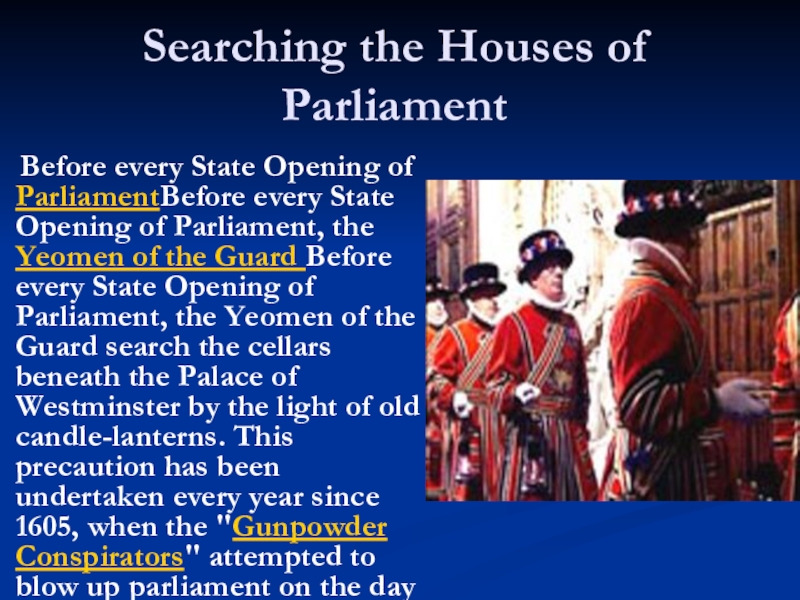
Opening of ParliamentBefore every State Opening of Parliament, the Yeomen of the Guard Before every State Opening of Parliament, the Yeomen of the Guard search the cellars beneath the Palace of Westminster by the light of old candle-lanterns. This precaution has been undertaken every year since 1605, when the "Gunpowder Conspirators" attempted to blow up parliament on the day of the State Opening.
Слайд 3The State Opening of Parliament.
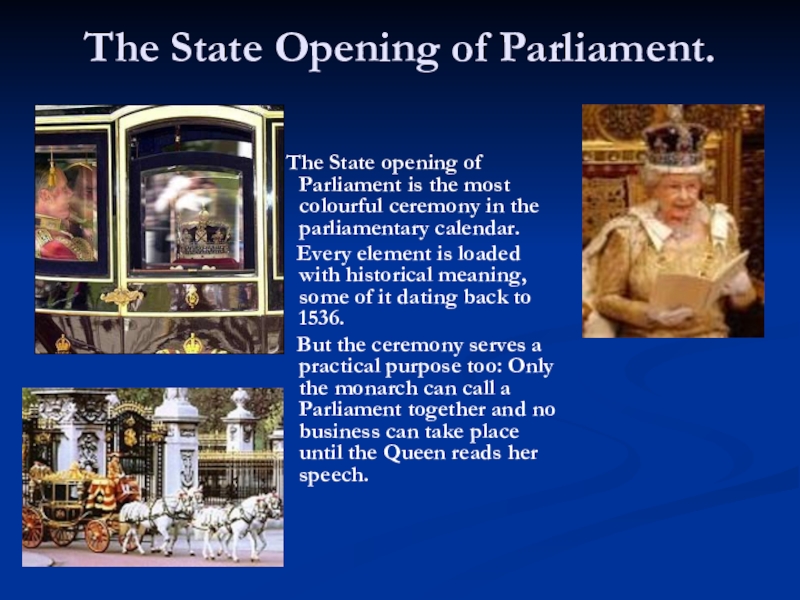
The State opening
of Parliament is the most colourful ceremony in the parliamentary calendar.
Every element is loaded with historical meaning, some of it dating back to 1536.
But the ceremony serves a practical purpose too: Only the monarch can call a Parliament together and no business can take place until the Queen reads her speech.
Every element is loaded with historical meaning, some of it dating back to 1536.
But the ceremony serves a practical purpose too: Only the monarch can call a Parliament together and no business can take place until the Queen reads her speech.
Слайд 4Ceremony of the Keys
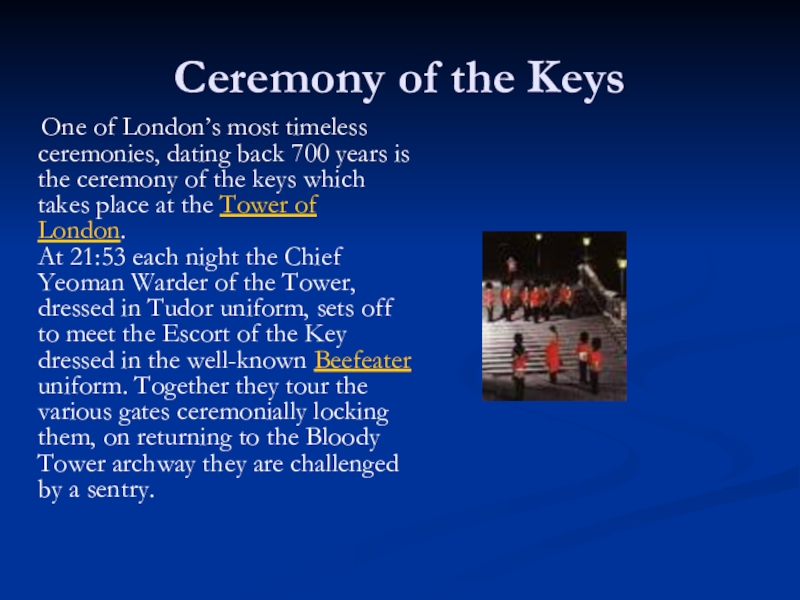
One of London’s most timeless
ceremonies, dating back 700 years is the ceremony of the keys which takes place at the Tower of London.
At 21:53 each night the Chief Yeoman Warder of the Tower, dressed in Tudor uniform, sets off to meet the Escort of the Key dressed in the well-known Beefeater uniform. Together they tour the various gates ceremonially locking them, on returning to the Bloody Tower archway they are challenged by a sentry.
Слайд 5CHANGING of the GUARD.
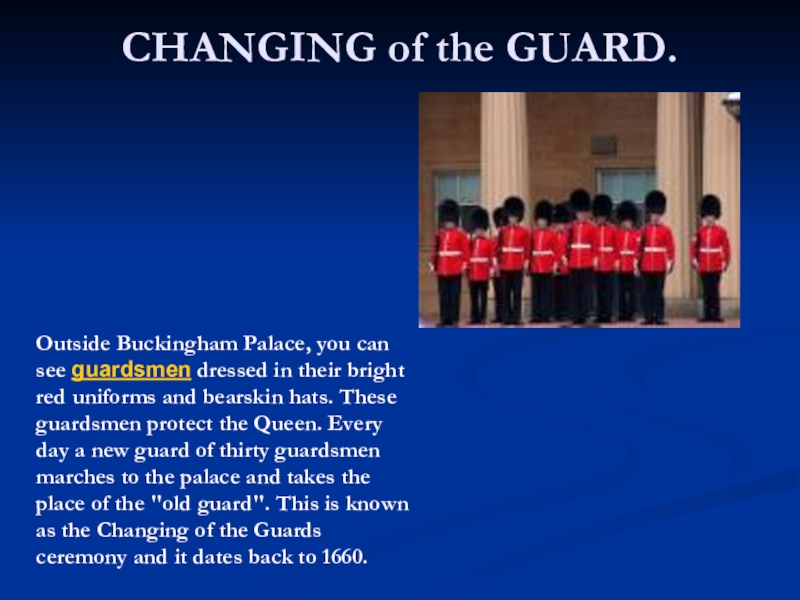
Outside Buckingham Palace, you can see guardsmen
dressed in their bright red uniforms and bearskin hats. These guardsmen protect the Queen. Every day a new guard of thirty guardsmen marches to the palace and takes the place of the "old guard". This is known as the Changing of the Guards ceremony and it dates back to 1660.
Слайд 6
Maundy Money.
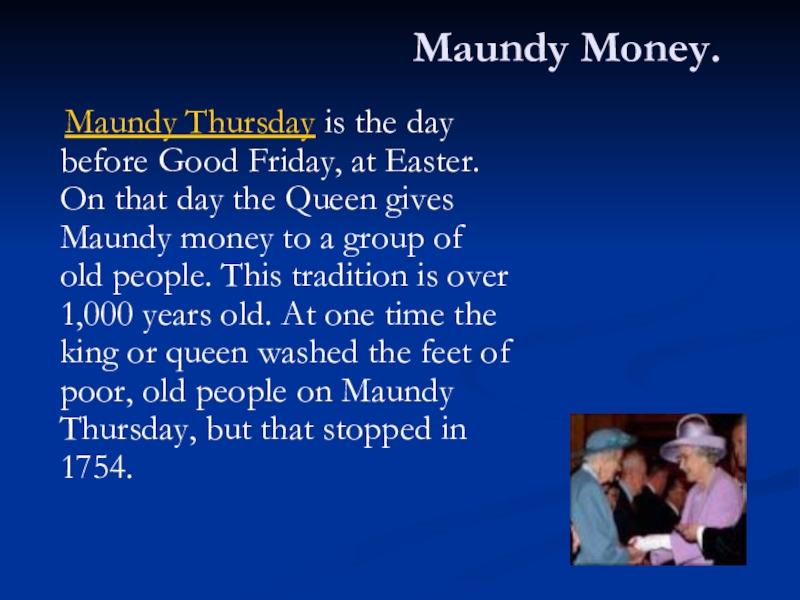
Maundy Thursday is the day before Good Friday, at Easter. On that day the Queen gives Maundy money to a group of old people. This tradition is over 1,000 years old. At one time the king or queen washed the feet of poor, old people on Maundy Thursday, but that stopped in 1754.
Слайд 7Swan Upping.
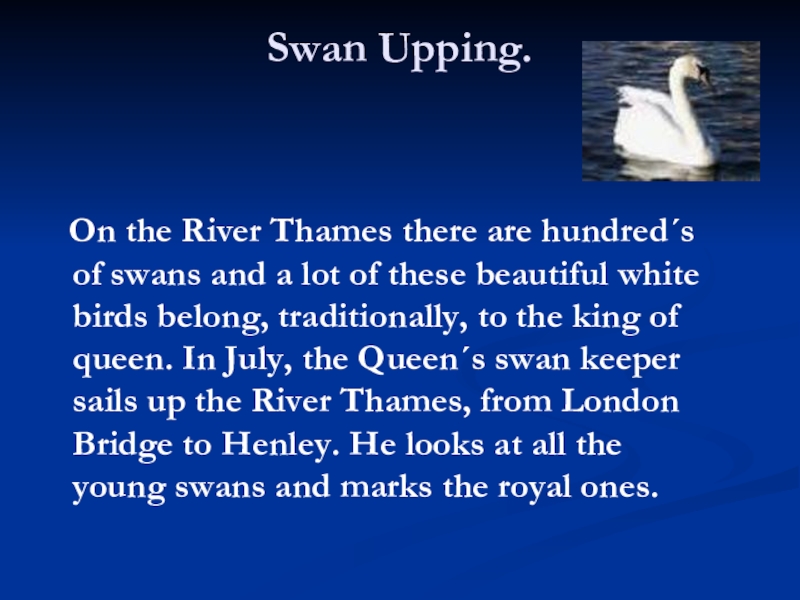
On the River Thames there are hundred´s of
swans and a lot of these beautiful white birds belong, traditionally, to the king of queen. In July, the Queen´s swan keeper sails up the River Thames, from London Bridge to Henley. He looks at all the young swans and marks the royal ones.
Слайд 8The Birthday Honours list and the New Year Honours list:
Twice a year at Buckingham Palace, the Queen gives titles or 'honours', once in January and once in June.
Honours received include: C.B.E. - Companion of the British Empire O.B.E. - Order of the British Empire M.B.E. - Member of the British Empire These honours began in the nineteenth century, because then Britain had an empire.
Honours received include: C.B.E. - Companion of the British Empire O.B.E. - Order of the British Empire M.B.E. - Member of the British Empire These honours began in the nineteenth century, because then Britain had an empire.
Слайд 9Searching the cellars
The day begins at 10am when the
Yeomen of the Guard – the royal bodyguards otherwise known as Beefeaters – search the cellars of the Houses of Parliament.
This tradition dates back to the Gunpowder Plot of 1605 when Guy Fawkes tried to blow up Parliament.
Today, officers from the Metropolitan police join the Yeomen in their search.
This tradition dates back to the Gunpowder Plot of 1605 when Guy Fawkes tried to blow up Parliament.
Today, officers from the Metropolitan police join the Yeomen in their search.
Слайд 10Crown, sword and cap
The Imperial State Crown, the Sword
of State and the Cap of Maintenance are transported to Westminster by coach ahead of the Queen.
The crown was made for George VI’s Coronation in 1937 and contains the huge Cullinan II diamond and other historic jewels.
The Sword of State and the Cap of Maintenance are symbols of royal power.
The crown was made for George VI’s Coronation in 1937 and contains the huge Cullinan II diamond and other historic jewels.
The Sword of State and the Cap of Maintenance are symbols of royal power.
Слайд 11The Queen's journey
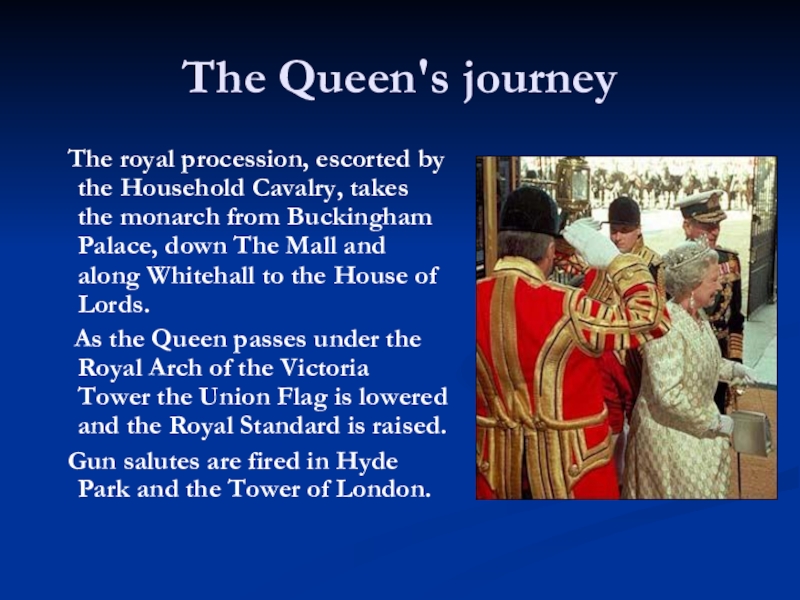
The royal procession, escorted by the
Household Cavalry, takes the monarch from Buckingham Palace, down The Mall and along Whitehall to the House of Lords.
As the Queen passes under the Royal Arch of the Victoria Tower the Union Flag is lowered and the Royal Standard is raised.
Gun salutes are fired in Hyde Park and the Tower of London.
As the Queen passes under the Royal Arch of the Victoria Tower the Union Flag is lowered and the Royal Standard is raised.
Gun salutes are fired in Hyde Park and the Tower of London.
Слайд 12Procession
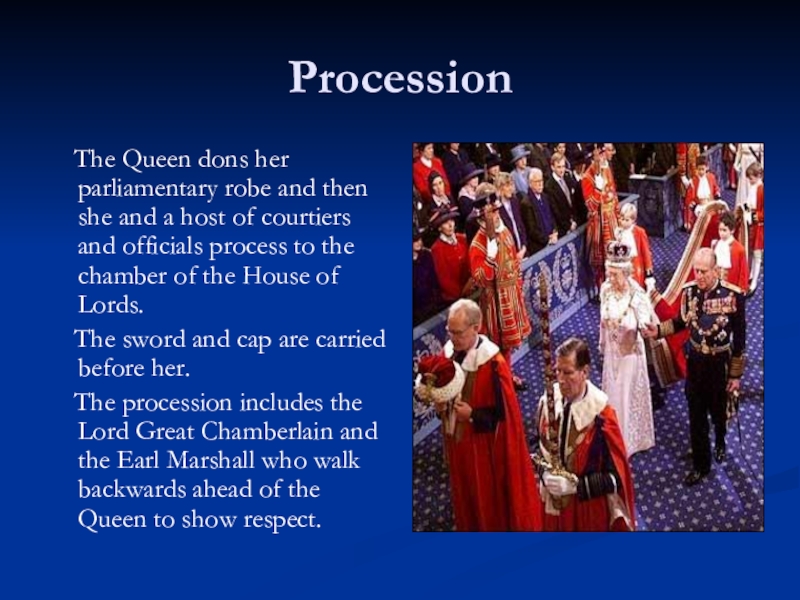
The Queen dons her parliamentary robe and then
she and a host of courtiers and officials process to the chamber of the House of Lords.
The sword and cap are carried before her.
The procession includes the Lord Great Chamberlain and the Earl Marshall who walk backwards ahead of the Queen to show respect.
The sword and cap are carried before her.
The procession includes the Lord Great Chamberlain and the Earl Marshall who walk backwards ahead of the Queen to show respect.
Слайд 13Black Rod
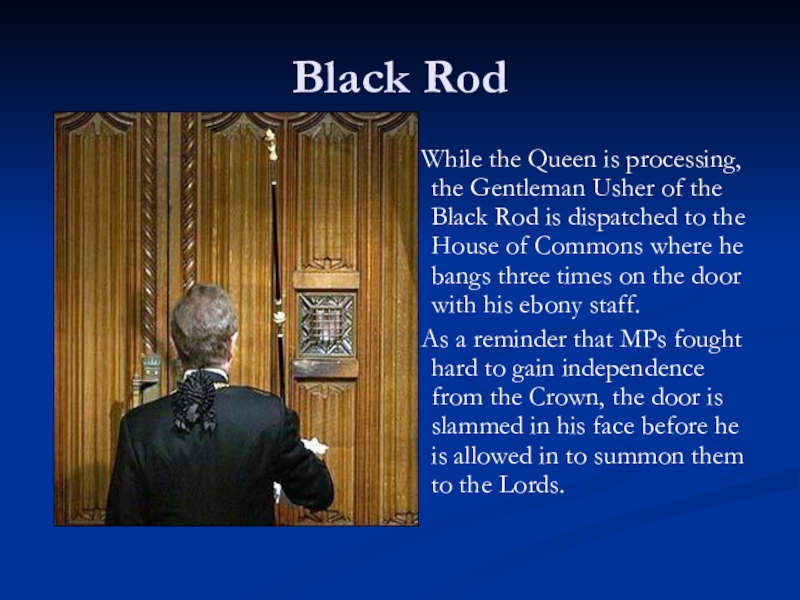
While the Queen is processing, the Gentleman
Usher of the Black Rod is dispatched to the House of Commons where he bangs three times on the door with his ebony staff.
As a reminder that MPs fought hard to gain independence from the Crown, the door is slammed in his face before he is allowed in to summon them to the Lords.
As a reminder that MPs fought hard to gain independence from the Crown, the door is slammed in his face before he is allowed in to summon them to the Lords.
Слайд 14All assembled
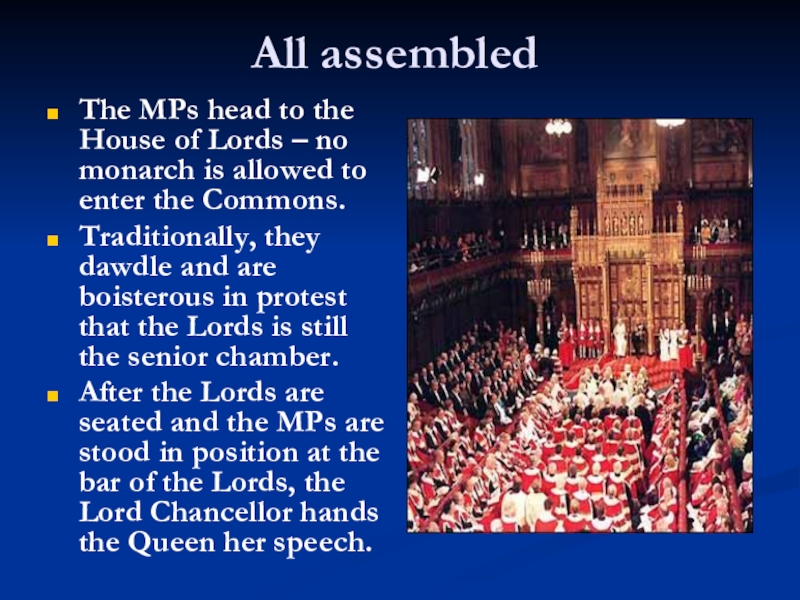
The MPs head to the House of Lords –
no monarch is allowed to enter the Commons.
Traditionally, they dawdle and are boisterous in protest that the Lords is still the senior chamber.
After the Lords are seated and the MPs are stood in position at the bar of the Lords, the Lord Chancellor hands the Queen her speech.
Traditionally, they dawdle and are boisterous in protest that the Lords is still the senior chamber.
After the Lords are seated and the MPs are stood in position at the bar of the Lords, the Lord Chancellor hands the Queen her speech.
Слайд 15The speech
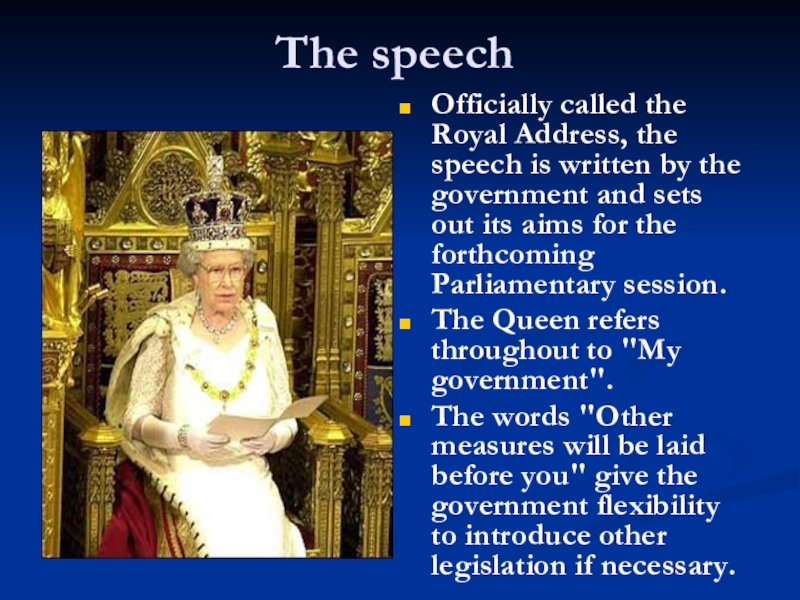
Officially called the Royal Address, the speech is written
by the government and sets out its aims for the forthcoming Parliamentary session.
The Queen refers throughout to "My government".
The words "Other measures will be laid before you" give the government flexibility to introduce other legislation if necessary.
The Queen refers throughout to "My government".
The words "Other measures will be laid before you" give the government flexibility to introduce other legislation if necessary.