- Главная
- Разное
- Образование
- Спорт
- Естествознание
- Природоведение
- Религиоведение
- Французский язык
- Черчение
- Английский язык
- Астрономия
- Алгебра
- Биология
- География
- Геометрия
- Детские презентации
- Информатика
- История
- Литература
- Математика
- Музыка
- МХК
- Немецкий язык
- ОБЖ
- Обществознание
- Окружающий мир
- Педагогика
- Русский язык
- Технология
- Физика
- Философия
- Химия
- Шаблоны, фоны, картинки для презентаций
- Экология
- Экономика
Презентация, доклад по английскому языку The verb: the category of mood
Содержание
- 1. Презентация по английскому языку The verb: the category of mood
- 2. Topic The verb: the category of
- 3. Использованная литература Марк Яковлевич Блох «ТЕОРЕТИЧЕСКАЯ ГРАММАТИКА
- 4. The definition of the grammatical category of
- 5. Extensive investigations were undertaken by Soviet scholars
- 6. Academician V.Vinogradov wrote: “Mood expresses the relation
- 7. mood =a way to express the attitude of the speaker to what is being said.
- 8. Mood is one of the kinds of
- 9. The number of moods in English. The
- 10. The Suppositional and Subjunctive I almost coincide
- 11. Some of the scholars (Plotkin) are of
- 12. Most of the soviet grammarians distinguish three
- 13. In our interpretation and classification of moods
- 14. His system of moods includes six moods:the
- 15. 3. The Indicative mood. Its boundaries. Means
- 16. The Indicative mood presents the action as
- 17. Morphologically it’s the most developed system including
- 18. Indicative means "stating a fact." The
- 19. The Indicative has no special forms of
- 20. 4. The Subjunctive mood. Forms and meaning.
- 21. Examples: "It may snow tomorrow." (It is
- 22. "I doubt if Mary would forget your
- 23. We follow the Smirnitskij's classificaion. It is
- 24. The Subjunctive mood may be expressed both
- 25. 1) Subjunctive I expresses synthetically a problematic
- 26. Suppositional mood specializes in the expression
- 27. 5. The Imperative mood, form and meaning.
- 28. The Imperative mood is used to express
- 29. Imperative means "expressing an order." The
- 30. – represented by one form only, without
- 31. The negative form is built by means
- 32. The problem of let forms. GROUP
- 33. (1) a decision of the 1st person
- 34. There is the question whether groups of
- 35. Expressions of the type let me go,
- 36. Thank you for your attention
Topic The verb: the category of mood.The definition of the grammatical category of mood. Mood and Modality.The number of moods in English. The traditional approach to the problem, the binary approach, the approach from meaning
Слайд 2Topic
The verb: the category of mood.
The definition of the grammatical
category of mood. Mood and Modality.
The number of moods in English. The traditional approach to the problem, the binary approach, the approach from meaning to form.
The Indicative mood. Its boundaries. Means of expression.
The Subjunctive mood. Forms and meaning. A. I. Smirnitskiy’s treatment of the problem.
The Imperative mood, form and meaning. The problem of let forms.
The number of moods in English. The traditional approach to the problem, the binary approach, the approach from meaning to form.
The Indicative mood. Its boundaries. Means of expression.
The Subjunctive mood. Forms and meaning. A. I. Smirnitskiy’s treatment of the problem.
The Imperative mood, form and meaning. The problem of let forms.
Слайд 3Использованная литература
Марк Яковлевич Блох
«ТЕОРЕТИЧЕСКАЯ ГРАММАТИКА АНГЛИЙСКОГО ЯЗЫКА»
Москва «Высшая школа»
1983
Борис Александрович Ильиш
«Строй современного английского языка»
ПРОСВЕЩЕНИЕ«ЛЕНИНГРАД 1971
Материалы из Википедии — свободной энциклопедии
Иванова И.П. «Теоретическая грамматика английского языка»
Москва 1981
Смирницкий А. И. «Морфология современного английского языка»
Москва 1955
Борис Александрович Ильиш
«Строй современного английского языка»
ПРОСВЕЩЕНИЕ«ЛЕНИНГРАД 1971
Материалы из Википедии — свободной энциклопедии
Иванова И.П. «Теоретическая грамматика английского языка»
Москва 1981
Смирницкий А. И. «Морфология современного английского языка»
Москва 1955
Слайд 4The definition of the grammatical category of mood. Mood and Modality.
The
category of mood is the most controversial category of the verb.
Professor Ilyish wrote : “the category of mood in the present English verb has given rise to so many discussions and has been treated in so many different ways that it seems hardly possible to arrive at any more or less convincing and universally acceptable conclusion concerning it”.
Professor Ilyish wrote : “the category of mood in the present English verb has given rise to so many discussions and has been treated in so many different ways that it seems hardly possible to arrive at any more or less convincing and universally acceptable conclusion concerning it”.
Слайд 5Extensive investigations were undertaken by Soviet scholars in the past decades.
They are A.I. Smirnitsky, Ilyish, Barkhudarov and a number of others.
The category of mood expresses the character of connection between the process denoted by the verb and the actual reality, either presenting the process as a fact that really happened, happens or will happen, or treating it as an imaginary phenomenon.
Слайд 6Academician V.Vinogradov wrote: “Mood expresses the relation of the action to
reality as a stated by the speaker”.
Слайд 8Mood is one of the kinds of modality, which may be
expressed also by lexical means (modal verbs (may, can, must, etc.) and modal words (perhaps, probably, etc.)) and intonation (melody).
Mood modality is based on the opposition: reality – unreality.
Mood modality is based on the opposition: reality – unreality.
Слайд 9The number of moods in English. The traditional approach to the
problem, the binary approach, the approach from meaning to form.
The forms of the moods serve the needs of the speaker to present the action as real, unreal (contradicting the state of things in reality) or hypothetical.
The category of mood presents the interpretation of the action by the speaker from the point of view of its relation to reality.
Scholars differ greatly in the understanding of this category, its scope and, consequently, in the number of grammatical forms of the mood they find in English. This number- varies from two (in Barkhudarov's interpretation) to sixteeen (in Deutchbein's interpretation).
The forms of the moods serve the needs of the speaker to present the action as real, unreal (contradicting the state of things in reality) or hypothetical.
The category of mood presents the interpretation of the action by the speaker from the point of view of its relation to reality.
Scholars differ greatly in the understanding of this category, its scope and, consequently, in the number of grammatical forms of the mood they find in English. This number- varies from two (in Barkhudarov's interpretation) to sixteeen (in Deutchbein's interpretation).
Слайд 10The Suppositional and Subjunctive I almost coincide in meaning but differ
in style and usage.
Professor Barkhudarov finds only 2 moods: Imperative and Indicative, the latter may express unreality by the shifting of tenses or context. He puts Subjunctive I as Imperative on the ground that they both are similar in form and meaning.
E.g. I suggest that he go there. Go there!
Professor Barkhudarov finds only 2 moods: Imperative and Indicative, the latter may express unreality by the shifting of tenses or context. He puts Subjunctive I as Imperative on the ground that they both are similar in form and meaning.
E.g. I suggest that he go there. Go there!
Слайд 11Some of the scholars (Plotkin) are of the opinion that there
is no morphological system of moods at all and various mood meanings are expressed syntactically and by lexico-semantic means.
The mood forms are often homonymous and synonymous and their meanings often depend on the context. E.g. I wish he would go. He would go if you went. He said he would go. Various oblique mood meanings are connected with syntax rather than with morphology and one and the same meaning may be expressed by different forms: If he came. If he had come. Should he come.
The mood forms are often homonymous and synonymous and their meanings often depend on the context. E.g. I wish he would go. He would go if you went. He said he would go. Various oblique mood meanings are connected with syntax rather than with morphology and one and the same meaning may be expressed by different forms: If he came. If he had come. Should he come.
Слайд 12Most of the soviet grammarians distinguish three moods in Modern English.
It is a traditional division
Indicative expressing real facts.
Imperative expressing command, order, request.
Subjunctive expressing something desirable, problematic, unreal etc
Слайд 13
In our interpretation and classification of moods we shall follow the
classification system of moods presented by Smirnitsky.
It appears to be the most consistent because it is meaning-oriented and it also takes into consideration the difference between an analytical form and a free syntactic combination.
It appears to be the most consistent because it is meaning-oriented and it also takes into consideration the difference between an analytical form and a free syntactic combination.
Слайд 14His system of moods includes six moods:
the Indicative,
the Imperative,
Subjunctive
I,
Subjunctive II,
the Conditional Mood
the Suppositional mood
Subjunctive II,
the Conditional Mood
the Suppositional mood
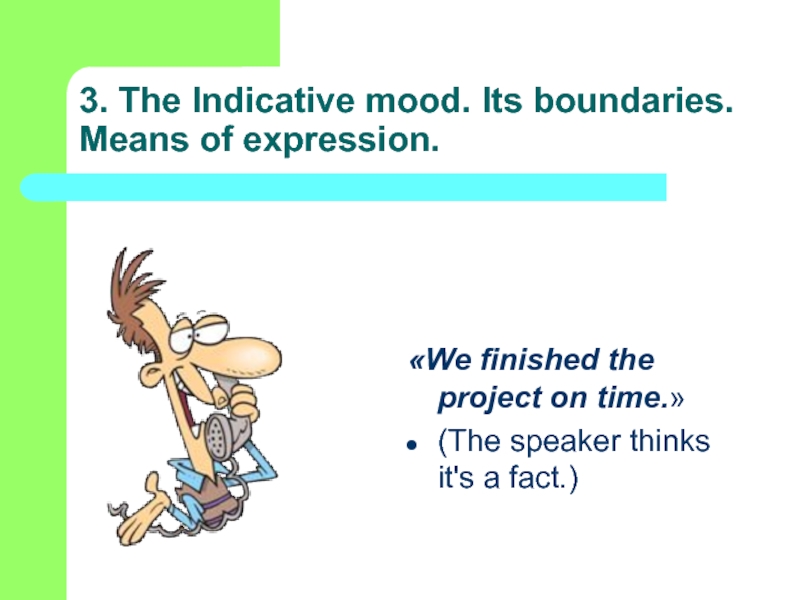
Слайд 153. The Indicative mood. Its boundaries. Means of expression.
«We finished the
project on time.»
(The speaker thinks it's a fact.)
(The speaker thinks it's a fact.)
Слайд 16
The Indicative mood presents the action as real from the speaker's
point of view. It is the most frequently used type of mood and it has the greatest number of forms. The forms of the Indicative mood are used in two communicative types of sentences: declarative and interrogative.
Слайд 17
Morphologically it’s the most developed system including all the categories of
the verb.
Semantically it’s a fact mood.
It serves to present an action as a fact of reality. It’s the most objective of all the moods. It conveys minimum personal attitude to the fact: Ex. Water consists of oxygen.
Semantically it’s a fact mood.
It serves to present an action as a fact of reality. It’s the most objective of all the moods. It conveys minimum personal attitude to the fact: Ex. Water consists of oxygen.
Слайд 18
Indicative means "stating a fact."
The indicative mood is a category of
verb forms that we use to state facts.
Examples:
"Joe plays outside." (The speaker thinks it's a fact.)
"It will rain soon." (The speaker thinks it's a fact.)
"She was studying all day long." (The speaker thinks it's a fact.)
The indicative mood is the basic mood of verbs in English.
"Joe plays outside." (The speaker thinks it's a fact.)
"It will rain soon." (The speaker thinks it's a fact.)
"She was studying all day long." (The speaker thinks it's a fact.)
The indicative mood is the basic mood of verbs in English.
Слайд 19
The Indicative has no special forms of expression – it is
all the tenses in active and passive.
H. Sweet calls it a fact mood. Its modal meaning is reality and it may be considered as expressing zero modality.
H. Sweet calls it a fact mood. Its modal meaning is reality and it may be considered as expressing zero modality.
Слайд 204. The Subjunctive mood. Forms and meaning. A. I. Smirnitskiy’s treatment
of the problem.
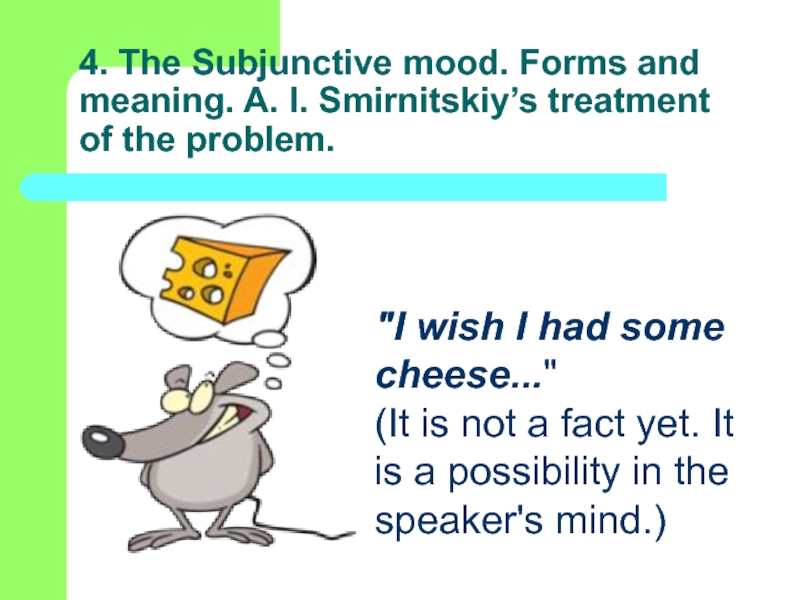
"I wish I had some cheese..."
(It is not a fact yet. It is a possibility in the speaker's mind.)
Слайд 21Examples:
"It may snow tomorrow."
(It is not a fact yet. It
is a possibility in the speaker's mind.)
(Incorrect: "It will snow tomorrow.")
"I would do it if I had the time." (It is not a fact. It depends on me having the time.)
"You should listen to your parents." (It is not a fact. It is a suggestion.)
I suggest that Robert wait a few minutes. (It is not a fact. It is a suggestion.) (Incorrect: "I suggest that Robert waits a few minutes.")
It's important that Sandra leave on time. (It is not a fact. It is what needs to be done.) (Incorrect: "It's important that Sandra leaves on time.")
"I would do it if I had the time." (It is not a fact. It depends on me having the time.)
"You should listen to your parents." (It is not a fact. It is a suggestion.)
I suggest that Robert wait a few minutes. (It is not a fact. It is a suggestion.) (Incorrect: "I suggest that Robert waits a few minutes.")
It's important that Sandra leave on time. (It is not a fact. It is what needs to be done.) (Incorrect: "It's important that Sandra leaves on time.")
Слайд 22"I doubt if Mary would forget your birthday." (It is not a
fact that Mary will forget the birthday. The speakers has doubts about it.)
"Father insisted that Jeniffer go to school." (It is not a fact that Jeniffer will go to school. It is father's intention.) (Incorrect: "Father insisted that Jeniffer goes to school.")
If he had worked harder, he would have completed the task on time. (He didn't work harder, so he didn't complete the task on time.)
"I wish I were faster." (I am not faster. This is a wish in my mind.) (Incorrect: "I wish I was faster.")
"If I were you, I would accept the offer." (I am not you. This is an unreal condition in my mind.) (Incorrect: "If I was you, I will accept the offer.")
"I wish it were summer now." (It is not summer now. This is a wish in my mind.) (Incorrect: "I wish it is summer now.")
"She suggests that Michael move to the sales department." (Incorrect: "She suggests that Michael moves to the sales department.")
All these sentences were examples of the use of the subjunctive mood.
"Father insisted that Jeniffer go to school." (It is not a fact that Jeniffer will go to school. It is father's intention.) (Incorrect: "Father insisted that Jeniffer goes to school.")
If he had worked harder, he would have completed the task on time. (He didn't work harder, so he didn't complete the task on time.)
"I wish I were faster." (I am not faster. This is a wish in my mind.) (Incorrect: "I wish I was faster.")
"If I were you, I would accept the offer." (I am not you. This is an unreal condition in my mind.) (Incorrect: "If I was you, I will accept the offer.")
"I wish it were summer now." (It is not summer now. This is a wish in my mind.) (Incorrect: "I wish it is summer now.")
"She suggests that Michael move to the sales department." (Incorrect: "She suggests that Michael moves to the sales department.")
All these sentences were examples of the use of the subjunctive mood.
Слайд 23
We follow the Smirnitskij's classificaion. It is the most constant &
meaning oriented. His system includes 6 Moods:
Real___________Hypothetical_______________Unreal_____
(Indicative) (Imperative,subj1,Suppos) (Subj2,Condition)
Слайд 24
The Subjunctive mood may be expressed both synthetically and analytically.
E.g.
I wish you were here.
Professor Smirnitsky distinguishes 4 oblique moods: Subjunctive I, Subjunctive II, the Conditional and the Suppositional. Each of them differs in modal meaning and in form.
Слайд 251) Subjunctive I expresses synthetically a problematic action, which doesn’t contradict
reality.
E.g. He gave orders that we be present.
2) Subjunctive II expresses synthetically and analytically an unreal action.
E.g. I wish you were not late. 3) The Conditional mood expresses analytically depended unreality: the realization of the action depends on some condition, which may not be expressed.
E.g. It would be good to be here. 4) The Suppositional mood expresses analytically a problematic action, not contradicting reality. The realization of the action may depend on certain circumstances.
E.g. Should you meet him, tell him to come The Suppositional and Subjunctive I almost coincide in meaning but differ in style and usage.
E.g. I wish you were not late. 3) The Conditional mood expresses analytically depended unreality: the realization of the action depends on some condition, which may not be expressed.
E.g. It would be good to be here. 4) The Suppositional mood expresses analytically a problematic action, not contradicting reality. The realization of the action may depend on certain circumstances.
E.g. Should you meet him, tell him to come The Suppositional and Subjunctive I almost coincide in meaning but differ in style and usage.
Слайд 26 Suppositional mood specializes in the expression of hypothetical actions. The
comparison of such sentences as
"If he turns up tell him to -wait for me" and
"Should he turn up tell him to wait for me"
shows that both the verbal forms present the action as hypothetical but differ in the degree of certainty which is higher in the case of Present Indefinite Indicative.
"If he turns up tell him to -wait for me" and
"Should he turn up tell him to wait for me"
shows that both the verbal forms present the action as hypothetical but differ in the degree of certainty which is higher in the case of Present Indefinite Indicative.
Слайд 275. The Imperative mood, form and meaning. The problem of let
forms.
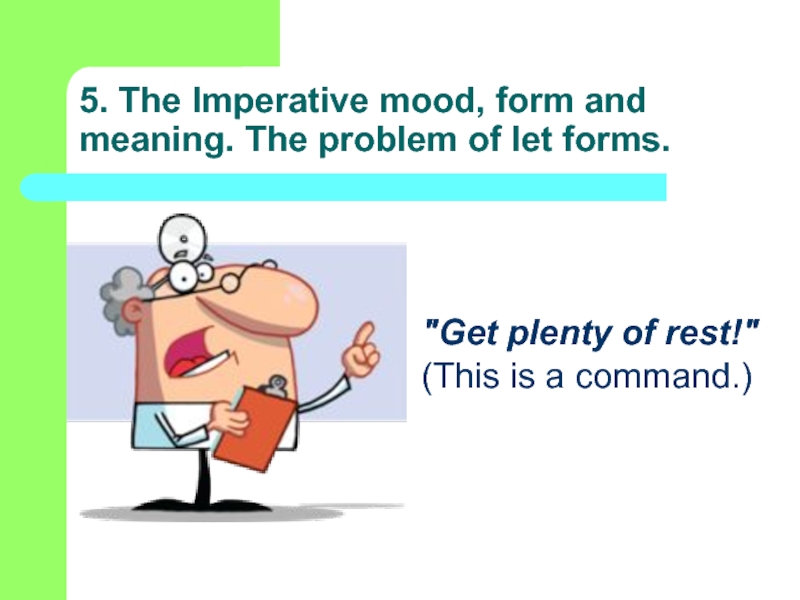
"Get plenty of rest!"
(This is a command.)
Слайд 28
The Imperative mood is used to express inducement(побуждение, стимул) to action,
which means that the speaker considers the action as desirable. The use of the Imperative mood is restricted to only one communicative type of sentences - imperative sentences.
Слайд 29Imperative means "expressing an order." The imperative mood is a category of
verb forms that we use to express orders, instructions, commands or requests.
Examples:
"Go outside!" (This is a command.)
"Close the door, please." (This is a request.)
"Don't move the object." (This is an instruction.)
"Go outside!" (This is a command.)
"Close the door, please." (This is a request.)
"Don't move the object." (This is an instruction.)
Слайд 30
– represented by one form only, without any suffix or ending.
Has no person, number, tense, aspect, it’s limited to one type of sentence only
– Usually a verb in the imperative sentences has no pronoun, but may be used in emotional speech. – eq. You leave me alone!
The Imperative mood expresses a command or a request to perform an action addressed to smbody, but not the action itself. As it doesn’t actually denote a specific action it has no tense category; the action always refers to the future.
Aspect distinctions and voice distinctions aren’t characteristic of the imp.mood, although forms such as eq. be writing, be warned sometimes occur.
The Imperative mood form coincides with the plain stem of the verb, for example – Come here! Sit down.
Слайд 31
The negative form is built by means of the aux. DO:
Eq Don’t be a fool. Don’t worry.
Emphatic requests\commands: eq. Do come and stay with us. Do be quiet.
commands and requests addressed to a second person
The imperative mood is used only in imperative sentences and can’t be used in questions.
Emphatic requests\commands: eq. Do come and stay with us. Do be quiet.
commands and requests addressed to a second person
The imperative mood is used only in imperative sentences and can’t be used in questions.
Слайд 32The problem of let forms.
GROUP WHICH OUGHT NOT TO BE
CLASSED UNDER MODAL CATEGORIES
We must mention first the group
let me go,
let us go,
let him (them) go
the patterns "let + personal pronoun (in the objective case) or noun (in the common case) + infinitive' which may be used to denote
We must mention first the group
let me go,
let us go,
let him (them) go
the patterns "let + personal pronoun (in the objective case) or noun (in the common case) + infinitive' which may be used to denote
Слайд 33
(1) a decision of the 1st person singular (i. e. of
the speaker himself) to commit an action, or
(2) an appeal to the 1st person plural, that is to one or more interlocutors to commit an action together with the speaker, or
(3) an appeal to the 3rd person (singular or plural) to commit some action.
(2) an appeal to the 1st person plural, that is to one or more interlocutors to commit an action together with the speaker, or
(3) an appeal to the 3rd person (singular or plural) to commit some action.
Слайд 34
There is the question whether groups of this structure can or
cannot be recognised as analytical forms of the imperative.
This question must be answered in the negative for the following reasons.
The noun or pronoun following the verb let stands in an object relation to this verb. This is especially clear with personal pronouns, which are bound to appear in the objective case form:
Let me go (not I),
let him go (not he),
If we were to say that the formation "let + personal pronoun + infinitive" is a form of the imperative, we should have to accept the conclusion that the subject is expressed by a pronoun in the objective case (the nominative being impossible here), which is obviously unacceptable, as it would run counter to all the principles of English syntactic structure.
This formation is therefore not an analytical form of the imperative mood, and the verb let not an auxiliary of that mood (or, indeed, of any other grammatical category).
This question must be answered in the negative for the following reasons.
The noun or pronoun following the verb let stands in an object relation to this verb. This is especially clear with personal pronouns, which are bound to appear in the objective case form:
Let me go (not I),
let him go (not he),
If we were to say that the formation "let + personal pronoun + infinitive" is a form of the imperative, we should have to accept the conclusion that the subject is expressed by a pronoun in the objective case (the nominative being impossible here), which is obviously unacceptable, as it would run counter to all the principles of English syntactic structure.
This formation is therefore not an analytical form of the imperative mood, and the verb let not an auxiliary of that mood (or, indeed, of any other grammatical category).
Слайд 35
Expressions of the type let me go, let us go, let
him go are therefore not in any way morphological phenomena. They belong to syntax. The imperative mood is represented by 2nd person forms only.