- Главная
- Разное
- Образование
- Спорт
- Естествознание
- Природоведение
- Религиоведение
- Французский язык
- Черчение
- Английский язык
- Астрономия
- Алгебра
- Биология
- География
- Геометрия
- Детские презентации
- Информатика
- История
- Литература
- Математика
- Музыка
- МХК
- Немецкий язык
- ОБЖ
- Обществознание
- Окружающий мир
- Педагогика
- Русский язык
- Технология
- Физика
- Философия
- Химия
- Шаблоны, фоны, картинки для презентаций
- Экология
- Экономика
Презентация, доклад по английскому языку The moon and sixpence
Содержание
- 1. Презентация по английскому языку The moon and sixpence
- 2. William Somerset MaughamWilliam Somerset Maugham was born
- 3. After an education at King's School, Canterbury,
- 4. In 1916, Maugham married Syrie but continued
- 5. The Moon and SixpenceThis book is a
- 6. The PlotThe story is told in episodic
- 7. Strickland cares nothing for physical comfort or
- 8. After the Paris episode, the story continues
- 9. Paul Gauguin and
- 10. Слайд 10
- 11. The idea of artMaugham describes three types
- 12. 3. And finally, he shows the real
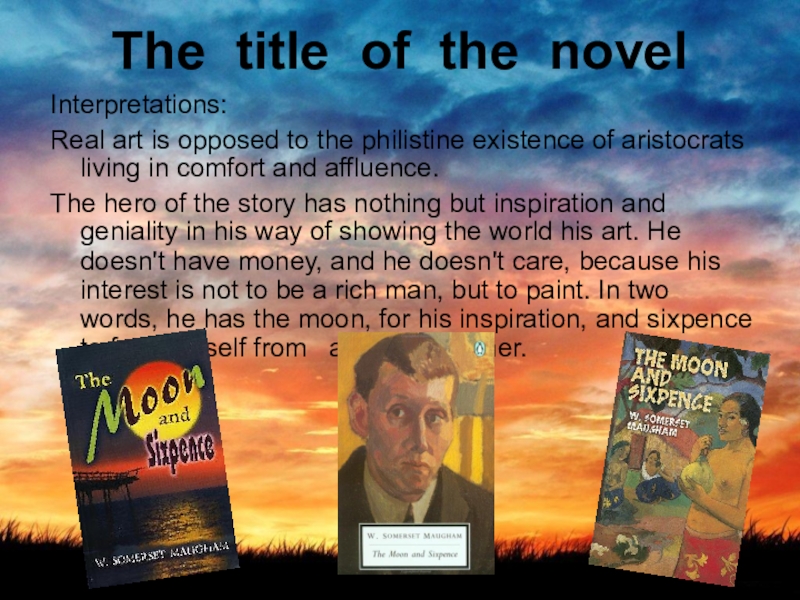
- 13. The title of the novelInterpretations:Real art is
- 14. Conclusion ‘ In truth, his life consists
- 15. The End
William Somerset MaughamWilliam Somerset Maugham was born in the British Embassy in Paris on 25th January, 1874. William's father, Robert Ormond Maugham, a wealthy solicitor, worked for the Embassy in France. By the time he was
Слайд 2William Somerset Maugham
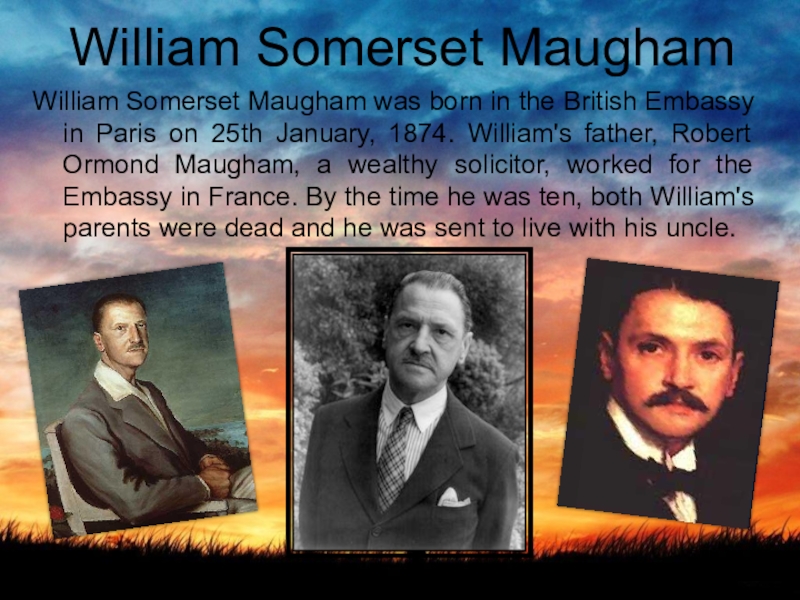
William Somerset Maugham was born in the British Embassy
in Paris on 25th January, 1874. William's father, Robert Ormond Maugham, a wealthy solicitor, worked for the Embassy in France. By the time he was ten, both William's parents were dead and he was sent to live with his uncle.
Слайд 3After an education at King's School, Canterbury, and Heildelberg University in
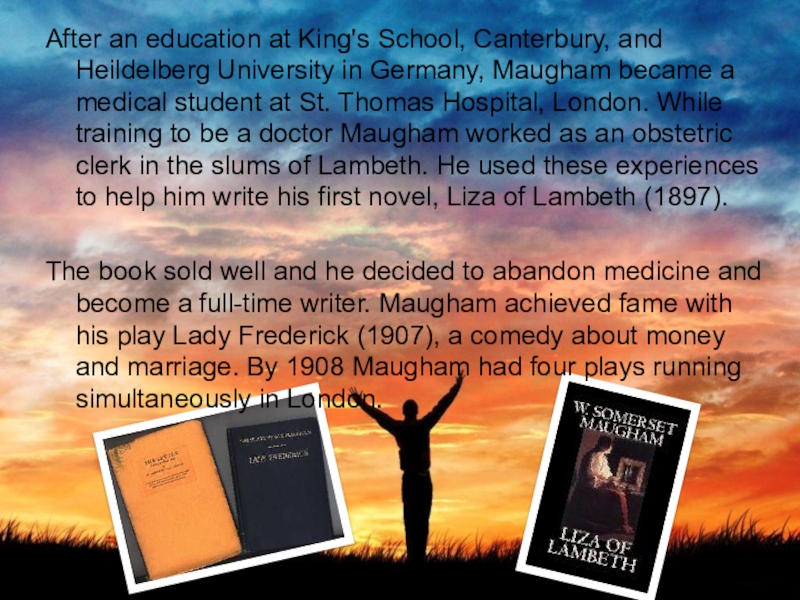
Germany, Maugham became a medical student at St. Thomas Hospital, London. While training to be a doctor Maugham worked as an obstetric clerk in the slums of Lambeth. He used these experiences to help him write his first novel, Liza of Lambeth (1897).
The book sold well and he decided to abandon medicine and become a full-time writer. Maugham achieved fame with his play Lady Frederick (1907), a comedy about money and marriage. By 1908 Maugham had four plays running simultaneously in London.
The book sold well and he decided to abandon medicine and become a full-time writer. Maugham achieved fame with his play Lady Frederick (1907), a comedy about money and marriage. By 1908 Maugham had four plays running simultaneously in London.
Слайд 4In 1916, Maugham married Syrie but continued to live with Gerald
Haxton.
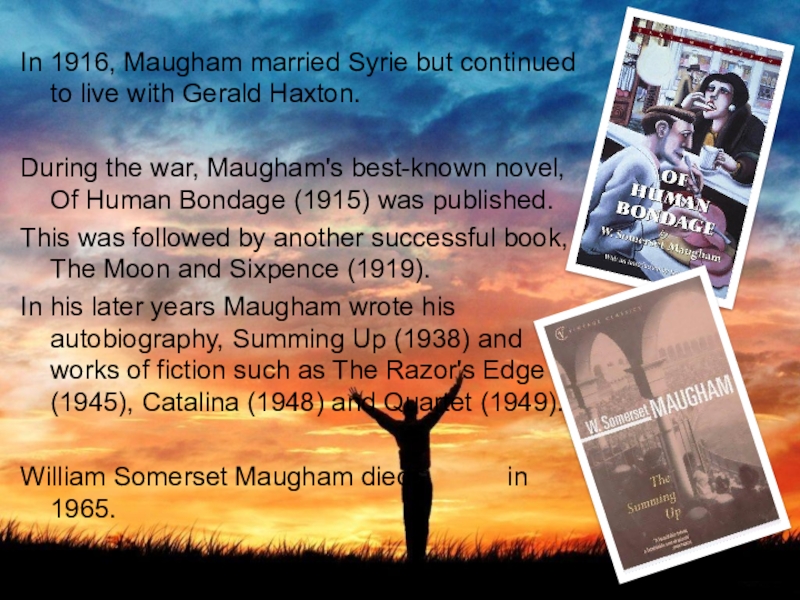
During the war, Maugham's best-known novel, Of Human Bondage (1915) was published.
This was followed by another successful book, The Moon and Sixpence (1919).
In his later years Maugham wrote his autobiography, Summing Up (1938) and works of fiction such as The Razor's Edge (1945), Catalina (1948) and Quartet (1949).
William Somerset Maugham died in 1965.
During the war, Maugham's best-known novel, Of Human Bondage (1915) was published.
This was followed by another successful book, The Moon and Sixpence (1919).
In his later years Maugham wrote his autobiography, Summing Up (1938) and works of fiction such as The Razor's Edge (1945), Catalina (1948) and Quartet (1949).
William Somerset Maugham died in 1965.
Слайд 5The Moon and Sixpence
This book is a biographical novel, because it
based on the life of the real painter Paul Gauguin. He was born in Paris. Was a leading Post-Impressionist painter.
In this book there are two main characters. The first one is a young, but prosperous English writer. And the second one is a strange painter Charles Strickland, whose life is described by the young writer.
In this book there are two main characters. The first one is a young, but prosperous English writer. And the second one is a strange painter Charles Strickland, whose life is described by the young writer.
Слайд 6The Plot
The story is told in episodic form by the first-person
narrator as a series of glimpses into the mind and soul of the central character, Charles Strickland, a middle aged English stock broker who abandons his wife and children abruptly in order to pursue his desire to become an artist.
Strickland first goes to Paris and lives a destitute but defiantly content life there as an artist, lodging in run-down hotels and falling prey to both illness and hunger.
Strickland first goes to Paris and lives a destitute but defiantly content life there as an artist, lodging in run-down hotels and falling prey to both illness and hunger.
Слайд 7Strickland cares nothing for physical comfort or needs, but is generously
supported by a commercially successful yet unexceptional Dutch painter, Dirk Stroeve, who immediately recognizes Strickland's genius.
After helping Strickland recover from a life-threatening condition, Stroeve is repaid by having his wife abandon him for Strickland.
Strickland later discards the wife, who then commits suicide (for some time she was a Strickland’s sitter but then he was tired of painting her naked).
After helping Strickland recover from a life-threatening condition, Stroeve is repaid by having his wife abandon him for Strickland.
Strickland later discards the wife, who then commits suicide (for some time she was a Strickland’s sitter but then he was tired of painting her naked).
Слайд 8After the Paris episode, the story continues in Tahiti. Strickland has
already died, and the narrator attempts to piece together his life there from the recollections of others.
He finds that Strickland had taken up with a native woman and started painting profusely. We learn that Strickland had settled for a short while in the French port of Marseilles before traveling to Tahiti, where he lived for a few years before finally dying of leprosy.
Strickland left behind numerous paintings, but his last work, which he painted on the walls of his hut in a half-crazed state of leprosy - induced blindness, was burnt down after his death by his wife under his orders.
He finds that Strickland had taken up with a native woman and started painting profusely. We learn that Strickland had settled for a short while in the French port of Marseilles before traveling to Tahiti, where he lived for a few years before finally dying of leprosy.
Strickland left behind numerous paintings, but his last work, which he painted on the walls of his hut in a half-crazed state of leprosy - induced blindness, was burnt down after his death by his wife under his orders.
Слайд 9 Paul Gauguin
and
Charles Strickland
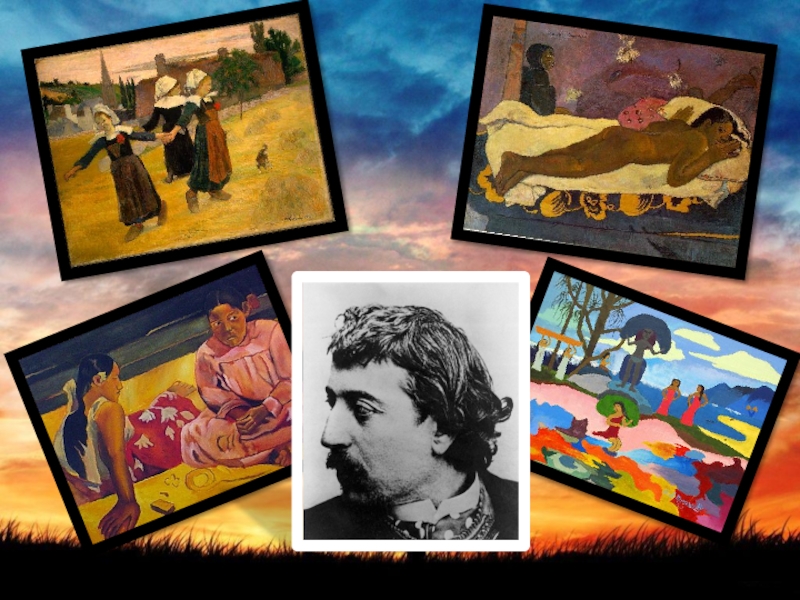
The main differences between Gauguin
and Strickland are that Gauguin was French rather than English, and whilst Maugham describes the character of Strickland as being ignorant of his contemporaries in Modern art, Gauguin himself was well acquainted with Van Gogh.
How many of the details of the story are based on fact is not known. However, Maugham had visited the place where Gauguin lived in Tahiti, and purchased some glass panels painted by Gauguin in his final days.
How many of the details of the story are based on fact is not known. However, Maugham had visited the place where Gauguin lived in Tahiti, and purchased some glass panels painted by Gauguin in his final days.
Слайд 11The idea of art
Maugham describes three types of art:
He shows us
the art of London high-society drawing rooms where everybody behaves according to the unwritten rules of refinement and propriety.
He also shows philistine mansions, which can only nominally be called ‘real art’. This kind of art is represented in the paintings of Dirk Stroeve. The Dutch artist with no gift for painting strives to depict real life in paintings but he utterly fails to do that.
He also shows philistine mansions, which can only nominally be called ‘real art’. This kind of art is represented in the paintings of Dirk Stroeve. The Dutch artist with no gift for painting strives to depict real life in paintings but he utterly fails to do that.
Слайд 123. And finally, he shows the real art of Strickland which
is really great and genuine. His art is the art of genuine, which destroys all dogmas and perceptions. His art is both fresh and crude.
His art serves beauty, but not the beauty that is governed by fashion , new trends and spirit of the times. His art reflects genuine beauty which has always existed regardless of fashion and epochs. And this type of beauty requires complete devotion rather than ‘good taste’.
His art serves beauty, but not the beauty that is governed by fashion , new trends and spirit of the times. His art reflects genuine beauty which has always existed regardless of fashion and epochs. And this type of beauty requires complete devotion rather than ‘good taste’.
Слайд 13The title of the novel
Interpretations:
Real art is opposed to the philistine
existence of aristocrats living in comfort and affluence.
The hero of the story has nothing but inspiration and geniality in his way of showing the world his art. He doesn't have money, and he doesn't care, because his interest is not to be a rich man, but to paint. In two words, he has the moon, for his inspiration, and sixpence to feet himself from a day to another.
The hero of the story has nothing but inspiration and geniality in his way of showing the world his art. He doesn't have money, and he doesn't care, because his interest is not to be a rich man, but to paint. In two words, he has the moon, for his inspiration, and sixpence to feet himself from a day to another.
Слайд 14Conclusion
‘ In truth, his life consists of extremely hard work
and a dream’.
‘The moon and sixpence’ is an artistic analysis of contradiction between the personality of the creator and the art at all.
‘Strickland is a genius of a posthumous fortune’.
‘The moon and sixpence’ is an artistic analysis of contradiction between the personality of the creator and the art at all.
‘Strickland is a genius of a posthumous fortune’.