- Главная
- Разное
- Образование
- Спорт
- Естествознание
- Природоведение
- Религиоведение
- Французский язык
- Черчение
- Английский язык
- Астрономия
- Алгебра
- Биология
- География
- Геометрия
- Детские презентации
- Информатика
- История
- Литература
- Математика
- Музыка
- МХК
- Немецкий язык
- ОБЖ
- Обществознание
- Окружающий мир
- Педагогика
- Русский язык
- Технология
- Физика
- Философия
- Химия
- Шаблоны, фоны, картинки для презентаций
- Экология
- Экономика
Презентация, доклад по английскому языку The dual nature of verbals.(nominal and verbal)
Содержание
- 1. Презентация по английскому языку The dual nature of verbals.(nominal and verbal)
- 2. The combinability of verbals as parts of
- 3. The combinability of the gerund.The combinability of
- 4. The combinability of the gerund.Continuation.The specific combination
- 5. The combinability of the present participle.(I)The present
- 6. The combinability of the past participle.(II)As different
- 7. The notion of the “ secondary predication“.There
- 8. The notion of the “ secondary predication
- 9. The plan of the two presentation forms
- 10. The bare infinitive- «unmarked infinitive.»It’s used,( besides
- 11. Thanks for your attention.
Слайд 2
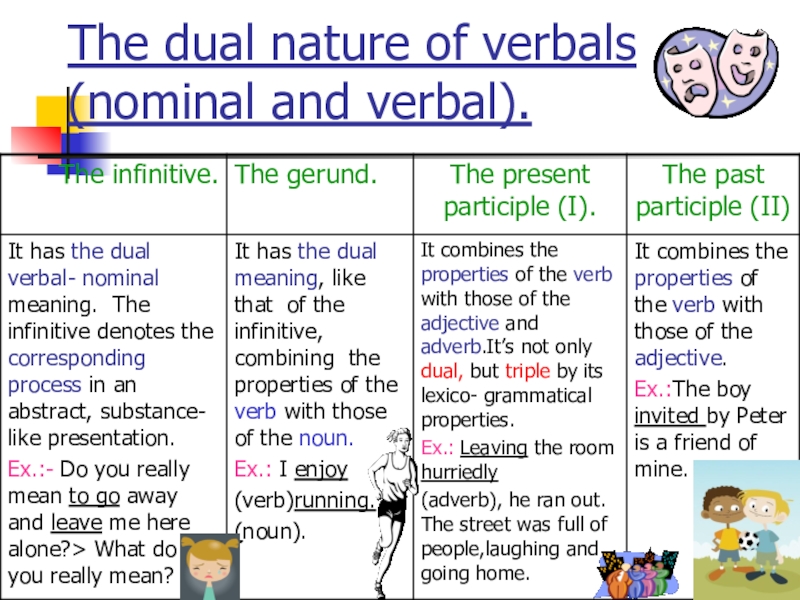
The combinability of verbals as parts of speech.
The combinability of
The infinitive’s
combinability.
The verb- type combinability – is displayed in its combining:
With nouns, expressing the object of the action.
With nouns, expressing the subject of the action.
With modifying adverbs.
With predicator verbs of semi- functional nature, forming a verbal predicate.
With auxiliary finite verbs( word - morphemes) in the analytical forms of the verb.
The noun- type combinability- is displayed in its combining:
With finite notional verbs as the object of the action.
With finite notional verbs as the subject of the action.
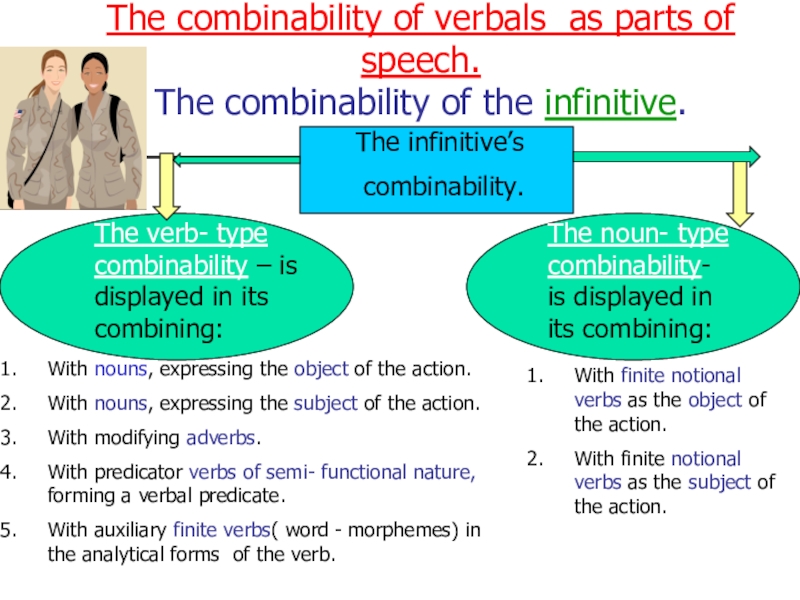
Слайд 3The combinability of the gerund.
The combinability
of the gerund.
The verb- type
With modifying adverbs.
With nouns, expressing the object of the action.
With certain semi- functional predicator verbs, but other than modal.
The noun- type combinability- is displayed in its combining:
With finite notional verbs as the object of the action.
With finite notional verbs as the prepositional adjunct of various functions
With finite notional verbs as the subject of the action.
With nouns as the prepositional adjunct of various functions.
Слайд 4The combinability of the gerund.Continuation.
The specific combination of the gerund
With the
E.g.:Powell’s being rude like that was disgusting.How can she know about the Morions’ being connected with this unaccountable affair?
The verbal ing- form + the noun- subject in the common case or its objective pronominal equivalent; this gerundial use to present very peculiar features of categorial mediality.
E.g.:I read in yesterday’s paper about the hostages having been released.
Слайд 5The combinability of the present participle.(I)
The present participle:
The verb- type combinability
In its being combined, in various uses, with nouns, expressing the object of the action.
With nouns, expressing the subject of the action(in semi-predicative complexes)
With modifying adverbs.
With auxiliary finite verbs( word- morphemes) in the analytical forms of the verb.
The adjective- type combinability is revealed in its association with the modified nouns, as well as with some modifying adverbs, such as adverbs of degree.
The adverb- type combinability is revealed in its association with the modified verbs.
Слайд 6The combinability of the past participle.(II)
As different from the present participle,
Слайд 7The notion of the “ secondary predication“.
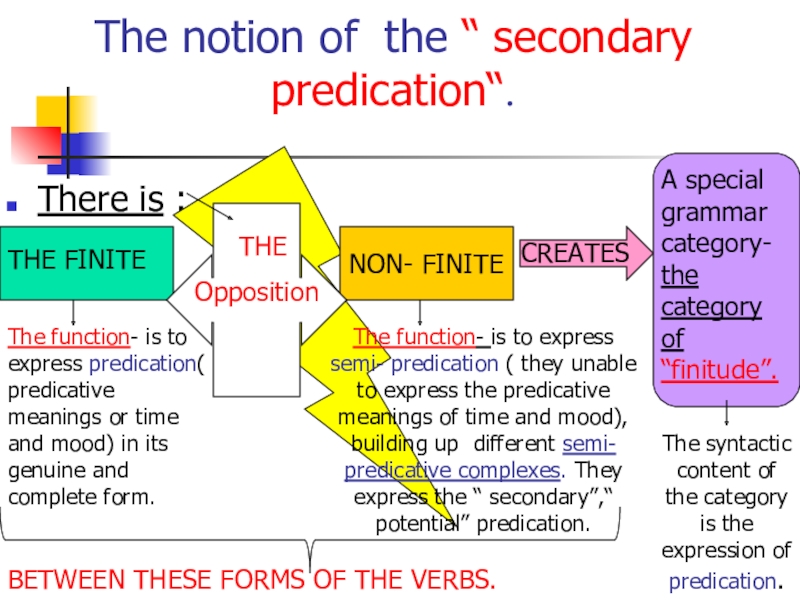
There is :
THE FINITE
NON- FINITE
THE
Opposition
CREATES
BETWEEN
A special grammar category- the category of “finitude”.
The function- is to express semi- predication ( they unable to express the predicative meanings of time and mood), building up different semi- predicative complexes. They express the “ secondary”,“ potential” predication.
The function- is to express predication( predicative meanings or time and mood) in its genuine and complete form.
The syntactic content of the category is the expression of predication.
Слайд 8The notion of the “ secondary predication ” as reflected in
The verbids, expressing the “ secondary” predication,
form syntactic complexes directly related
certain types of subordinate clauses:
Cf.: Have you ever had anything caught in your head? Have you ever had anything that was caught in your head? – He said it half under his breath for the others not to hear it.- He said it half under his breath, so that the others couldn’t hear it.
The verbid complexes anything caught in your head, or for the others not to hear it, or the like, while expressing secondary predication, are not self- dependent in a predicative sense.They normally exist only as part of sentences built up by genuine, primary predicative constructions that have a finite verb as their core. And it’s through the reference to the finite verb- predicate that these complexes set up the situations denoted by them in the corresponding time and mood perspective.
Слайд 9The plan of the two presentation forms of the English infinitive:
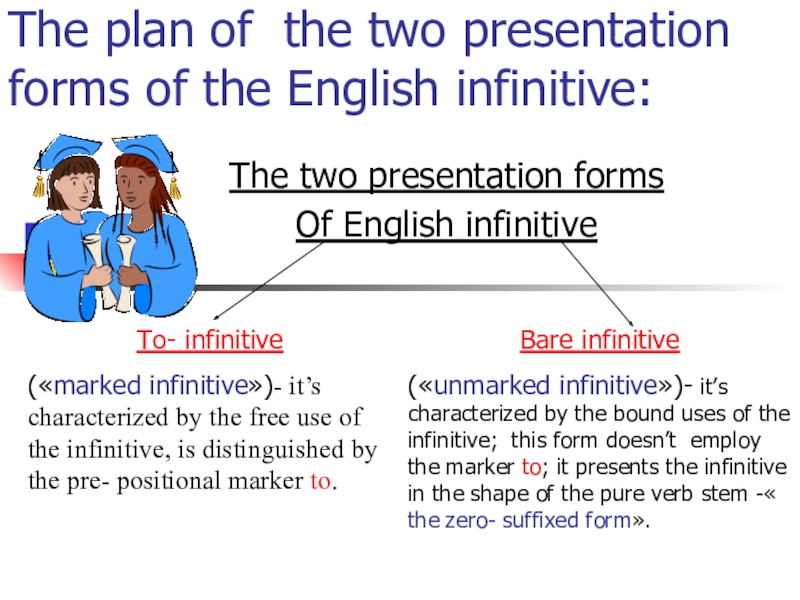
The
Of English infinitive
To- infinitive
(«marked infinitive»)- it’s characterized by the free use of the infinitive, is distinguished by the pre- positional marker to.
Bare infinitive
(«unmarked infinitive»)- it’s characterized by the bound uses of the infinitive; this form doesn’t employ the marker to; it presents the infinitive in the shape of the pure verb stem -« the zero- suffixed form».
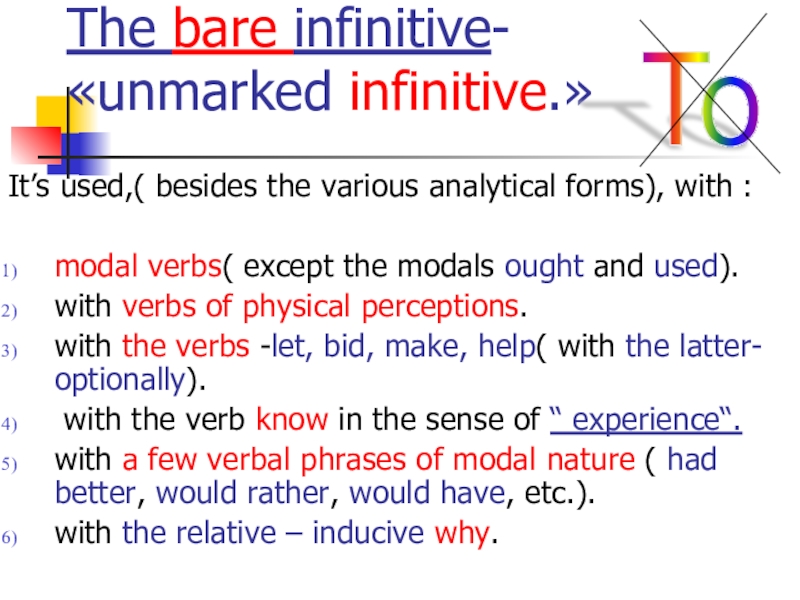
Слайд 10The bare infinitive- «unmarked infinitive.»
It’s used,( besides the various analytical forms),
modal verbs( except the modals ought and used).
with verbs of physical perceptions.
with the verbs -let, bid, make, help( with the latter- optionally).
with the verb know in the sense of “ experience“.
with a few verbal phrases of modal nature ( had better, would rather, would have, etc.).
with the relative – inducive why.
To