- Главная
- Разное
- Образование
- Спорт
- Естествознание
- Природоведение
- Религиоведение
- Французский язык
- Черчение
- Английский язык
- Астрономия
- Алгебра
- Биология
- География
- Геометрия
- Детские презентации
- Информатика
- История
- Литература
- Математика
- Музыка
- МХК
- Немецкий язык
- ОБЖ
- Обществознание
- Окружающий мир
- Педагогика
- Русский язык
- Технология
- Физика
- Философия
- Химия
- Шаблоны, фоны, картинки для презентаций
- Экология
- Экономика
Презентация, доклад по английскому языку Президенты Америки
Содержание
- 1. Презентация по английскому языку Президенты Америки
- 2. The President of the United States is
- 3. George WashingtonThomas JeffersonJames MadisonJames MonroeJohn Quincy AdamsAndrew
- 4. George Washington (February 22, 1732 – December
- 5. John Adams (October 30, 1735 – July
- 6. Thomas Jefferson (April 13, 1743 – July
- 7. James Madison, Jr. (March 16, 1751 –
- 8. James Lawrence Monroe (April 28, 1758 –
- 9. John Quincy Adams (July 11, 1767–February 23,
- 10. Andrew Jackson (March 15, 1767 – June
- 11. Martin Van Buren (December 5, 1782 –
- 12. William Henry Harrison (February 9, 1773 –
- 13. John Tyler, Jr. (March 29, 1790 –
- 14. James Knox Polk ( November 2, 1795–June
- 15. Zachary Taylor (November 24, 1784 – July
- 16. Millard Fillmore (January 7, 1800 – March
- 17. Franklin Pierce (November 23, 1804 – October
- 18. James Buchanan, Jr.[1] (April 23, 1791 –
- 19. Abraham Lincoln (February 12, 1809 – April
- 20. Andrew Johnson (December 29, 1808–July 31, 1875)
- 21. Ulysses S. Grant, born Hiram Ulysses Grant
- 22. Rutherford Birchard Hayes (October 4, 1822 –
- 23. James Abram Garfield (November 19, 1831 –
- 24. Chester Alan Arthur (October 5, 1829 –
- 25. Stephen Grover Cleveland (March 18, 1837 –
- 26. Benjamin Harrison (August 20, 1833 – March
- 27. William McKinley, Jr. (January 29, 1843 –
- 28. Theodore Roosevelt ( October 27, 1858 –
- 29. His presidency was characterized by trust-busting, strengthening
- 30. Thomas Woodrow Wilson (December 28, 1856 –
- 31. Warren Gamaliel Harding (November 2, 1865 –
- 32. John Calvin Coolidge, Jr. (July 4, 1872
- 33. Herbert Clark Hoover (August 10, 1874 –
- 34. Franklin Delano Roosevelt (January 30, 1882 –
- 35. Harry S. Truman (May 8, 1884 –
- 36. Dwight David "Ike" Eisenhower (October 14, 1890
- 37. John Fitzgerald "Jack" Kennedy (May 29, 1917
- 38. Lyndon Baines Johnson (August 27, 1908 –
- 39. Richard Milhous Nixon (January 9, 1913 –
- 40. Gerald Rudolph Ford, Jr. (born Leslie Lynch
- 41. James Earl "Jimmy" Carter, Jr. (born October
- 42. Ronald Wilson Reagan (February 6, 1911 –
- 43. George Herbert Walker Bush (born June 12,
- 44. William Jefferson "Bill" Clinton (born William Jefferson
- 45. George Walker Bush (born July 6, 1946)
- 46. Barack Hussein Obama II ( born August
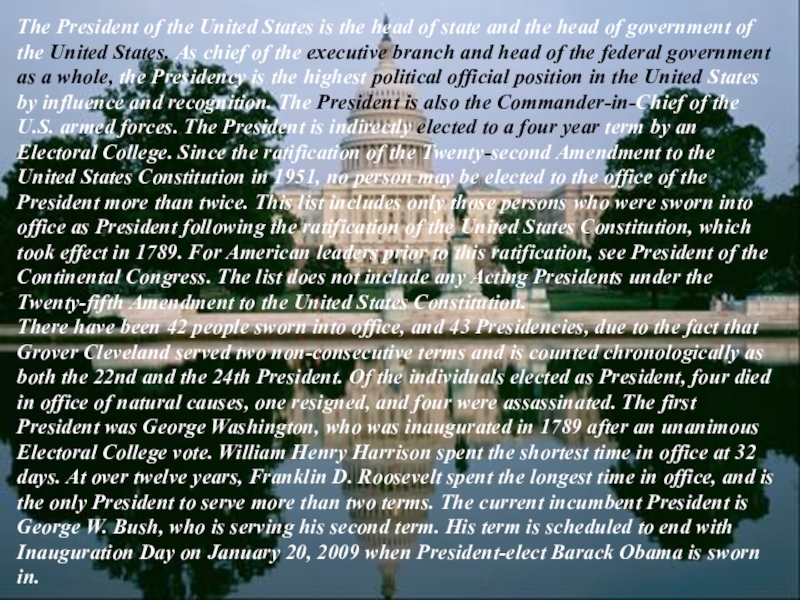
Слайд 2The President of the United States is the head of state
There have been 42 people sworn into office, and 43 Presidencies, due to the fact that Grover Cleveland served two non-consecutive terms and is counted chronologically as both the 22nd and the 24th President. Of the individuals elected as President, four died in office of natural causes, one resigned, and four were assassinated. The first President was George Washington, who was inaugurated in 1789 after an unanimous Electoral College vote. William Henry Harrison spent the shortest time in office at 32 days. At over twelve years, Franklin D. Roosevelt spent the longest time in office, and is the only President to serve more than two terms. The current incumbent President is George W. Bush, who is serving his second term. His term is scheduled to end with Inauguration Day on January 20, 2009 when President-elect Barack Obama is sworn in.
Слайд 3
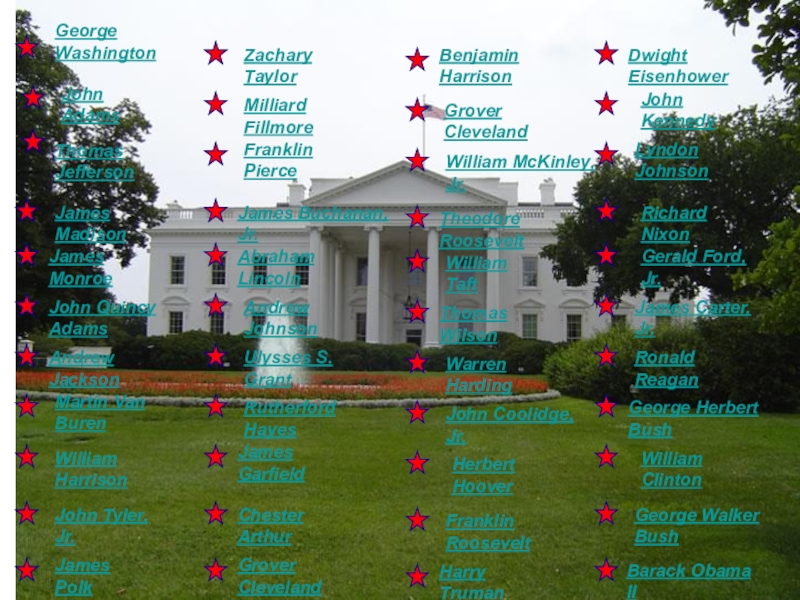
George Washington
Thomas Jefferson
James Madison
James Monroe
John Quincy Adams
Andrew Jackson
Martin Van Buren
William Harrison
John
James Polk
Zachary Taylor
Milliard Fillmore
Franklin Pierce
James Buchanan, Jr.
Abraham Lincoln
Andrew Johnson
Ulysses S. Grant
Rutherford Hayes
James Garfield
Chester Arthur
Grover Cleveland
Benjamin Harrison
William McKinley, Jr.
Theodore Roosevelt
William Taft
Thomas Wilson
Warren Harding
John Coolidge, Jr.
Herbert Hoover
Franklin Roosevelt
Harry Truman
Dwight Eisenhower
John Kennedy
Lyndon Johnson
Richard Nixon
Gerald Ford, Jr.
James Carter, Jr.
Ronald Reagan
George Herbert Bush
William Clinton
George Walker Bush
Barack Obama II
Grover Cleveland
John Adams
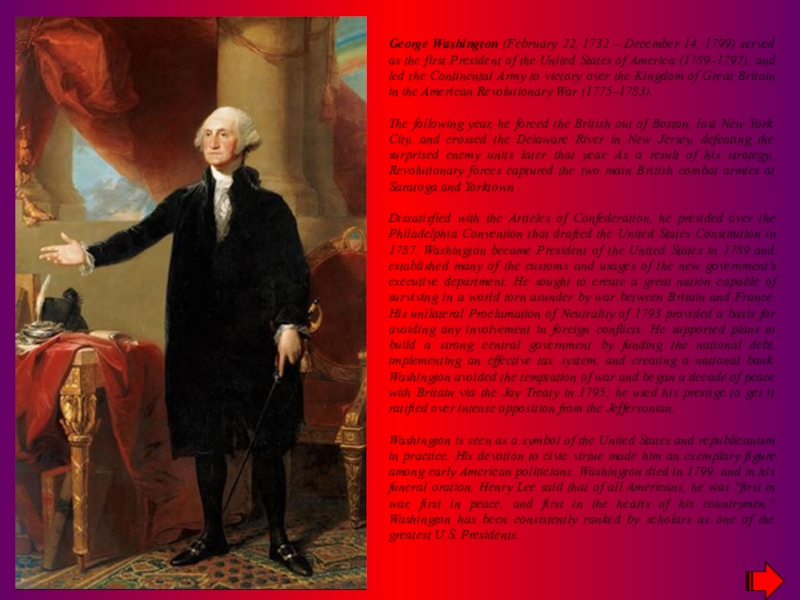
Слайд 4George Washington (February 22, 1732 – December 14, 1799) served as
The following year, he forced the British out of Boston, lost New York City, and crossed the Delaware River in New Jersey, defeating the surprised enemy units later that year. As a result of his strategy, Revolutionary forces captured the two main British combat armies at Saratoga and Yorktown .
Dissatisfied with the Articles of Confederation, he presided over the Philadelphia Convention that drafted the United States Constitution in 1787. Washington became President of the United States in 1789 and established many of the customs and usages of the new government's executive department. He sought to create a great nation capable of surviving in a world torn asunder by war between Britain and France. His unilateral Proclamation of Neutrality of 1793 provided a basis for avoiding any involvement in foreign conflicts. He supported plans to build a strong central government by funding the national debt, implementing an effective tax system, and creating a national bank. Washington avoided the temptation of war and began a decade of peace with Britain via the Jay Treaty in 1795; he used his prestige to get it ratified over intense opposition from the Jeffersonian.
Washington is seen as a symbol of the United States and republicanism in practice. His devotion to civic virtue made him an exemplary figure among early American politicians. Washington died in 1799, and in his funeral oration, Henry Lee said that of all Americans, he was "first in war, first in peace, and first in the hearts of his countrymen." Washington has been consistently ranked by scholars as one of the greatest U.S. Presidents.
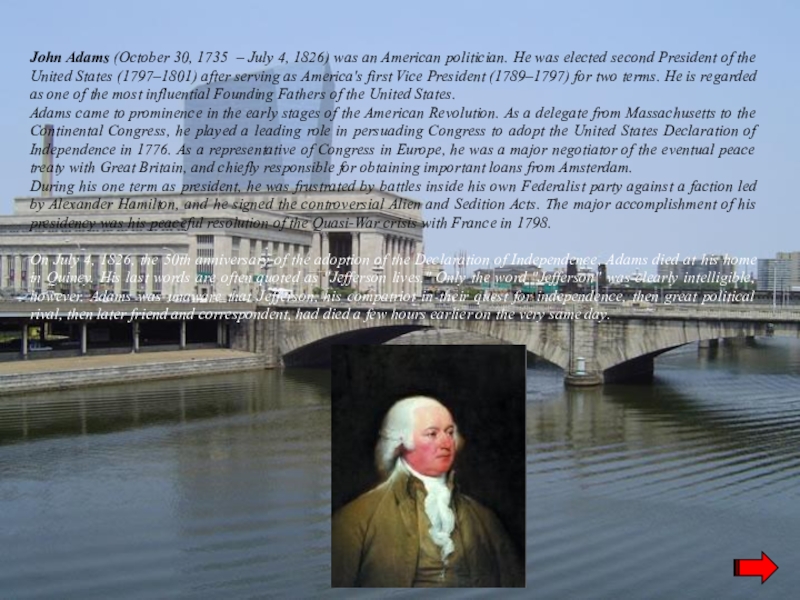
Слайд 5John Adams (October 30, 1735 – July 4, 1826) was an
Adams came to prominence in the early stages of the American Revolution. As a delegate from Massachusetts to the Continental Congress, he played a leading role in persuading Congress to adopt the United States Declaration of Independence in 1776. As a representative of Congress in Europe, he was a major negotiator of the eventual peace treaty with Great Britain, and chiefly responsible for obtaining important loans from Amsterdam.
During his one term as president, he was frustrated by battles inside his own Federalist party against a faction led by Alexander Hamilton, and he signed the controversial Alien and Sedition Acts. The major accomplishment of his presidency was his peaceful resolution of the Quasi-War crisis with France in 1798.
On July 4, 1826, the 50th anniversary of the adoption of the Declaration of Independence, Adams died at his home in Quincy. His last words are often quoted as "Jefferson lives." Only the word "Jefferson" was clearly intelligible, however. Adams was unaware that Jefferson, his compatriot in their quest for independence, then great political rival, then later friend and correspondent, had died a few hours earlier on the very same day.
Слайд 6Thomas Jefferson (April 13, 1743 – July 4, 1826)[1] was the
As a political philosopher, Jefferson was a man of the Enlightenment and knew many intellectual leaders in Britain and France. He idealized the independent yeoman farmer as exemplar of republican virtues, distrusted cities and financiers, and favored states' rights and a strictly limited federal government. Jefferson supported the separation of church and state[2] and was the author of the Virginia Statute for Religious Freedom (1779, 1786). He was the eponym of Jeffersonian democracy and the co-founder and leader of the Democratic-Republican Party, which dominated American politics for a quarter-century. Jefferson served as the wartime Governor of Virginia (1779–1781), first United States Secretary of State (1789–1793) and second Vice President (1797–1801).
A polymath, Jefferson achieved distinction as, among other things, a horticulturist, statesman, architect, archaeologist, paleontologist, author, inventor, and founder of the University of Virginia. When President John F. Kennedy welcomed forty-nine Nobel Prize winners to the White House in 1962 he said, "I think this is the most extraordinary collection of talent and of human knowledge that has ever been gathered together at the White House – with the possible exception of when Thomas Jefferson dined alone”. Jefferson has been consistently ranked by scholars as one of the greatest U.S. Presidents.
Jefferson died on the Fourth of July, 1826, the 50th anniversary of the adoption of the Declaration of Independence. He died a few hours before the death of John Adams.
![Thomas Jefferson (April 13, 1743 – July 4, 1826)[1] was the third President of the United States](/img/thumbs/1d1f814ddb7e74effaa86d325cd38b90-800x.jpg "Презентация по английскому языку Президенты Америки Thomas Jefferson (April 13, 1743 – July 4, 1826)[1] was the")
Слайд 7James Madison, Jr. (March 16, 1751 – June 28, 1836) was
As leader in the House of Representatives, Madison worked closely with President George Washington to organize the new federal government. Breaking with Treasury Secretary Alexander Hamilton in 1791, Madison and Thomas Jefferson organized what they called the Republican Party (later called the Democratic–Republican Party)[8] in opposition to key policies of the Federalists, especially the national bank and the Jay Treaty. He secretly co-authored, along with Thomas Jefferson, the Kentucky and Virginia Resolutions in 1798 to protest the Alien and Sedition Acts.
As Jefferson's Secretary of State (1801–1809), Madison supervised the Louisiana Purchase, doubling the nation's size, and sponsored the ill-fated Embargo Act of 1807. As president, he led the nation into the War of 1812 against Great Britain in order to protect the United States' economic rights. That conflict began poorly as Americans suffered defeat after defeat by smaller forces, but ended on a high note in 1815, with the Treaty of Ghent, after which a new Era of Good Feelings swept the country. During and after the war, Madison reversed many of his positions. By 1815, he supported the creation of the second National Bank, a strong military, and a high tariff to protect the new factories opened during the war.
Madison lived on until 1836, increasingly ignored by the new leaders of the American polity. He died at Montpellier on June 28, the last Founding Father to die. He is buried in the Madison Family Cemetery at Montpelier.
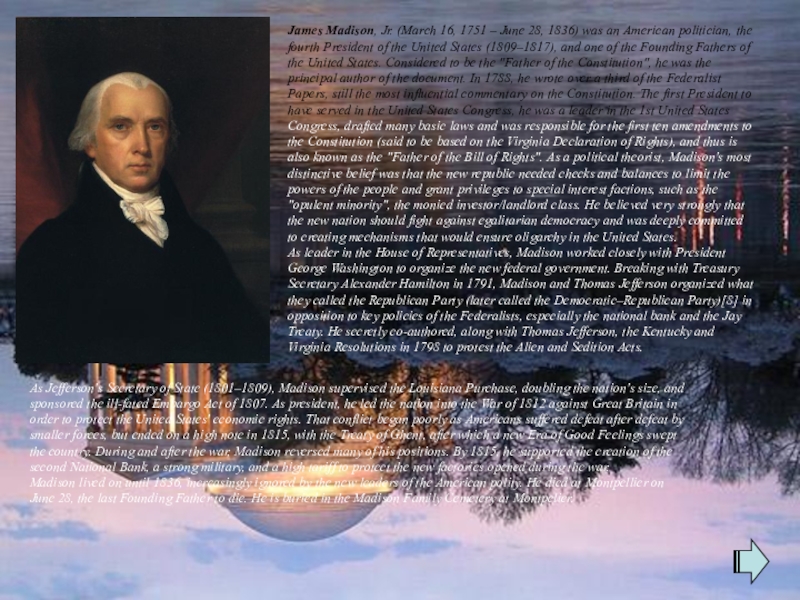
Слайд 8James Lawrence Monroe (April 28, 1758 – July 4, 1831) was
Monroe died in new York from heart failure and tuberculosis on July 4, 1831, becoming the third president to die on the 4th of July.
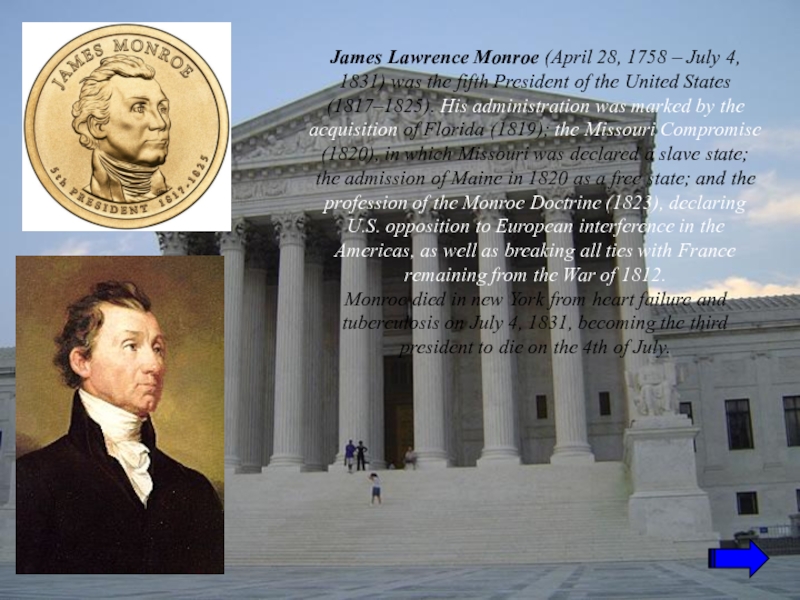
Слайд 9John Quincy Adams (July 11, 1767–February 23, 1848) was an American
Adams was the son of the second President John Adams and his wife Abigail Adams, the name "Quincy" having come from Abigail's maternal grandfather, Colonel John Quincy, after whom Quincy, Massachusetts is also named. He was a diplomat, involved in many international negotiations, and helped formulate the Monroe Doctrine as Secretary of State. As president he proposed a program of modernization and educational advancement, but was stymied by Congress. Adams lost his 1828 bid for re-election to Andrew Jackson.
Adams was elected a U.S. Representative from Massachusetts after leaving office, the only president ever to do so, serving for the last 17 years of his life. In the House he became a leading opponent of the Slave Power and argued that if a civil war ever broke out the president could abolish slavery by using his war powers, which Abraham Lincoln did during the American Civil War in the 1863 Emancipation Proclamation.
While preparing to address the House of Representatives on February 21, 1848, Adams collapsed, having suffered a massive cerebral hemorrhage. Two days later, on February 23, he died with his wife and son at his side in the Speaker's Room inside the Capitol Building in Washington, D.C. His last words were reported to have been, "This is the last of Earth. I am content."
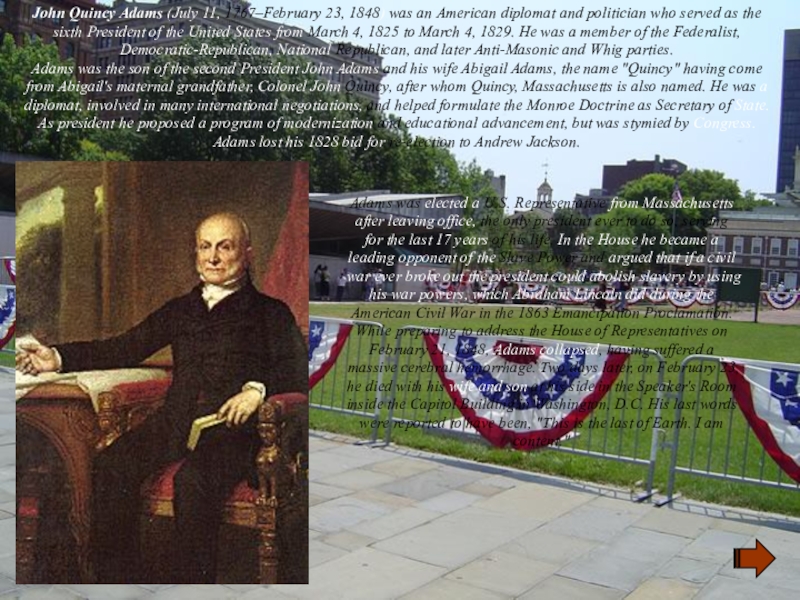
Слайд 10Andrew Jackson (March 15, 1767 – June 8, 1845) was the
Jackson was one of the more sickly presidents, suffering from chronic headaches, abdominal pains, and a hacking cough, caused by a musket ball in his lung which was never removed, that often brought up blood and sometimes even made his whole body shake. After retiring to Nashville, he enjoyed eight years of retirement and died at The Hermitage on June 8, 1845 at the age of 78, of chronic tuberculosis, "dropsy" and heart failure.
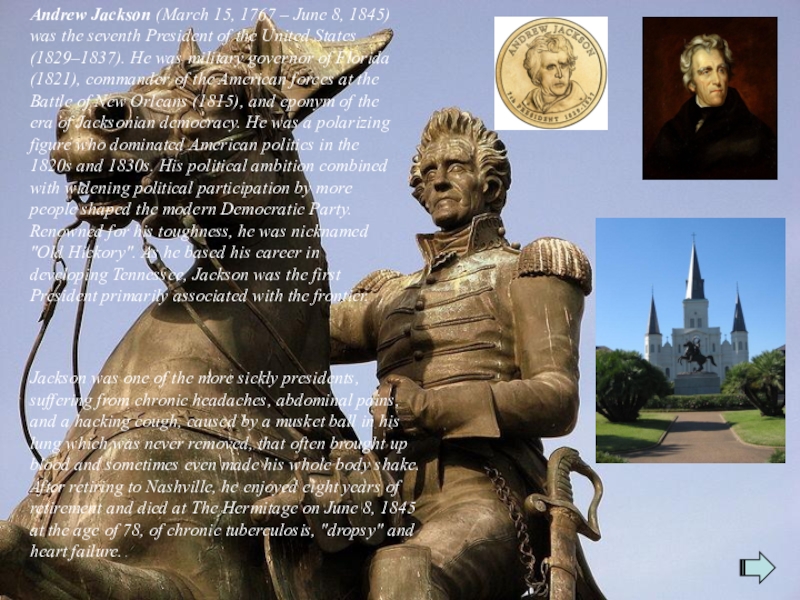
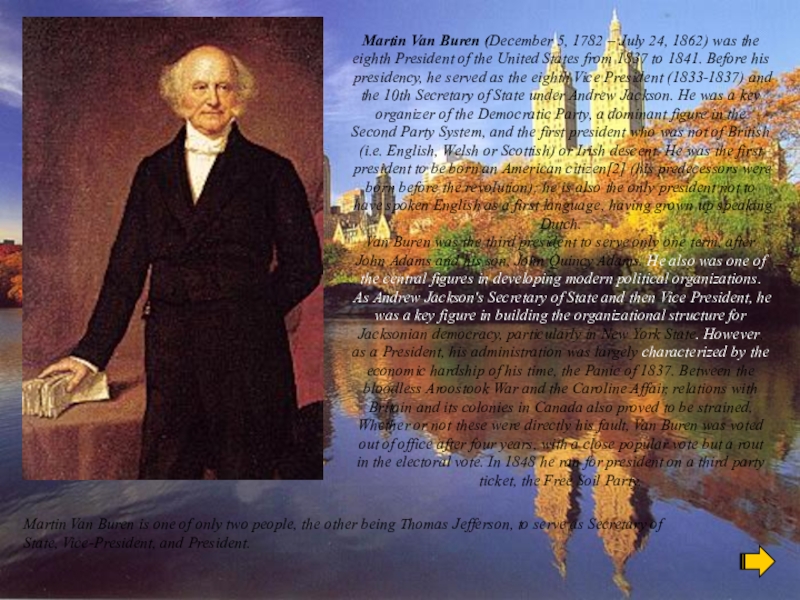
Слайд 11Martin Van Buren (December 5, 1782 – July 24, 1862) was
Van Buren was the third president to serve only one term, after John Adams and his son, John Quincy Adams. He also was one of the central figures in developing modern political organizations. As Andrew Jackson's Secretary of State and then Vice President, he was a key figure in building the organizational structure for Jacksonian democracy, particularly in New York State. However, as a President, his administration was largely characterized by the economic hardship of his time, the Panic of 1837. Between the bloodless Aroostook War and the Caroline Affair, relations with Britain and its colonies in Canada also proved to be strained. Whether or not these were directly his fault, Van Buren was voted out of office after four years, with a close popular vote but a rout in the electoral vote. In 1848 he ran for president on a third party ticket, the Free Soil Party.
Martin Van Buren is one of only two people, the other being Thomas Jefferson, to serve as Secretary of State, Vice-President, and President.
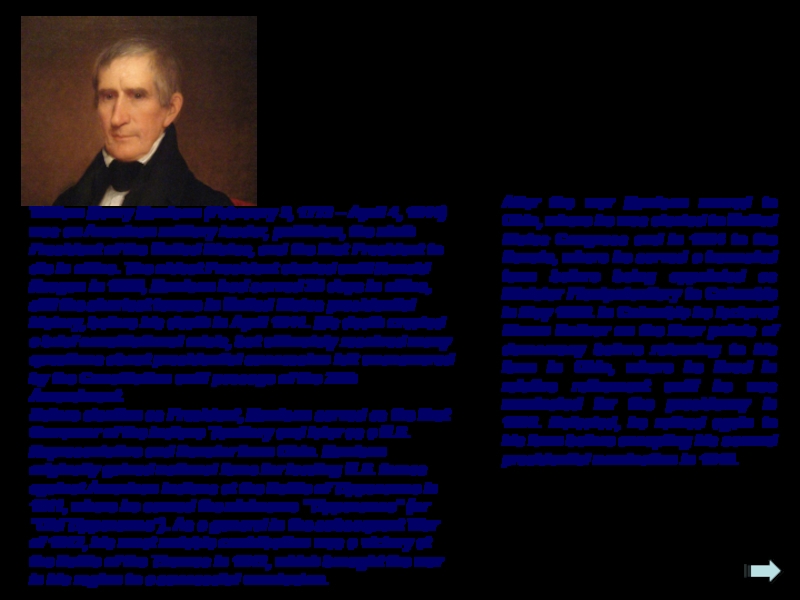
Слайд 12William Henry Harrison (February 9, 1773 – April 4, 1841) was
Before election as President, Harrison served as the first Governor of the Indiana Territory and later as a U.S. Representative and Senator from Ohio. Harrison originally gained national fame for leading U.S. forces against American Indians at the Battle of Tippecanoe in 1811, where he earned the nickname "Tippecanoe" (or "Old Tippecanoe"). As a general in the subsequent War of 1812, his most notable contribution was a victory at the Battle of the Thames in 1813, which brought the war in his region to a successful conclusion.
After the war Harrison moved to Ohio, where he was elected to United States Congress and in 1824 to the Senate, where he served a truncated term before being appointed as Minister Plenipotentiary to Colombia in May 1828. In Colombia he lectured Simon Bolivar on the finer points of democracy before returning to his farm in Ohio, where he lived in relative retirement until he was nominated for the presidency in 1836. Defeated, he retired again to his farm before accepting his second presidential nomination in 1840.
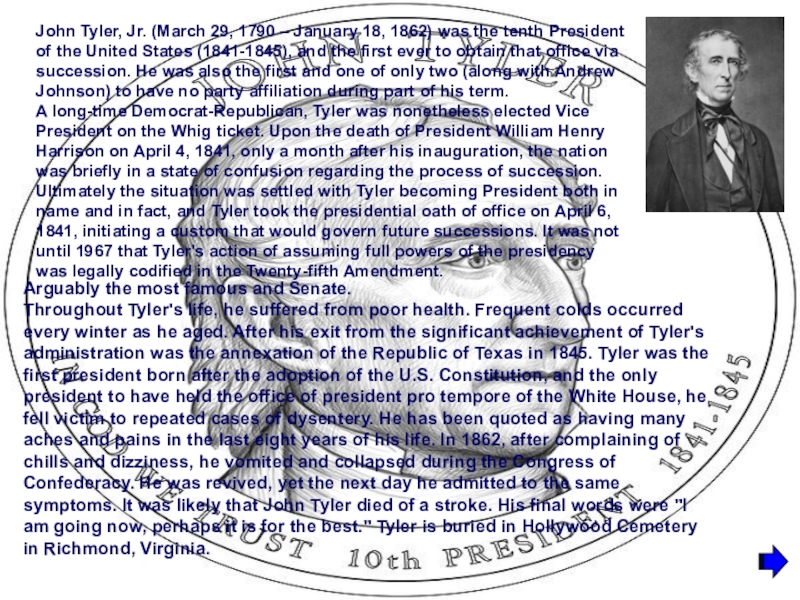
Слайд 13John Tyler, Jr. (March 29, 1790 – January 18, 1862) was
A long-time Democrat-Republican, Tyler was nonetheless elected Vice President on the Whig ticket. Upon the death of President William Henry Harrison on April 4, 1841, only a month after his inauguration, the nation was briefly in a state of confusion regarding the process of succession. Ultimately the situation was settled with Tyler becoming President both in name and in fact, and Tyler took the presidential oath of office on April 6, 1841, initiating a custom that would govern future successions. It was not until 1967 that Tyler's action of assuming full powers of the presidency was legally codified in the Twenty-fifth Amendment.
Arguably the most famous and Senate.
Throughout Tyler's life, he suffered from poor health. Frequent colds occurred every winter as he aged. After his exit from the significant achievement of Tyler's administration was the annexation of the Republic of Texas in 1845. Tyler was the first president born after the adoption of the U.S. Constitution, and the only president to have held the office of president pro tempore of the White House, he fell victim to repeated cases of dysentery. He has been quoted as having many aches and pains in the last eight years of his life. In 1862, after complaining of chills and dizziness, he vomited and collapsed during the Congress of Confederacy. He was revived, yet the next day he admitted to the same symptoms. It was likely that John Tyler died of a stroke. His final words were "I am going now, perhaps it is for the best." Tyler is buried in Hollywood Cemetery in Richmond, Virginia.
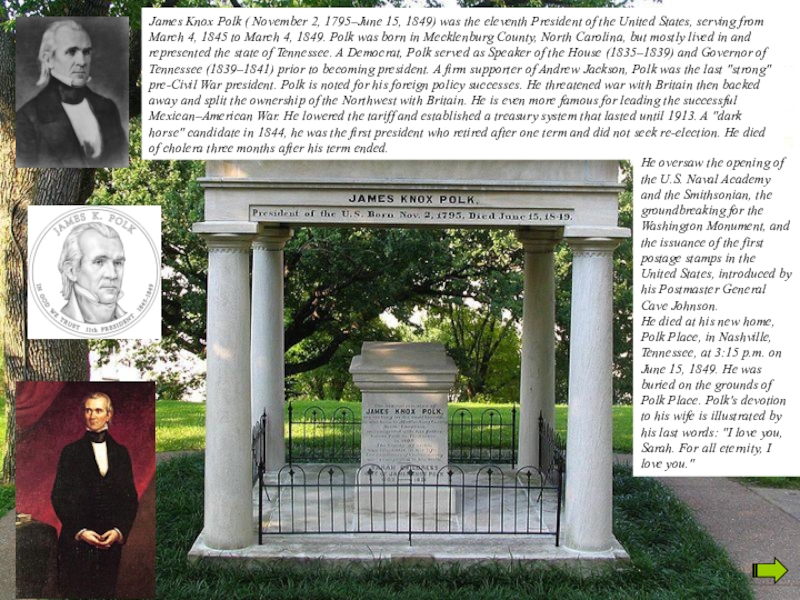
Слайд 14James Knox Polk ( November 2, 1795–June 15, 1849) was the
He oversaw the opening of the U.S. Naval Academy and the Smithsonian, the groundbreaking for the Washington Monument, and the issuance of the first postage stamps in the United States, introduced by his Postmaster General Cave Johnson.
He died at his new home, Polk Place, in Nashville, Tennessee, at 3:15 p.m. on June 15, 1849. He was buried on the grounds of Polk Place. Polk's devotion to his wife is illustrated by his last words: "I love you, Sarah. For all eternity, I love you."
Слайд 15
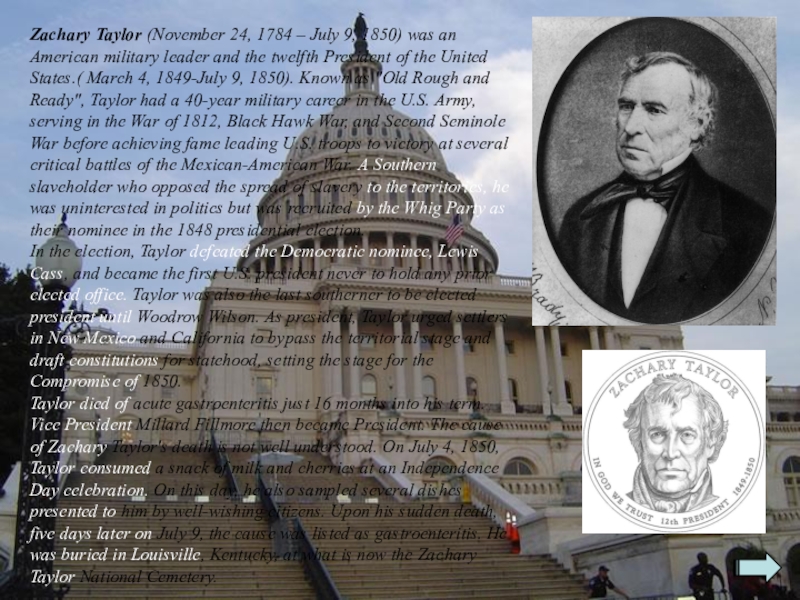
Zachary Taylor (November 24, 1784 – July 9, 1850) was an
In the election, Taylor defeated the Democratic nominee, Lewis Cass, and became the first U.S. president never to hold any prior elected office. Taylor was also the last southerner to be elected president until Woodrow Wilson. As president, Taylor urged settlers in New Mexico and California to bypass the territorial stage and draft constitutions for statehood, setting the stage for the Compromise of 1850.
Taylor died of acute gastroenteritis just 16 months into his term. Vice President Millard Fillmore then became President. The cause of Zachary Taylor's death is not well understood. On July 4, 1850, Taylor consumed a snack of milk and cherries at an Independence Day celebration. On this day, he also sampled several dishes presented to him by well-wishing citizens. Upon his sudden death, five days later on July 9, the cause was listed as gastroenteritis. He was buried in Louisville, Kentucky, at what is now the Zachary Taylor National Cemetery.
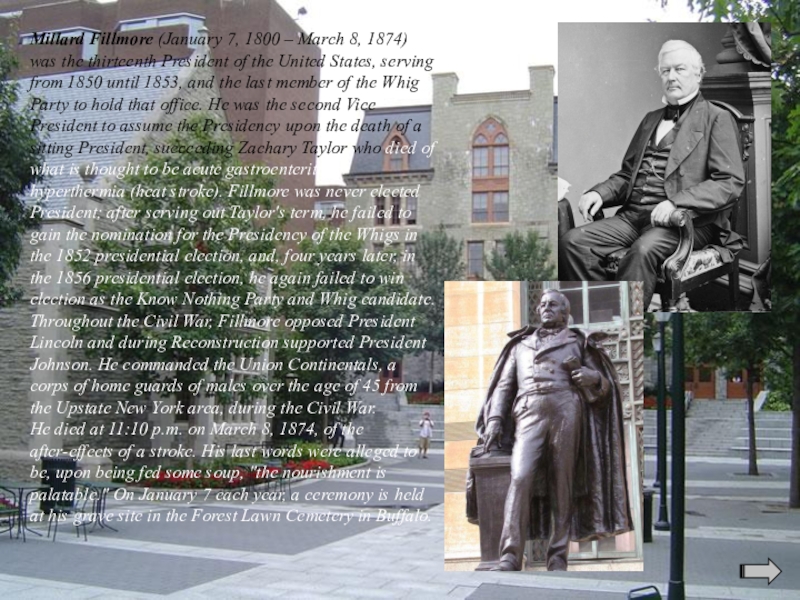
Слайд 16Millard Fillmore (January 7, 1800 – March 8, 1874) was the
Throughout the Civil War, Fillmore opposed President Lincoln and during Reconstruction supported President Johnson. He commanded the Union Continentals, a corps of home guards of males over the age of 45 from the Upstate New York area, during the Civil War.
He died at 11:10 p.m. on March 8, 1874, of the after-effects of a stroke. His last words were alleged to be, upon being fed some soup, "the nourishment is palatable." On January 7 each year, a ceremony is held at his grave site in the Forest Lawn Cemetery in Buffalo.
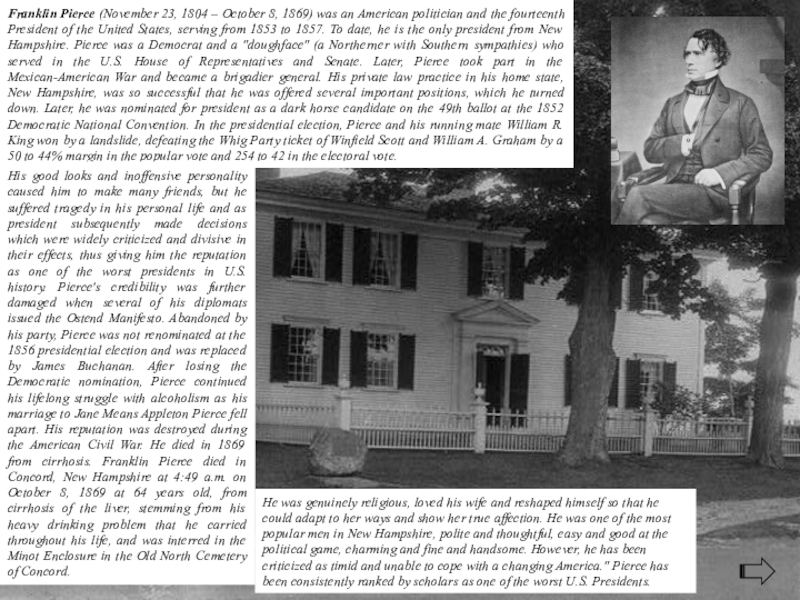
Слайд 17Franklin Pierce (November 23, 1804 – October 8, 1869) was an
His good looks and inoffensive personality caused him to make many friends, but he suffered tragedy in his personal life and as president subsequently made decisions which were widely criticized and divisive in their effects, thus giving him the reputation as one of the worst presidents in U.S. history. Pierce's credibility was further damaged when several of his diplomats issued the Ostend Manifesto. Abandoned by his party, Pierce was not renominated at the 1856 presidential election and was replaced by James Buchanan. After losing the Democratic nomination, Pierce continued his lifelong struggle with alcoholism as his marriage to Jane Means Appleton Pierce fell apart. His reputation was destroyed during the American Civil War. He died in 1869 from cirrhosis. Franklin Pierce died in Concord, New Hampshire at 4:49 a.m. on October 8, 1869 at 64 years old, from cirrhosis of the liver, stemming from his heavy drinking problem that he carried throughout his life, and was interred in the Minot Enclosure in the Old North Cemetery of Concord.
He was genuinely religious, loved his wife and reshaped himself so that he could adapt to her ways and show her true affection. He was one of the most popular men in New Hampshire, polite and thoughtful, easy and good at the political game, charming and fine and handsome. However, he has been criticized as timid and unable to cope with a changing America." Pierce has been consistently ranked by scholars as one of the worst U.S. Presidents.
Слайд 18James Buchanan, Jr.[1] (April 23, 1791 – June 1, 1868) was
To date he is the only President from Pennsylvania, and is the only never to marry. As president he was a "doughface" (a Northerner with Southern sympathies) who battled Stephen A. Douglas for control of the Democratic Party. As Southern states declared their secession in the lead-up to the American Civil War, he held that secession was illegal but that going to war to stop it was also illegal and hence remained inactive. His inability to avert the Civil War has subsequently been assessed as the worst single failure by any President of the United States.[2] Buchanan has been consistently ranked by scholars as one of the worst Presidents.
He died June 1, 1868, at the age of 77 at his home at Wheatland and was interred in Woodward Hill Cemetery in Lancaster.
![James Buchanan, Jr.[1] (April 23, 1791 – June 1, 1868) was the fifteenth President of the United](/img/thumbs/018455a7003142cda42943f7e243d481-800x.jpg "Презентация по английскому языку Президенты Америки James Buchanan, Jr.[1] (April 23, 1791 – June 1, 1868) was")
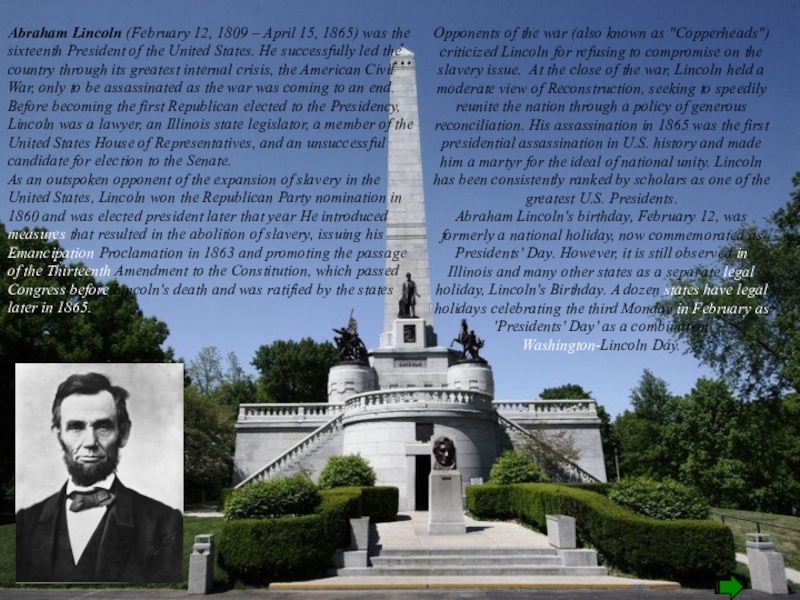
Слайд 19Abraham Lincoln (February 12, 1809 – April 15, 1865) was the
As an outspoken opponent of the expansion of slavery in the United States, Lincoln won the Republican Party nomination in 1860 and was elected president later that year He introduced measures that resulted in the abolition of slavery, issuing his Emancipation Proclamation in 1863 and promoting the passage of the Thirteenth Amendment to the Constitution, which passed Congress before Lincoln's death and was ratified by the states later in 1865.
Opponents of the war (also known as "Copperheads") criticized Lincoln for refusing to compromise on the slavery issue. At the close of the war, Lincoln held a moderate view of Reconstruction, seeking to speedily reunite the nation through a policy of generous reconciliation. His assassination in 1865 was the first presidential assassination in U.S. history and made him a martyr for the ideal of national unity. Lincoln has been consistently ranked by scholars as one of the greatest U.S. Presidents.
Abraham Lincoln's birthday, February 12, was formerly a national holiday, now commemorated as Presidents' Day. However, it is still observed in Illinois and many other states as a separate legal holiday, Lincoln's Birthday. A dozen states have legal holidays celebrating the third Monday in February as 'Presidents' Day' as a combination Washington-Lincoln Day.
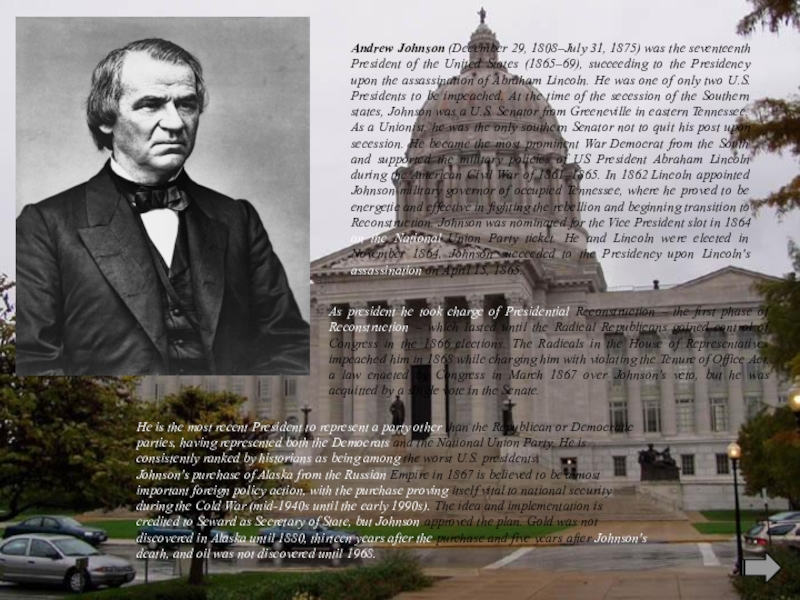
Слайд 20Andrew Johnson (December 29, 1808–July 31, 1875) was the seventeenth President
As president he took charge of Presidential Reconstruction – the first phase of Reconstruction – which lasted until the Radical Republicans gained control of Congress in the 1866 elections. The Radicals in the House of Representatives impeached him in 1868 while charging him with violating the Tenure of Office Act, a law enacted by Congress in March 1867 over Johnson's veto, but he was acquitted by a single vote in the Senate.
He is the most recent President to represent a party other than the Republican or Democratic parties, having represented both the Democrats and the National Union Party. He is consistently ranked by historians as being among the worst U.S. presidents.
Johnson's purchase of Alaska from the Russian Empire in 1867 is believed to be a most important foreign policy action, with the purchase proving itself vital to national security during the Cold War (mid-1940s until the early 1990s). The idea and implementation is credited to Seward as Secretary of State, but Johnson approved the plan. Gold was not discovered in Alaska until 1880, thirteen years after the purchase and five years after Johnson's death, and oil was not discovered until 1968.
Слайд 21
Ulysses S. Grant, born Hiram Ulysses Grant (April 27, 1822 –
In 1868, Grant was elected president as a Republican. Grant was the first president to serve for two full terms since Andrew Jackson forty years before. He led Radical Reconstruction and built a powerful patronage-based Republican party in the South, with the adroit use of the army. He took a hard line that reduced violence by groups like the Ku Klux Klan.
Presidential experts typically rank Grant in the lowest quartile of U.S. presidents, primarily for his tolerance of corruption. In recent years, however, his reputation as president has improved somewhat among scholars impressed by his support for civil rights for African Americans. Unsuccessful in winning the nomination for a third term in 1880, bankrupted by bad investments, and terminally ill with throat cancer, Grant wrote his Memoirs, which were enormously successful among veterans, the public, and the critics.

Слайд 22Rutherford Birchard Hayes (October 4, 1822 – January 17, 1893) was
Rutherford Birchard Hayes died of complications of a heart attack in Fremont, Sandusky County, Ohio, at 12:00 p.m. on Tuesday January 17, 1893. His last words were "I know that I'm going where Lucy is." Interment was in Riverwood Cemetery. Following the gift of his home to the state of Ohio for the Spiegel Grove State Park, he was reentered there in 1915.

Слайд 23James Abram Garfield (November 19, 1831 – September 19, 1881) was
Prior to his election as president, Garfield served as a major general in the United States Army and as a member of the U.S. House of Representatives, and as a member of the Electoral Commission of 1876. Garfield was the second U.S. President to be assassinated; Abraham Lincoln was the first. President Garfield, a Republican, had been in office a scant four months when he was shot and fatally wounded on July 2, 1881. He lived until September 19, having served for six months and fifteen days. To date, Garfield is the only sitting member of the House of Representatives to have been elected President.
He died of a massive heart attack or a ruptured splenic artery aneurysm, following blood poisoning and bronchial pneumonia, at 10:35 p.m. on Monday, September 19, 1881, in the Elberon section of Long Branch, New Jersey. The wounded president died exactly two months before his 50th birthday. During the eighty days between his shooting and death, his only official act was to sign an extradition paper.

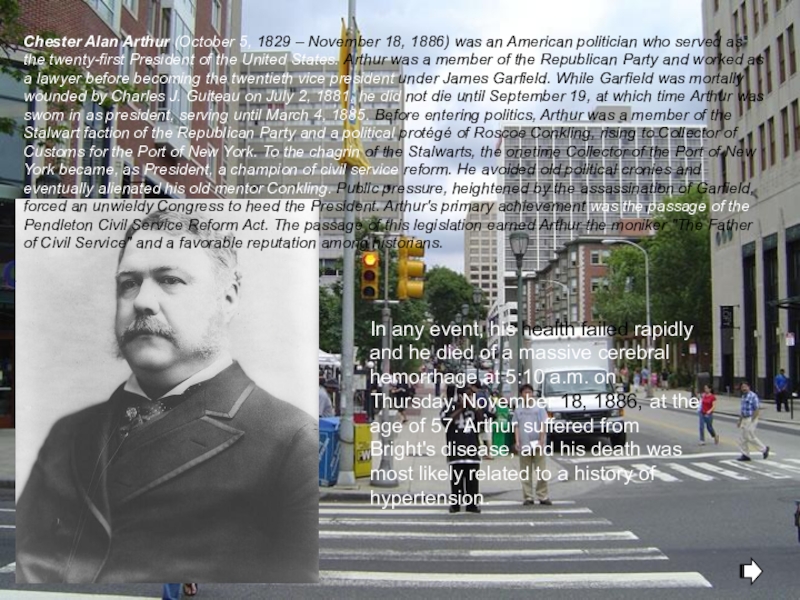
Слайд 24Chester Alan Arthur (October 5, 1829 – November 18, 1886) was
In any event, his health failed rapidly and he died of a massive cerebral hemorrhage at 5:10 a.m. on Thursday, November 18, 1886, at the age of 57. Arthur suffered from Bright's disease, and his death was most likely related to a history of hypertension.
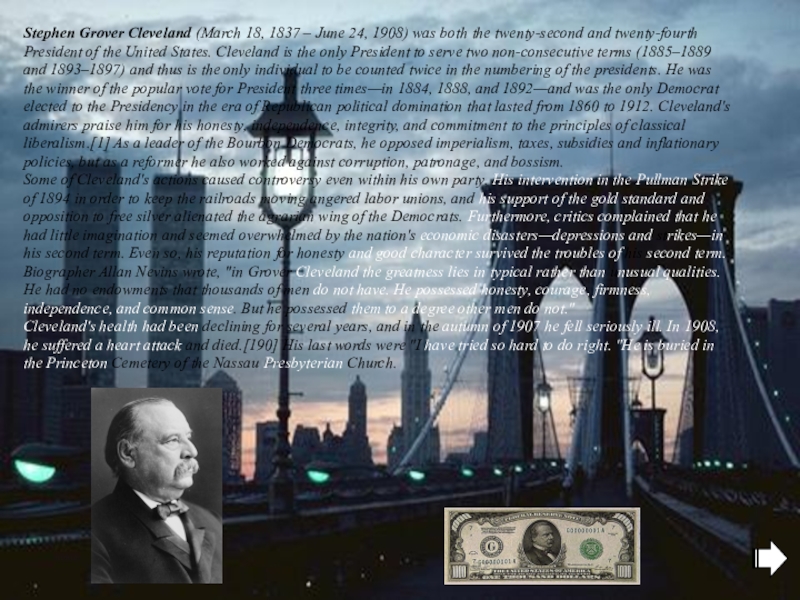
Слайд 25Stephen Grover Cleveland (March 18, 1837 – June 24, 1908) was
Some of Cleveland's actions caused controversy even within his own party. His intervention in the Pullman Strike of 1894 in order to keep the railroads moving angered labor unions, and his support of the gold standard and opposition to free silver alienated the agrarian wing of the Democrats. Furthermore, critics complained that he had little imagination and seemed overwhelmed by the nation's economic disasters—depressions and strikes—in his second term. Even so, his reputation for honesty and good character survived the troubles of his second term. Biographer Allan Nevins wrote, "in Grover Cleveland the greatness lies in typical rather than unusual qualities. He had no endowments that thousands of men do not have. He possessed honesty, courage, firmness, independence, and common sense. But he possessed them to a degree other men do not."
Cleveland's health had been declining for several years, and in the autumn of 1907 he fell seriously ill. In 1908, he suffered a heart attack and died.[190] His last words were "I have tried so hard to do right. "He is buried in the Princeton Cemetery of the Nassau Presbyterian Church.
Слайд 26Benjamin Harrison (August 20, 1833 – March 13, 1901) was the
Harrison, a Republican, was elected to the presidency in 1888, defeating the Democrat Grover Cleveland. He was the first, and to date only, president from the state of Indiana. His presidential administration is best known for its economic legislation, including the McKinley Tariff and the Sherman Antitrust Act, and for annual federal spending that reached one billion dollars for the first time. Democrats attacked the "Billion Dollar Congress", and used the issue to defeat the Republican Party, both in the 1890 mid-term elections and in Harrison's bid for reelection in 1892.
Harrison's wife died near the end of his presidential term. After failing to win reelection he returned to private life at his home in Indianapolis where he remarried, wrote a book, and later represented the Republic of Venezuela in an international case against the United Kingdom of Great Britain and Ireland. In 1900 he traveled to Europe as part of the case and, after a brief stay, returned to Indianapolis where he died the following year, from complications arising from influenza.
Harrison died from influenza and pneumonia on Wednesday, March 13, 1901, aged 67.

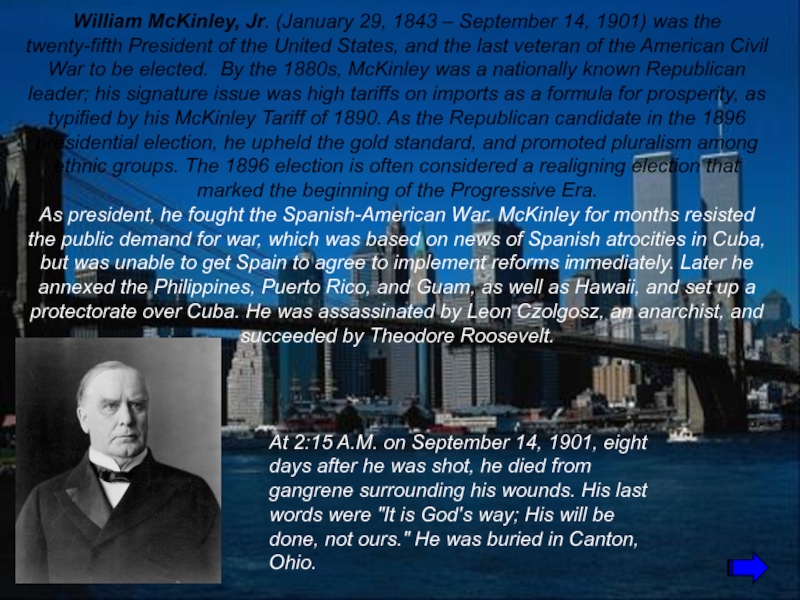
Слайд 27William McKinley, Jr. (January 29, 1843 – September 14, 1901) was
As president, he fought the Spanish-American War. McKinley for months resisted the public demand for war, which was based on news of Spanish atrocities in Cuba, but was unable to get Spain to agree to implement reforms immediately. Later he annexed the Philippines, Puerto Rico, and Guam, as well as Hawaii, and set up a protectorate over Cuba. He was assassinated by Leon Czolgosz, an anarchist, and succeeded by Theodore Roosevelt.
At 2:15 A.M. on September 14, 1901, eight days after he was shot, he died from gangrene surrounding his wounds. His last words were "It is God's way; His will be done, not ours." He was buried in Canton, Ohio.
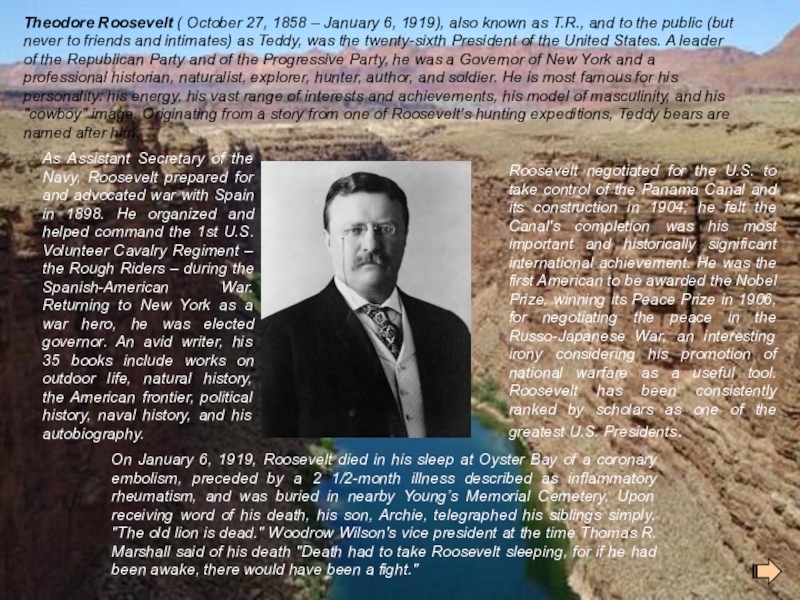
Слайд 28Theodore Roosevelt ( October 27, 1858 – January 6, 1919), also
As Assistant Secretary of the Navy, Roosevelt prepared for and advocated war with Spain in 1898. He organized and helped command the 1st U.S. Volunteer Cavalry Regiment – the Rough Riders – during the Spanish-American War. Returning to New York as a war hero, he was elected governor. An avid writer, his 35 books include works on outdoor life, natural history, the American frontier, political history, naval history, and his autobiography.
Roosevelt negotiated for the U.S. to take control of the Panama Canal and its construction in 1904; he felt the Canal's completion was his most important and historically significant international achievement. He was the first American to be awarded the Nobel Prize, winning its Peace Prize in 1906, for negotiating the peace in the Russo-Japanese War, an interesting irony considering his promotion of national warfare as a useful tool. Roosevelt has been consistently ranked by scholars as one of the greatest U.S. Presidents.
On January 6, 1919, Roosevelt died in his sleep at Oyster Bay of a coronary embolism, preceded by a 2 1/2-month illness described as inflammatory rheumatism, and was buried in nearby Young’s Memorial Cemetery. Upon receiving word of his death, his son, Archie, telegraphed his siblings simply, "The old lion is dead." Woodrow Wilson's vice president at the time Thomas R. Marshall said of his death "Death had to take Roosevelt sleeping, for if he had been awake, there would have been a fight."
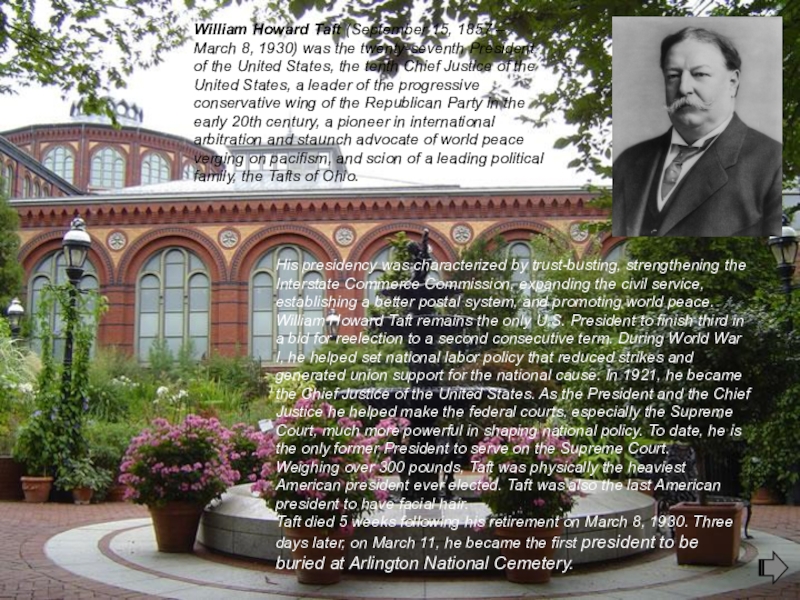
Слайд 29His presidency was characterized by trust-busting, strengthening the Interstate Commerce Commission,
Weighing over 300 pounds, Taft was physically the heaviest American president ever elected. Taft was also the last American president to have facial hair.
Taft died 5 weeks following his retirement on March 8, 1930. Three days later, on March 11, he became the first president to be buried at Arlington National Cemetery.
William Howard Taft (September 15, 1857 – March 8, 1930) was the twenty-seventh President of the United States, the tenth Chief Justice of the United States, a leader of the progressive conservative wing of the Republican Party in the early 20th century, a pioneer in international arbitration and staunch advocate of world peace verging on pacifism, and scion of a leading political family, the Tafts of Ohio.
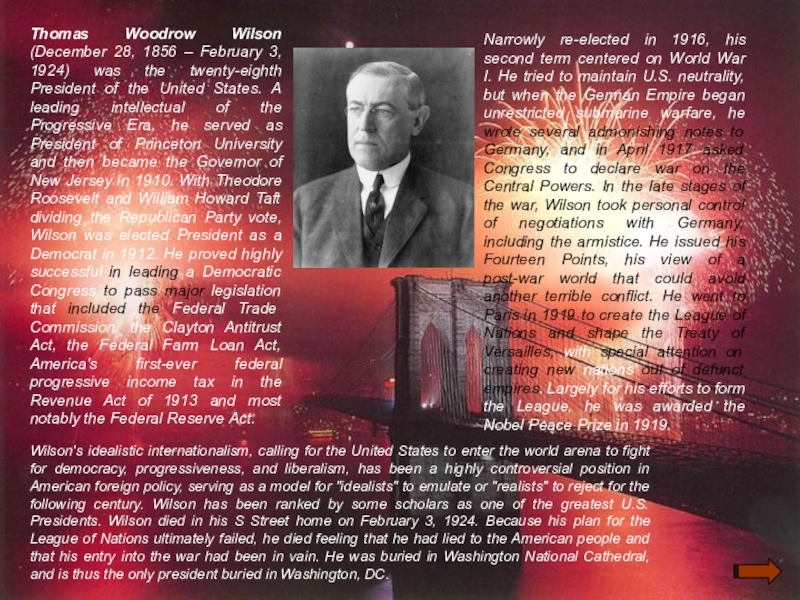
Слайд 30Thomas Woodrow Wilson (December 28, 1856 – February 3, 1924) was
Narrowly re-elected in 1916, his second term centered on World War I. He tried to maintain U.S. neutrality, but when the German Empire began unrestricted submarine warfare, he wrote several admonishing notes to Germany, and in April 1917 asked Congress to declare war on the Central Powers. In the late stages of the war, Wilson took personal control of negotiations with Germany, including the armistice. He issued his Fourteen Points, his view of a post-war world that could avoid another terrible conflict. He went to Paris in 1919 to create the League of Nations and shape the Treaty of Versailles, with special attention on creating new nations out of defunct empires. Largely for his efforts to form the League, he was awarded the Nobel Peace Prize in 1919.
Wilson's idealistic internationalism, calling for the United States to enter the world arena to fight for democracy, progressiveness, and liberalism, has been a highly controversial position in American foreign policy, serving as a model for "idealists" to emulate or "realists" to reject for the following century. Wilson has been ranked by some scholars as one of the greatest U.S. Presidents. Wilson died in his S Street home on February 3, 1924. Because his plan for the League of Nations ultimately failed, he died feeling that he had lied to the American people and that his entry into the war had been in vain. He was buried in Washington National Cathedral, and is thus the only president buried in Washington, DC.
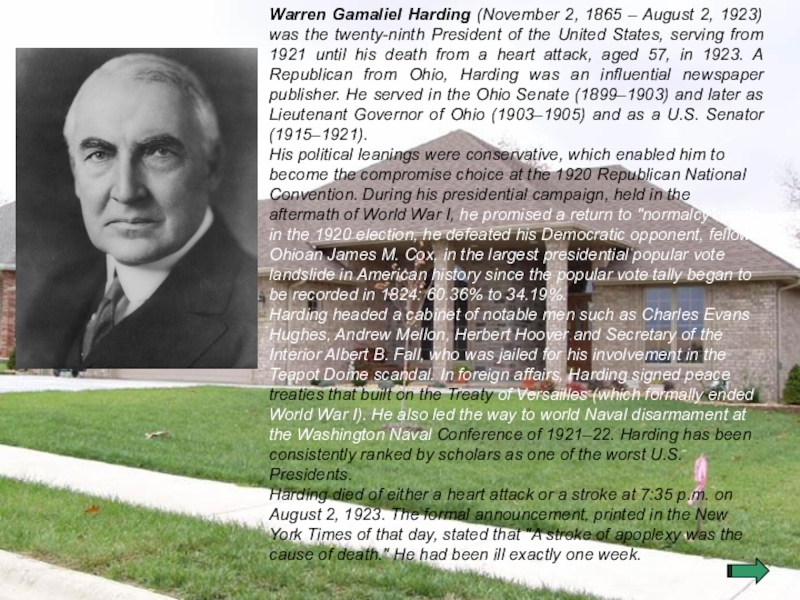
Слайд 31Warren Gamaliel Harding (November 2, 1865 – August 2, 1923) was
His political leanings were conservative, which enabled him to become the compromise choice at the 1920 Republican National Convention. During his presidential campaign, held in the aftermath of World War I, he promised a return to "normalcy"; and, in the 1920 election, he defeated his Democratic opponent, fellow Ohioan James M. Cox, in the largest presidential popular vote landslide in American history since the popular vote tally began to be recorded in 1824: 60.36% to 34.19%.
Harding headed a cabinet of notable men such as Charles Evans Hughes, Andrew Mellon, Herbert Hoover and Secretary of the Interior Albert B. Fall, who was jailed for his involvement in the Teapot Dome scandal. In foreign affairs, Harding signed peace treaties that built on the Treaty of Versailles (which formally ended World War I). He also led the way to world Naval disarmament at the Washington Naval Conference of 1921–22. Harding has been consistently ranked by scholars as one of the worst U.S. Presidents.
Harding died of either a heart attack or a stroke at 7:35 p.m. on August 2, 1923. The formal announcement, printed in the New York Times of that day, stated that "A stroke of apoplexy was the cause of death." He had been ill exactly one week.
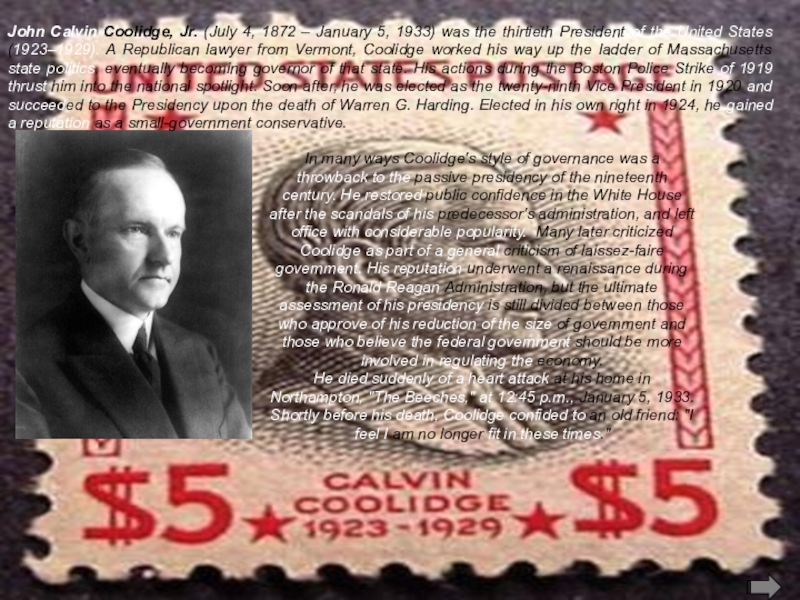
Слайд 32John Calvin Coolidge, Jr. (July 4, 1872 – January 5, 1933)
In many ways Coolidge's style of governance was a throwback to the passive presidency of the nineteenth century. He restored public confidence in the White House after the scandals of his predecessor's administration, and left office with considerable popularity. Many later criticized Coolidge as part of a general criticism of laissez-faire government. His reputation underwent a renaissance during the Ronald Reagan Administration, but the ultimate assessment of his presidency is still divided between those who approve of his reduction of the size of government and those who believe the federal government should be more involved in regulating the economy.
He died suddenly of a heart attack at his home in Northampton, "The Beeches," at 12:45 p.m., January 5, 1933. Shortly before his death, Coolidge confided to an old friend: "I feel I am no longer fit in these times."
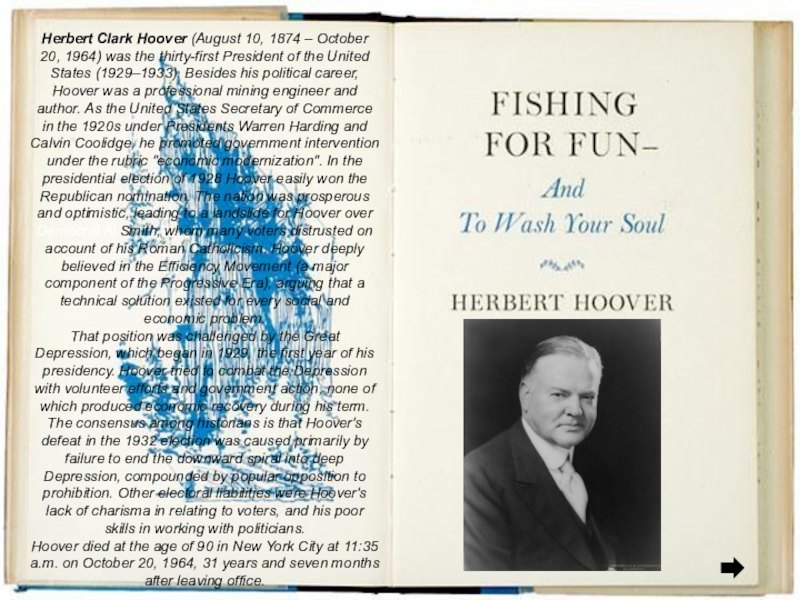
Слайд 33Herbert Clark Hoover (August 10, 1874 – October 20, 1964) was
That position was challenged by the Great Depression, which began in 1929, the first year of his presidency. Hoover tried to combat the Depression with volunteer efforts and government action, none of which produced economic recovery during his term. The consensus among historians is that Hoover's defeat in the 1932 election was caused primarily by failure to end the downward spiral into deep Depression, compounded by popular opposition to prohibition. Other electoral liabilities were Hoover's lack of charisma in relating to voters, and his poor skills in working with politicians.
Hoover died at the age of 90 in New York City at 11:35 a.m. on October 20, 1964, 31 years and seven months after leaving office.
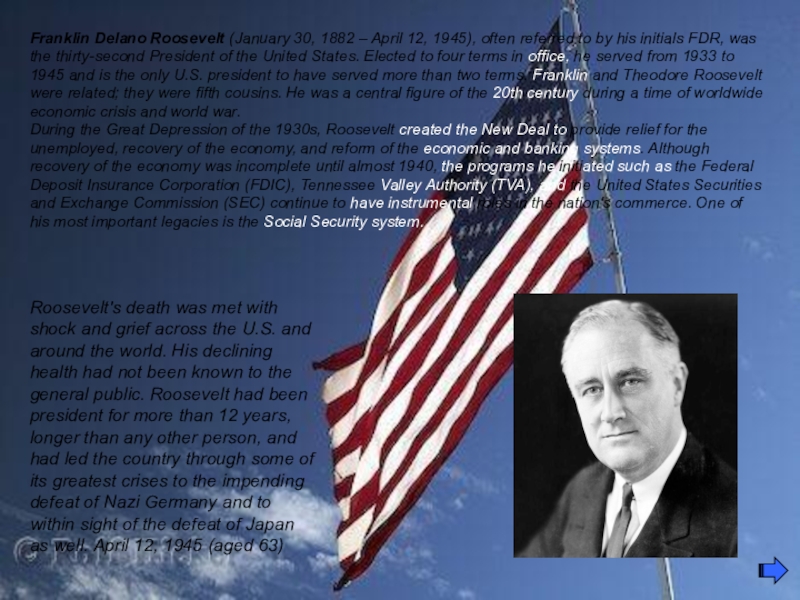
Слайд 34Franklin Delano Roosevelt (January 30, 1882 – April 12, 1945), often
During the Great Depression of the 1930s, Roosevelt created the New Deal to provide relief for the unemployed, recovery of the economy, and reform of the economic and banking systems. Although recovery of the economy was incomplete until almost 1940, the programs he initiated such as the Federal Deposit Insurance Corporation (FDIC), Tennessee Valley Authority (TVA), and the United States Securities and Exchange Commission (SEC) continue to have instrumental roles in the nation's commerce. One of his most important legacies is the Social Security system.
Roosevelt's death was met with shock and grief across the U.S. and around the world. His declining health had not been known to the general public. Roosevelt had been president for more than 12 years, longer than any other person, and had led the country through some of its greatest crises to the impending defeat of Nazi Germany and to within sight of the defeat of Japan as well. April 12, 1945 (aged 63)
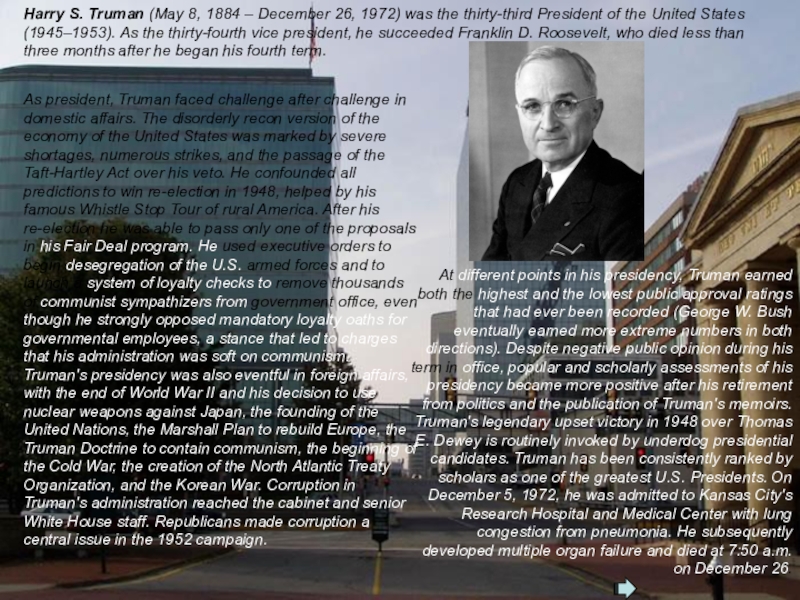
Слайд 35Harry S. Truman (May 8, 1884 – December 26, 1972) was
As president, Truman faced challenge after challenge in domestic affairs. The disorderly recon version of the economy of the United States was marked by severe shortages, numerous strikes, and the passage of the Taft-Hartley Act over his veto. He confounded all predictions to win re-election in 1948, helped by his famous Whistle Stop Tour of rural America. After his re-election he was able to pass only one of the proposals in his Fair Deal program. He used executive orders to begin desegregation of the U.S. armed forces and to launch a system of loyalty checks to remove thousands of communist sympathizers from government office, even though he strongly opposed mandatory loyalty oaths for governmental employees, a stance that led to charges that his administration was soft on communism. Truman's presidency was also eventful in foreign affairs, with the end of World War II and his decision to use nuclear weapons against Japan, the founding of the United Nations, the Marshall Plan to rebuild Europe, the Truman Doctrine to contain communism, the beginning of the Cold War, the creation of the North Atlantic Treaty Organization, and the Korean War. Corruption in Truman's administration reached the cabinet and senior White House staff. Republicans made corruption a central issue in the 1952 campaign.
At different points in his presidency, Truman earned both the highest and the lowest public approval ratings that had ever been recorded (George W. Bush eventually earned more extreme numbers in both directions). Despite negative public opinion during his term in office, popular and scholarly assessments of his presidency became more positive after his retirement from politics and the publication of Truman's memoirs. Truman's legendary upset victory in 1948 over Thomas E. Dewey is routinely invoked by underdog presidential candidates. Truman has been consistently ranked by scholars as one of the greatest U.S. Presidents. On December 5, 1972, he was admitted to Kansas City's Research Hospital and Medical Center with lung congestion from pneumonia. He subsequently developed multiple organ failure and died at 7:50 a.m. on December 26.
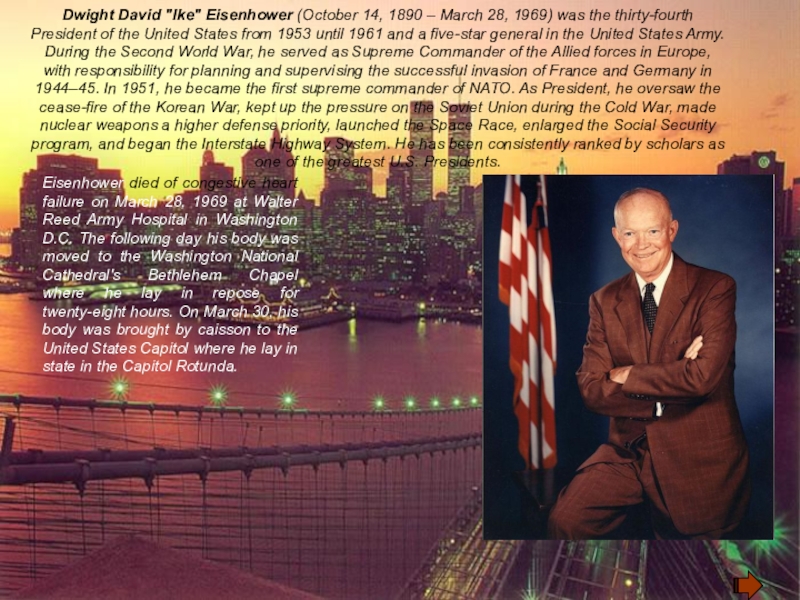
Слайд 36Dwight David "Ike" Eisenhower (October 14, 1890 – March 28, 1969)
Eisenhower died of congestive heart failure on March 28, 1969 at Walter Reed Army Hospital in Washington D.C. The following day his body was moved to the Washington National Cathedral's Bethlehem Chapel where he lay in repose for twenty-eight hours. On March 30, his body was brought by caisson to the United States Capitol where he lay in state in the Capitol Rotunda.
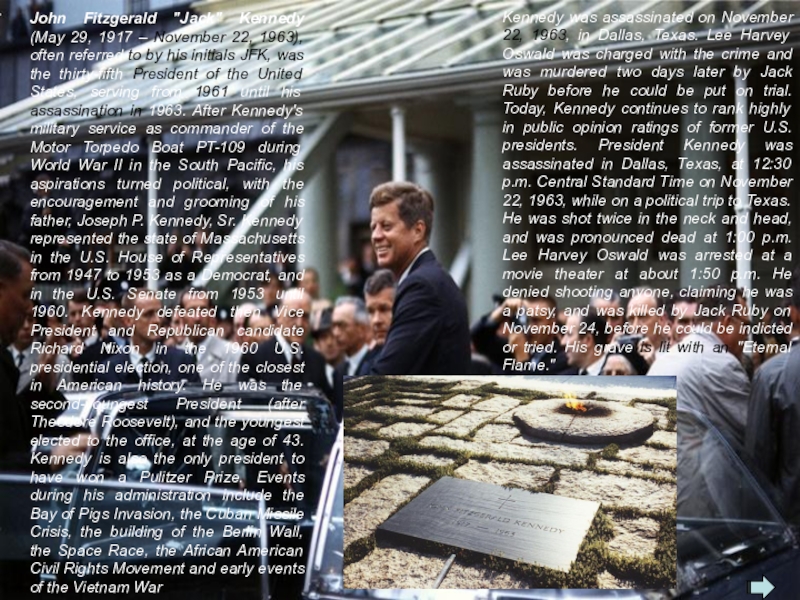
Слайд 37John Fitzgerald "Jack" Kennedy (May 29, 1917 – November 22, 1963),
Kennedy was assassinated on November 22, 1963, in Dallas, Texas. Lee Harvey Oswald was charged with the crime and was murdered two days later by Jack Ruby before he could be put on trial. Today, Kennedy continues to rank highly in public opinion ratings of former U.S. presidents. President Kennedy was assassinated in Dallas, Texas, at 12:30 p.m. Central Standard Time on November 22, 1963, while on a political trip to Texas. He was shot twice in the neck and head, and was pronounced dead at 1:00 p.m. Lee Harvey Oswald was arrested at a movie theater at about 1:50 p.m. He denied shooting anyone, claiming he was a patsy, and was killed by Jack Ruby on November 24, before he could be indicted or tried. His grave is lit with an "Eternal Flame."
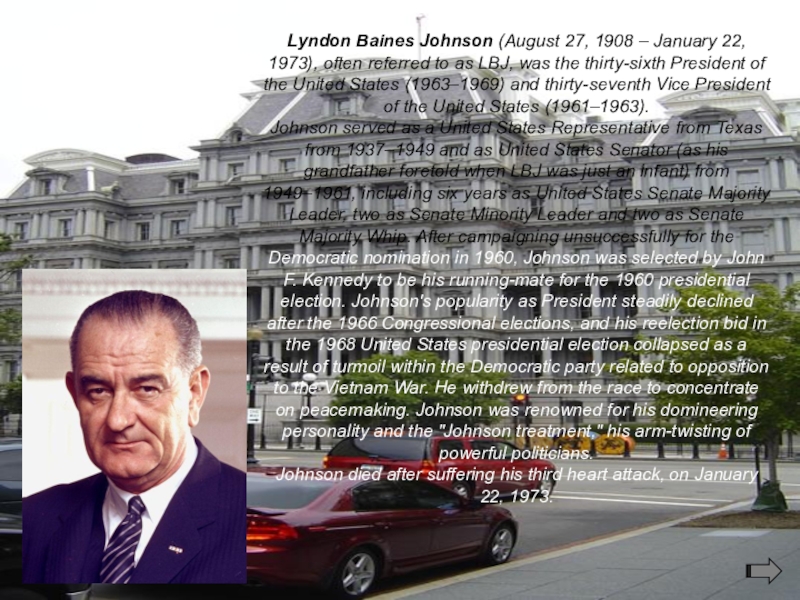
Слайд 38Lyndon Baines Johnson (August 27, 1908 – January 22, 1973), often
Johnson served as a United States Representative from Texas from 1937–1949 and as United States Senator (as his grandfather foretold when LBJ was just an infant) from 1949–1961, including six years as United States Senate Majority Leader, two as Senate Minority Leader and two as Senate Majority Whip. After campaigning unsuccessfully for the Democratic nomination in 1960, Johnson was selected by John F. Kennedy to be his running-mate for the 1960 presidential election. Johnson's popularity as President steadily declined after the 1966 Congressional elections, and his reelection bid in the 1968 United States presidential election collapsed as a result of turmoil within the Democratic party related to opposition to the Vietnam War. He withdrew from the race to concentrate on peacemaking. Johnson was renowned for his domineering personality and the "Johnson treatment," his arm-twisting of powerful politicians.
Johnson died after suffering his third heart attack, on January 22, 1973.
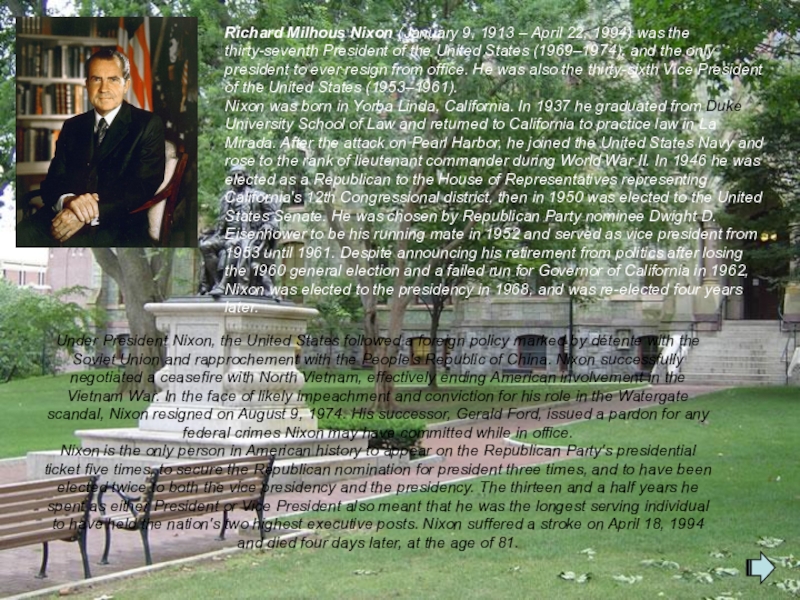
Слайд 39Richard Milhous Nixon (January 9, 1913 – April 22, 1994) was
Nixon was born in Yorba Linda, California. In 1937 he graduated from Duke University School of Law and returned to California to practice law in La Mirada. After the attack on Pearl Harbor, he joined the United States Navy and rose to the rank of lieutenant commander during World War II. In 1946 he was elected as a Republican to the House of Representatives representing California's 12th Congressional district, then in 1950 was elected to the United States Senate. He was chosen by Republican Party nominee Dwight D. Eisenhower to be his running mate in 1952 and served as vice president from 1953 until 1961. Despite announcing his retirement from politics after losing the 1960 general election and a failed run for Governor of California in 1962, Nixon was elected to the presidency in 1968, and was re-elected four years later.
Under President Nixon, the United States followed a foreign policy marked by détente with the Soviet Union and rapprochement with the People's Republic of China. Nixon successfully negotiated a ceasefire with North Vietnam, effectively ending American involvement in the Vietnam War. In the face of likely impeachment and conviction for his role in the Watergate scandal, Nixon resigned on August 9, 1974. His successor, Gerald Ford, issued a pardon for any federal crimes Nixon may have committed while in office.
Nixon is the only person in American history to appear on the Republican Party's presidential ticket five times, to secure the Republican nomination for president three times, and to have been elected twice to both the vice presidency and the presidency. The thirteen and a half years he spent as either President or Vice President also meant that he was the longest serving individual to have held the nation's two highest executive posts. Nixon suffered a stroke on April 18, 1994 and died four days later, at the age of 81.
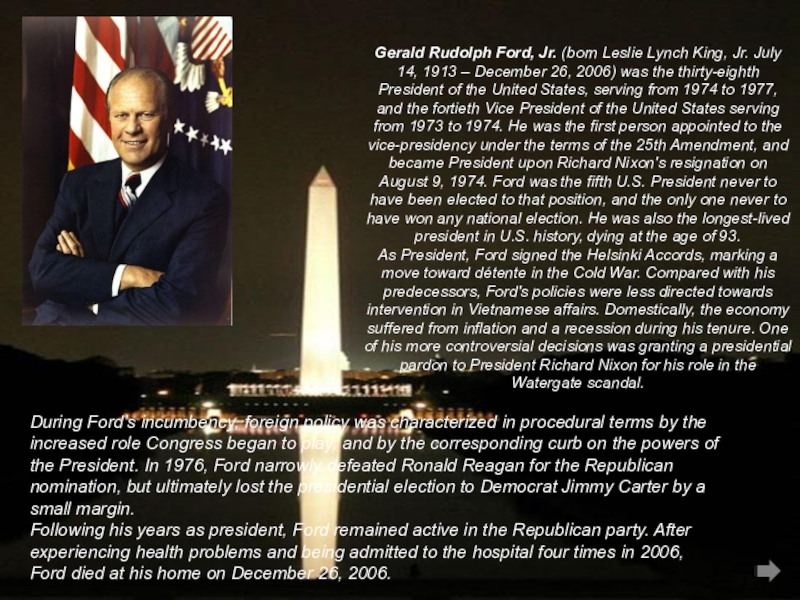
Слайд 40Gerald Rudolph Ford, Jr. (born Leslie Lynch King, Jr. July 14,
As President, Ford signed the Helsinki Accords, marking a move toward détente in the Cold War. Compared with his predecessors, Ford's policies were less directed towards intervention in Vietnamese affairs. Domestically, the economy suffered from inflation and a recession during his tenure. One of his more controversial decisions was granting a presidential pardon to President Richard Nixon for his role in the Watergate scandal.
During Ford’s incumbency, foreign policy was characterized in procedural terms by the increased role Congress began to play, and by the corresponding curb on the powers of the President. In 1976, Ford narrowly defeated Ronald Reagan for the Republican nomination, but ultimately lost the presidential election to Democrat Jimmy Carter by a small margin.
Following his years as president, Ford remained active in the Republican party. After experiencing health problems and being admitted to the hospital four times in 2006, Ford died at his home on December 26, 2006.
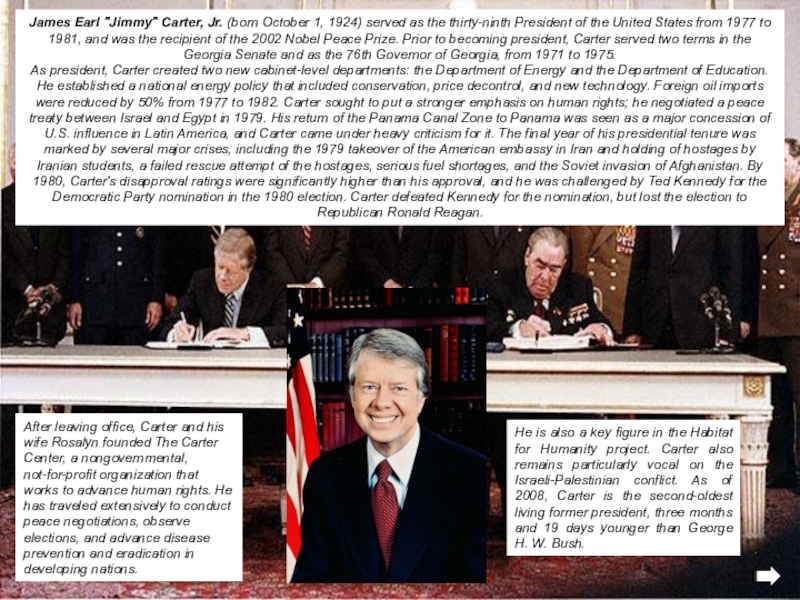
Слайд 41James Earl "Jimmy" Carter, Jr. (born October 1, 1924) served as
As president, Carter created two new cabinet-level departments: the Department of Energy and the Department of Education. He established a national energy policy that included conservation, price decontrol, and new technology. Foreign oil imports were reduced by 50% from 1977 to 1982. Carter sought to put a stronger emphasis on human rights; he negotiated a peace treaty between Israel and Egypt in 1979. His return of the Panama Canal Zone to Panama was seen as a major concession of U.S. influence in Latin America, and Carter came under heavy criticism for it. The final year of his presidential tenure was marked by several major crises, including the 1979 takeover of the American embassy in Iran and holding of hostages by Iranian students, a failed rescue attempt of the hostages, serious fuel shortages, and the Soviet invasion of Afghanistan. By 1980, Carter's disapproval ratings were significantly higher than his approval, and he was challenged by Ted Kennedy for the Democratic Party nomination in the 1980 election. Carter defeated Kennedy for the nomination, but lost the election to Republican Ronald Reagan.
After leaving office, Carter and his wife Rosalyn founded The Carter Center, a nongovernmental, not-for-profit organization that works to advance human rights. He has traveled extensively to conduct peace negotiations, observe elections, and advance disease prevention and eradication in developing nations.
He is also a key figure in the Habitat for Humanity project. Carter also remains particularly vocal on the Israeli-Palestinian conflict. As of 2008, Carter is the second-oldest living former president, three months and 19 days younger than George H. W. Bush.
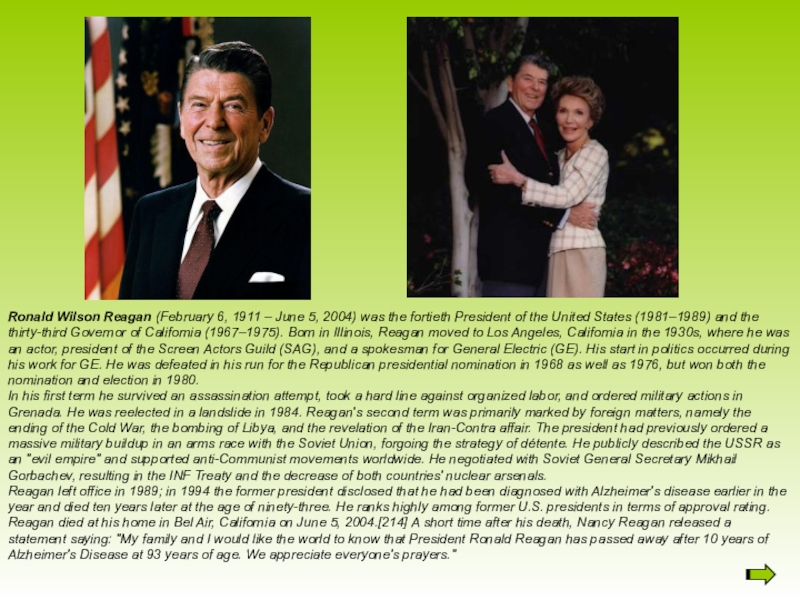
Слайд 42Ronald Wilson Reagan (February 6, 1911 – June 5, 2004) was
In his first term he survived an assassination attempt, took a hard line against organized labor, and ordered military actions in Grenada. He was reelected in a landslide in 1984. Reagan's second term was primarily marked by foreign matters, namely the ending of the Cold War, the bombing of Libya, and the revelation of the Iran-Contra affair. The president had previously ordered a massive military buildup in an arms race with the Soviet Union, forgoing the strategy of détente. He publicly described the USSR as an "evil empire" and supported anti-Communist movements worldwide. He negotiated with Soviet General Secretary Mikhail Gorbachev, resulting in the INF Treaty and the decrease of both countries' nuclear arsenals.
Reagan left office in 1989; in 1994 the former president disclosed that he had been diagnosed with Alzheimer's disease earlier in the year and died ten years later at the age of ninety-three. He ranks highly among former U.S. presidents in terms of approval rating.
Reagan died at his home in Bel Air, California on June 5, 2004.[214] A short time after his death, Nancy Reagan released a statement saying: "My family and I would like the world to know that President Ronald Reagan has passed away after 10 years of Alzheimer's Disease at 93 years of age. We appreciate everyone's prayers."
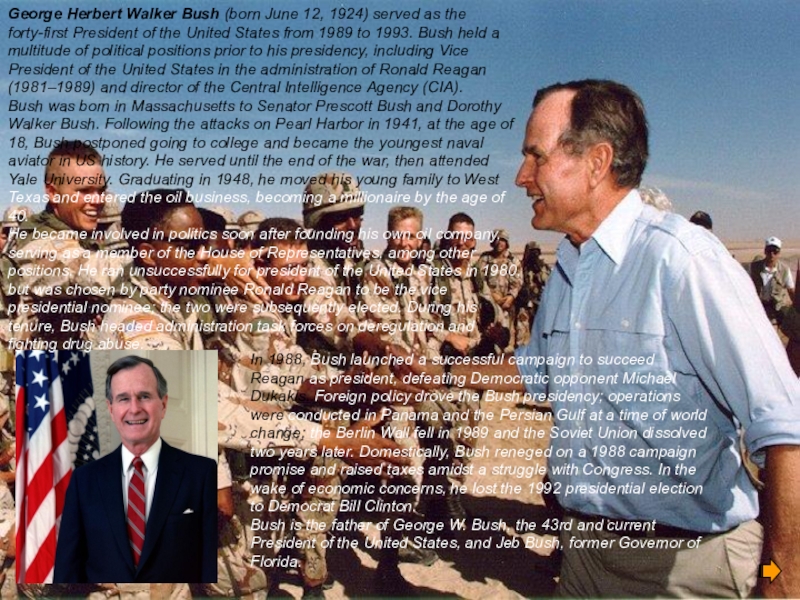
Слайд 43George Herbert Walker Bush (born June 12, 1924) served as the
Bush was born in Massachusetts to Senator Prescott Bush and Dorothy Walker Bush. Following the attacks on Pearl Harbor in 1941, at the age of 18, Bush postponed going to college and became the youngest naval aviator in US history. He served until the end of the war, then attended Yale University. Graduating in 1948, he moved his young family to West Texas and entered the oil business, becoming a millionaire by the age of 40.
He became involved in politics soon after founding his own oil company, serving as a member of the House of Representatives, among other positions. He ran unsuccessfully for president of the United States in 1980, but was chosen by party nominee Ronald Reagan to be the vice presidential nominee; the two were subsequently elected. During his tenure, Bush headed administration task forces on deregulation and fighting drug abuse.
In 1988, Bush launched a successful campaign to succeed Reagan as president, defeating Democratic opponent Michael Dukakis. Foreign policy drove the Bush presidency; operations were conducted in Panama and the Persian Gulf at a time of world change; the Berlin Wall fell in 1989 and the Soviet Union dissolved two years later. Domestically, Bush reneged on a 1988 campaign promise and raised taxes amidst a struggle with Congress. In the wake of economic concerns, he lost the 1992 presidential election to Democrat Bill Clinton.
Bush is the father of George W. Bush, the 43rd and current President of the United States, and Jeb Bush, former Governor of Florida.
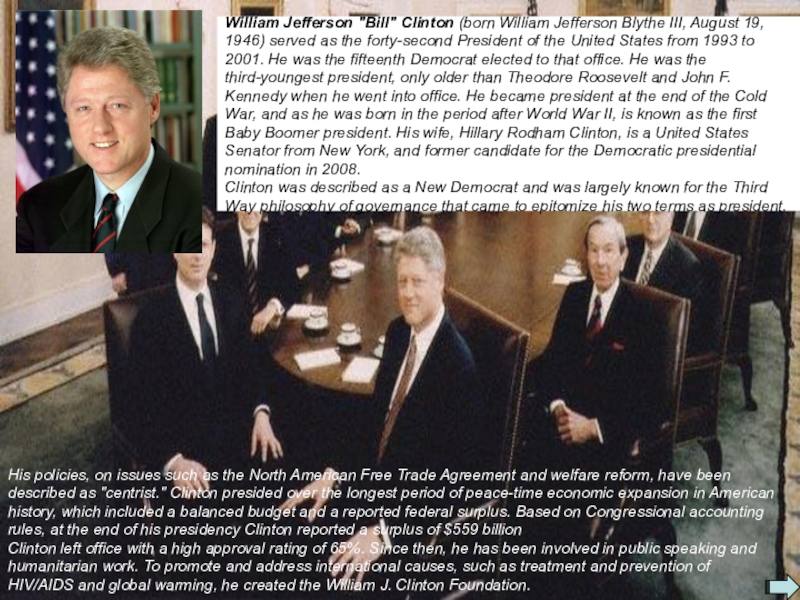
Слайд 44William Jefferson "Bill" Clinton (born William Jefferson Blythe III, August 19,
Clinton was described as a New Democrat and was largely known for the Third Way philosophy of governance that came to epitomize his two terms as president.
His policies, on issues such as the North American Free Trade Agreement and welfare reform, have been described as "centrist." Clinton presided over the longest period of peace-time economic expansion in American history, which included a balanced budget and a reported federal surplus. Based on Congressional accounting rules, at the end of his presidency Clinton reported a surplus of $559 billion
Clinton left office with a high approval rating of 65%. Since then, he has been involved in public speaking and humanitarian work. To promote and address international causes, such as treatment and prevention of HIV/AIDS and global warming, he created the William J. Clinton Foundation.
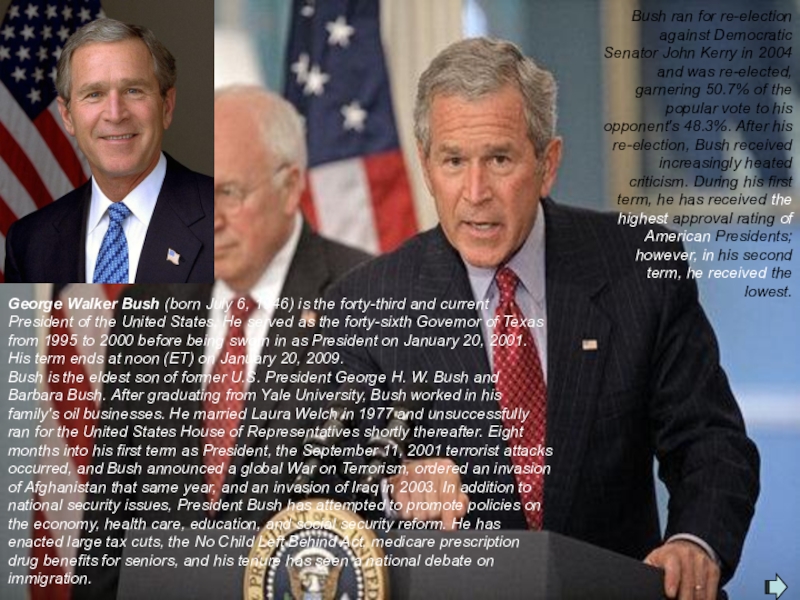
Слайд 45George Walker Bush (born July 6, 1946) is the forty-third and
Bush is the eldest son of former U.S. President George H. W. Bush and Barbara Bush. After graduating from Yale University, Bush worked in his family's oil businesses. He married Laura Welch in 1977 and unsuccessfully ran for the United States House of Representatives shortly thereafter. Eight months into his first term as President, the September 11, 2001 terrorist attacks occurred, and Bush announced a global War on Terrorism, ordered an invasion of Afghanistan that same year, and an invasion of Iraq in 2003. In addition to national security issues, President Bush has attempted to promote policies on the economy, health care, education, and social security reform. He has enacted large tax cuts, the No Child Left Behind Act, medicare prescription drug benefits for seniors, and his tenure has seen a national debate on immigration.
Bush ran for re-election against Democratic Senator John Kerry in 2004 and was re-elected, garnering 50.7% of the popular vote to his opponent's 48.3%. After his re-election, Bush received increasingly heated criticism. During his first term, he has received the highest approval rating of American Presidents; however, in his second term, he received the lowest.
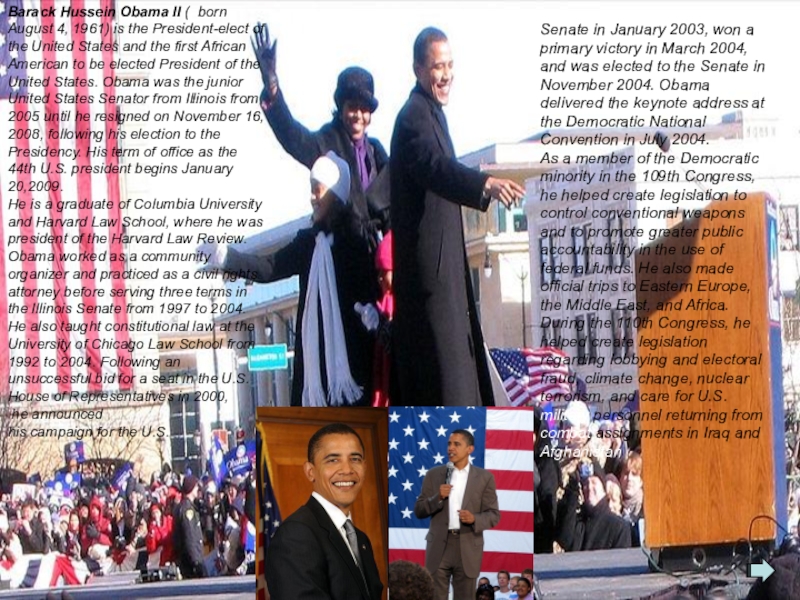
Слайд 46Barack Hussein Obama II ( born August 4, 1961) is the
He is a graduate of Columbia University and Harvard Law School, where he was president of the Harvard Law Review. Obama worked as a community organizer and practiced as a civil rights attorney before serving three terms in the Illinois Senate from 1997 to 2004. He also taught constitutional law at the University of Chicago Law School from 1992 to 2004. Following an unsuccessful bid for a seat in the U.S. House of Representatives in 2000,
he announced
his campaign for the U.S.
Senate in January 2003, won a primary victory in March 2004, and was elected to the Senate in November 2004. Obama delivered the keynote address at the Democratic National Convention in July 2004.
As a member of the Democratic minority in the 109th Congress, he helped create legislation to control conventional weapons and to promote greater public accountability in the use of federal funds. He also made official trips to Eastern Europe, the Middle East, and Africa. During the 110th Congress, he helped create legislation regarding lobbying and electoral fraud, climate change, nuclear terrorism, and care for U.S. military personnel returning from combat assignments in Iraq and Afghanistan