- Главная
- Разное
- Образование
- Спорт
- Естествознание
- Природоведение
- Религиоведение
- Французский язык
- Черчение
- Английский язык
- Астрономия
- Алгебра
- Биология
- География
- Геометрия
- Детские презентации
- Информатика
- История
- Литература
- Математика
- Музыка
- МХК
- Немецкий язык
- ОБЖ
- Обществознание
- Окружающий мир
- Педагогика
- Русский язык
- Технология
- Физика
- Философия
- Химия
- Шаблоны, фоны, картинки для презентаций
- Экология
- Экономика
Презентация, доклад по английскому языку Пассивный залог
Содержание
- 1. Презентация по английскому языку Пассивный залог
- 2. Passive VoiceActive VoiceIn English there are two
- 3. В английском языке существуют два способа описывать
- 4. Страдательный залог образуется с помощьюглагола to be
- 5. To beV3/edForms of the verb in Passive
- 6. Prepositionsbywithупотребляется перед предметом или объектом, совершившим действиеупотребляется
- 7. Make Passive sentences in Simple Present. 1.
- 8. Make Passive sentences in Simple Past.1. the
- 9. Make Passive sentences in Future .1. the
- 10. Make Active sentences to Passive :Simple Present1.
- 11. Make Active sentences to Passive :Simple Past1.
- 12. Make Active sentences to Passive :Simple Future1.
- 13. Слайд 13
- 14. Complete the sentences (Active or Passive Voice).
- 15. Complete the sentences (Active or Passive Voice).
- 16. Complete the sentences (Active or Passive Voice).
- 17. The Statue of Liberty Complete the sentences
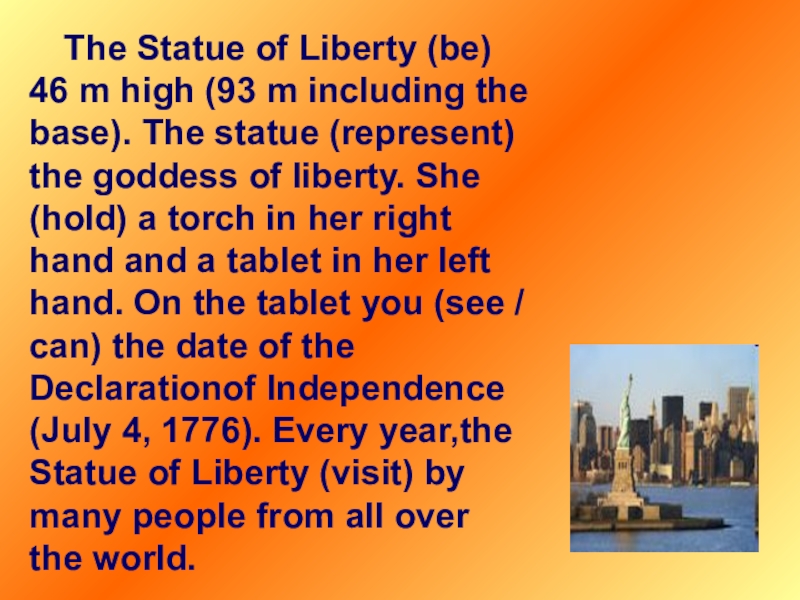
- 18. The Statue of Liberty (be)
- 19. В презентации использовались материалыс сайта http//www.ego4u.com/enGoog luck!
Слайд 2
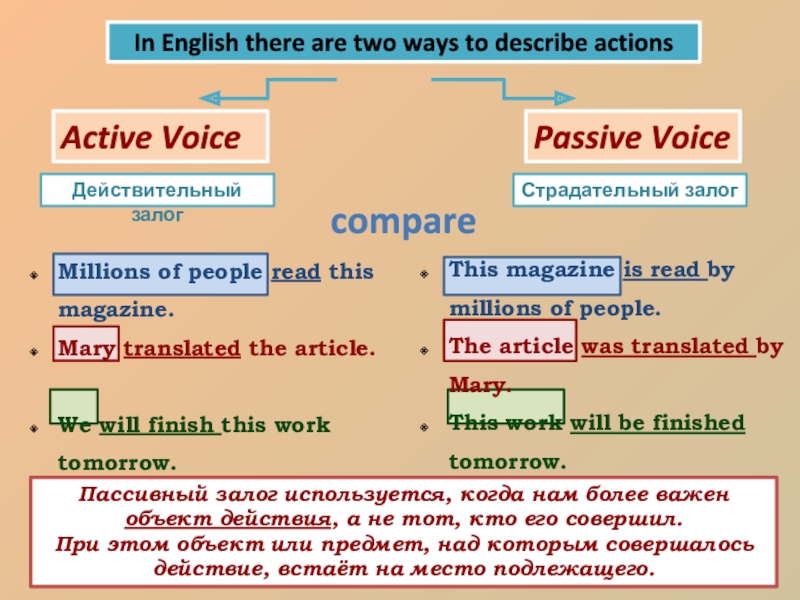
Passive Voice
Active Voice
In English there are two ways to describe actions
Действительный
Страдательный залог
compare
Millions of people read this magazine.
Mary translated the article.
We will finish this work tomorrow.
This magazine is read by millions of people.
The article was translated by Mary.
This work will be finished tomorrow.
Пассивный залог используется, когда нам более важен объект действия, а не тот, кто его совершил.
При этом объект или предмет, над которым совершалось действие, встаёт на место подлежащего.
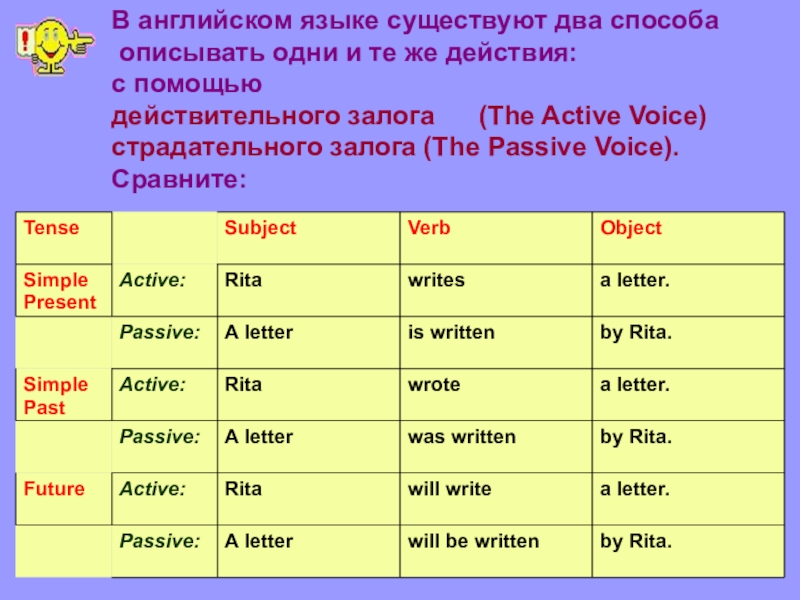
Слайд 3В английском языке существуют два способа
описывать одни и те же
с помощью
действительного залога (The Active Voice)
страдательного залога (The Passive Voice).
Сравните:
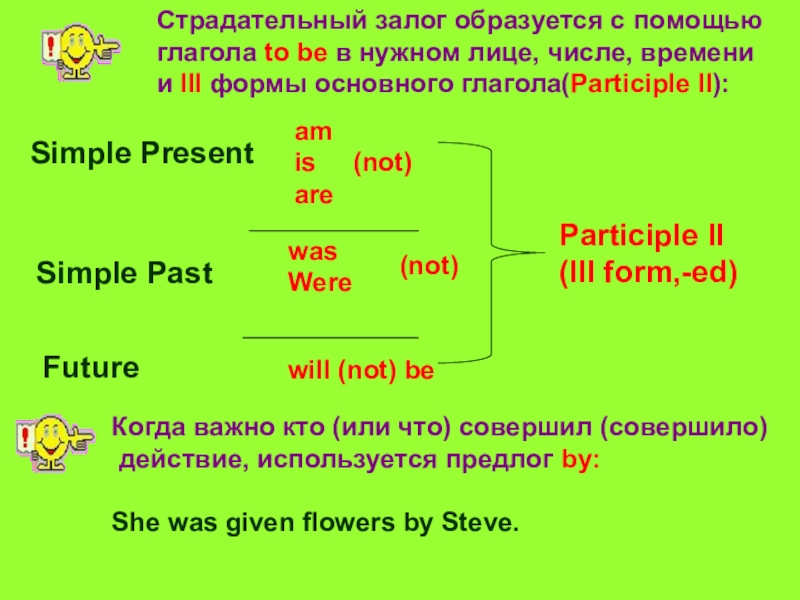
Слайд 4Страдательный залог образуется с помощью
глагола to be в нужном лице, числе,
и III формы основного глагола(Participle II):
Simple Present
Simple Past
Future
am
is (not)
are
was
Were
will (not) be
Participle II
(III form,-ed)
Когда важно кто (или что) совершил (совершило)
действие, используется предлог by:
She was given flowers by Steve.
(not)
Слайд 5
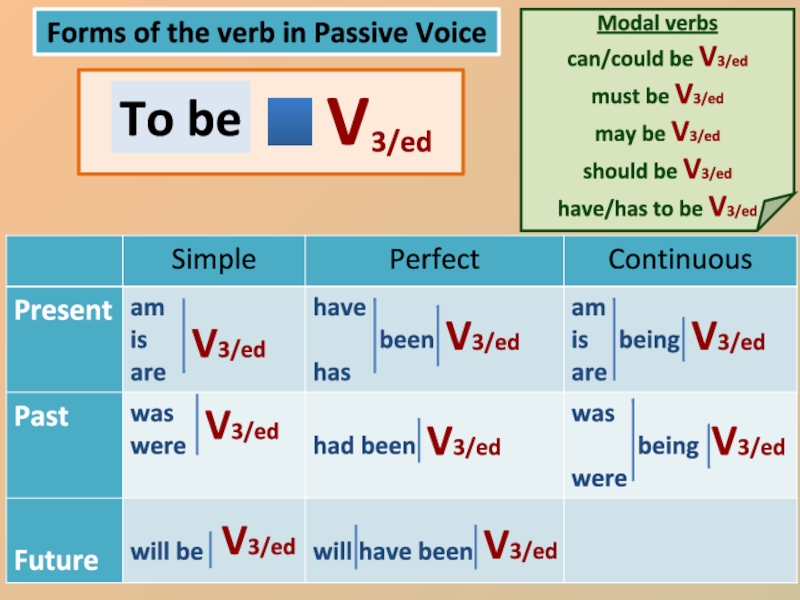
To be
V
3/ed
Forms of the verb in Passive Voice
V3/ed
V3/ed
V3/ed
V3/ed
V3/ed
V3/ed
V3/ed
V3/ed
Modal verbs
can/could be V3/ed
must
may be V3/ed
should be V3/ed
have/has to be V3/ed
Слайд 6
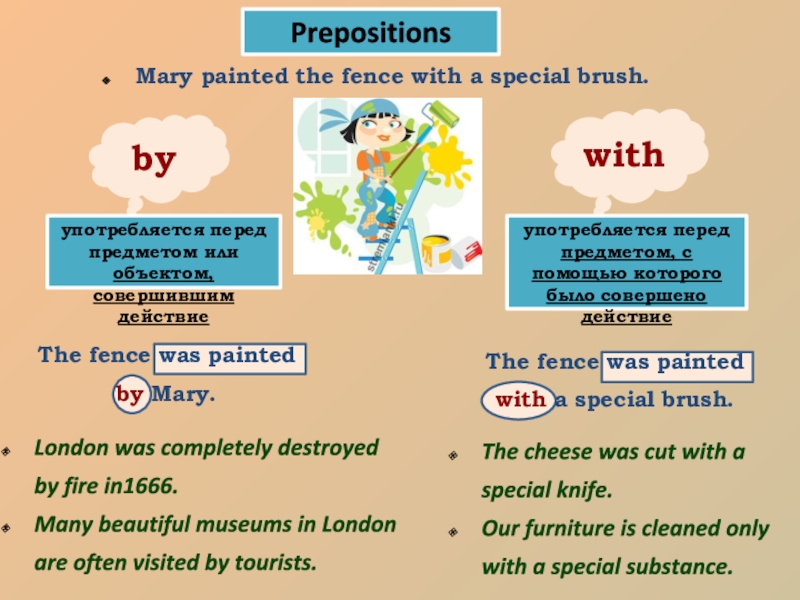
Prepositions
by
with
употребляется перед предметом или объектом, совершившим действие
употребляется перед предметом, с помощью
Mary painted the fence with a special brush.
The fence was painted
by Mary.
The fence was painted
with a special brush.
London was completely destroyed by fire in1666.
Many beautiful museums in London are often visited by tourists.
The cheese was cut with a special knife.
Our furniture is cleaned only with a special substance.
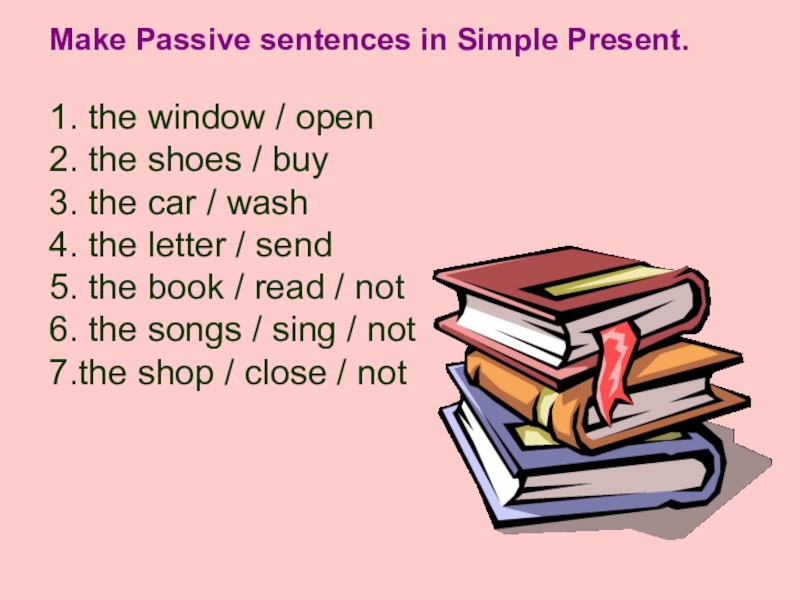
Слайд 7Make Passive sentences in Simple Present.
1. the window / open
2. the shoes / buy
3. the car / wash
4. the letter / send
5. the book / read / not
6. the songs / sing / not
7.the shop / close / not
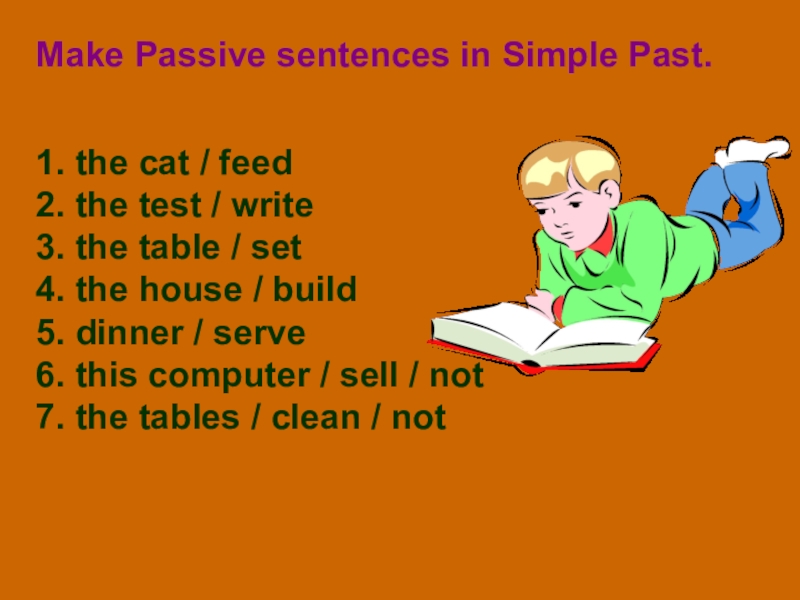
Слайд 8Make Passive sentences in Simple Past.
1. the cat / feed
2. the
3. the table / set
4. the house / build
5. dinner / serve
6. this computer / sell / not
7. the tables / clean / not
Слайд 9Make Passive sentences in Future .
1. the exhibition / visit
2.
3. the message / read
4. the photo / take
5. these songs / sing
6. a dictionary / use / not
7. credit cards / accept / not
Слайд 10Make Active sentences to Passive :
Simple Present
1. He opens the door.
2. We set the table. -
3. She pays a lot of money. -
4. I draw a picture. -
5. He doesn't open the book. –
6. You do not write the letter. -
7. Does the police officer catch the thief? -
Слайд 11Make Active sentences to Passive :
Simple Past
1. She sang a song.
2. We stopped the bus. -
3. A thief stole my car. -
4. They didn't let him go. -
5. She didn't win the prize. -
6. I did not tell them. -
7. Did he send the letter? -
Слайд 12Make Active sentences to Passive :
Simple Future
1. Jane will buy a
2. Millions of people will visit the museum. -
3. You will not do it. -
4. They will not show the new
film. -
5. They will not ask him. -
6. Will the company employ a new worker? -
Слайд 14Complete the sentences (Active or Passive Voice).
Use Simple Present.
1. He
2. The blue car (sell) .
3. In summer, more ice-cream (eat) than in winter.
4. She (call) her grandparents every Friday.
5. The letters (type) .
6. We (go) to school by bus.
7. She (work / not) for a bank.
Слайд 15Complete the sentences (Active or Passive Voice).
Use Simple Past.
1. They
2. We (visit) by our teacher.
3. She (go) to school in Boston.
4. The new shopping centre (build) last year.
5. The film (produce / not) in Hollywood.
6. Barbara (know) James very well.
7. We (spend / not) all day on the beach.
Слайд 16Complete the sentences (Active or Passive Voice).
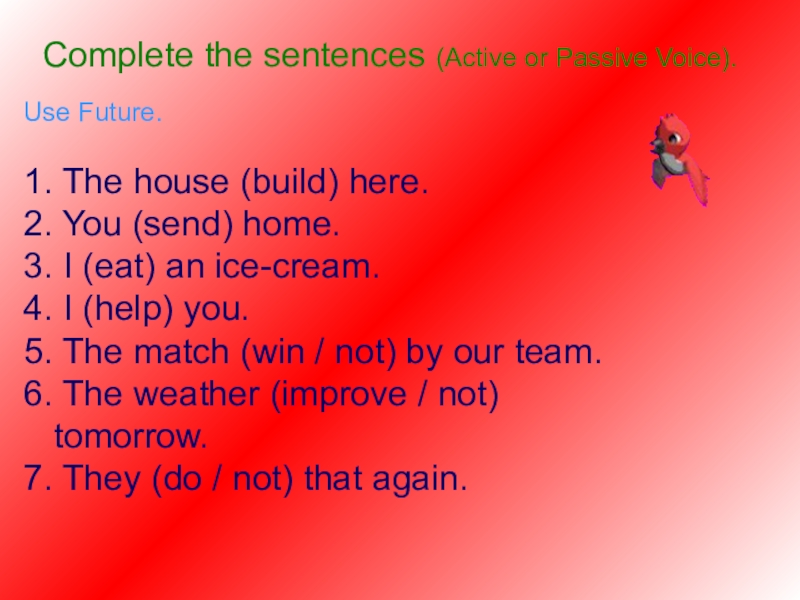
Use Future.
1. The house
2. You (send) home.
3. I (eat) an ice-cream.
4. I (help) you.
5. The match (win / not) by our team.
6. The weather (improve / not) tomorrow.
7. They (do / not) that again.
Слайд 17The Statue of Liberty
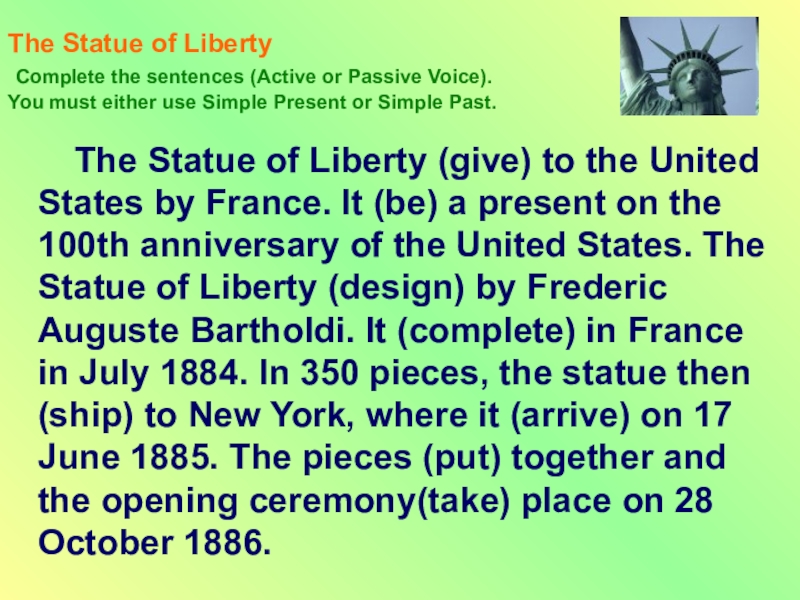
Complete the sentences (Active or Passive Voice).
You must either use Simple Present or Simple Past.
The Statue of Liberty (give) to the United States by France. It (be) a present on the 100th anniversary of the United States. The Statue of Liberty (design) by Frederic Auguste Bartholdi. It (complete) in France in July 1884. In 350 pieces, the statue then (ship) to New York, where it (arrive) on 17 June 1885. The pieces (put) together and the opening ceremony(take) place on 28 October 1886.
Слайд 18 The Statue of Liberty (be) 46 m high (93