- Главная
- Разное
- Образование
- Спорт
- Естествознание
- Природоведение
- Религиоведение
- Французский язык
- Черчение
- Английский язык
- Астрономия
- Алгебра
- Биология
- География
- Геометрия
- Детские презентации
- Информатика
- История
- Литература
- Математика
- Музыка
- МХК
- Немецкий язык
- ОБЖ
- Обществознание
- Окружающий мир
- Педагогика
- Русский язык
- Технология
- Физика
- Философия
- Химия
- Шаблоны, фоны, картинки для презентаций
- Экология
- Экономика
Презентация, доклад по английскому языку Nicolaus Copernicus (7 класс)
Содержание
- 1. Презентация по английскому языку Nicolaus Copernicus (7 класс)
- 2. Nicolaus Copernicus (19 February 1473 – 24
- 3. Nicolaus Copernicus was born on 19 February
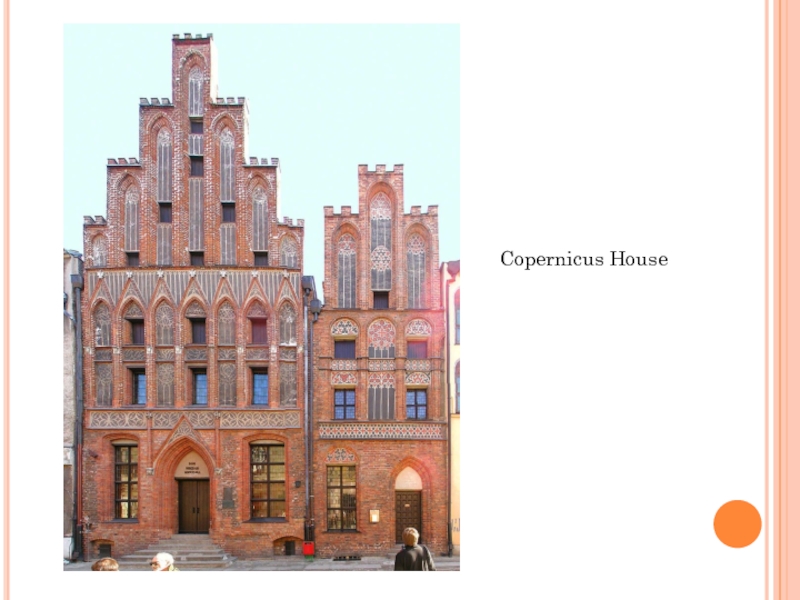
- 4. Copernicus House
- 5. Copernicus is postulated to have spoken Latin
- 6. Future scientist orphaned early, he was raised
- 7. Сopernicus spent the jubilee year 1500 in
- 8. In 1503, Nikolai Kopernik returned to his
- 9. The creation of the heliocentric system was
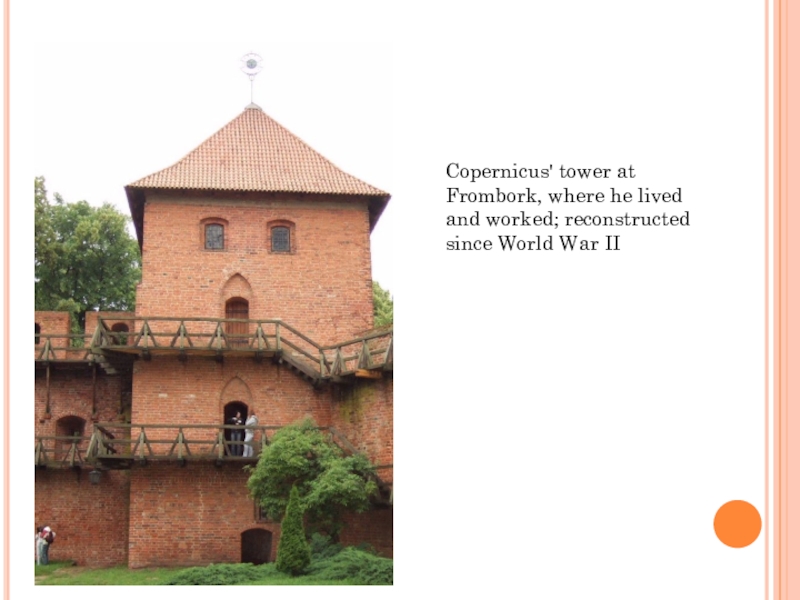
- 10. Copernicus' tower at Frombork, where he lived and worked; reconstructed since World War II
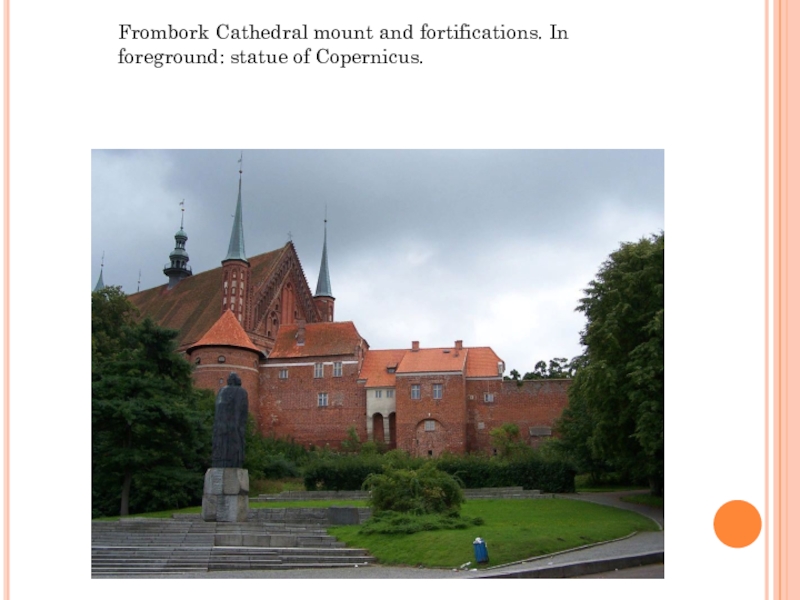
- 11. Frombork Cathedral mount and fortifications. In foreground: statue of Copernicus.
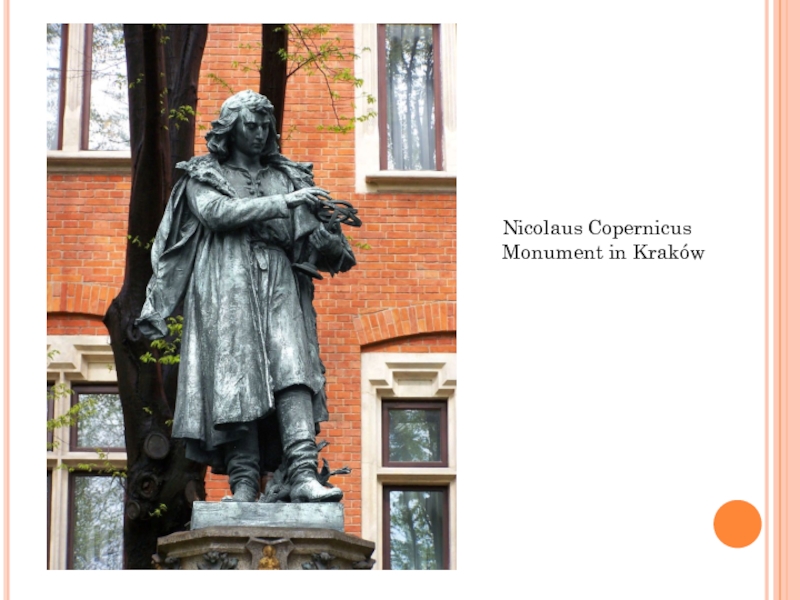
- 12. Nicolaus Copernicus Monument in Kraków
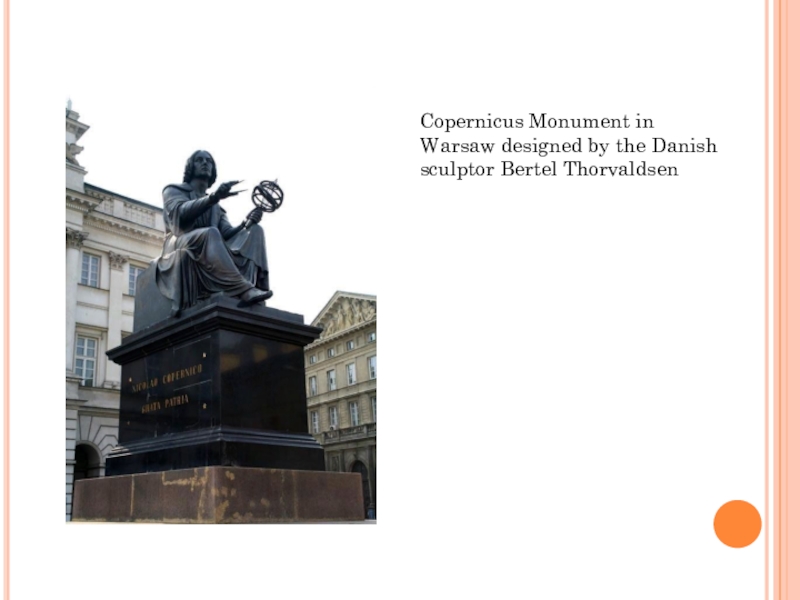
- 13. Copernicus Monument in Warsaw designed by the Danish sculptor Bertel Thorvaldsen
- 14. Слайд 14
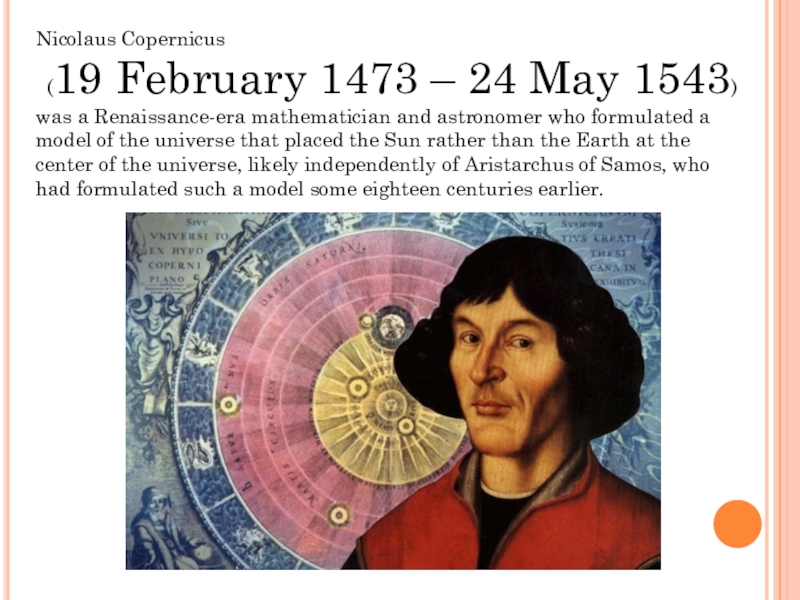
Nicolaus Copernicus (19 February 1473 – 24 May 1543) was a Renaissance-era mathematician and astronomer who formulated a model of the universe that placed the Sun rather than the Earth at the center of the universe,
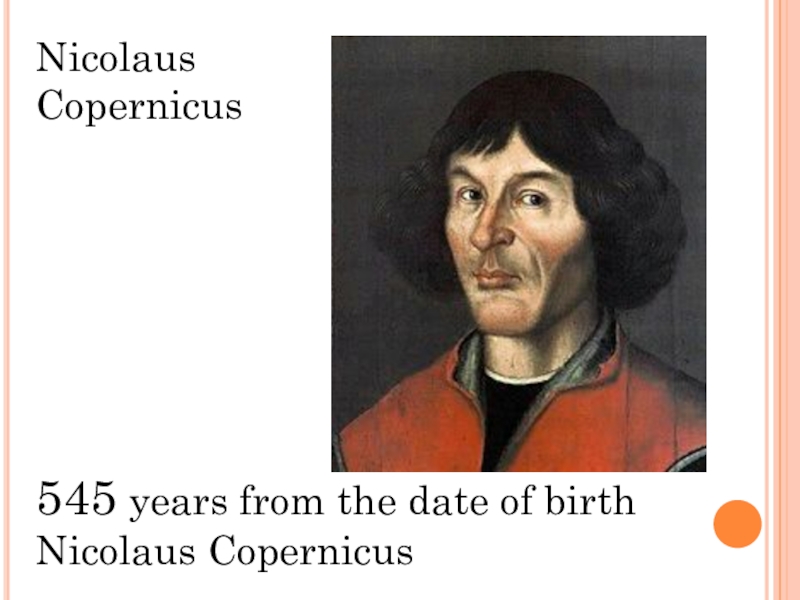
Слайд 2Nicolaus Copernicus
(19 February 1473 – 24 May 1543) was a
Renaissance-era mathematician and astronomer who formulated a model of the universe that placed the Sun rather than the Earth at the center of the universe, likely independently of Aristarchus of Samos, who had formulated such a model some eighteen centuries earlier.
Слайд 3Nicolaus Copernicus was born on 19 February 1473 in the city
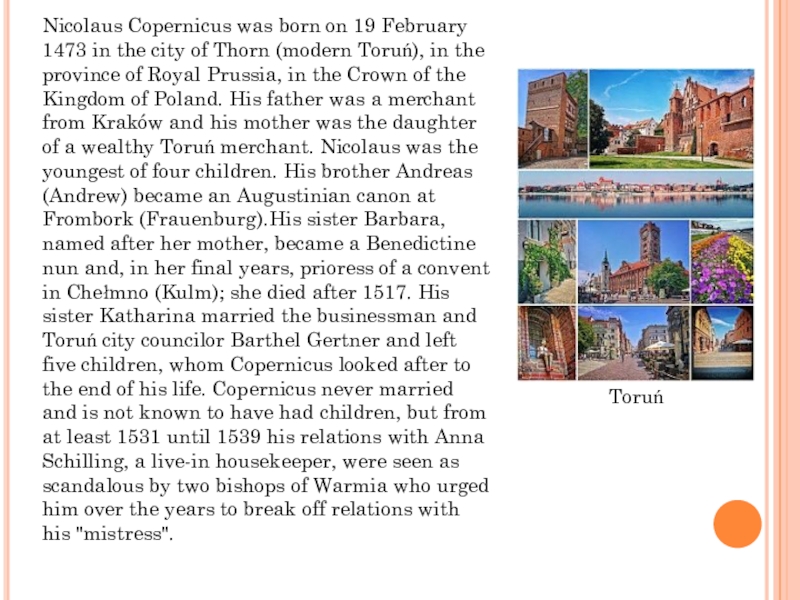
of Thorn (modern Toruń), in the province of Royal Prussia, in the Crown of the Kingdom of Poland. His father was a merchant from Kraków and his mother was the daughter of a wealthy Toruń merchant. Nicolaus was the youngest of four children. His brother Andreas (Andrew) became an Augustinian canon at Frombork (Frauenburg).His sister Barbara, named after her mother, became a Benedictine nun and, in her final years, prioress of a convent in Chełmno (Kulm); she died after 1517. His sister Katharina married the businessman and Toruń city councilor Barthel Gertner and left five children, whom Copernicus looked after to the end of his life. Copernicus never married and is not known to have had children, but from at least 1531 until 1539 his relations with Anna Schilling, a live-in housekeeper, were seen as scandalous by two bishops of Warmia who urged him over the years to break off relations with his "mistress".
Toruń
Слайд 5Copernicus is postulated to have spoken Latin and German with equal
fluency. He also spoke Polish, Greek and Italian. The vast majority of Copernicus's surviving works are in Latin, which in his lifetime was the language of academia in Europe. Latin was also the official language of the Roman Catholic Church and of Poland's royal court, and thus all of Copernicus's correspondence with the Church and with Polish leaders was in Latin. There survive a few documents written by Copernicus in German. The German philosophy professor Martin Carrier mentions this as a reason to consider Copernicus's native language to have been German.
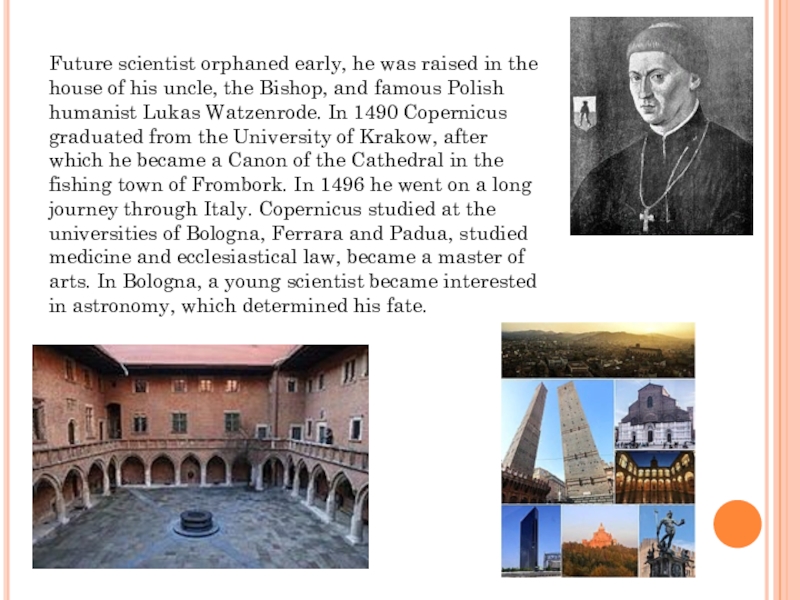
Слайд 6Future scientist orphaned early, he was raised in the house of
his uncle, the Bishop, and famous Polish humanist Lukas Watzenrode. In 1490 Copernicus graduated from the University of Krakow, after which he became a Canon of the Cathedral in the fishing town of Frombork. In 1496 he went on a long journey through Italy. Copernicus studied at the universities of Bologna, Ferrara and Padua, studied medicine and ecclesiastical law, became a master of arts. In Bologna, a young scientist became interested in astronomy, which determined his fate.
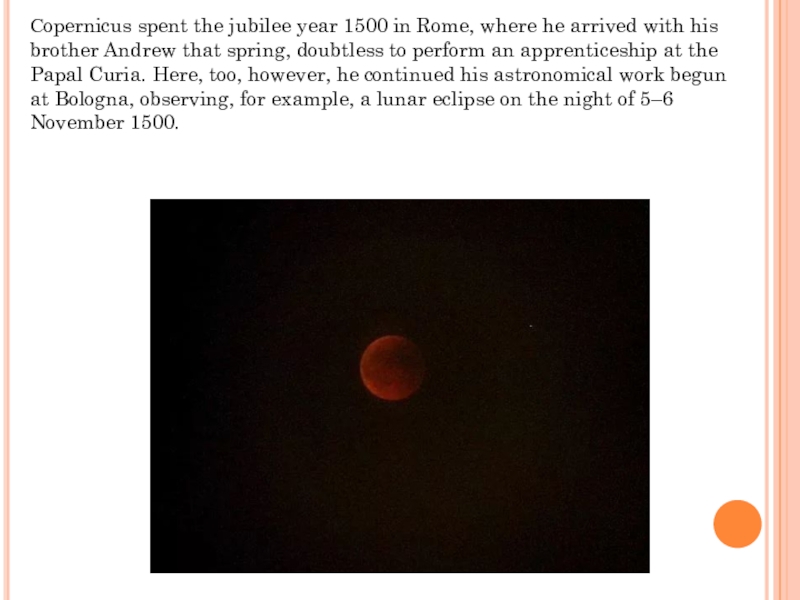
Слайд 7Сopernicus spent the jubilee year 1500 in Rome, where he arrived
with his brother Andrew that spring, doubtless to perform an apprenticeship at the Papal Curia. Here, too, however, he continued his astronomical work begun at Bologna, observing, for example, a lunar eclipse on the night of 5–6 November 1500.
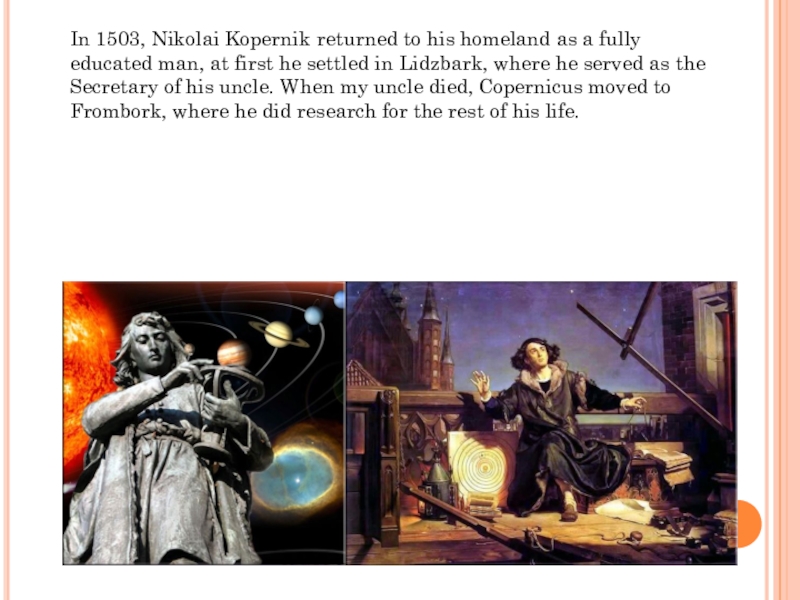
Слайд 8In 1503, Nikolai Kopernik returned to his homeland as a fully
educated man, at first he settled in Lidzbark, where he served as the Secretary of his uncle. When my uncle died, Copernicus moved to Frombork, where he did research for the rest of his life.
Слайд 9The creation of the heliocentric system was the result of years
of work by Nikolai Copernicus. About one and a half millennia there was a system of peace, proposed by the ancient Greek scholar Claudius Ptolemy. It was thought, that Earth is in the center of the Universe, and other planet and the Sun revolve around it. This theory could not explain many of the phenomena observed by astronomers, but it is well consistent with the teachings of the Catholic Church. Copernicus watched the movements of the heavenly bodies and came to the conclusion that the Ptolemaic theory is wrong. In order to prove that all the planets revolve around the Sun, and the Earth is only one of them, Copernicus made complex mathematical calculations and spent more than 30 years of hard work. Although the scientist mistakenly believed that all the stars are fixed and are on the surface of a huge sphere, he managed to explain the visible movement of the Sun and the rotation of the heavenly vault .The results of the observations were summarized in the work of Nikolai Copernicus "on the circulation of celestial spheres", published in 1543. In it, he developed new philosophical ideas and focused on improving the mathematical theory describing the movement of celestial bodies. the Revolutionary nature of the scientist's views was realized by the Catholic Church later, when in 1616 his work was included in the "Index of forbidden books".