- Главная
- Разное
- Образование
- Спорт
- Естествознание
- Природоведение
- Религиоведение
- Французский язык
- Черчение
- Английский язык
- Астрономия
- Алгебра
- Биология
- География
- Геометрия
- Детские презентации
- Информатика
- История
- Литература
- Математика
- Музыка
- МХК
- Немецкий язык
- ОБЖ
- Обществознание
- Окружающий мир
- Педагогика
- Русский язык
- Технология
- Физика
- Философия
- Химия
- Шаблоны, фоны, картинки для презентаций
- Экология
- Экономика
Презентация, доклад по английскому языку Неличные формы глагола (10 класс)
Содержание
- 1. Презентация по английскому языку Неличные формы глагола (10 класс)
- 2. Non-finite forms of the verbThe InfinitiveThe GerundThe Participle
- 3. Эти формы называются неличными, т.к. не имеют
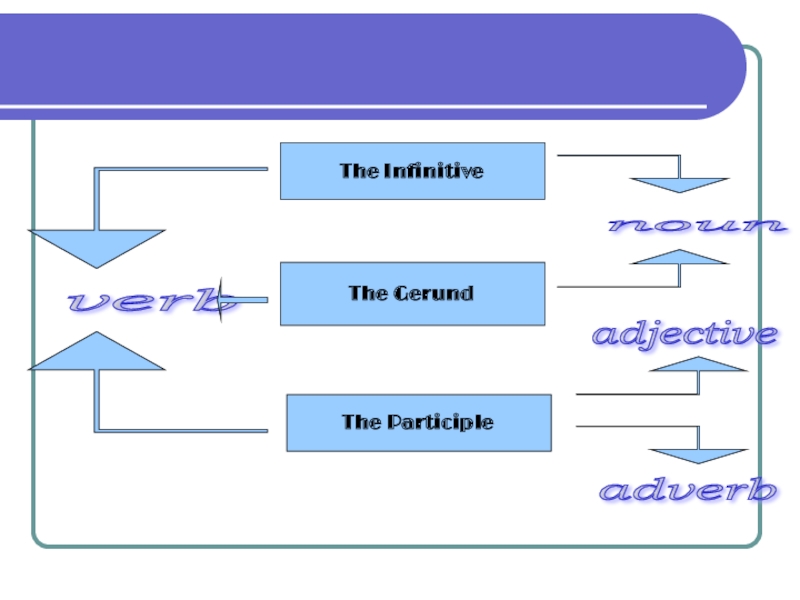
- 4. The InfinitiveThe GerundThe Participlenoun adjective adverb verb
- 5. Слайд 5
- 6. Слайд 6
- 7. The InfinitiveНеличная форма глагола, которая только называет
- 8. The FunctionsПризнаки существительного:служит в предложенииподлежащим (To skate
- 9. Признаки глаголаимеет прямое дополнение (I told him
- 10. Слайд 10
- 11. Слайд 11
- 12. Translate the sentences into Russian1. To become
- 13. 8. I had to come down to
- 14. Reword the sentences according to examples.Example:
- 15. Слайд 15
- 16. The GerundНеличная форма глагола, которая сочетает свойства
- 17. Spelling+ ing к инфинитиву без to !
- 18. The FunctionsПризнаки существительного:служит в предложенииподлежащим (Reading is
- 19. Признаки глаголаимеет прямое дополнение (I remember reading
- 20. Слайд 20
- 21. NB!В русском языке нет форм, соответствующих формам
- 22. The Participleнеличная глагольная форма, которая наряду со
- 23. The ParticipleParticiple I (причастие наст.времени) Participle II
- 24. Spelling! To give – giv_ing! To cut
- 25. The FunctionsПризнаки прилагательногослужит в предложении - определением
- 26. Выполняет в предложении функцию обстоятельства - времени
- 27. Признаки наречияслужит в предложении обстоятельством, определяющим действие, выраженное сказуемым (He sat at the table thinking)
- 28. Признаки глагола- имеет дополнение (Signing the letter
- 29. имеет формы времени и залога
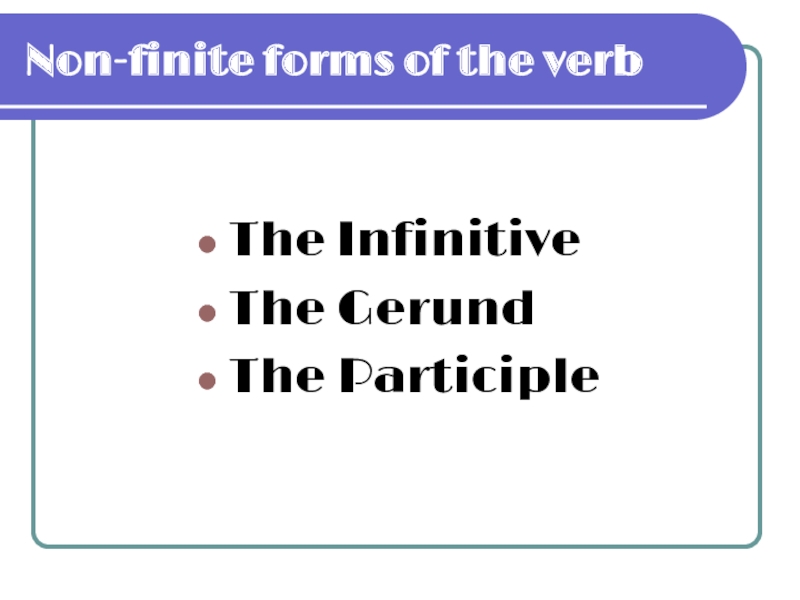
Non-finite forms of the verbThe InfinitiveThe GerundThe Participle
Слайд 3Эти формы называются неличными, т.к. не имеют категорий лица, числа и
наклонения, следовательно, не могут выполнять синтаксической функции сказуемого.
Неличные формы глагола отличаются двойственностью характера, совмещая в себе именные и глагольные черты, причем, имея общие глагольные свойства, с одной стороны, с другой они обладают различными чертами, свойственными именными частями речи, что и определяет их различные синтаксические функции.
Неличные формы глагола отличаются двойственностью характера, совмещая в себе именные и глагольные черты, причем, имея общие глагольные свойства, с одной стороны, с другой они обладают различными чертами, свойственными именными частями речи, что и определяет их различные синтаксические функции.
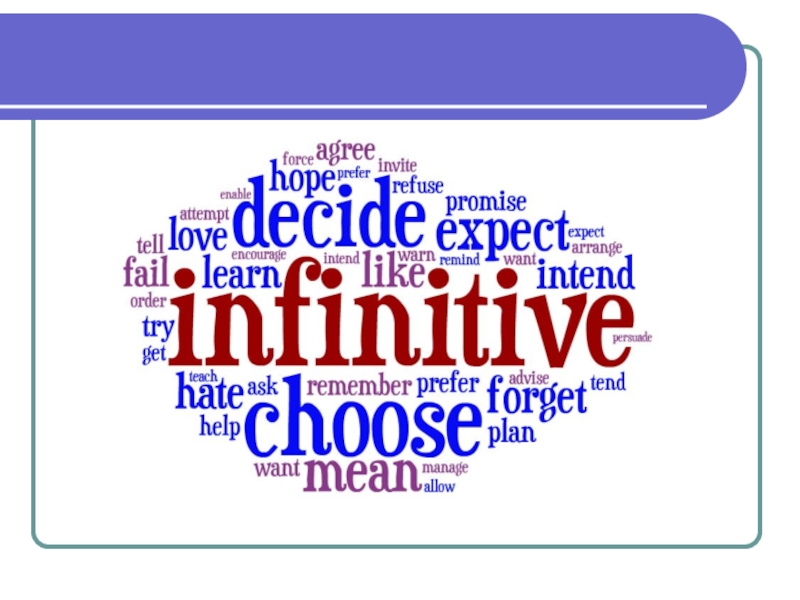
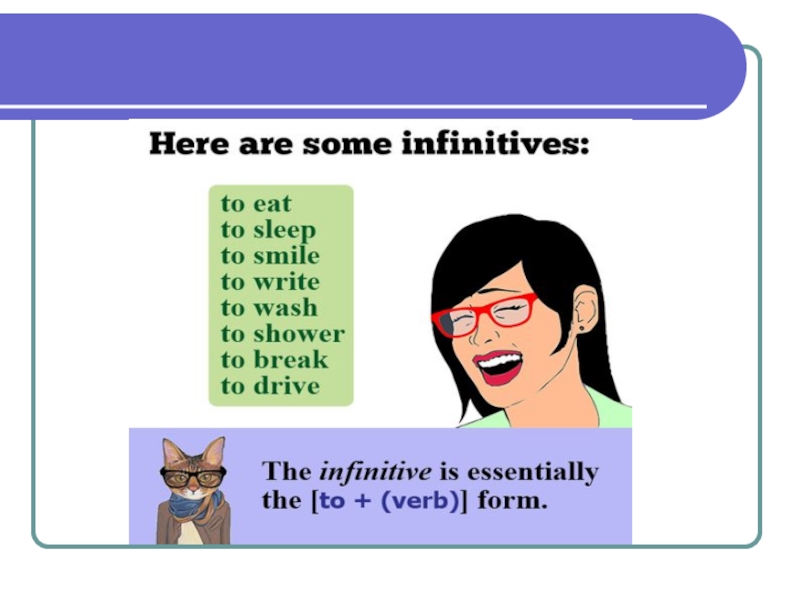
Слайд 7The Infinitive
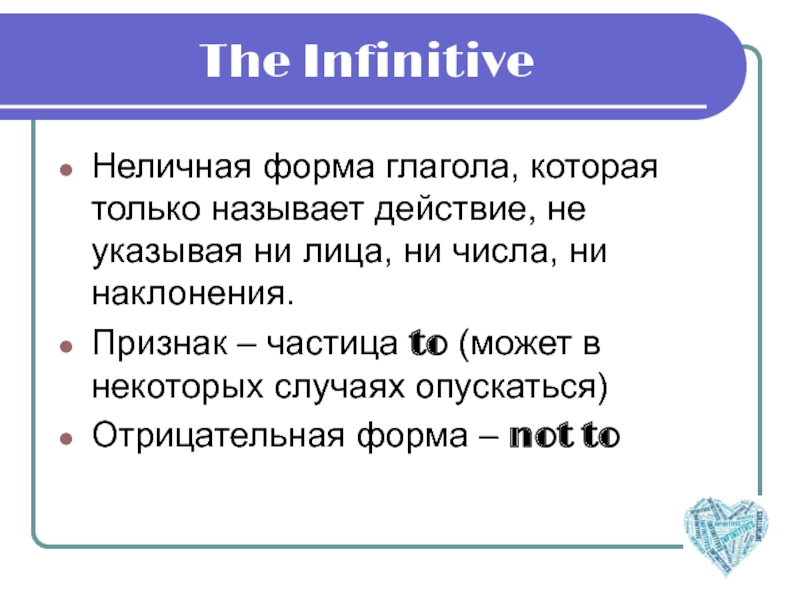
Неличная форма глагола, которая только называет действие, не указывая ни
лица, ни числа, ни наклонения.
Признак – частица to (может в некоторых случаях опускаться)
Отрицательная форма – not to
Признак – частица to (может в некоторых случаях опускаться)
Отрицательная форма – not to
Слайд 8The Functions
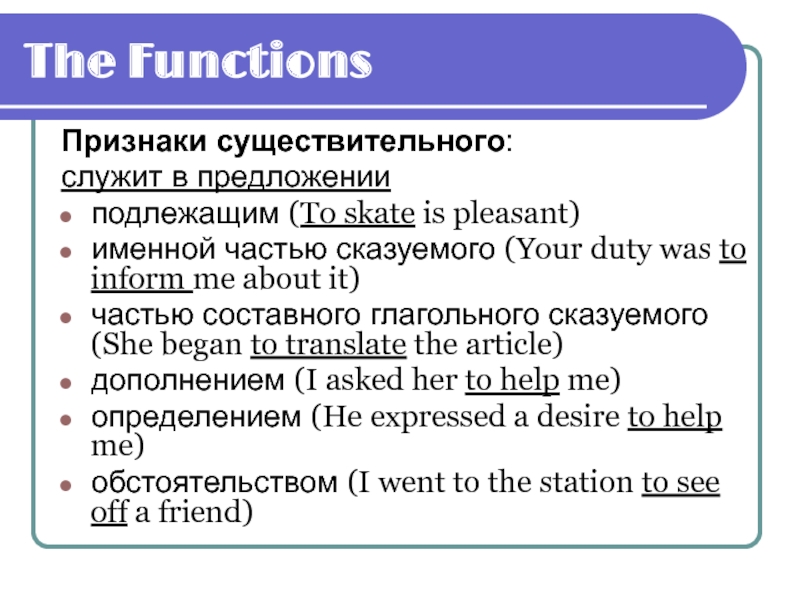
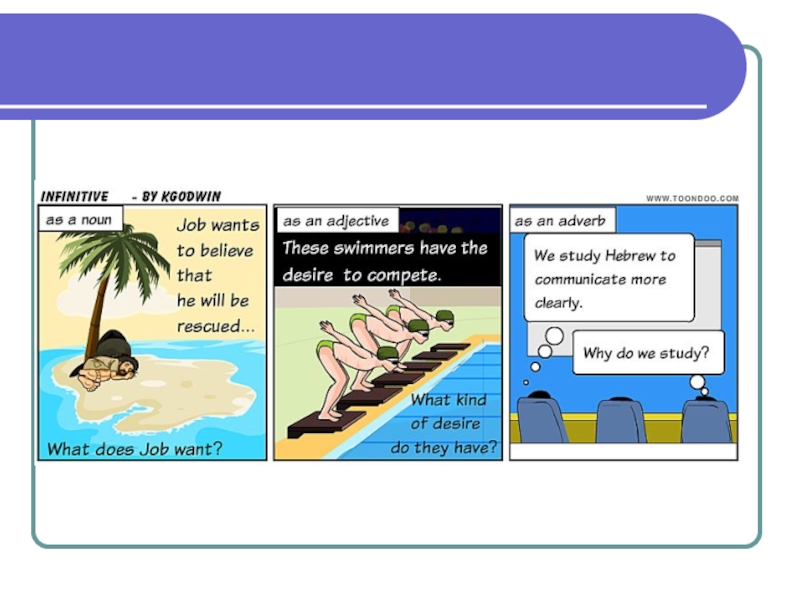
Признаки существительного:
служит в предложении
подлежащим (To skate is pleasant)
именной частью сказуемого
(Your duty was to inform me about it)
частью составного глагольного сказуемого (She began to translate the article)
дополнением (I asked her to help me)
определением (He expressed a desire to help me)
обстоятельством (I went to the station to see off a friend)
частью составного глагольного сказуемого (She began to translate the article)
дополнением (I asked her to help me)
определением (He expressed a desire to help me)
обстоятельством (I went to the station to see off a friend)
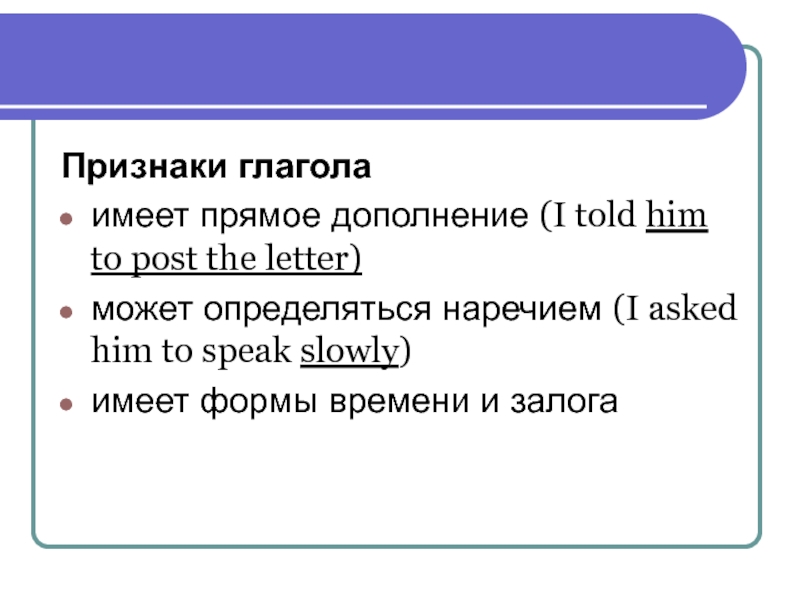
Слайд 9Признаки глагола
имеет прямое дополнение (I told him to post the letter)
может
определяться наречием (I asked him to speak slowly)
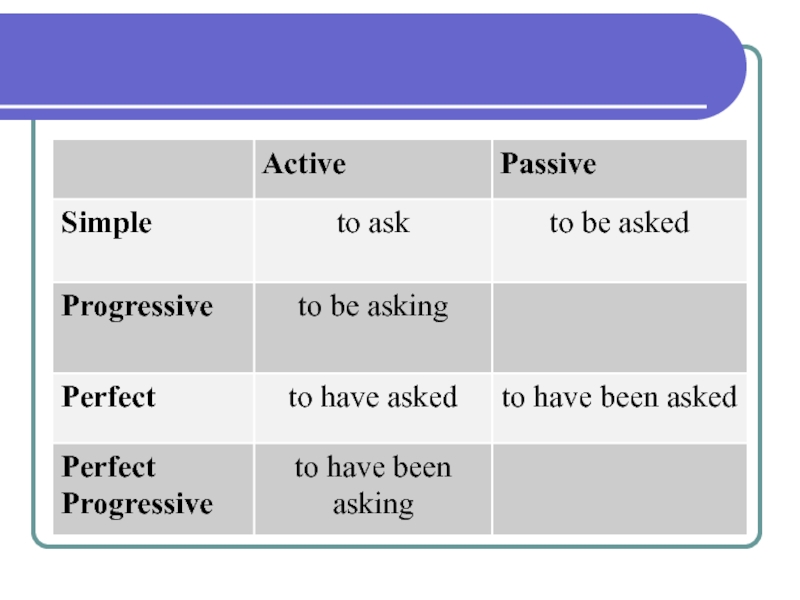
имеет формы времени и залога
имеет формы времени и залога
Слайд 12Translate the sentences into Russian
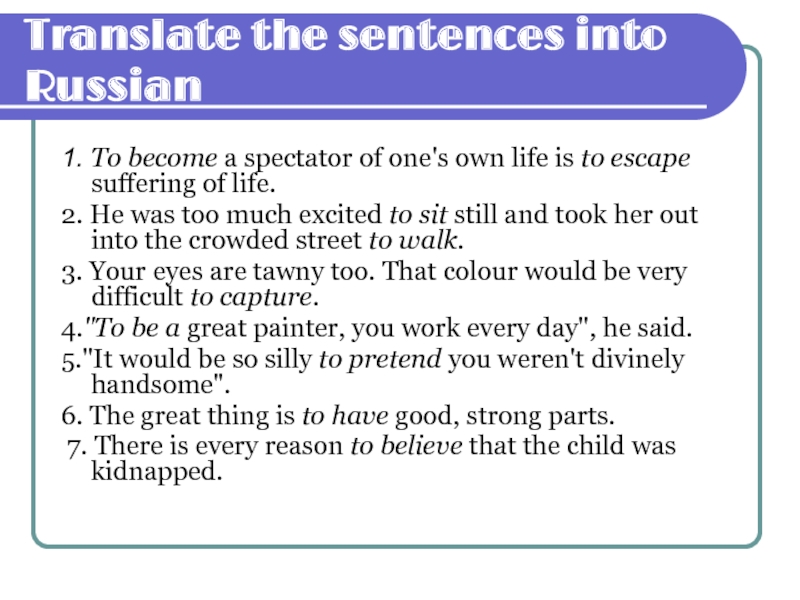
1. To become a spectator of one's
own life is to escape suffering of life.
2. He was too much excited to sit still and took her out into the crowded street to walk.
3. Your eyes are tawny too. That colour would be very difficult to capture.
4."To be a great painter, you work every day", he said.
5."It would be so silly to pretend you weren't divinely handsome".
6. The great thing is to have good, strong parts.
7. There is every reason to believe that the child was kidnapped.
2. He was too much excited to sit still and took her out into the crowded street to walk.
3. Your eyes are tawny too. That colour would be very difficult to capture.
4."To be a great painter, you work every day", he said.
5."It would be so silly to pretend you weren't divinely handsome".
6. The great thing is to have good, strong parts.
7. There is every reason to believe that the child was kidnapped.
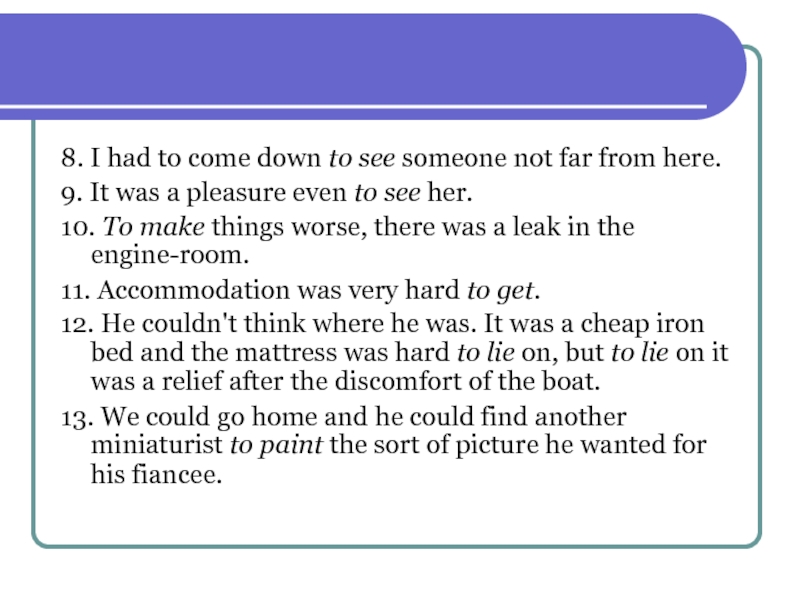
Слайд 138. I had to come down to see someone not far
from here.
9. It was a pleasure even to see her.
10. To make things worse, there was a leak in the engine-room.
11. Accommodation was very hard to get.
12. He couldn't think where he was. It was a cheap iron bed and the mattress was hard to lie on, but to lie on it was a relief after the discomfort of the boat.
13. We could go home and he could find another miniaturist to paint the sort of picture he wanted for his fiancee.
9. It was a pleasure even to see her.
10. To make things worse, there was a leak in the engine-room.
11. Accommodation was very hard to get.
12. He couldn't think where he was. It was a cheap iron bed and the mattress was hard to lie on, but to lie on it was a relief after the discomfort of the boat.
13. We could go home and he could find another miniaturist to paint the sort of picture he wanted for his fiancee.
Слайд 14Reword the sentences according to examples.
Example: She is very
weak now and she can't take her exams.
She is too weak now to take her exams.
Jane was very frightened. She couldn't even call.
The man is very cold. He cannot write any more.
He was very polite. He couldn't make any personal remarks put loud.
The young writer was very tired. He could not finish his play.
She is very happy. She can't think of anything else.
We have gone very far. We can't return to the camp.
He has done very much. He can't give up his experiments.
The man is very wicked. He won't make you a good husband.
The painter is very proud of his work. He won't stand any criticism.
She is too weak now to take her exams.
Jane was very frightened. She couldn't even call.
The man is very cold. He cannot write any more.
He was very polite. He couldn't make any personal remarks put loud.
The young writer was very tired. He could not finish his play.
She is very happy. She can't think of anything else.
We have gone very far. We can't return to the camp.
He has done very much. He can't give up his experiments.
The man is very wicked. He won't make you a good husband.
The painter is very proud of his work. He won't stand any criticism.
Слайд 16The Gerund
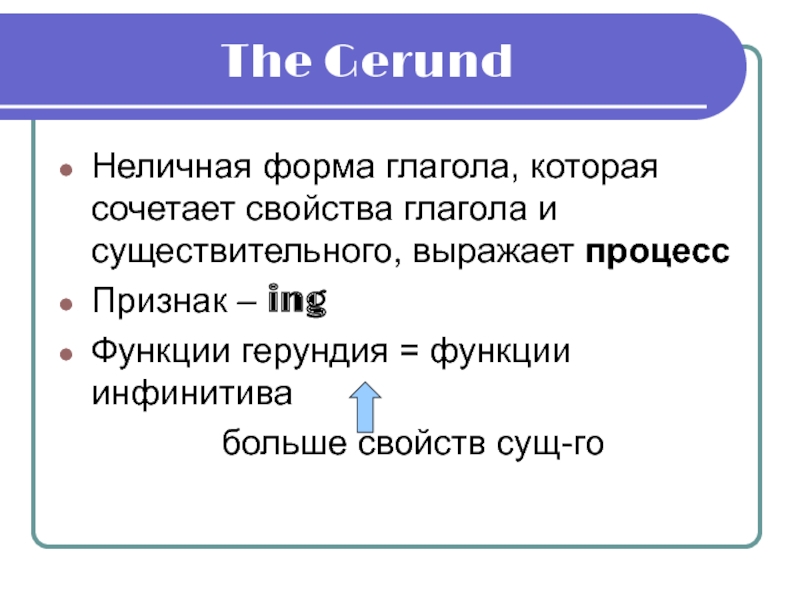
Неличная форма глагола, которая сочетает свойства глагола и существительного, выражает
процесс
Признак – ing
Функции герундия = функции инфинитива
больше свойств сущ-го
Признак – ing
Функции герундия = функции инфинитива
больше свойств сущ-го
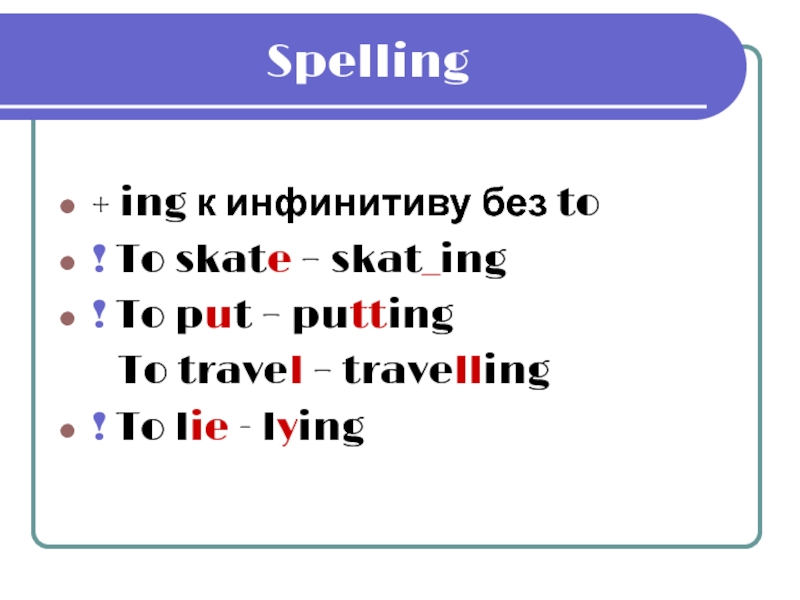
Слайд 17Spelling
+ ing к инфинитиву без to
! To skate – skat_ing
!
To put – putting
To travel – travelling
! To lie - lying
To travel – travelling
! To lie - lying
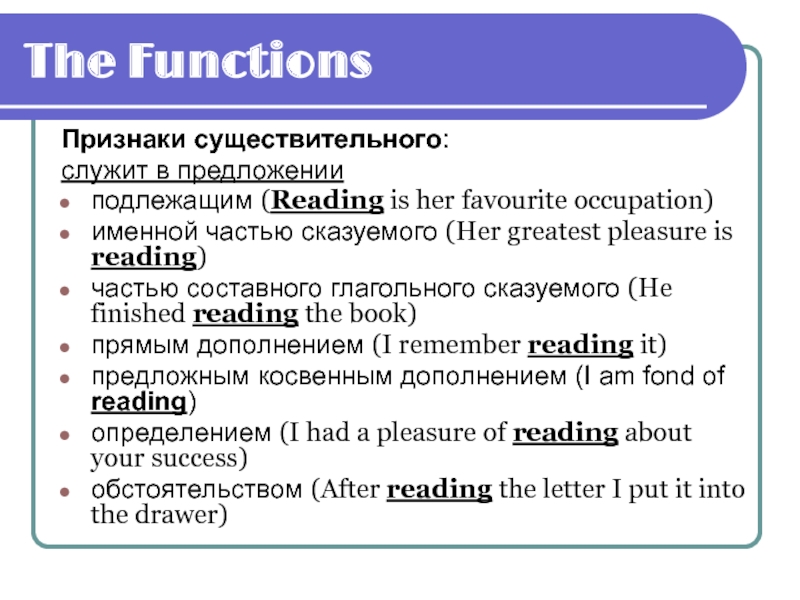
Слайд 18The Functions
Признаки существительного:
служит в предложении
подлежащим (Reading is her favourite occupation)
именной частью
сказуемого (Her greatest pleasure is reading)
частью составного глагольного сказуемого (He finished reading the book)
прямым дополнением (I remember reading it)
предложным косвенным дополнением (I am fond of reading)
определением (I had a pleasure of reading about your success)
обстоятельством (After reading the letter I put it into the drawer)
частью составного глагольного сказуемого (He finished reading the book)
прямым дополнением (I remember reading it)
предложным косвенным дополнением (I am fond of reading)
определением (I had a pleasure of reading about your success)
обстоятельством (After reading the letter I put it into the drawer)
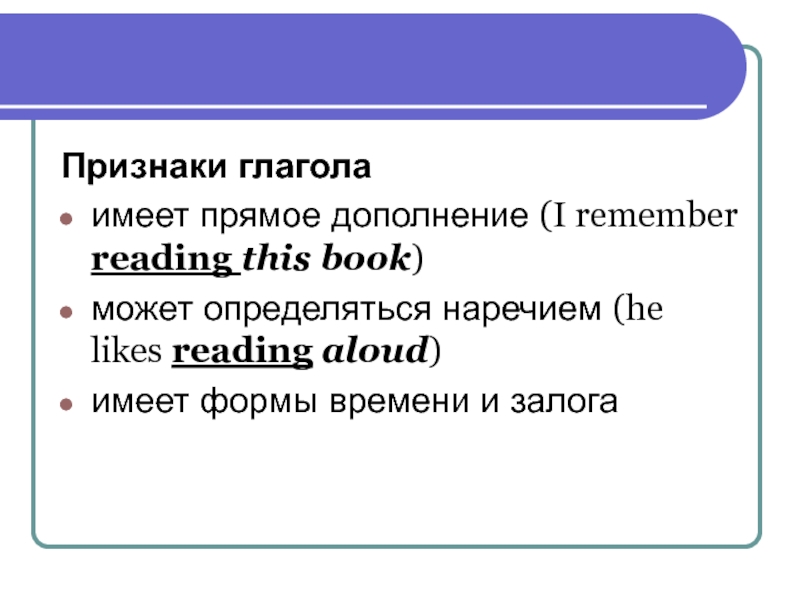
Слайд 19Признаки глагола
имеет прямое дополнение (I remember reading this book)
может определяться наречием
(he likes reading aloud)
имеет формы времени и залога
имеет формы времени и залога
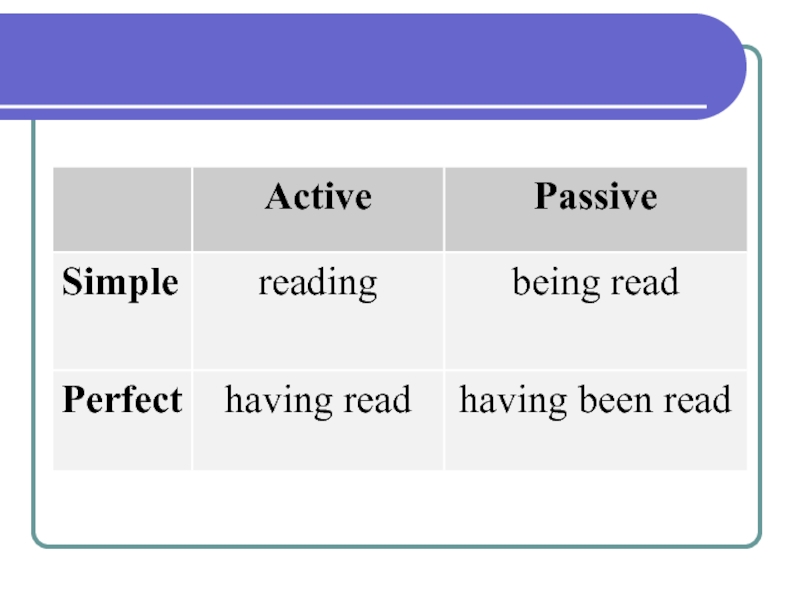
Слайд 21NB!
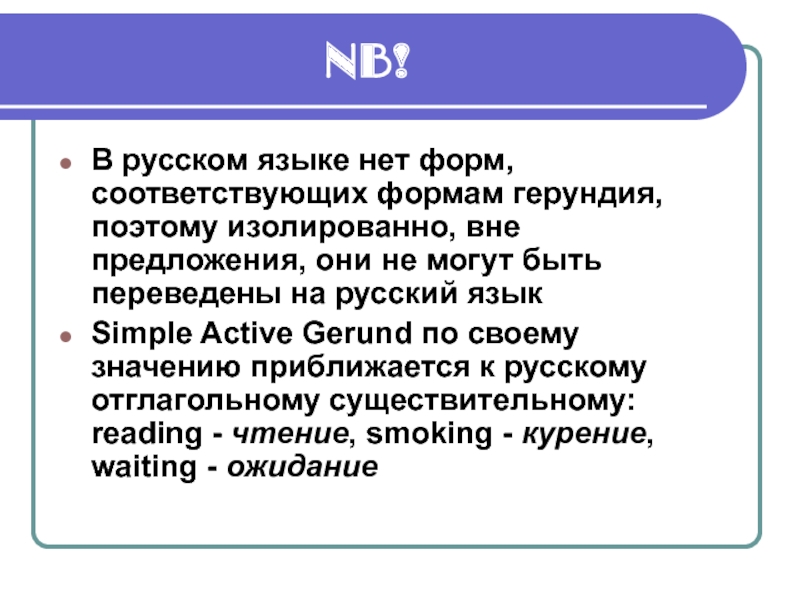
В русском языке нет форм, соответствующих формам герундия, поэтому изолированно, вне
предложения, они не могут быть переведены на русский язык
Simple Active Gerund по своему значению приближается к русскому отглагольному существительному: reading - чтение, smoking - курение, waiting - ожидание
Simple Active Gerund по своему значению приближается к русскому отглагольному существительному: reading - чтение, smoking - курение, waiting - ожидание
Слайд 22The Participle
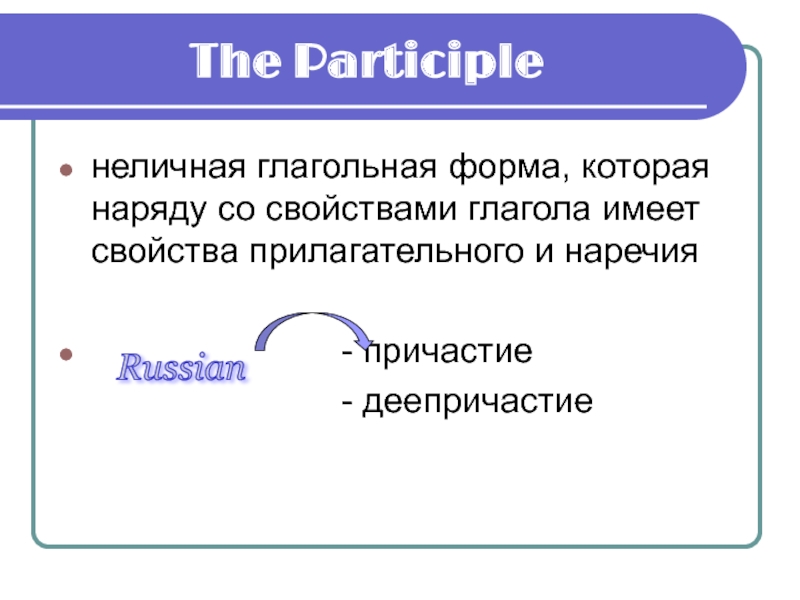
неличная глагольная форма, которая наряду со свойствами глагола имеет свойства
прилагательного и наречия
- причастие
- деепричастие
- причастие
- деепричастие
Russian
Слайд 23The Participle
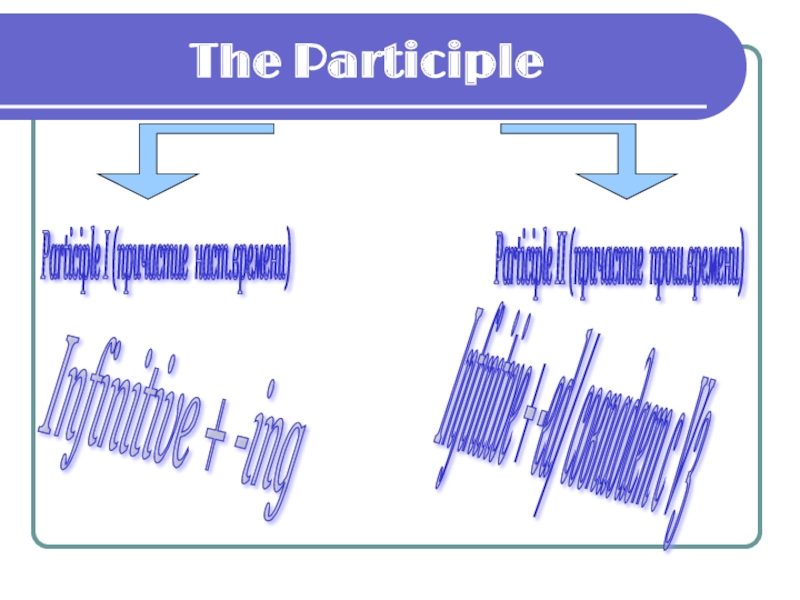
Participle I (причастие наст.времени)
Participle II (причастие прош.времени)
Infinitive +
-ing
Infinitive + -ed/ совпадает с V3
Слайд 24Spelling
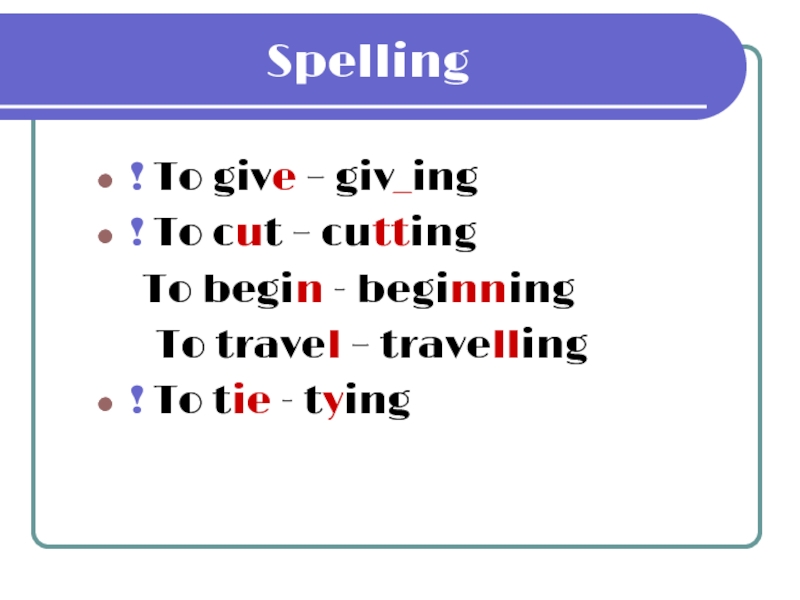
! To give – giv_ing
! To cut – cutting
To begin - beginning
To travel – travelling
! To tie - tying
To travel – travelling
! To tie - tying
Слайд 25The Functions
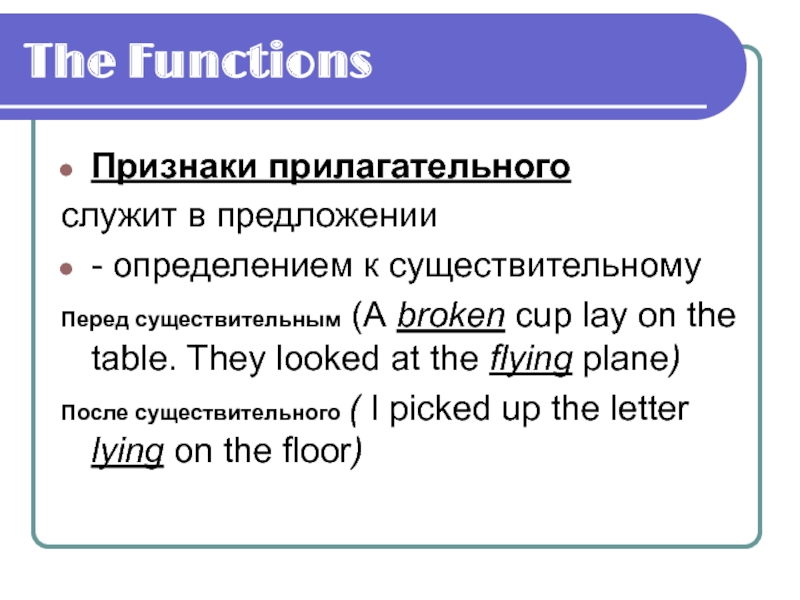
Признаки прилагательного
служит в предложении
- определением к существительному
Перед существительным (A
broken cup lay on the table. They looked at the flying plane)
После существительного ( I picked up the letter lying on the floor)
После существительного ( I picked up the letter lying on the floor)
Слайд 26Выполняет в предложении функцию обстоятельства
- времени (Arriving at the station
I phoned them)
-причины (Knowing English well he translated the article without a dictionary)
- образа действия (He sat in the armchair reading a newspaper.)
- сопутствующих обстоятельств (She was cleaning the room singing)
-причины (Knowing English well he translated the article without a dictionary)
- образа действия (He sat in the armchair reading a newspaper.)
- сопутствующих обстоятельств (She was cleaning the room singing)

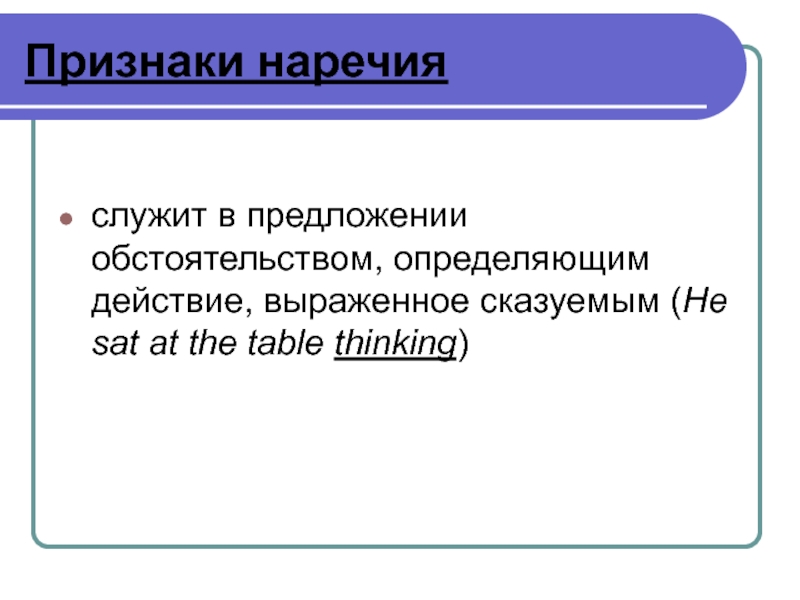
Слайд 27Признаки наречия
служит в предложении обстоятельством, определяющим действие, выраженное сказуемым (He sat
at the table thinking)
Слайд 28Признаки глагола
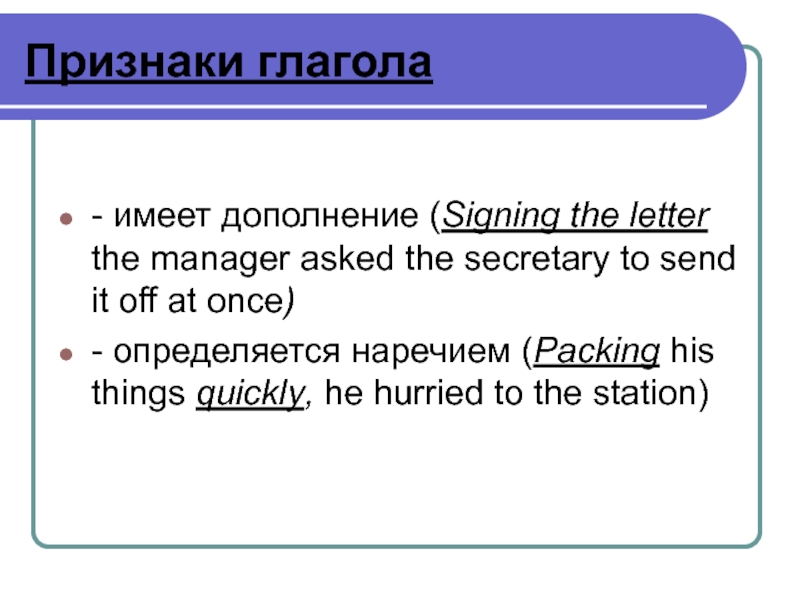
- имеет дополнение (Signing the letter the manager asked the
secretary to send it off at once)
- определяется наречием (Packing his things quickly, he hurried to the station)
- определяется наречием (Packing his things quickly, he hurried to the station)