Данная презентация разработана для УМК М.З.Биболетовой «Enjoy English» для 5 класса. Представляет грамматический материал по теме «Tag questions ». Также может использоваться как дидактический материал при работе с другими УМК.
- Главная
- Разное
- Образование
- Спорт
- Естествознание
- Природоведение
- Религиоведение
- Французский язык
- Черчение
- Английский язык
- Астрономия
- Алгебра
- Биология
- География
- Геометрия
- Детские презентации
- Информатика
- История
- Литература
- Математика
- Музыка
- МХК
- Немецкий язык
- ОБЖ
- Обществознание
- Окружающий мир
- Педагогика
- Русский язык
- Технология
- Физика
- Философия
- Химия
- Шаблоны, фоны, картинки для презентаций
- Экология
- Экономика
Презентация, доклад по английскому языку на темуTag questions (5 класс)
Содержание
- 1. Презентация по английскому языку на темуTag questions (5 класс)
- 2. RulesExamplesExercises
- 3. В английском языке существуют специальные окончания вопросов,
- 4. Подобные вопросы называются tag-questions (разделительные вопросы). Главное
- 5. Познакомьтесь с некоторыми правилами их употребления:Если в
- 6. Если в первой части предложения есть глаголы
- 7. На разделительные вопросы (tag-questions) следует отвечать так
- 8. Examples
- 9. They can ride a bike.They can ride
- 10. Exercises
- 11. I am reading.I am reading, aren’t I?2.
- 12. 6. We will drink tea. We will
- 13. 11. I have a book. I have
- 14. 16. You worked on Sundays. You worked
- 15. 21. I must do homework. I must
- 16. Match the questions and the answers: a) No,
- 17. Answer the following questions:You are in the
- 18. WELL DONE
RulesExamplesExercises
Слайд 1Tag questions
Яровая Оксана Станиславовна
учитель английского языка
МБОУ «СОШ №120»
г.
Казань, Республика Татарстан
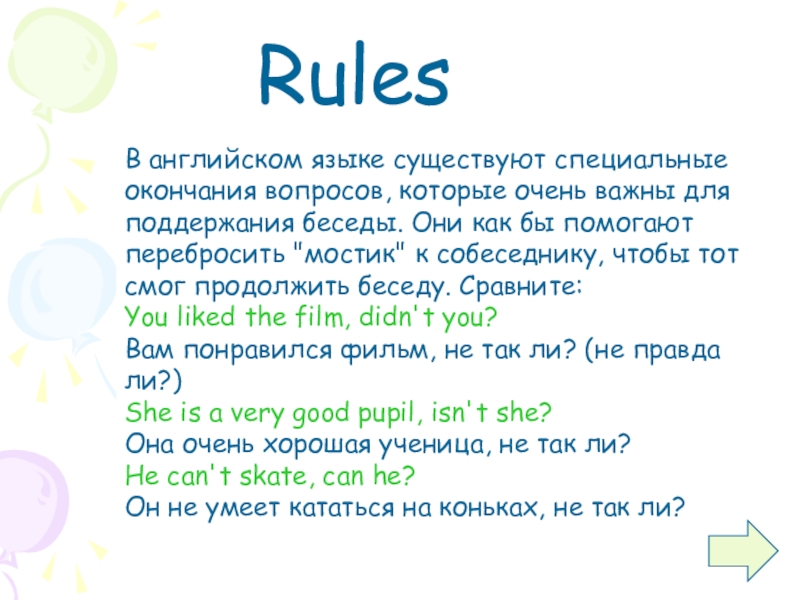
Слайд 3В английском языке существуют специальные окончания вопросов, которые очень важны для
поддержания беседы. Они как бы помогают перебросить "мостик" к собеседнику, чтобы тот смог продолжить беседу. Сравните:
You liked the film, didn't you?
Вам понравился фильм, не так ли? (не правда ли?)
She is a very good pupil, isn't she?
Она очень хорошая ученица, не так ли?
He can't skate, can he?
Он не умеет кататься на коньках, не так ли?
You liked the film, didn't you?
Вам понравился фильм, не так ли? (не правда ли?)
She is a very good pupil, isn't she?
Она очень хорошая ученица, не так ли?
He can't skate, can he?
Он не умеет кататься на коньках, не так ли?
Rules
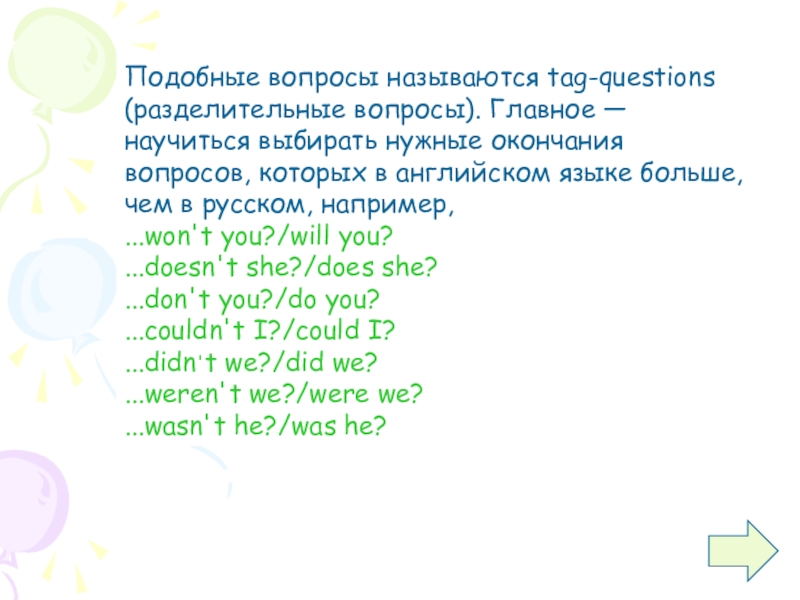
Слайд 4Подобные вопросы называются tag-questions (разделительные вопросы). Главное — научиться выбирать нужные
окончания вопросов, которых в английском языке больше, чем в русском, например,
...won't you?/will you?
...doesn't she?/does she?
...don't you?/do you?
...couldn't I?/could I?
...didn't we?/did we?
...weren't we?/were we?
...wasn't he?/was he?
...won't you?/will you?
...doesn't she?/does she?
...don't you?/do you?
...couldn't I?/could I?
...didn't we?/did we?
...weren't we?/were we?
...wasn't he?/was he?
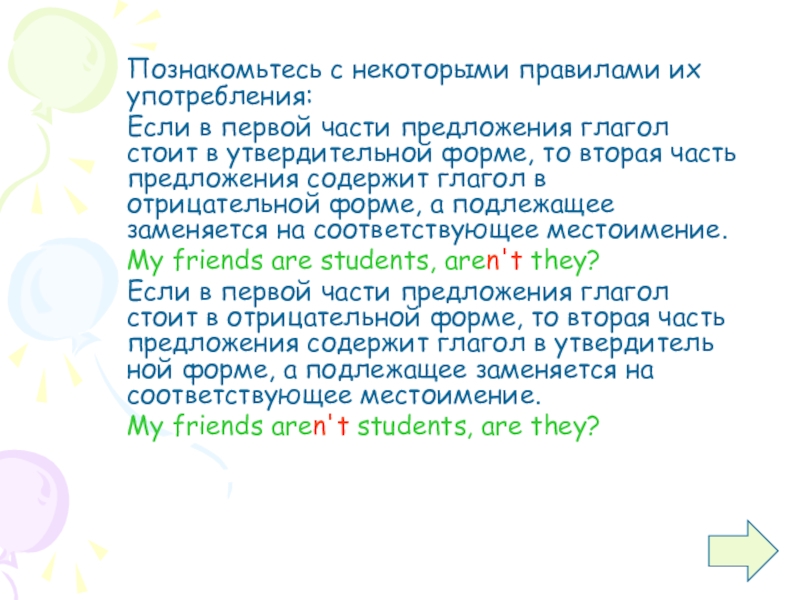
Слайд 5Познакомьтесь с некоторыми правилами их употребления:
Если в первой части предложения глагол
стоит в утвердительной форме, то вторая часть предложения содержит глагол в отрицательной форме, а подлежащее заменяется на соответствующее местоимение.
My friends are students, aren't they?
Если в первой части предложения глагол стоит в отрицательной форме, то вторая часть предложения содержит глагол в утвердительной форме, а подлежащее заменяется на соответствующее местоимение.
My friends aren't students, are they?
My friends are students, aren't they?
Если в первой части предложения глагол стоит в отрицательной форме, то вторая часть предложения содержит глагол в утвердительной форме, а подлежащее заменяется на соответствующее местоимение.
My friends aren't students, are they?
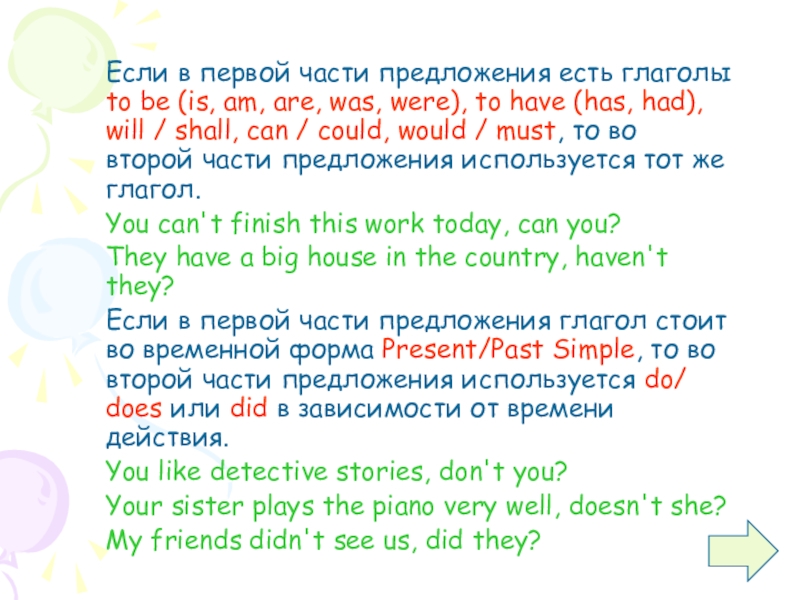
Слайд 6Если в первой части предложения есть глаголы to be (is, am,
are, was, were), to have (has, had), will / shall, can / could, would / must, то во второй части предложения используется тот же глагол.
You can't finish this work today, can you?
They have a big house in the country, haven't they?
Если в первой части предложения глагол стоит во временной форма Present/Past Simple, то во второй части предложения используется do/ does или did в зависимости от времени действия.
You like detective stories, don't you?
Your sister plays the piano very well, doesn't she?
My friends didn't see us, did they?
You can't finish this work today, can you?
They have a big house in the country, haven't they?
Если в первой части предложения глагол стоит во временной форма Present/Past Simple, то во второй части предложения используется do/ does или did в зависимости от времени действия.
You like detective stories, don't you?
Your sister plays the piano very well, doesn't she?
My friends didn't see us, did they?
Слайд 7На разделительные вопросы (tag-questions) следует отвечать так же, как и на
любой общий вопрос, требующий ответ "Да" или "Нет":
She was in England a year ago, wasn't she? — Yes, she was. / No, she wasn't.
You don't go to music school on Saturdays, do you? — No, I don't. / Yes, I do.
She was in England a year ago, wasn't she? — Yes, she was. / No, she wasn't.
You don't go to music school on Saturdays, do you? — No, I don't. / Yes, I do.
Слайд 9They can ride a bike.
They can ride a bike, can not
they?
We are not playing football.
We are not playing football, are we?.
They like chocolate.
They like chocolate, do not they?
He speaks French well.
He speaks French well, does not he?.
You listened to music yesterday.
You listened to music yesterday, did not you?
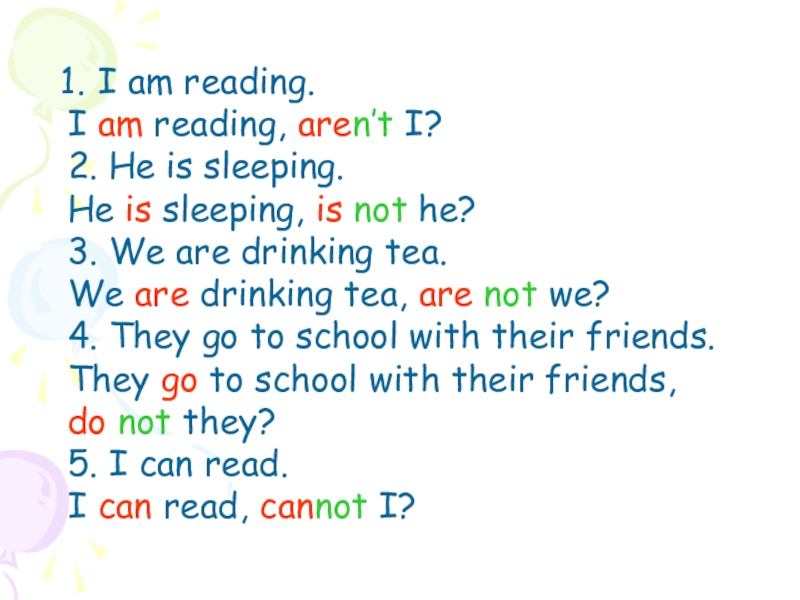
Слайд 11I am reading.
I am reading, aren’t I?
2. He is sleeping.
He
is sleeping, is not he?
3. We are drinking tea.
We are drinking tea, are not we?
4. They go to school with their friends.
They go to school with their friends,
do not they?
5. I can read.
I can read, cannot I?
3. We are drinking tea.
We are drinking tea, are not we?
4. They go to school with their friends.
They go to school with their friends,
do not they?
5. I can read.
I can read, cannot I?
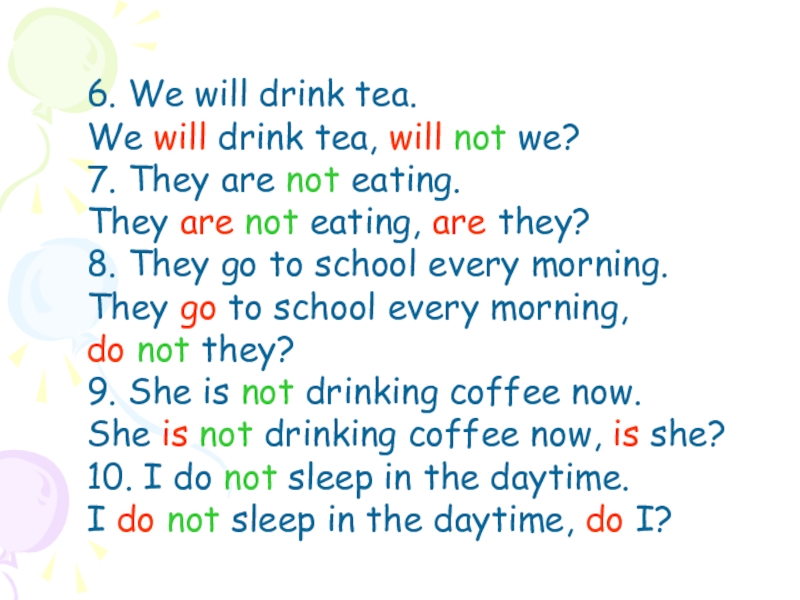
Слайд 126. We will drink tea.
We will drink tea, will not
we?
7. They are not eating.
They are not eating, are they?
8. They go to school every morning.
They go to school every morning,
do not they?
9. She is not drinking coffee now.
She is not drinking coffee now, is she?
10. I do not sleep in the daytime.
I do not sleep in the daytime, do I?
7. They are not eating.
They are not eating, are they?
8. They go to school every morning.
They go to school every morning,
do not they?
9. She is not drinking coffee now.
She is not drinking coffee now, is she?
10. I do not sleep in the daytime.
I do not sleep in the daytime, do I?
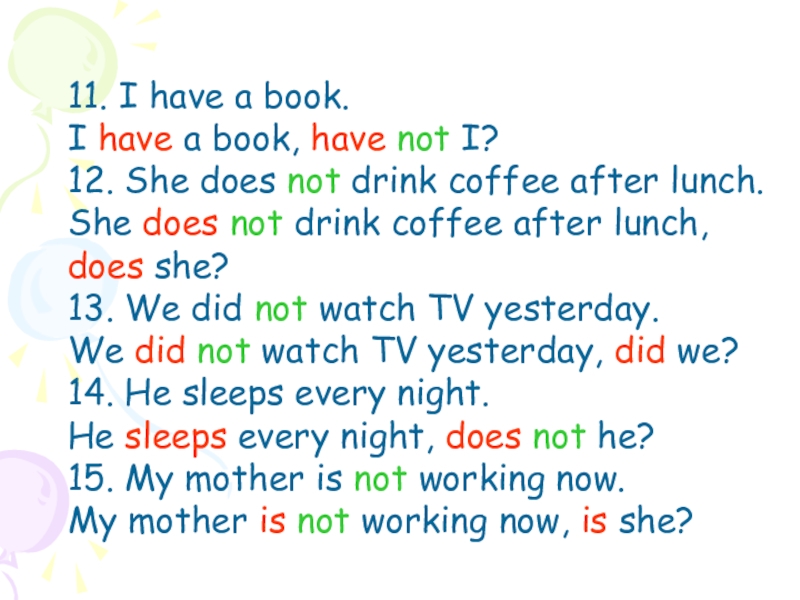
Слайд 1311. I have a book.
I have a book, have not
I?
12. She does not drink coffee after lunch.
She does not drink coffee after lunch,
does she?
13. We did not watch TV yesterday.
We did not watch TV yesterday, did we?
14. He sleeps every night.
He sleeps every night, does not he?
15. My mother is not working now.
My mother is not working now, is she?
12. She does not drink coffee after lunch.
She does not drink coffee after lunch,
does she?
13. We did not watch TV yesterday.
We did not watch TV yesterday, did we?
14. He sleeps every night.
He sleeps every night, does not he?
15. My mother is not working now.
My mother is not working now, is she?
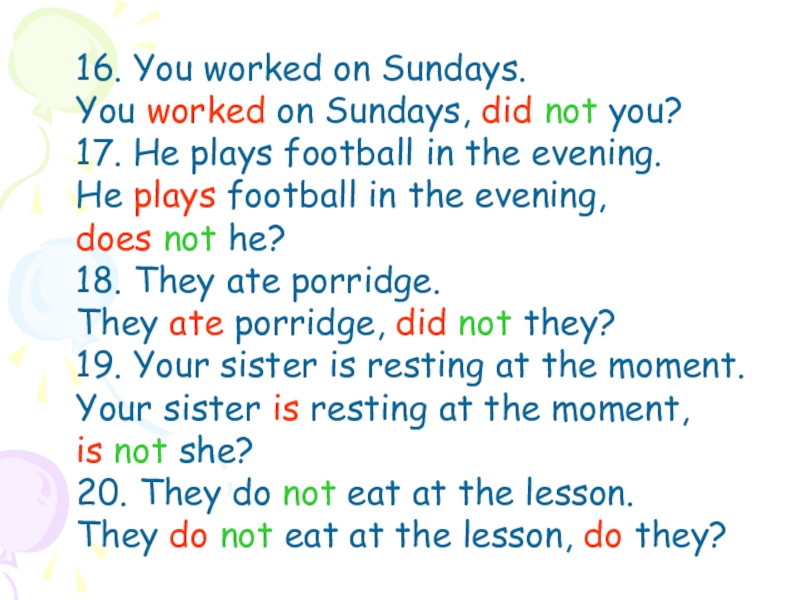
Слайд 1416. You worked on Sundays.
You worked on Sundays, did not
you?
17. He plays football in the evening.
He plays football in the evening,
does not he?
18. They ate porridge.
They ate porridge, did not they?
19. Your sister is resting at the moment.
Your sister is resting at the moment,
is not she?
20. They do not eat at the lesson.
They do not eat at the lesson, do they?
17. He plays football in the evening.
He plays football in the evening,
does not he?
18. They ate porridge.
They ate porridge, did not they?
19. Your sister is resting at the moment.
Your sister is resting at the moment,
is not she?
20. They do not eat at the lesson.
They do not eat at the lesson, do they?
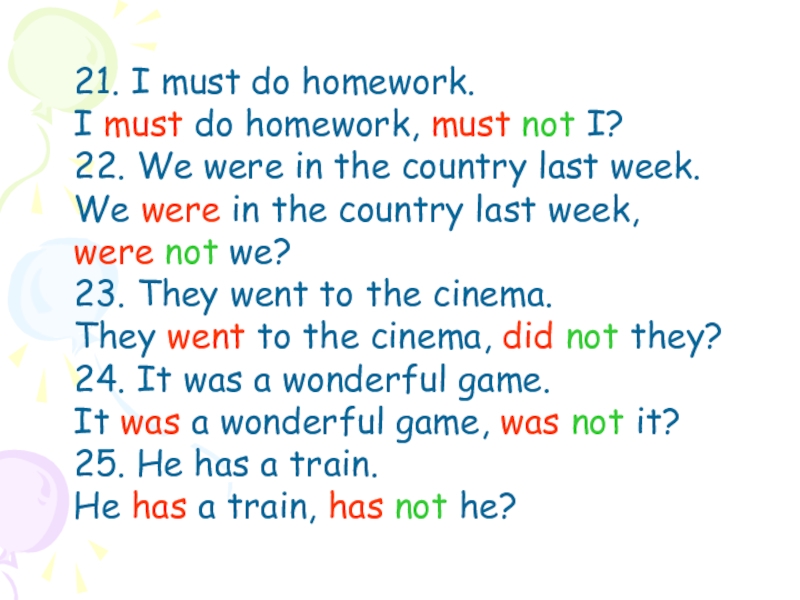
Слайд 1521. I must do homework.
I must do homework, must not
I?
22. We were in the country last week.
We were in the country last week,
were not we?
23. They went to the cinema.
They went to the cinema, did not they?
24. It was a wonderful game.
It was a wonderful game, was not it?
25. He has a train.
He has a train, has not he?
22. We were in the country last week.
We were in the country last week,
were not we?
23. They went to the cinema.
They went to the cinema, did not they?
24. It was a wonderful game.
It was a wonderful game, was not it?
25. He has a train.
He has a train, has not he?
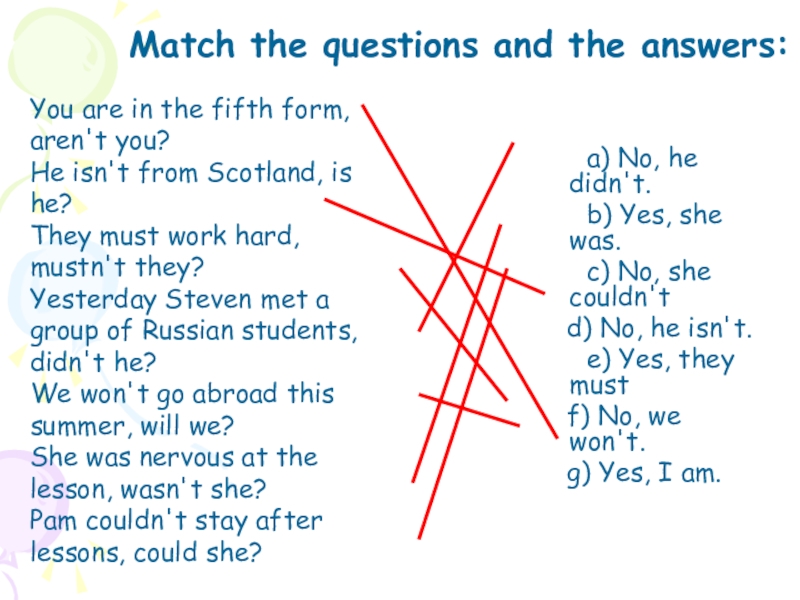
Слайд 16Match the questions and the answers:
a) No, he didn't.
b) Yes, she
was.
c) No, she couldn't
d) No, he isn't.
e) Yes, they must
f) No, we won't.
g) Yes, I am.
c) No, she couldn't
d) No, he isn't.
e) Yes, they must
f) No, we won't.
g) Yes, I am.
You are in the fifth form, aren't you?
He isn't from Scotland, is he?
They must work hard, mustn't they?
Yesterday Steven met a group of Russian students, didn't he?
We won't go abroad this summer, will we?
She was nervous at the lesson, wasn't she?
Pam couldn't stay after lessons, could she?
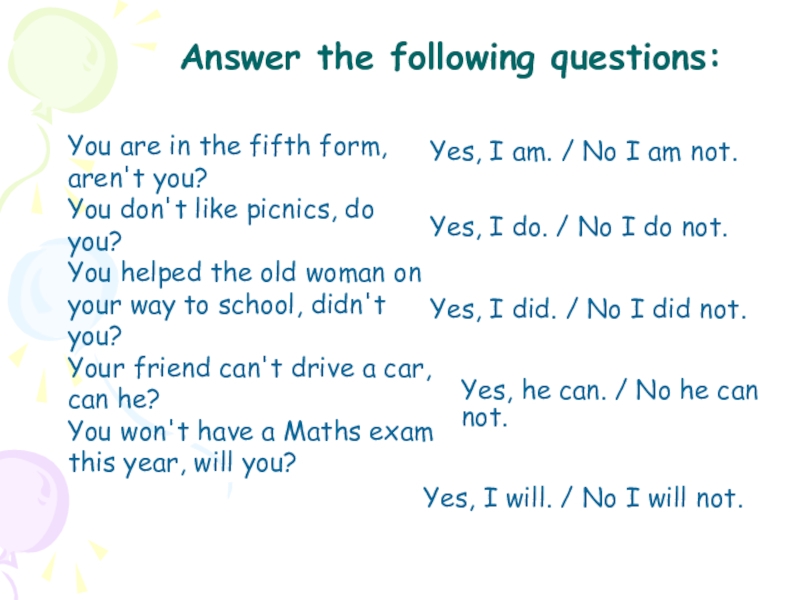
Слайд 17Answer the following questions:
You are in the fifth form, aren't you?
You
don't like picnics, do you?
You helped the old woman on your way to school, didn't you?
Your friend can't drive a car, can he?
You won't have a Maths exam this year, will you?
You helped the old woman on your way to school, didn't you?
Your friend can't drive a car, can he?
You won't have a Maths exam this year, will you?
Yes, I am. / No I am not.
Yes, I do. / No I do not.
Yes, I did. / No I did not.
Yes, he can. / No he can not.
Yes, I will. / No I will not.