- Главная
- Разное
- Образование
- Спорт
- Естествознание
- Природоведение
- Религиоведение
- Французский язык
- Черчение
- Английский язык
- Астрономия
- Алгебра
- Биология
- География
- Геометрия
- Детские презентации
- Информатика
- История
- Литература
- Математика
- Музыка
- МХК
- Немецкий язык
- ОБЖ
- Обществознание
- Окружающий мир
- Педагогика
- Русский язык
- Технология
- Физика
- Философия
- Химия
- Шаблоны, фоны, картинки для презентаций
- Экология
- Экономика
Презентация, доклад по английскому языку на темуRussia from A to Z ( 9 класс)
Содержание
- 1. Презентация по английскому языку на темуRussia from A to Z ( 9 класс)
- 2. “A”Aivazovsky Ivan 17 (30) July 1817 -
- 3. “B”Bulgakov Mikhail was born on May 15,
- 4. “C”Chekhov Anton Pavlovich (1860-1904), Russian writer, honorary
- 5. “D” Dostoevsky Fyodor Mikhailovich (1821 - 1881)
- 6. “E” Elizaveta Petrovna - Russian empressThe
- 7. “F”Fadeev A.A.The works on the Revolution and
- 8. “G”Griboyedov Aleksander was a Russian diplomat, playwright,
- 9. “H”The State Hermitage is a museum of
- 10. “I”Isaakievskiy Sobor or Saint Isaac's Cathedral in Russiais
- 11. “K”Kremlin. The Moscow Kremlin is a historic
- 12. “L”Lomonosov Mikhail Vasilyevich was a polymath, scientist and writer, who
- 13. “M”Moscow is the capital, the most populous city, and
- 14. “N”Novosibirsk - the third most populous city
- 15. “O”Orenburg shawlsThe people there are legends about
- 16. “P”Pancake rites in RussiaPerhaps the most fun
- 17. “R”Romanov Mikhail. The first Russian-king (1613 -
- 18. “S”Saint Petersburg was founded by Peter the Great.
- 19. “T”Tchaikovsky Pyotr Ilyich was a Russian composer
- 20. “U”Ural MountainsThe Urals stretch 2,500 km from
- 21. “V”Vysotsky Vladimir, (1938-1980) Russian poet and actorHe
- 22. “Y”Yekaterinburgthe city was founded in 1723 by
- 23. “Z”Zoo. The Moscow Zoo was founded in
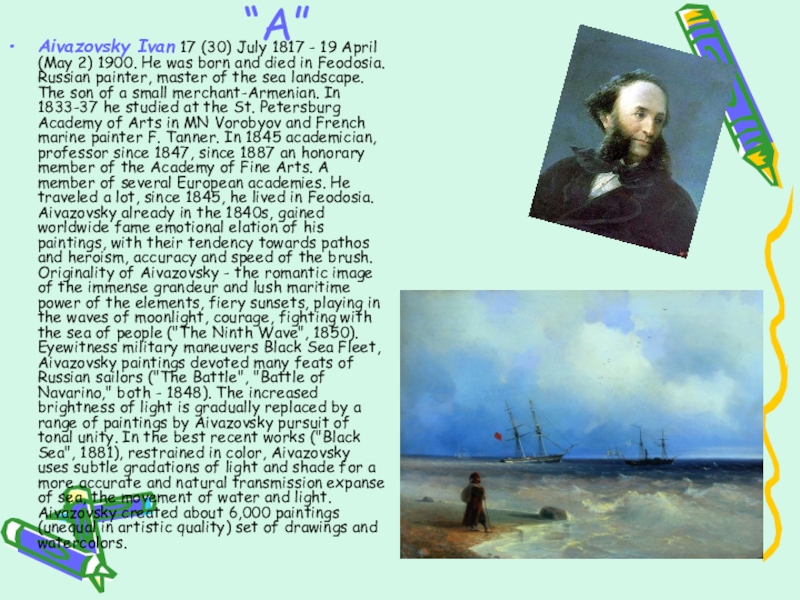
“A”Aivazovsky Ivan 17 (30) July 1817 - 19 April (May 2) 1900. He was born and died in Feodosia. Russian painter, master of the sea landscape. The son of a small merchant-Armenian. In 1833-37 he studied
Слайд 2“A”
Aivazovsky Ivan 17 (30) July 1817 - 19 April (May 2)
1900. He was born and died in Feodosia. Russian painter, master of the sea landscape. The son of a small merchant-Armenian. In 1833-37 he studied at the St. Petersburg Academy of Arts in MN Vorobyov and French marine painter F. Tanner. In 1845 academician, professor since 1847, since 1887 an honorary member of the Academy of Fine Arts. A member of several European academies. He traveled a lot, since 1845, he lived in Feodosia. Aivazovsky already in the 1840s, gained worldwide fame emotional elation of his paintings, with their tendency towards pathos and heroism, accuracy and speed of the brush. Originality of Aivazovsky - the romantic image of the immense grandeur and lush maritime power of the elements, fiery sunsets, playing in the waves of moonlight, courage, fighting with the sea of people ("The Ninth Wave", 1850). Eyewitness military maneuvers Black Sea Fleet, Aivazovsky paintings devoted many feats of Russian sailors ("The Battle", "Battle of Navarino," both - 1848). The increased brightness of light is gradually replaced by a range of paintings by Aivazovsky pursuit of tonal unity. In the best recent works ("Black Sea", 1881), restrained in color, Aivazovsky uses subtle gradations of light and shade for a more accurate and natural transmission expanse of sea, the movement of water and light. Aivazovsky created about 6,000 paintings (unequal in artistic quality) set of drawings and watercolors.
Слайд 3“B”
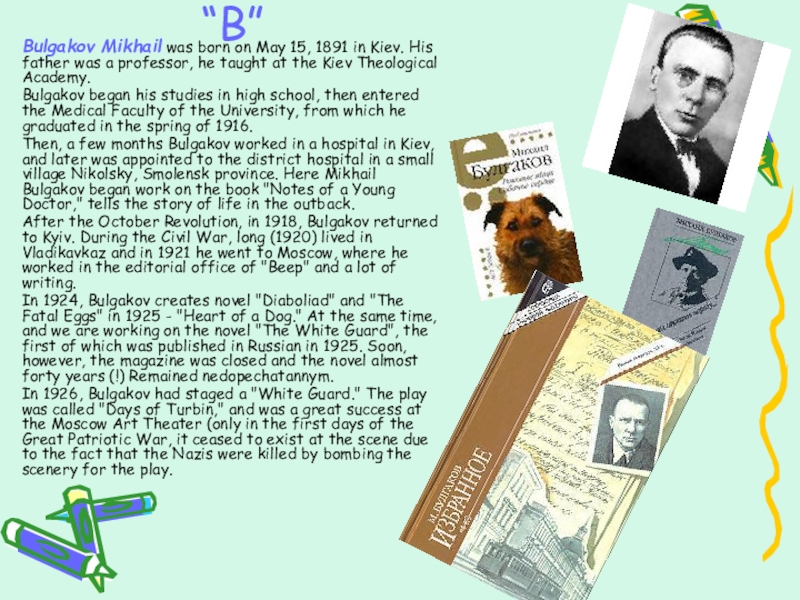
Bulgakov Mikhail was born on May 15, 1891 in Kiev. His
father was a professor, he taught at the Kiev Theological Academy.
Bulgakov began his studies in high school, then entered the Medical Faculty of the University, from which he graduated in the spring of 1916.
Then, a few months Bulgakov worked in a hospital in Kiev, and later was appointed to the district hospital in a small village Nikolsky, Smolensk province. Here Mikhail Bulgakov began work on the book "Notes of a Young Doctor," tells the story of life in the outback.
After the October Revolution, in 1918, Bulgakov returned to Kyiv. During the Civil War, long (1920) lived in Vladikavkaz and in 1921 he went to Moscow, where he worked in the editorial office of "Beep" and a lot of writing.
In 1924, Bulgakov creates novel "Diaboliad" and "The Fatal Eggs" in 1925 - "Heart of a Dog." At the same time, and we are working on the novel "The White Guard", the first of which was published in Russian in 1925. Soon, however, the magazine was closed and the novel almost forty years (!) Remained nedopechatannym.
In 1926, Bulgakov had staged a "White Guard." The play was called "Days of Turbin," and was a great success at the Moscow Art Theater (only in the first days of the Great Patriotic War, it ceased to exist at the scene due to the fact that the Nazis were killed by bombing the scenery for the play.
Bulgakov began his studies in high school, then entered the Medical Faculty of the University, from which he graduated in the spring of 1916.
Then, a few months Bulgakov worked in a hospital in Kiev, and later was appointed to the district hospital in a small village Nikolsky, Smolensk province. Here Mikhail Bulgakov began work on the book "Notes of a Young Doctor," tells the story of life in the outback.
After the October Revolution, in 1918, Bulgakov returned to Kyiv. During the Civil War, long (1920) lived in Vladikavkaz and in 1921 he went to Moscow, where he worked in the editorial office of "Beep" and a lot of writing.
In 1924, Bulgakov creates novel "Diaboliad" and "The Fatal Eggs" in 1925 - "Heart of a Dog." At the same time, and we are working on the novel "The White Guard", the first of which was published in Russian in 1925. Soon, however, the magazine was closed and the novel almost forty years (!) Remained nedopechatannym.
In 1926, Bulgakov had staged a "White Guard." The play was called "Days of Turbin," and was a great success at the Moscow Art Theater (only in the first days of the Great Patriotic War, it ceased to exist at the scene due to the fact that the Nazis were killed by bombing the scenery for the play.
Слайд 4“C”
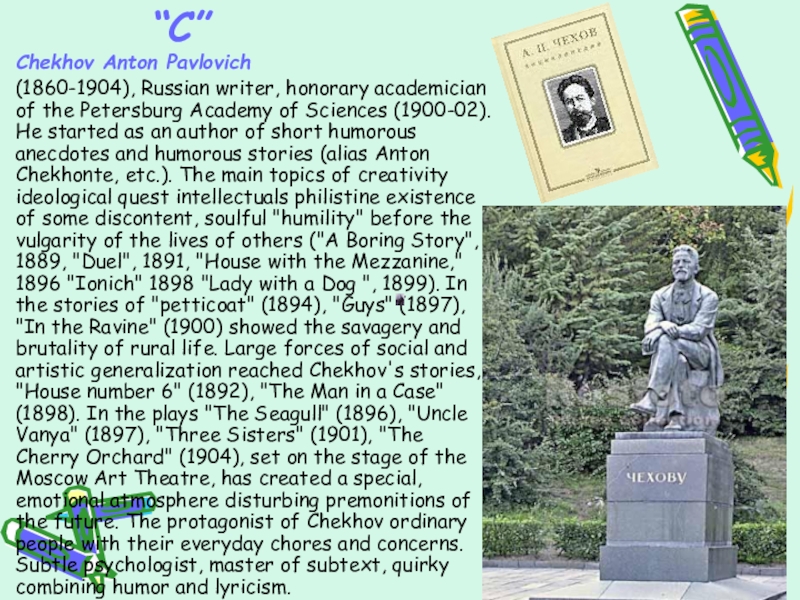
Chekhov Anton Pavlovich
(1860-1904), Russian writer, honorary academician of the Petersburg
Academy of Sciences (1900-02). He started as an author of short humorous anecdotes and humorous stories (alias Anton Chekhonte, etc.). The main topics of creativity ideological quest intellectuals philistine existence of some discontent, soulful "humility" before the vulgarity of the lives of others ("A Boring Story", 1889, "Duel", 1891, "House with the Mezzanine," 1896 "Ionich" 1898 "Lady with a Dog ", 1899). In the stories of "petticoat" (1894), "Guys" (1897), "In the Ravine" (1900) showed the savagery and brutality of rural life. Large forces of social and artistic generalization reached Chekhov's stories, "House number 6" (1892), "The Man in a Case" (1898). In the plays "The Seagull" (1896), "Uncle Vanya" (1897), "Three Sisters" (1901), "The Cherry Orchard" (1904), set on the stage of the Moscow Art Theatre, has created a special, emotional atmosphere disturbing premonitions of the future. The protagonist of Chekhov ordinary people with their everyday chores and concerns. Subtle psychologist, master of subtext, quirky combining humor and lyricism.
Слайд 5“D”
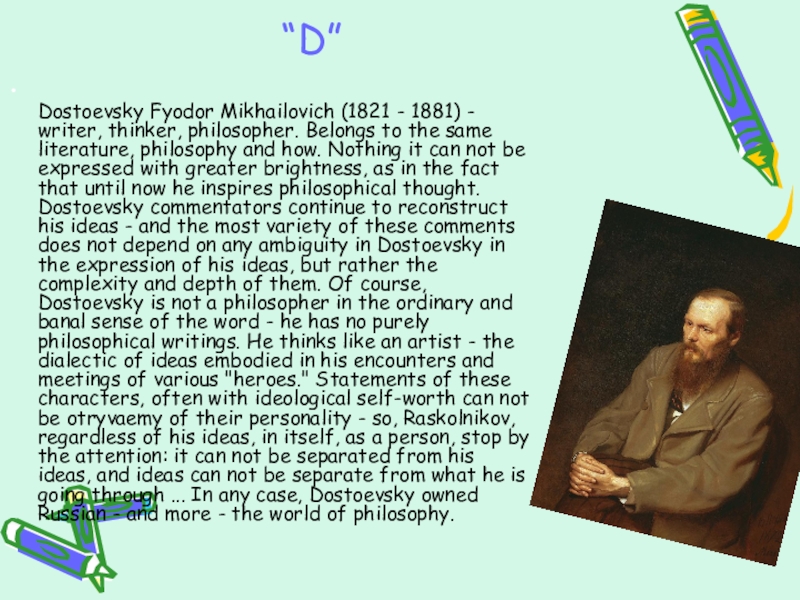
Dostoevsky Fyodor Mikhailovich (1821 - 1881) - writer, thinker, philosopher. Belongs
to the same literature, philosophy and how. Nothing it can not be expressed with greater brightness, as in the fact that until now he inspires philosophical thought. Dostoevsky commentators continue to reconstruct his ideas - and the most variety of these comments does not depend on any ambiguity in Dostoevsky in the expression of his ideas, but rather the complexity and depth of them. Of course, Dostoevsky is not a philosopher in the ordinary and banal sense of the word - he has no purely philosophical writings. He thinks like an artist - the dialectic of ideas embodied in his encounters and meetings of various "heroes." Statements of these characters, often with ideological self-worth can not be otryvaemy of their personality - so, Raskolnikov, regardless of his ideas, in itself, as a person, stop by the attention: it can not be separated from his ideas, and ideas can not be separate from what he is going through ... In any case, Dostoevsky owned Russian - and more - the world of philosophy.
Слайд 6“E”
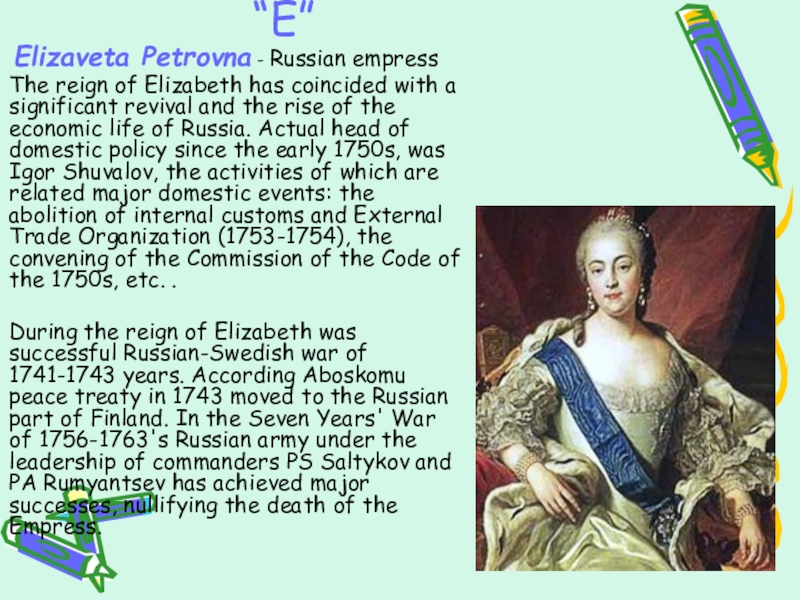
Elizaveta Petrovna - Russian empress
The reign of Elizabeth has
coincided with a significant revival and the rise of the economic life of Russia. Actual head of domestic policy since the early 1750s, was Igor Shuvalov, the activities of which are related major domestic events: the abolition of internal customs and External Trade Organization (1753-1754), the convening of the Commission of the Code of the 1750s, etc. .
During the reign of Elizabeth was successful Russian-Swedish war of 1741-1743 years. According Aboskomu peace treaty in 1743 moved to the Russian part of Finland. In the Seven Years' War of 1756-1763's Russian army under the leadership of commanders PS Saltykov and PA Rumyantsev has achieved major successes, nullifying the death of the Empress.
During the reign of Elizabeth was successful Russian-Swedish war of 1741-1743 years. According Aboskomu peace treaty in 1743 moved to the Russian part of Finland. In the Seven Years' War of 1756-1763's Russian army under the leadership of commanders PS Saltykov and PA Rumyantsev has achieved major successes, nullifying the death of the Empress.
Слайд 7“F”
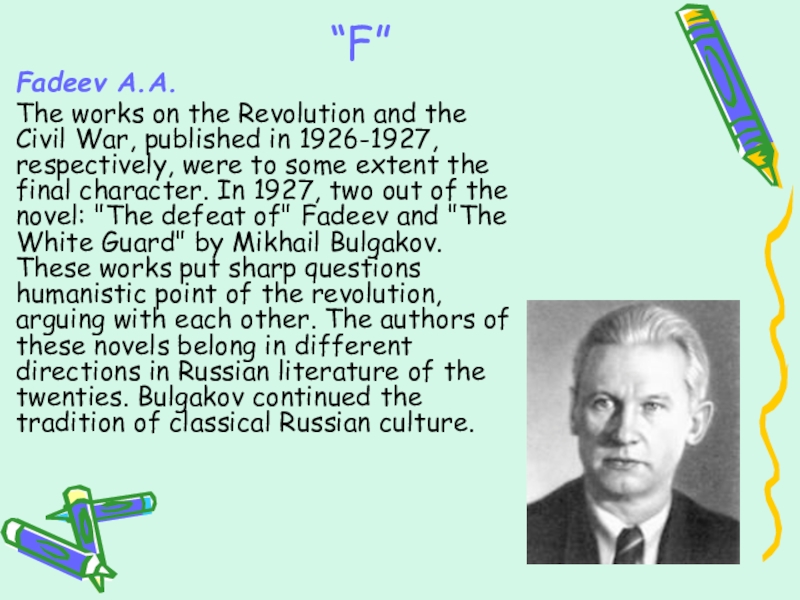
Fadeev A.A.
The works on the Revolution and the Civil War, published
in 1926-1927, respectively, were to some extent the final character. In 1927, two out of the novel: "The defeat of" Fadeev and "The White Guard" by Mikhail Bulgakov. These works put sharp questions humanistic point of the revolution, arguing with each other. The authors of these novels belong in different directions in Russian literature of the twenties. Bulgakov continued the tradition of classical Russian culture.
Слайд 8“G”
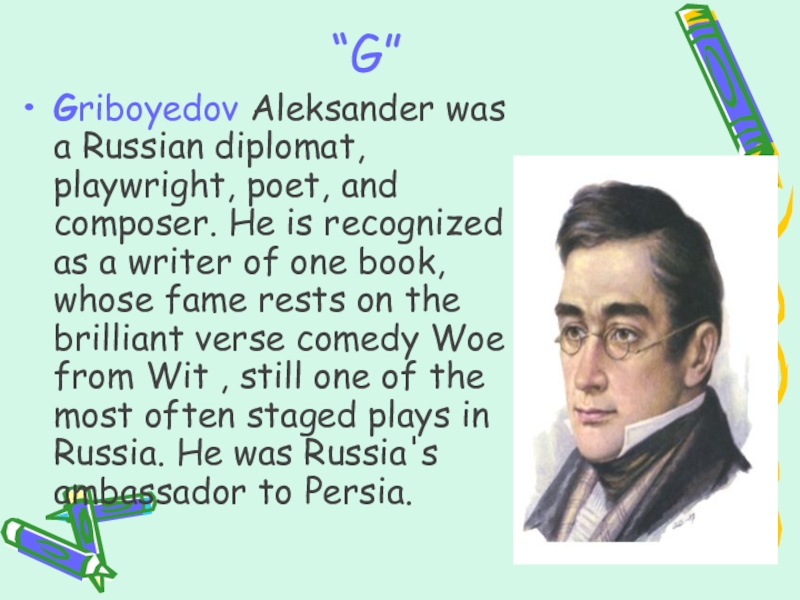
Griboyedov Aleksander was a Russian diplomat, playwright, poet, and composer. He
is recognized as a writer of one book, whose fame rests on the brilliant verse comedy Woe from Wit , still one of the most often staged plays in Russia. He was Russia's ambassador to Persia.
Слайд 9“H”
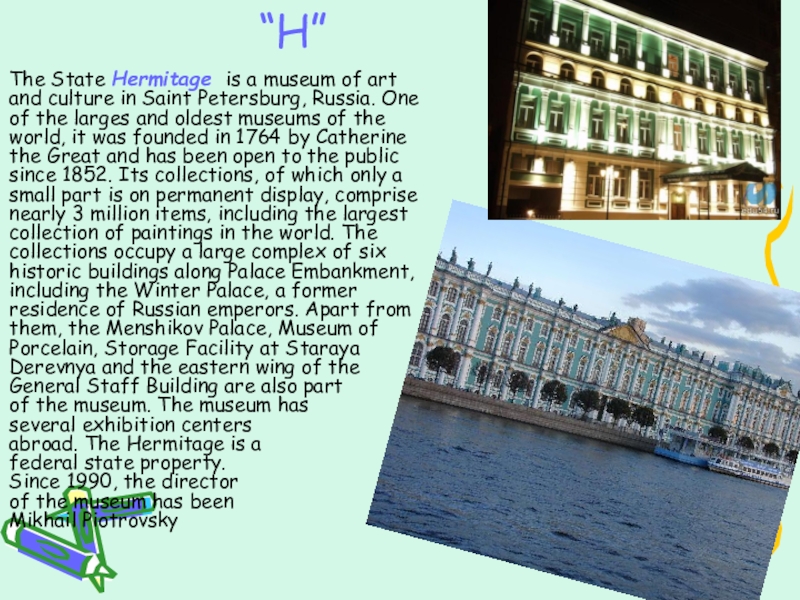
The State Hermitage is a museum of art and culture in
Saint Petersburg, Russia. One of the larges and oldest museums of the world, it was founded in 1764 by Catherine the Great and has been open to the public since 1852. Its collections, of which only a small part is on permanent display, comprise nearly 3 million items, including the largest collection of paintings in the world. The collections occupy a large complex of six historic buildings along Palace Embankment, including the Winter Palace, a former residence of Russian emperors. Apart from them, the Menshikov Palace, Museum of Porcelain, Storage Facility at Staraya Derevnya and the eastern wing of the General Staff Building are also part of the museum. The museum has several exhibition centers abroad. The Hermitage is a federal state property. Since 1990, the director of the museum has been Mikhail Piotrovsky
Слайд 10“I”
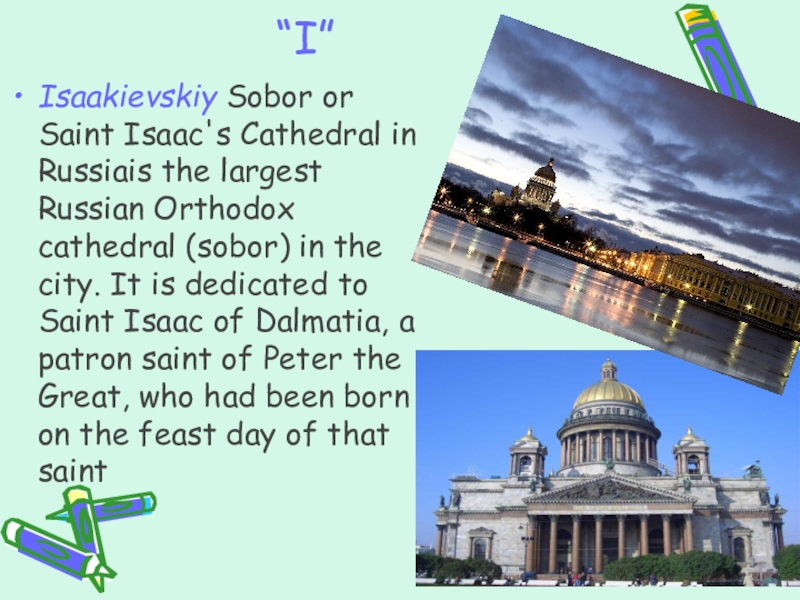
Isaakievskiy Sobor or Saint Isaac's Cathedral in Russiais the largest Russian Orthodox
cathedral (sobor) in the city. It is dedicated to Saint Isaac of Dalmatia, a patron saint of Peter the Great, who had been born on the feast day of that saint
Слайд 11“K”
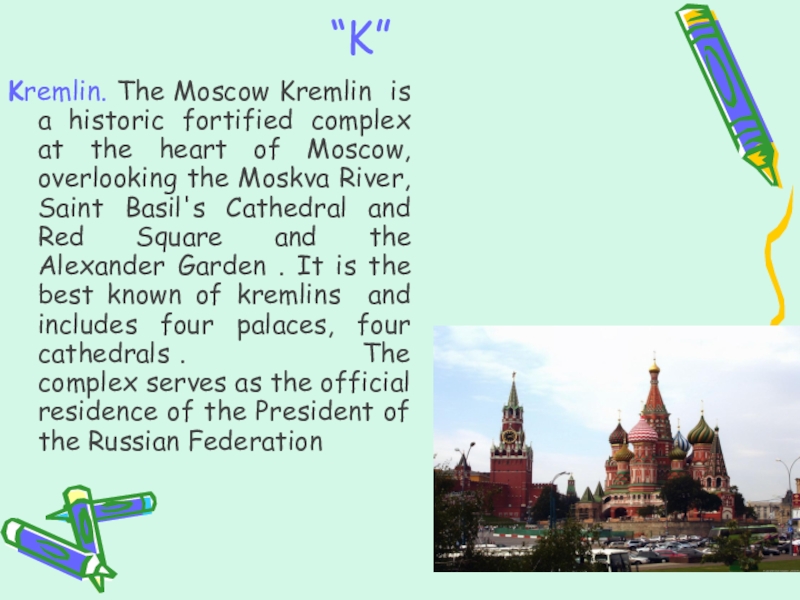
Kremlin. The Moscow Kremlin is a historic fortified complex at the
heart of Moscow, overlooking the Moskva River, Saint Basil's Cathedral and Red Square and the Alexander Garden . It is the best known of kremlins and includes four palaces, four cathedrals . The complex serves as the official residence of the President of the Russian Federation
Слайд 12“L”
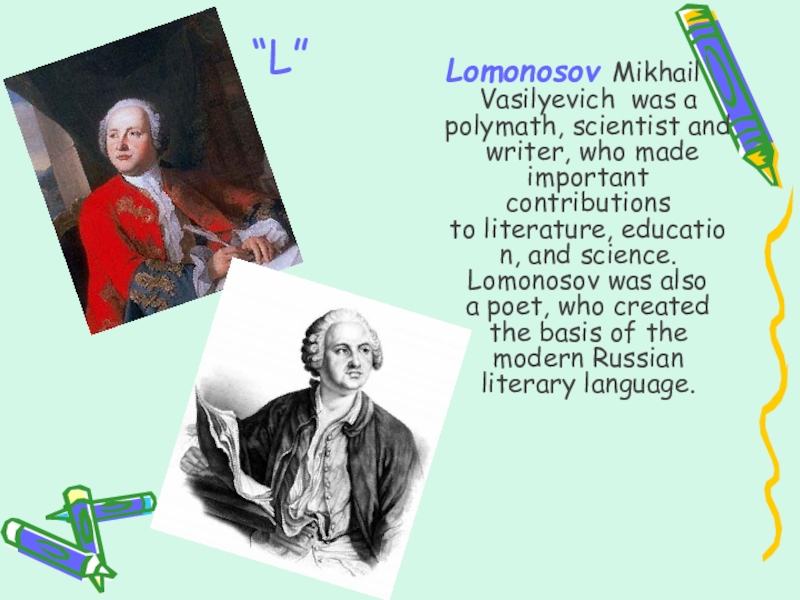
Lomonosov Mikhail Vasilyevich was a polymath, scientist and writer, who made important contributions to literature, education,
and science. Lomonosov was also a poet, who created the basis of the modern Russian literary language.
Слайд 13“M”
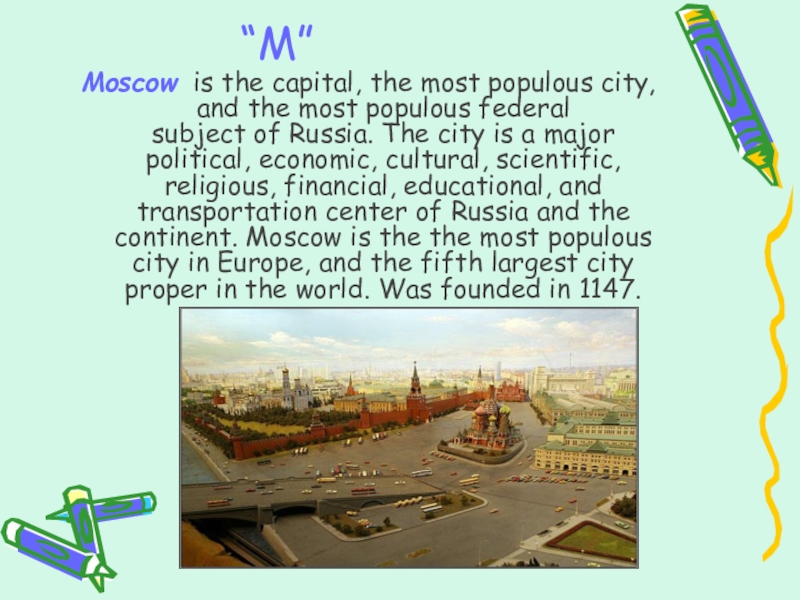
Moscow is the capital, the most populous city, and the most populous federal subject of Russia.
The city is a major political, economic, cultural, scientific, religious, financial, educational, and transportation center of Russia and the continent. Moscow is the the most populous city in Europe, and the fifth largest city proper in the world. Was founded in 1147.
Слайд 14“N”
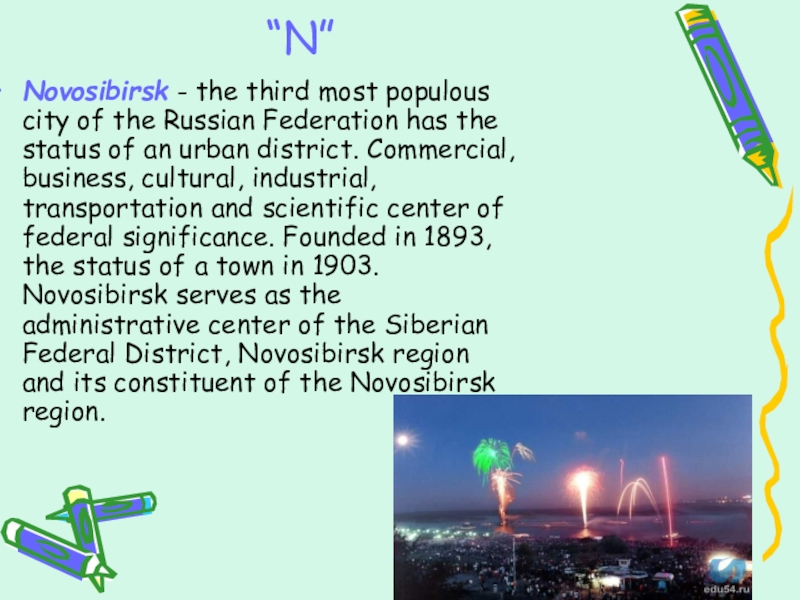
Novosibirsk - the third most populous city of the Russian Federation
has the status of an urban district. Commercial, business, cultural, industrial, transportation and scientific center of federal significance. Founded in 1893, the status of a town in 1903. Novosibirsk serves as the administrative center of the Siberian Federal District, Novosibirsk region and its constituent of the Novosibirsk region.
Слайд 15“O”
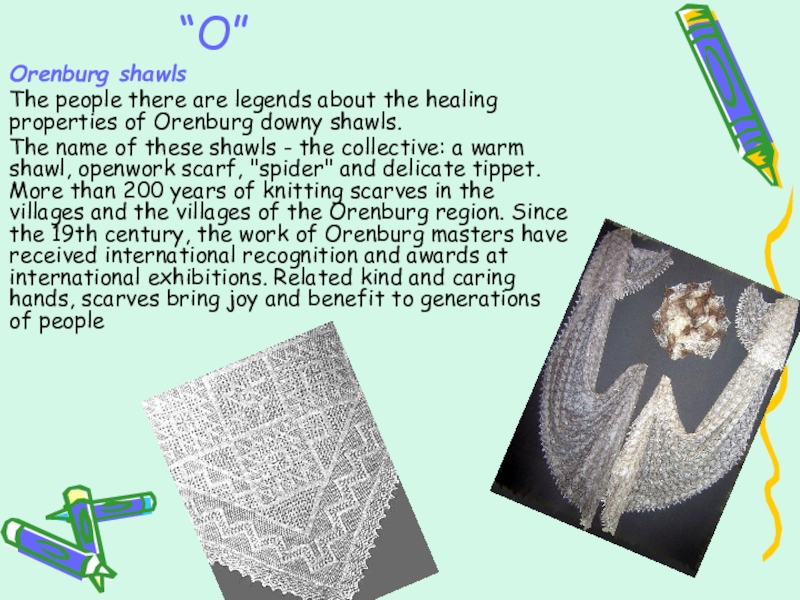
Orenburg shawls
The people there are legends about the healing properties of
Orenburg downy shawls.
The name of these shawls - the collective: a warm shawl, openwork scarf, "spider" and delicate tippet. More than 200 years of knitting scarves in the villages and the villages of the Orenburg region. Since the 19th century, the work of Orenburg masters have received international recognition and awards at international exhibitions. Related kind and caring hands, scarves bring joy and benefit to generations of people
The name of these shawls - the collective: a warm shawl, openwork scarf, "spider" and delicate tippet. More than 200 years of knitting scarves in the villages and the villages of the Orenburg region. Since the 19th century, the work of Orenburg masters have received international recognition and awards at international exhibitions. Related kind and caring hands, scarves bring joy and benefit to generations of people
Слайд 16“P”
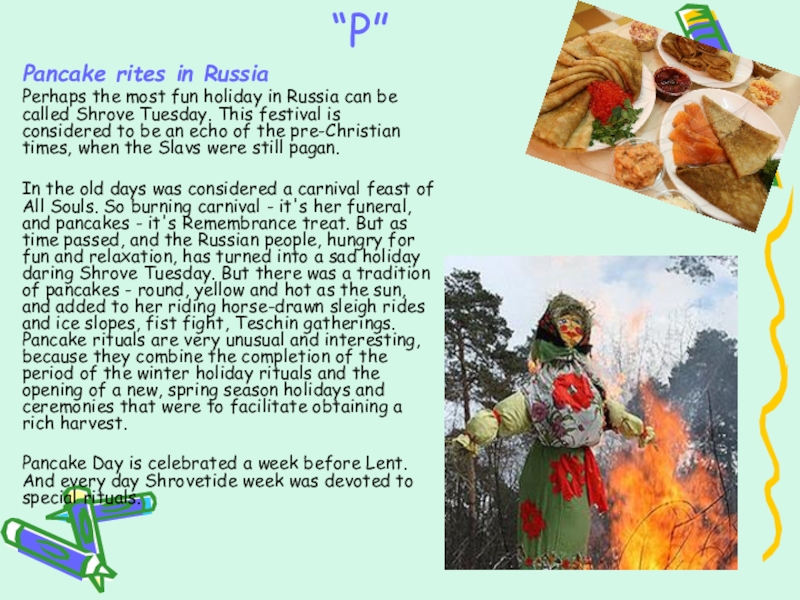
Pancake rites in Russia
Perhaps the most fun holiday in Russia can
be called Shrove Tuesday. This festival is considered to be an echo of the pre-Christian times, when the Slavs were still pagan.
In the old days was considered a carnival feast of All Souls. So burning carnival - it's her funeral, and pancakes - it's Remembrance treat. But as time passed, and the Russian people, hungry for fun and relaxation, has turned into a sad holiday daring Shrove Tuesday. But there was a tradition of pancakes - round, yellow and hot as the sun, and added to her riding horse-drawn sleigh rides and ice slopes, fist fight, Teschin gatherings. Pancake rituals are very unusual and interesting, because they combine the completion of the period of the winter holiday rituals and the opening of a new, spring season holidays and ceremonies that were to facilitate obtaining a rich harvest.
Pancake Day is celebrated a week before Lent. And every day Shrovetide week was devoted to special rituals.
In the old days was considered a carnival feast of All Souls. So burning carnival - it's her funeral, and pancakes - it's Remembrance treat. But as time passed, and the Russian people, hungry for fun and relaxation, has turned into a sad holiday daring Shrove Tuesday. But there was a tradition of pancakes - round, yellow and hot as the sun, and added to her riding horse-drawn sleigh rides and ice slopes, fist fight, Teschin gatherings. Pancake rituals are very unusual and interesting, because they combine the completion of the period of the winter holiday rituals and the opening of a new, spring season holidays and ceremonies that were to facilitate obtaining a rich harvest.
Pancake Day is celebrated a week before Lent. And every day Shrovetide week was devoted to special rituals.
Слайд 17“R”
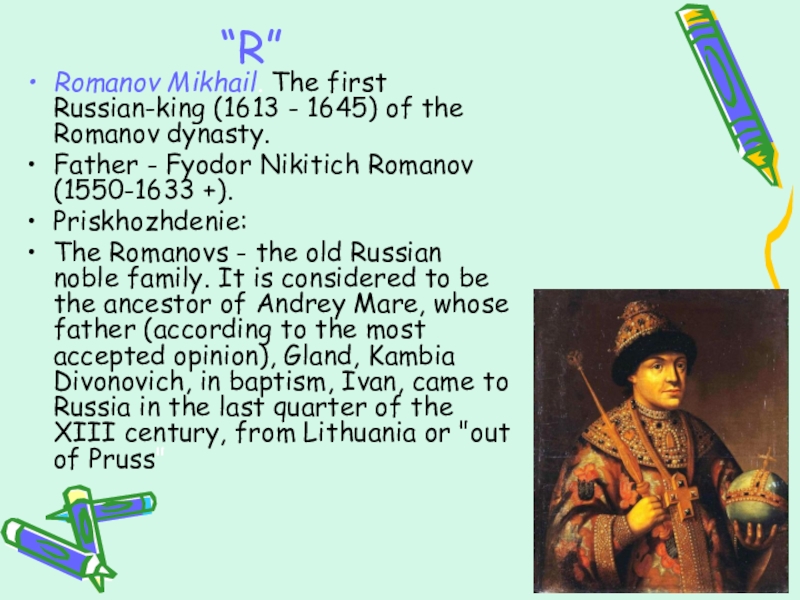
Romanov Mikhail. The first Russian-king (1613 - 1645) of the Romanov
dynasty.
Father - Fyodor Nikitich Romanov (1550-1633 +).
Priskhozhdenie:
The Romanovs - the old Russian noble family. It is considered to be the ancestor of Andrey Mare, whose father (according to the most accepted opinion), Gland, Kambia Divonovich, in baptism, Ivan, came to Russia in the last quarter of the XIII century, from Lithuania or "out of Pruss"
Father - Fyodor Nikitich Romanov (1550-1633 +).
Priskhozhdenie:
The Romanovs - the old Russian noble family. It is considered to be the ancestor of Andrey Mare, whose father (according to the most accepted opinion), Gland, Kambia Divonovich, in baptism, Ivan, came to Russia in the last quarter of the XIII century, from Lithuania or "out of Pruss"
Слайд 18“S”
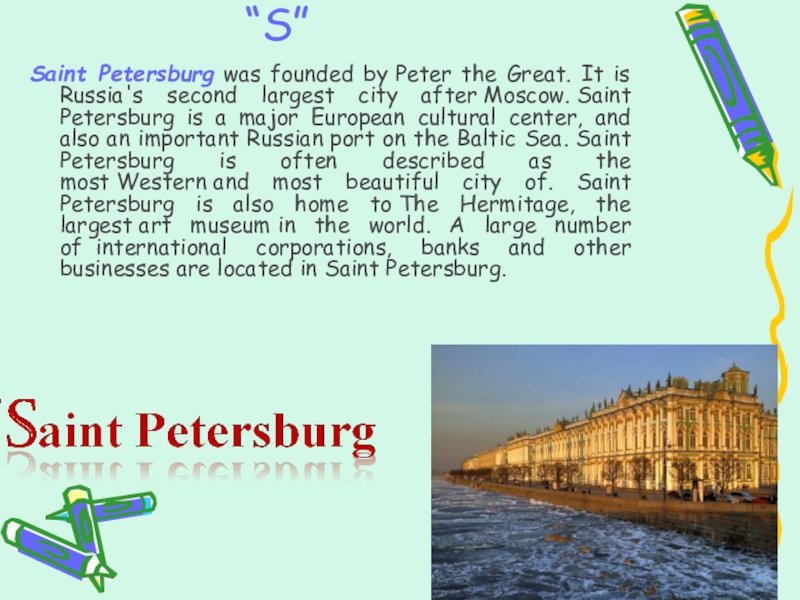
Saint Petersburg was founded by Peter the Great. It is Russia's second
largest city after Moscow. Saint Petersburg is a major European cultural center, and also an important Russian port on the Baltic Sea. Saint Petersburg is often described as the most Western and most beautiful city of. Saint Petersburg is also home to The Hermitage, the largest art museum in the world. A large number of international corporations, banks and other businesses are located in Saint Petersburg.
Слайд 19“T”
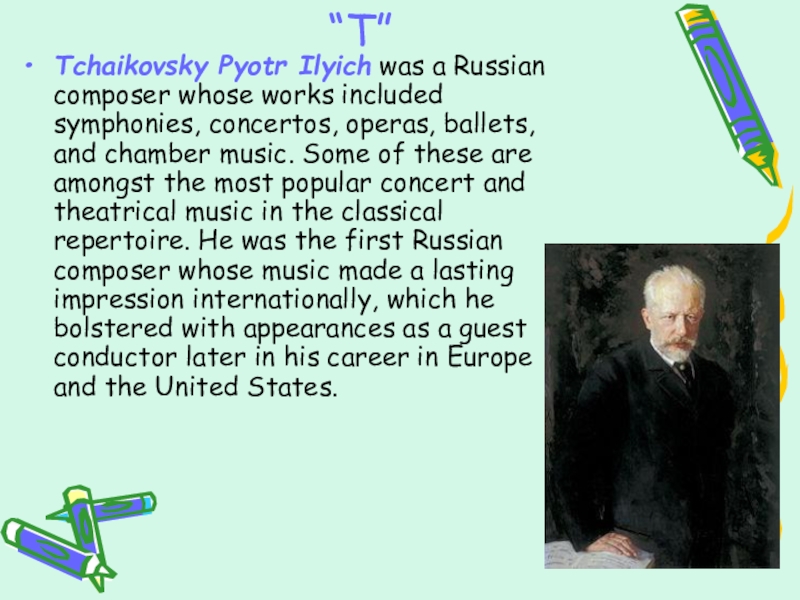
Tchaikovsky Pyotr Ilyich was a Russian composer whose works included symphonies,
concertos, operas, ballets, and chamber music. Some of these are amongst the most popular concert and theatrical music in the classical repertoire. He was the first Russian composer whose music made a lasting impression internationally, which he bolstered with appearances as a guest conductor later in his career in Europe and the United States.
Слайд 20“U”
Ural Mountains
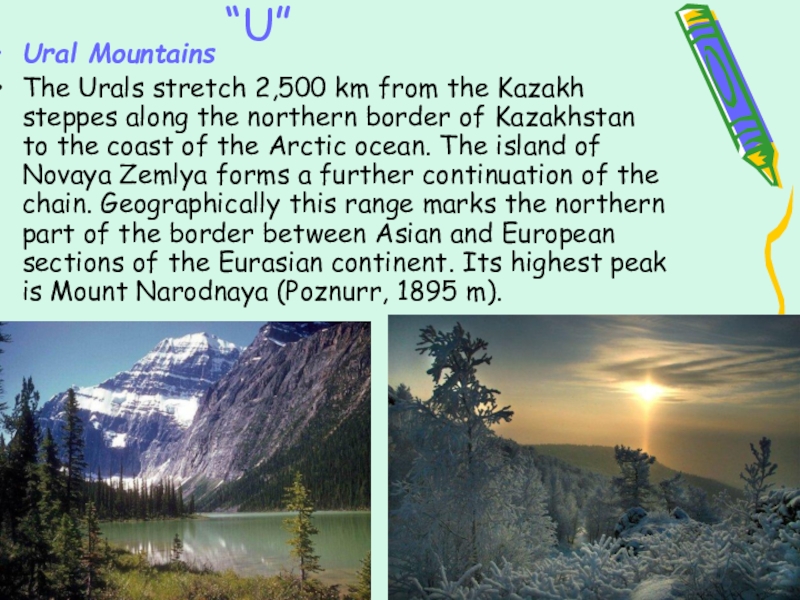
The Urals stretch 2,500 km from the Kazakh steppes along
the northern border of Kazakhstan to the coast of the Arctic ocean. The island of Novaya Zemlya forms a further continuation of the chain. Geographically this range marks the northern part of the border between Asian and European sections of the Eurasian continent. Its highest peak is Mount Narodnaya (Poznurr, 1895 m).
Слайд 21“V”
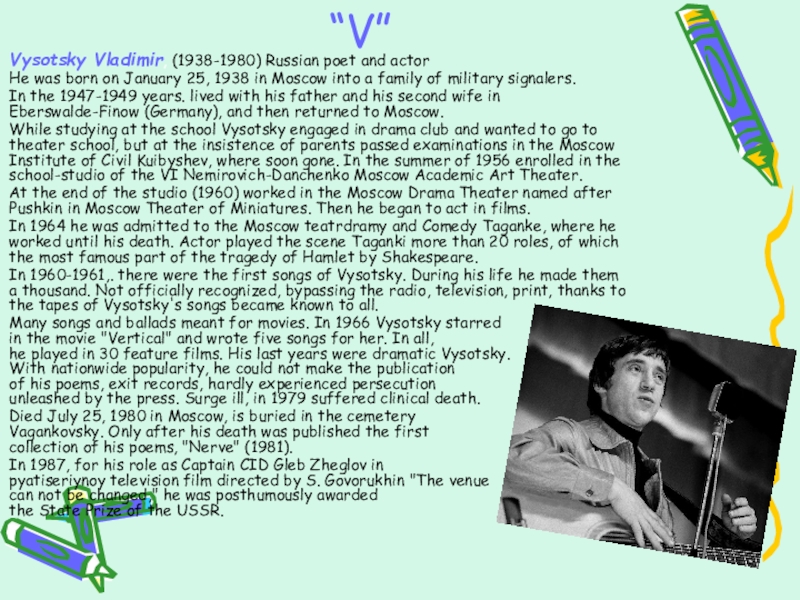
Vysotsky Vladimir, (1938-1980) Russian poet and actor
He was born on January
25, 1938 in Moscow into a family of military signalers.
In the 1947-1949 years. lived with his father and his second wife in Eberswalde-Finow (Germany), and then returned to Moscow.
While studying at the school Vysotsky engaged in drama club and wanted to go to theater school, but at the insistence of parents passed examinations in the Moscow Institute of Civil Kuibyshev, where soon gone. In the summer of 1956 enrolled in the school-studio of the VI Nemirovich-Danchenko Moscow Academic Art Theater.
At the end of the studio (1960) worked in the Moscow Drama Theater named after Pushkin in Moscow Theater of Miniatures. Then he began to act in films.
In 1964 he was admitted to the Moscow teatrdramy and Comedy Taganke, where he worked until his death. Actor played the scene Taganki more than 20 roles, of which the most famous part of the tragedy of Hamlet by Shakespeare.
In 1960-1961,. there were the first songs of Vysotsky. During his life he made them a thousand. Not officially recognized, bypassing the radio, television, print, thanks to the tapes of Vysotsky's songs became known to all.
Many songs and ballads meant for movies. In 1966 Vysotsky starred in the movie "Vertical" and wrote five songs for her. In all, he played in 30 feature films. His last years were dramatic Vysotsky. With nationwide popularity, he could not make the publication of his poems, exit records, hardly experienced persecution unleashed by the press. Surge ill, in 1979 suffered clinical death.
Died July 25, 1980 in Moscow, is buried in the cemetery Vagankovsky. Only after his death was published the first collection of his poems, "Nerve" (1981).
In 1987, for his role as Captain CID Gleb Zheglov in pyatiseriynoy television film directed by S. Govorukhin "The venue can not be changed," he was posthumously awarded the State Prize of the USSR.
In the 1947-1949 years. lived with his father and his second wife in Eberswalde-Finow (Germany), and then returned to Moscow.
While studying at the school Vysotsky engaged in drama club and wanted to go to theater school, but at the insistence of parents passed examinations in the Moscow Institute of Civil Kuibyshev, where soon gone. In the summer of 1956 enrolled in the school-studio of the VI Nemirovich-Danchenko Moscow Academic Art Theater.
At the end of the studio (1960) worked in the Moscow Drama Theater named after Pushkin in Moscow Theater of Miniatures. Then he began to act in films.
In 1964 he was admitted to the Moscow teatrdramy and Comedy Taganke, where he worked until his death. Actor played the scene Taganki more than 20 roles, of which the most famous part of the tragedy of Hamlet by Shakespeare.
In 1960-1961,. there were the first songs of Vysotsky. During his life he made them a thousand. Not officially recognized, bypassing the radio, television, print, thanks to the tapes of Vysotsky's songs became known to all.
Many songs and ballads meant for movies. In 1966 Vysotsky starred in the movie "Vertical" and wrote five songs for her. In all, he played in 30 feature films. His last years were dramatic Vysotsky. With nationwide popularity, he could not make the publication of his poems, exit records, hardly experienced persecution unleashed by the press. Surge ill, in 1979 suffered clinical death.
Died July 25, 1980 in Moscow, is buried in the cemetery Vagankovsky. Only after his death was published the first collection of his poems, "Nerve" (1981).
In 1987, for his role as Captain CID Gleb Zheglov in pyatiseriynoy television film directed by S. Govorukhin "The venue can not be changed," he was posthumously awarded the State Prize of the USSR.
Слайд 22“Y”
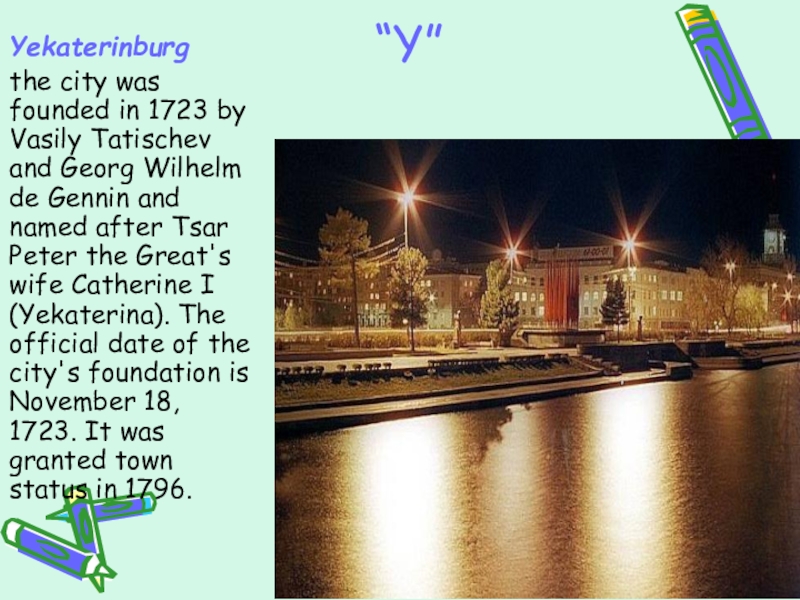
Yekaterinburg
the city was founded in 1723 by Vasily Tatischev and Georg
Wilhelm de Gennin and named after Tsar Peter the Great's wife Catherine I (Yekaterina). The official date of the city's foundation is November 18, 1723. It was granted town status in 1796.
Слайд 23“Z”
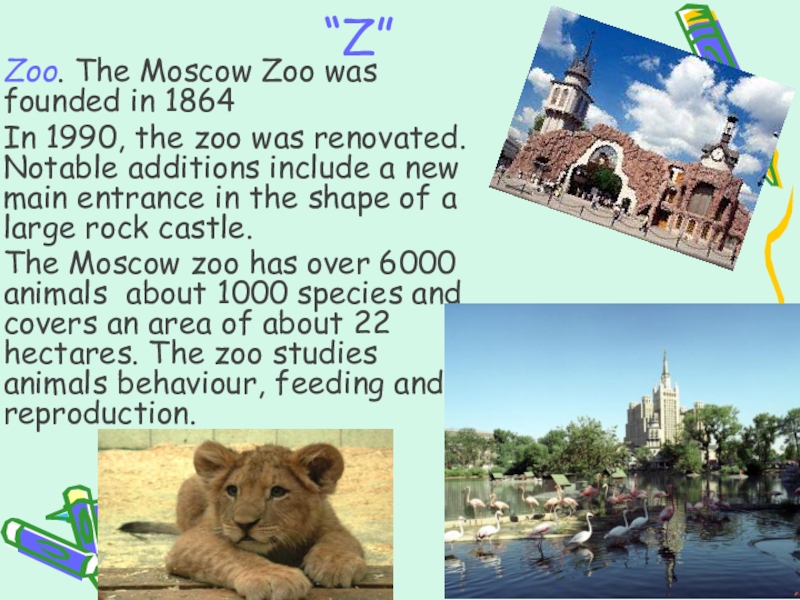
Zoo. The Moscow Zoo was founded in 1864
In 1990, the zoo
was renovated. Notable additions include a new main entrance in the shape of a large rock castle.
The Moscow zoo has over 6000 animals about 1000 species and covers an area of about 22 hectares. The zoo studies animals behaviour, feeding and reproduction.
The Moscow zoo has over 6000 animals about 1000 species and covers an area of about 22 hectares. The zoo studies animals behaviour, feeding and reproduction.