- Главная
- Разное
- Образование
- Спорт
- Естествознание
- Природоведение
- Религиоведение
- Французский язык
- Черчение
- Английский язык
- Астрономия
- Алгебра
- Биология
- География
- Геометрия
- Детские презентации
- Информатика
- История
- Литература
- Математика
- Музыка
- МХК
- Немецкий язык
- ОБЖ
- Обществознание
- Окружающий мир
- Педагогика
- Русский язык
- Технология
- Физика
- Философия
- Химия
- Шаблоны, фоны, картинки для презентаций
- Экология
- Экономика
Презентация, доклад по английскому языку на тему:Мой Берлин
Содержание
- 1. Презентация по английскому языку на тему:Мой Берлин
- 2. Слайд 2
- 3. The main attraction that comes to your
- 4. Constructed between 1788 and 1791, the Brandenburg
- 5. Propylaea of the Athenian Acropolis - an
- 6. Пропилеи Афинского Акрополя – выдающийся памятник древнегреческой
- 7. Слайд 7
- 8. Слайд 8
- 9. Слайд 9
- 10. Слайд 10
- 11. When East and West Berlin were divided
- 12. Слайд 12
- 13. The Reichstag is an internationally recognisable symbol
- 14. Слайд 14
- 15. Слайд 15
- 16. The original building is designed by Paul
- 17. The Reichstag serves as the home of
- 18. In 1990 the Reichstag is the site
- 19. Five fascinating facts about the ReichstagCyrillic graffiti
- 20. Слайд 20
- 21. Слайд 21
- 22. Слайд 22
- 23. Слайд 23
- 24. Слайд 24
- 25. Jews of EuropeThe Holocaust Memorial
- 26. In 1999, after lengthy debates, the German
- 27. The memorial is on a slight slope
- 28. Слайд 28
- 29. Слайд 29
- 30. Checkpoint Charlie was the setting for many
- 31. Слайд 31
- 32. The history of Checkpoint CharlieThe name Checkpoint
- 33. Слайд 33
- 34. Слайд 34
- 35. On 22 September 1961, Allied guards began
- 36. Слайд 36
- 37. The Cathedral Church is dominated by a
- 38. Слайд 38
- 39. Слайд 39
- 40. Слайд 40
- 41. Слайд 41
- 42. Soaring 368 metres into the sky, Berlin’s TV
- 43. The Berlin TV Tower was inaugurated on
- 44. Слайд 44
- 45. Слайд 45
- 46. Слайд 46
- 47. Слайд 47
- 48. In just 40 seconds, the express elevator
- 49. Neo-Renaissance architecture The Rotes Rathaus was built
- 50. Слайд 50
- 51. The heraldic hall and other roomsThe Rotes
- 52. https://www.visitberlin.de
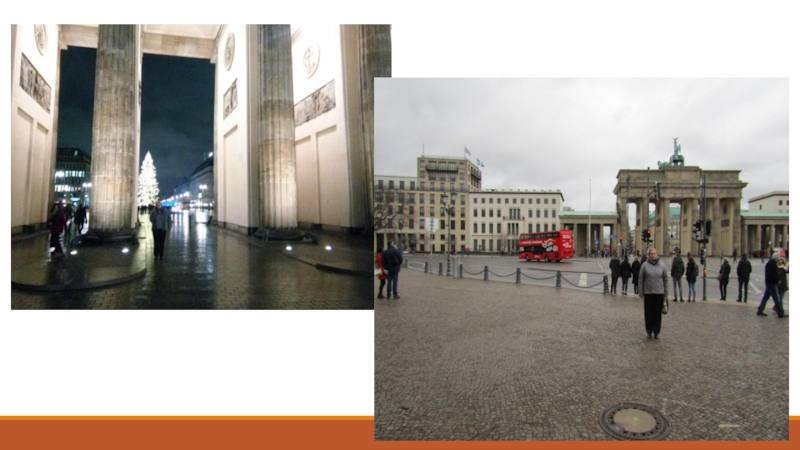
The main attraction that comes to your mind at the mention of the word Berlin is the Brandenburg Gate.Brandenburg Gate is the first stop for every visitor to Berlin! The city’s iconic landmark offers fascinating insights
Слайд 3The main attraction that comes to your mind at the mention
of the word Berlin is the Brandenburg Gate.Brandenburg Gate is the first stop for every visitor to Berlin! The city’s iconic landmark offers fascinating insights into the city’s history.
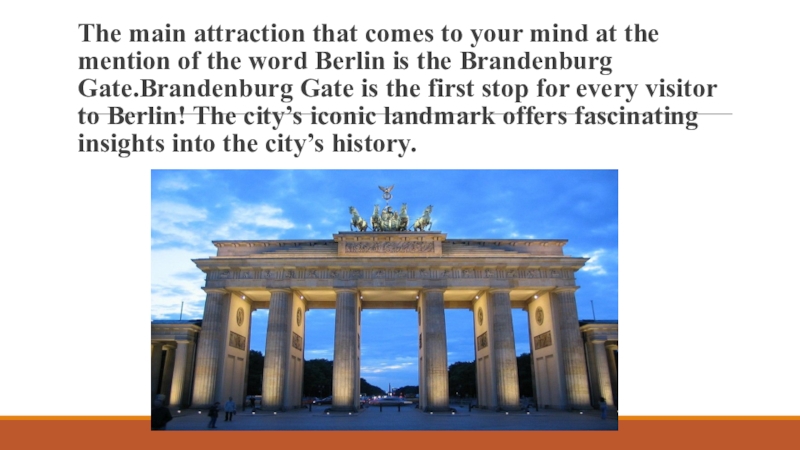
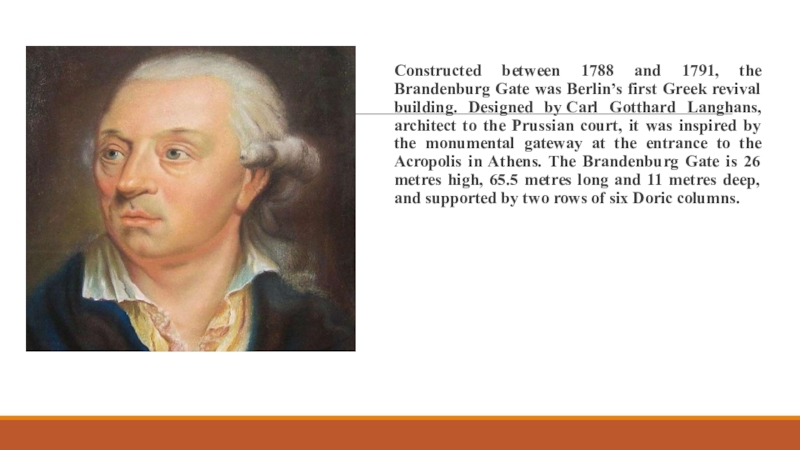
Слайд 4Constructed between 1788 and 1791, the Brandenburg Gate was Berlin’s first
Greek revival building. Designed by Carl Gotthard Langhans, architect to the Prussian court, it was inspired by the monumental gateway at the entrance to the Acropolis in Athens. The Brandenburg Gate is 26 metres high, 65.5 metres long and 11 metres deep, and supported by two rows of six Doric columns.
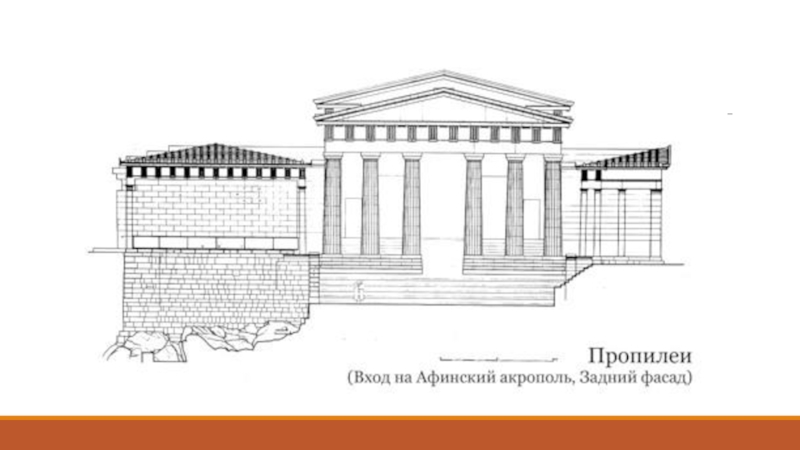
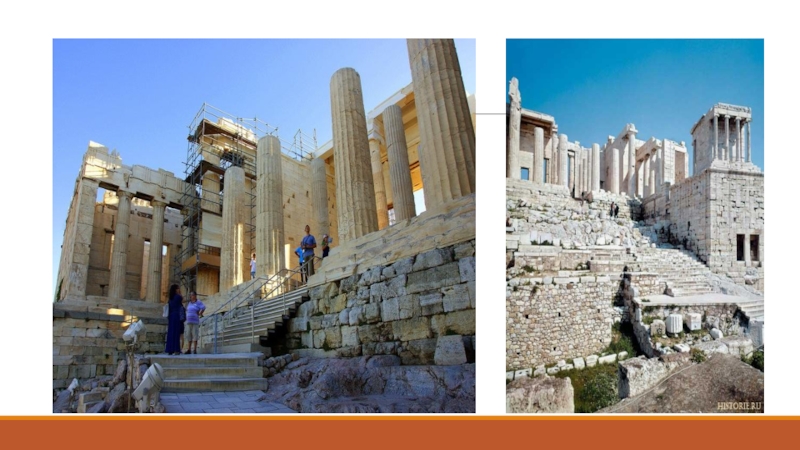
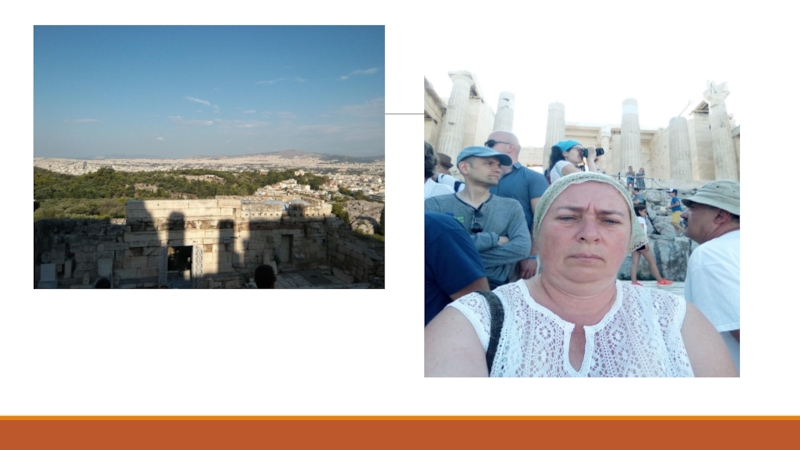
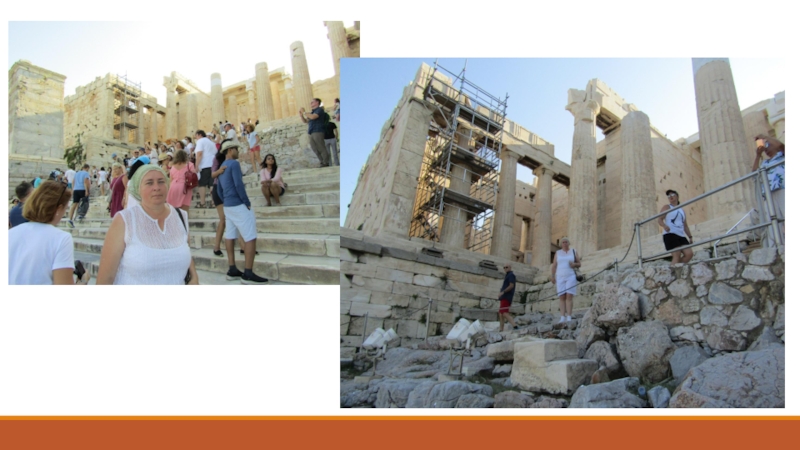
Слайд 5Propylaea of the Athenian Acropolis - an outstanding monument of ancient
Greek architecture. The word "propylene" comes from the prefix "pro" (from Latin to or in front) and "pili" (from the Greek gate), which literally translates as "in front of the gate", although in fact it means just a gate or entrance (passage). As a rule, the “propylene” is the front gate formed by porticoes and colonnades. Similar structures are characteristic of ancient Greek architecture, although the idea was used later in other countries. For example, the Brandenburg Gate in Berlin and the Propylaea in Munich are a replica of the central part of the Acropolis Propylene.
Слайд 6Пропилеи Афинского Акрополя – выдающийся памятник древнегреческой архитектуры. Слово «пропилеи» произошло
от приставки «про» (с лат. до или перед) и «пилеи» (от греч. ворота), что дословно переводится как «перед воротам», хотя по сути означает просто ворота или вход (проезд). Как правило, «пропилеи» это парадные ворота, образованные портиками и колоннадами. Подобные сооружения характерны для древнегреческой архитектуры, хотя идея использовалась и позднее в других странах. Например, Бранденбургские ворота в Берлине и Пропилеи в Мюнхене являются копией центральной части Акропольских Пропилей.
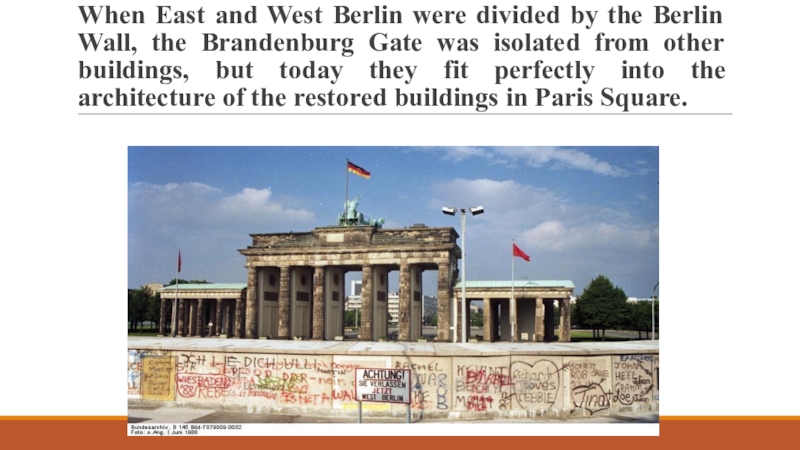
Слайд 11When East and West Berlin were divided by the Berlin Wall,
the Brandenburg Gate was isolated from other buildings, but today they fit perfectly into the architecture of the restored buildings in Paris Square.
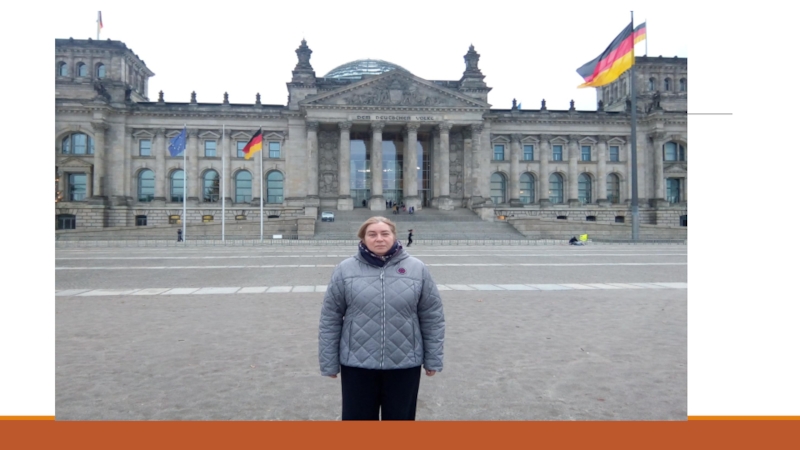
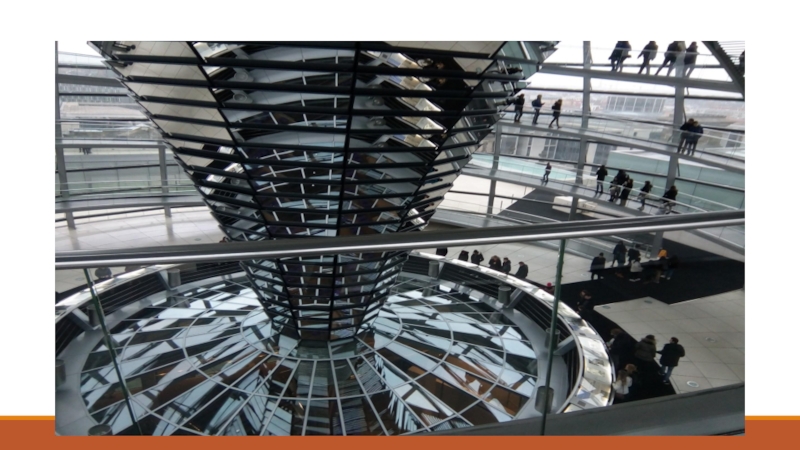
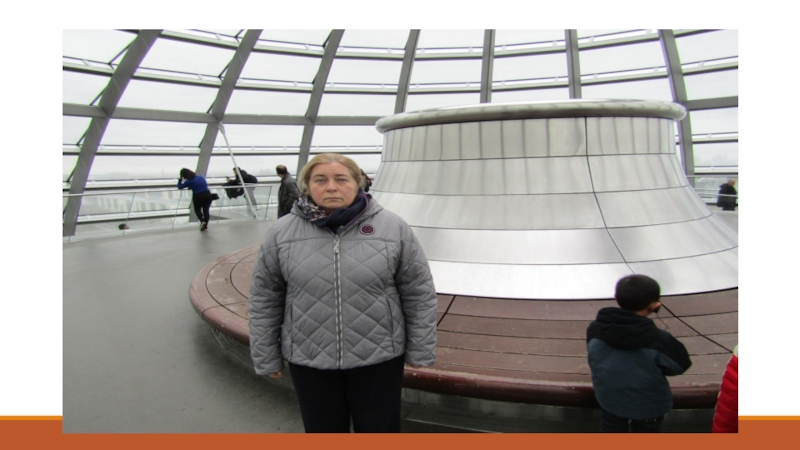
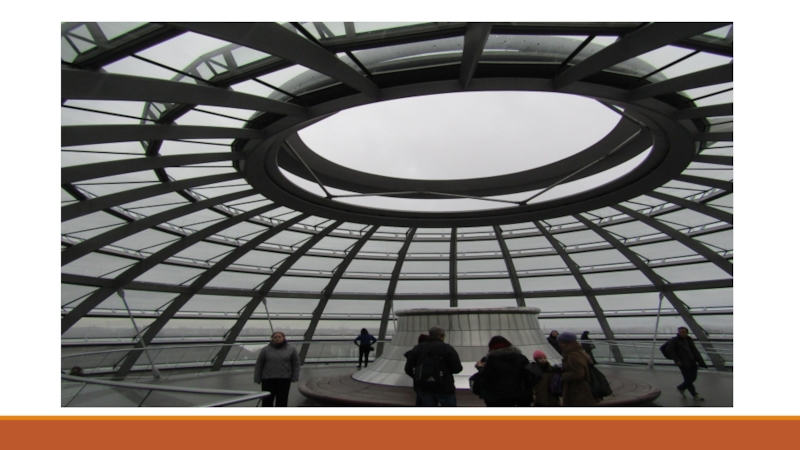
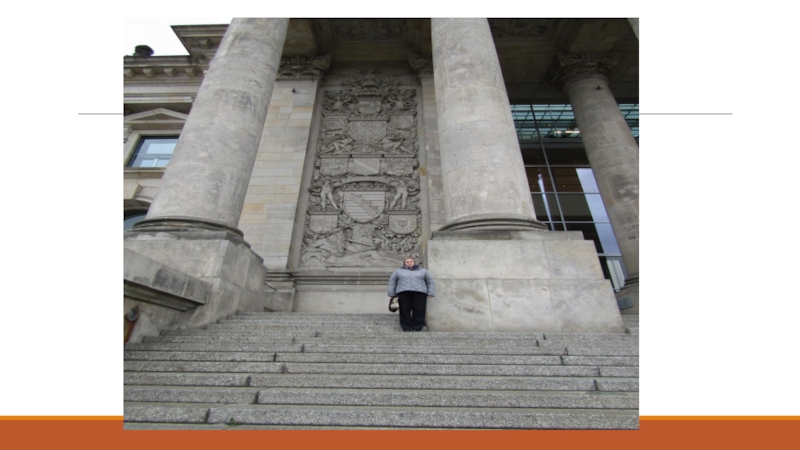
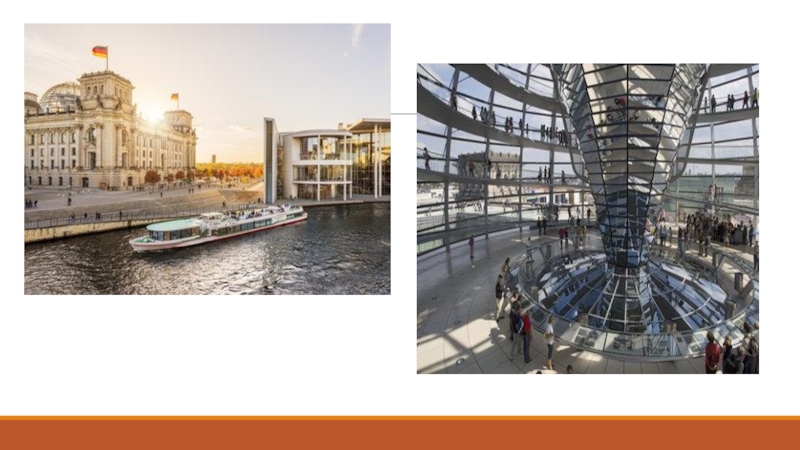
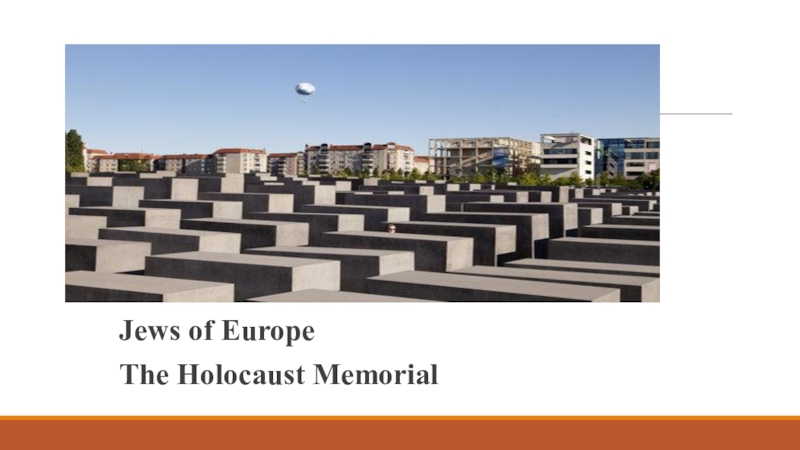
Слайд 13The Reichstag is an internationally recognisable symbol of democracy and the
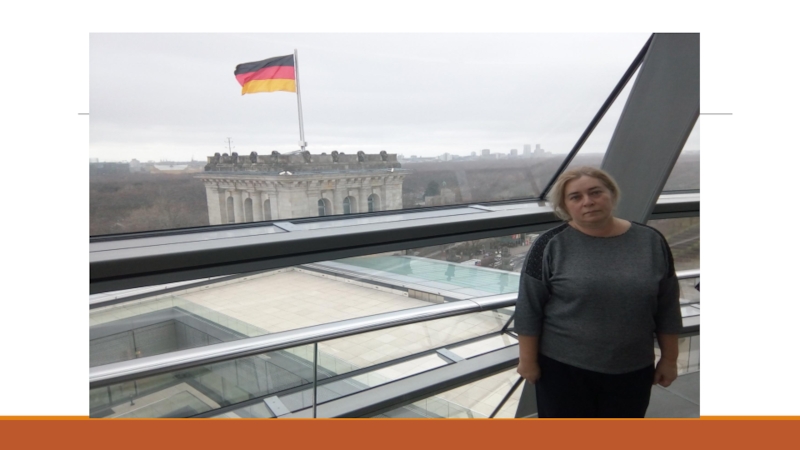
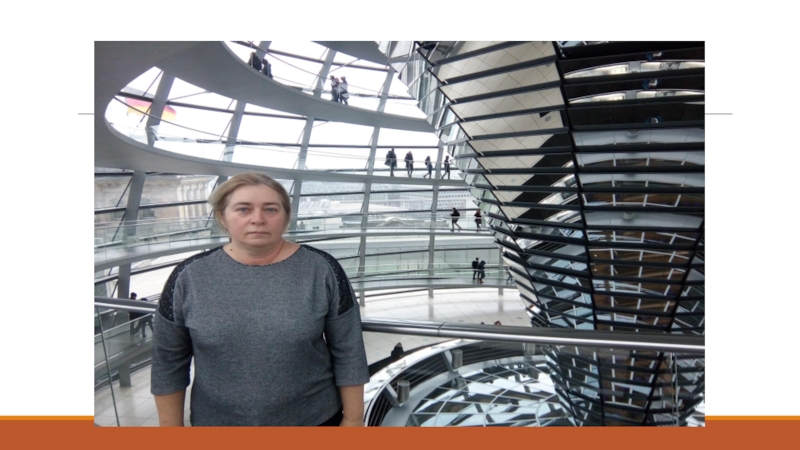
current home of the German parliament. Every year, thousands of guests visit the Reichstag - and with good reason: It is not often that you can enjoy such an amazing panorama while, just beneath your feet, the political decisions of tomorrow are being made. Both as an architectural wonder and a historical testimony, the Reichstag has an important role to play in Berlin.
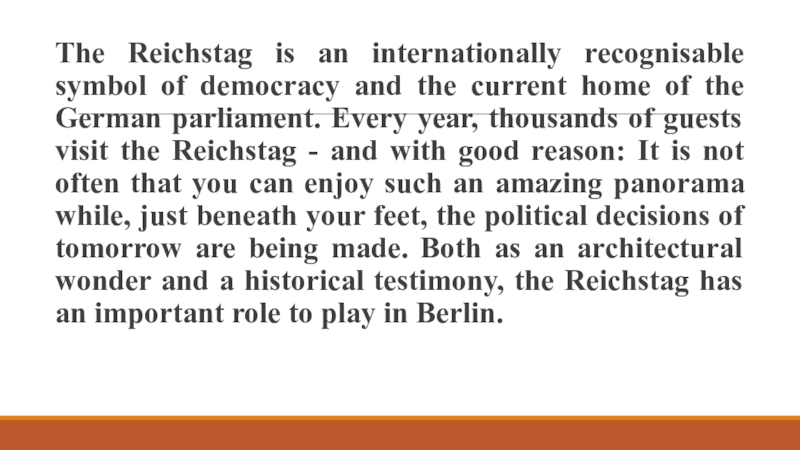
Слайд 16The original building is designed by Paul Wallot and modelled after
the Memorial Hall in Philadelphia. Decorative motifs, sculptures and mosaics are contributed by the artist Otto Lessing. The Reichstag is completed in 1894 although it doesn’t acquire its iconic dedication to “the German People” until 1916 when the words Dem Deutschen Volke are inscribed on its façade. At the time Kaiser Wilhelm II regards the building as “the pinnacle of bad taste”.
Слайд 17The Reichstag serves as the home of the German parliament until
1933 when the building is badly damaged in a fire. This event marks the end of the Weimar Republic and provides a convenient pretext for Hitler to suppress dissent. Under Nazi dictatorship, the building falls into neglect and is severely damaged during the Second World War. In 1945 it becomes one of the primary targets for the Red Army due to its perceived propaganda value.
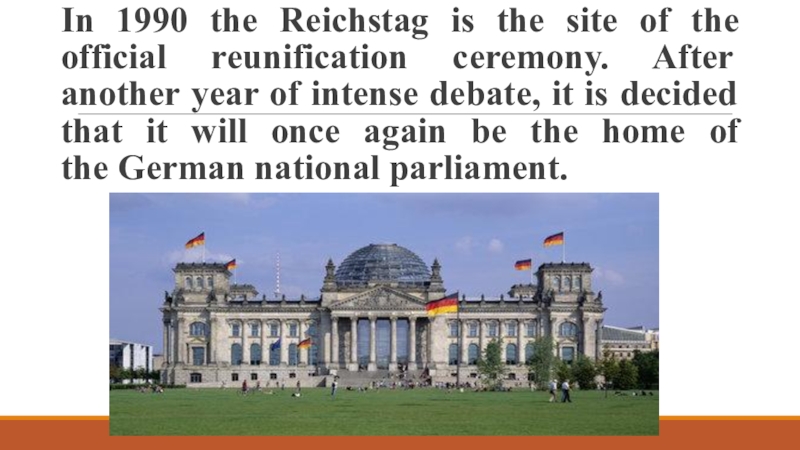
Слайд 18In 1990 the Reichstag is the site of the official reunification
ceremony. After another year of intense debate, it is decided that it will once again be the home of the German national parliament.
Слайд 19Five fascinating facts about the Reichstag
Cyrillic graffiti left by Soviet soldiers,
after their siege of the Reichstag in 1945, has been carefully preserved and can be still seen by visitors today.
A true example of eco-architecture, the Reichstag is highly self sufficient in its production of energy. The shape of the dome allows the building to make use of natural lighting and ventilation which makes the building a unique symbol of sustainability.
The Reichstag is an important art venue. It has a considerable art collection and shows changing exhibitions as well as permanently installed artworks.
The roof of the Reichstag is home to the Käfer Dachgarten Restaurant where guests with a prior reservation can enjoy a delicious breakfast, lunch or dinner. Free panoramic view included!
Besides its eventful history, Berlin is known to be a casual and friendly city. See for yourself on the grass in front of the Reichstag. This is a perfect place for picnics and a popular spot for sunbathing and relaxing.
A true example of eco-architecture, the Reichstag is highly self sufficient in its production of energy. The shape of the dome allows the building to make use of natural lighting and ventilation which makes the building a unique symbol of sustainability.
The Reichstag is an important art venue. It has a considerable art collection and shows changing exhibitions as well as permanently installed artworks.
The roof of the Reichstag is home to the Käfer Dachgarten Restaurant where guests with a prior reservation can enjoy a delicious breakfast, lunch or dinner. Free panoramic view included!
Besides its eventful history, Berlin is known to be a casual and friendly city. See for yourself on the grass in front of the Reichstag. This is a perfect place for picnics and a popular spot for sunbathing and relaxing.
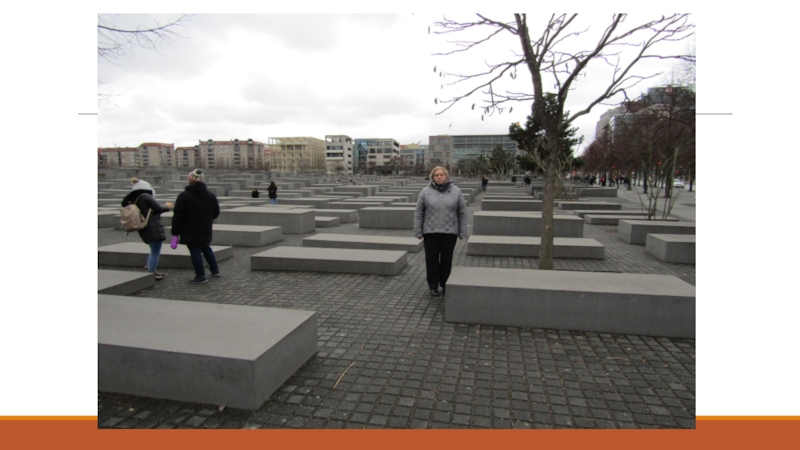
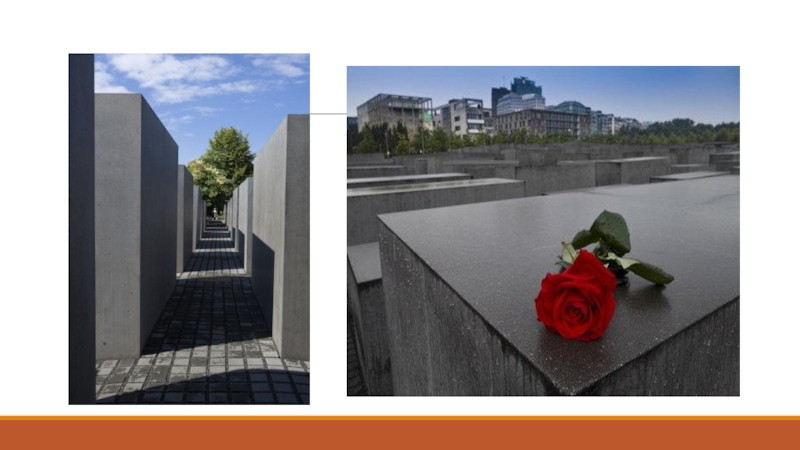
Слайд 26In 1999, after lengthy debates, the German parliament decided to establish
a central memorial site, the Memorial to the Murdered Jews of Europe. The competition to design it was won by the New York architect Peter Eisenman. The memorial was ceremonially opened in 2005.
On a site covering 19,000 square metres, Eisenman placed 2711 concrete slabs of different heights. The area is open day and night and from all four sides you can fully immerse yourself in the fully accessible spatial structure.
On a site covering 19,000 square metres, Eisenman placed 2711 concrete slabs of different heights. The area is open day and night and from all four sides you can fully immerse yourself in the fully accessible spatial structure.
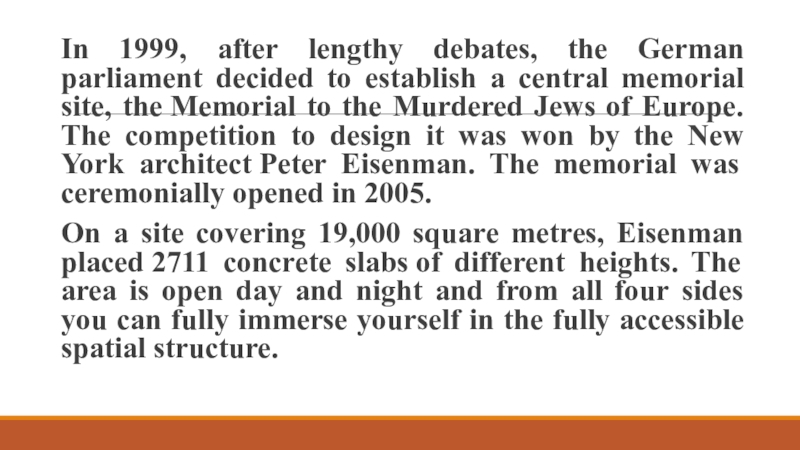
Слайд 27The memorial is on a slight slope and its wave-like form
is different wherever you stand. The uneven concrete floor gives many visitor a moment of giddiness or even uncertainty. Its openness and abstractness give you space to confront the topic in your own personal way. The sheer size of the installation and its lack of a central point of remembrance call into question the conventional concept of a memorial. This creates a place of remembrance, but not with the usual means.
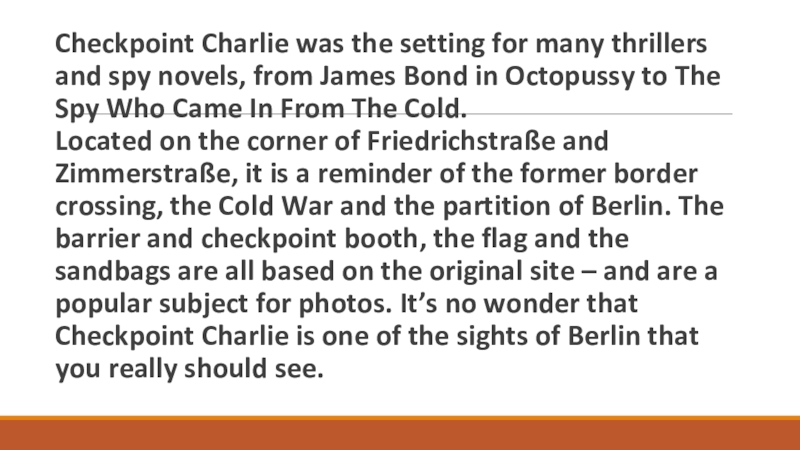
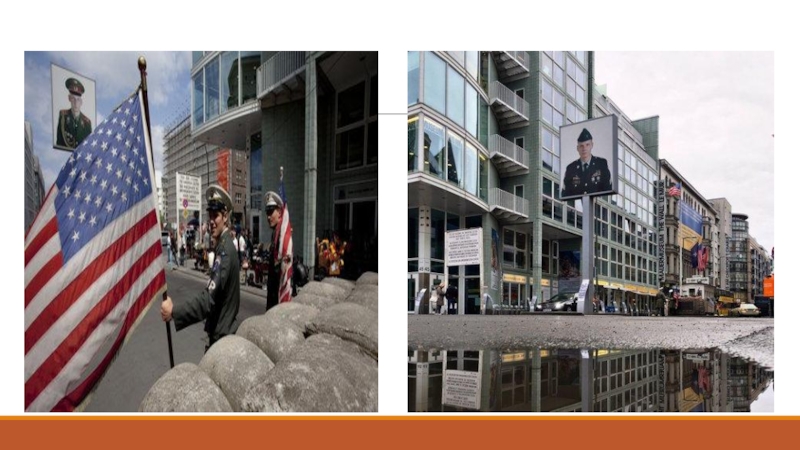
Слайд 30Checkpoint Charlie was the setting for many thrillers and spy novels,
from James Bond in Octopussy to The Spy Who Came In From The Cold.
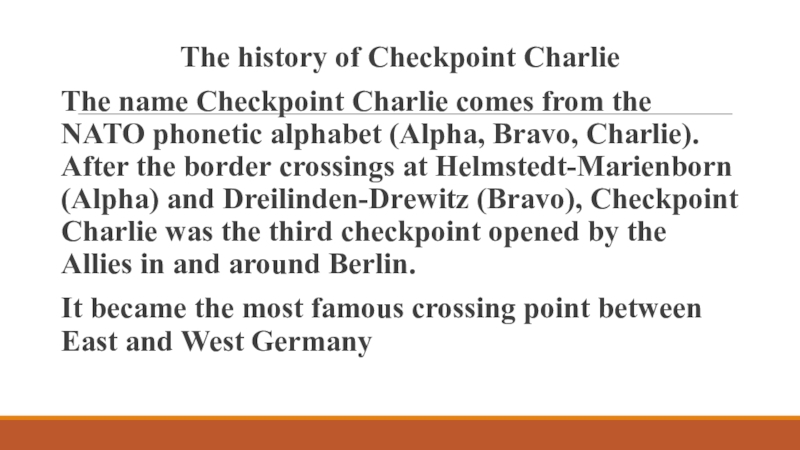
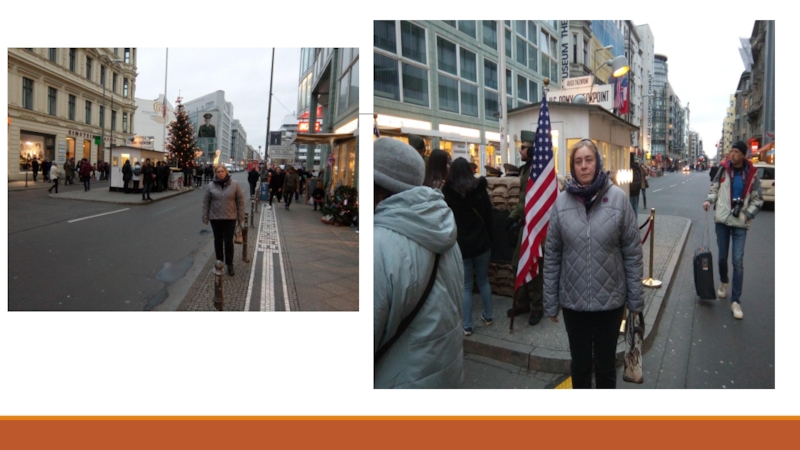
Located on the corner of Friedrichstraße and Zimmerstraße, it is a reminder of the former border crossing, the Cold War and the partition of Berlin. The barrier and checkpoint booth, the flag and the sandbags are all based on the original site – and are a popular subject for photos. It’s no wonder that Checkpoint Charlie is one of the sights of Berlin that you really should see.
Слайд 32The history of Checkpoint Charlie
The name Checkpoint Charlie comes from the
NATO phonetic alphabet (Alpha, Bravo, Charlie). After the border crossings at Helmstedt-Marienborn (Alpha) and Dreilinden-Drewitz (Bravo), Checkpoint Charlie was the third checkpoint opened by the Allies in and around Berlin.
It became the most famous crossing point between East and West Germany
It became the most famous crossing point between East and West Germany
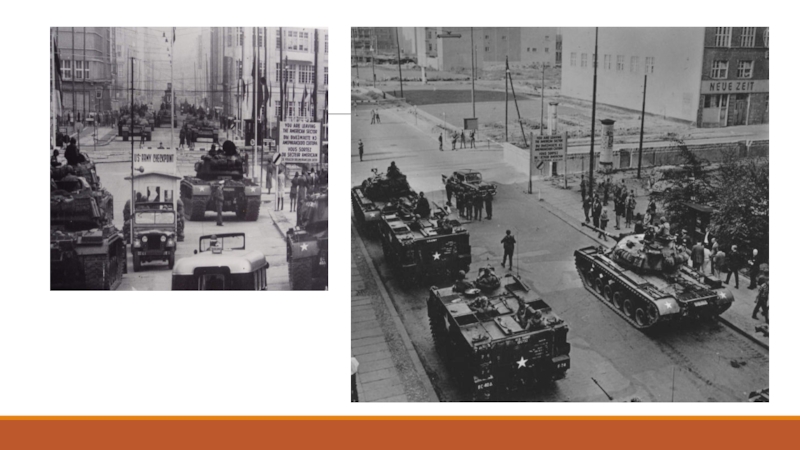
Слайд 35On 22 September 1961, Allied guards began registering members of the
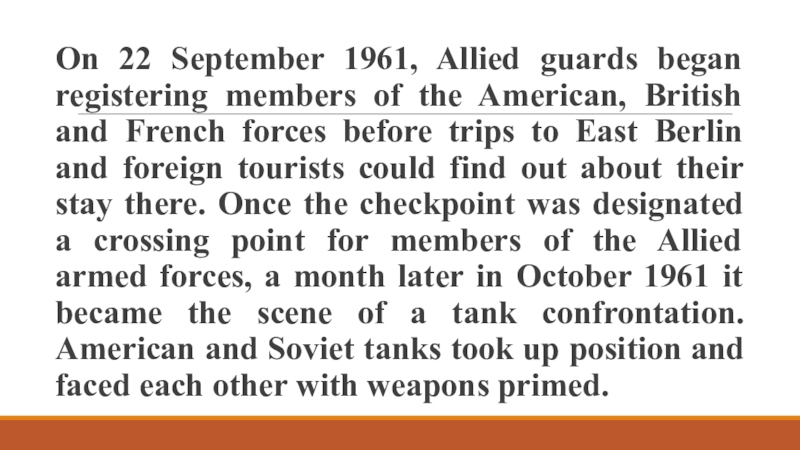
American, British and French forces before trips to East Berlin and foreign tourists could find out about their stay there. Once the checkpoint was designated a crossing point for members of the Allied armed forces, a month later in October 1961 it became the scene of a tank confrontation. American and Soviet tanks took up position and faced each other with weapons primed.
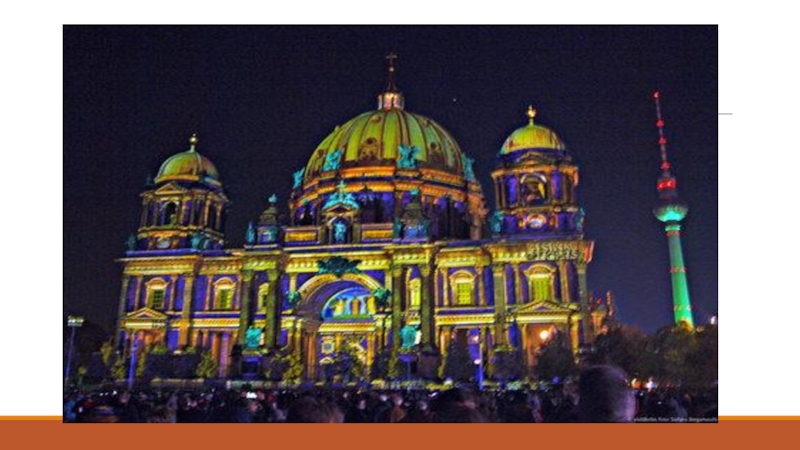
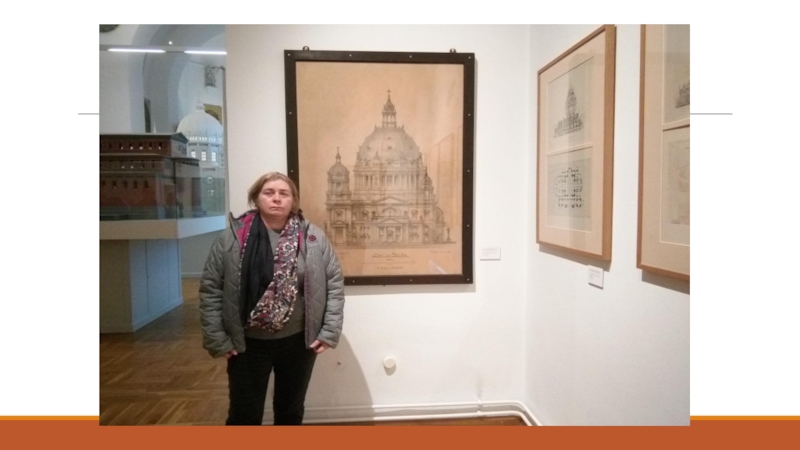
Слайд 37The Cathedral Church is dominated by a monumental dome crowned by
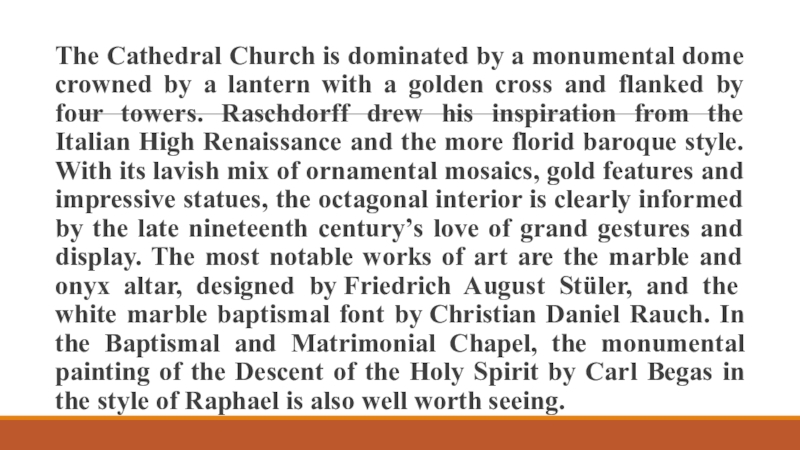
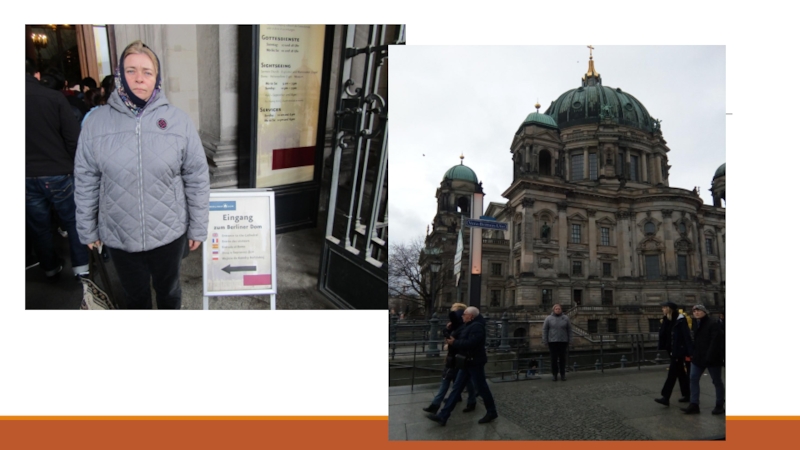
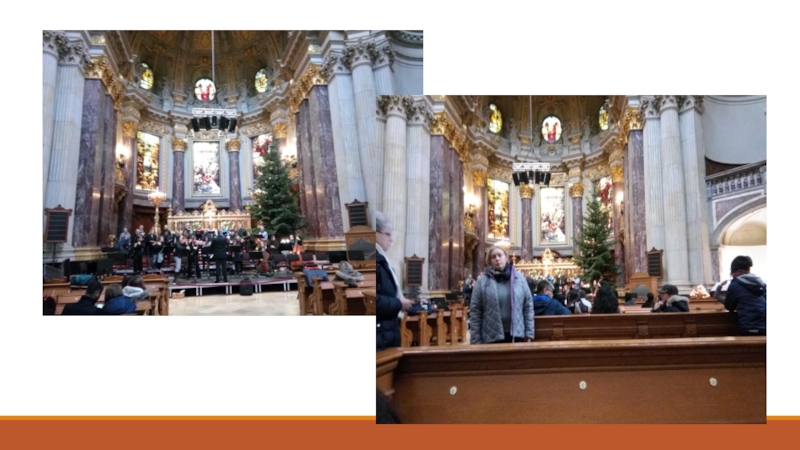
a lantern with a golden cross and flanked by four towers. Raschdorff drew his inspiration from the Italian High Renaissance and the more florid baroque style. With its lavish mix of ornamental mosaics, gold features and impressive statues, the octagonal interior is clearly informed by the late nineteenth century’s love of grand gestures and display. The most notable works of art are the marble and onyx altar, designed by Friedrich August Stüler, and the white marble baptismal font by Christian Daniel Rauch. In the Baptismal and Matrimonial Chapel, the monumental painting of the Descent of the Holy Spirit by Carl Begas in the style of Raphael is also well worth seeing.
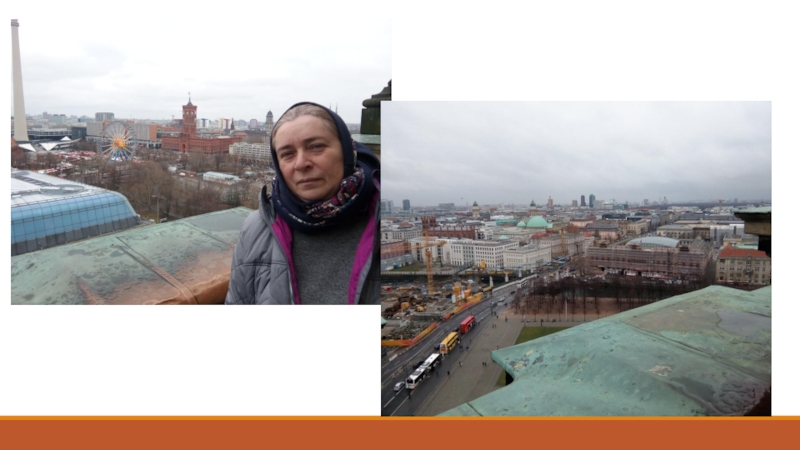
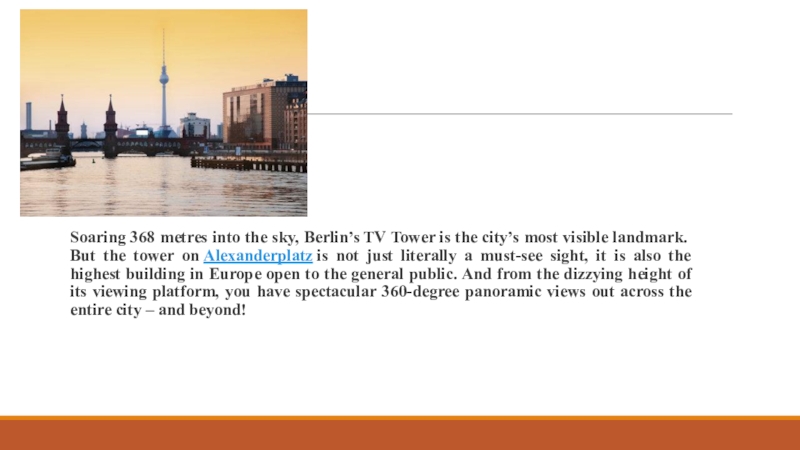
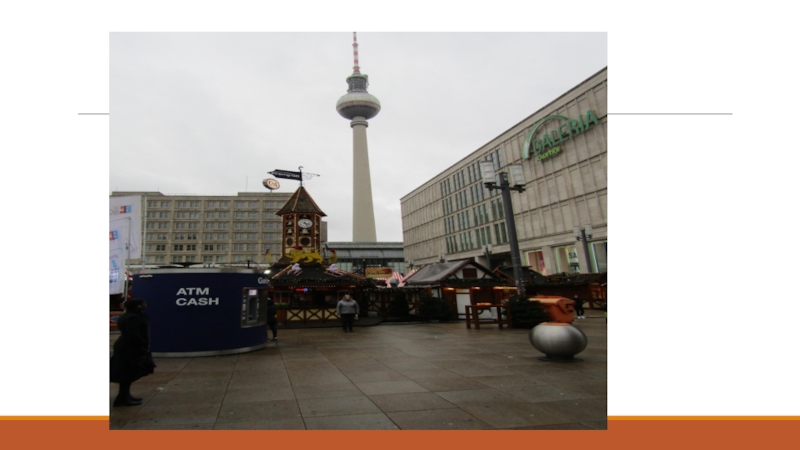
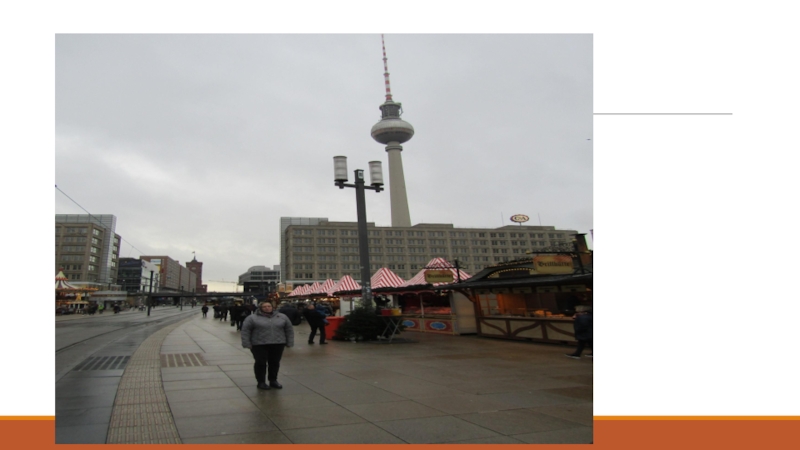
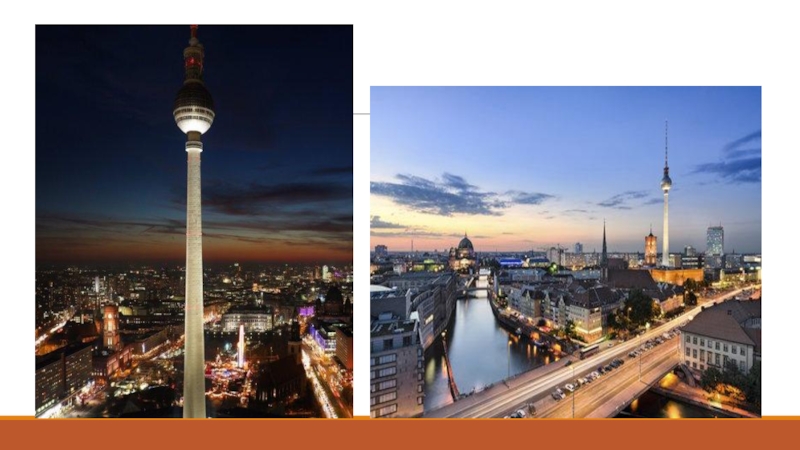
Слайд 42Soaring 368 metres into the sky, Berlin’s TV Tower is the city’s most
visible landmark. But the tower on Alexanderplatz is not just literally a must-see sight, it is also the highest building in Europe open to the general public. And from the dizzying height of its viewing platform, you have spectacular 360-degree panoramic views out across the entire city – and beyond!
Слайд 43The Berlin TV Tower was inaugurated on 3 October 1969 –
shortly before East Germany held its twentieth anniversary celebrations. For Walter Ulbricht, then East Germany’s head of state, the TV Tower, constructed in just four years, was emblematic of the communist system's superiority – unequivocal evidence that the GDR was building a better future. The tower was designed by Hermann Henselmann and the group of architects around Fritz Dieter, Günter Franke and Werner Neumann in the state-owned enterprise Industrieprojektierung (Ipro) Berlin. For a time, the executive manager for the entire project was Gerhard Kosel, then President of the GDR’s Deutsche Bauakademie in Berlin.
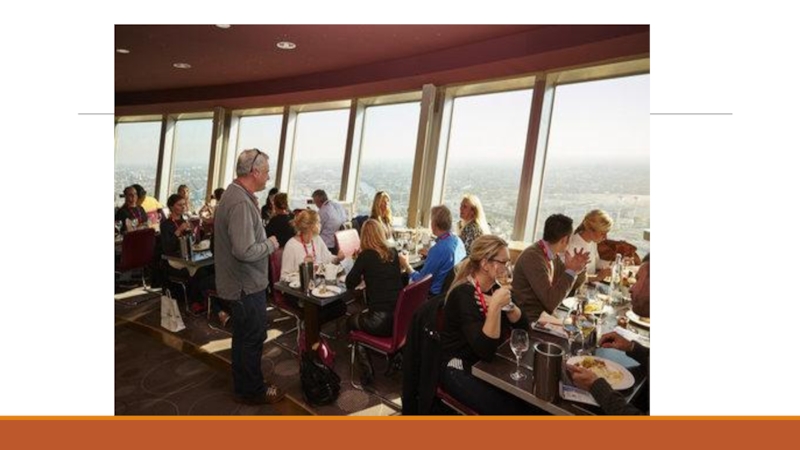
Слайд 48In just 40 seconds, the express elevator in the TV Tower
whisks guests to the observation platform high above the city. The fantastic panorama of the cityscape from here includes many of the city’s well-known sights, from the Reichstag Parliament building to the Olympic Stadium or the decommissioned Tempelhof airport. Through the coin-operated telescopes, you can explore the city below in detail and even see the wind turbines turning out in the surrounding countryside. The display panels set around the observation platform are marked with the key sights help you to identify buildings, parks and gardens.
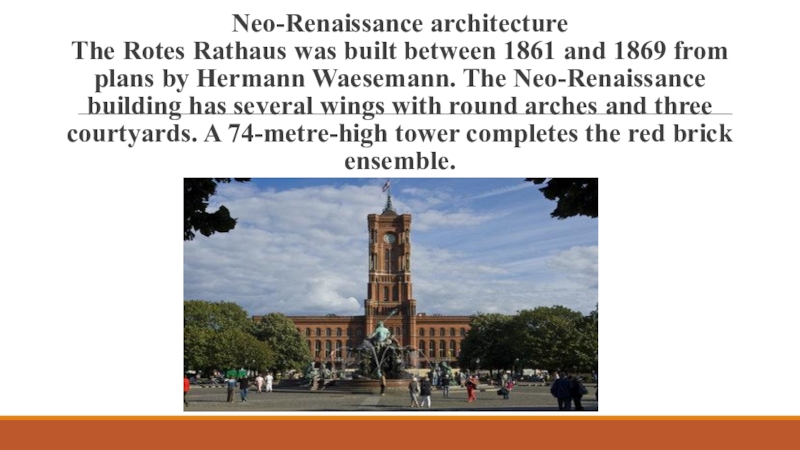
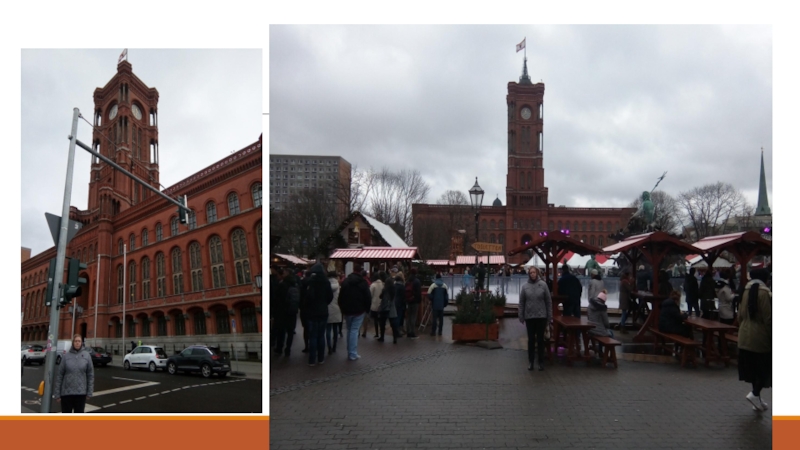
Слайд 49Neo-Renaissance architecture The Rotes Rathaus was built between 1861 and 1869 from
plans by Hermann Waesemann. The Neo-Renaissance building has several wings with round arches and three courtyards. A 74-metre-high tower completes the red brick ensemble.
Слайд 51The heraldic hall and other rooms
The Rotes Rathaus contains many impressive
rooms which are well worth a visit.
The heraldic hall (with the coats of arms of all Berlin’s boroughs) is where state visitors are received.
The great banqueting hall is used for events such as official receptions and ceremonies.
The most beautiful hall is the nine-metre-high pillared hall with its orange rib-vaulted ceiling and many busts of prominent people. At one time, the library was housed here, and now there are often exhibitions.
In the corridors of the third floor, there are portraits of all Berlin’s honorary citizens, drawn by Rolf Dübner.
The heraldic hall (with the coats of arms of all Berlin’s boroughs) is where state visitors are received.
The great banqueting hall is used for events such as official receptions and ceremonies.
The most beautiful hall is the nine-metre-high pillared hall with its orange rib-vaulted ceiling and many busts of prominent people. At one time, the library was housed here, and now there are often exhibitions.
In the corridors of the third floor, there are portraits of all Berlin’s honorary citizens, drawn by Rolf Dübner.