- Главная
- Разное
- Образование
- Спорт
- Естествознание
- Природоведение
- Религиоведение
- Французский язык
- Черчение
- Английский язык
- Астрономия
- Алгебра
- Биология
- География
- Геометрия
- Детские презентации
- Информатика
- История
- Литература
- Математика
- Музыка
- МХК
- Немецкий язык
- ОБЖ
- Обществознание
- Окружающий мир
- Педагогика
- Русский язык
- Технология
- Физика
- Философия
- Химия
- Шаблоны, фоны, картинки для презентаций
- Экология
- Экономика
Презентация, доклад по английскому языку на темуGERMANIC LANGUAGES
Содержание
- 1. Презентация по английскому языку на темуGERMANIC LANGUAGES
- 2. Modern Germanic Languages Languages can be classified
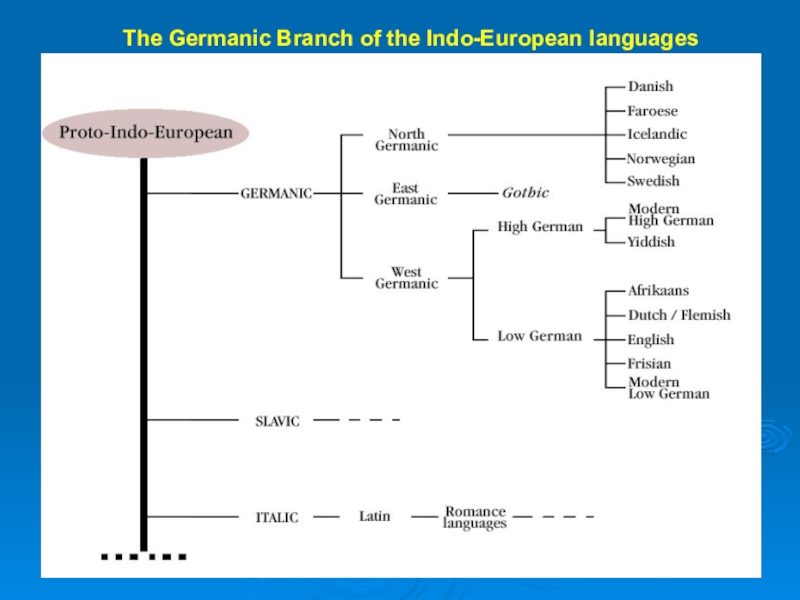
- 3. Genetically, English belongs to the Germanic or
- 4. The Germanic Branch of the Indo-European languages
- 5. The Germanic languages in the modern world are as follows:
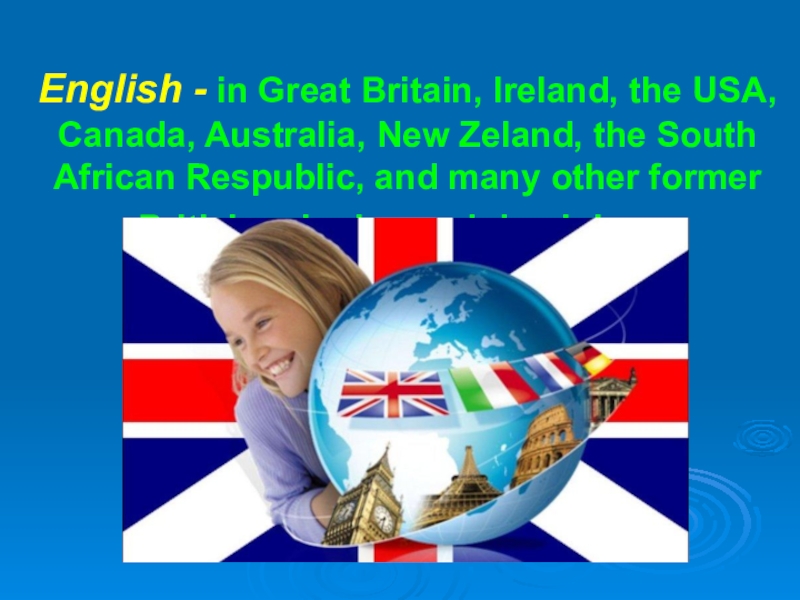
- 6. English - in Great Britain, Ireland, the
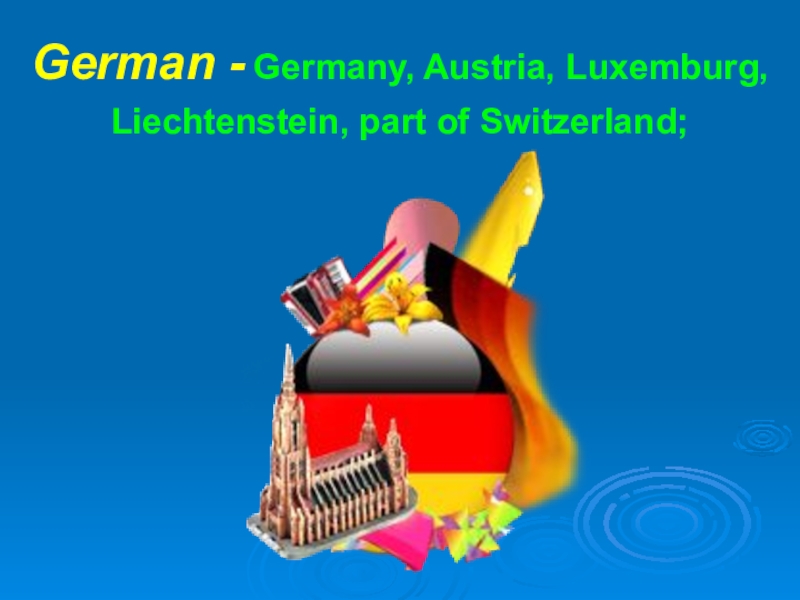
- 7. German - Germany, Austria, Luxemburg, Liechtenstein, part of Switzerland;
- 8. Netherlandish - in the Netherlands and Flanders (Belgium) (known also as Dutch and Flemish respectively);
- 9. Afrikaans - in the South African Respublic;
- 10. Norwegian - in Norway; Icelandic - in
- 11. All the Germanic languages are related through
- 12. The Earliest Period of Germanic History. Proto-Germanic
- 13. PG is an entirely pre-historical language: it
- 14. It is believed that at the earliest
- 15. The earliest migration of the Germanic tribes
- 16. At the beginning of our era some
- 17. LINGUISTIC and Grammatical FEATURES OF GERMANIC LANGUAGES The
- 18. The common I-E notional word consisted of
- 19. The Germanic nouns had a well-developed case system
- 20. Germanic adjectives had two types of declination: weakstrong. They also had degrees of comparison.
- 21. Germanic verbs are divided into 2 principal groups: strong
- 22. The grammatical forms of the word were
- 23. Though in the Germanic languages inflections were
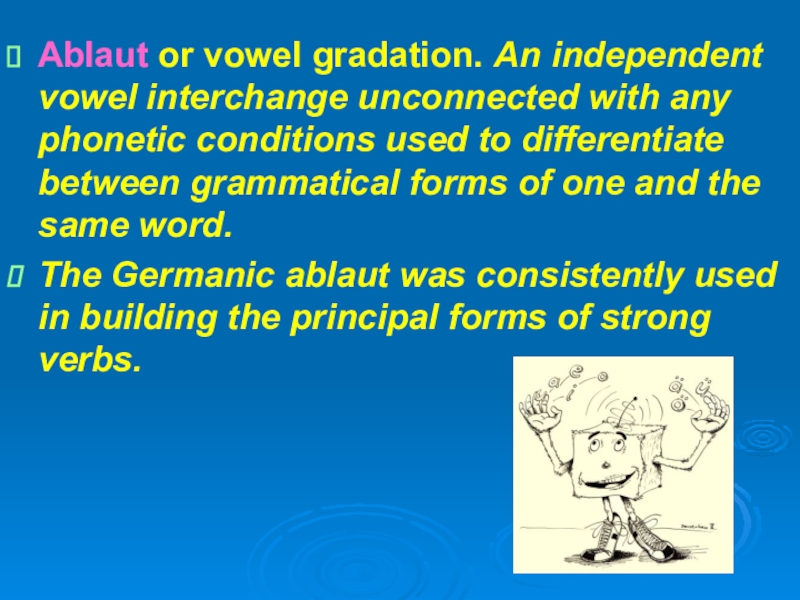
- 24. Ablaut or vowel gradation. An independent vowel interchange unconnected
Modern Germanic Languages Languages can be classified according to different principles. The historical, or genealogical classification, groups languages in accordance with their origin form a common linguistic ancestor.
Слайд 2Modern Germanic Languages
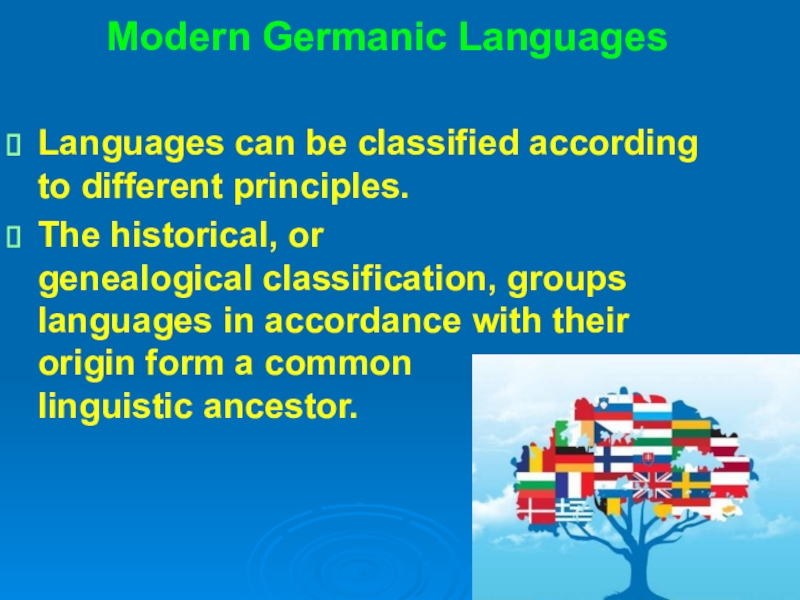
Languages can be classified according to different principles.
The historical, or genealogical classification, groups languages in accordance with their origin form a common linguistic ancestor.
Слайд 3Genetically, English belongs to the Germanic or Teutonic group of languages,
which is
one of the twelve groups of the IE linguistic family.
Most of the area of Europe and large parts of other continents are occupied today by the IE languages, Germanic being one of their major groups.
Most of the area of Europe and large parts of other continents are occupied today by the IE languages, Germanic being one of their major groups.
Слайд 6English - in Great Britain, Ireland, the USA, Canada, Australia, New
Zeland, the South
African Respublic, and many other former British colonies and dominions;
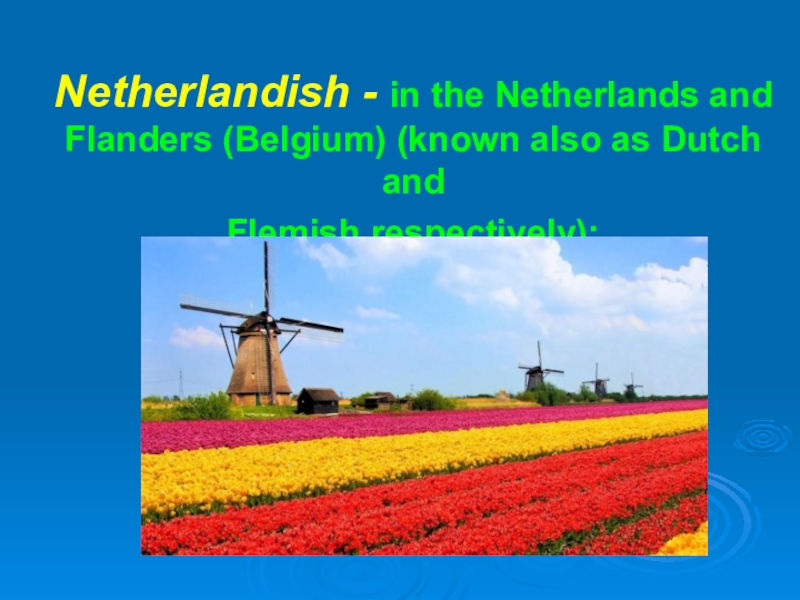
Слайд 8Netherlandish - in the Netherlands and Flanders (Belgium) (known also as
Dutch and
Flemish respectively);
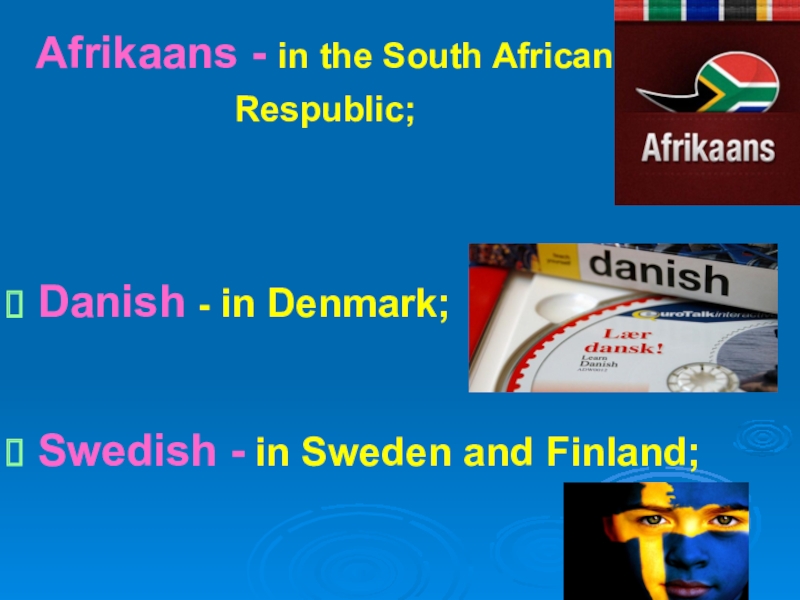
Слайд 9Afrikaans - in the South African Respublic;
Danish - in Denmark;
Swedish
- in Sweden and Finland;
Слайд 10Norwegian - in Norway;
Icelandic - in Iceland;
Frisian - in some regions
of the Netherlands and Germany;
Faroese - in the Faroe Islands;
Yiddish - in different countries.
Faroese - in the Faroe Islands;
Yiddish - in different countries.
Слайд 11All the Germanic languages are related through their common origin and
joint
development at the early stages of history.
The survey of their external history will show where and when the Germanic languages arose and acquired their common features and also how they have developed into modern tongues.
The survey of their external history will show where and when the Germanic languages arose and acquired their common features and also how they have developed into modern tongues.
Слайд 12The Earliest Period of Germanic History.
Proto-Germanic
The history of the Germanic
group begins with the appearance of what is known as the
Proto-Germanic (PG) language (also termed Common or Primitive Germanic, Primitive
Teutonic and simply Gemanic).
PG is the linguistic ancestor or the parent-language of the Germanic group.
It is supposed to have split from related IE languages sometime between the 15th and 10th c. B.C.
The would-be Germanic tribes belonged to the western division of the IE speech community.
PG is the linguistic ancestor or the parent-language of the Germanic group.
It is supposed to have split from related IE languages sometime between the 15th and 10th c. B.C.
The would-be Germanic tribes belonged to the western division of the IE speech community.
Слайд 13PG is an entirely pre-historical language: it was never recorded in
written form.
In the 19th c. it was reconstructed by methods of comparative linguistics from written evidence in descendant languages.
In the 19th c. it was reconstructed by methods of comparative linguistics from written evidence in descendant languages.
Слайд 14It is believed that at the earliest stages of history PG
was fundamentally one language, though dialectally coloured.
In its later stages dialectal differences grew, so that towards the beginning of our era Germanic appears divided into dialectical groups and tribal dialects.
Dialectal differentation increases with the migrations and geographical expansion of the Teutons caused by overpopulation, poor agricultural technigue and scanty natural resources in the areas of their original settlement.
In its later stages dialectal differences grew, so that towards the beginning of our era Germanic appears divided into dialectical groups and tribal dialects.
Dialectal differentation increases with the migrations and geographical expansion of the Teutons caused by overpopulation, poor agricultural technigue and scanty natural resources in the areas of their original settlement.
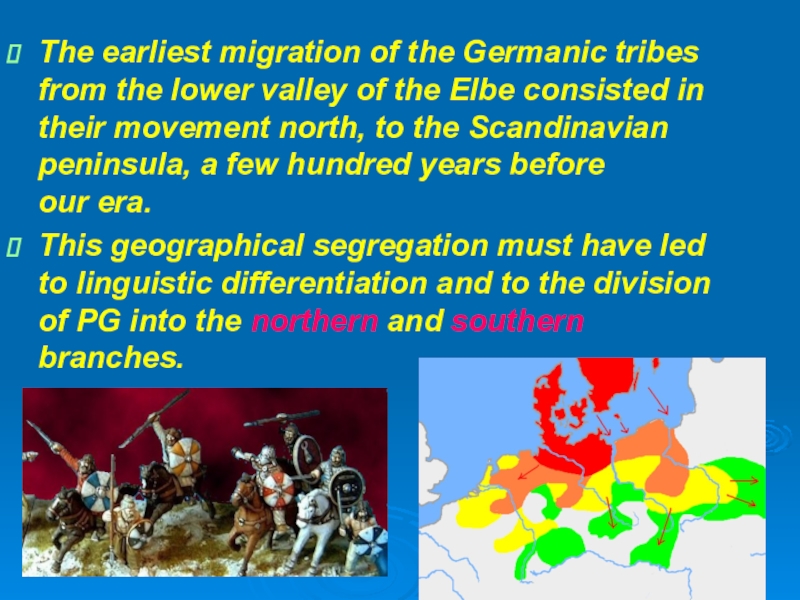
Слайд 15The earliest migration of the Germanic tribes from the lower valley
of the Elbe consisted in their movement north, to the Scandinavian peninsula, a few hundred years before
our era.
This geographical segregation must have led to linguistic differentiation and to the division of PG into the northern and southern branches.
This geographical segregation must have led to linguistic differentiation and to the division of PG into the northern and southern branches.
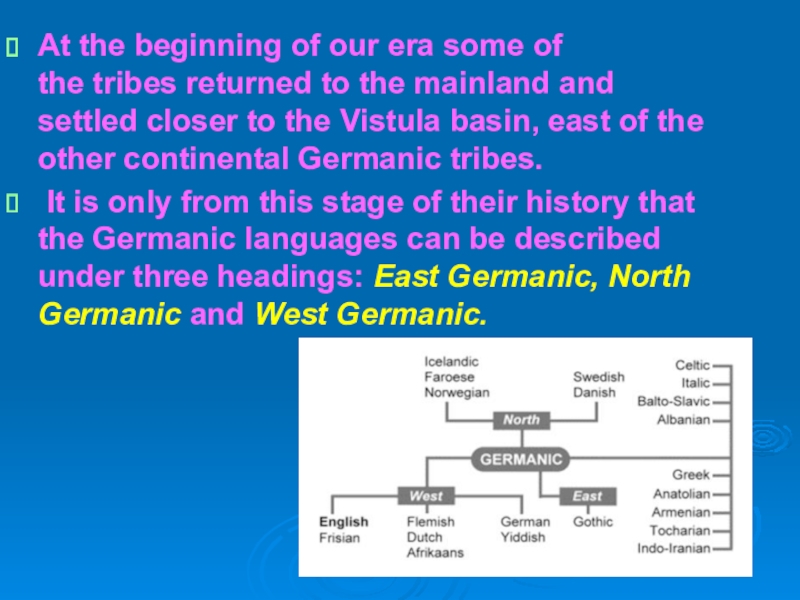
Слайд 16At the beginning of our era some of the tribes returned to
the mainland and settled closer to the Vistula basin, east of the other continental Germanic tribes.
It is only from this stage of their history that the Germanic languages can be described under three headings: East Germanic, North Germanic and West Germanic.
It is only from this stage of their history that the Germanic languages can be described under three headings: East Germanic, North Germanic and West Germanic.
Слайд 17LINGUISTIC and Grammatical
FEATURES OF GERMANIC LANGUAGES
The Proto-Germanic and the old Germanic
languages were synthetic languages (the relationships between the parts of the sentence were shown by the forms of the words rather than position in the sentence or by auxiliary words).
One the main processes in the development of the Germanic morphological system was the change in the word structure.
One the main processes in the development of the Germanic morphological system was the change in the word structure.
Слайд 18The common I-E notional word consisted of 3 elements:
root (expressing
the lexical meaning),
inflexion (ending) (showing the grammatical form),
stem-forming suffix.
However in Germanic languages the stem forming suffix fuses with the ending and is often no longer visible.
inflexion (ending) (showing the grammatical form),
stem-forming suffix.
However in Germanic languages the stem forming suffix fuses with the ending and is often no longer visible.
Слайд 19 The Germanic nouns had a well-developed case system with 4 cases:
nominative,
genitive,
dative,
accusative.
And two number forms: singular and plural.
They also had the category of gender: feminine, masculine, neuter.
Слайд 20 Germanic adjectives had two types of declination:
weak
strong.
They also had degrees
of comparison.
Слайд 21Germanic verbs are divided into 2 principal groups: strong and weak.
Depending on
the way they formed their past tense forms.
The past tense of strong verbs was formed with the help of ablaut(чередование гласных).
Weak verbs expressed past tense with the help of the dental suffix “d/t”.
The Germanic verb had a well-developed system of categories including the category of person 1st, 2nd, 3rd; category of number singular/plural.
Also Germanic verb had tense: past and present.
They also had mood: indicative, imperative, optative.
The past tense of strong verbs was formed with the help of ablaut(чередование гласных).
Weak verbs expressed past tense with the help of the dental suffix “d/t”.
The Germanic verb had a well-developed system of categories including the category of person 1st, 2nd, 3rd; category of number singular/plural.
Also Germanic verb had tense: past and present.
They also had mood: indicative, imperative, optative.
Слайд 22The grammatical forms of the word were built by means of
suppletion (the usage of two or more different roots as forms of one and the same word) (I, my, mine, me) (ich, mich, mir).
Слайд 23Though in the Germanic languages inflections were simpler and shorter than
in other in other I-E languages.
The usage of interchange of vowels and consonants for the purpose of word and form building. (tooth-teeth, build-built).
The usage of interchange of vowels and consonants for the purpose of word and form building. (tooth-teeth, build-built).
Слайд 24Ablaut or vowel gradation. An independent vowel interchange unconnected with any phonetic conditions
used to differentiate between grammatical forms of one and the same word.
The Germanic ablaut was consistently used in building the principal forms of strong verbs.
The Germanic ablaut was consistently used in building the principal forms of strong verbs.