- Главная
- Разное
- Образование
- Спорт
- Естествознание
- Природоведение
- Религиоведение
- Французский язык
- Черчение
- Английский язык
- Астрономия
- Алгебра
- Биология
- География
- Геометрия
- Детские презентации
- Информатика
- История
- Литература
- Математика
- Музыка
- МХК
- Немецкий язык
- ОБЖ
- Обществознание
- Окружающий мир
- Педагогика
- Русский язык
- Технология
- Физика
- Философия
- Химия
- Шаблоны, фоны, картинки для презентаций
- Экология
- Экономика
Презентация, доклад по английскому языку на темуАвстралия 8 класс
Содержание
- 1. Презентация по английскому языку на темуАвстралия 8 класс
- 2. AUSTRALIA Australia is the smallest, flattest, and driest
- 3. THE COUNTRY Is the area
- 4. THE CITY Is any large city
- 5. CULTURE Australia is very much a multi-cultural nation,
- 6. A LITTLE HISTORY In 1836 Colonel William
- 7. PLACES TO VISIT The National Trust of Australia
- 8. FLINDERS RANGES NATIONAL PARK Forming part of a
- 9. SOUTH AUSTRALIA TOURIST
- 10. YORKE PENINSULA The York Peninsula was originally settled
- 11. REN MARKSome 260 km north-east of Adelaide
- 12. SOUTH AUSTRALIA
- 13. WAVE ROCK Wave
- 14. FOOD Australian cuisine has the most diverse range,
- 15. FOREST Today in Australia, the rainforest and
- 16. BRIDGE OF AUSTRALIA
- 17. Слайд 17
- 18. AVON VALLEY NATIONAL PARKS
- 19. LEISURE To make life
- 20. Without Spending money I
AUSTRALIA Australia is the smallest, flattest, and driest inhabited continent in the world. It is the only country which is also a whole continent. 18.6 million people live here. The people of Australia are called Australians. Australians call
Слайд 2AUSTRALIA
Australia is the smallest, flattest, and driest inhabited continent in the
world. It is the only country which is also a whole continent. 18.6 million people live here.
The people of Australia are called Australians. Australians call different parts of their country by different names.
The Outback
Is the sparsely populated arid interior of Australia. The Australian Outback is both harsh and breathtakingly beautiful. It's like no other place on earth. Coober Pedy, Uluru, etc are in the Outback.
The people of Australia are called Australians. Australians call different parts of their country by different names.
The Outback
Is the sparsely populated arid interior of Australia. The Australian Outback is both harsh and breathtakingly beautiful. It's like no other place on earth. Coober Pedy, Uluru, etc are in the Outback.
Слайд 3THE COUNTRY
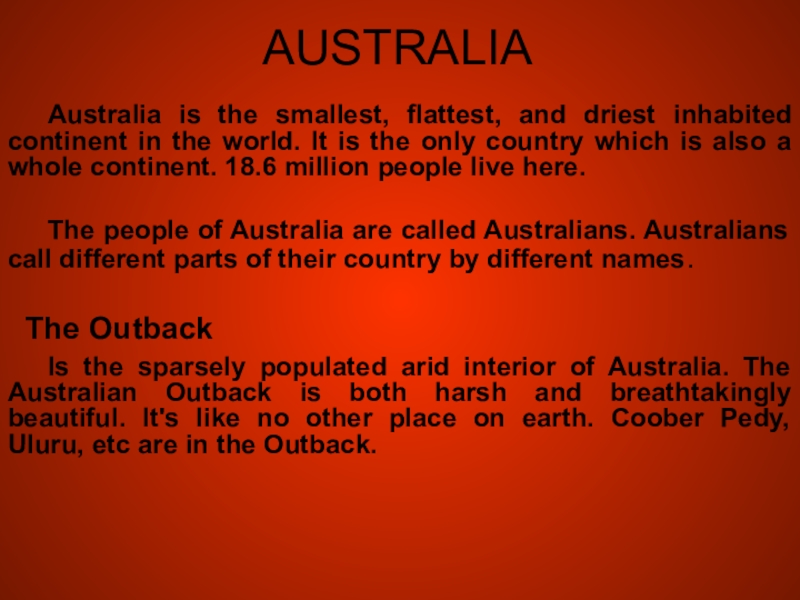
Is the area immediately outside
the city
and usually includes the
surrounding smaller towns and
farms. Most of what is called
"the country" is a stretch of land
about 200 kilometres deep
around the eastern and southern
seaboards of Australia. Upper
Beaconsfield, the Great Ocean
Road , the Dandenongs, etc are
in "the country".
surrounding smaller towns and
farms. Most of what is called
"the country" is a stretch of land
about 200 kilometres deep
around the eastern and southern
seaboards of Australia. Upper
Beaconsfield, the Great Ocean
Road , the Dandenongs, etc are
in "the country".
Слайд 4THE CITY
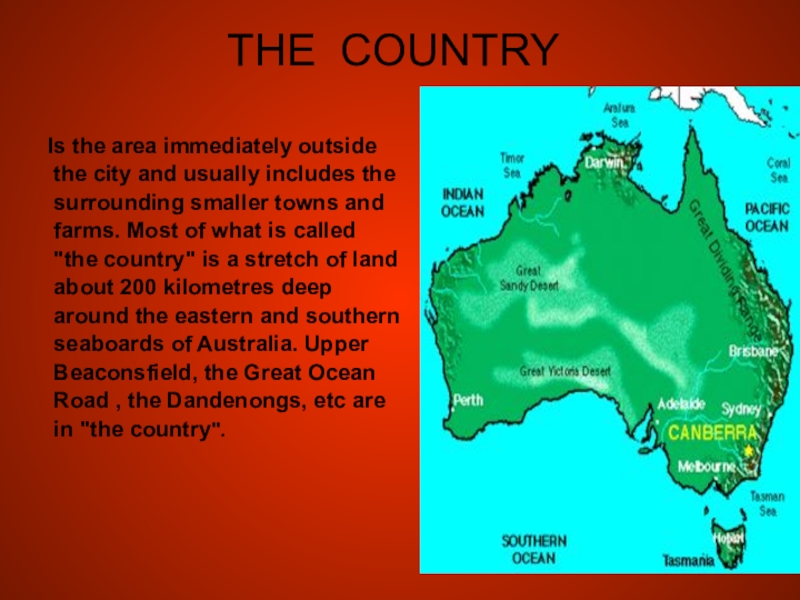
Is any large city and its suburbs. Over
85% of the people live in cities. Melbourne Is any large city and its suburbs. Over 85% of the people live in cities. Melbourne, Sydney Is any large city and its suburbs. Over 85% of the people live in cities. Melbourne, Sydney, Brisbane, Perth and Canberra are major cities
Слайд 5CULTURE
Australia is very much a multi-cultural nation, having enjoyed waves of
immigration starting with the Australian Aboriginals 40,000 years ago, followed by the English 200 years ago. Since the Second World War, Australia has received millions of migrants, with the population roughly tripling over a period of fifty years. However, although Australia is similar in size to the continental USA, its population is still only around 20 million and is heavily concentrated in the major coastal cities; central Australia is essentially a wildly beautiful but uninhabited desert.
Much of the Australian life-style revolves around the outdoors and sport. Australians like to relax actively by bush-walking, skiing, surfing, sailing, swimming, or any other activity that takes them into the sun and open air.
Much of the Australian life-style revolves around the outdoors and sport. Australians like to relax actively by bush-walking, skiing, surfing, sailing, swimming, or any other activity that takes them into the sun and open air.
Слайд 6A LITTLE HISTORY
In 1836 Colonel William Light arrived at Holdfast
Bay (now named Glenelg) to claim the region as a British colony. Adelaide was chosen for a capital, and the first Governor (Captain John Hindmarsh) named it after the King of Englands wife.
The colony nearly went bankrupt, due to slow progress, but British funds saved it. By the mid 1840's the colony was able to support itself, and was self-governed by 1856.
The colony nearly went bankrupt, due to slow progress, but British funds saved it. By the mid 1840's the colony was able to support itself, and was self-governed by 1856.
Слайд 7PLACES TO VISIT
The National Trust of Australia (W.A.) is actively involved
in the conservation and interpretation of a significant number of heritage properties. Regardless of the form of title or vesting, the National Trust regards its role as one of stewardship of these heritage places for the ongoing enjoyment of the public. It is through visits to National Trust properties that we can develop an awareness of our heritage, an understanding of the issues involved and an appreciation of the role of heritage in our community today and into the future.
Membership in the National Trust of Australia (W.A.) includes an entitlement for free entry to Trust properties throughout Western Australia as well as nationally and internationally..
Membership in the National Trust of Australia (W.A.) includes an entitlement for free entry to Trust properties throughout Western Australia as well as nationally and internationally..
Слайд 8FLINDERS RANGES NATIONAL PARK
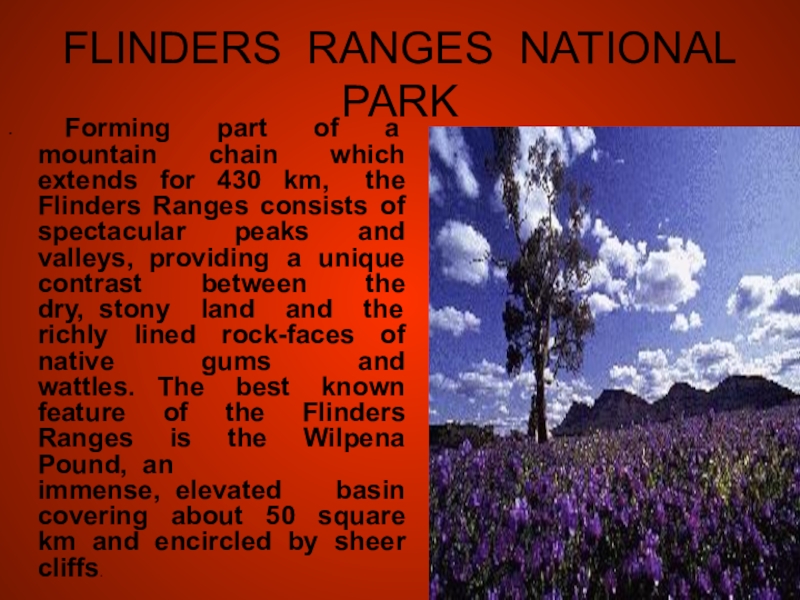
Forming part of a mountain chain which extends
for 430 km, the Flinders Ranges consists of spectacular peaks and valleys, providing a unique contrast between the dry, stony land and the richly lined rock-faces of native gums and wattles. The best known feature of the Flinders Ranges is the Wilpena Pound, an immense, elevated basin covering about 50 square km and encircled by sheer cliffs.
Слайд 9SOUTH AUSTRALIA TOURIST PLACES
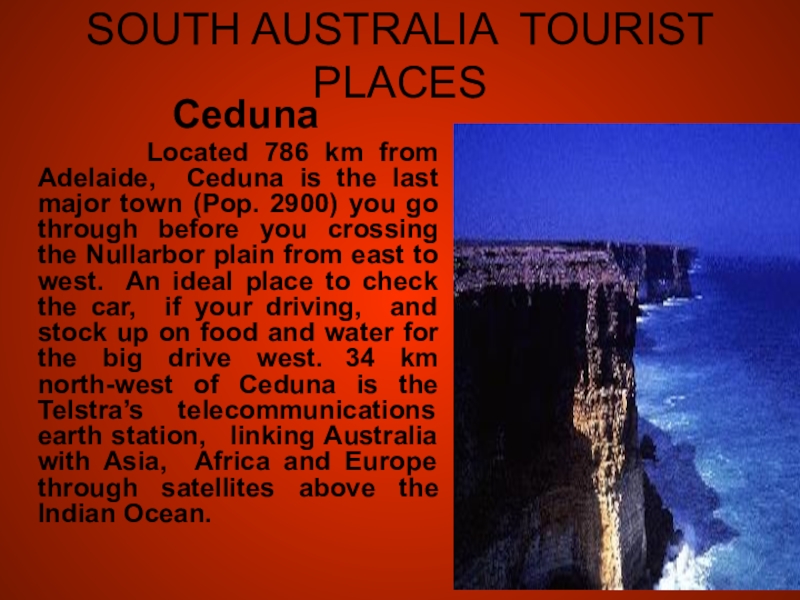
Ceduna
Located 786 km from Adelaide, Ceduna is the last major town (Pop. 2900) you go through before you crossing the Nullarbor plain from east to west. An ideal place to check the car, if your driving, and stock up on food and water for the big drive west. 34 km north-west of Ceduna is the Telstra’s telecommunications earth station, linking Australia with Asia, Africa and Europe through satellites above the Indian Ocean.
Слайд 10YORKE PENINSULA
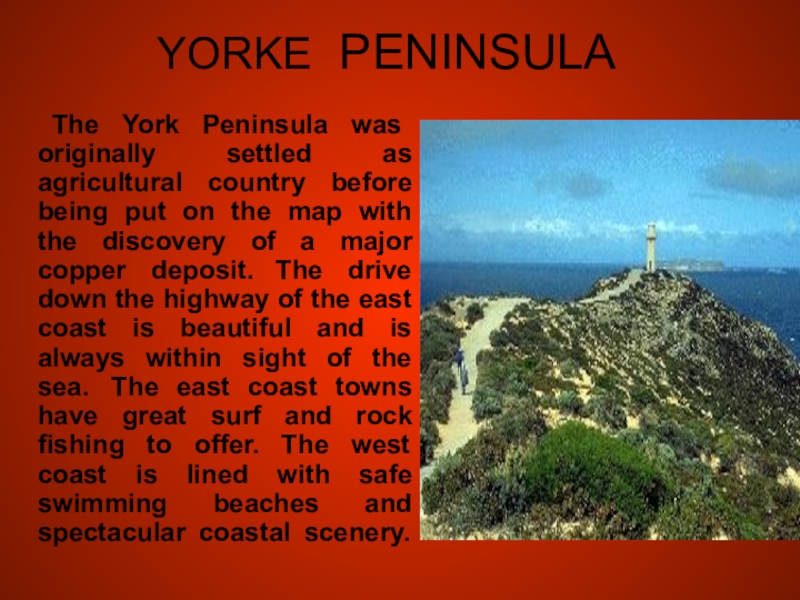
The York Peninsula was originally settled as agricultural country before
being put on the map with the discovery of a major copper deposit. The drive down the highway of the east coast is beautiful and is always within sight of the sea. The east coast towns have great surf and rock fishing to offer. The west coast is lined with safe swimming beaches and spectacular coastal scenery.
Слайд 11REN MARK
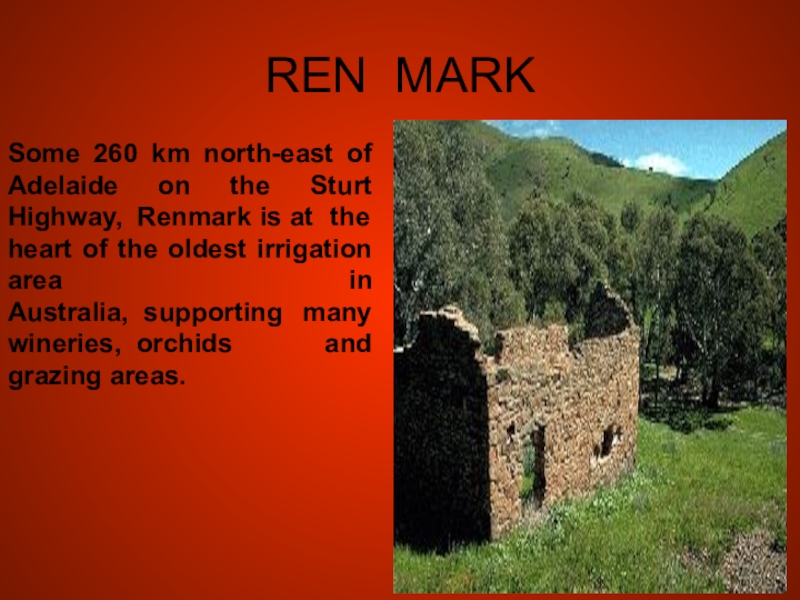
Some 260 km north-east of Adelaide on the Sturt Highway, Renmark
is at the heart of the oldest irrigation area in Australia, supporting many wineries, orchids and grazing areas.
Слайд 12SOUTH AUSTRALIA
South Australia, with
it's huge semi-desert areas in the far Outback South Australia, with it's huge semi-desert areas in the far Outback, is the driest out of all of the states and also the most urbanised. Adelaide, the capital, has been called 'the city of churches' and is home to 80% of the regions population of roughly 1.47 million, living in 984,277 sq km.
Although the churches are still in Adelaide, times are different now. The main spirit of the city is demonstrated through Adelaide's Festival of Arts. It has a liberal attitude and Maslin Beach was the first nudist beach.
Although the churches are still in Adelaide, times are different now. The main spirit of the city is demonstrated through Adelaide's Festival of Arts. It has a liberal attitude and Maslin Beach was the first nudist beach.
Слайд 13WAVE ROCK
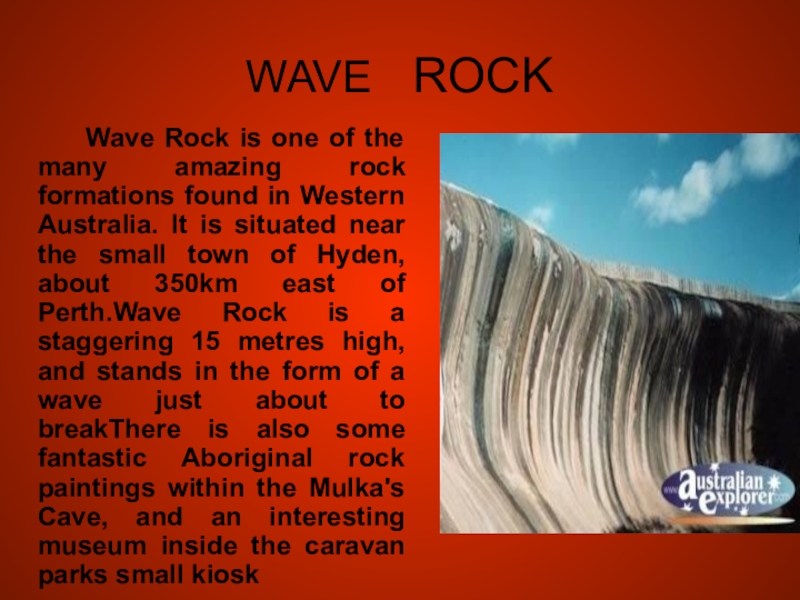
Wave Rock is one of
the many amazing rock formations found in Western Australia. It is situated near the small town of Hyden, about 350km east of Perth.Wave Rock is a staggering 15 metres high, and stands in the form of a wave just about to breakThere is also some fantastic Aboriginal rock paintings within the Mulka's Cave, and an interesting museum inside the caravan parks small kiosk
Слайд 14FOOD
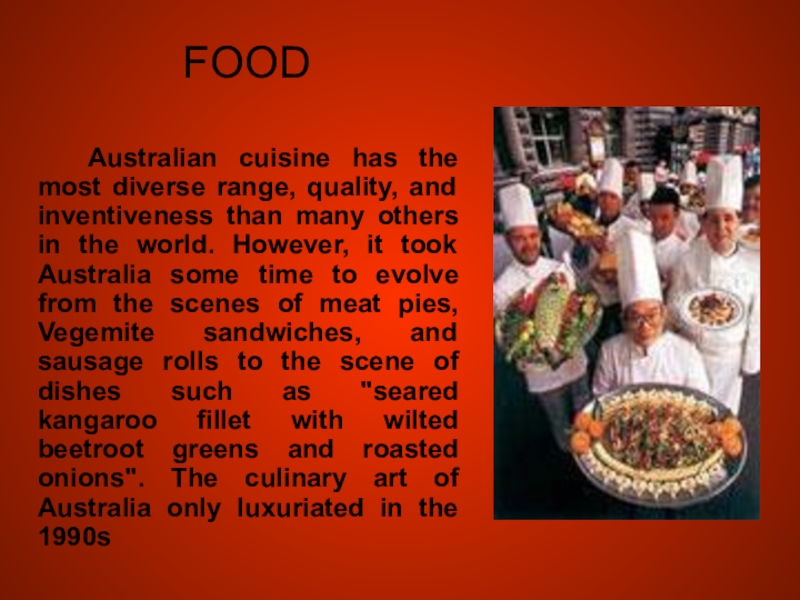
Australian cuisine has the most diverse range, quality, and inventiveness than
many others in the world. However, it took Australia some time to evolve from the scenes of meat pies, Vegemite sandwiches, and sausage rolls to the scene of dishes such as "seared kangaroo fillet with wilted beetroot greens and roasted onions". The culinary art of Australia only luxuriated in the 1990s
Слайд 15FOREST
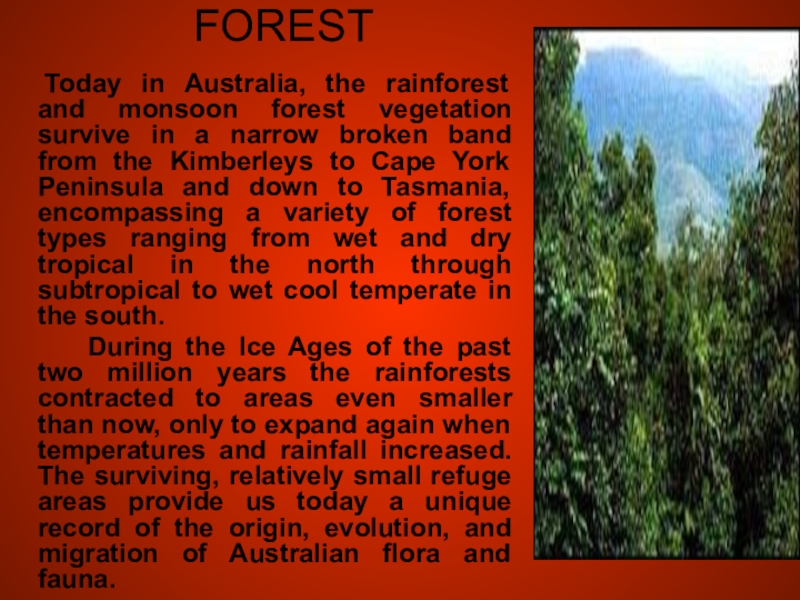
Today in Australia, the rainforest and monsoon forest vegetation survive in
a narrow broken band from the Kimberleys to Cape York Peninsula and down to Tasmania, encompassing a variety of forest types ranging from wet and dry tropical in the north through subtropical to wet cool temperate in the south.
During the Ice Ages of the past two million years the rainforests contracted to areas even smaller than now, only to expand again when temperatures and rainfall increased. The surviving, relatively small refuge areas provide us today a unique record of the origin, evolution, and migration of Australian flora and fauna.
During the Ice Ages of the past two million years the rainforests contracted to areas even smaller than now, only to expand again when temperatures and rainfall increased. The surviving, relatively small refuge areas provide us today a unique record of the origin, evolution, and migration of Australian flora and fauna.
Слайд 18AVON VALLEY NATIONAL PARKS
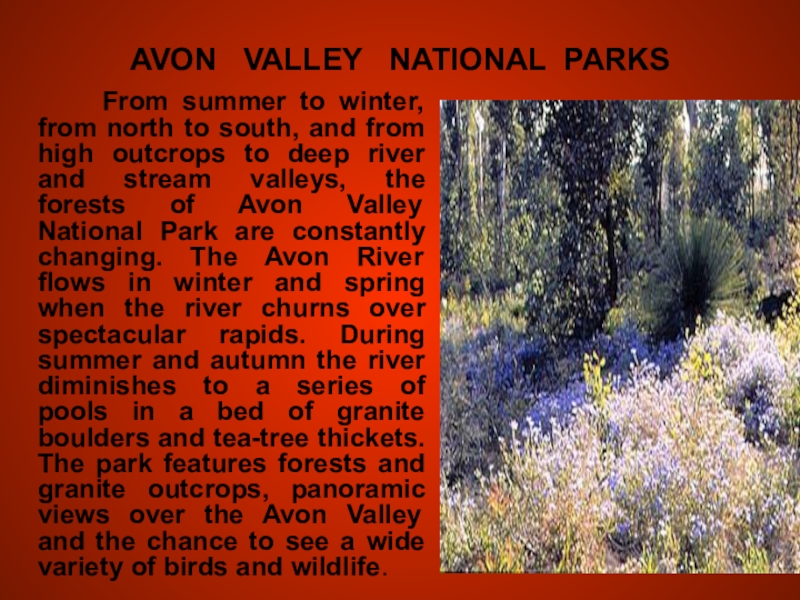
From summer
to winter, from north to south, and from high outcrops to deep river and stream valleys, the forests of Avon Valley National Park are constantly changing. The Avon River flows in winter and spring when the river churns over spectacular rapids. During summer and autumn the river diminishes to a series of pools in a bed of granite boulders and tea-tree thickets. The park features forests and granite outcrops, panoramic views over the Avon Valley and the chance to see a wide variety of birds and wildlife.
Слайд 19LEISURE
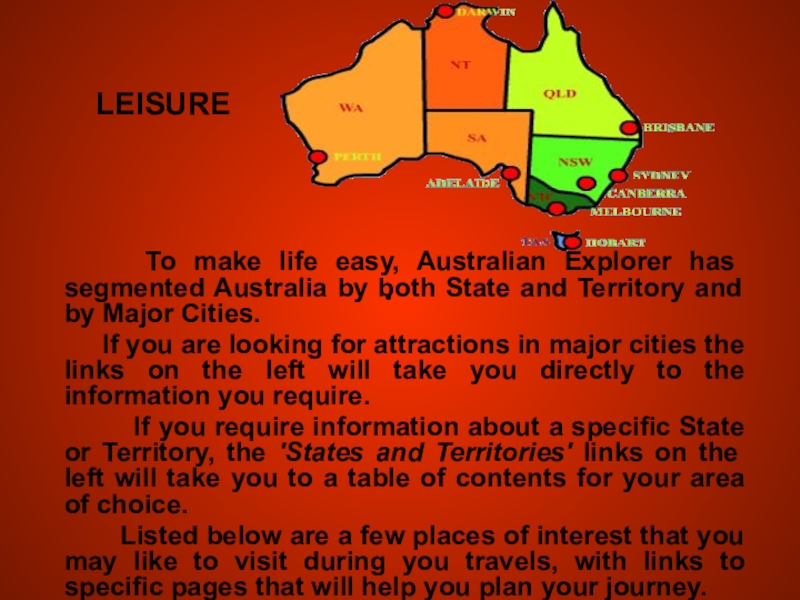
To make life easy, Australian Explorer has
segmented Australia by both State and Territory and by Major Cities.
If you are looking for attractions in major cities the links on the left will take you directly to the information you require.
If you require information about a specific State or Territory, the 'States and Territories' links on the left will take you to a table of contents for your area of choice.
Listed below are a few places of interest that you may like to visit during you travels, with links to specific pages that will help you plan your journey.
If you are looking for attractions in major cities the links on the left will take you directly to the information you require.
If you require information about a specific State or Territory, the 'States and Territories' links on the left will take you to a table of contents for your area of choice.
Listed below are a few places of interest that you may like to visit during you travels, with links to specific pages that will help you plan your journey.
Слайд 20 Without Spending money I have enjoyed a lot.I
hope u too .
Thank You.
Regards,
Ruban
Thank You.
Regards,
Ruban
Conclusion