- Главная
- Разное
- Образование
- Спорт
- Естествознание
- Природоведение
- Религиоведение
- Французский язык
- Черчение
- Английский язык
- Астрономия
- Алгебра
- Биология
- География
- Геометрия
- Детские презентации
- Информатика
- История
- Литература
- Математика
- Музыка
- МХК
- Немецкий язык
- ОБЖ
- Обществознание
- Окружающий мир
- Педагогика
- Русский язык
- Технология
- Физика
- Философия
- Химия
- Шаблоны, фоны, картинки для презентаций
- Экология
- Экономика
Презентация, доклад по английскому языку на тему Научно-технический прогресс
Содержание
- 1. Презентация по английскому языку на тему Научно-технический прогресс
- 2. The technological revolution) - a radical transformation
- 3. NTS began in 1940-1950-s as a
- 4. Modern scientific and technological revolution is a
- 5. Science in the NTS is a very
- 6. The present stage of scientific and technological
- 7. The first stage.40th, the - the television,
- 8. One of the major incentives for the
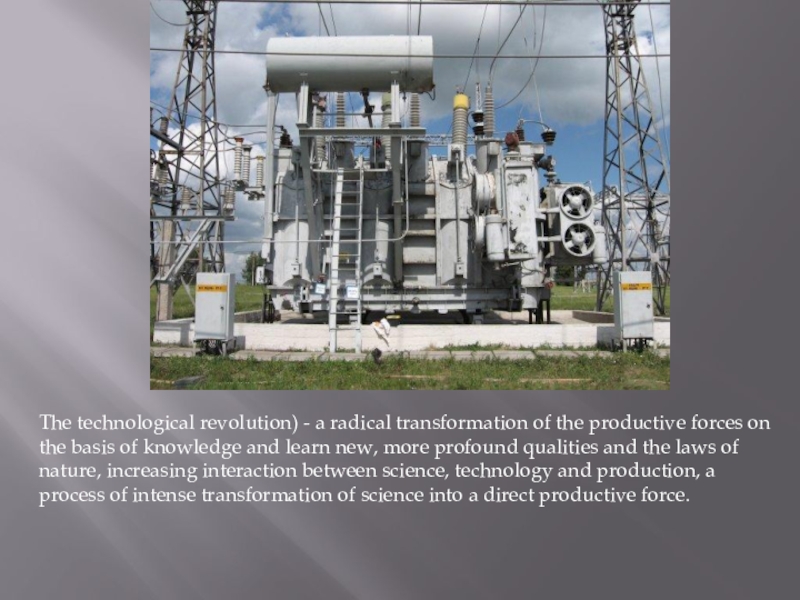
The technological revolution) - a radical transformation of the productive forces on the basis of knowledge and learn new, more profound qualities and the laws of nature, increasing interaction between science, technology and production, a process

Слайд 2The technological revolution) - a radical transformation of the productive forces
on the basis of knowledge and learn new, more profound qualities and the laws of nature, increasing interaction between science, technology and production, a process of intense transformation of science into a direct productive force.
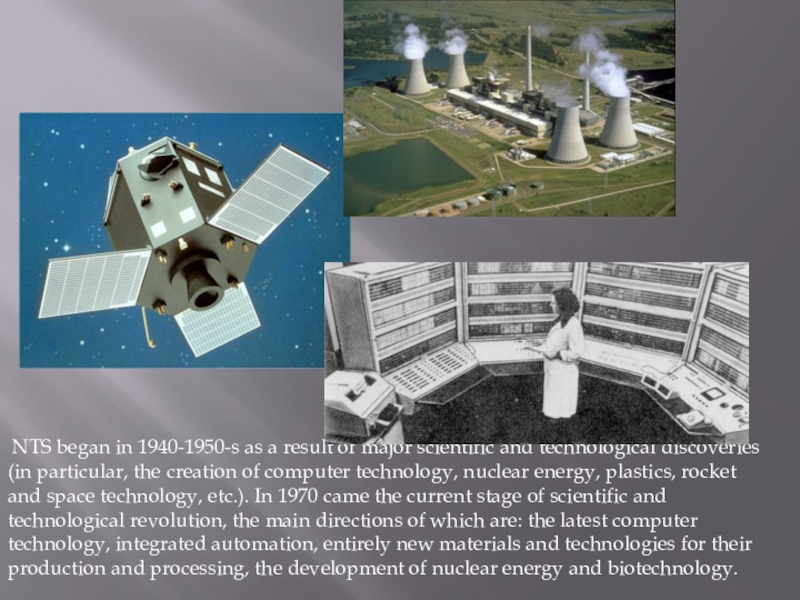
Слайд 3 NTS began in 1940-1950-s as a result of major scientific
and technological discoveries (in particular, the creation of computer technology, nuclear energy, plastics, rocket and space technology, etc.). In 1970 came the current stage of scientific and technological revolution, the main directions of which are: the latest computer technology, integrated automation, entirely new materials and technologies for their production and processing, the development of nuclear energy and biotechnology.
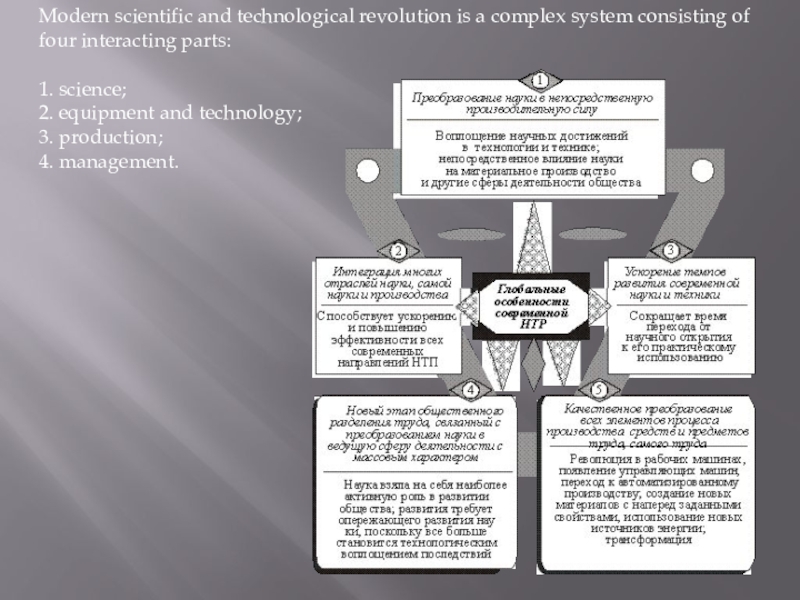
Слайд 4Modern scientific and technological revolution is a complex system consisting of
four interacting parts:
1. science;
2. equipment and technology;
3. production;
4. management.
1. science;
2. equipment and technology;
3. production;
4. management.
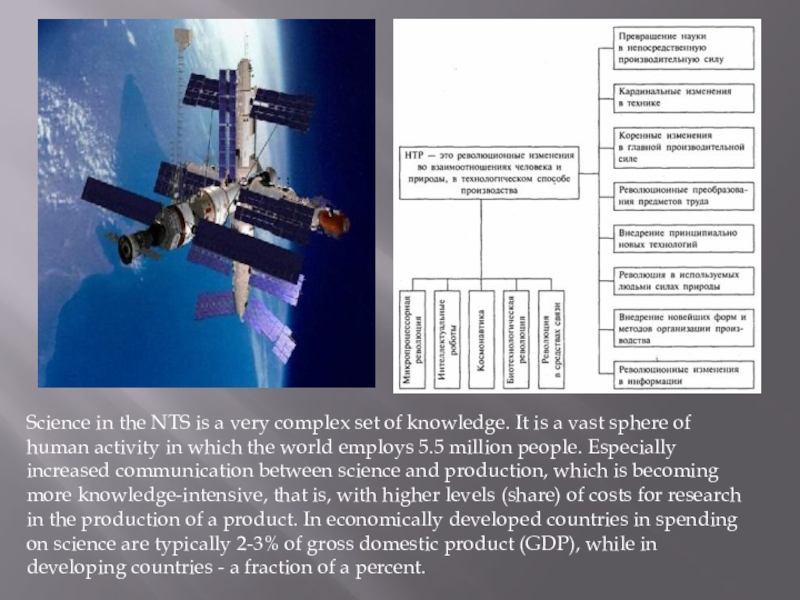
Слайд 5Science in the NTS is a very complex set of knowledge.
It is a vast sphere of human activity in which the world employs 5.5 million people. Especially increased communication between science and production, which is becoming more knowledge-intensive, that is, with higher levels (share) of costs for research in the production of a product. In economically developed countries in spending on science are typically 2-3% of gross domestic product (GDP), while in developing countries - a fraction of a percent.
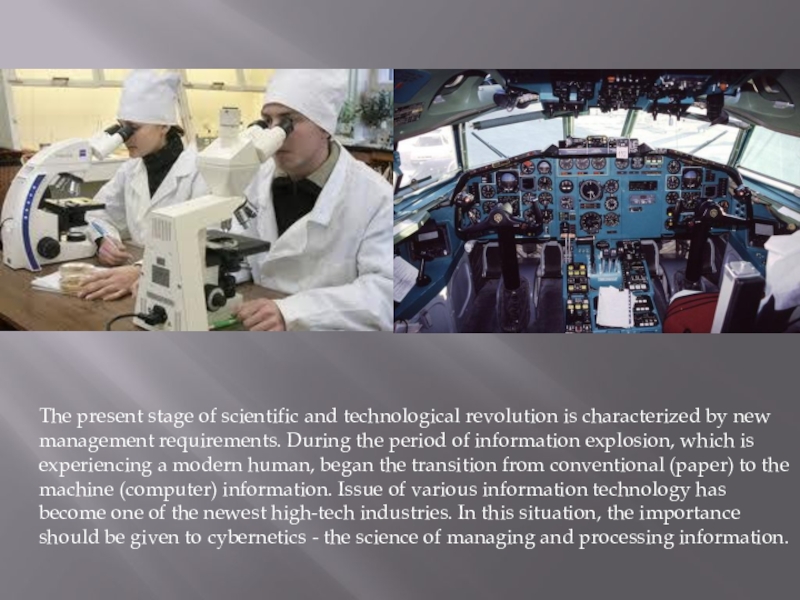
Слайд 6The present stage of scientific and technological revolution is characterized by
new management requirements. During the period of information explosion, which is experiencing a modern human, began the transition from conventional (paper) to the machine (computer) information. Issue of various information technology has become one of the newest high-tech industries. In this situation, the importance should be given to cybernetics - the science of managing and processing information.
Слайд 7The first stage.
40th, the - the television, transistors, computers, radar, missile,
bomb, synthetic fibers, penicillin;
50s. - The hydrogen bomb, satellites, jet passenger aircraft, electric power plant on the basis of nuclear reactors, machine tools with numerical control (CNC);
60s. - Lasers, integrated circuits, communications satellites, high-speed express trains.
The second stage.
70s - microprocessors, fiber-optic communication, industrial robots, biotechnology;
80s. - Extra large and bulky integrated circuits, heavy-duty ceramic, a fifth-generation computers, genetic engineering, nuclear fusion.
50s. - The hydrogen bomb, satellites, jet passenger aircraft, electric power plant on the basis of nuclear reactors, machine tools with numerical control (CNC);
60s. - Lasers, integrated circuits, communications satellites, high-speed express trains.
The second stage.
70s - microprocessors, fiber-optic communication, industrial robots, biotechnology;
80s. - Extra large and bulky integrated circuits, heavy-duty ceramic, a fifth-generation computers, genetic engineering, nuclear fusion.
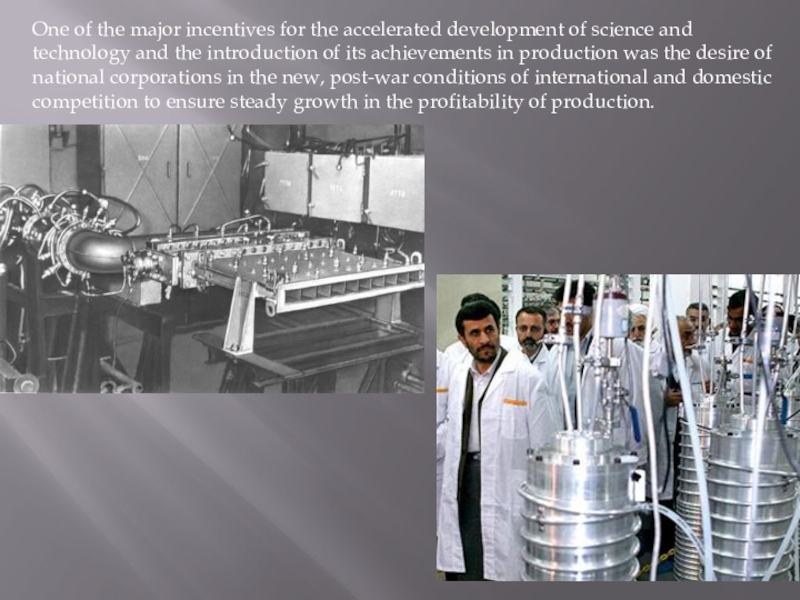
Слайд 8One of the major incentives for the accelerated development of science
and technology and the introduction of its achievements in production was the desire of national corporations in the new, post-war conditions of international and domestic competition to ensure steady growth in the profitability of production.