- Главная
- Разное
- Образование
- Спорт
- Естествознание
- Природоведение
- Религиоведение
- Французский язык
- Черчение
- Английский язык
- Астрономия
- Алгебра
- Биология
- География
- Геометрия
- Детские презентации
- Информатика
- История
- Литература
- Математика
- Музыка
- МХК
- Немецкий язык
- ОБЖ
- Обществознание
- Окружающий мир
- Педагогика
- Русский язык
- Технология
- Физика
- Философия
- Химия
- Шаблоны, фоны, картинки для презентаций
- Экология
- Экономика
Презентация, доклад по английскому языку на тему Архитектура 11 класс
Содержание
- 1. Презентация по английскому языку на тему Архитектура 11 класс
- 2. Byzantine architecture of IstanbulDuring 1123 a city
- 3. Cathedral of Saint Sofia Up to 360
- 4. Слайд 4
- 5. Sultanahmet, the Blue MosqueA square in front
- 6. Слайд 6
- 7. Topkapi PalaceThe main palace of the Ottoman
- 8. Слайд 8
- 9. Слайд 9
- 10. Слайд 10
- 11. Eminonu SquareEminonu Square is located at the
- 12. Слайд 12
- 13. Yeni Valide MosqueA small mosque is named
- 14. Слайд 14
- 15. Слайд 15
- 16. Mosque MihrimahMihrimah (favorite daughter of Suleiman the
- 17. Слайд 17
- 18. Done by Eliza Kibizova Form 11 «В»
Byzantine architecture of IstanbulDuring 1123 a city was the center of christian life, and to our days surprisingly plenty of building reached from a that era.When Mehmed Conqueror took Istanbul in 1453, great number of churches
Слайд 2Byzantine architecture of Istanbul
During 1123 a city was the center of
christian life, and to our days surprisingly plenty of building reached from a that era.
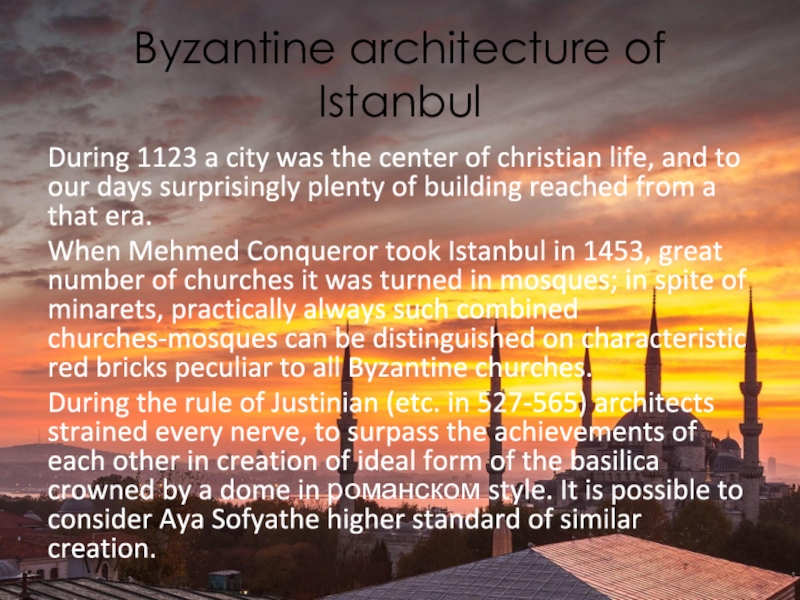
When Mehmed Conqueror took Istanbul in 1453, great number of churches it was turned in mosques; in spite of minarets, practically always such combined churches-mosques can be distinguished on characteristic red bricks peculiar to all Byzantine churches.
During the rule of Justinian (etc. in 527-565) architects strained every nerve, to surpass the achievements of each other in creation of ideal form of the basilica crowned by a dome in романском style. It is possible to consider Aya Sofyathe higher standard of similar creation.
When Mehmed Conqueror took Istanbul in 1453, great number of churches it was turned in mosques; in spite of minarets, practically always such combined churches-mosques can be distinguished on characteristic red bricks peculiar to all Byzantine churches.
During the rule of Justinian (etc. in 527-565) architects strained every nerve, to surpass the achievements of each other in creation of ideal form of the basilica crowned by a dome in романском style. It is possible to consider Aya Sofyathe higher standard of similar creation.
Слайд 3Cathedral of Saint Sofia
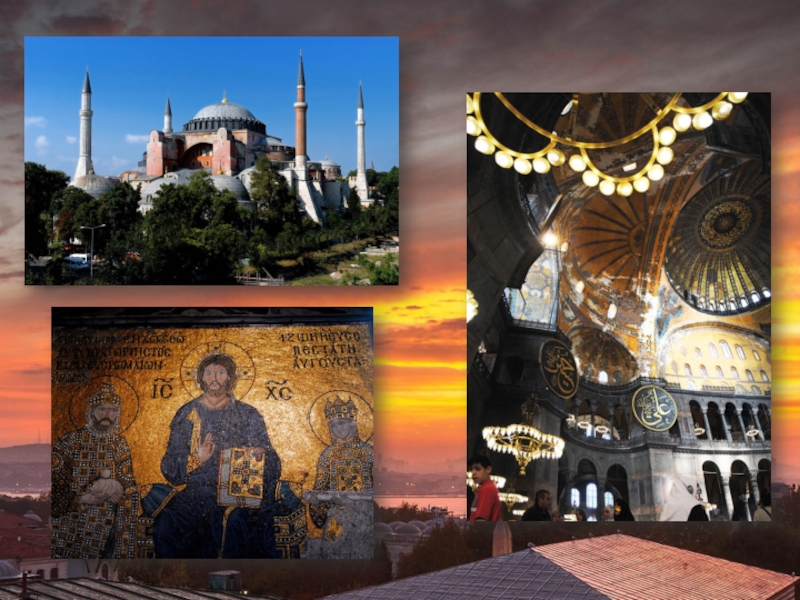
Up to 360 years at this place
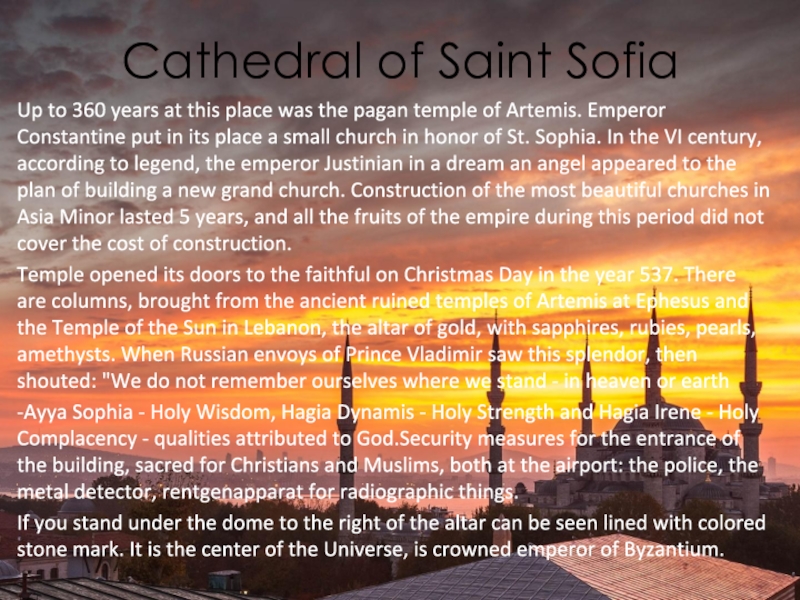
was the pagan temple of Artemis. Emperor Constantine put in its place a small church in honor of St. Sophia. In the VI century, according to legend, the emperor Justinian in a dream an angel appeared to the plan of building a new grand church. Construction of the most beautiful churches in Asia Minor lasted 5 years, and all the fruits of the empire during this period did not cover the cost of construction.
Temple opened its doors to the faithful on Christmas Day in the year 537. There are columns, brought from the ancient ruined temples of Artemis at Ephesus and the Temple of the Sun in Lebanon, the altar of gold, with sapphires, rubies, pearls, amethysts. When Russian envoys of Prince Vladimir saw this splendor, then shouted: "We do not remember ourselves where we stand - in heaven or earth
-Ayya Sophia - Holy Wisdom, Hagia Dynamis - Holy Strength and Hagia Irene - Holy Complacency - qualities attributed to God.Security measures for the entrance of the building, sacred for Christians and Muslims, both at the airport: the police, the metal detector, rentgenapparat for radiographic things.
If you stand under the dome to the right of the altar can be seen lined with colored stone mark. It is the center of the Universe, is crowned emperor of Byzantium.
Temple opened its doors to the faithful on Christmas Day in the year 537. There are columns, brought from the ancient ruined temples of Artemis at Ephesus and the Temple of the Sun in Lebanon, the altar of gold, with sapphires, rubies, pearls, amethysts. When Russian envoys of Prince Vladimir saw this splendor, then shouted: "We do not remember ourselves where we stand - in heaven or earth
-Ayya Sophia - Holy Wisdom, Hagia Dynamis - Holy Strength and Hagia Irene - Holy Complacency - qualities attributed to God.Security measures for the entrance of the building, sacred for Christians and Muslims, both at the airport: the police, the metal detector, rentgenapparat for radiographic things.
If you stand under the dome to the right of the altar can be seen lined with colored stone mark. It is the center of the Universe, is crowned emperor of Byzantium.
Слайд 5Sultanahmet, the Blue Mosque
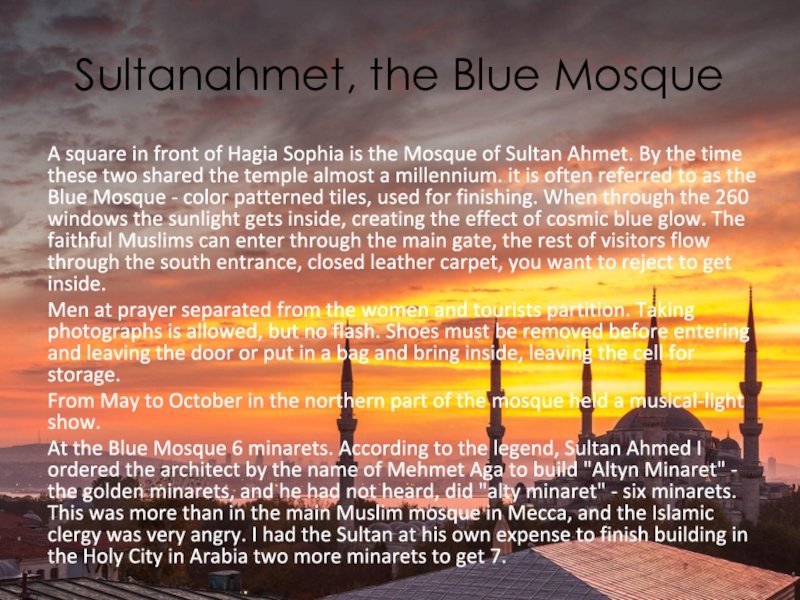
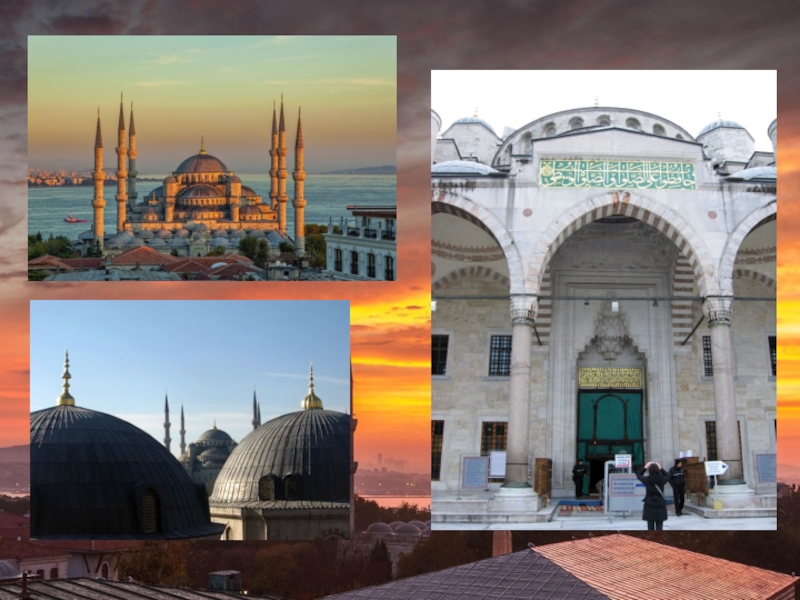
A square in front of Hagia Sophia is
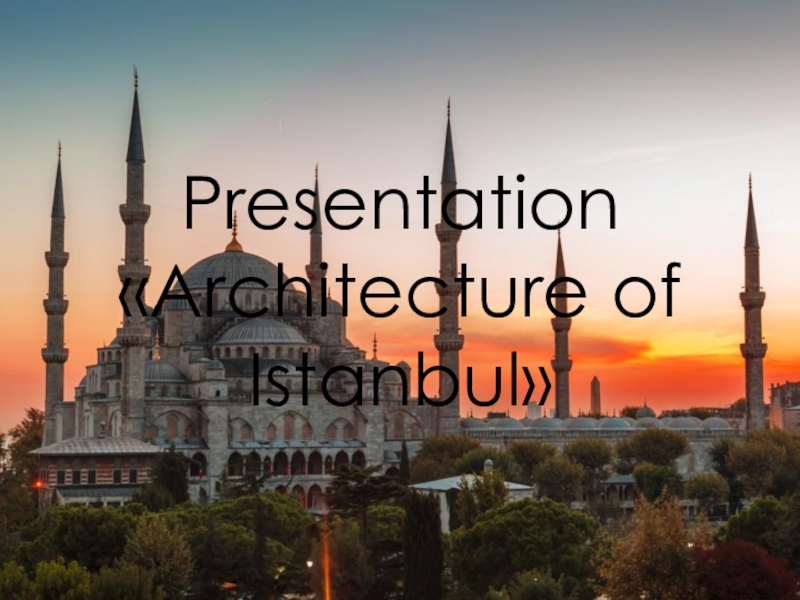
the Mosque of Sultan Ahmet. By the time these two shared the temple almost a millennium. it is often referred to as the Blue Mosque - color patterned tiles, used for finishing. When through the 260 windows the sunlight gets inside, creating the effect of cosmic blue glow. The faithful Muslims can enter through the main gate, the rest of visitors flow through the south entrance, closed leather carpet, you want to reject to get inside.
Men at prayer separated from the women and tourists partition. Taking photographs is allowed, but no flash. Shoes must be removed before entering and leaving the door or put in a bag and bring inside, leaving the cell for storage.
From May to October in the northern part of the mosque held a musical-light show.
At the Blue Mosque 6 minarets. According to the legend, Sultan Ahmed I ordered the architect by the name of Mehmet Aga to build "Altyn Minaret" - the golden minarets, and he had not heard, did "alty minaret" - six minarets. This was more than in the main Muslim mosque in Mecca, and the Islamic clergy was very angry. I had the Sultan at his own expense to finish building in the Holy City in Arabia two more minarets to get 7.
Men at prayer separated from the women and tourists partition. Taking photographs is allowed, but no flash. Shoes must be removed before entering and leaving the door or put in a bag and bring inside, leaving the cell for storage.
From May to October in the northern part of the mosque held a musical-light show.
At the Blue Mosque 6 minarets. According to the legend, Sultan Ahmed I ordered the architect by the name of Mehmet Aga to build "Altyn Minaret" - the golden minarets, and he had not heard, did "alty minaret" - six minarets. This was more than in the main Muslim mosque in Mecca, and the Islamic clergy was very angry. I had the Sultan at his own expense to finish building in the Holy City in Arabia two more minarets to get 7.
Слайд 7Topkapi Palace
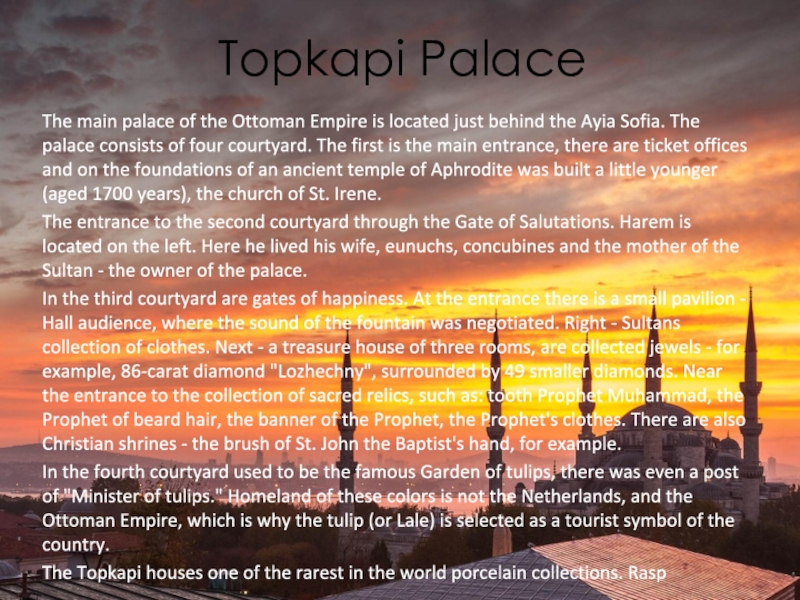
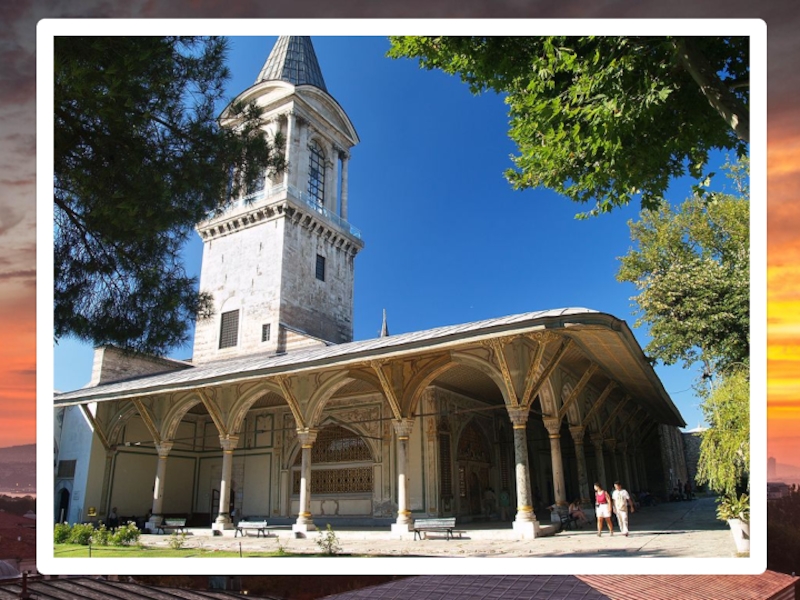
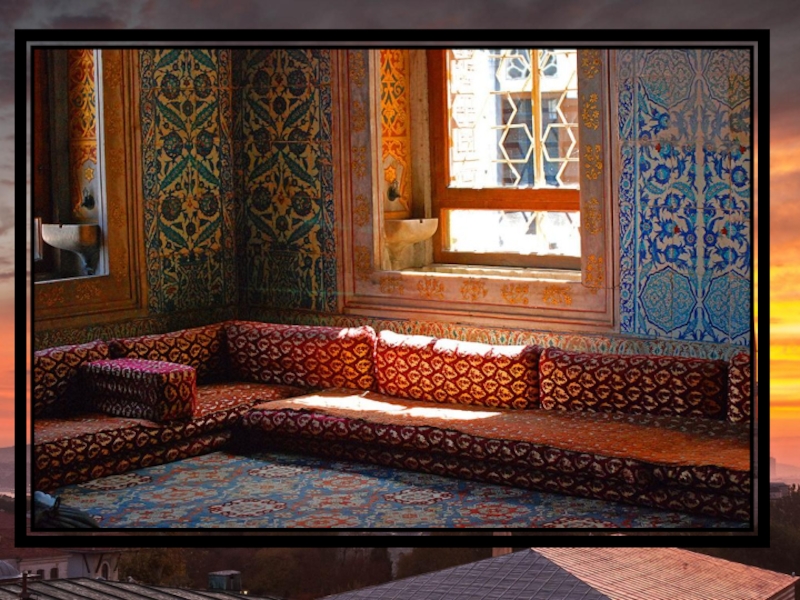
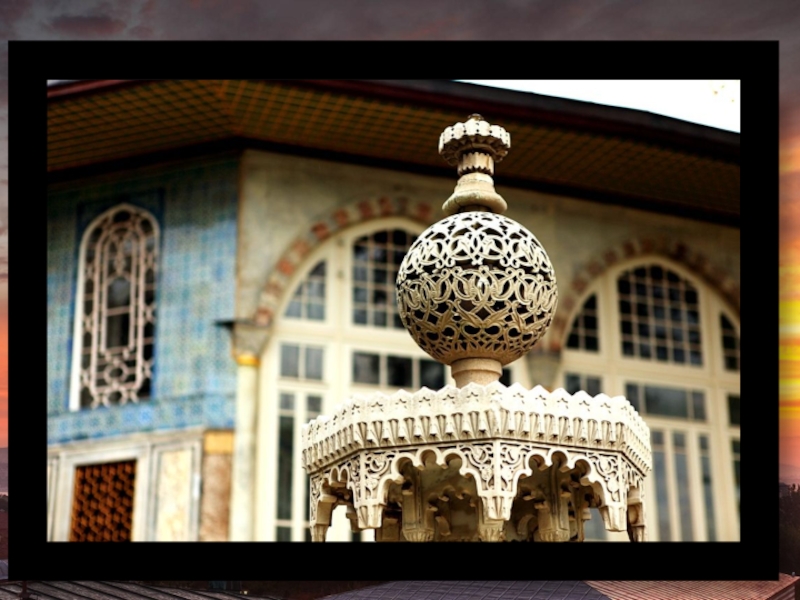
The main palace of the Ottoman Empire is located just
behind the Ayia Sofia. The palace consists of four courtyard. The first is the main entrance, there are ticket offices and on the foundations of an ancient temple of Aphrodite was built a little younger (aged 1700 years), the church of St. Irene.
The entrance to the second courtyard through the Gate of Salutations. Harem is located on the left. Here he lived his wife, eunuchs, concubines and the mother of the Sultan - the owner of the palace.
In the third courtyard are gates of happiness. At the entrance there is a small pavilion - Hall audience, where the sound of the fountain was negotiated. Right - Sultans collection of clothes. Next - a treasure house of three rooms, are collected jewels - for example, 86-carat diamond "Lozhechny", surrounded by 49 smaller diamonds. Near the entrance to the collection of sacred relics, such as: tooth Prophet Muhammad, the Prophet of beard hair, the banner of the Prophet, the Prophet's clothes. There are also Christian shrines - the brush of St. John the Baptist's hand, for example.
In the fourth courtyard used to be the famous Garden of tulips, there was even a post of "Minister of tulips." Homeland of these colors is not the Netherlands, and the Ottoman Empire, which is why the tulip (or Lale) is selected as a tourist symbol of the country.
The Topkapi houses one of the rarest in the world porcelain collections. Rasp
The entrance to the second courtyard through the Gate of Salutations. Harem is located on the left. Here he lived his wife, eunuchs, concubines and the mother of the Sultan - the owner of the palace.
In the third courtyard are gates of happiness. At the entrance there is a small pavilion - Hall audience, where the sound of the fountain was negotiated. Right - Sultans collection of clothes. Next - a treasure house of three rooms, are collected jewels - for example, 86-carat diamond "Lozhechny", surrounded by 49 smaller diamonds. Near the entrance to the collection of sacred relics, such as: tooth Prophet Muhammad, the Prophet of beard hair, the banner of the Prophet, the Prophet's clothes. There are also Christian shrines - the brush of St. John the Baptist's hand, for example.
In the fourth courtyard used to be the famous Garden of tulips, there was even a post of "Minister of tulips." Homeland of these colors is not the Netherlands, and the Ottoman Empire, which is why the tulip (or Lale) is selected as a tourist symbol of the country.
The Topkapi houses one of the rarest in the world porcelain collections. Rasp
Слайд 11Eminonu Square
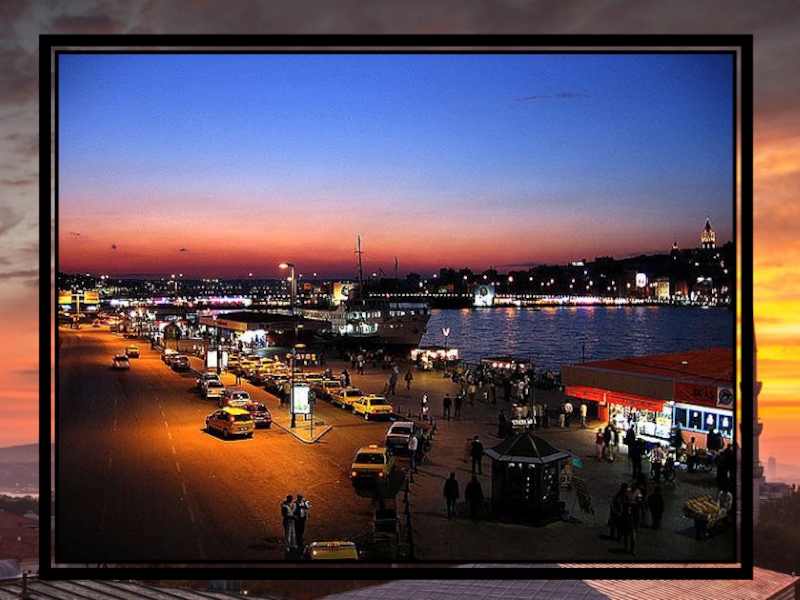
Eminonu Square is located at the foot of the hill,
where stands the Yeni Mosque, next to it - the entrance to the Egyptian Bazaar. It also crosses the Golden Horn old Galata Bridge. From Eminonu ferries to different parts of Istanbul and its surroundings.
Near Galata Bridge is a pier, from which depart pleasure boats. Standard tours last up to 6 hours (with a three-hour stop in the fishermen's village). Route - Dolmabahce Palace, Bosphorus Bridge, the Atatürk Bridge and Sultan Ahmed Palace Beylerbeyi, Rumeli Hisar fortress on, the fish market and restaurants in the village Saryyor. The last point - a three-hour parking in the village of Anadolu Kava, where the Black Sea meets the Bosphorus, and the ruins of the Genoese fortress. Cost of the tour 10 euros.
There are shorter walking tours up to 2 hours. And the most economical option - to swim in the passenger ferry from the European to the Asian side and back.
And on the pier Eminonu are many braziers, where they cook the fish. Freshly, in split, grilled big fish fit into the cut-ekmek half loaf with lettuce, worth 2-3 euros. There you sell mussels stuffed with rice. Before use, you must squeeze them lemon juice (half a lemon attached). The cost depending on the size of mussels - 25 cents.
Near Galata Bridge is a pier, from which depart pleasure boats. Standard tours last up to 6 hours (with a three-hour stop in the fishermen's village). Route - Dolmabahce Palace, Bosphorus Bridge, the Atatürk Bridge and Sultan Ahmed Palace Beylerbeyi, Rumeli Hisar fortress on, the fish market and restaurants in the village Saryyor. The last point - a three-hour parking in the village of Anadolu Kava, where the Black Sea meets the Bosphorus, and the ruins of the Genoese fortress. Cost of the tour 10 euros.
There are shorter walking tours up to 2 hours. And the most economical option - to swim in the passenger ferry from the European to the Asian side and back.
And on the pier Eminonu are many braziers, where they cook the fish. Freshly, in split, grilled big fish fit into the cut-ekmek half loaf with lettuce, worth 2-3 euros. There you sell mussels stuffed with rice. Before use, you must squeeze them lemon juice (half a lemon attached). The cost depending on the size of mussels - 25 cents.
Слайд 13Yeni Valide Mosque
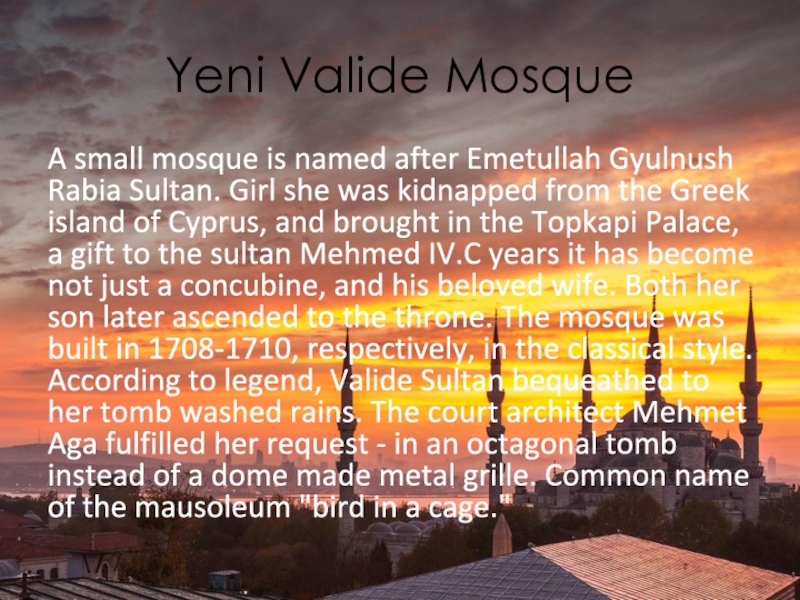
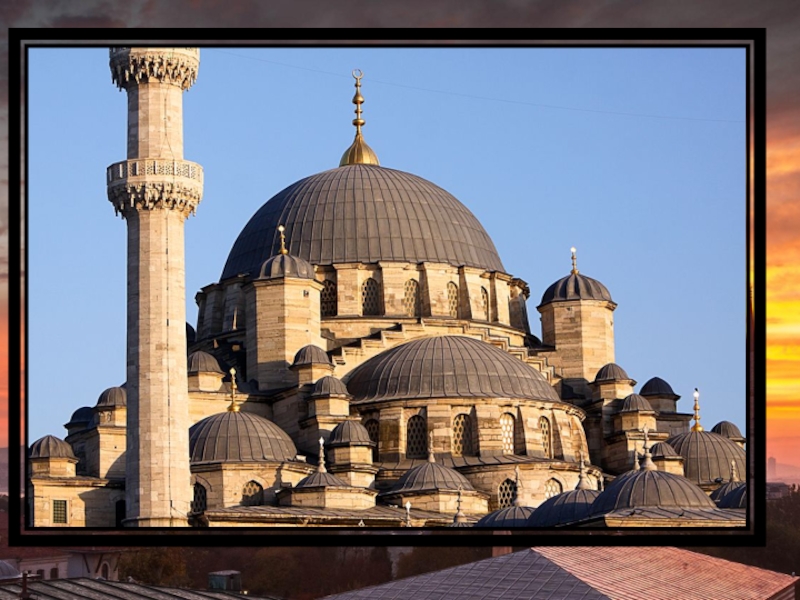
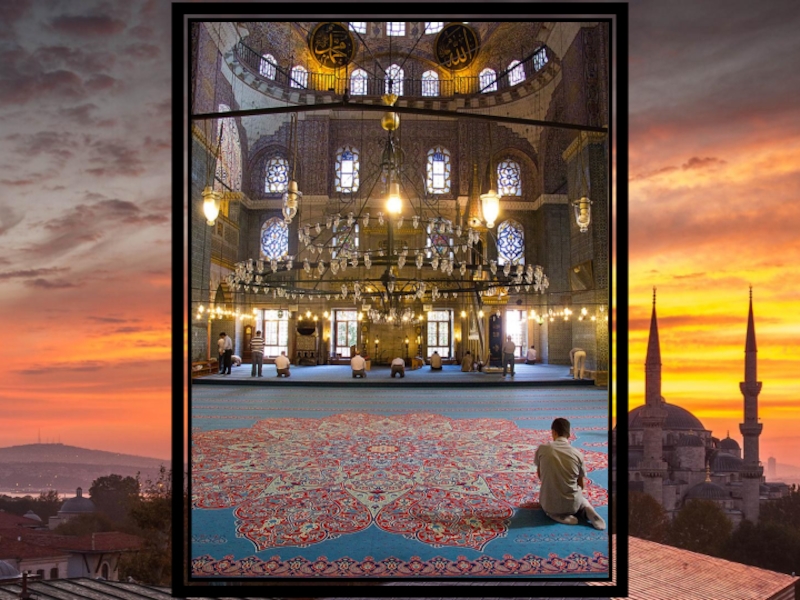
A small mosque is named after Emetullah Gyulnush Rabia
Sultan. Girl she was kidnapped from the Greek island of Cyprus, and brought in the Topkapi Palace, a gift to the sultan Mehmed IV.C years it has become not just a concubine, and his beloved wife. Both her son later ascended to the throne. The mosque was built in 1708-1710, respectively, in the classical style. According to legend, Valide Sultan bequeathed to her tomb washed rains. The court architect Mehmet Aga fulfilled her request - in an octagonal tomb instead of a dome made metal grille. Common name of the mausoleum "bird in a cage."
Слайд 16Mosque Mihrimah
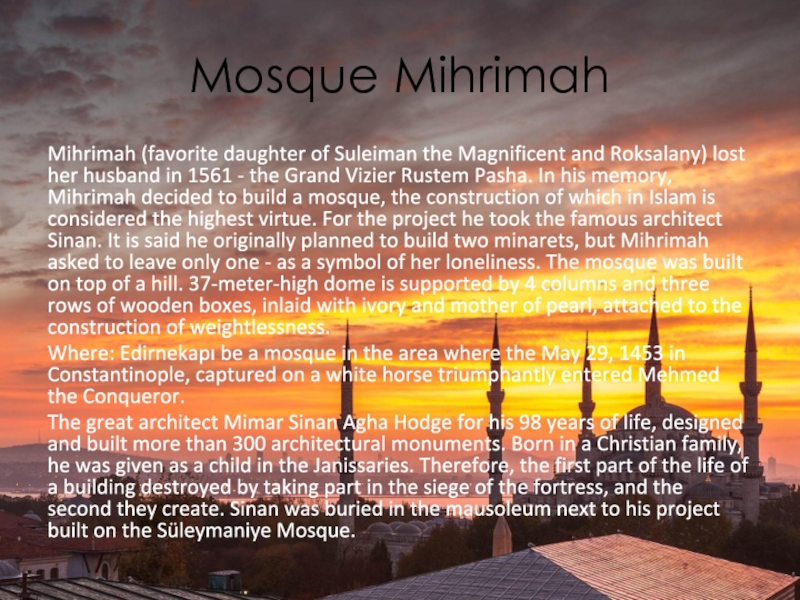
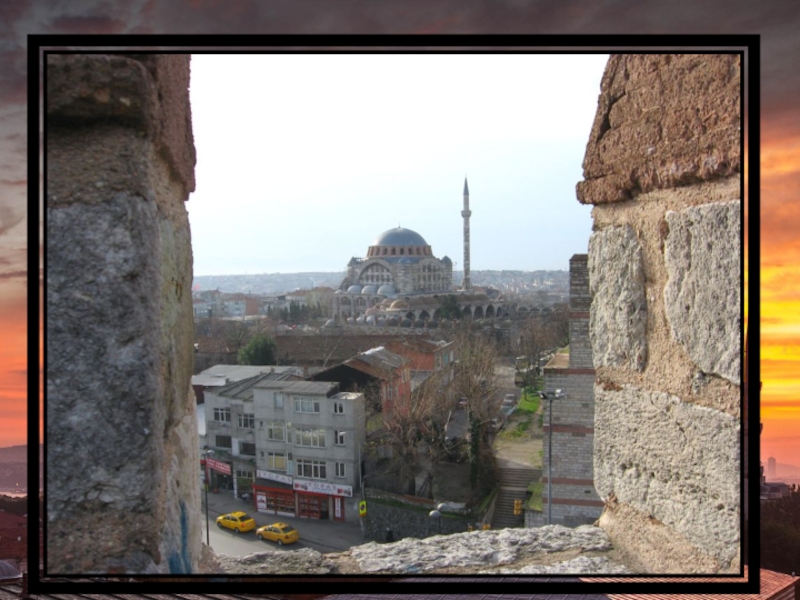
Mihrimah (favorite daughter of Suleiman the Magnificent and Roksalany) lost
her husband in 1561 - the Grand Vizier Rustem Pasha. In his memory, Mihrimah decided to build a mosque, the construction of which in Islam is considered the highest virtue. For the project he took the famous architect Sinan. It is said he originally planned to build two minarets, but Mihrimah asked to leave only one - as a symbol of her loneliness. The mosque was built on top of a hill. 37-meter-high dome is supported by 4 columns and three rows of wooden boxes, inlaid with ivory and mother of pearl, attached to the construction of weightlessness.
Where: Edirnekapı be a mosque in the area where the May 29, 1453 in Constantinople, captured on a white horse triumphantly entered Mehmed the Conqueror.
The great architect Mimar Sinan Agha Hodge for his 98 years of life, designed and built more than 300 architectural monuments. Born in a Christian family, he was given as a child in the Janissaries. Therefore, the first part of the life of a building destroyed by taking part in the siege of the fortress, and the second they create. Sinan was buried in the mausoleum next to his project built on the Süleymaniye Mosque.
Where: Edirnekapı be a mosque in the area where the May 29, 1453 in Constantinople, captured on a white horse triumphantly entered Mehmed the Conqueror.
The great architect Mimar Sinan Agha Hodge for his 98 years of life, designed and built more than 300 architectural monuments. Born in a Christian family, he was given as a child in the Janissaries. Therefore, the first part of the life of a building destroyed by taking part in the siege of the fortress, and the second they create. Sinan was buried in the mausoleum next to his project built on the Süleymaniye Mosque.