- Главная
- Разное
- Образование
- Спорт
- Естествознание
- Природоведение
- Религиоведение
- Французский язык
- Черчение
- Английский язык
- Астрономия
- Алгебра
- Биология
- География
- Геометрия
- Детские презентации
- Информатика
- История
- Литература
- Математика
- Музыка
- МХК
- Немецкий язык
- ОБЖ
- Обществознание
- Окружающий мир
- Педагогика
- Русский язык
- Технология
- Физика
- Философия
- Химия
- Шаблоны, фоны, картинки для презентаций
- Экология
- Экономика
Презентация, доклад по английскому языку на тему Шотландия (7-9 класс)
Содержание
- 1. Презентация по английскому языку на тему Шотландия (7-9 класс)
- 2. Contents: Scotland in commonMountainsNatural wondersLochs and riversEdinburghCastlesThe
- 3. Scotland is one of four constituent nations
- 4. The moors and mountains of Scotland are
- 5. Scotland's Incredible Natural WondersThere are a few
- 6. Although the island of Eilean Donan has
- 7. The capital of Scotland and a place
- 8. Certainly, one of the most popular attractions
- 9. For centuries the inhabitants of Scotland have
- 10. The Romans invaded Britain in the 1st
- 11. In the year 1290, the heiress to
- 12. Robert the Bruce followed in Wallace's foot
- 13. The Military Tattoo Festival in EdinburghEvery year,
- 14. The Scottish Highland GamesThere are a number
- 15. Highland Games Photo Galery
- 16. Discover the flag of ScotlandThe national flag
- 17. There is another Scottish Flag which is
- 18. William Wallace is known as the greatest
- 19. . Sir Alexander Fleming Sir Alexander
- 20. Sir James BarrieSir James Barrie, was born
- 21. Robert Louis Stevenson
- 22. Traditional Scottish MusicScottish music comes in many
- 23. Made byOrlova Nina Anatolyevna
Слайд 2Contents:
Scotland in common
Mountains
Natural wonders
Lochs and rivers
Edinburgh
Castles
The History of Scotland
The Military
The Highland Games
The Flag of Scotland
Famous people
Traditional music
Слайд 3
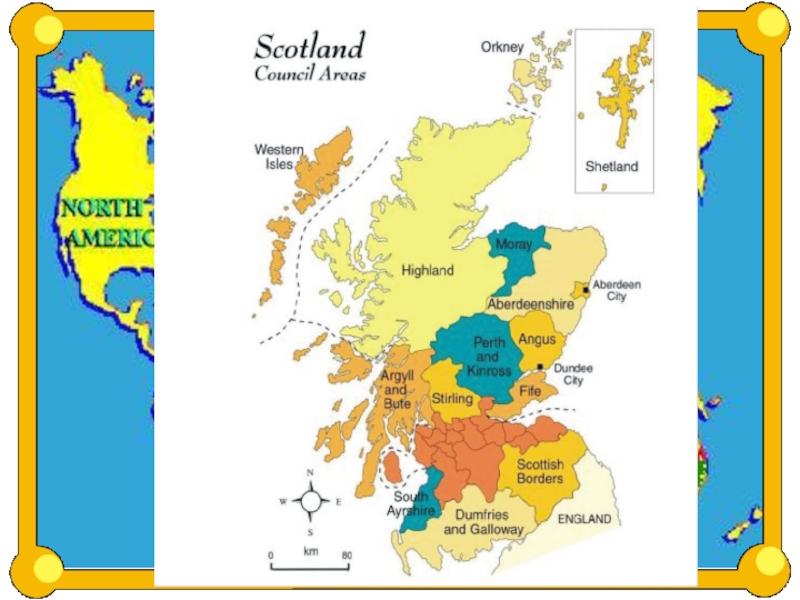
Scotland is one of four constituent nations which form the United
Scotland is 31,510 sq. miles in area; it is 274 miles long from North to South and varies in breadth between 24 and 154 miles.
The official language is English, although Gaelic is spoken, primarily in the North and West of Scotland. The Scots language (which has many similarities to English, but also draws on French and Gaelic) is also spoken. Whereas Gaelic is the language of the Highlands and Islands, Scots is the language of the Lowlands.
The national flower is the thistle, although the heather which covers significant moorland areas is also closely associated with the country, providing peat for the fire and, along with lichens, dyes for tartan.
Scotland
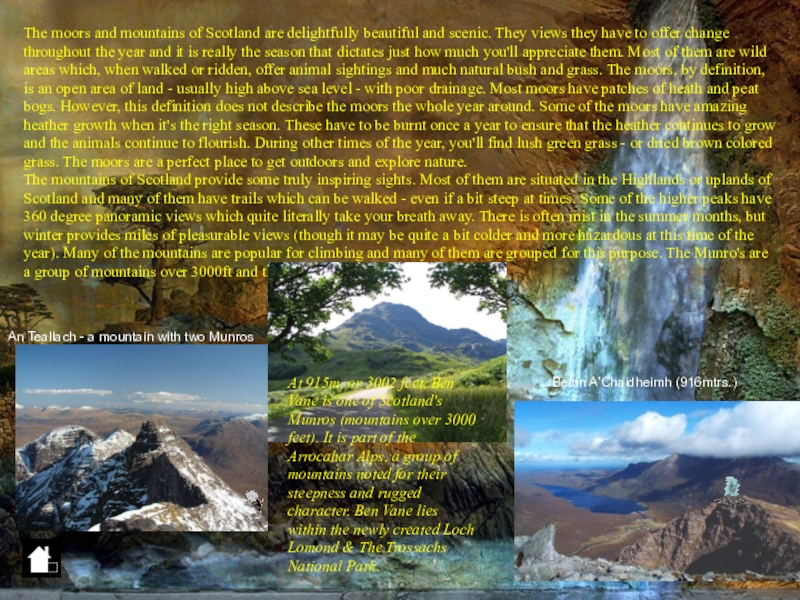
Слайд 4The moors and mountains of Scotland are delightfully beautiful and scenic.
The mountains of Scotland provide some truly inspiring sights. Most of them are situated in the Highlands or uplands of Scotland and many of them have trails which can be walked - even if a bit steep at times. Some of the higher peaks have 360 degree panoramic views which quite literally take your breath away. There is often mist in the summer months, but winter provides miles of pleasurable views (though it may be quite a bit colder and more hazardous at this time of the year). Many of the mountains are popular for climbing and many of them are grouped for this purpose. The Munro's are a group of mountains over 3000ft and they often get visitors.
At 915m, or 3002 feet, Ben Vane is one of Scotland's Munros (mountains over 3000 feet). It is part of the Arrocahar Alps, a group of mountains noted for their steepness and rugged character. Ben Vane lies within the newly created Loch Lomond & The Trossachs National Park.
An Teallach - a mountain with two Munros
Beinn A'Chaidheimh (916mtrs.)
Слайд 5Scotland's Incredible Natural Wonders
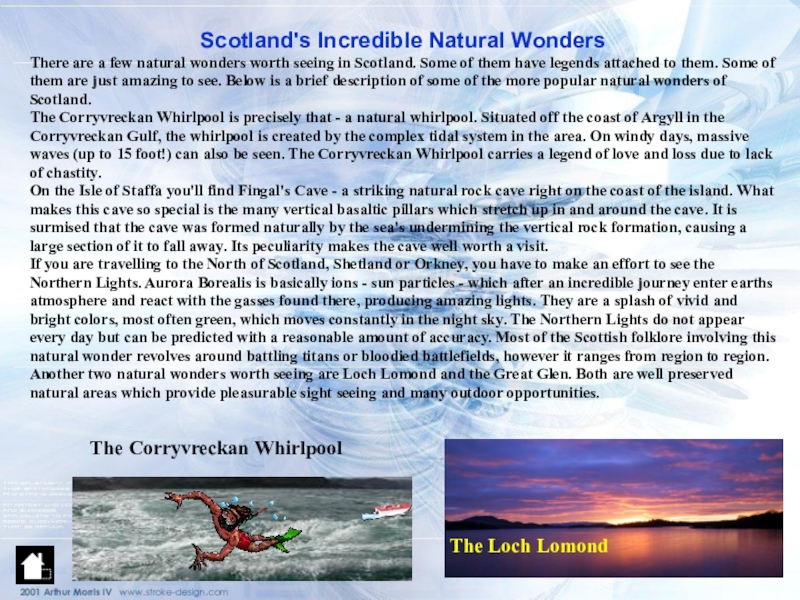
There are a few natural wonders worth seeing
The Corryvreckan Whirlpool is precisely that - a natural whirlpool. Situated off the coast of Argyll in the Corryvreckan Gulf, the whirlpool is created by the complex tidal system in the area. On windy days, massive waves (up to 15 foot!) can also be seen. The Corryvreckan Whirlpool carries a legend of love and loss due to lack of chastity.
On the Isle of Staffa you'll find Fingal's Cave - a striking natural rock cave right on the coast of the island. What makes this cave so special is the many vertical basaltic pillars which stretch up in and around the cave. It is surmised that the cave was formed naturally by the sea's undermining the vertical rock formation, causing a large section of it to fall away. Its peculiarity makes the cave well worth a visit.
If you are travelling to the North of Scotland, Shetland or Orkney, you have to make an effort to see the Northern Lights. Aurora Borealis is basically ions - sun particles - which after an incredible journey enter earths atmosphere and react with the gasses found there, producing amazing lights. They are a splash of vivid and bright colors, most often green, which moves constantly in the night sky. The Northern Lights do not appear every day but can be predicted with a reasonable amount of accuracy. Most of the Scottish folklore involving this natural wonder revolves around battling titans or bloodied battlefields, however it ranges from region to region.
Another two natural wonders worth seeing are Loch Lomond and the Great Glen. Both are well preserved natural areas which provide pleasurable sight seeing and many outdoor opportunities.
The Corryvreckan Whirlpool
The Loch Lomond
Слайд 6
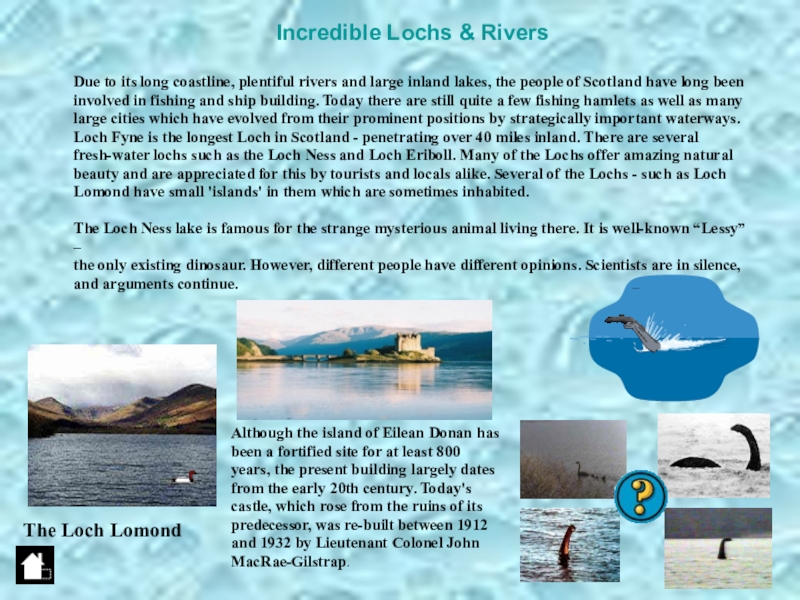
Although the island of Eilean Donan has been a fortified site
The Loch Lomond
Incredible Lochs & Rivers
Due to its long coastline, plentiful rivers and large inland lakes, the people of Scotland have long been involved in fishing and ship building. Today there are still quite a few fishing hamlets as well as many large cities which have evolved from their prominent positions by strategically important waterways.
Loch Fyne is the longest Loch in Scotland - penetrating over 40 miles inland. There are several fresh-water lochs such as the Loch Ness and Loch Eriboll. Many of the Lochs offer amazing natural beauty and are appreciated for this by tourists and locals alike. Several of the Lochs - such as Loch Lomond have small 'islands' in them which are sometimes inhabited.
The Loch Ness lake is famous for the strange mysterious animal living there. It is well-known “Lessy” –
the only existing dinosaur. However, different people have different opinions. Scientists are in silence,
and arguments continue.
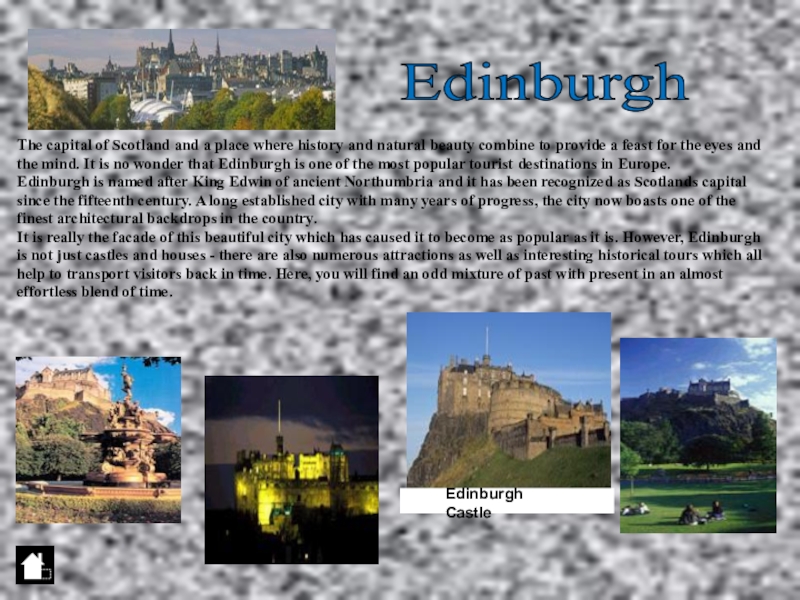
Слайд 7The capital of Scotland and a place where history and natural
Edinburgh is named after King Edwin of ancient Northumbria and it has been recognized as Scotlands capital since the fifteenth century. A long established city with many years of progress, the city now boasts one of the finest architectural backdrops in the country.
It is really the facade of this beautiful city which has caused it to become as popular as it is. However, Edinburgh is not just castles and houses - there are also numerous attractions as well as interesting historical tours which all help to transport visitors back in time. Here, you will find an odd mixture of past with present in an almost effortless blend of time.
Edinburgh
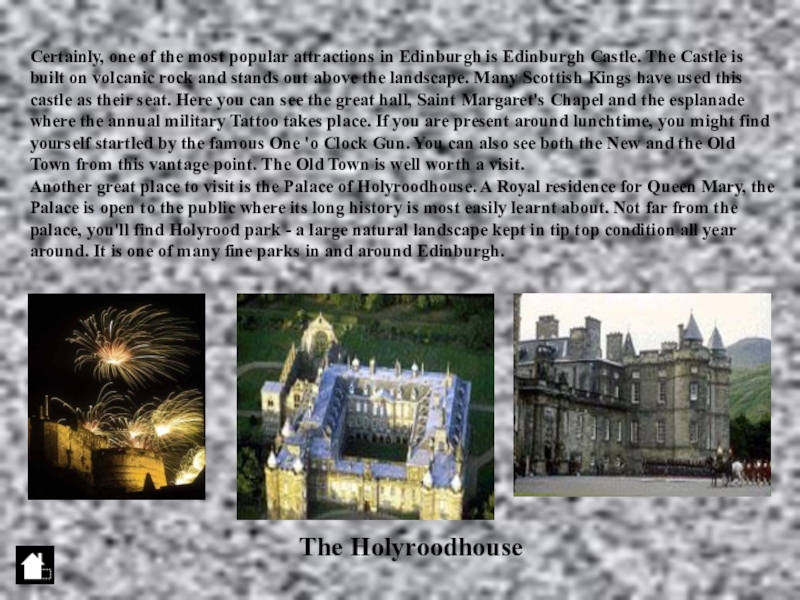
Слайд 8Certainly, one of the most popular attractions in Edinburgh is Edinburgh
Another great place to visit is the Palace of Holyroodhouse. A Royal residence for Queen Mary, the Palace is open to the public where its long history is most easily learnt about. Not far from the palace, you'll find Holyrood park - a large natural landscape kept in tip top condition all year around. It is one of many fine parks in and around Edinburgh.
The Holyroodhouse
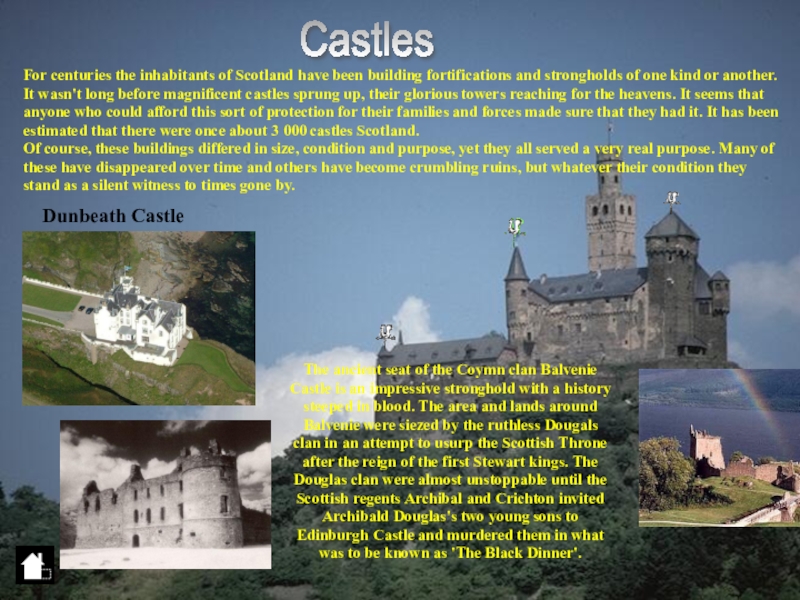
Слайд 9For centuries the inhabitants of Scotland have been building fortifications and
Of course, these buildings differed in size, condition and purpose, yet they all served a very real purpose. Many of these have disappeared over time and others have become crumbling ruins, but whatever their condition they stand as a silent witness to times gone by.
Castles
Dunbeath Castle
The ancient seat of the Coymn clan Balvenie Castle is an impressive stronghold with a history steeped in blood. The area and lands around Balvenie were siezed by the ruthless Dougals clan in an attempt to usurp the Scottish Throne after the reign of the first Stewart kings. The Douglas clan were almost unstoppable until the Scottish regents Archibal and Crichton invited Archibald Douglas's two young sons to Edinburgh Castle and murdered them in what was to be known as 'The Black Dinner'.
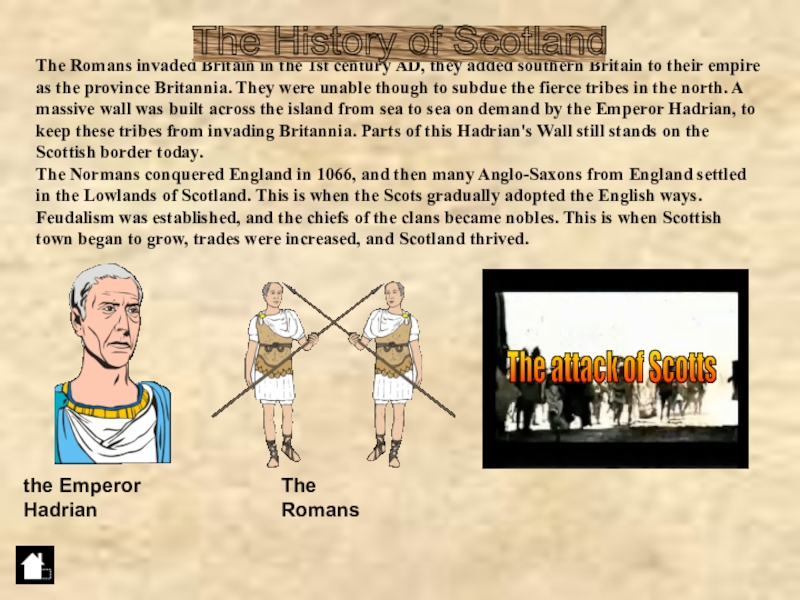
Слайд 10The Romans invaded Britain in the 1st century AD, they added
The Normans conquered England in 1066, and then many Anglo-Saxons from England settled in the Lowlands of Scotland. This is when the Scots gradually adopted the English ways. Feudalism was established, and the chiefs of the clans became nobles. This is when Scottish town began to grow, trades were increased, and Scotland thrived.
the Emperor Hadrian
The attack of Scotts
The Romans
The History of Scotland
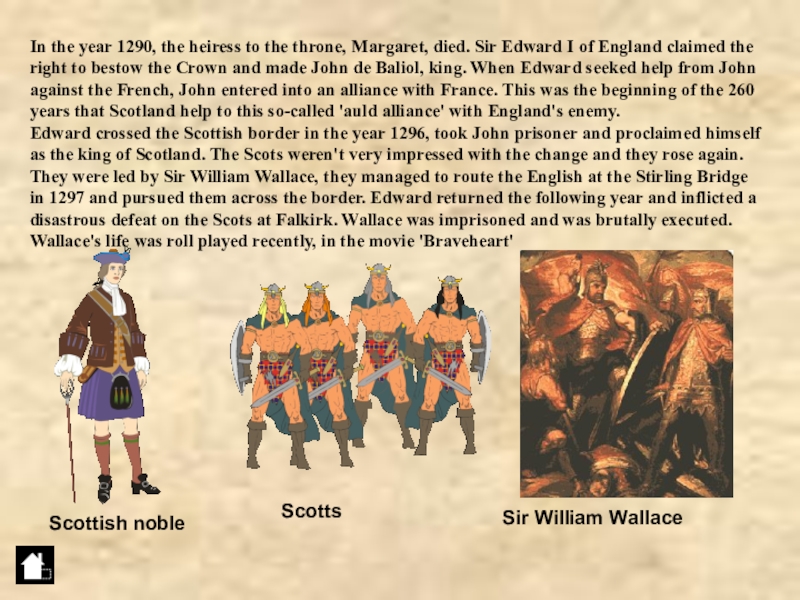
Слайд 11In the year 1290, the heiress to the throne, Margaret, died.
Edward crossed the Scottish border in the year 1296, took John prisoner and proclaimed himself as the king of Scotland. The Scots weren't very impressed with the change and they rose again. They were led by Sir William Wallace, they managed to route the English at the Stirling Bridge in 1297 and pursued them across the border. Edward returned the following year and inflicted a disastrous defeat on the Scots at Falkirk. Wallace was imprisoned and was brutally executed. Wallace's life was roll played recently, in the movie 'Braveheart'
Sir William Wallace
Scottish noble
Scotts
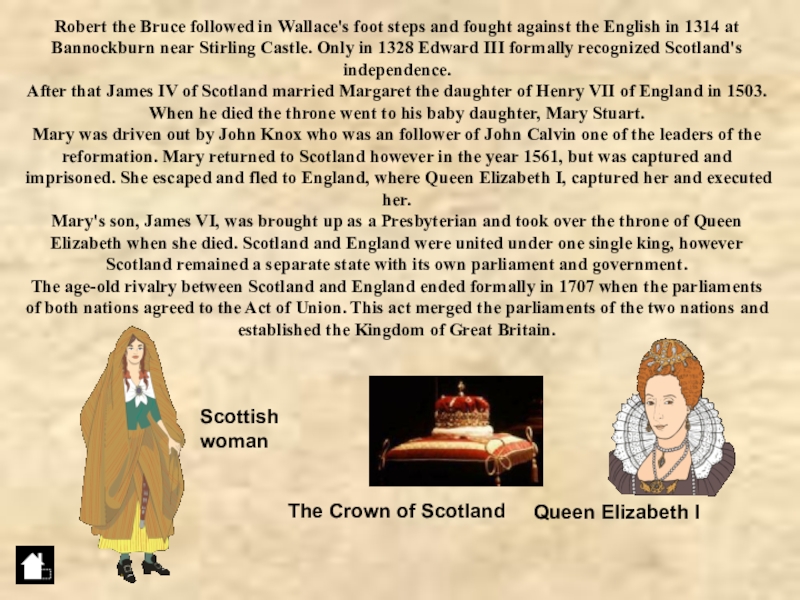
Слайд 12Robert the Bruce followed in Wallace's foot steps and fought against
After that James IV of Scotland married Margaret the daughter of Henry VII of England in 1503. When he died the throne went to his baby daughter, Mary Stuart.
Mary was driven out by John Knox who was an follower of John Calvin one of the leaders of the reformation. Mary returned to Scotland however in the year 1561, but was captured and imprisoned. She escaped and fled to England, where Queen Elizabeth I, captured her and executed her.
Mary's son, James VI, was brought up as a Presbyterian and took over the throne of Queen Elizabeth when she died. Scotland and England were united under one single king, however Scotland remained a separate state with its own parliament and government.
The age-old rivalry between Scotland and England ended formally in 1707 when the parliaments of both nations agreed to the Act of Union. This act merged the parliaments of the two nations and established the Kingdom of Great Britain.
Queen Elizabeth I
Scottish woman
The Crown of Scotland
Слайд 13The Military Tattoo Festival in Edinburgh
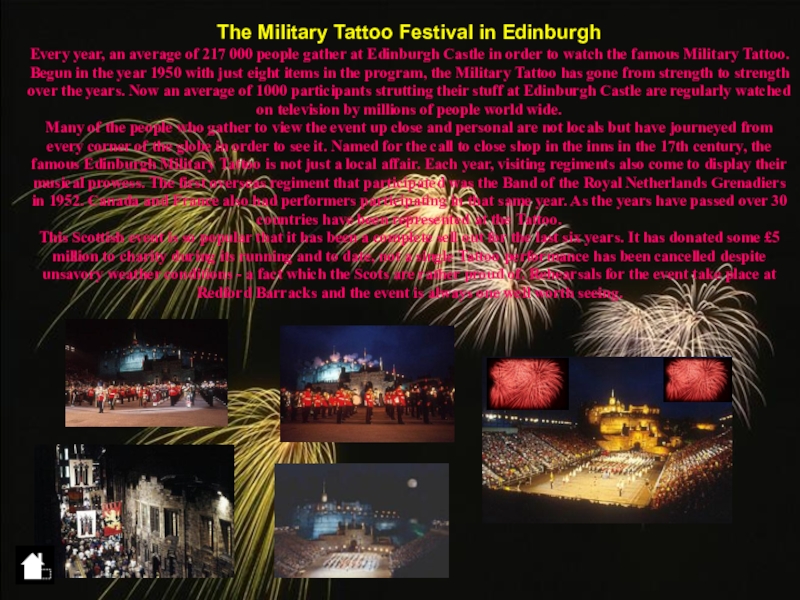
Every year, an average of 217
Many of the people who gather to view the event up close and personal are not locals but have journeyed from every corner of the globe in order to see it. Named for the call to close shop in the inns in the 17th century, the famous Edinburgh Military Tattoo is not just a local affair. Each year, visiting regiments also come to display their musical prowess. The first overseas regiment that participated was the Band of the Royal Netherlands Grenadiers in 1952. Canada and France also had performers participating in that same year. As the years have passed over 30 countries have been represented at the Tattoo.
This Scottish event is so popular that it has been a complete sell out for the last six years. It has donated some £5 million to charity during its running and to date, not a single Tattoo performance has been cancelled despite unsavory weather conditions - a fact which the Scots are rather proud of. Rehearsals for the event take place at Redford Barracks and the event is always one well worth seeing.
Слайд 14The Scottish Highland Games
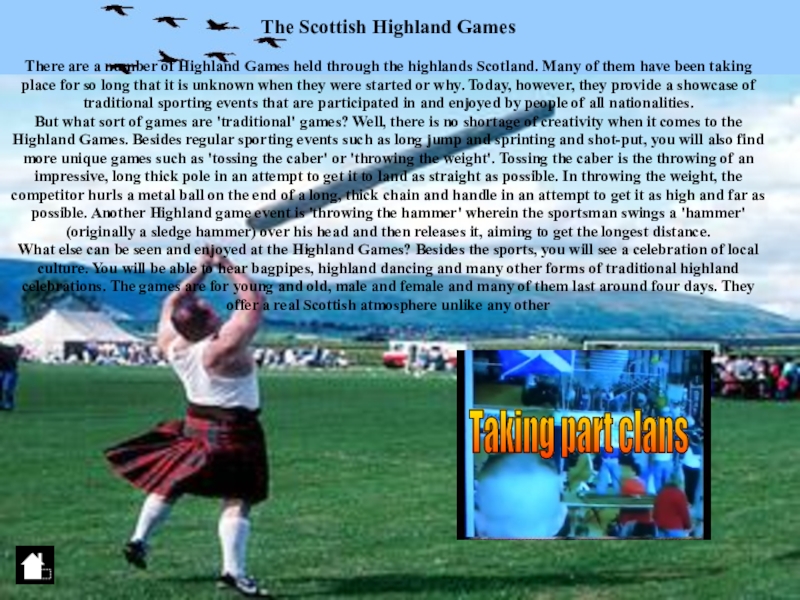
There are a number of Highland Games held
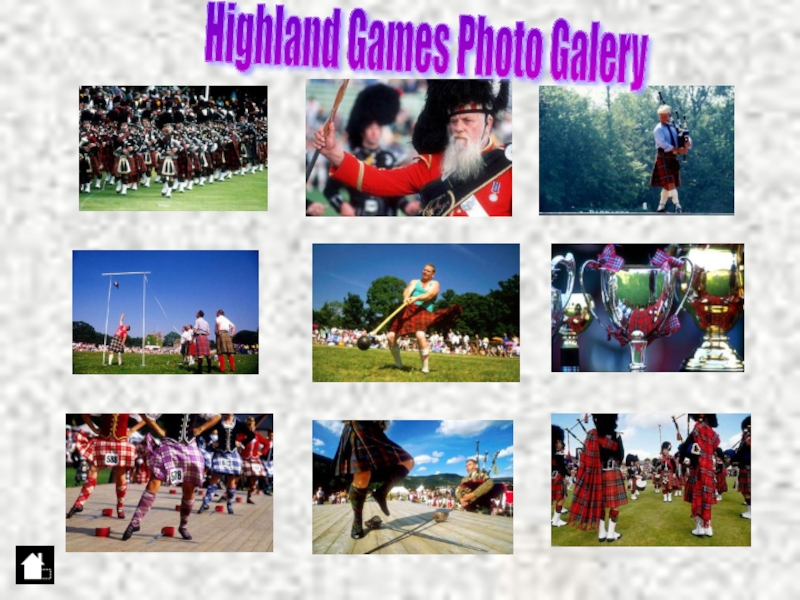
But what sort of games are 'traditional' games? Well, there is no shortage of creativity when it comes to the Highland Games. Besides regular sporting events such as long jump and sprinting and shot-put, you will also find more unique games such as 'tossing the caber' or 'throwing the weight'. Tossing the caber is the throwing of an impressive, long thick pole in an attempt to get it to land as straight as possible. In throwing the weight, the competitor hurls a metal ball on the end of a long, thick chain and handle in an attempt to get it as high and far as possible. Another Highland game event is 'throwing the hammer' wherein the sportsman swings a 'hammer' (originally a sledge hammer) over his head and then releases it, aiming to get the longest distance.
What else can be seen and enjoyed at the Highland Games? Besides the sports, you will see a celebration of local culture. You will be able to hear bagpipes, highland dancing and many other forms of traditional highland celebrations. The games are for young and old, male and female and many of them last around four days. They offer a real Scottish atmosphere unlike any other
Taking part clans
Слайд 16Discover the flag of Scotland
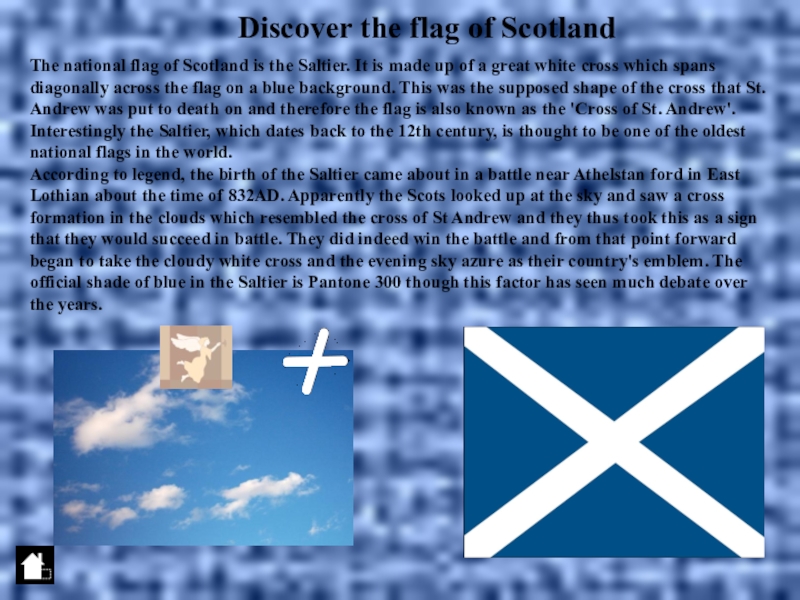
The national flag of Scotland is the
According to legend, the birth of the Saltier came about in a battle near Athelstan ford in East Lothian about the time of 832AD. Apparently the Scots looked up at the sky and saw a cross formation in the clouds which resembled the cross of St Andrew and they thus took this as a sign that they would succeed in battle. They did indeed win the battle and from that point forward began to take the cloudy white cross and the evening sky azure as their country's emblem. The official shade of blue in the Saltier is Pantone 300 though this factor has seen much debate over the years.
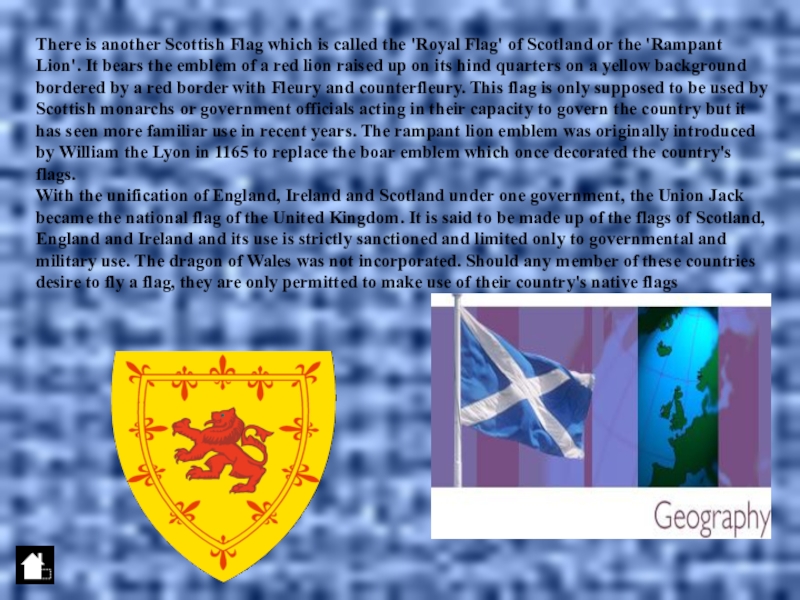
Слайд 17There is another Scottish Flag which is called the 'Royal Flag'
With the unification of England, Ireland and Scotland under one government, the Union Jack became the national flag of the United Kingdom. It is said to be made up of the flags of Scotland, England and Ireland and its use is strictly sanctioned and limited only to governmental and military use. The dragon of Wales was not incorporated. Should any member of these countries desire to fly a flag, they are only permitted to make use of their country's native flags
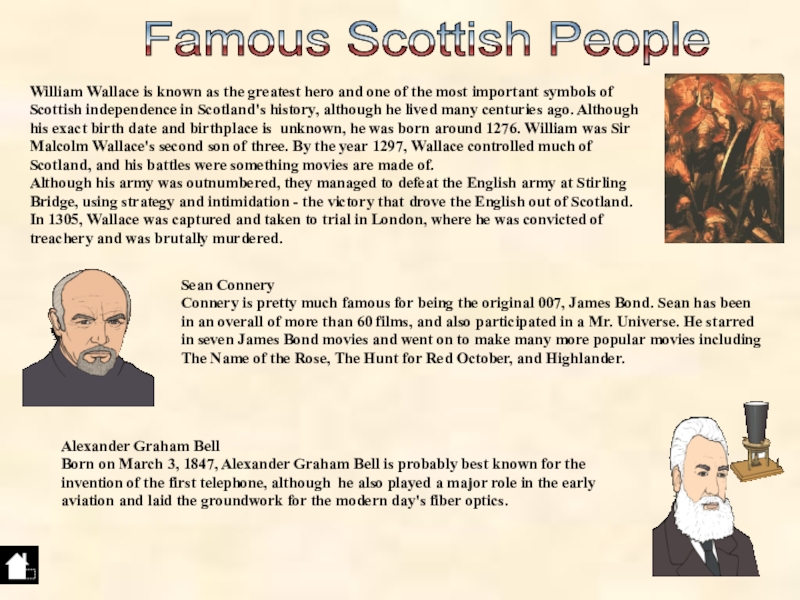
Слайд 18William Wallace is known as the greatest hero and one of
Although his army was outnumbered, they managed to defeat the English army at Stirling Bridge, using strategy and intimidation - the victory that drove the English out of Scotland. In 1305, Wallace was captured and taken to trial in London, where he was convicted of treachery and was brutally murdered.
Sean Connery
Connery is pretty much famous for being the original 007, James Bond. Sean has been in an overall of more than 60 films, and also participated in a Mr. Universe. He starred in seven James Bond movies and went on to make many more popular movies including The Name of the Rose, The Hunt for Red October, and Highlander.
Alexander Graham Bell
Born on March 3, 1847, Alexander Graham Bell is probably best known for the invention of the first telephone, although he also played a major role in the early aviation and laid the groundwork for the modern day's fiber optics.
Famous Scottish People
Слайд 19.
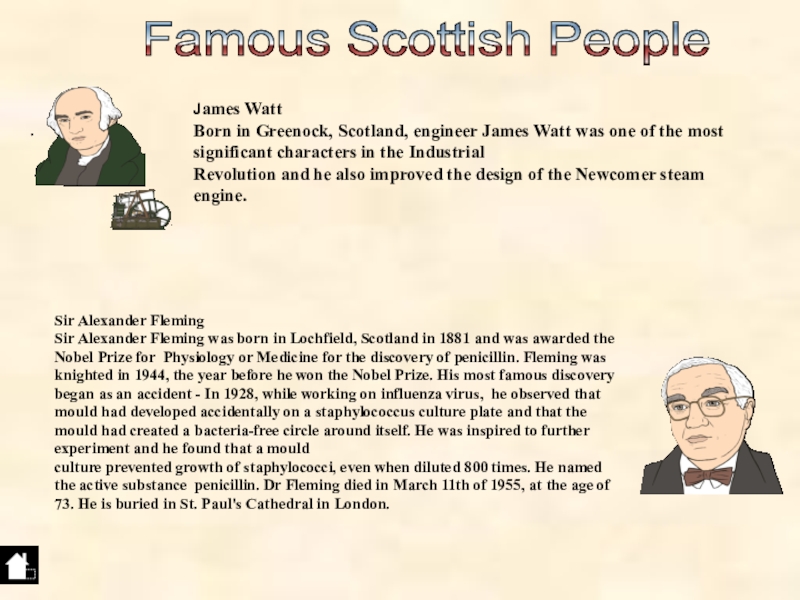
Sir Alexander Fleming
Sir Alexander Fleming was born in Lochfield,
culture prevented growth of staphylococci, even when diluted 800 times. He named the active substance penicillin. Dr Fleming died in March 11th of 1955, at the age of 73. He is buried in St. Paul's Cathedral in London.
James Watt
Born in Greenock, Scotland, engineer James Watt was one of the most significant characters in the Industrial
Revolution and he also improved the design of the Newcomer steam engine.
Famous Scottish People
Слайд 20Sir James Barrie
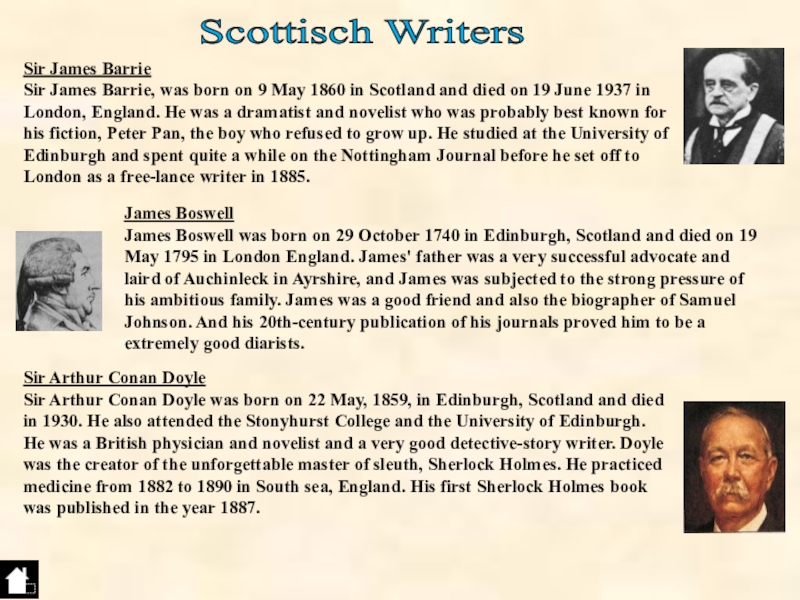
Sir James Barrie, was born on 9 May 1860
James Boswell
James Boswell was born on 29 October 1740 in Edinburgh, Scotland and died on 19 May 1795 in London England. James' father was a very successful advocate and laird of Auchinleck in Ayrshire, and James was subjected to the strong pressure of his ambitious family. James was a good friend and also the biographer of Samuel Johnson. And his 20th-century publication of his journals proved him to be a extremely good diarists.
Sir Arthur Conan Doyle
Sir Arthur Conan Doyle was born on 22 May, 1859, in Edinburgh, Scotland and died in 1930. He also attended the Stonyhurst College and the University of Edinburgh. He was a British physician and novelist and a very good detective-story writer. Doyle was the creator of the unforgettable master of sleuth, Sherlock Holmes. He practiced medicine from 1882 to 1890 in South sea, England. His first Sherlock Holmes book was published in the year 1887.
Scottisch Writers
Слайд 21Robert Louis Stevenson
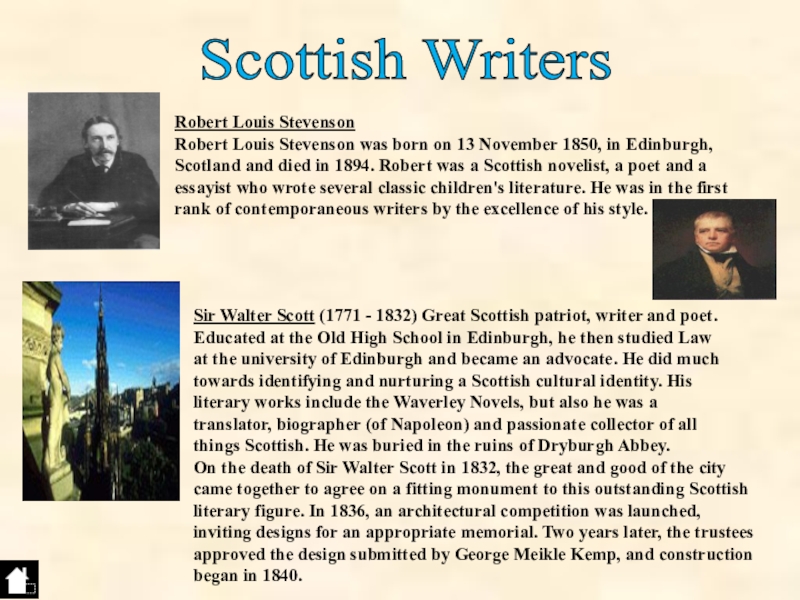
Robert Louis Stevenson was born on 13 November 1850, in Edinburgh, Scotland and died in 1894. Robert was a Scottish novelist, a poet and a essayist who wrote several classic children's literature. He was in the first rank of contemporaneous writers by the excellence of his style.
Sir Walter Scott (1771 - 1832) Great Scottish patriot, writer and poet.
Educated at the Old High School in Edinburgh, he then studied Law
at the university of Edinburgh and became an advocate. He did much
towards identifying and nurturing a Scottish cultural identity. His
literary works include the Waverley Novels, but also he was a
translator, biographer (of Napoleon) and passionate collector of all
things Scottish. He was buried in the ruins of Dryburgh Abbey.
On the death of Sir Walter Scott in 1832, the great and good of the city came together to agree on a fitting monument to this outstanding Scottish literary figure. In 1836, an architectural competition was launched, inviting designs for an appropriate memorial. Two years later, the trustees approved the design submitted by George Meikle Kemp, and construction began in 1840.
Scottish Writers
Слайд 22Traditional Scottish Music
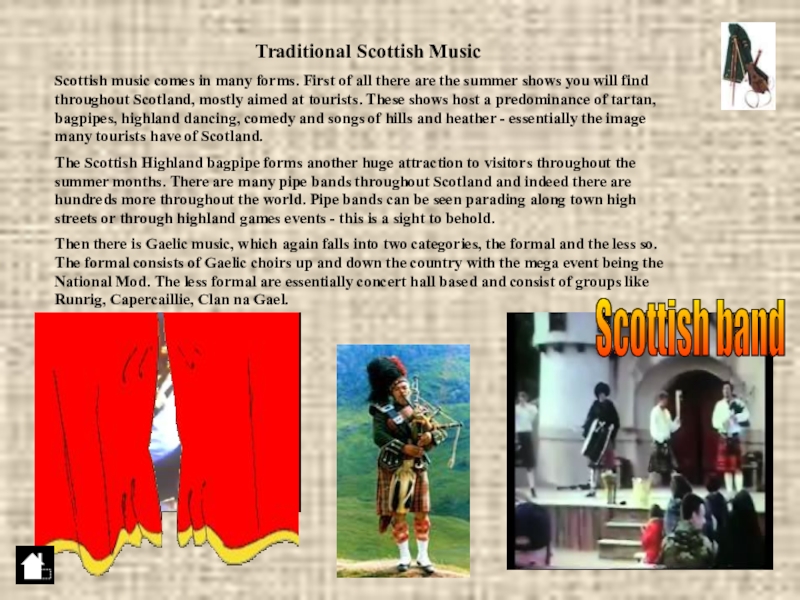
Scottish music comes in many forms. First of all
The Scottish Highland bagpipe forms another huge attraction to visitors throughout the summer months. There are many pipe bands throughout Scotland and indeed there are hundreds more throughout the world. Pipe bands can be seen parading along town high streets or through highland games events - this is a sight to behold.
Then there is Gaelic music, which again falls into two categories, the formal and the less so. The formal consists of Gaelic choirs up and down the country with the mega event being the National Mod. The less formal are essentially concert hall based and consist of groups like Runrig, Capercaillie, Clan na Gael.
Scottish band