- Главная
- Разное
- Образование
- Спорт
- Естествознание
- Природоведение
- Религиоведение
- Французский язык
- Черчение
- Английский язык
- Астрономия
- Алгебра
- Биология
- География
- Геометрия
- Детские презентации
- Информатика
- История
- Литература
- Математика
- Музыка
- МХК
- Немецкий язык
- ОБЖ
- Обществознание
- Окружающий мир
- Педагогика
- Русский язык
- Технология
- Физика
- Философия
- Химия
- Шаблоны, фоны, картинки для презентаций
- Экология
- Экономика
Презентация, доклад по английскому языку на тему Великие поэты Британии
Содержание
- 1. Презентация по английскому языку на тему Великие поэты Британии
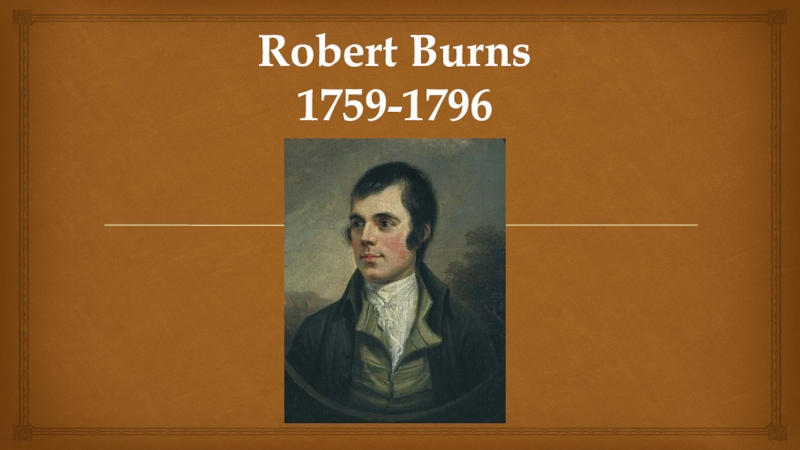
- 2. Robert Burns 1759-1796
- 3. Robert Burns also known as Rabbie Burns, the Bard
- 4. Burns was born two miles (3 km) south
- 5. By the age of 15, Burns was
- 6. In December 1781, Burns moved to Irvine to learn
- 7. He continued to write poems and songs
- 8. On 31 July 1786 John Wilson published
- 9. On 27 November 1786 Burns borrowed a
- 10. In Edinburgh, in early 1787, he met
- 11. Burns's style is marked by spontaneity, directness,
- 12. Burns became the "people's poet" of Russia.
- 13. As his health began to give way,
- 14. “O, My Love is Like a Red,
- 15. William Blake"Blake is the Romantic writer who
- 16. 1. Biography: a)poet b)artist c)engraver2. Blake's views3. Blake today
- 17. BiographyWilliam Blake was born on 28 November
- 18. PoetWriting, he began only after marriage. Blake's
- 19. ArtistBlake started engraving copies of drawings of
- 20. EngraverOn 4 August 1772, Blake was apprenticed
- 21. Blake's viewsThe Bible was an early and
- 22. Blake todayBlake's work was neglected for a
- 23. “Never Seek To Tell Thy Love” by
- 24. The AngelI dreamt a dream! What can
- 25. The End
- 26. Biography Charles Lutwidge Dodgson was born 27
- 27. In may 1850 he was enrolled in
- 28. In 1856, the College has a new
- 29. Work has become a classic and the
- 30. Lewis Carroll died on 14 January 1898
- 31. My Fairy I have a fairy by
- 32. END OF SLIDES

Слайд 3Robert Burns also known as Rabbie Burns, the Bard of Ayrshire and various other
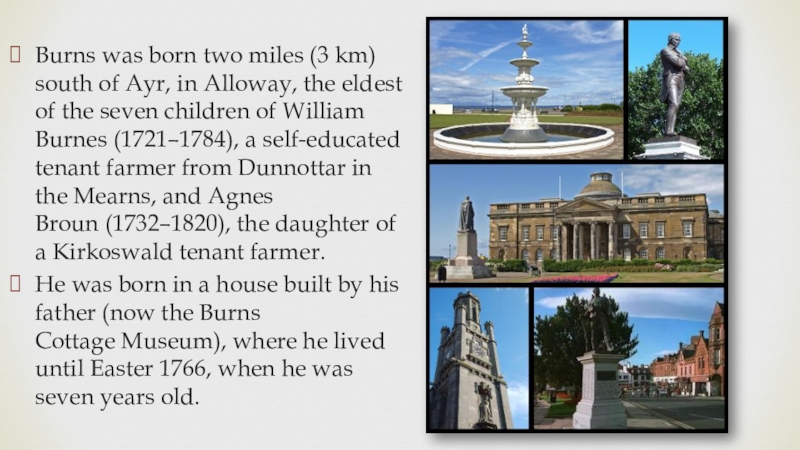
Слайд 4Burns was born two miles (3 km) south of Ayr, in Alloway, the eldest
He was born in a house built by his father (now the Burns Cottage Museum), where he lived until Easter 1766, when he was seven years old.
Слайд 5By the age of 15, Burns was the principal labourer at
Слайд 6
In December 1781, Burns moved to Irvine to learn to become a flax-dresser, but
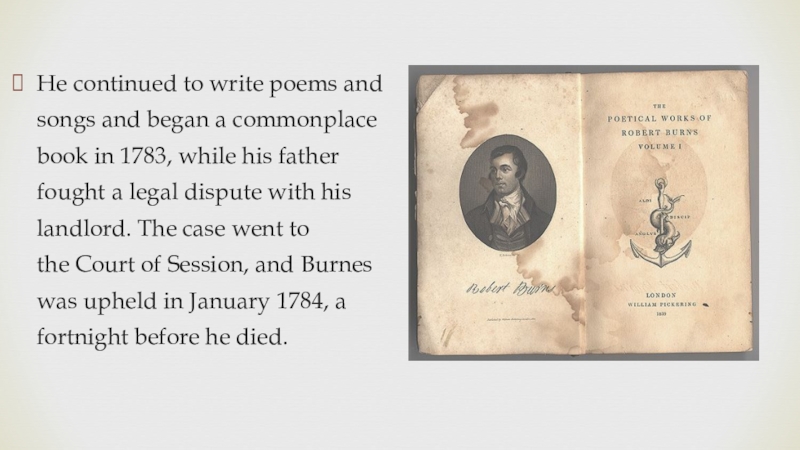
Слайд 7He continued to write poems and songs and began a commonplace book
Слайд 8On 31 July 1786 John Wilson published the volume of works
Слайд 9On 27 November 1786 Burns borrowed a pony and set out
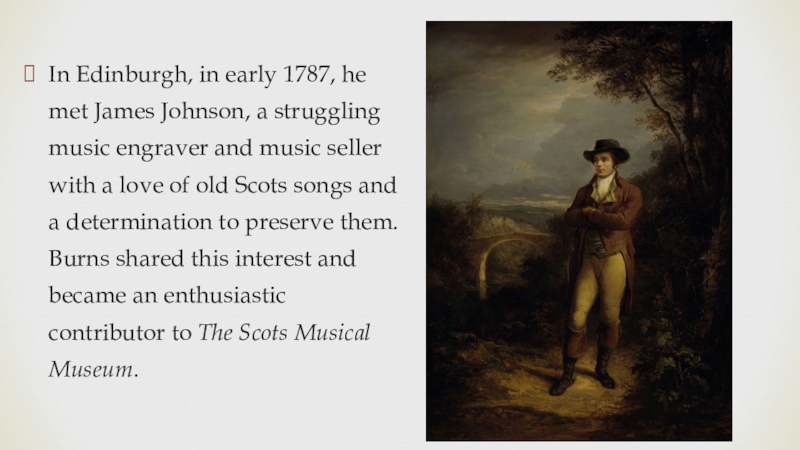
Слайд 10In Edinburgh, in early 1787, he met James Johnson, a struggling
Слайд 11Burns's style is marked by spontaneity, directness, and sincerity, and ranges
Statue of Burns in Dumfries town centre, unveiled in 1882.
Literary style
Слайд 12Burns became the "people's poet" of Russia. In Imperial Russia Burns was translated
Russia
Слайд 13As his health began to give way, he began to age
Failing health and death
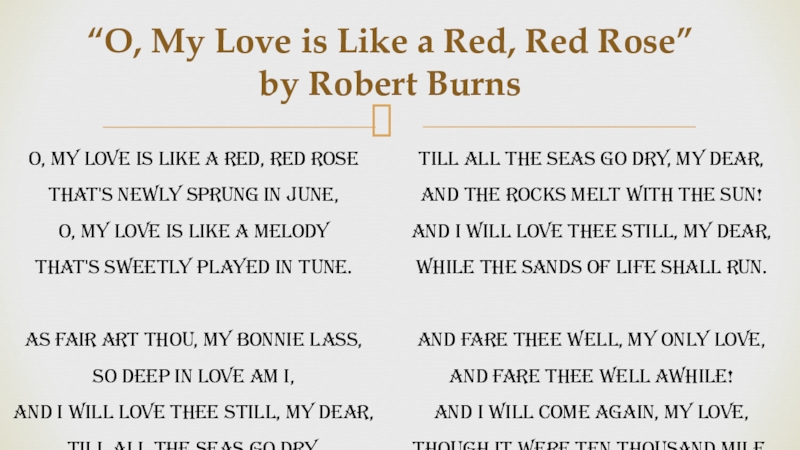
Слайд 14“O, My Love is Like a Red, Red Rose” by Robert
O, my love is like a red, red rose
That's newly sprung in June,
O, my love is like a melody
That's sweetly played in tune.
As fair art thou, my bonnie lass,
So deep in love am I,
And I will love thee still, my dear,
Till all the seas go dry.
Till all the seas go dry, my dear,
And the rocks melt with the sun!
And I will love thee still, my dear,
While the sands of life shall run.
And fare thee well, my only love,
And fare thee well awhile!
And I will come again, my love,
Though it were ten thousand mile.
Слайд 15William Blake
"Blake is the Romantic writer who has exerted the most
Слайд 17Biography
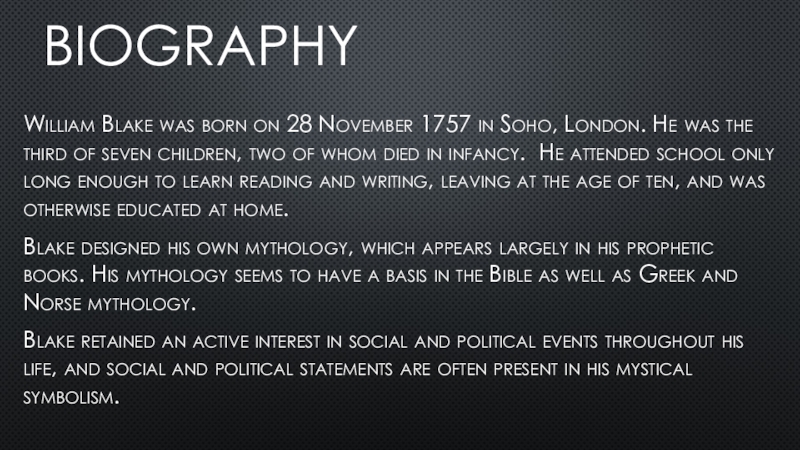
William Blake was born on 28 November 1757 in Soho, London.
Blake designed his own mythology, which appears largely in his prophetic books. His mythology seems to have a basis in the Bible as well as Greek and Norse mythology.
Blake retained an active interest in social and political events throughout his life, and social and political statements are often present in his mystical symbolism.
Слайд 18Poet
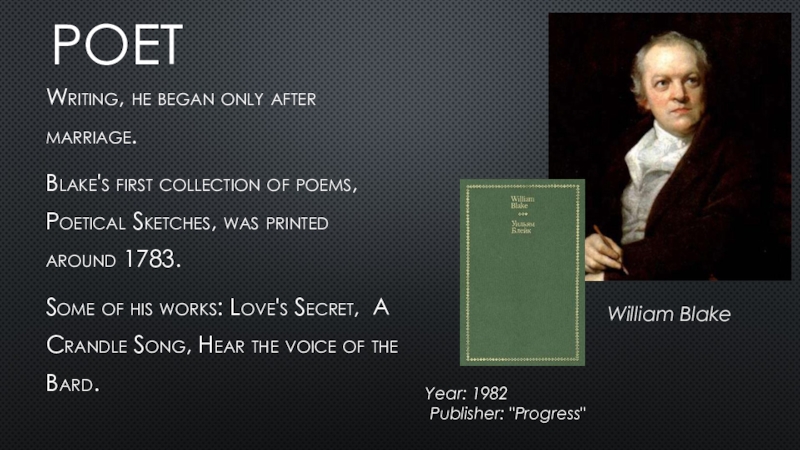
Writing, he began only after marriage.
Blake's first collection of poems,
Some of his works: Love's Secret, A Crandle Song, Hear the voice of the Bard.
Year: 1982
Publisher: "Progress"
William Blake
Слайд 19Artist
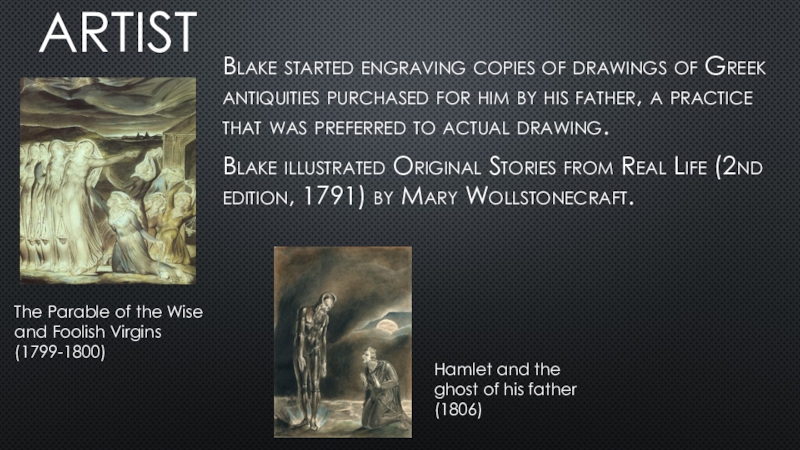
Blake started engraving copies of drawings of Greek antiquities purchased for
Blake illustrated Original Stories from Real Life (2nd edition, 1791) by Mary Wollstonecraft.
The Parable of the Wise
and Foolish Virgins
(1799-1800)
Hamlet and the
ghost of his father
(1806)
Слайд 20Engraver
On 4 August 1772, Blake was apprenticed to engraver James Basire
In the long afternoons Blake spent sketching in the Abbey.
Blake also became famous for his relief etching technology. Blake used illuminated printing for most of his well-known works.
Blake employed intaglio engraving in his own work. The standard process of engraving in the 18th century in which the artist incised an image into the copper plate, a complex and laborious process, with plates taking months or years.
Слайд 21Blake's views
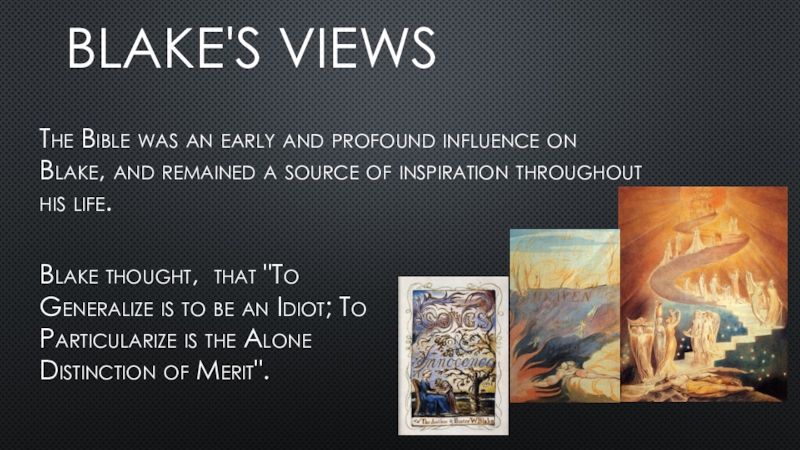
The Bible was an early and profound influence on Blake,
Blake thought, that "To Generalize is to be an Idiot; To Particularize is the Alone Distinction of Merit".
Слайд 22Blake today
Blake's work was neglected for a generation after his death
It was during the Modernist period that this work began to influence a wider set of writers and artists. Blake had an enormous influence on the beat poets of the 1950s and the counterculture of the 1960s, frequently being cited by such seminal figures.
After World War II, Blake's role in popular culture came to the fore in a variety of areas such as popular music, film, and the graphic novel, leading Edward Larrissy to assert that "Blake is the Romantic writer who has exerted the most powerful influence on the twentieth century."
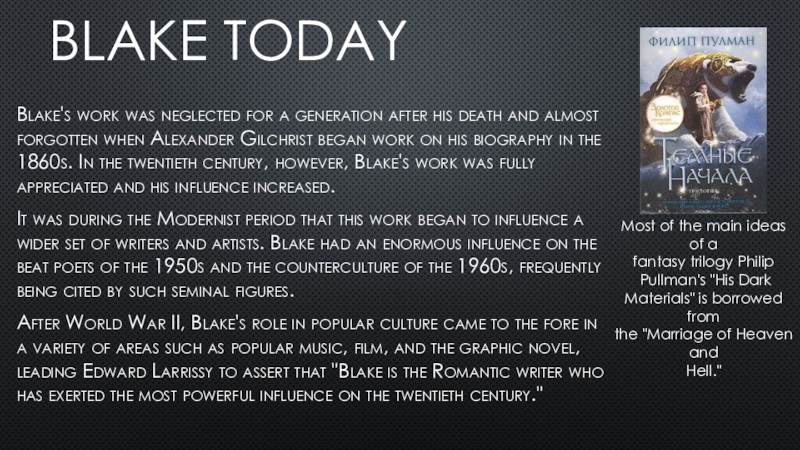
Most of the main ideas of a
fantasy trilogy Philip
Pullman's "His Dark
Materials" is borrowed from
the "Marriage of Heaven and
Hell."
Слайд 23“Never Seek To Tell Thy Love” by William Blake
Never seek to
I told my love, I told my love. I told her all my heart, Trembling, cold, in ghastly tears – Ah, she did depart.
Soon as she was gone from me A traveler came by Silently, invisibly – He took her with a sigh.
Слайд 24The Angel
I dreamt a dream! What can it mean?
And that I
So he took his wings and fled;
Then the morn blushed rosy red;
I dried my tears, and armed my fears
With ten thousand shields and spears.
Soon my Angel came again:
I was armed, he came in vain;
For the time of youth was fled,
And grey hairs were on my head.
Слайд 26Biography
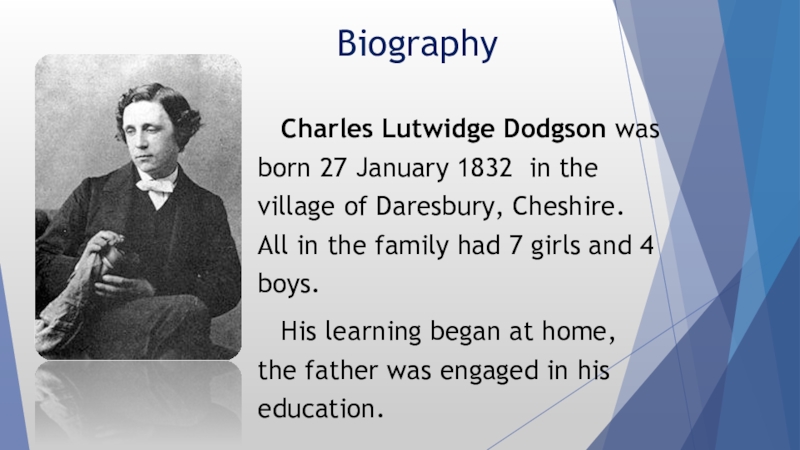
Charles Lutwidge Dodgson was born 27 January 1832 in the village
His learning began at home, the father was engaged in his education.
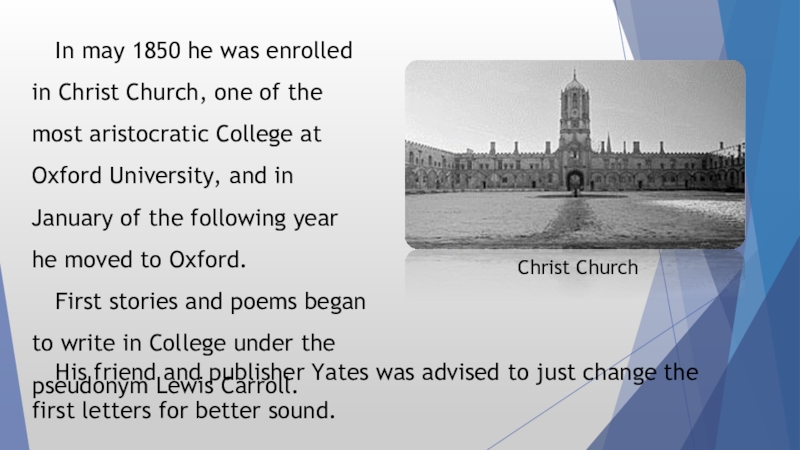
Слайд 27In may 1850 he was enrolled in Christ Church, one of
First stories and poems began to write in College under the pseudonym Lewis Carroll.
Christ Church
His friend and publisher Yates was advised to just change the first letters for better sound.
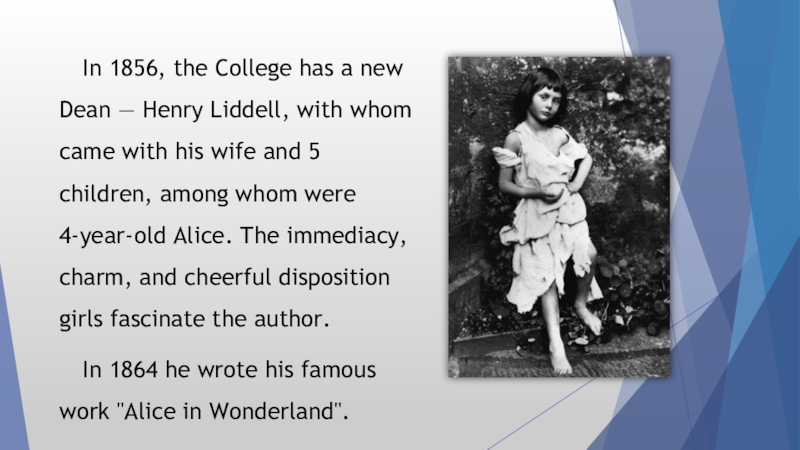
Слайд 28In 1856, the College has a new Dean — Henry Liddell,
In 1864 he wrote his famous work "Alice in Wonderland".
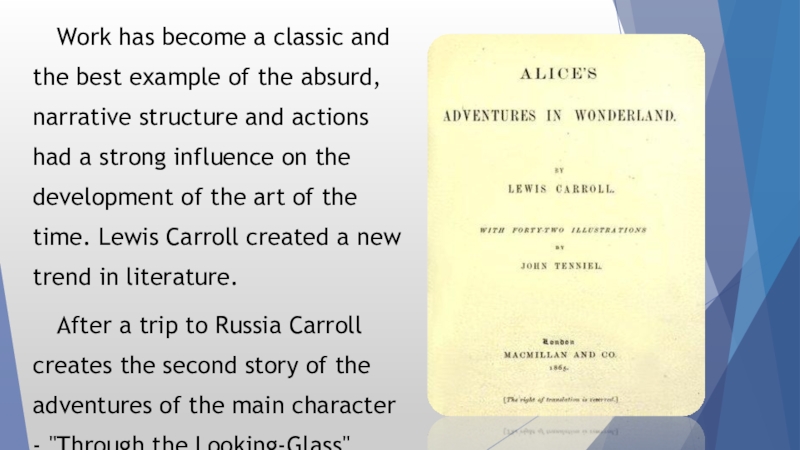
Слайд 29Work has become a classic and the best example of the
After a trip to Russia Carroll creates the second story of the adventures of the main character - "Through the Looking-Glass", published in 1871.
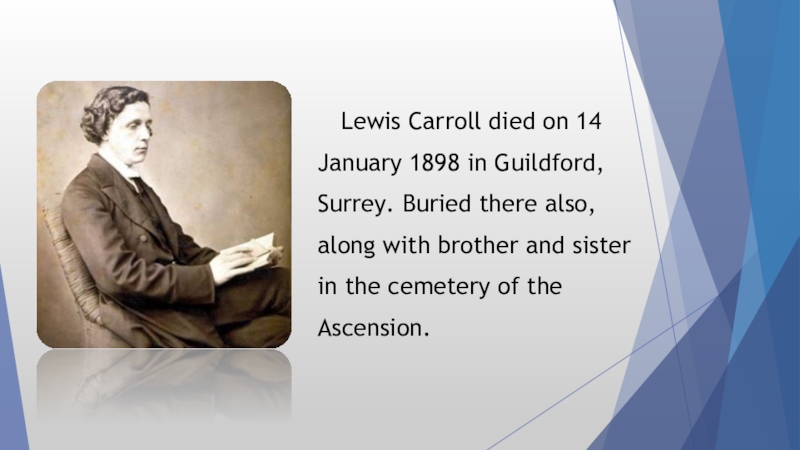
Слайд 30Lewis Carroll died on 14 January 1898 in Guildford, Surrey. Buried
Слайд 31My Fairy
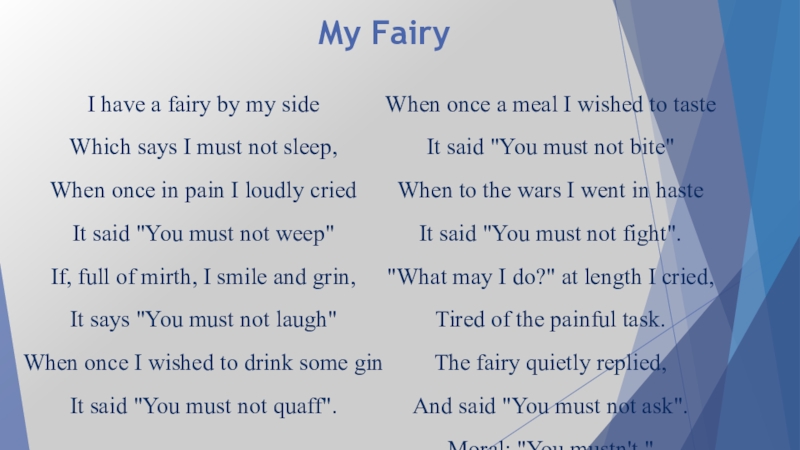
I have a fairy by my side
Which says I must
When once in pain I loudly cried
It said "You must not weep"
If, full of mirth, I smile and grin,
It says "You must not laugh"
When once I wished to drink some gin
It said "You must not quaff".
When once a meal I wished to taste
It said "You must not bite"
When to the wars I went in haste
It said "You must not fight".
"What may I do?" at length I cried,
Tired of the painful task.
The fairy quietly replied,
And said "You must not ask".
Moral: "You mustn't."