OCCURRED IN THE EMPLOYMENT RATES, EDUCATION LEVELS, AND FAMILY ROLES AND ECSPECTATIONS OF American women.
- Главная
- Разное
- Образование
- Спорт
- Естествознание
- Природоведение
- Религиоведение
- Французский язык
- Черчение
- Английский язык
- Астрономия
- Алгебра
- Биология
- География
- Геометрия
- Детские презентации
- Информатика
- История
- Литература
- Математика
- Музыка
- МХК
- Немецкий язык
- ОБЖ
- Обществознание
- Окружающий мир
- Педагогика
- Русский язык
- Технология
- Физика
- Философия
- Химия
- Шаблоны, фоны, картинки для презентаций
- Экология
- Экономика
Презентация, доклад по английскому языку на тему Роль женщин
Содержание
- 1. Презентация по английскому языку на тему Роль женщин
- 2. Слайд 2
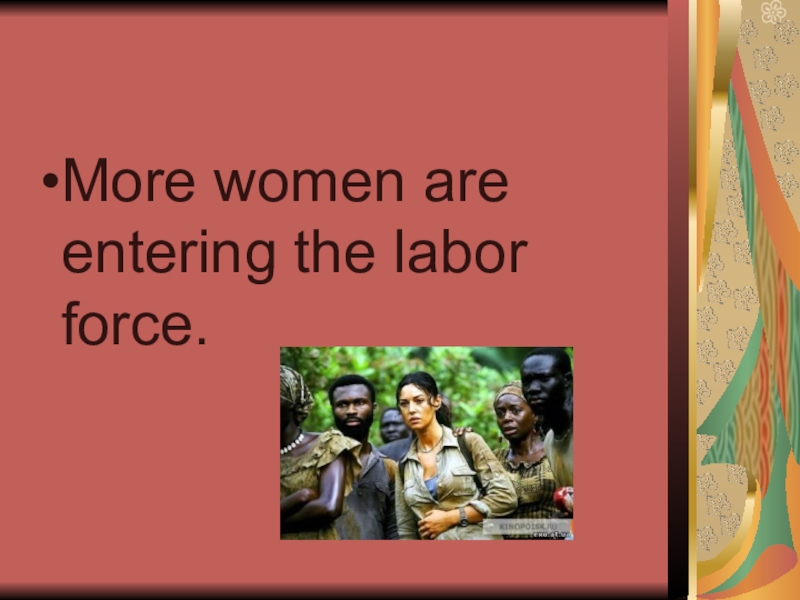
- 3. More women are entering the labor force.
- 4. Слайд 4
- 5. Слайд 5
- 6. In 1940 only 27.4% of all American
- 7. More women have been attaining higher educational levels.
- 8. Слайд 8
- 9. In 1960, of all persons aged 25
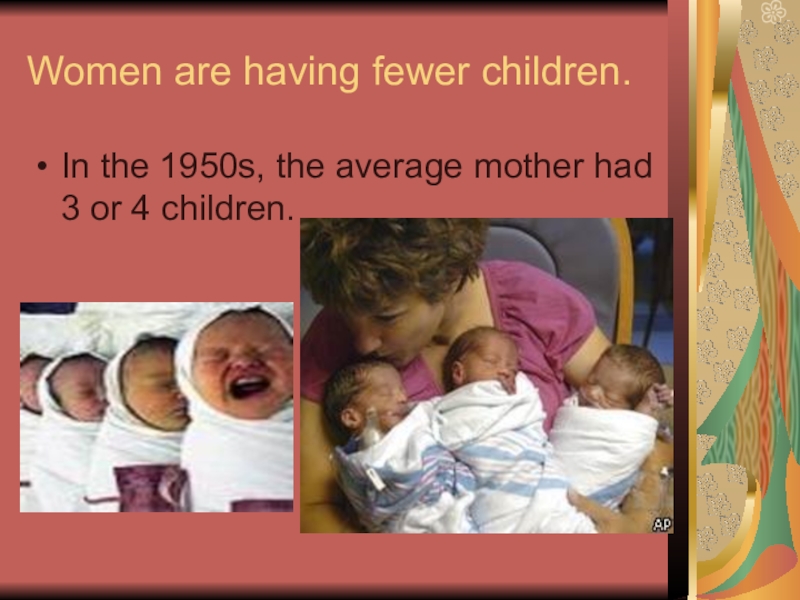
- 10. Women are having fewer children.In the 1950s, the average mother had 3 or 4 children.
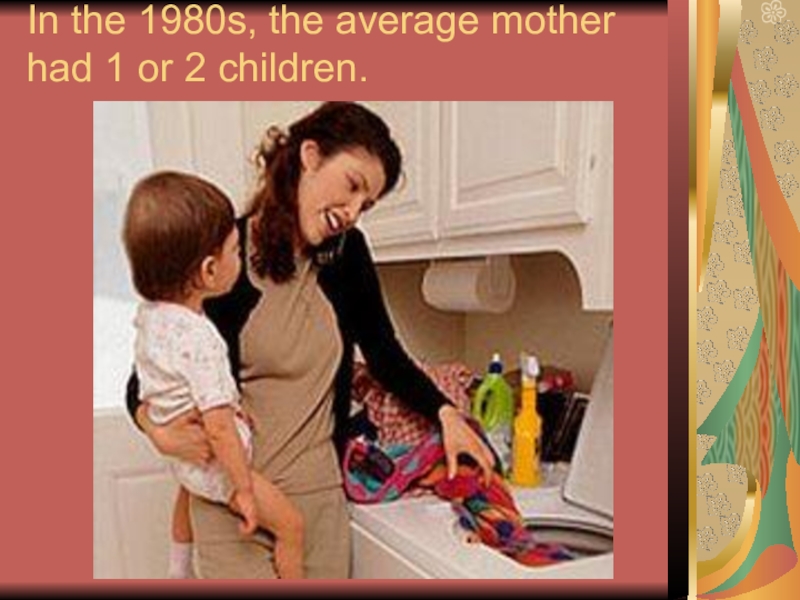
- 11. In the 1980s, the average mother had 1 or 2 children.
- 12. Слайд 12
- 13. More young women are single.In 1970, the
- 14. Women are marrying at a later age.
- 15. Слайд 15
- 16. Слайд 16
- 17. Opinion polls reveal that women’s attitudes toward
- 18. Слайд 18
- 19. However, in 1985, 57 percent of women
- 20. Слайд 20
- 21. Couples want to have fewer children.In 1941,
- 22. Слайд 22
- 23. Слайд 23
- 24. These statistics on demographics and attitudes indicate
- 25. Women now compete with men:For professional trainingEmploymentLeadership positionsAnd political power.
- 26. Слайд 26
- 27. Слайд 27
- 28. Sex discriminationFor many years, discriminatory laws and practices barred women from entering male dominated spheres.
- 29. Feminists have drawn attention to inequalities between
- 30. The modern feminist movementIN MORE RECENT DECADES,
- 31. Betty Friedan
- 32. Слайд 32
- 33. When Betty Friedan wrote The Feminine Mystique
- 34. With this book, Friedan became the standard
- 35. Feminist demanded greater access to jobs and
- 36. Legislation for equality The women’s movement has
- 37. In 1972, Congress barred gender-based discrimination in
- 38. Слайд 38
- 39. Professional womenLegislation prohibiting sex discrimination has benefited
- 40. In 1980 over 80% of the graduates
- 41. More and more women are training to
- 42. Слайд 42
- 43. Слайд 43
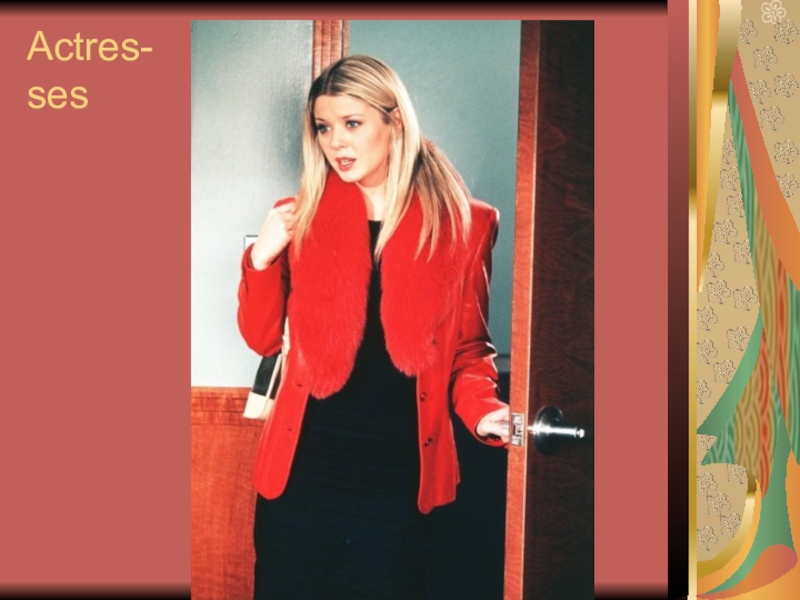
- 44. Actres- ses
- 45. Teachers
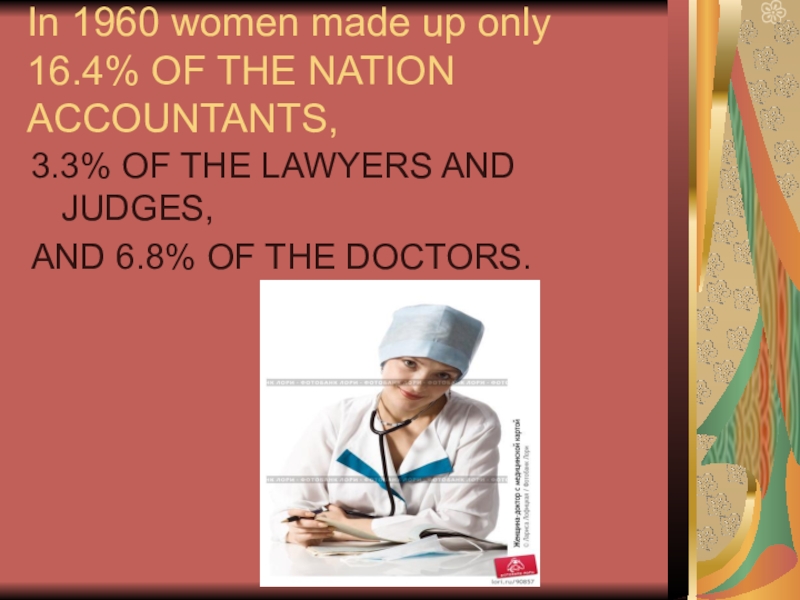
- 46. In 1960 women made up only 16.4%
- 47. BY THE 1980 THE PROPORTION OF WOMEN
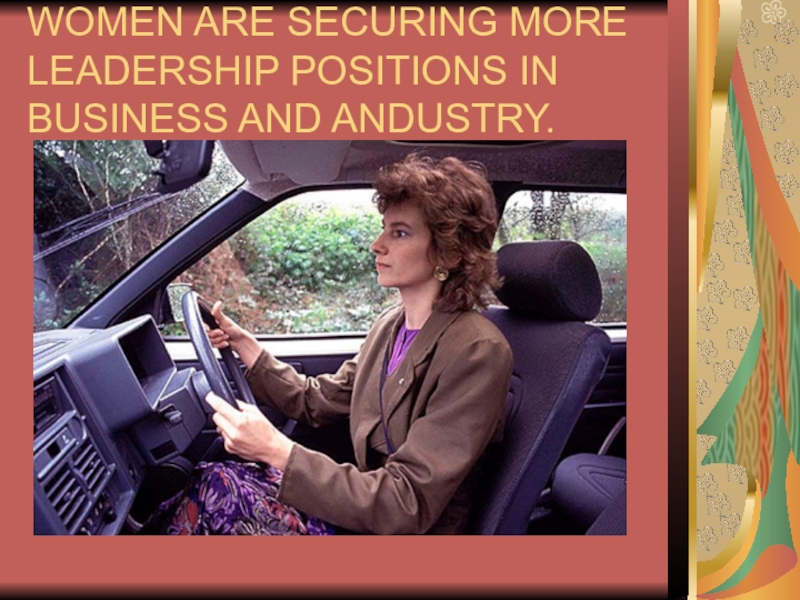
- 48. WOMEN ARE SECURING MORE LEADERSHIP POSITIONS IN BUSINESS AND ANDUSTRY.
- 49. WOMEN IN POLITICSALTHOUGH WOMAN’S SHARE OF POLITICAL
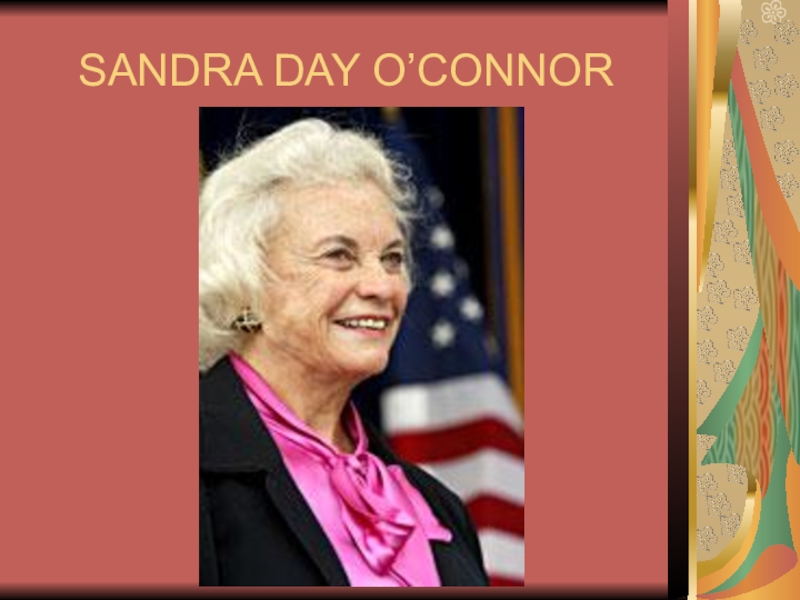
- 50. SANDRA DAY O’CONNOR
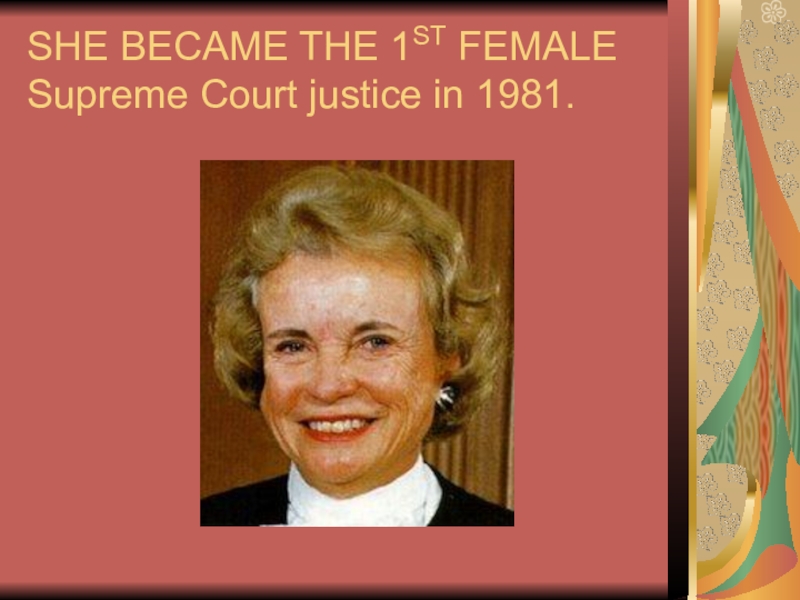
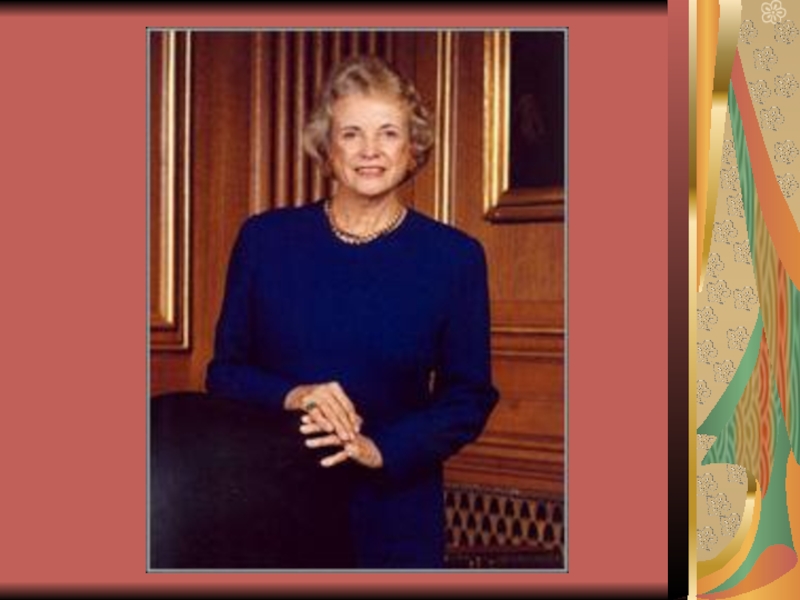
- 51. SHE BECAME THE 1ST FEMALE Supreme Court justice in 1981.
- 52. Слайд 52
- 53. Geraldine Ferraro
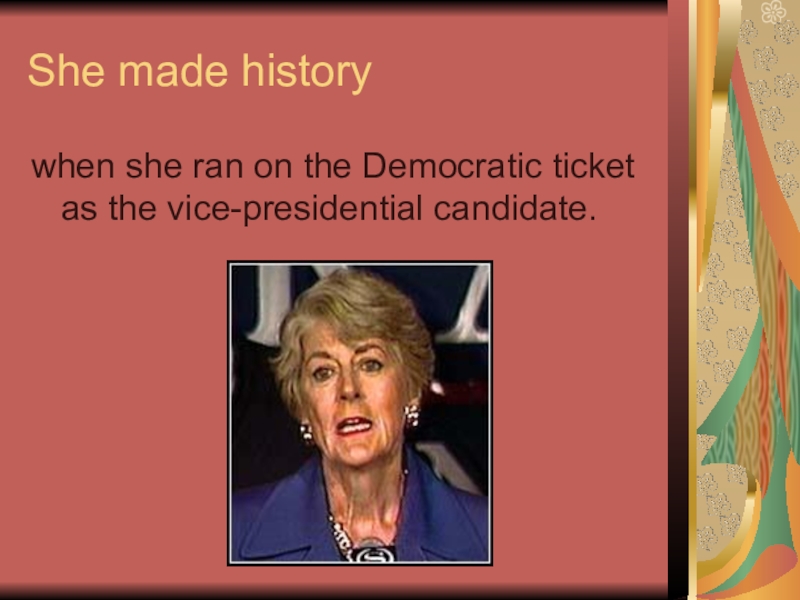
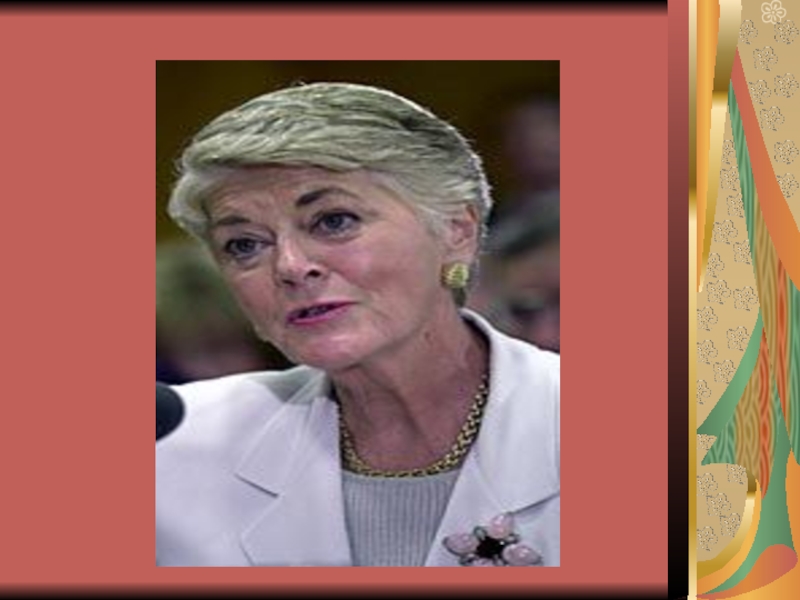
- 54. She made historywhen she ran on the Democratic ticket as the vice-presidential candidate.
- 55. Слайд 55
- 56. Progress for womenIn addition to these professional
- 57. The word “chairperson” replaces “chairman”, and “mail
- 58. Predicament of working womanSome feminists, including Betty Friedan, have acknowledged the predicament ofworking women.
- 59. It is difficult for a professional woman
- 60. Слайд 60
- 61. Women who choose a successful career instead of a family sometimes wish they could have both.
- 62. Many women who do manage both careers and families complain they are overworked.
- 63. Слайд 63
- 64. Слайд 64
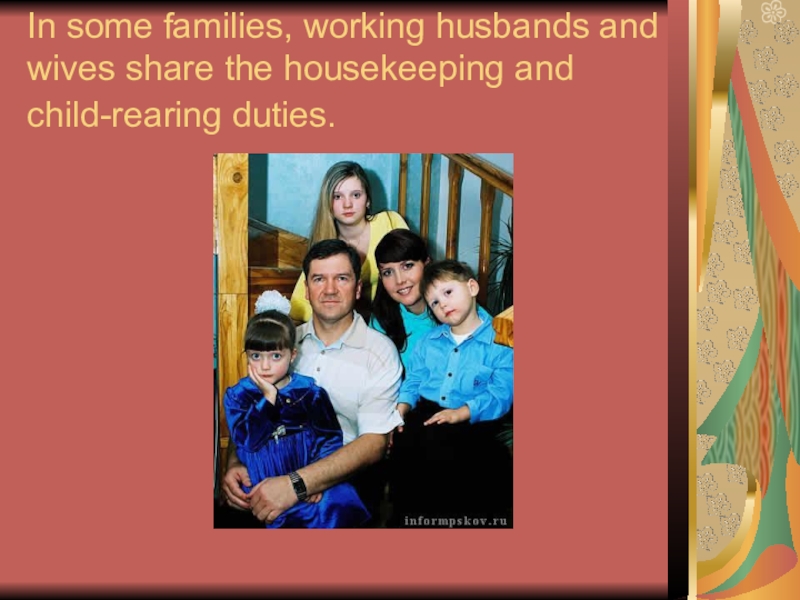
- 65. In some families, working husbands and wives share the housekeeping and child-rearing duties.
- 66. But statisticscontinue to show that most working
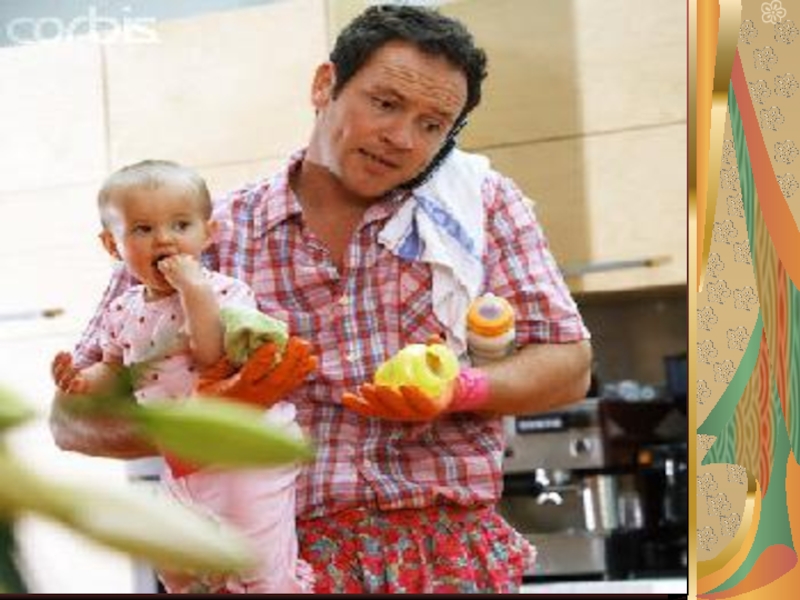
- 67. Arranging and affording child care is another burden on working parents.
- 68. Слайд 68
- 69. Daycare centers for pre-school-age children are often
- 70. In spite of some difficulties at lastwomen
- 71. The end!
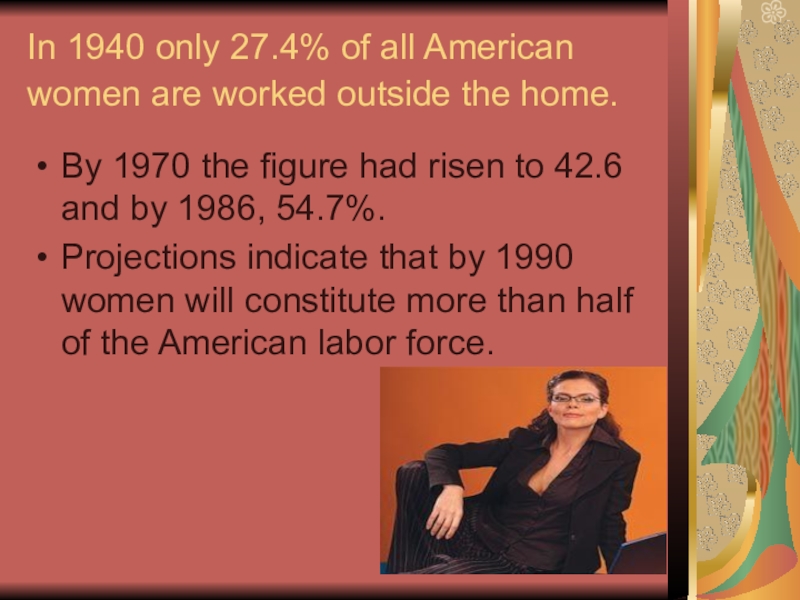
More women are entering the labor force.



Слайд 6In 1940 only 27.4% of all American women are worked outside
the home.
By 1970 the figure had risen to 42.6 and by 1986, 54.7%.
Projections indicate that by 1990 women will constitute more than half of the American labor force.
Слайд 9In 1960, of all persons aged 25 and older who had
been in college four or more times, 39 % were women. By 1975, the proportion had grown to 41 % by 1980.
Слайд 13More young women are single.
In 1970, the proportion of women from
25 to 29 who had never married was 10.5%.
By 1985, the proportion of single (never-married) women between those ages was 26.4%.
By 1985, the proportion of single (never-married) women between those ages was 26.4%.
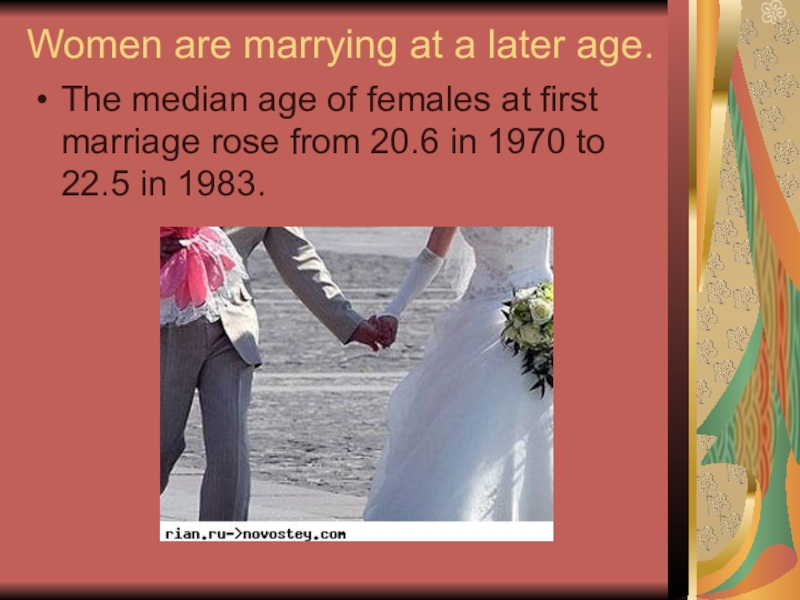
Слайд 14Women are marrying at a later age.
The median age of females
at first marriage rose from 20.6 in 1970 to 22.5 in 1983.

Слайд 17Opinion polls reveal that women’s attitudes toward family roles and child
rearing are changing:
The majority of women no longer favor traditional marriages.
In 1974, 49% of American women said they favored traditional marriages in which the husband is money-earner and the wife the homemaker and child rearer.

Слайд 19However, in 1985, 57 percent of women were convinced that a
better marriage is one in which the husband and wife share responsibilities of careers, housekeeping, and child rearing.

Слайд 21Couples want to have fewer children.
In 1941, when men and women
were asked what they considered the ideal number of children to have in family, the median ideal number was 3.7.
That number dropped to 2.8 in 1986.
That number dropped to 2.8 in 1986.


Слайд 24These statistics on demographics and attitudes indicate that the role of
women
in American society is changing.
Marriage and motherhood are no longer perceived as a woman’s only areas of responsibility.
Слайд 25Women now compete with men:
For professional training
Employment
Leadership positions
And political power.


Слайд 28Sex discrimination
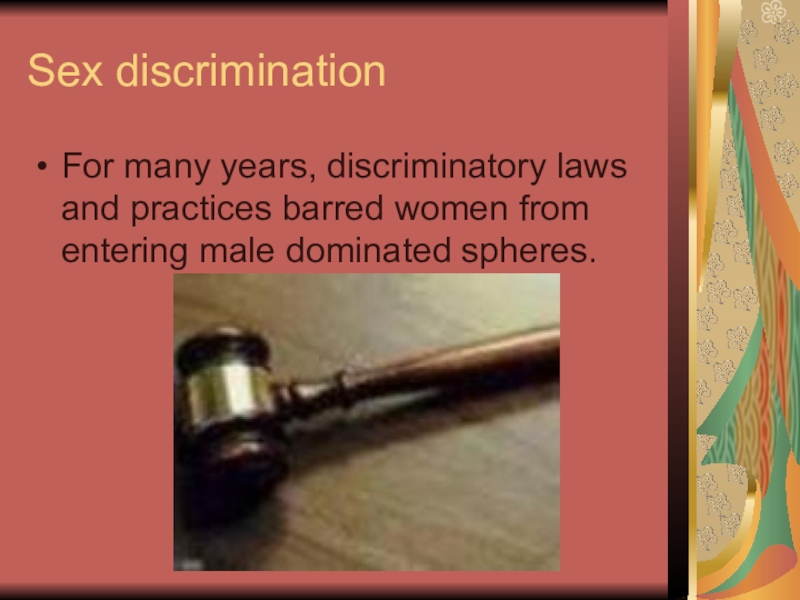
For many years, discriminatory laws and practices barred women from
entering male dominated spheres.
Слайд 29Feminists have drawn attention to inequalities between the sexes and have
succeeded in breaking down many of the barriers that kept women from professional and economic advancement.
Слайд 30The modern feminist movement
IN MORE RECENT DECADES, WOMEN HAVE SECURED MANY
RIGHTS AS A RESULT OF THE MODERN FEMINIST MOVEMENT, WHICH GAINED MOMENTUM IN THE 1960S.

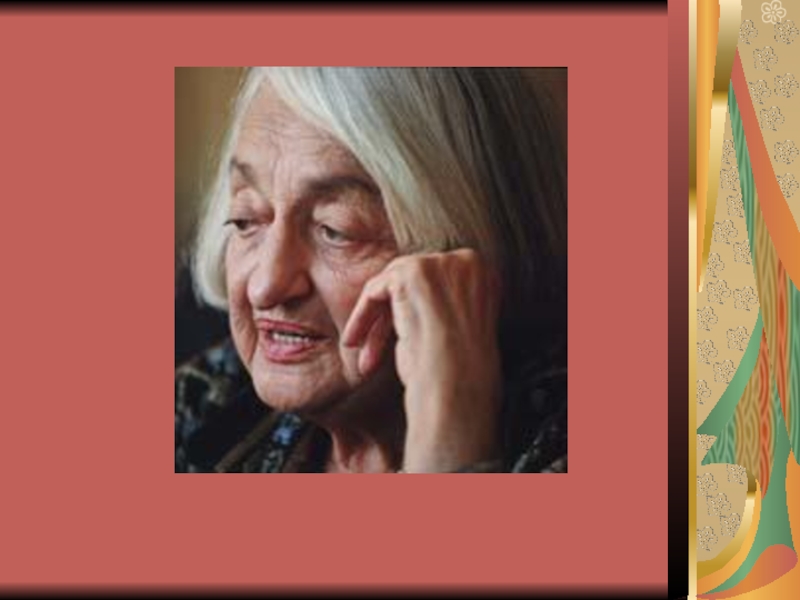
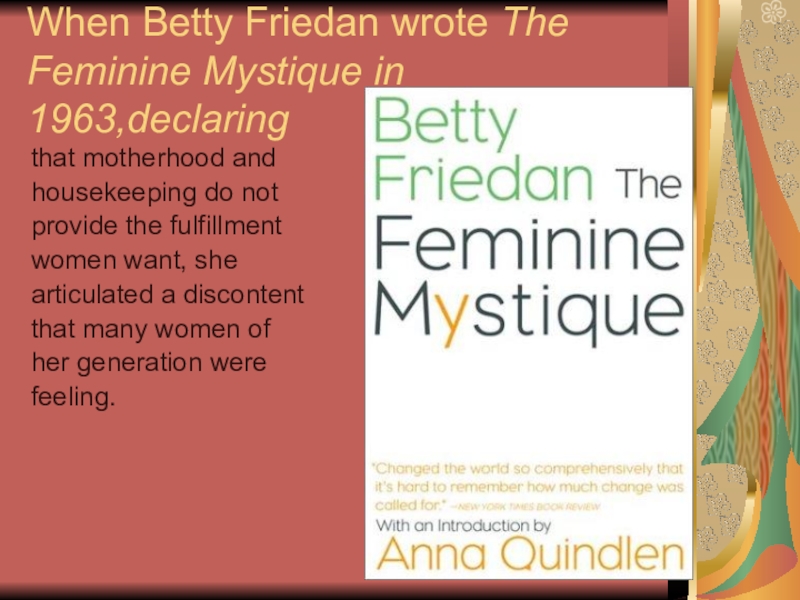
Слайд 33When Betty Friedan wrote The Feminine Mystique in 1963,declaring
that motherhood and
housekeeping
do not
provide the fulfillment
women want, she
articulated a discontent
that many women of
her generation were
feeling.
provide the fulfillment
women want, she
articulated a discontent
that many women of
her generation were
feeling.
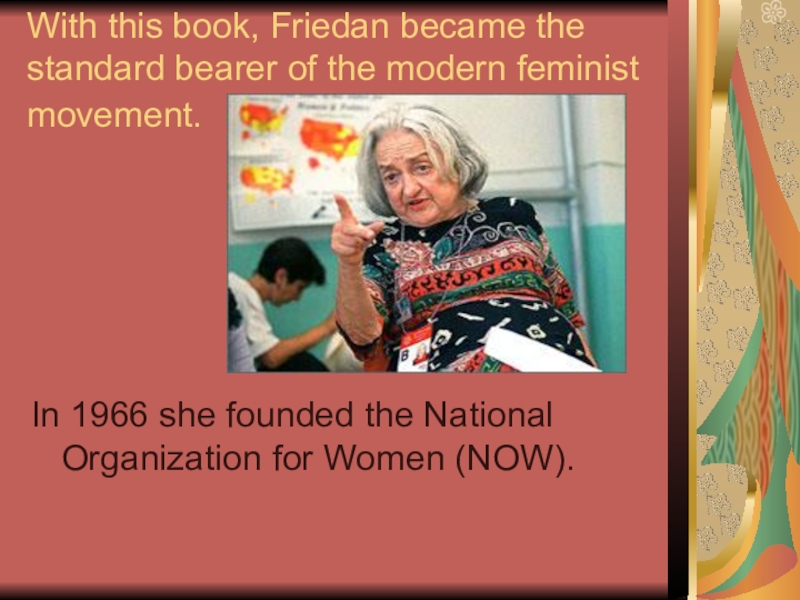
Слайд 34With this book, Friedan became the standard bearer of the modern
feminist movement.
In 1966 she founded the National Organization for Women (NOW).
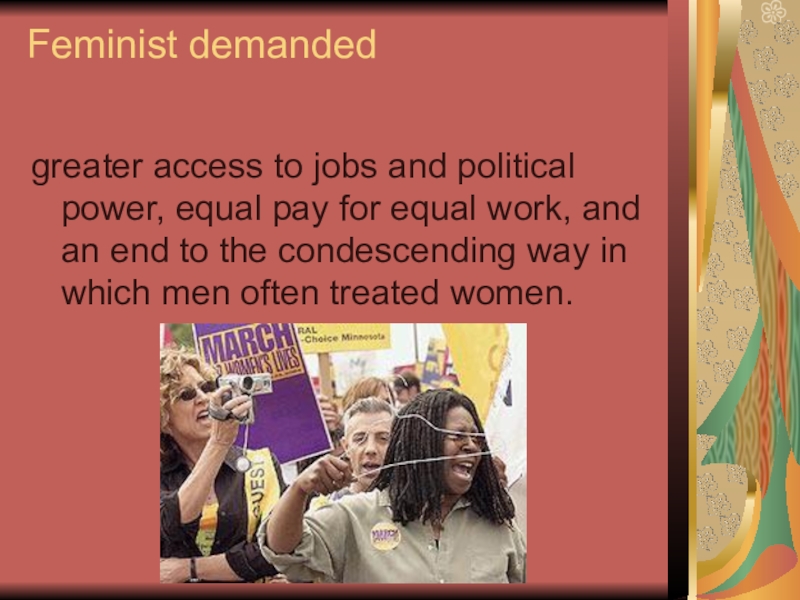
Слайд 35Feminist demanded
greater access to jobs and political power, equal pay for
equal work, and an end to the condescending way in which men often treated women.
Слайд 36Legislation for equality
The women’s movement has helped bring about legislation
that ensures greater equality of the sexes.
The Equal Pay Act of 1963 guarantees that man and women feeling the same jobs will receive the same pay.
Job discrimination on the basis of sex was prohibited by the Equal Rights Act of 1964.
The Equal Pay Act of 1963 guarantees that man and women feeling the same jobs will receive the same pay.
Job discrimination on the basis of sex was prohibited by the Equal Rights Act of 1964.
Слайд 37In 1972, Congress barred gender-based discrimination in all federally supported education
programs.
The same Congress passed a law making it easier for women to qualify for loans and mortgages.
A 1978 amendment to the Civil Rights Act protect pregnant women from job discrimination.
The same Congress passed a law making it easier for women to qualify for loans and mortgages.
A 1978 amendment to the Civil Rights Act protect pregnant women from job discrimination.

Слайд 39Professional women
Legislation prohibiting sex discrimination has benefited many women, especially those
in professional or technical fields.
Women have entered many male-dominated professions.
Women have entered many male-dominated professions.
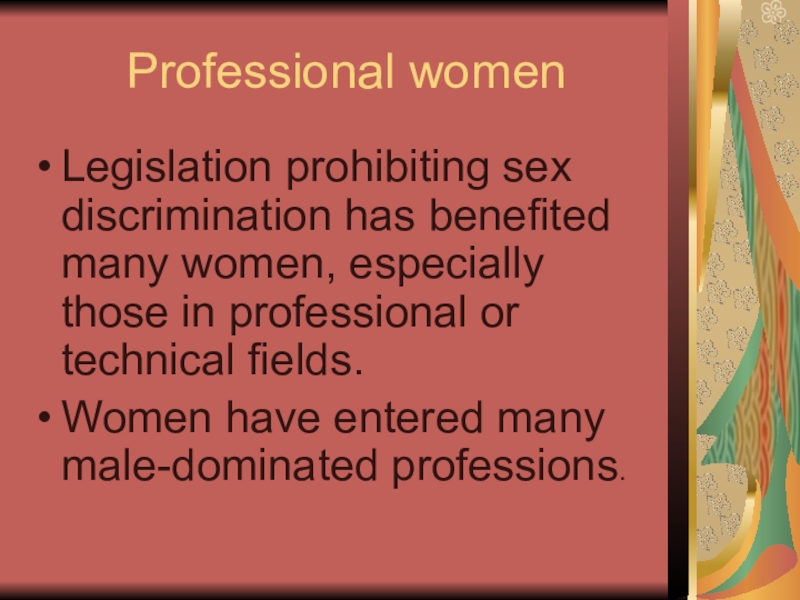
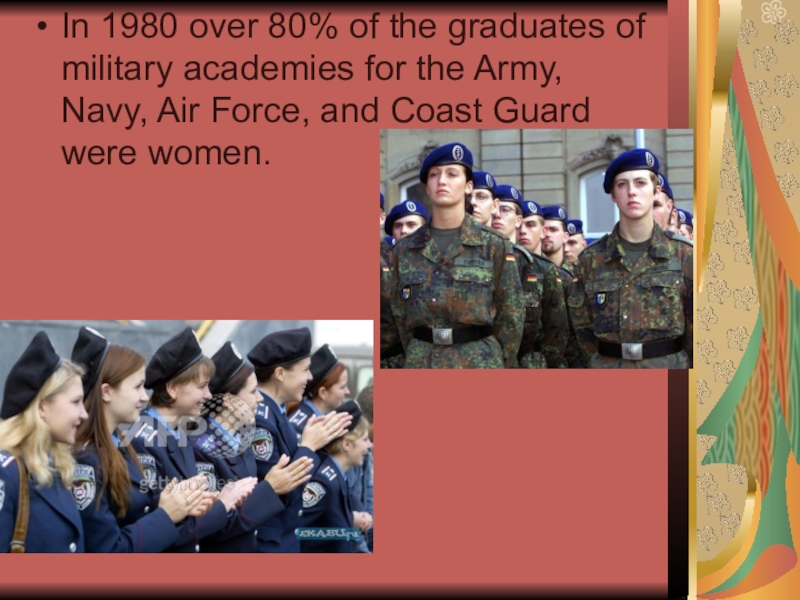
Слайд 40In 1980 over 80% of the graduates of military academies for
the Army, Navy, Air Force, and Coast Guard were women.
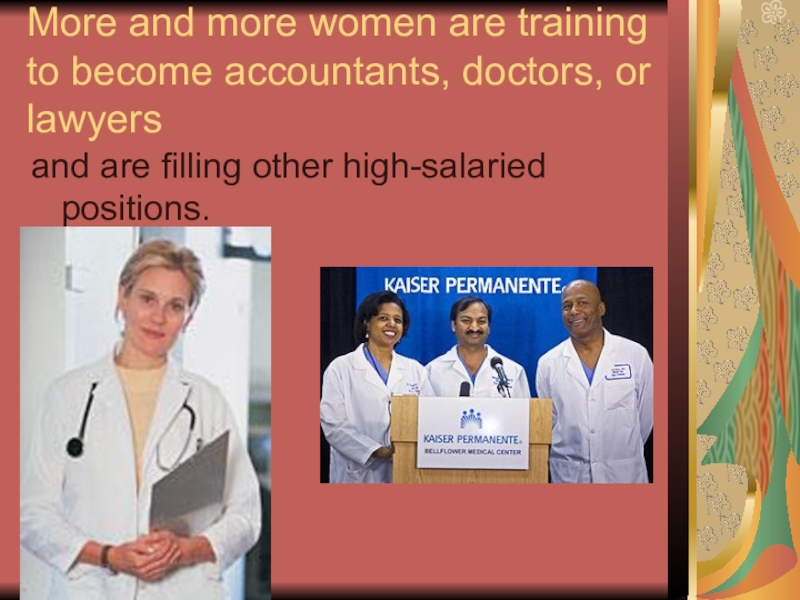
Слайд 41More and more women are training to become accountants, doctors, or
lawyers
and are filling other high-salaried positions.

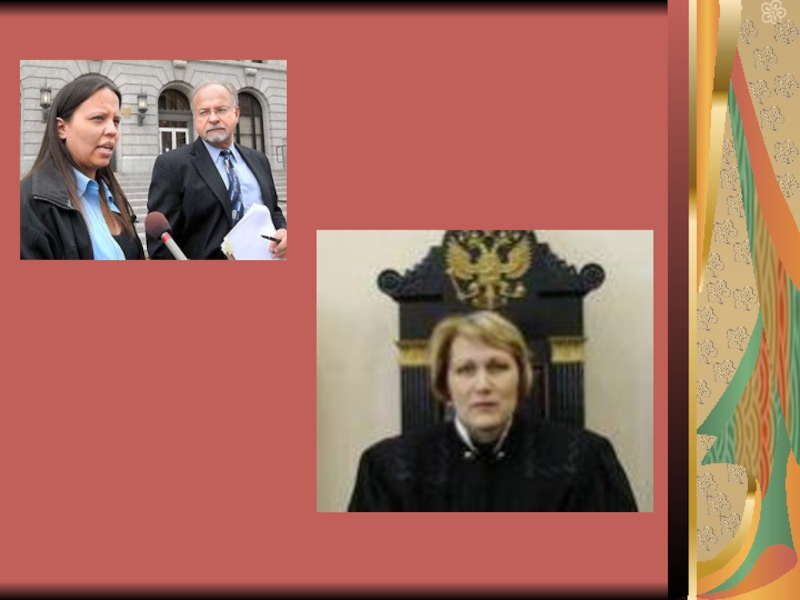

Слайд 46In 1960 women made up only 16.4% OF THE NATION ACCOUNTANTS,
3.3%
OF THE LAWYERS AND JUDGES,
AND 6.8% OF THE DOCTORS.
AND 6.8% OF THE DOCTORS.
Слайд 47BY THE 1980 THE PROPORTION OF WOMEN IN THESE HIGH-PAID PROFESSIONS
HAD RISEN CONSIDERABLY: 36.2% OF ACCOUNTANTS, 12.8% OF THE LAWYERS AND JUDGES, AND 13.4% OF THE PHYSICIANS WERE WOMEN!
Слайд 49WOMEN IN POLITICS
ALTHOUGH WOMAN’S SHARE OF POLITICAL REPRESENTATION IS STILL SMAII.
THE
ELECTION OR APPOINTMENT OF A WOMAN TO POLITICAL OFFICE IS BECOMING MORE COMMON.

Слайд 56Progress for women
In addition to these professional and political gains, the
heightened awareness of women’s rights has brought progress in other areas.
Federal agencies and other institutions have officially adopted non-sexist language.
Federal agencies and other institutions have officially adopted non-sexist language.
Слайд 57The word “chairperson” replaces “chairman”, and “mail carrier” is used instead
of “mailman”.
In the area of education and scholarship, women’s history has emerged as a new field of study.
Within this discipline, scholars are reexamining the events of America’s political and social history from a feminist perspective.
In the area of education and scholarship, women’s history has emerged as a new field of study.
Within this discipline, scholars are reexamining the events of America’s political and social history from a feminist perspective.
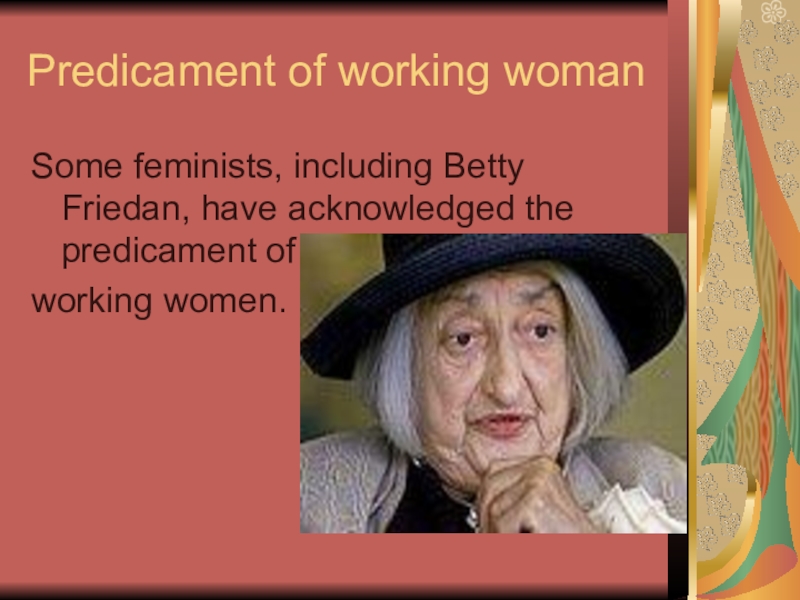
Слайд 58Predicament of working woman
Some feminists, including Betty Friedan, have acknowledged the
predicament of
working women.
working women.
Слайд 59It is difficult for a professional woman to become highly successful
if
she must divide her energies between duties at home and those at work.

Слайд 61Women who choose a successful career instead of a family sometimes
wish they could have both.


Слайд 65In some families, working husbands and wives share the housekeeping and
child-rearing duties.
Слайд 66But statistics
continue to show that most working women still do a
greater share of the housework than their husbands.
Слайд 69Daycare centers for pre-school-age children are often expensive.
Some corporations are responding
to women’s needs.
But still many people feel that solutions such as these need to be more broadly instituted to relieve pressure on women and families.
But still many people feel that solutions such as these need to be more broadly instituted to relieve pressure on women and families.
Слайд 70In spite of some difficulties at last
women become more free, emancipated
than they were hundred years ago.