Слайд 1
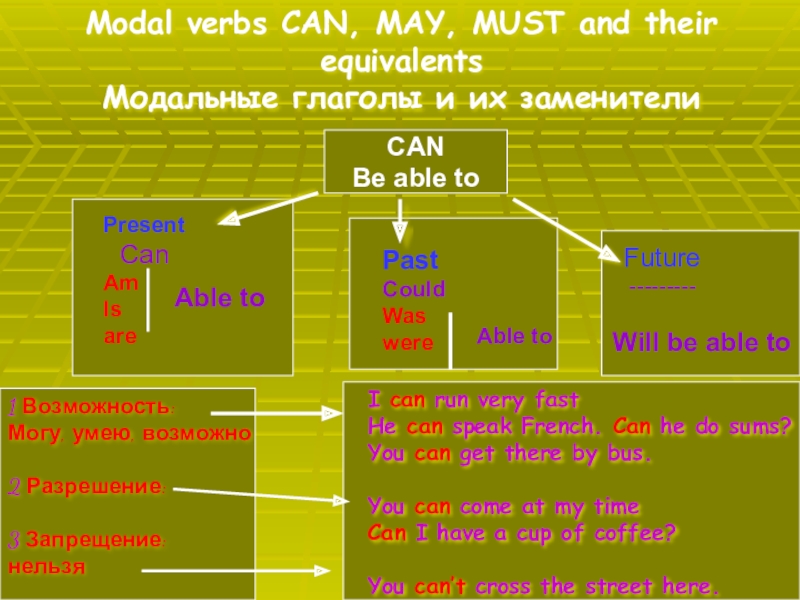
Modal verbs CAN, MAY, MUST and their equivalents
Модальные глаголы и их
заменители
1 Возможность:
Могу, умею, возможно
2 Разрешение:
3 Запрещение:
нельзя
I can run very fast
He can speak French. Can he do sums?
You can get there by bus.
You can come at my time
Can I have a cup of coffee?
You can’t cross the street here.
Слайд 2. Rewrite the sentences changing the tense form of the modal
verb (if necessary) adding the words in brackets.
I am sorry, I cannot come to your birthday party (yesterday). 2. I speak very little French now, I can understand it (when I finish school next year). 3. He has always been good at Maths, but even he cannot solve this problem
(at the last lesson). 4. Can I see the doctor (now)? 5. There was a sign. I cannot take pictures in the museum (when we were there). 6. Nobody can help me (then). 7. Can you do this work (tomorrow)? 8. We can go to the mountains (next year).
Слайд 3Translate the words in brackets using modal verbs.
1. He (не мог)
decide what career to choose. 2. Jane (сможет) to pass the exams well, if she studies hard. 3. She (может) apply for the job, but she has no experience. 4. Robert knew a lot about the job, he (мог) get on-the-job training but his father wanted him to take a course of studies. 5. (Смогу ли я) attend evening classes if I take the job? 6. But she (не смогла) do the job property and had to quit (уволиться). 7. He (мог) play chess well but he (не смог) to win the game. 8. He knew what he wanted to be since he was six and he (смог) to persuade (убедить) his father to help him. 9. John (не мог) pass the exams when he finished school but he (смог) to retake it a year later. 10. He (мог) do the work by himself but together they (смогли) to finish it very quickly.
Слайд 4Translate the sentences from Russian into English.
1. Я не смогу сдать
этот тест. Он очень трудный. 2. Он не смог сдать экзамен, он провалился. (fail) 3. В 16 лет молодые люди не могут поступать в университет, они должны сдать еще экзамены A-level. 4. После экзаменов мы сможем продолжить обучение в колледже.! 5. Сейчас трудно найти работу, боюсь, ты не сможешь найти работу, когда получишь диплом. 6. Можно мне поговорить с мистером Джонсоном? Я хочу сказать ему, что не сшя4 встретиться с ним завтра. 7. В 16 лет он не мог решить, кем он хочет быть. 8. Я надеюсь что я смогу принять решение, когда поговорю с консультантом по выбору профессии. (Career Adviser) 9. Я не смогу дать тебе книгу на неделю. 10. Вы не сможете принять участие в а проекте (scheme), если не сдадите экзамены.
Слайд 5
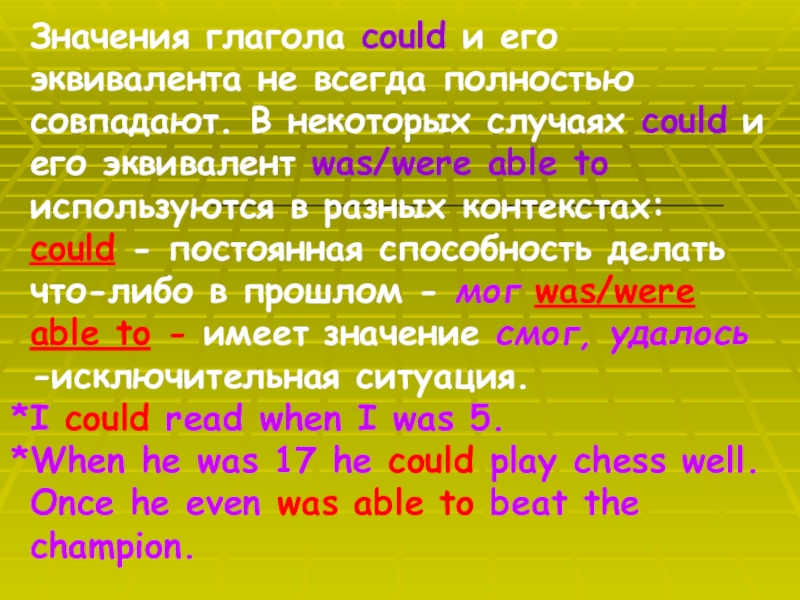
Значения глагола could и его эквивалента не всегда полностью совпадают. В
некоторых случаях could и его эквивалент was/were able to используются в разных контекстах:
could - постоянная способность делать что-либо в прошлом - мог was/were able to - имеет значение смог, удалось -исключительная ситуация.
I could read when I was 5.
When he was 17 he could play chess well. Once he even was able to beat the
champion.
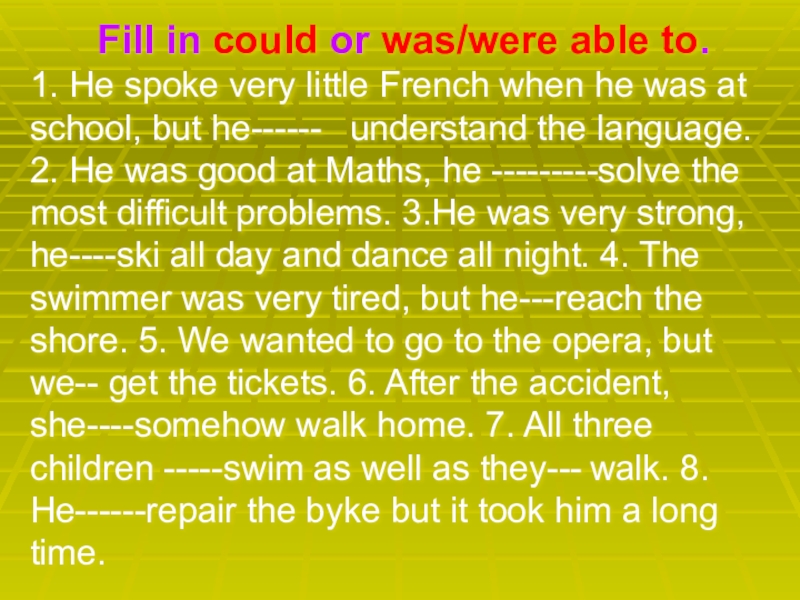
Слайд 6Fill in could or was/were able to.
1. He spoke very little
French when he was at school, but he------ understand the language. 2. He was good at Maths, he ---------solve the most difficult problems. 3.He was very strong, he----ski all day and dance all night. 4. The swimmer was very tired, but he---reach the shore. 5. We wanted to go to the opera, but
we-- get the tickets. 6. After the accident, she----somehow walk home. 7. All three children -----swim as well as they--- walk. 8. He------repair the byke but it took him a long time.
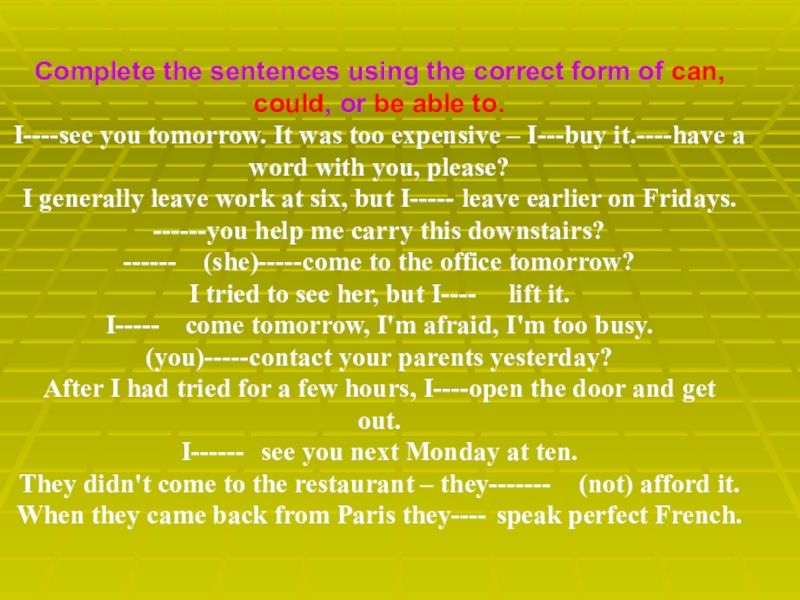
Слайд 7Complete the sentences using the correct form of can, could, or
be able to.
I----see you tomorrow. It was too expensive – I---buy it.----have a word with you, please?
I generally leave work at six, but I----- leave earlier on Fridays.
------you help me carry this downstairs?
------ (she)-----come to the office tomorrow?
I tried to see her, but I---- lift it.
I----- come tomorrow, I'm afraid, I'm too busy.
(you)-----contact your parents yesterday?
After I had tried for a few hours, I----open the door and get
out.
I------ see you next Monday at ten.
They didn't come to the restaurant – they------- (not) afford it.
When they came back from Paris they---- speak perfect French.
Слайд 8
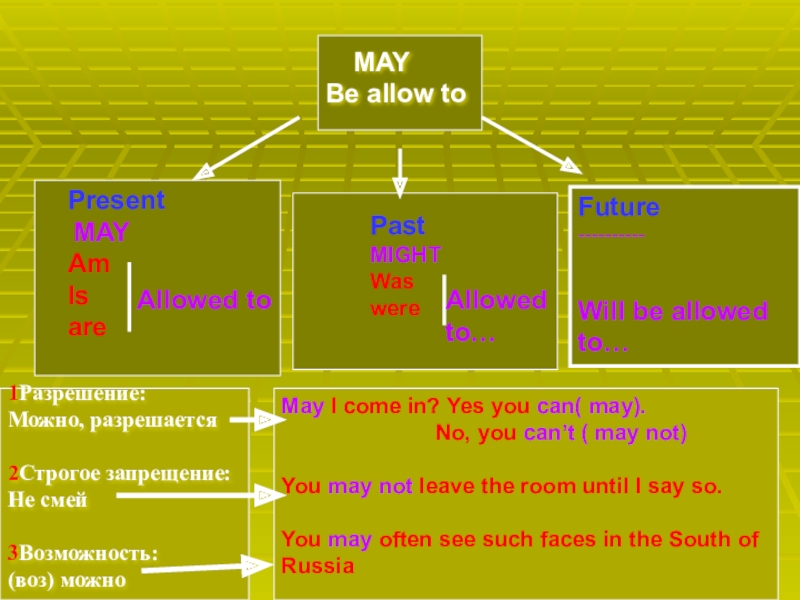
MAY
Be allow to
Present
MAY
Am
Is
are
Allowed to
Past
MIGHT
Was
were
Allowed to…
Future
----------
Will be allowed
to…
1Разрешение:
Можно, разрешается
2Строгое запрещение:
Не смей
3Возможность:
(воз) можно
May I come in? Yes you can( may).
No, you can’t ( may not)
You may not leave the room until I say so.
You may often see such faces in the South of Russia
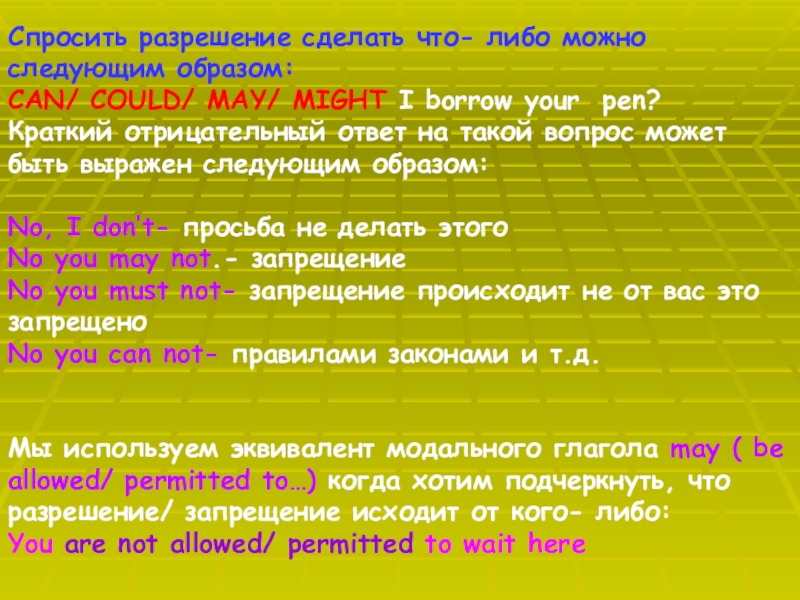
Слайд 9Спросить разрешение сделать что- либо можно следующим образом:
CAN/ COULD/ MAY/ MIGHT
I borrow your pen?
Краткий отрицательный ответ на такой вопрос может быть выражен следующим образом:
No, I don’t- просьба не делать этого
No you may not.- запрещение
No you must not- запрещение происходит не от вас это запрещено
No you can not- правилами законами и т.д.
Мы используем эквивалент модального глагола may ( be allowed/ permitted to…) когда хотим подчеркнуть, что разрешение/ запрещение исходит от кого- либо:
You are not allowed/ permitted to wait here
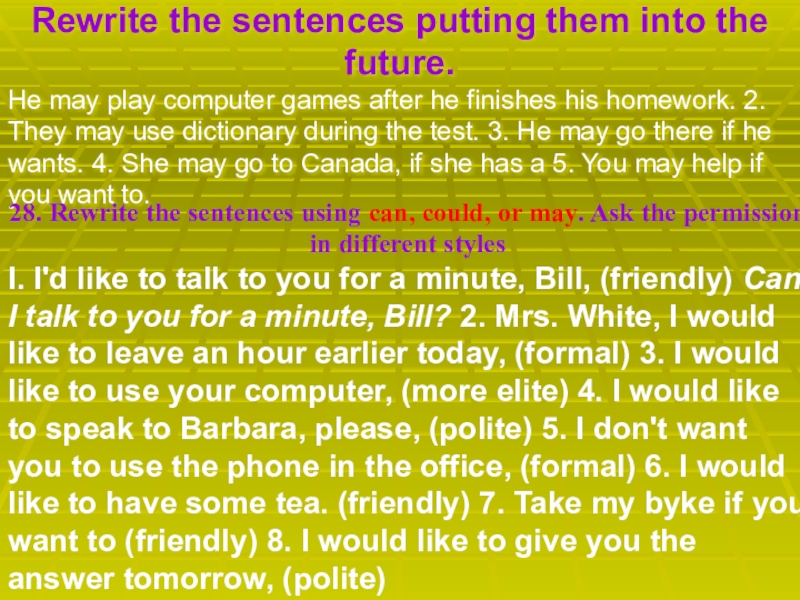
Слайд 10Rewrite the sentences putting them into the future.
He may play computer
games after he finishes his homework. 2. They may use dictionary during the test. 3. He may go there if he wants. 4. She may go to Canada, if she has a 5. You may help if you want to.
28. Rewrite the sentences using can, could, or may. Ask the permission in different styles
I. I'd like to talk to you for a minute, Bill, (friendly) Can I talk to you for a minute, Bill? 2. Mrs. White, I would like to leave an hour earlier today, (formal) 3. I would like to use your computer, (more elite) 4. I would like to speak to Barbara, please, (polite) 5. I don't want you to use the phone in the office, (formal) 6. I would like to have some tea. (friendly) 7. Take my byke if you want to (friendly) 8. I would like to give you the answer tomorrow, (polite)
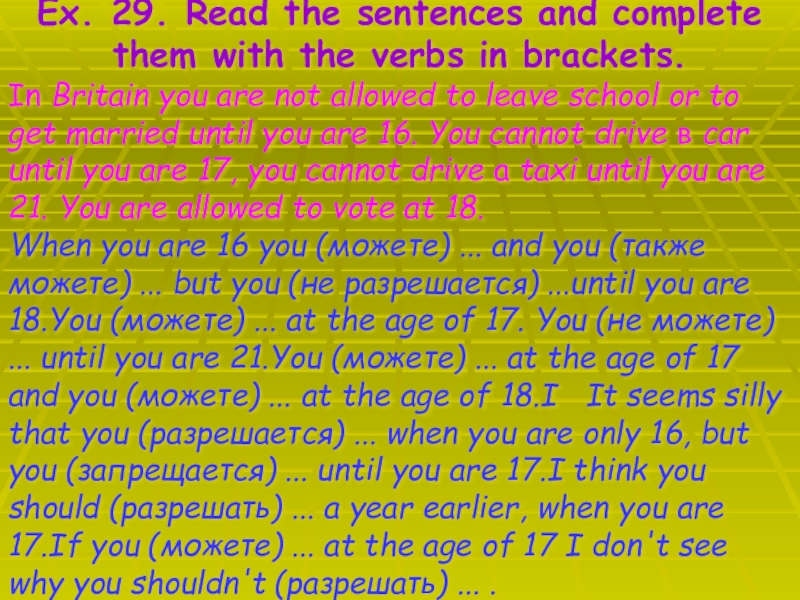
Слайд 11Ex. 29. Read the sentences and complete them with the verbs
in brackets.
In Britain you are not allowed to leave school or to get married until you are 16. You cannot drive в car until you are 17, you cannot drive a taxi until you are 21. You are allowed to vote at 18.
When you are 16 you (можете) ... and you (также можете) ... but you (не разрешается) ...until you are 18.You (можете) ... at the age of 17. You (не можете) ... until you are 21.You (можете) ... at the age of 17 and you (можете) ... at the age of 18.I It seems silly that you (разрешается) ... when you are only 16, but you (запрещается) ... until you are 17.I think you should (разрешать) ... a year earlier, when you are 17.If you (можете) ... at the age of 17 I don't see why you shouldn't (разрешать) ... .
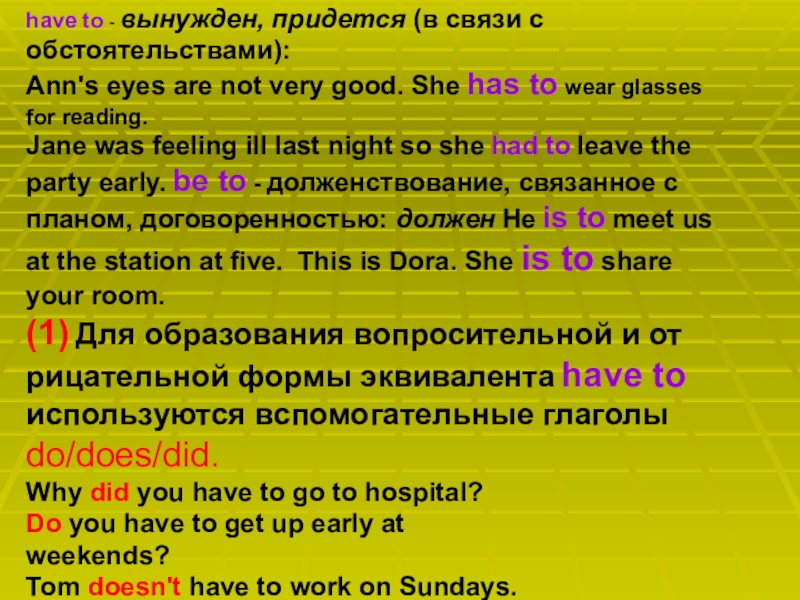
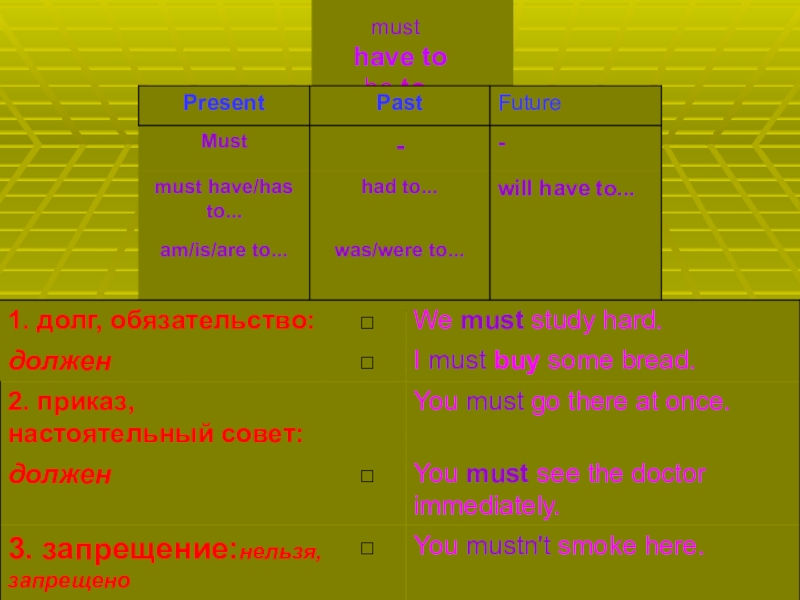
Слайд 13have to - вынужден, придется (в связи с обстоятельствами):
Ann's eyes are
not very good. She has to wear glasses for reading.
Jane was feeling ill last night so she had to leave the party early. be to - долженствование, связанное с планом, договоренностью: должен Не is to meet us at the station at five. This is Dora. She is to share your room.
(1) Для образования вопросительной и отрицательной формы эквивалента have to используются вспомогательные глаголы do/does/did.
Why did you have to go to hospital?
Do you have to get up early at
weekends?
Tom doesn't have to work on Sundays.
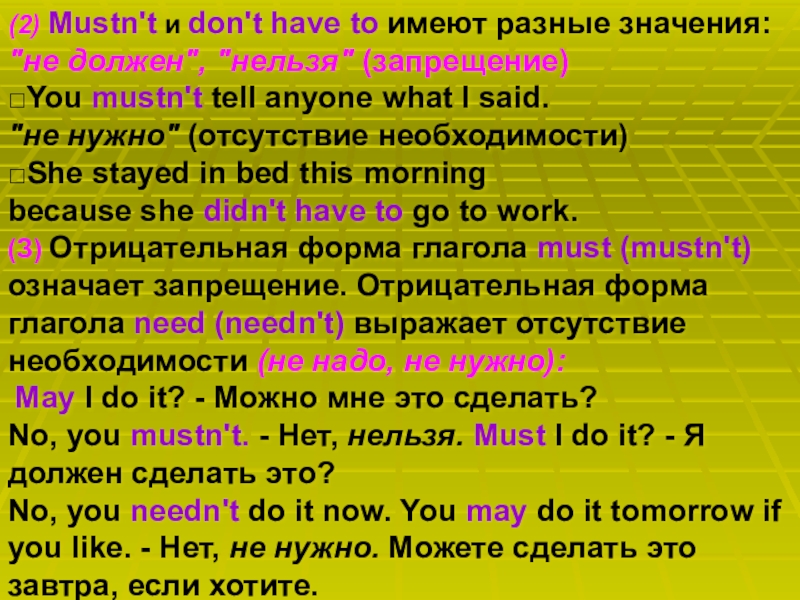
Слайд 14(2) Mustn't и don't have to имеют разные значения: "не должен",
"нельзя" (запрещение)
□You mustn't tell anyone what I said.
"не нужно" (отсутствие необходимости)
□She stayed in bed this morning
because she didn't have to go to work.
(З) Отрицательная форма глагола must (mustn't) означает запрещение. Отрицательная форма глагола need (needn't) выражает отсутствие необходимости (не надо, не нужно):
May I do it? - Можно мне это сделать?
No, you mustn't. - Нет, нельзя. Must I do it? - Я должен сделать это?
No, you needn't do it now. You may do it tomorrow if you like. - Нет, не нужно. Можете сделать это завтра, если хотите.
Слайд 15
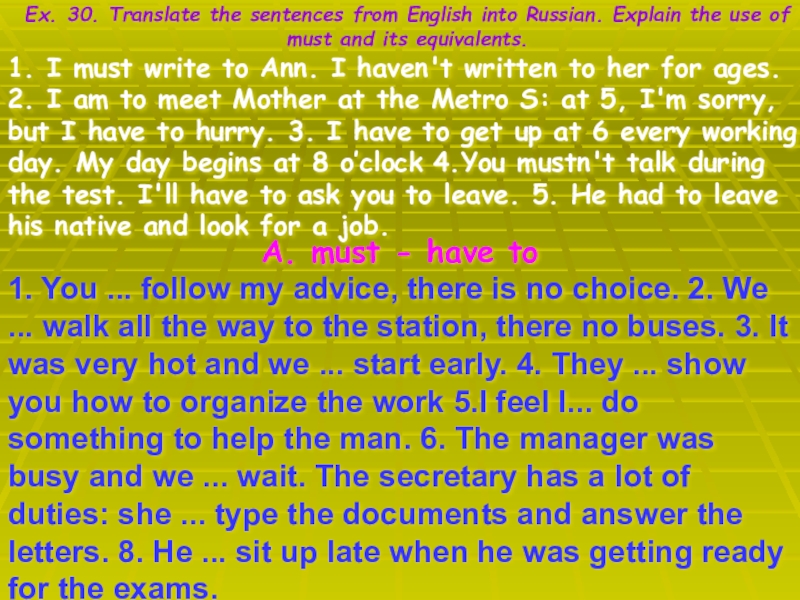
Ex. 30. Translate the sentences from English into Russian. Explain the
use of must and its equivalents.
1. I must write to Ann. I haven't written to her for ages. 2. I am to meet Mother at the Metro S: at 5, I'm sorry, but I have to hurry. 3. I have to get up at 6 every working day. My day begins at 8 o’clock 4.You mustn't talk during the test. I'll have to ask you to leave. 5. He had to leave his native and look for a job.
A. must - have to
1. You ... follow my advice, there is no choice. 2. We ... walk all the way to the station, there no buses. 3. It was very hot and we ... start early. 4. They ... show you how to organize the work 5.I feel I... do something to help the man. 6. The manager was busy and we ... wait. The secretary has a lot of duties: she ... type the documents and answer the letters. 8. He ... sit up late when he was getting ready for the exams.
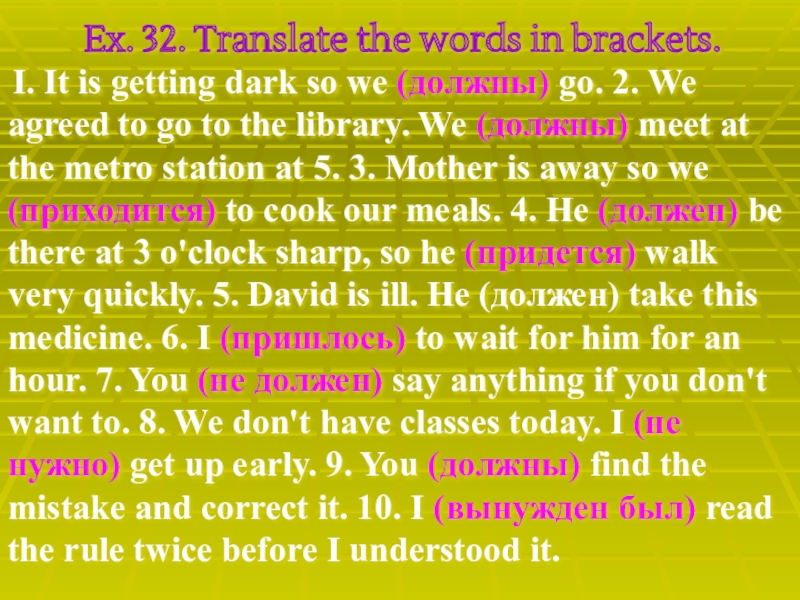
Слайд 16Ex. 32. Translate the words in brackets.
I. It is getting dark
so we (должны) go. 2. We agreed to go to the library. We (должны) meet at the metro station at 5. 3. Mother is away so we (приходится) to cook our meals. 4. He (должен) be there at 3 o'clock sharp, so he (придется) walk very quickly. 5. David is ill. He (должен) take this medicine. 6. I (пришлось) to wait for him for an hour. 7. You (не должен) say anything if you don't want to. 8. We don't have classes today. I (не нужно) get up early. 9. You (должны) find the mistake and correct it. 10. I (вынужден был) read the rule twice before I understood it.
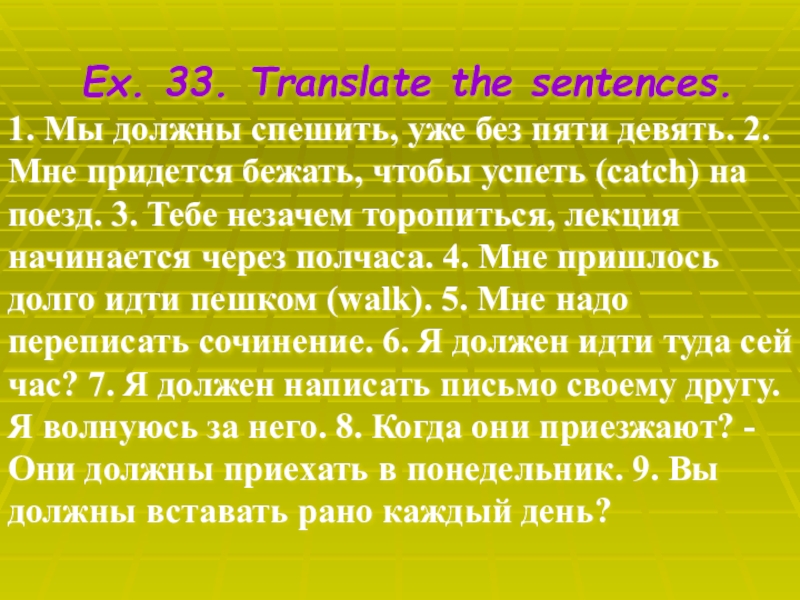
Слайд 17Ex. 33. Translate the sentences.
1. Мы должны спешить, уже без пяти
девять. 2. Мне придется бежать, чтобы успеть (catch) на поезд. 3. Тебе незачем торопиться, лекция начинается через полчаса. 4. Мне пришлось долго идти пешком (walk). 5. Мне надо переписать сочинение. 6. Я должен идти туда сейчас? 7. Я должен написать письмо своему другу. Я волнуюсь за него. 8. Когда они приезжают? - Они должны приехать в понедельник. 9. Вы должны вставать рано каждый день?
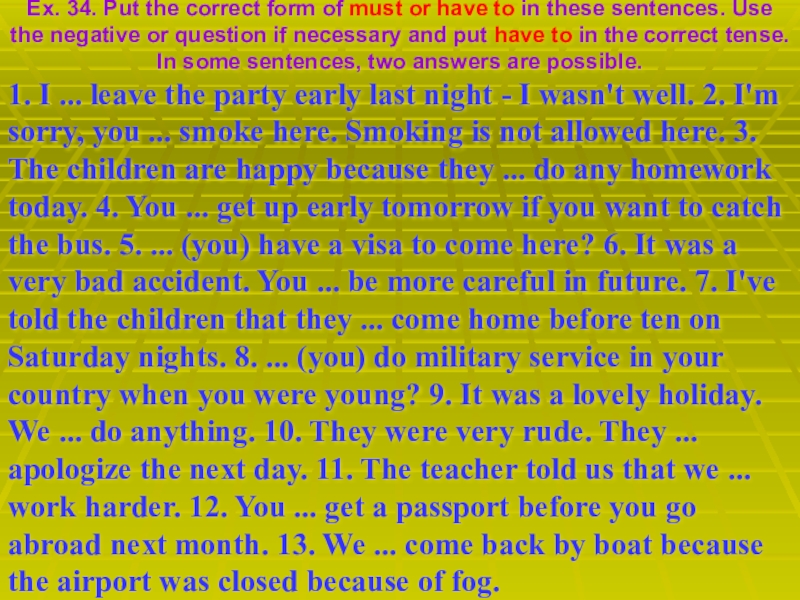
Слайд 18Ex. 34. Put the correct form of must or have to
in these sentences. Use the negative or question if necessary and put have to in the correct tense. In some sentences, two answers are possible.
1. I ... leave the party early last night - I wasn't well. 2. I'm sorry, you ... smoke here. Smoking is not allowed here. 3. The children are happy because they ... do any homework today. 4. You ... get up early tomorrow if you want to catch the bus. 5. ... (you) have a visa to come here? 6. It was a very bad accident. You ... be more careful in future. 7. I've told the children that they ... come home before ten on Saturday nights. 8. ... (you) do military service in your country when you were young? 9. It was a lovely holiday. We ... do anything. 10. They were very rude. They ... apologize the next day. 11. The teacher told us that we ... work harder. 12. You ... get a passport before you go abroad next month. 13. We ... come back by boat because the airport was closed because of fog.
Слайд 19
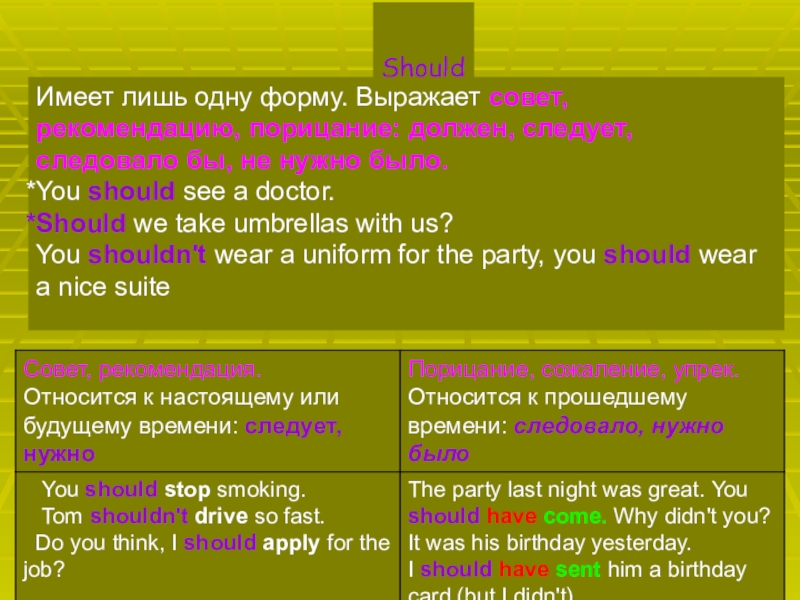
Should
Имеет лишь одну форму. Выражает совет, рекомендацию, порицание: должен, следует, следовало
бы, не нужно было.
You should see a doctor.
Should we take umbrellas with us?
You shouldn't wear a uniform for the party, you should wear a nice suite
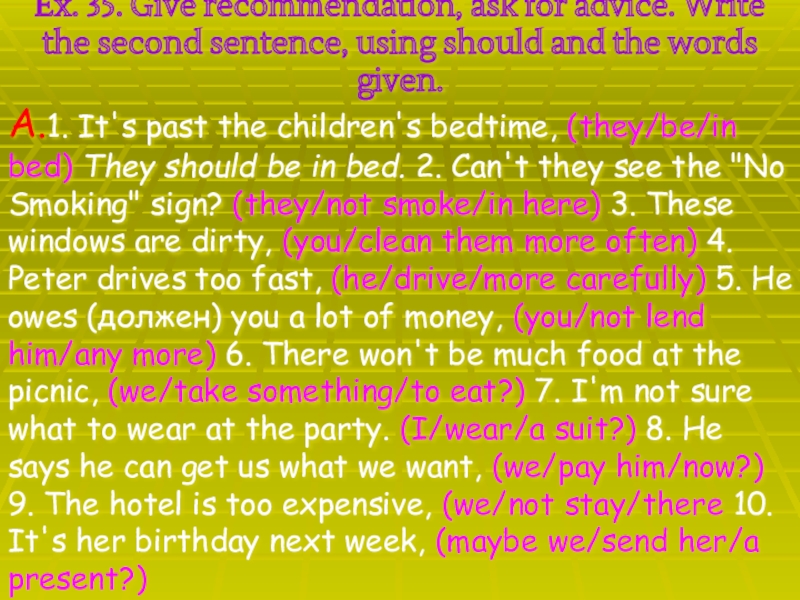
Слайд 20Ex. 35. Give recommendation, ask for advice. Write the second sentence,
using should and the words given.
A.1. It's past the children's bedtime, (they/be/in bed) They should be in bed. 2. Can't they see the "No Smoking" sign? (they/not smoke/in here) 3. These windows are dirty, (you/clean them more often) 4. Peter drives too fast, (he/drive/more carefully) 5. He owes (должен) you a lot of money, (you/not lend him/any more) 6. There won't be much food at the picnic, (we/take something/to eat?) 7. I'm not sure what to wear at the party. (I/wear/a suit?) 8. He says he can get us what we want, (we/pay him/now?) 9. The hotel is too expensive, (we/not stay/there 10. It's her birthday next week, (maybe we/send her/a present?)
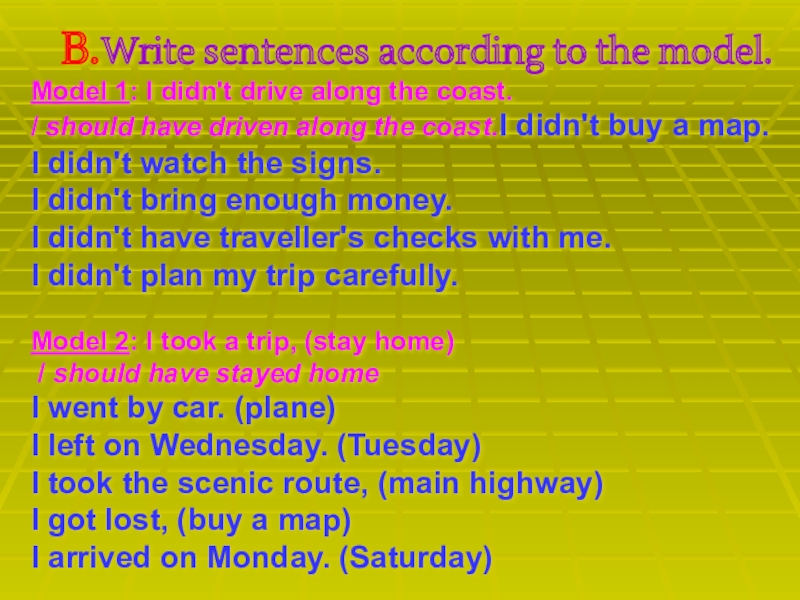
Слайд 21B. Write sentences according to the model.
Model 1: I didn't drive along
the coast.
/ should have driven along the coast.I didn't buy a map.
I didn't watch the signs.
I didn't bring enough money.
I didn't have traveller's checks with me.
I didn't plan my trip carefully.
Model 2: I took a trip, (stay home)
/ should have stayed home
I went by car. (plane)
I left on Wednesday. (Tuesday)
I took the scenic route, (main highway)
I got lost, (buy a map)
I arrived on Monday. (Saturday)
Слайд 22
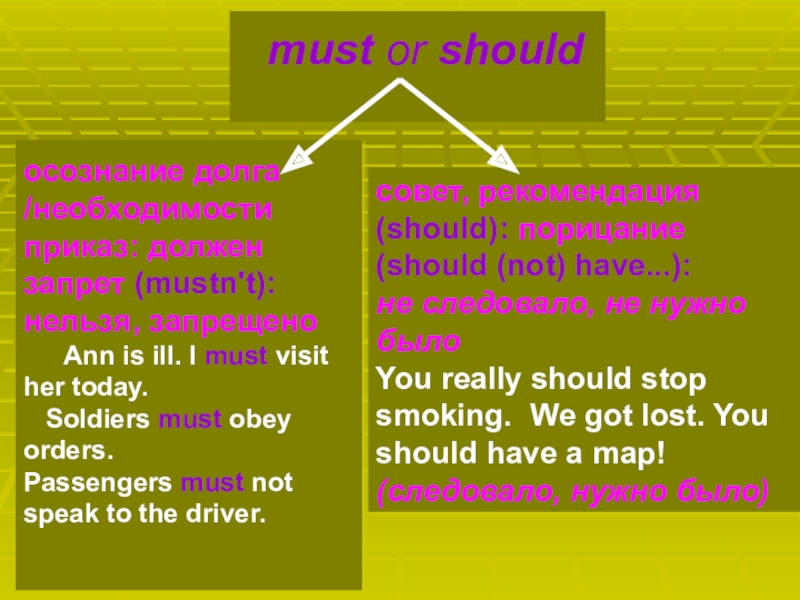
must or should
осознание долга /необходимости
приказ: должен
запрет (mustn't): нельзя, запрещено
Ann
is ill. I must visit her today.
Soldiers must obey orders.
Passengers must not speak to the driver.
совет, рекомендация (should): порицание (should (not) have...):
не следовало, не нужно было
You really should stop smoking. We got lost. You should have a map! (следовало, нужно было)
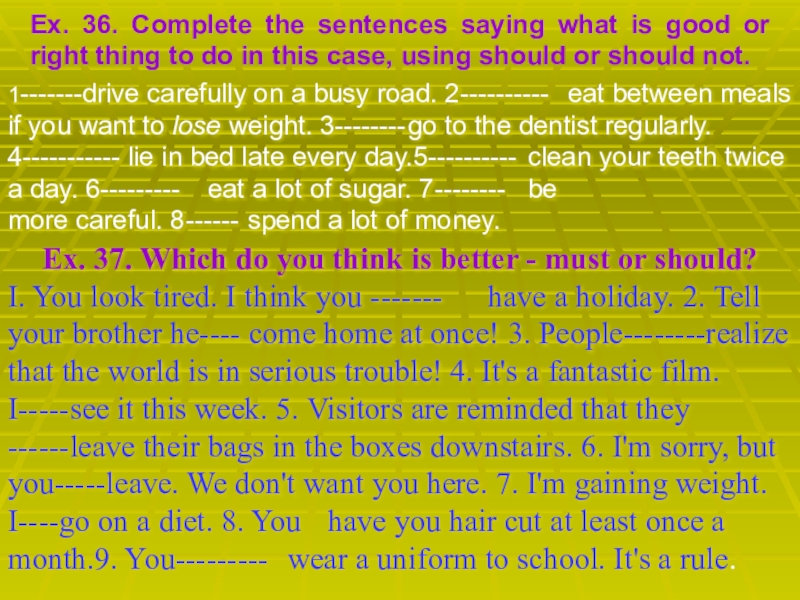
Слайд 23Ex. 36. Complete the sentences saying what is good or right
thing to do in this case, using should or should not.
1-------drive carefully on a busy road. 2---------- eat between meals if you want to lose weight. 3-------- go to the dentist regularly. 4----------- lie in bed late every day.5---------- clean your teeth twice a day. 6--------- eat a lot of sugar. 7-------- be
more careful. 8------ spend a lot of money.
Ex. 37. Which do you think is better - must or should?
I. You look tired. I think you ------- have a holiday. 2. Tell your brother he---- come home at once! 3. People--------realize that the world is in serious trouble! 4. It's a fantastic film. I-----see it this week. 5. Visitors are reminded that they ------leave their bags in the boxes downstairs. 6. I'm sorry, but you-----leave. We don't want you here. 7. I'm gaining weight. I----go on a diet. 8. You have you hair cut at least once a month.9. You--------- wear a uniform to school. It's a rule.
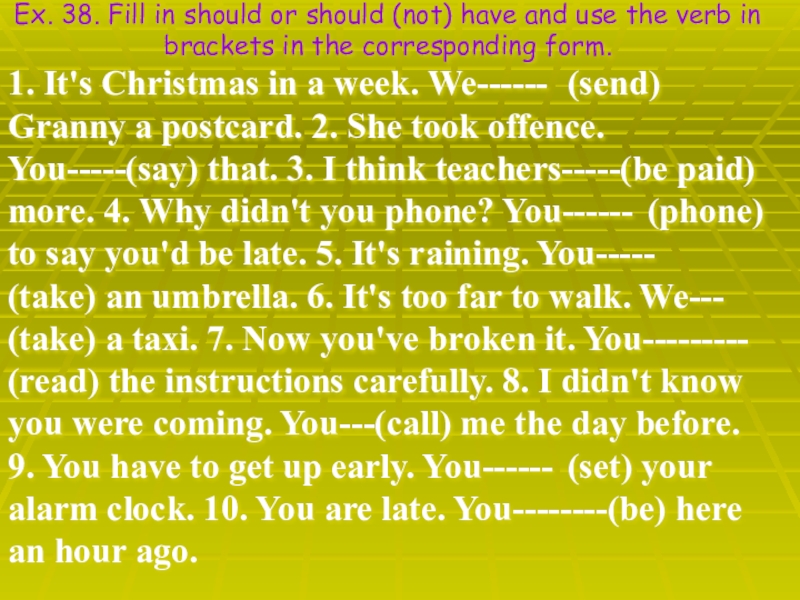
Слайд 24Ex. 38. Fill in should or should (not) have and use
the verb in brackets in the corresponding form.
1. It's Christmas in a week. We------ (send) Granny a postcard. 2. She took offence. You-----(say) that. 3. I think teachers-----(be paid) more. 4. Why didn't you phone? You------ (phone) to say you'd be late. 5. It's raining. You----- (take) an umbrella. 6. It's too far to walk. We--- (take) a taxi. 7. Now you've broken it. You--------- (read) the instructions carefully. 8. I didn't know you were coming. You---(call) me the day before. 9. You have to get up early. You------ (set) your alarm clock. 10. You are late. You-------- (be) here an hour ago.
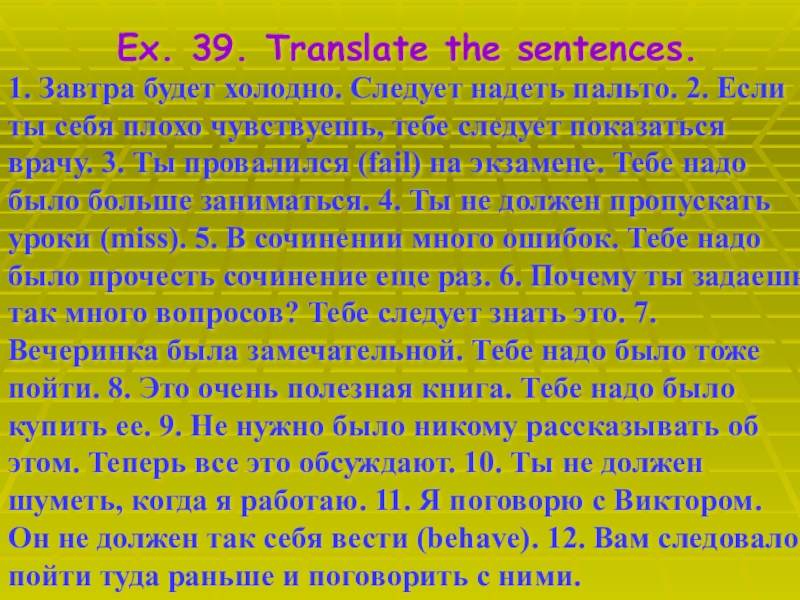
Слайд 25Ex. 39. Translate the sentences.
1. Завтра будет холодно. Следует надеть пальто.
2. Если ты себя плохо чувствуешь, тебе следует показаться врачу. 3. Ты провалился (fail) на экзамене. Тебе надо было больше заниматься. 4. Ты не должен пропускать уроки (miss). 5. В сочинении много ошибок. Тебе надо было прочесть сочинение еще раз. 6. Почему ты задаешь так много вопросов? Тебе следует знать это. 7. Вечеринка была замечательной. Тебе надо было тоже пойти. 8. Это очень полезная книга. Тебе надо было купить ее. 9. Не нужно было никому рассказывать об этом. Теперь все это обсуждают. 10. Ты не должен шуметь, когда я работаю. 11. Я поговорю с Виктором. Он не должен так себя вести (behave). 12. Вам следовало пойти туда раньше и поговорить с ними.
Слайд 26Ex. 40. Use should or have to / had to.
1. I------- send
a telegram, it was too late to send a letter. 2. You---- find a lawyer
to. give you good advice. 3. There were no buses yesterday. We ---- walk home.
4. When you are driving, you ----- wear a seat belt. 5. My eyesight isn't very good.
I----- wear glasses. 6. It's a good book, you--------- read it. 7. You look ill. You------- go
to bed and call the doctor. 8. He doesn't understand much English, so I----- speak to him very slowly.
Слайд 27
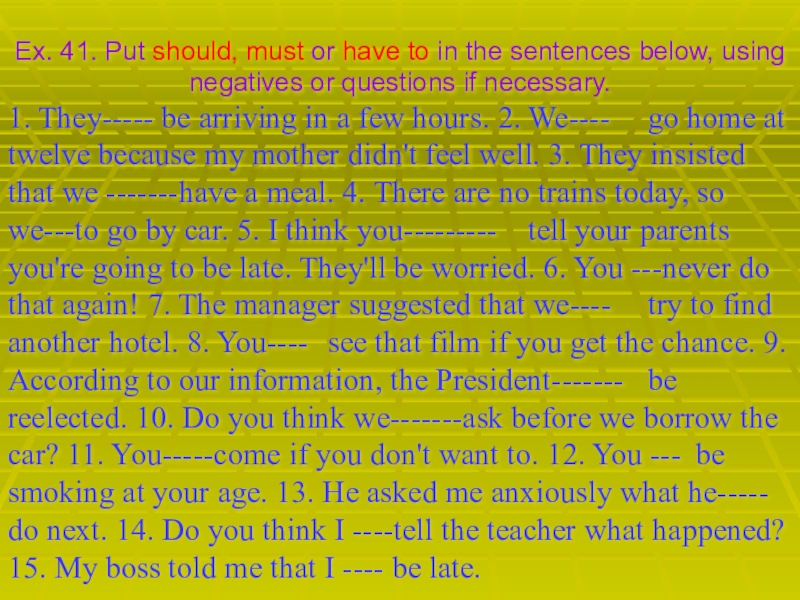
Ex. 41. Put should, must or have to in the sentences
below, using negatives or questions if necessary.
1. They----- be arriving in a few hours. 2. We---- go home at twelve because my mother didn't feel well. 3. They insisted that we -------have a meal. 4. There are no trains today, so we---to go by car. 5. I think you--------- tell your parents you're going to be late. They'll be worried. 6. You ---never do that again! 7. The manager suggested that we---- try to find another hotel. 8. You---- see that film if you get the chance. 9. According to our information, the President------- be reelected. 10. Do you think we-------ask before we borrow the car? 11. You-----come if you don't want to. 12. You --- be smoking at your age. 13. He asked me anxiously what he----- do next. 14. Do you think I ----tell the teacher what happened? 15. My boss told me that I ---- be late.
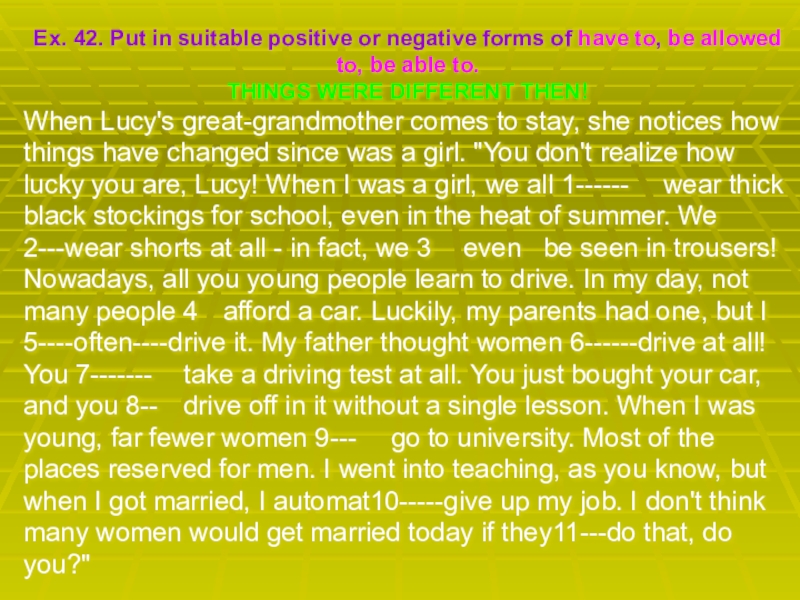
Слайд 28Ex. 42. Put in suitable positive or negative forms of have
to, be allowed to, be able to.
THINGS WERE DIFFERENT THEN!
When Lucy's great-grandmother comes to stay, she notices how things have changed since was a girl. "You don't realize how lucky you are, Lucy! When I was a girl, we all 1------ wear thick black stockings for school, even in the heat of summer. We 2---wear shorts at all - in fact, we 3 even be seen in trousers! Nowadays, all you young people learn to drive. In my day, not many people 4 afford a car. Luckily, my parents had one, but I 5----often----drive it. My father thought women 6------drive at all! You 7------- take a driving test at all. You just bought your car, and you 8-- drive off in it without a single lesson. When I was young, far fewer women 9--- go to university. Most of the places reserved for men. I went into teaching, as you know, but when I got married, I automat10-----give up my job. I don't think many women would get married today if they11---do that, do you?"
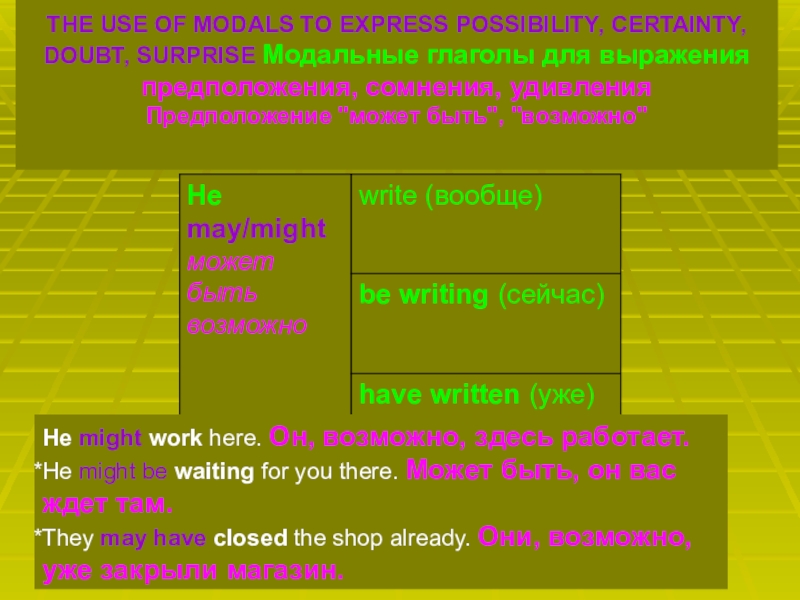
Слайд 29THE USE OF MODALS TO EXPRESS POSSIBILITY, CERTAINTY, DOUBT, SURPRISE Модальные
глаголы для выражения предположения, сомнения, удивления
Предположение "может быть", "возможно"
Не might work here. Он, возможно, здесь работает.
Не might be waiting for you there. Может быть, он вас ждет там.
They may have closed the shop already. Они, возможно, уже закрыли магазин.
Слайд 30Может быть/возможно, он не…. Не may NOT...
Не may not know
her address.
Он, возможно, и не знает ее адреса.
Он может и не знать ее адреса.
Не may not have come yet.
Он мог еще и не приехать.
Он, может быть, еще и не приехал.
"Might" выражает большую долю сомнений, чем "may".
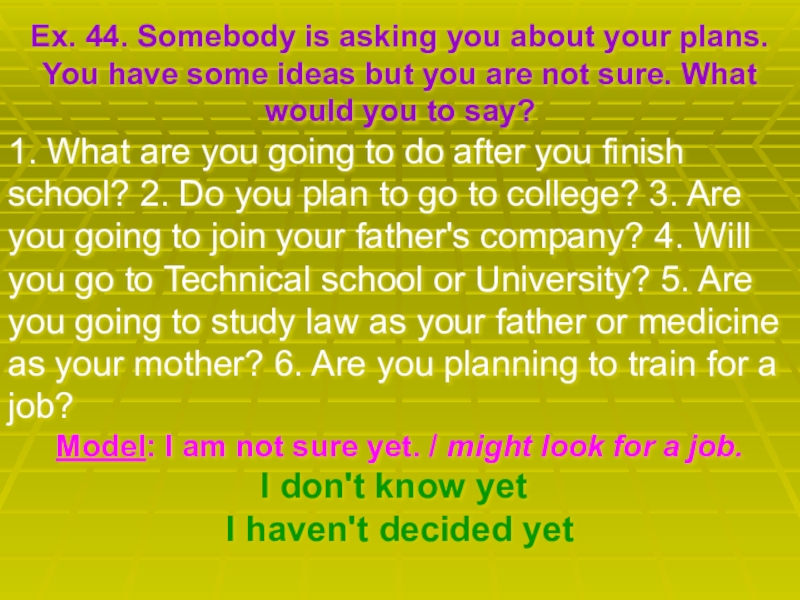
Слайд 31Ex. 44. Somebody is asking you about your plans. You have
some ideas but you are not sure. What would you to say?
1. What are you going to do after you finish school? 2. Do you plan to go to college? 3. Are you going to join your father's company? 4. Will you go to Technical school or University? 5. Are you going to study law as your father or medicine as your mother? 6. Are you planning to train for a job?
Model: I am not sure yet. / might look for a job.
I don't know yet
I haven't decided yet
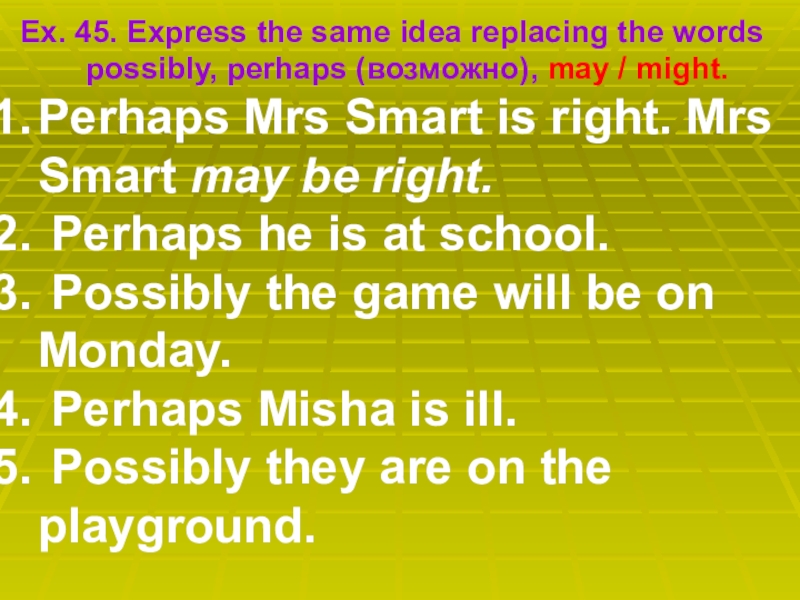
Слайд 32Ex. 45. Express the same idea replacing the words possibly, perhaps
(возможно), may / might.
Perhaps Mrs Smart is right. Mrs Smart may be right.
Perhaps he is at school.
Possibly the game will be on Monday.
Perhaps Misha is ill.
Possibly they are on the playground.
Слайд 33
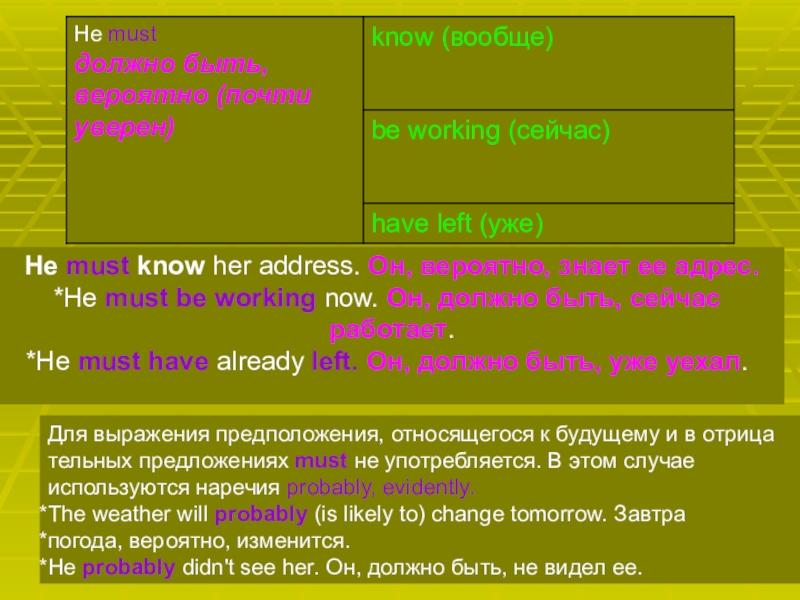
Не must know her address. Он, вероятно, знает ее адрес.
Не must
be working now. Он, должно быть, сейчас работает.
Не must have already left. Он, должно быть, уже уехал.
Для выражения предположения, относящегося к будущему и в отрицательных предложениях must не употребляется. В этом случае используются наречия probably, evidently.
The weather will probably (is likely to) change tomorrow. Завтра
погода, вероятно, изменится.
Не probably didn't see her. Он, должно быть, не видел ее.
Слайд 34
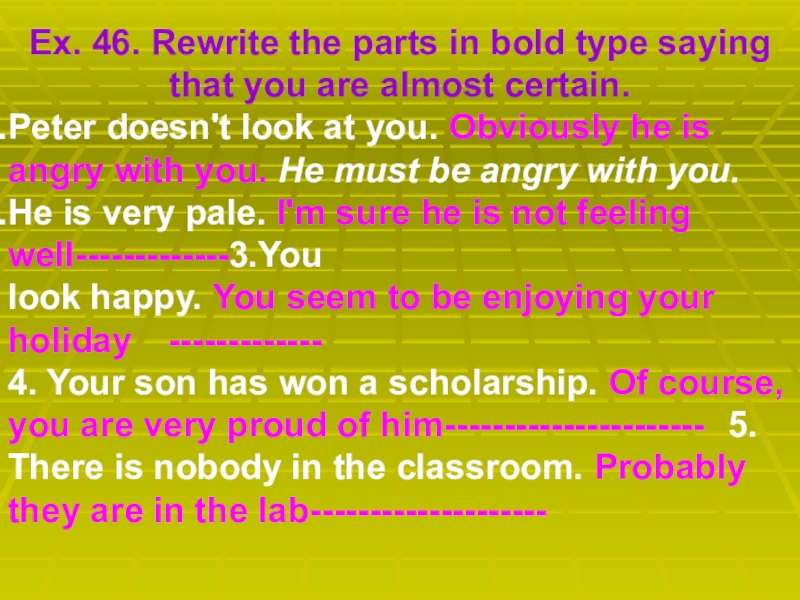
Ex. 46. Rewrite the parts in bold type saying that you
are almost certain.
Peter doesn't look at you. Obviously he is angry with you. He must be angry with you.
He is very pale. I'm sure he is not feeling well-------------3.You
look happy. You seem to be enjoying your holiday -------------
4. Your son has won a scholarship. Of course, you are very proud of him---------------------- 5. There is nobody in the classroom. Probably they are in the lab--------------------
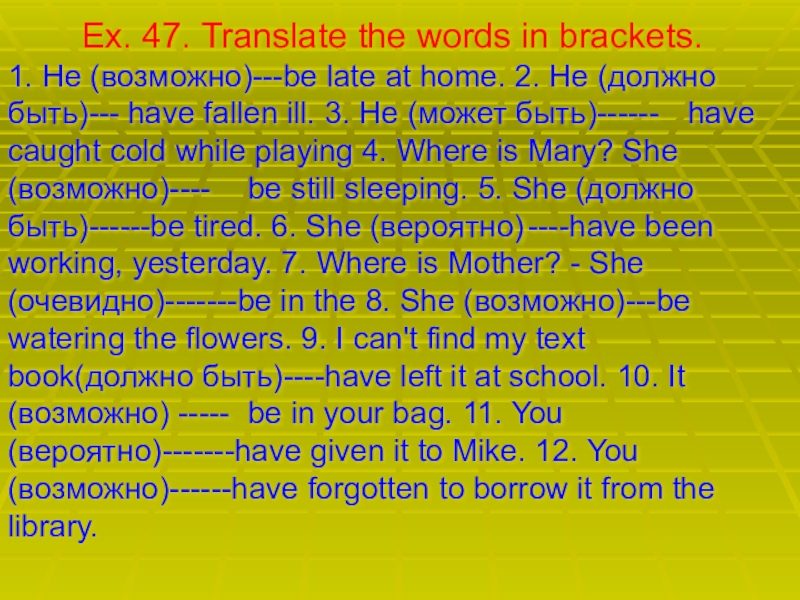
Слайд 35Ex. 47. Translate the words in brackets.
1. He (возможно)---be late at
home. 2. He (должно быть)--- have fallen ill. 3. He (может быть)------ have caught cold while playing 4. Where is Mary? She (возможно)---- be still sleeping. 5. She (должно быть)------be tired. 6. She (вероятно) ----have been working, yesterday. 7. Where is Mother? - She (очевидно)-------be in the 8. She (возможно)---be watering the flowers. 9. I can't find my text book(должно быть)----have left it at school. 10. It (возможно) ----- be in your bag. 11. You (вероятно)-------have given it to Mike. 12. You (возможно)------have forgotten to borrow it from the library.
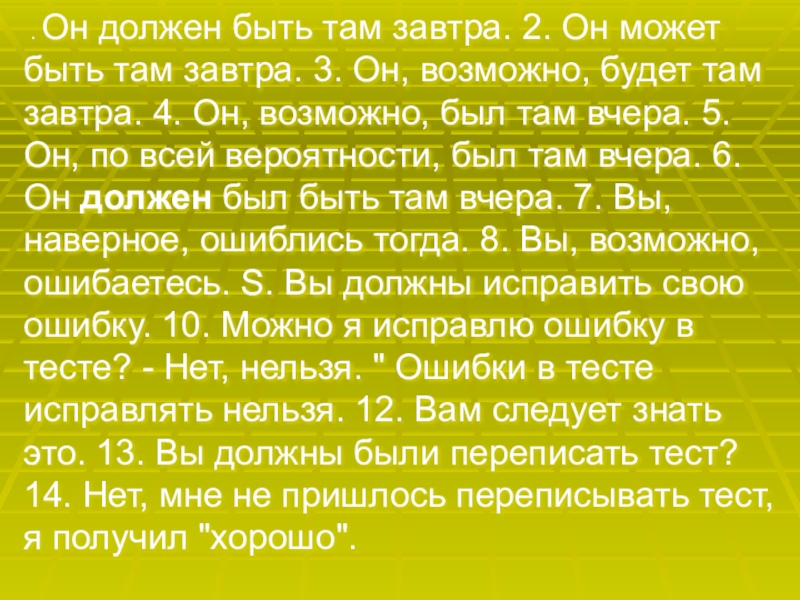
Слайд 36. Он должен быть там завтра. 2. Он может быть там
завтра. 3. Он, возможно, будет там завтра. 4. Он, возможно, был там вчера. 5. Он, по всей вероятности, был там вчера. 6. Он должен был быть там вчера. 7. Вы, наверное, ошиблись тогда. 8. Вы, возможно, ошибаетесь. S. Вы должны исправить свою ошибку. 10. Можно я исправлю ошибку в тесте? - Нет, нельзя. " Ошибки в тесте исправлять нельзя. 12. Вам следует знать это. 13. Вы должны были переписать тест? 14. Нет, мне не пришлось переписывать тест, я получил "хорошо".
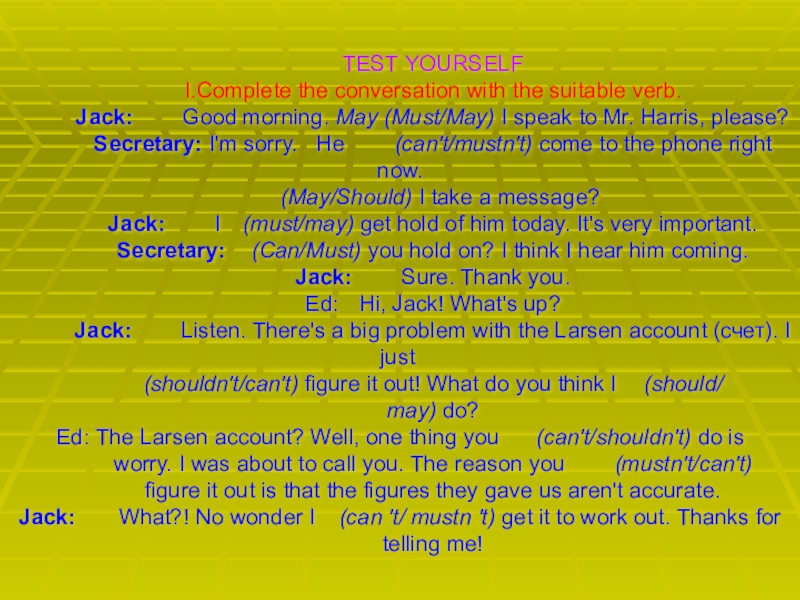
Слайд 37TEST YOURSELF
I.Complete the conversation with the suitable verb.
Jack:
Good morning. May (Must/May) I speak to Mr. Harris, please?
Secretary: I'm sorry. He (can't/mustn't) come to the phone right now.
(May/Should) I take a message?
Jack: I (must/may) get hold of him today. It's very important.
Secretary: (Can/Must) you hold on? I think I hear him coming.
Jack: Sure. Thank you.
Ed: Hi, Jack! What's up?
Jack: Listen. There's a big problem with the Larsen account (счет). I just
(shouldn't/can't) figure it out! What do you think I (should/
may) do?
Ed: The Larsen account? Well, one thing you (can't/shouldn't) do is
worry. I was about to call you. The reason you (mustn't/can't)
figure it out is that the figures they gave us aren't accurate.
Jack: What?! No wonder I (can 't/ mustn 't) get it to work out. Thanks for
telling me!
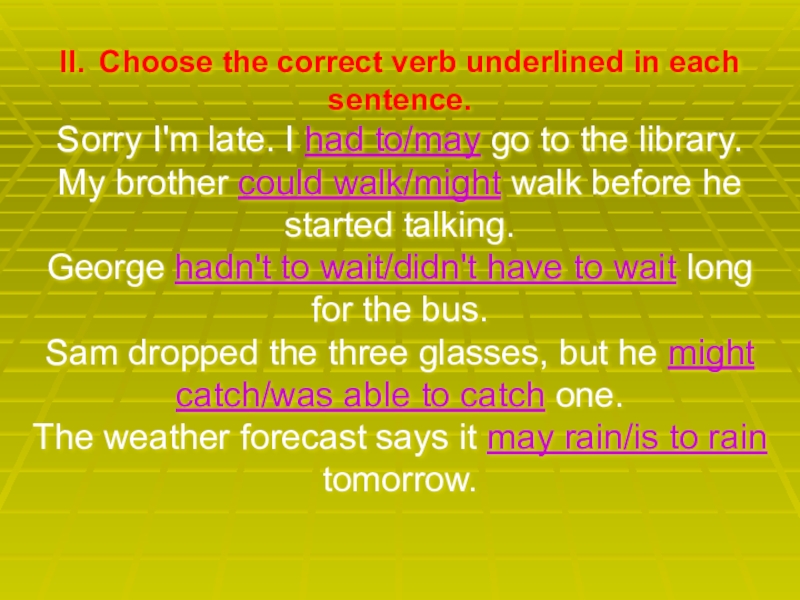
Слайд 38II. Choose the correct verb underlined in each sentence.
Sorry I'm late. I
had to/may go to the library.
My brother could walk/might walk before he started talking.
George hadn't to wait/didn't have to wait long for the bus.
Sam dropped the three glasses, but he might catch/was able to catch one.
The weather forecast says it may rain/is to rain tomorrow.
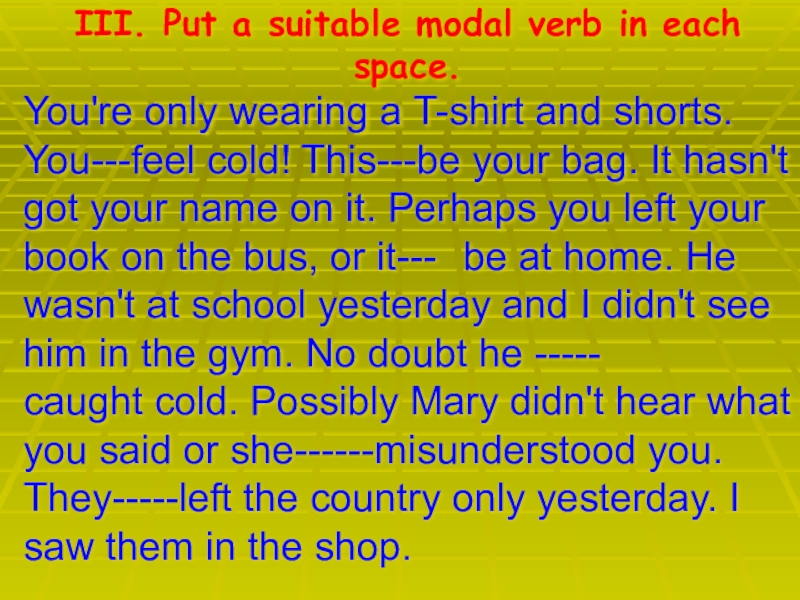
Слайд 39III. Put a suitable modal verb in each space.
You're only wearing
a T-shirt and shorts. You---feel cold! This---be your bag. It hasn't got your name on it. Perhaps you left your book on the bus, or it--- be at home. He wasn't at school yesterday and I didn't see him in the gym. No doubt he -----
caught cold. Possibly Mary didn't hear what you said or she------misunderstood you.
They-----left the country only yesterday. I saw them in the shop.