- Главная
- Разное
- Образование
- Спорт
- Естествознание
- Природоведение
- Религиоведение
- Французский язык
- Черчение
- Английский язык
- Астрономия
- Алгебра
- Биология
- География
- Геометрия
- Детские презентации
- Информатика
- История
- Литература
- Математика
- Музыка
- МХК
- Немецкий язык
- ОБЖ
- Обществознание
- Окружающий мир
- Педагогика
- Русский язык
- Технология
- Физика
- Философия
- Химия
- Шаблоны, фоны, картинки для презентаций
- Экология
- Экономика
Презентация, доклад по английскому языку на тему Moscow zoo. ( 6 класс).
Содержание
- 1. Презентация по английскому языку на тему Moscow zoo. ( 6 класс).
- 2. Moscow Zoo is
- 3. Moscow Zoo's activities are aimed at implementing
- 4. Research the zoo does scientific
- 5. Educational guided tours and lectures on biology
- 6. Recreationalthe zoo offers to its visitors the
- 7. MONKEYS
- 8. SNAKES, CROCODILES AND THE EXOTARIUM
- 9. ZEBRAS AND PONIES In
- 10. LARGE CARNIVORES
- 11.
- 12. Right behind the tall Fairytale Tree Right behind
- 13. ANIMALS WHICH CAN ONLY BE FOUND IN
- 14. INSECTS
- 15. ELEPHANTS AND GIRAFFES The Moscow Zoo is
- 16. The Cat
- 17. STELLER SEA LION, FUR SEALS, AND SEA
- 18. EXOTIC BIRDS
- 19. Слайд 19
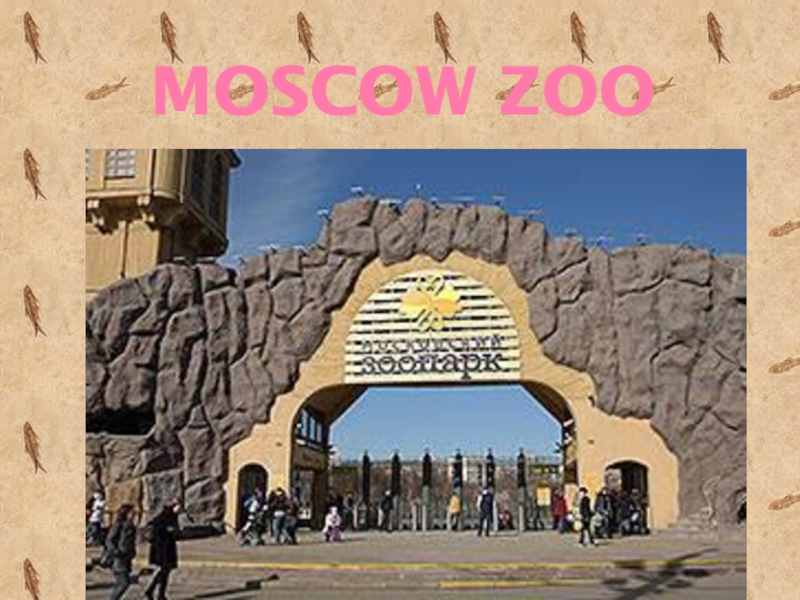
Moscow Zoo is the first zoo opened in Russia and one of the oldest in Europe. It was opened on February 13 (January 31) 1864. The zoo was organized
Слайд 2 Moscow Zoo is the first zoo opened
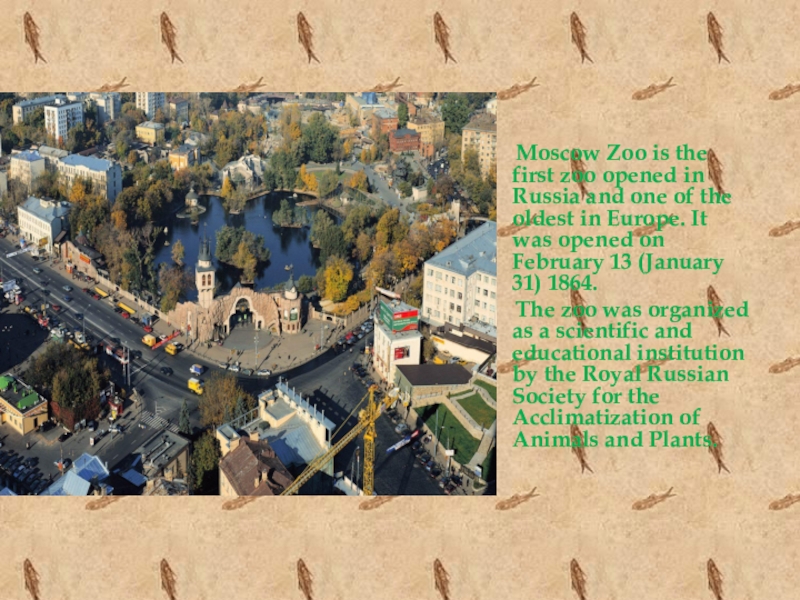
in Russia and one of the oldest in Europe. It was opened on February 13 (January 31) 1864.
The zoo was organized as a scientific and educational institution by the Royal Russian Society for the Acclimatization of Animals and Plants.
The zoo was organized as a scientific and educational institution by the Royal Russian Society for the Acclimatization of Animals and Plants.
Слайд 3Moscow Zoo's activities are aimed at implementing all the major tasks
of the zoos:
Nature conservation –
the zoo is keeping and breeding rare and endangered species of animals, takes part in reintroduction of the animals in nature and in monitoring natural populations.
Слайд 4Research
the zoo does scientific research aimed at
both improving the conditions of keeping the animals in captivity and breeding them, and at collecting information necessary for saving the species in nature and for the development of fundamental science; the research results are published and the zoo takes part in scientific cooperation.
Слайд 5Educational
guided tours and lectures on biology and nature conservation issues
are held at the zoo, and it provides for high quality and full-range keeping of the additional exposition; also, the zoo provides information for the media sources.
Слайд 6Recreational
the zoo offers to its visitors the opportunities to have a
rest and use the catering facilities.
Слайд 7MONKEYS
The road from
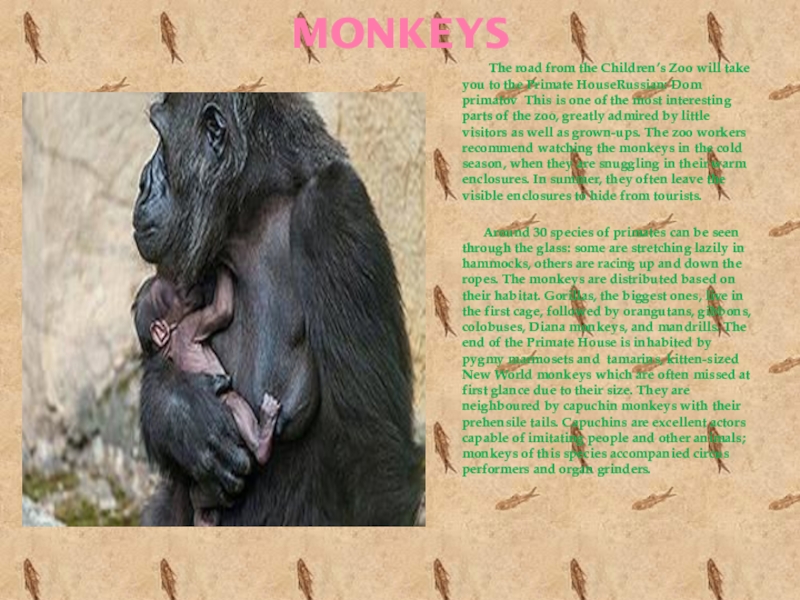
the Children’s Zoo will take you to the Primate HouseRussian: Dom primatov This is one of the most interesting parts of the zoo, greatly admired by little visitors as well as grown-ups. The zoo workers recommend watching the monkeys in the cold season, when they are snuggling in their warm enclosures. In summer, they often leave the visible enclosures to hide from tourists.
Around 30 species of primates can be seen through the glass: some are stretching lazily in hammocks, others are racing up and down the ropes. The monkeys are distributed based on their habitat. Gorillas, the biggest ones, live in the first cage, followed by orangutans, gibbons, colobuses, Diana monkeys, and mandrills. The end of the Primate House is inhabited by pygmy marmosets and tamarins, kitten-sized New World monkeys which are often missed at first glance due to their size. They are neighboured by capuchin monkeys with their prehensile tails. Capuchins are excellent actors capable of imitating people and other animals; monkeys of this species accompanied circus performers and organ grinders.
Around 30 species of primates can be seen through the glass: some are stretching lazily in hammocks, others are racing up and down the ropes. The monkeys are distributed based on their habitat. Gorillas, the biggest ones, live in the first cage, followed by orangutans, gibbons, colobuses, Diana monkeys, and mandrills. The end of the Primate House is inhabited by pygmy marmosets and tamarins, kitten-sized New World monkeys which are often missed at first glance due to their size. They are neighboured by capuchin monkeys with their prehensile tails. Capuchins are excellent actors capable of imitating people and other animals; monkeys of this species accompanied circus performers and organ grinders.
Слайд 8
SNAKES, CROCODILES AND THE EXOTARIUM
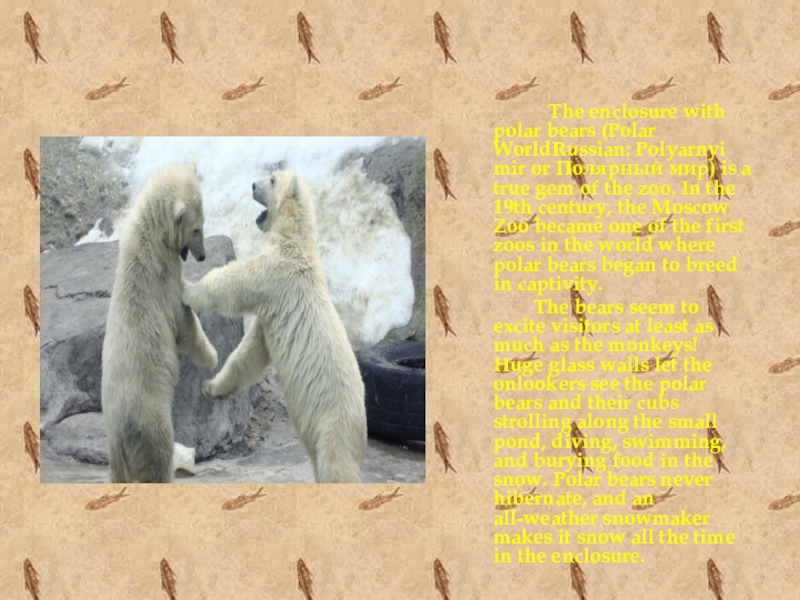
The Reptile Terrarium Russian: Террариум is situated opposite the Primate House. Huge snakes (pythons, boas, anacondas), turtles and iguanas can be found in one part of it, while the other is completely devoted to crocodiles. The crocodiles are so motionless, some visitors even think they are artificial—but they are definitely real. These reptiles are most active at night, remaining still most of the daytime.
Special attention should be definitely paid to Exotarium Russian: A real coral reef with its unique inhabitants sparkles in brightly-lit aquariums in a dim room. Angelfish, butter flyfish, surgeonfish, triggerfish, trunkfish, muraena, lionfish, groupers—the collection includes about 100 species of coral reef fishes of all colors, brought here from the reefs of the Pacific, Indian and Atlantic Oceans. You can also find small sharks here (black tip reef sharks).
Special attention should be definitely paid to Exotarium Russian: A real coral reef with its unique inhabitants sparkles in brightly-lit aquariums in a dim room. Angelfish, butter flyfish, surgeonfish, triggerfish, trunkfish, muraena, lionfish, groupers—the collection includes about 100 species of coral reef fishes of all colors, brought here from the reefs of the Pacific, Indian and Atlantic Oceans. You can also find small sharks here (black tip reef sharks).
Слайд 9ZEBRAS AND PONIES
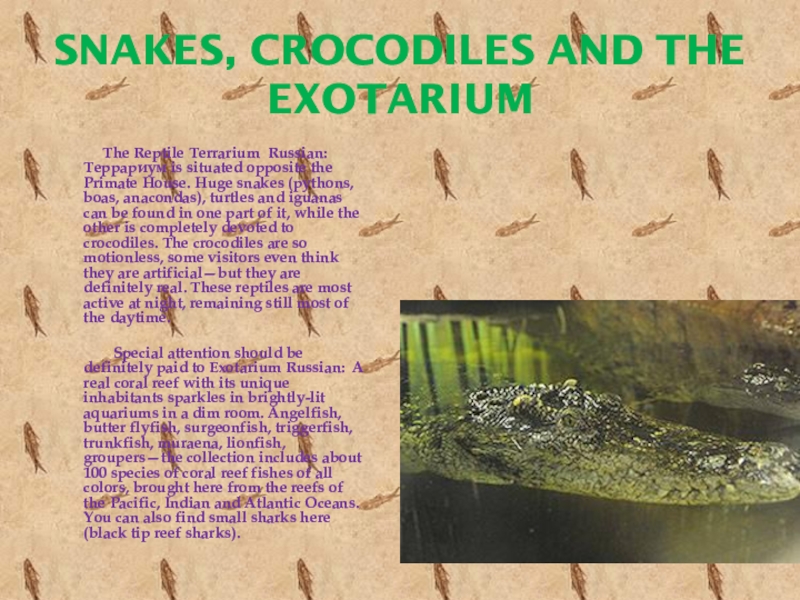
In the Animals of Africa Russian: Zhivotnyie
Afriki or Животные Африки exhibit, a giraffe, zebras, a Salt’s dik-dik, and an African ostrich stroll around a spacious paddock. Behind it, you will find the zoo stable with diverse species of ponies. Children can take a ride around the Old Territory in a pony-drawn cart in summer, or on a pony-drawn sleigh in winter. On weekends, children are sometimes allowed to ride on ponies using a saddle.
Слайд 10LARGE CARNIVORES
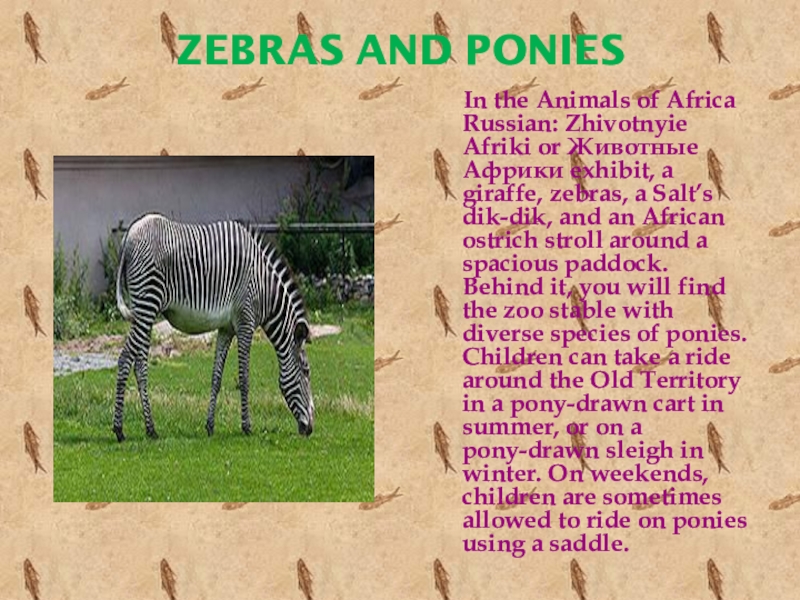
Next to Animals of
Africa, you will see the Animal IslandRussian: Ostrov zverey or Остров зверей with enclosures for large carnivores.
There you will meet a very rare animal—the Amur tiger, an IUCN Red List endangered species. Brown and Asian black bears can only be observed in the warmer months, as they hibernate from late autumn until early spring. Unusual white Arctic wolves live between the hyenas and the tiger.
There you will meet a very rare animal—the Amur tiger, an IUCN Red List endangered species. Brown and Asian black bears can only be observed in the warmer months, as they hibernate from late autumn until early spring. Unusual white Arctic wolves live between the hyenas and the tiger.
Слайд 11 The enclosure
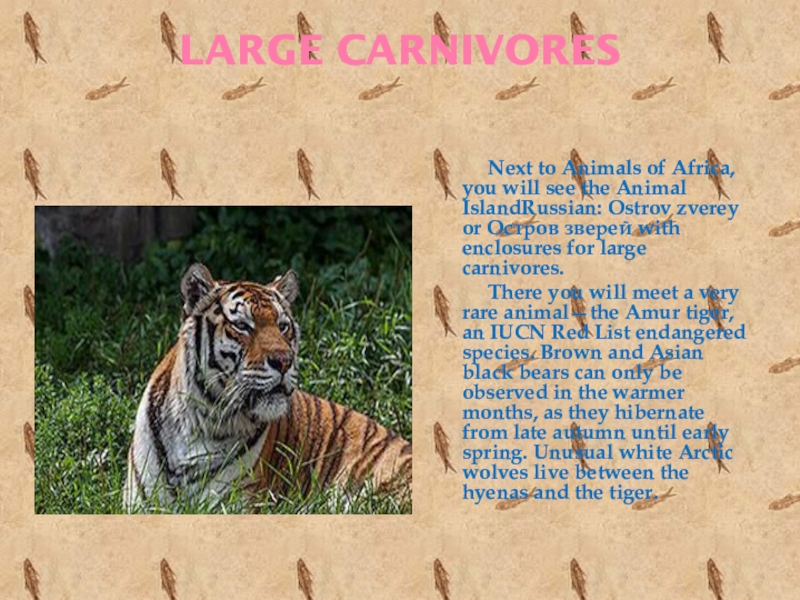
with polar bears (Polar WorldRussian: Polyarnyi mir or Полярный мир) is a true gem of the zoo. In the 19th century, the Moscow Zoo became one of the first zoos in the world where polar bears began to breed in captivity.
The bears seem to excite visitors at least as much as the monkeys! Huge glass walls let the onlookers see the polar bears and their cubs strolling along the small pond, diving, swimming, and burying food in the snow. Polar bears never hibernate, and an all-weather snowmaker makes it snow all the time in the enclosure.
The bears seem to excite visitors at least as much as the monkeys! Huge glass walls let the onlookers see the polar bears and their cubs strolling along the small pond, diving, swimming, and burying food in the snow. Polar bears never hibernate, and an all-weather snowmaker makes it snow all the time in the enclosure.
Слайд 12Right behind the tall Fairytale Tree
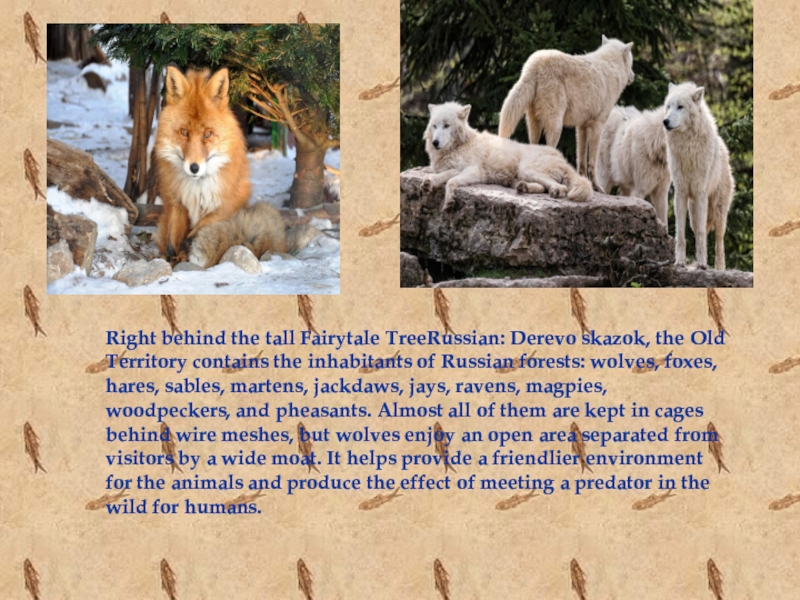
Right behind the tall Fairytale TreeRussian: Derevo skazok,
the Old Territory contains the inhabitants of Russian forests: wolves, foxes, hares, sables, martens, jackdaws, jays, ravens, magpies, woodpeckers, and pheasants. Almost all of them are kept in cages behind wire meshes, but wolves enjoy an open area separated from visitors by a wide moat. It helps provide a friendlier environment for the animals and produce the effect of meeting a predator in the wild for humans.
Слайд 13ANIMALS WHICH CAN ONLY BE FOUND IN ZOOS
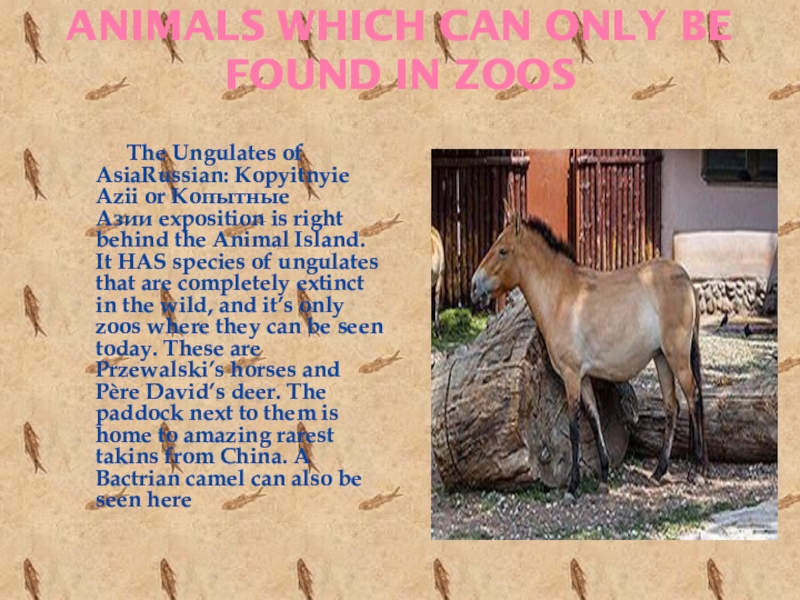
The Ungulates of AsiaRussian: Kopyitnyie Azii or Копытные Азии exposition is right behind the Animal Island. It HAS species of ungulates that are completely extinct in the wild, and it’s only zoos where they can be seen today. These are Przewalski’s horses and Père David’s deer. The paddock next to them is home to amazing rarest takins from China. A Bactrian camel can also be seen here
Слайд 14INSECTS
The Butterflies and Birds Russian:
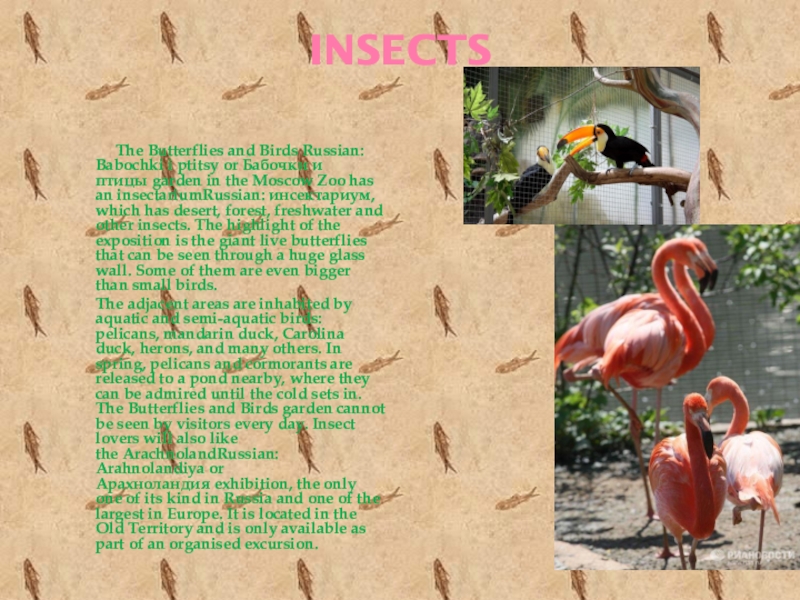
Babochki i ptitsy or Бабочки и птицы garden in the Moscow Zoo has an insectariumRussian: инсектариум, which has desert, forest, freshwater and other insects. The highlight of the exposition is the giant live butterflies that can be seen through a huge glass wall. Some of them are even bigger than small birds.
The adjacent areas are inhabited by aquatic and semi-aquatic birds: pelicans, mandarin duck, Carolina duck, herons, and many others. In spring, pelicans and cormorants are released to a pond nearby, where they can be admired until the cold sets in. The Butterflies and Birds garden cannot be seen by visitors every day. Insect lovers will also like the ArachnolandRussian: Arahnolandiya or Арахноландия exhibition, the only one of its kind in Russia and one of the largest in Europe. It is located in the Old Territory and is only available as part of an organised excursion.
The adjacent areas are inhabited by aquatic and semi-aquatic birds: pelicans, mandarin duck, Carolina duck, herons, and many others. In spring, pelicans and cormorants are released to a pond nearby, where they can be admired until the cold sets in. The Butterflies and Birds garden cannot be seen by visitors every day. Insect lovers will also like the ArachnolandRussian: Arahnolandiya or Арахноландия exhibition, the only one of its kind in Russia and one of the largest in Europe. It is located in the Old Territory and is only available as part of an organised excursion.
Слайд 15ELEPHANTS AND GIRAFFES
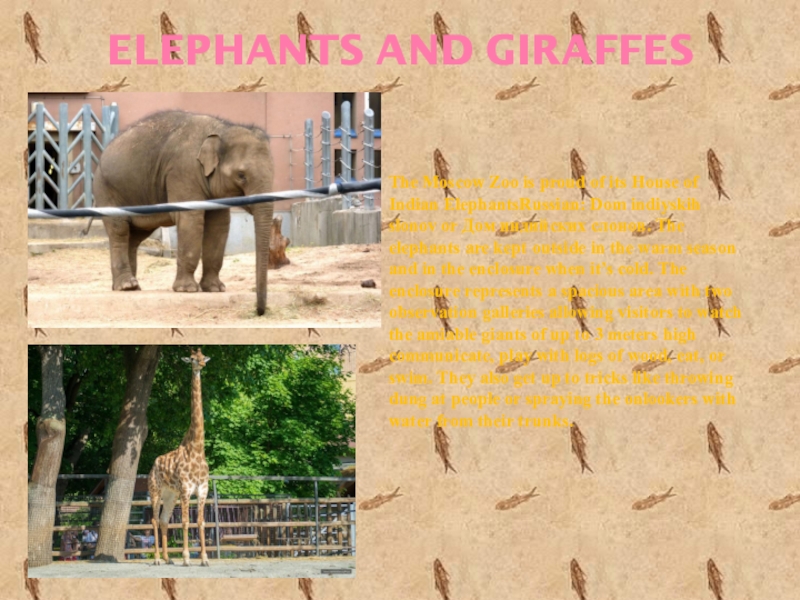
The Moscow Zoo is proud of its House of Indian
ElephantsRussian: Dom indiyskih slonov or Дом индийских слонов. The elephants are kept outside in the warm season and in the enclosure when it’s cold. The enclosure represents a spacious area with two observation galleries allowing visitors to watch the amiable giants of up to 3 meters high communicate, play with logs of wood, eat, or swim. They also get up to tricks like throwing dung at people or spraying the onlookers with water from their trunks.
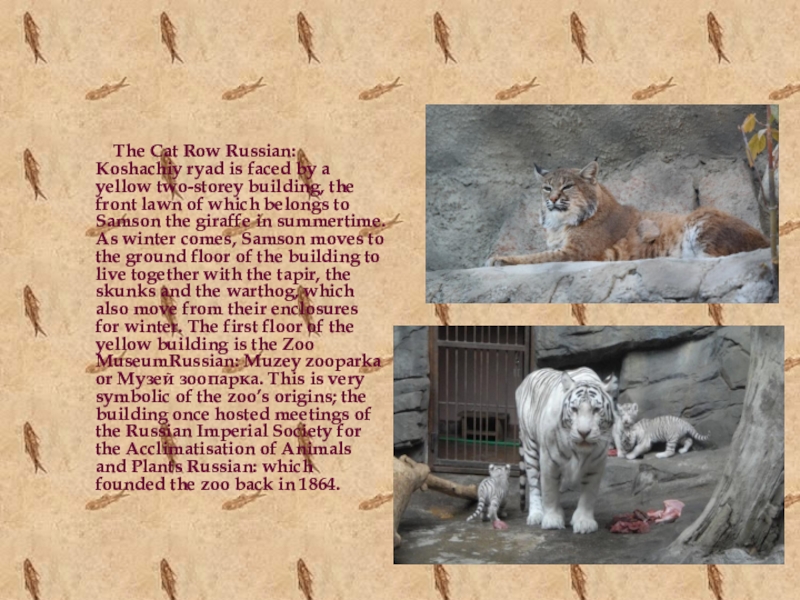
Слайд 16 The Cat Row Russian: Koshachiy ryad
is faced by a yellow two-storey building, the front lawn of which belongs to Samson the giraffe in summertime. As winter comes, Samson moves to the ground floor of the building to live together with the tapir, the skunks and the warthog, which also move from their enclosures for winter. The first floor of the yellow building is the Zoo MuseumRussian: Muzey zooparka or Музей зоопарка. This is very symbolic of the zoo’s origins; the building once hosted meetings of the Russian Imperial Society for the Acclimatisation of Animals and Plants Russian: which founded the zoo back in 1864.
Слайд 17STELLER SEA LION, FUR SEALS, AND SEA LIONS
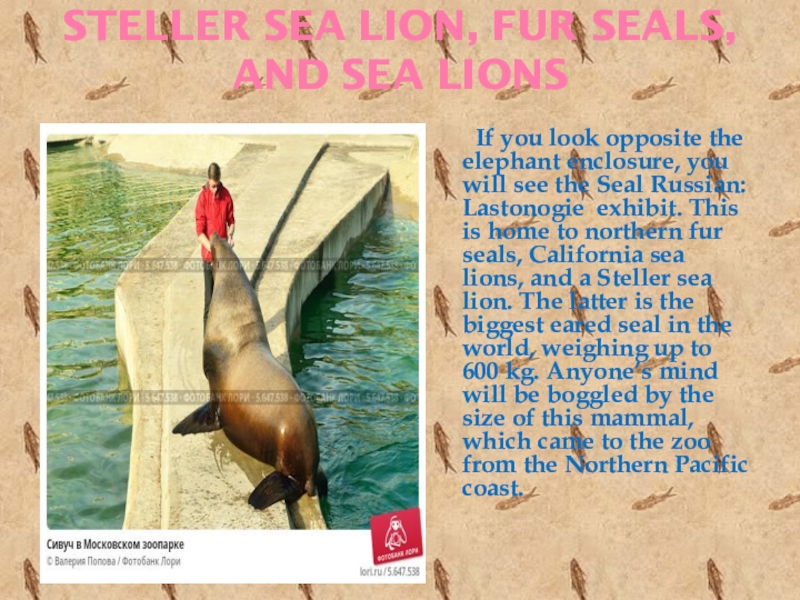
If you look opposite the elephant enclosure, you will see the Seal Russian: Lastonogie exhibit. This is home to northern fur seals, California sea lions, and a Steller sea lion. The latter is the biggest eared seal in the world, weighing up to 600 kg. Anyone’s mind will be boggled by the size of this mammal, which came to the zoo from the Northern Pacific coast.
Слайд 18EXOTIC BIRDS
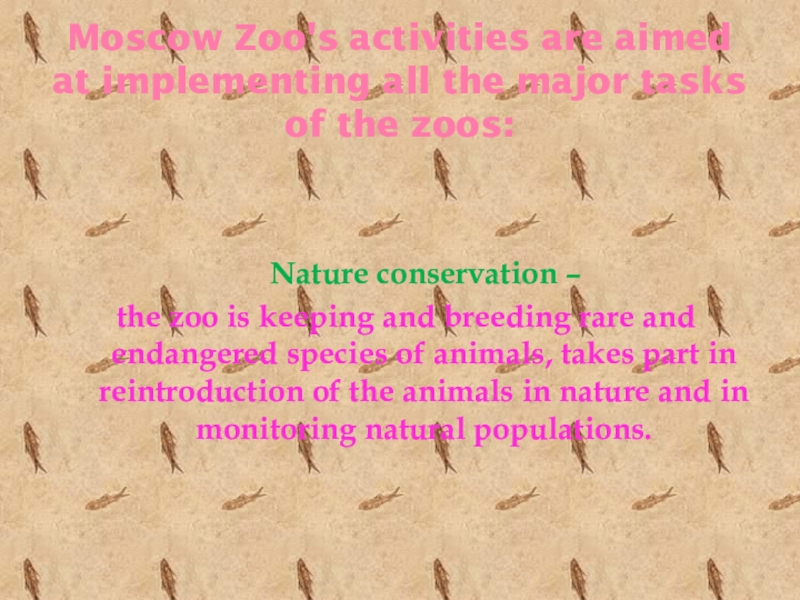
The Bird HouseRussian:
Dom ptits is inhabited by exotic birds from Africa, Australia, South and North Americas, and Asia (over 70 species). Humboldt penguins are the most popular among them. Spacious aviaries are home to parrots: cockatoos, Amazon parrots, macaws, African grey parrots, etc. The aviaries reproduce familiar landscapes of birds: steep coasts, stony shores, tropical rainforests, etc. Many feathered inhabitants are transferred to outside aviaries close to the central entrance for summer.
The lawn with the giraffe is neighboured by the Rock of RaptorsRussian: Skala hischnyih ptits or Скала хищных птиц inhabited by rare red-listed bald eagles. The central entrance opens on to the Big PondRussian: Bolshoy prud or Большой прудwith waterfowls. Flamingos and large white trumpeter swans are the birds which truly stand out. Small islands with nest boxes are designed to be a nesting site for the birds to brood. Don’t miss out on the daily feedings of Humboldt penguins (4:30 p.m.), the snow fox (5:00 p.m.), and the great white pelican (11:00 a.m., Tue, Wed and Thu only).
The lawn with the giraffe is neighboured by the Rock of RaptorsRussian: Skala hischnyih ptits or Скала хищных птиц inhabited by rare red-listed bald eagles. The central entrance opens on to the Big PondRussian: Bolshoy prud or Большой прудwith waterfowls. Flamingos and large white trumpeter swans are the birds which truly stand out. Small islands with nest boxes are designed to be a nesting site for the birds to brood. Don’t miss out on the daily feedings of Humboldt penguins (4:30 p.m.), the snow fox (5:00 p.m.), and the great white pelican (11:00 a.m., Tue, Wed and Thu only).