- Главная
- Разное
- Образование
- Спорт
- Естествознание
- Природоведение
- Религиоведение
- Французский язык
- Черчение
- Английский язык
- Астрономия
- Алгебра
- Биология
- География
- Геометрия
- Детские презентации
- Информатика
- История
- Литература
- Математика
- Музыка
- МХК
- Немецкий язык
- ОБЖ
- Обществознание
- Окружающий мир
- Педагогика
- Русский язык
- Технология
- Физика
- Философия
- Химия
- Шаблоны, фоны, картинки для презентаций
- Экология
- Экономика
Презентация, доклад по английскому языку на тему Льюис Кэрролл
Содержание
- 1. Презентация по английскому языку на тему Льюис Кэрролл
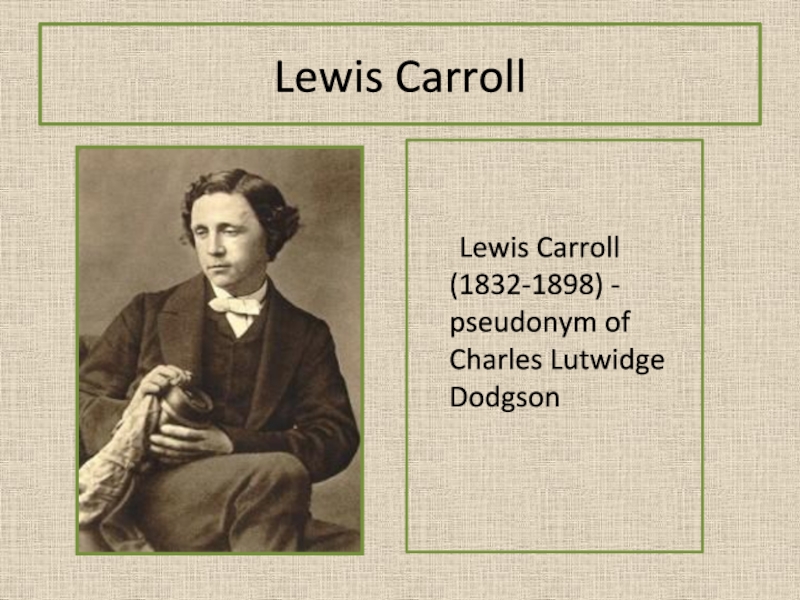
- 2. Lewis Carroll Lewis Carroll (1832-1898) - pseudonym of Charles Lutwidge Dodgson
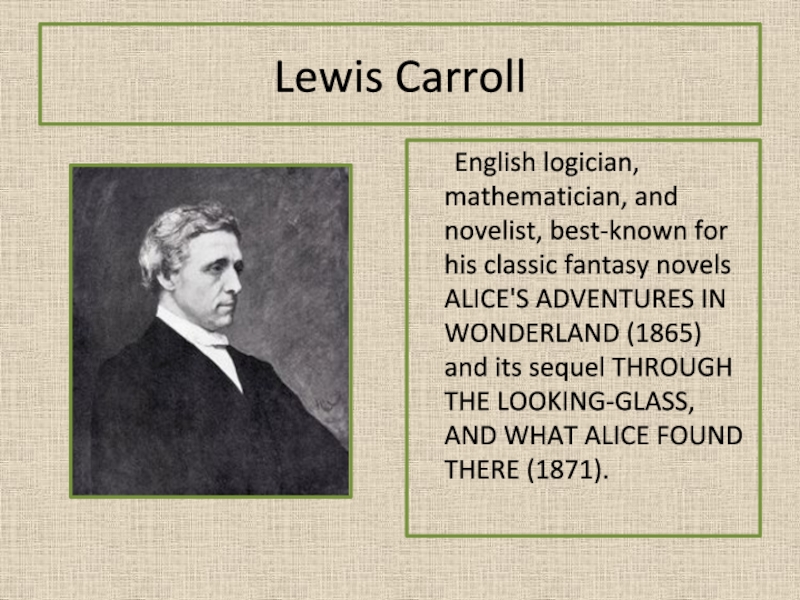
- 3. Lewis Carroll English logician, mathematician, and novelist, best-known
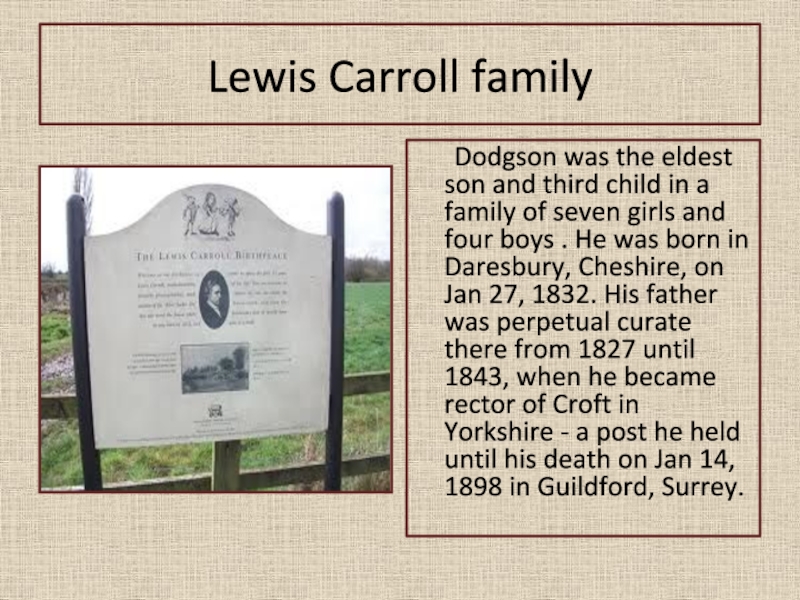
- 4. Lewis Carroll family Dodgson was the eldest son
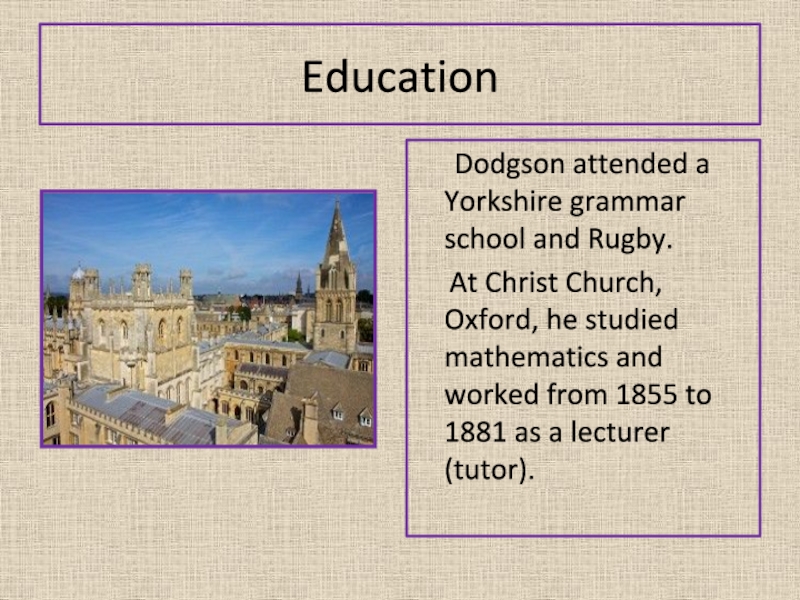
- 5. Education Dodgson attended a Yorkshire grammar school and
- 6. Charles L. Dodgson-author From a young age, Charles
- 7. Dodgson and Liddell In 1856, the new
- 8. How was the novel born? During one picnic
- 9. Sisters Liddell The girls loved Dodgson to tell
- 10. Alice Liddell , his ideal child friend’ Alice
- 11. Manuscript Alice’s Adventure under Grounds This first manuscript,
- 12. First publishing It wasn't long before the manuscript
- 13. Alice’s Adventures Under the Ground Originally the book
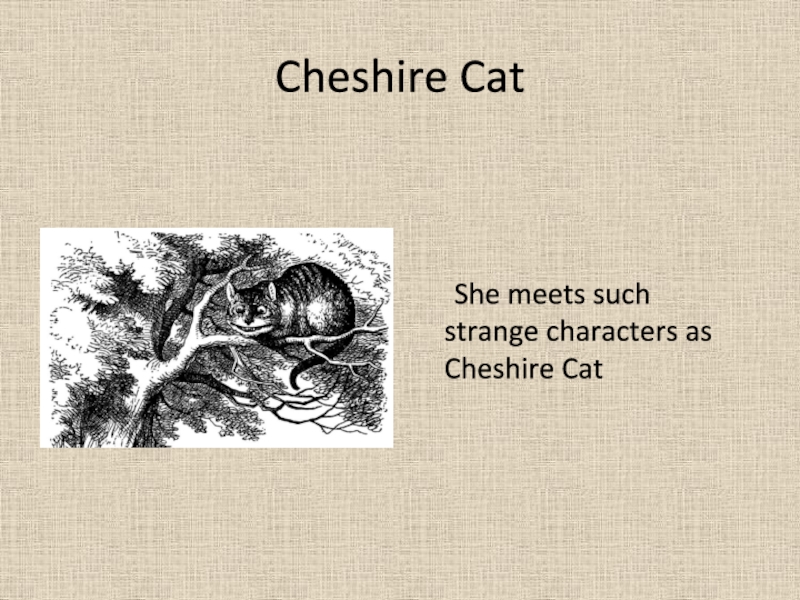
- 14. Cheshire Cat She meets such strange characters as Cheshire Cat
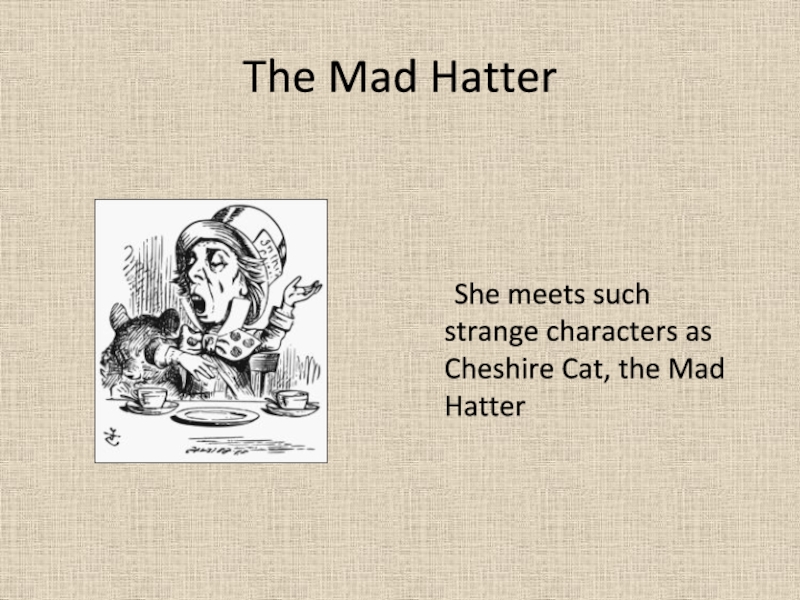
- 15. The Mad Hatter She meets such strange characters as Cheshire Cat, the Mad Hatter
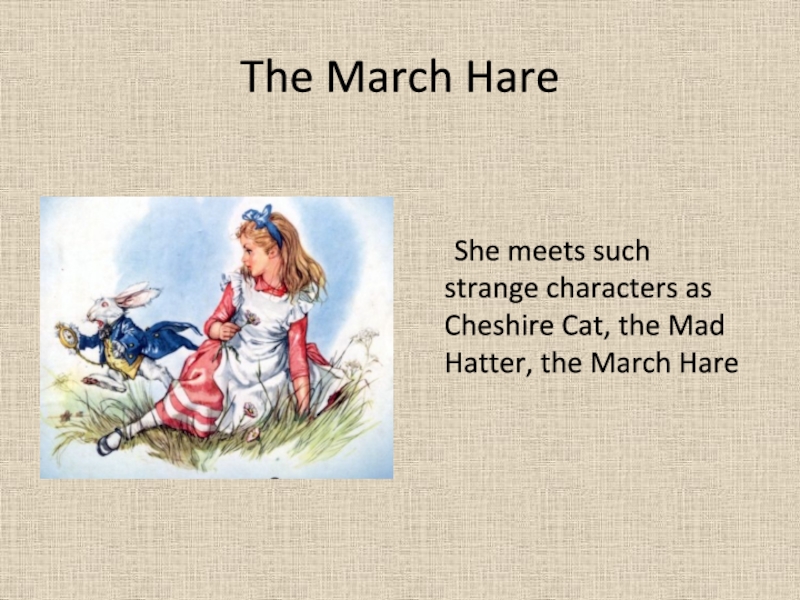
- 16. The March Hare She meets such strange characters as Cheshire Cat, the Mad Hatter, the March Hare
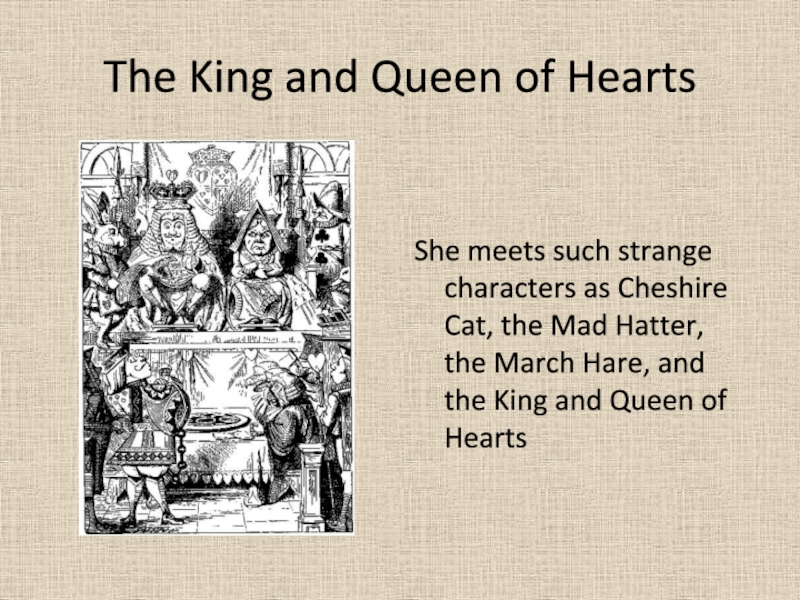
- 17. The King and Queen of Hearts She meets
- 18. Alice’s Adventures in Wonderland She experiences wondrous, often
- 19. Mathematical works Dodgson also wrote mathematical works, of
- 20. Слайд 20
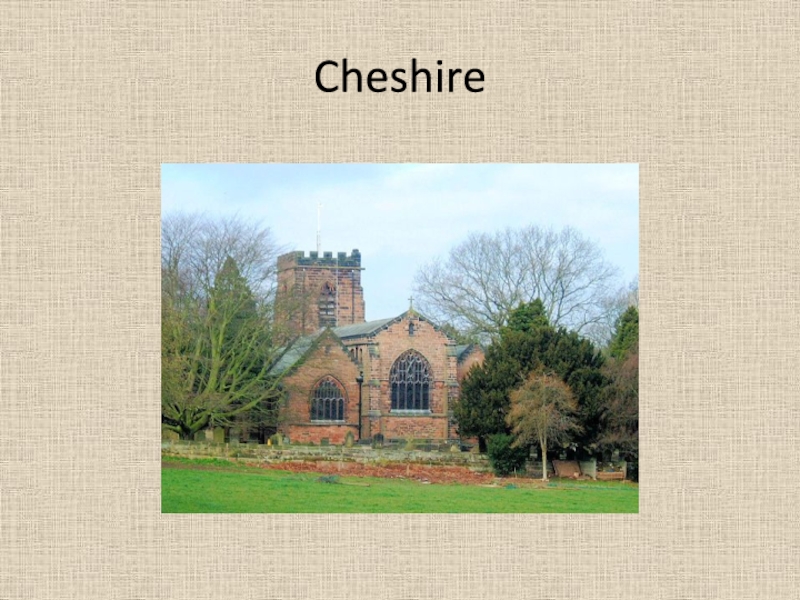
- 21. Cheshire
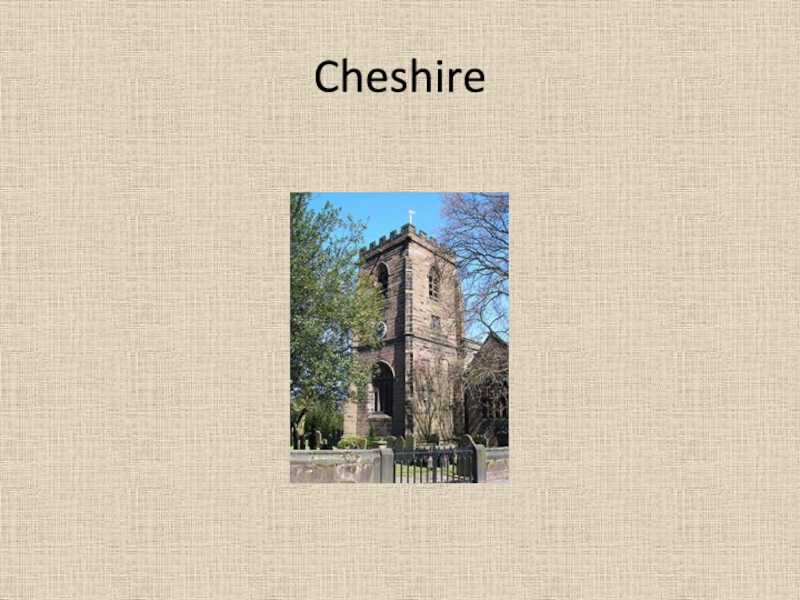
- 22. Cheshire
- 23. Cheshire
- 24. Cheshire
Lewis Carroll Lewis Carroll (1832-1898) - pseudonym of Charles Lutwidge Dodgson
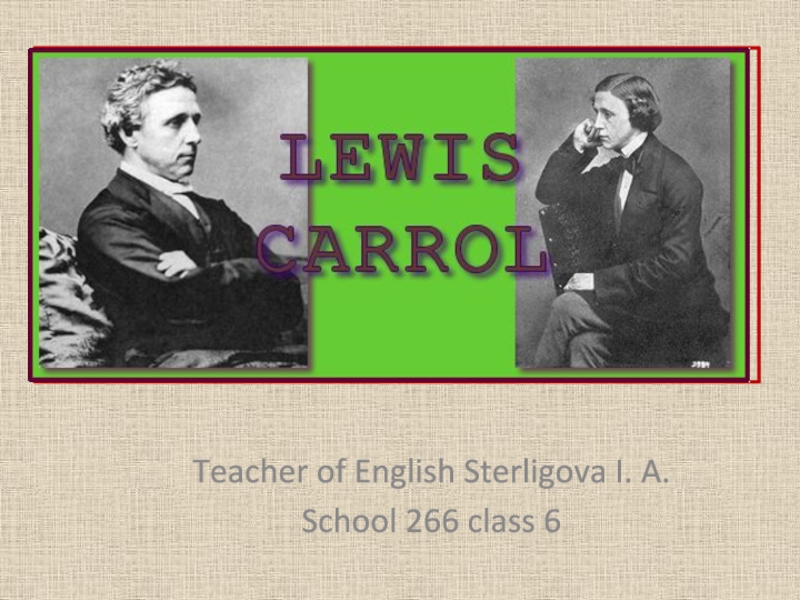
Слайд 3Lewis Carroll
English logician, mathematician, and novelist, best-known for his classic fantasy
novels ALICE'S ADVENTURES IN WONDERLAND (1865) and its sequel THROUGH THE LOOKING-GLASS, AND WHAT ALICE FOUND THERE (1871).
Слайд 4Lewis Carroll family
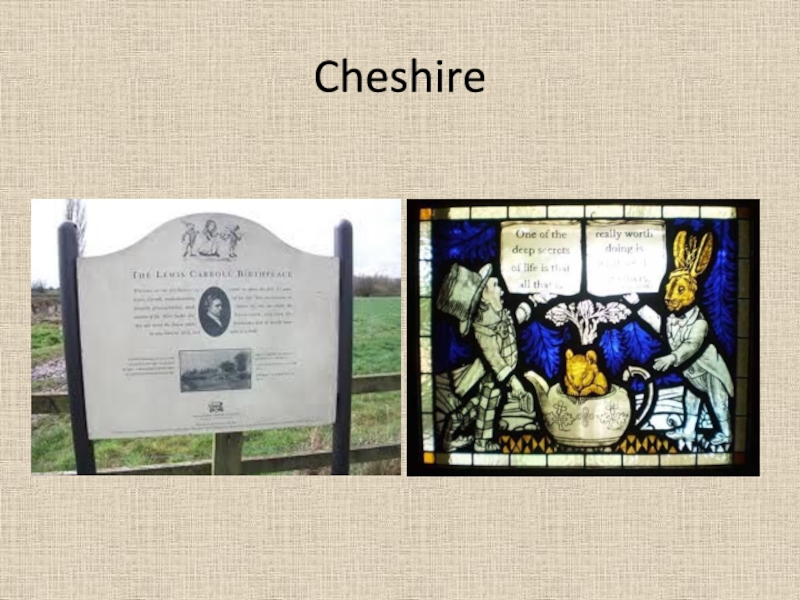
Dodgson was the eldest son and third child in
a family of seven girls and four boys . He was born in Daresbury, Cheshire, on Jan 27, 1832. His father was perpetual curate there from 1827 until 1843, when he became rector of Croft in Yorkshire - a post he held until his death on Jan 14, 1898 in Guildford, Surrey.
Слайд 5Education
Dodgson attended a Yorkshire grammar school and Rugby.
At
Christ Church, Oxford, he studied mathematics and worked from 1855 to 1881 as a lecturer (tutor).
Слайд 6Charles L. Dodgson-author
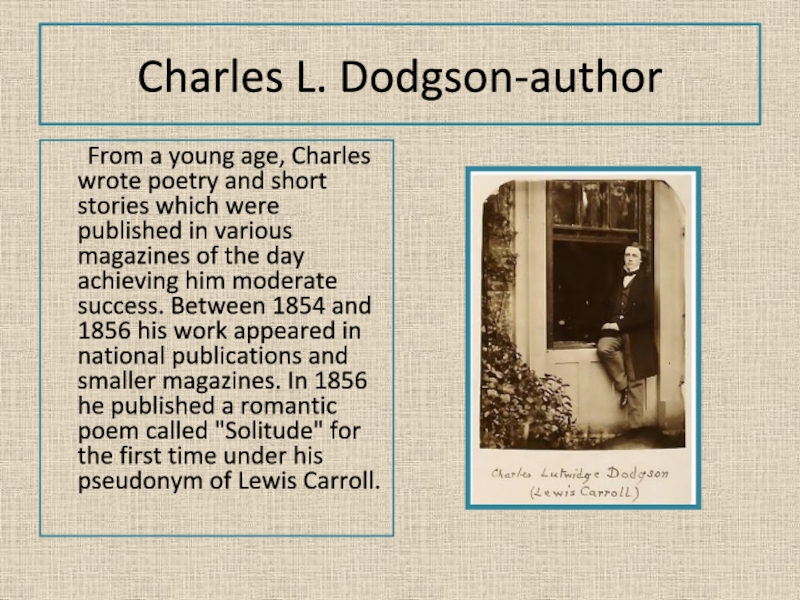
From a young age, Charles wrote poetry and short
stories which were published in various magazines of the day achieving him moderate success. Between 1854 and 1856 his work appeared in national publications and smaller magazines. In 1856 he published a romantic poem called "Solitude" for the first time under his pseudonym of Lewis Carroll.
Слайд 7Dodgson and Liddell
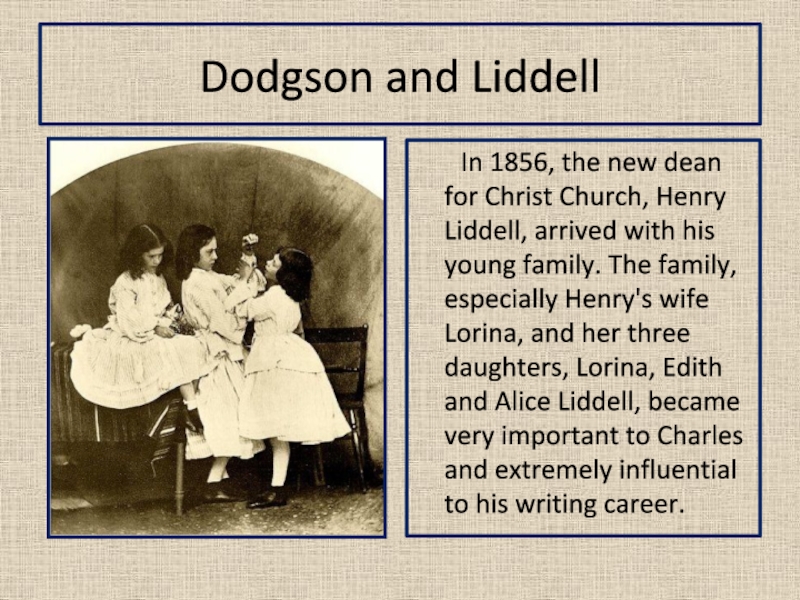
In 1856, the new dean for Christ Church,
Henry Liddell, arrived with his young family. The family, especially Henry's wife Lorina, and her three daughters, Lorina, Edith and Alice Liddell, became very important to Charles and extremely influential to his writing career.
Слайд 8How was the novel born?
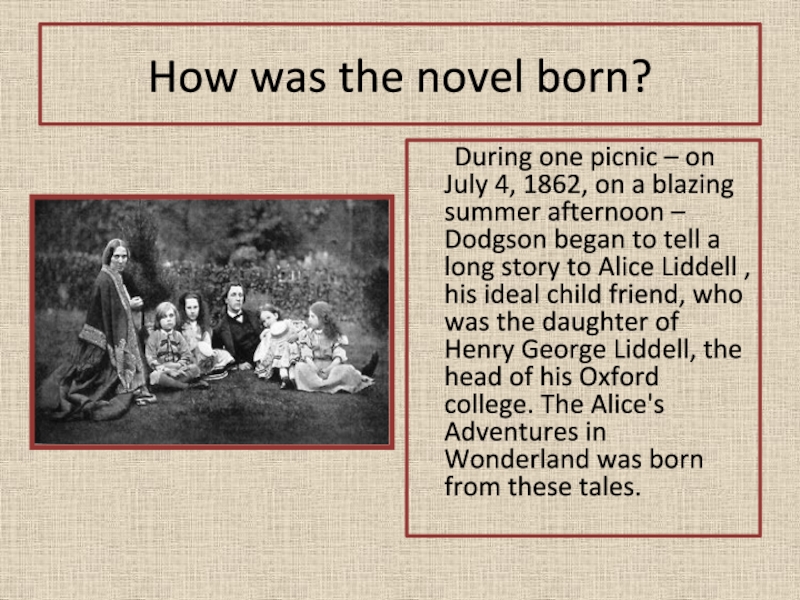
During one picnic – on July 4,
1862, on a blazing summer afternoon – Dodgson began to tell a long story to Alice Liddell , his ideal child friend, who was the daughter of Henry George Liddell, the head of his Oxford college. The Alice's Adventures in Wonderland was born from these tales.
Слайд 9Sisters Liddell
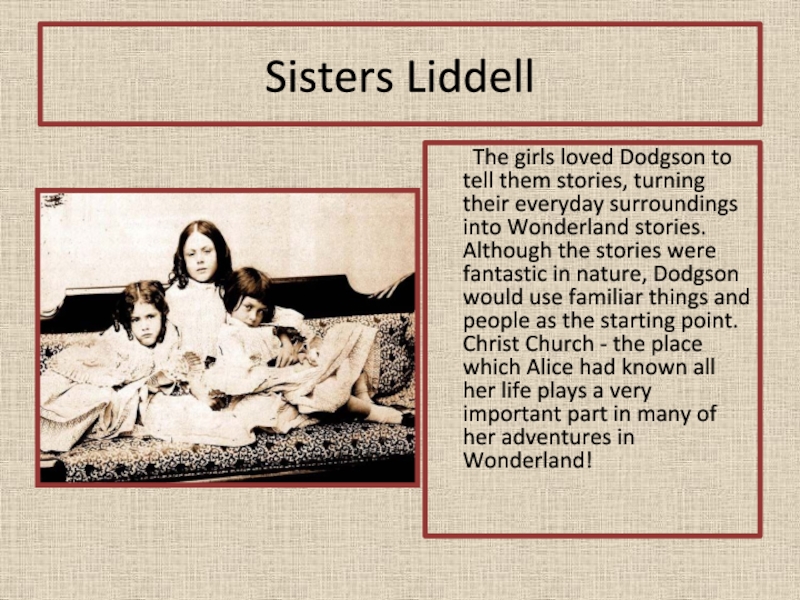
The girls loved Dodgson to tell them stories, turning their
everyday surroundings into Wonderland stories. Although the stories were fantastic in nature, Dodgson would use familiar things and people as the starting point. Christ Church - the place which Alice had known all her life plays a very important part in many of her adventures in Wonderland!
Слайд 10Alice Liddell , his ideal child friend’
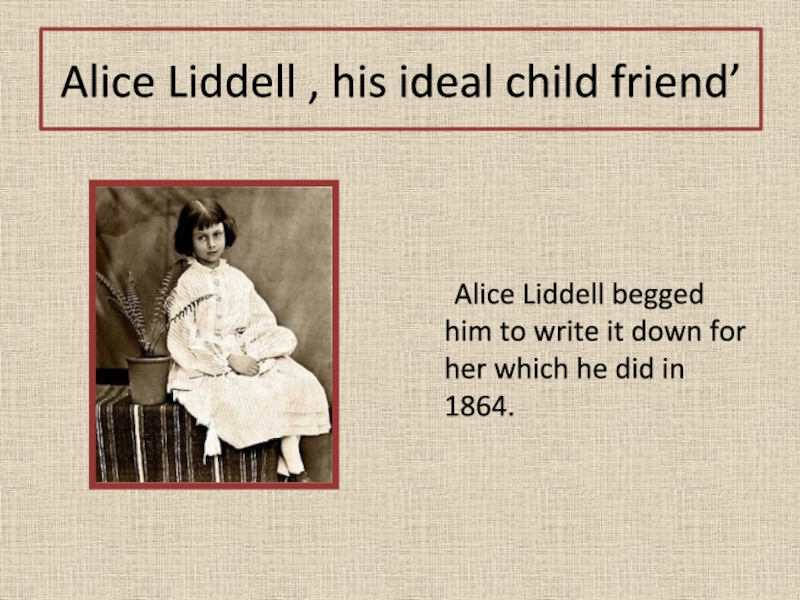
Alice Liddell begged him to
write it down for her which he did in 1864.
Слайд 11Manuscript Alice’s Adventure under Grounds
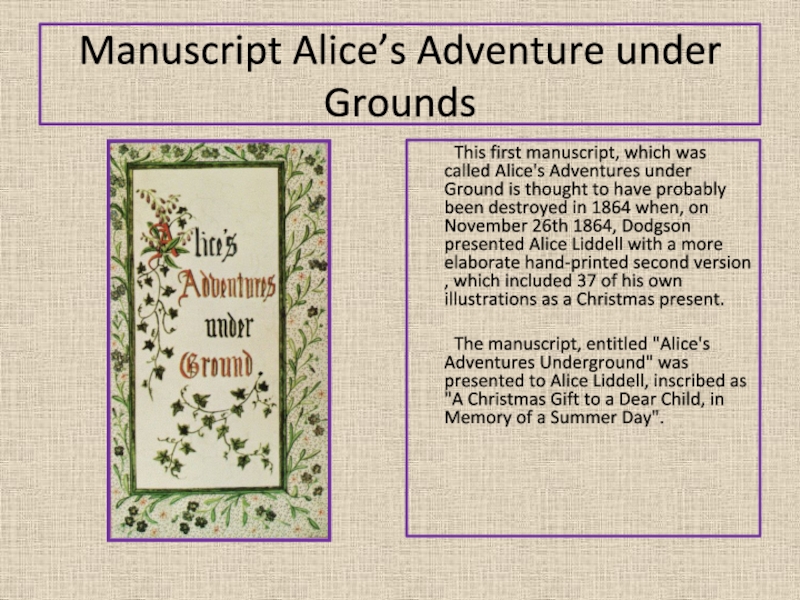
This first manuscript, which was called Alice's
Adventures under Ground is thought to have probably been destroyed in 1864 when, on November 26th 1864, Dodgson presented Alice Liddell with a more elaborate hand-printed second version , which included 37 of his own illustrations as a Christmas present.
The manuscript, entitled "Alice's Adventures Underground" was presented to Alice Liddell, inscribed as "A Christmas Gift to a Dear Child, in Memory of a Summer Day".
The manuscript, entitled "Alice's Adventures Underground" was presented to Alice Liddell, inscribed as "A Christmas Gift to a Dear Child, in Memory of a Summer Day".
Слайд 12First publishing
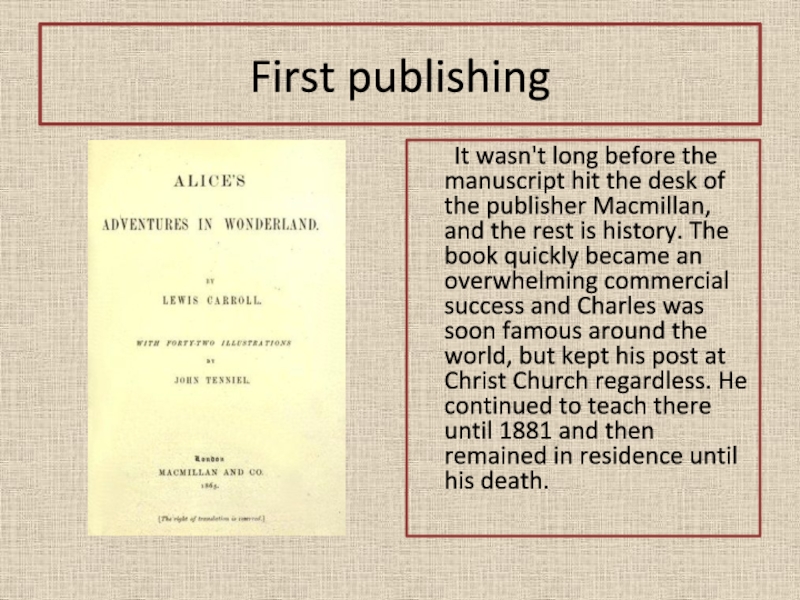
It wasn't long before the manuscript hit the desk of
the publisher Macmillan, and the rest is history. The book quickly became an overwhelming commercial success and Charles was soon famous around the world, but kept his post at Christ Church regardless. He continued to teach there until 1881 and then remained in residence until his death.
Слайд 13Alice’s Adventures Under the Ground
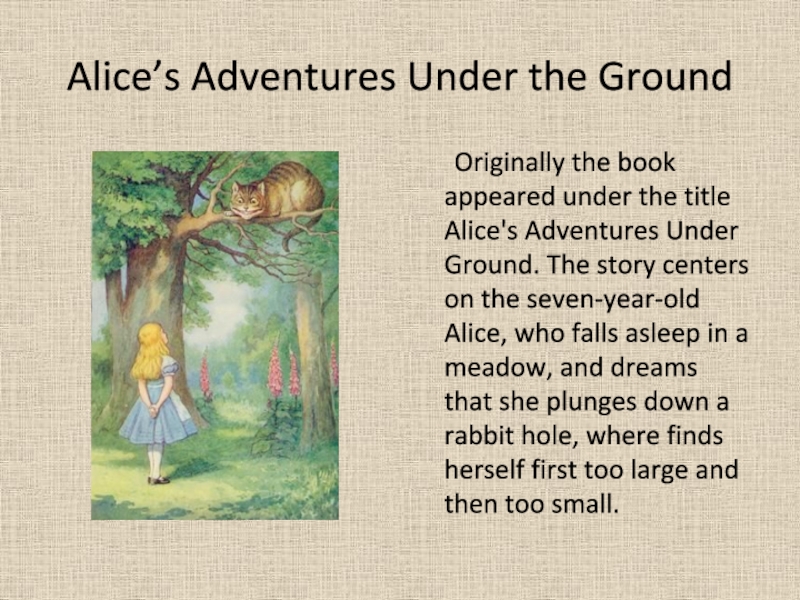
Originally the book appeared under the title
Alice's Adventures Under Ground. The story centers on the seven-year-old Alice, who falls asleep in a meadow, and dreams that she plunges down a rabbit hole, where finds herself first too large and then too small.
Слайд 16The March Hare
She meets such strange characters as Cheshire Cat, the
Mad Hatter, the March Hare
Слайд 17The King and Queen of Hearts
She meets such strange characters as
Cheshire Cat, the Mad Hatter, the March Hare, and the King and Queen of Hearts
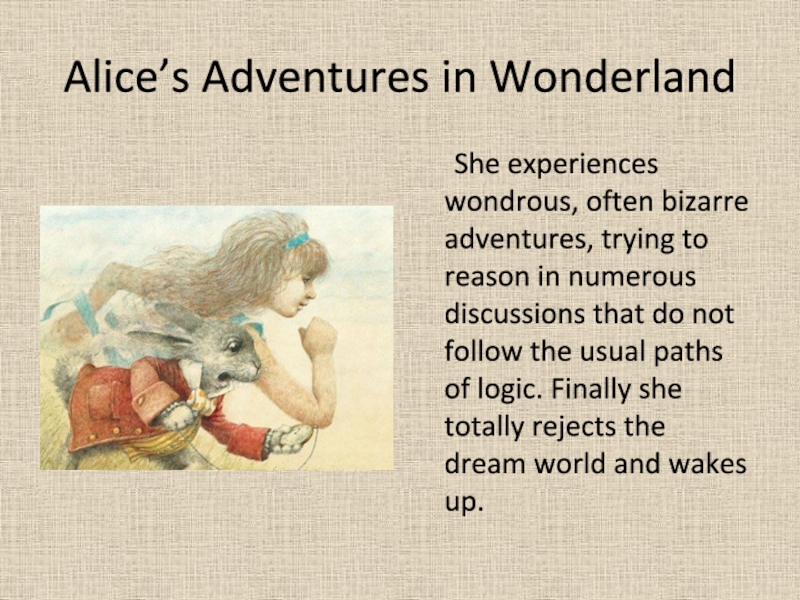
Слайд 18Alice’s Adventures in Wonderland
She experiences wondrous, often bizarre adventures, trying to
reason in numerous discussions that do not follow the usual paths of logic. Finally she totally rejects the dream world and wakes up.
Слайд 19Mathematical works
Dodgson also wrote mathematical works, of which Condensation of Determinants
(1866) and An Elementary Treatise On Determinants (1867) established his fame as a significant mathematical theorist. Moreover, Dodgson was a rather exceptional student of Aristotelian logic, and he delighted his friends with games, puzzles and riddles. Dodgson's mock-heroic poem, The Hunting of the Snark (1876), ending with the line "For the Snark was a Bojuum, you see", received mixed reviews when it appeared.