- Главная
- Разное
- Образование
- Спорт
- Естествознание
- Природоведение
- Религиоведение
- Французский язык
- Черчение
- Английский язык
- Астрономия
- Алгебра
- Биология
- География
- Геометрия
- Детские презентации
- Информатика
- История
- Литература
- Математика
- Музыка
- МХК
- Немецкий язык
- ОБЖ
- Обществознание
- Окружающий мир
- Педагогика
- Русский язык
- Технология
- Физика
- Философия
- Химия
- Шаблоны, фоны, картинки для презентаций
- Экология
- Экономика
Презентация, доклад по английскому языку на тему Towards a time (9 класс)
Содержание
- 1. Презентация по английскому языку на тему Towards a time (9 класс)
- 2. JupiterSaturnNeptuneMercuryUranusEarthVenusMarsThe Solar System consists of the Sun
- 3. The Sun is the star at the
- 4. The Earth is the third planet from
- 5. The Moon is the Earth's only natural
- 6. The space age began on October 4,
- 7. Laika, a dog, was the first animal
- 8. Belka and Strelka spent a day in
- 9. Yuri Alekseyevich Gagarin, a Soviet air force
- 10. Valentina Tershkova was the first woman-cosmonaut in
- 11. The first manned moon landing on the
- 12. The Apollo-Soyuz Test Project was the first
- 13. The Soviet space station Mir was launched
- 14. Match the dates and achievements in the
- 15. True or False:Konstantin Eduardovich Tsiolkovsky – the
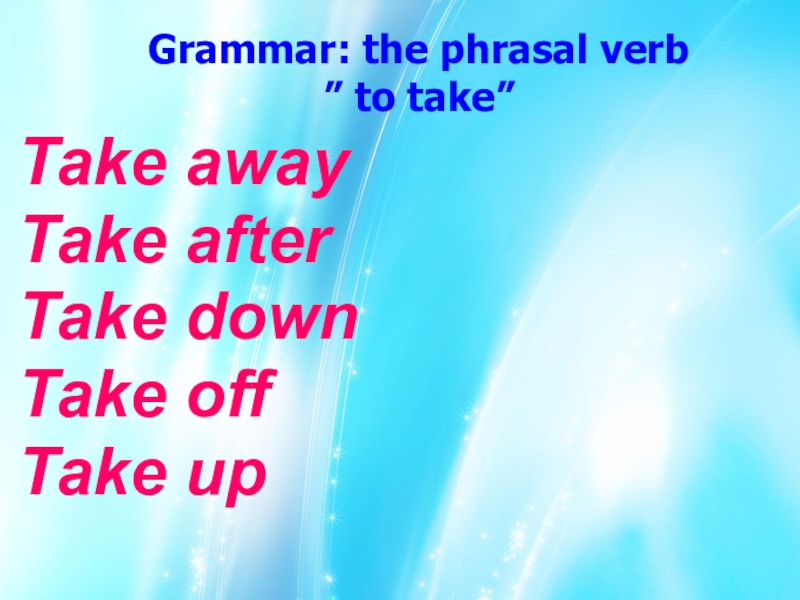
- 16. Grammar: the phrasal verb
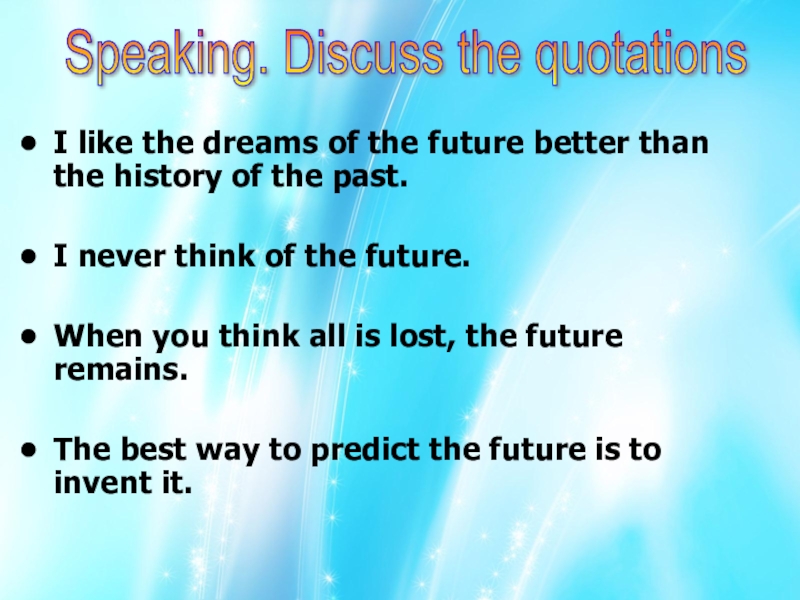
- 17. Speaking. Discuss the quotationsI like the dreams
- 18. Project: Talk about your future
- 19. The End
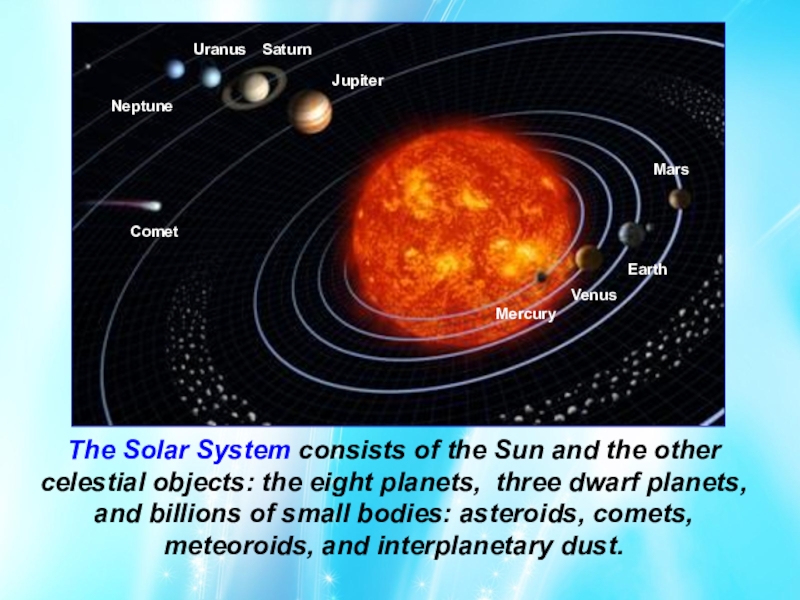
JupiterSaturnNeptuneMercuryUranusEarthVenusMarsThe Solar System consists of the Sun and the other celestial objects: the eight planets, three dwarf planets, and billions of small bodies: asteroids, comets, meteoroids, and interplanetary dust.Comet
Слайд 2Jupiter
Saturn
Neptune
Mercury
Uranus
Earth
Venus
Mars
The Solar System consists of the Sun and the other celestial
objects: the eight planets, three dwarf planets, and billions of small bodies: asteroids, comets, meteoroids, and interplanetary dust.
Comet
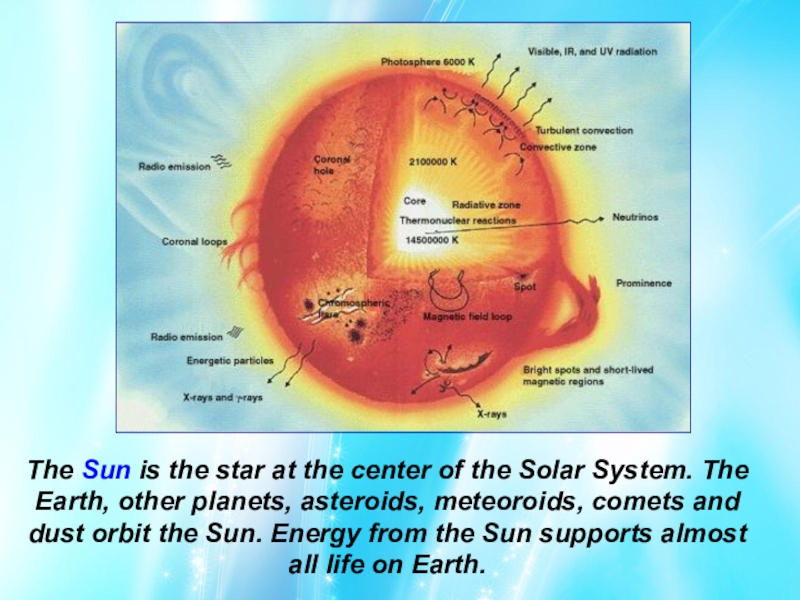
Слайд 3The Sun is the star at the center of the Solar
System. The Earth, other planets, asteroids, meteoroids, comets and dust orbit the Sun. Energy from the Sun supports almost all life on Earth.
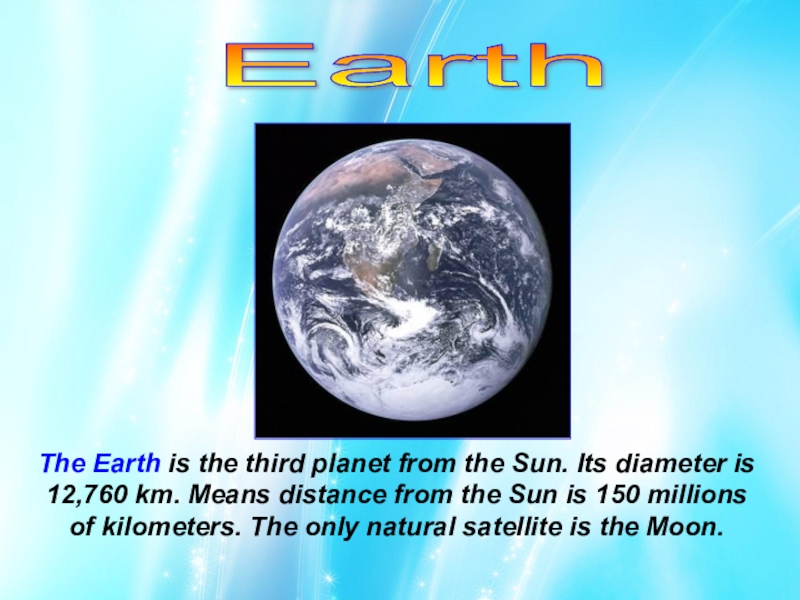
Слайд 4The Earth is the third planet from the Sun. Its diameter
is 12,760 km. Means distance from the Sun is 150 millions of kilometers. The only natural satellite is the Moon.
Earth
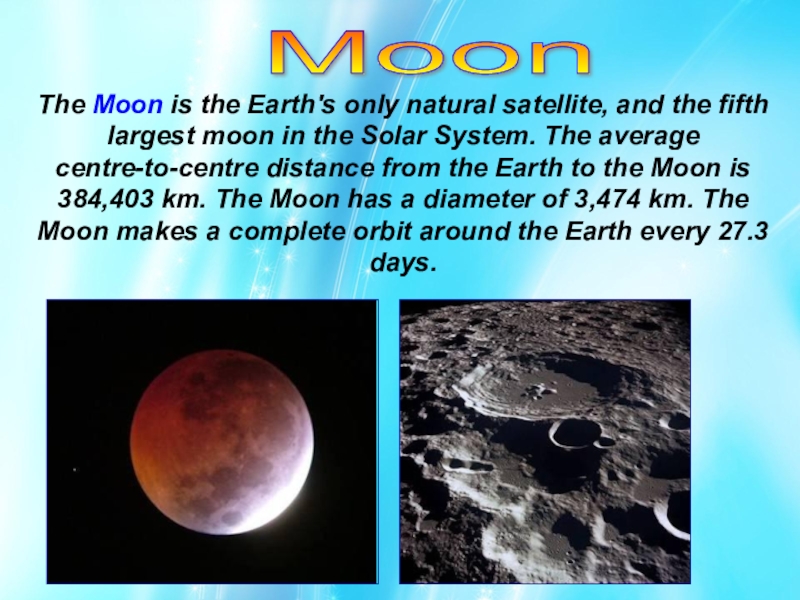
Слайд 5The Moon is the Earth's only natural satellite, and the fifth
largest moon in the Solar System. The average centre-to-centre distance from the Earth to the Moon is 384,403 km. The Moon has a diameter of 3,474 km. The Moon makes a complete orbit around the Earth every 27.3 days.
Moon
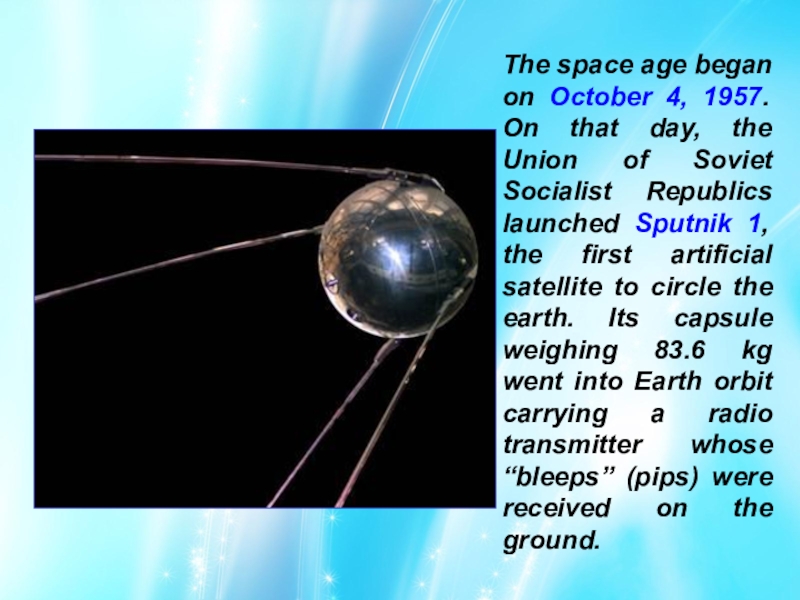
Слайд 6The space age began on October 4, 1957. On that day,
the Union of Soviet Socialist Republics launched Sputnik 1, the first artificial satellite to circle the earth. Its capsule weighing 83.6 kg went into Earth orbit carrying a radio transmitter whose “bleeps” (pips) were received on the ground.
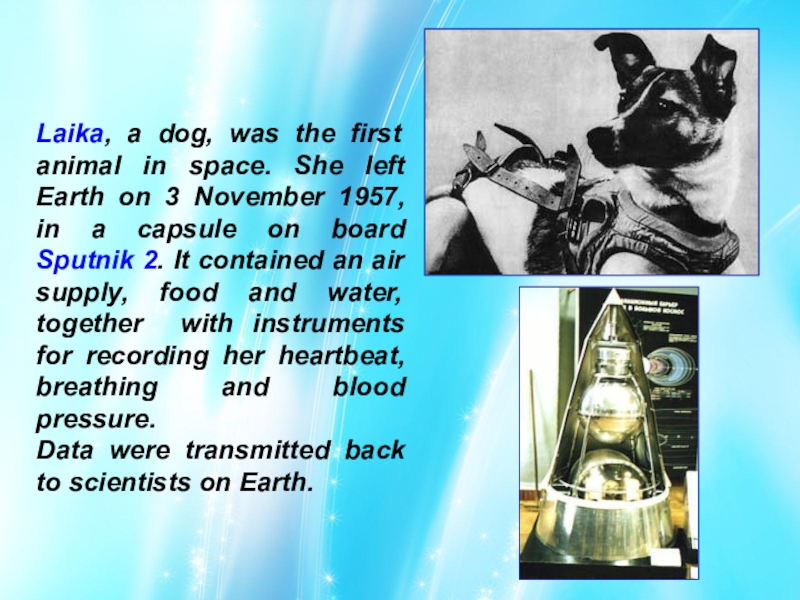
Слайд 7Laika, a dog, was the first animal in space. She left
Earth on 3 November 1957, in a capsule on board Sputnik 2. It contained an air supply, food and water, together with instruments for recording her heartbeat, breathing and blood pressure.
Data were transmitted back to scientists on Earth.
Data were transmitted back to scientists on Earth.
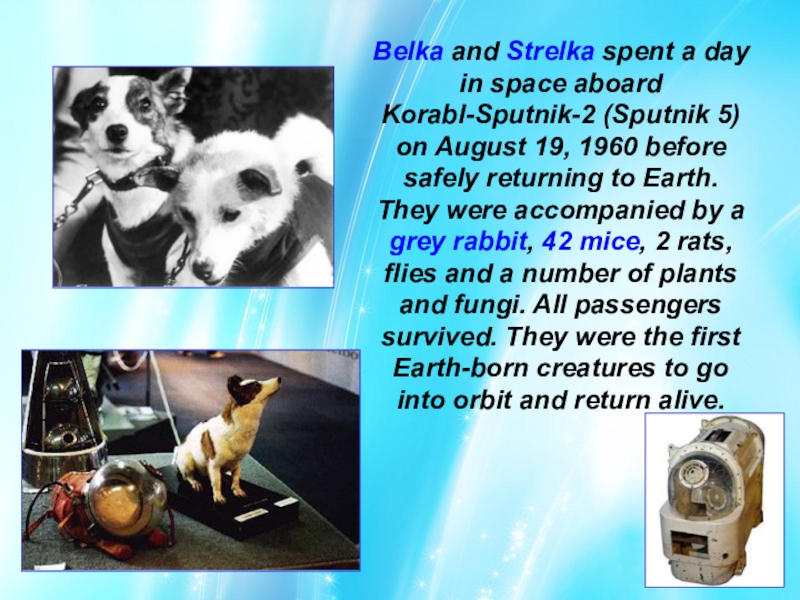
Слайд 8Belka and Strelka spent a day in space aboard Korabl-Sputnik-2 (Sputnik
5) on August 19, 1960 before safely returning to Earth. They were accompanied by a grey rabbit, 42 mice, 2 rats, flies and a number of plants and fungi. All passengers survived. They were the first Earth-born creatures to go into orbit and return alive.
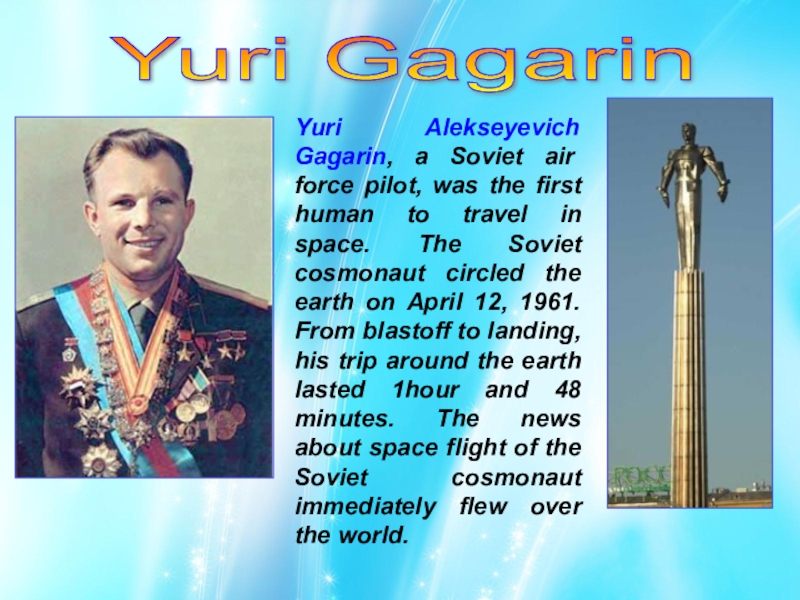
Слайд 9Yuri Alekseyevich Gagarin, a Soviet air force pilot, was the first
human to travel in space. The Soviet cosmonaut circled the earth on April 12, 1961. From blastoff to landing, his trip around the earth lasted 1hour and 48 minutes. The news about space flight of the Soviet cosmonaut immediately flew over the world.
Yuri Gagarin
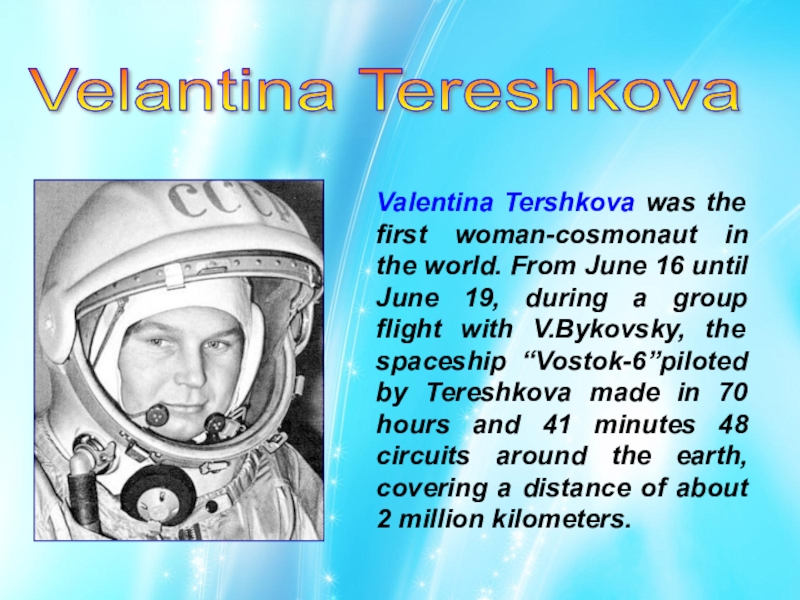
Слайд 10Valentina Tershkova was the first woman-cosmonaut in the world. From June
16 until June 19, during a group flight with V.Bykovsky, the spaceship “Vostok-6”piloted by Tereshkova made in 70 hours and 41 minutes 48 circuits around the earth, covering a distance of about 2 million kilometers.
Velantina Tereshkova
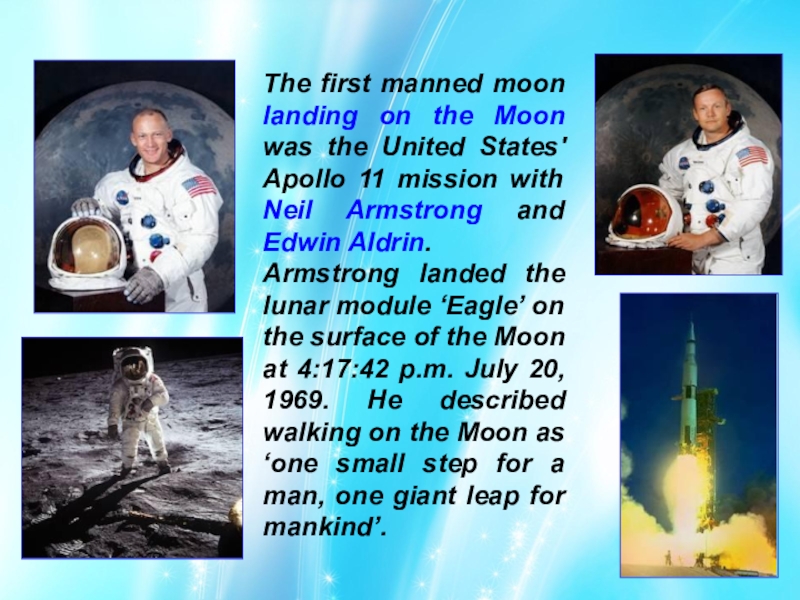
Слайд 11The first manned moon landing on the Moon was the United
States' Apollo 11 mission with Neil Armstrong and Edwin Aldrin.
Armstrong landed the lunar module ‘Eagle’ on the surface of the Moon at 4:17:42 p.m. July 20, 1969. He described walking on the Moon as ‘one small step for a man, one giant leap for mankind’.
Armstrong landed the lunar module ‘Eagle’ on the surface of the Moon at 4:17:42 p.m. July 20, 1969. He described walking on the Moon as ‘one small step for a man, one giant leap for mankind’.
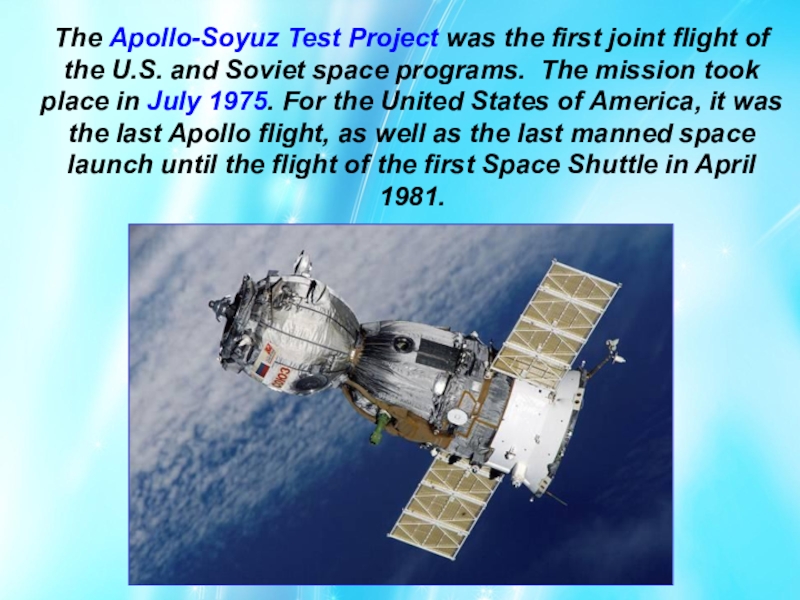
Слайд 12The Apollo-Soyuz Test Project was the first joint flight of the
U.S. and Soviet space programs. The mission took place in July 1975. For the United States of America, it was the last Apollo flight, as well as the last manned space launch until the flight of the first Space Shuttle in April 1981.
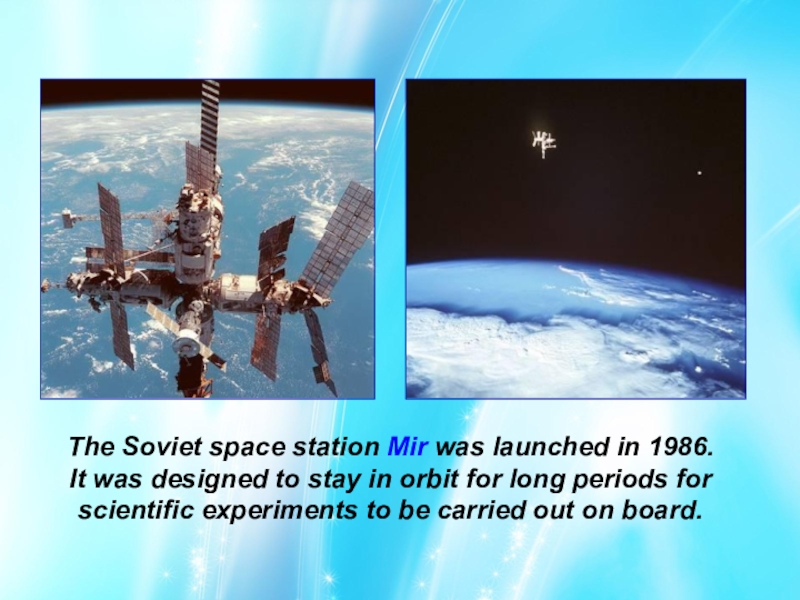
Слайд 13The Soviet space station Mir was launched in 1986. It was
designed to stay in orbit for long periods for scientific experiments to be carried out on board.
Слайд 14Match the dates and achievements in the exploration of space:
USSR launches
first satellite, Sputnik 1.
Yuri Gagarin (USSR) is the first man in space.
Apollo 11 astronauts Neil Armstrong and Edwin Aldrin (USA) land on the Moon.
USA and USSR cooperate in space; Apollo and Soyuz craft dock (link) in orbit.
The Soviet space station Mir is launched into space.
Yuri Gagarin (USSR) is the first man in space.
Apollo 11 astronauts Neil Armstrong and Edwin Aldrin (USA) land on the Moon.
USA and USSR cooperate in space; Apollo and Soyuz craft dock (link) in orbit.
The Soviet space station Mir is launched into space.
1969 1957 1963 1975 1986 1961
Слайд 15True or False:
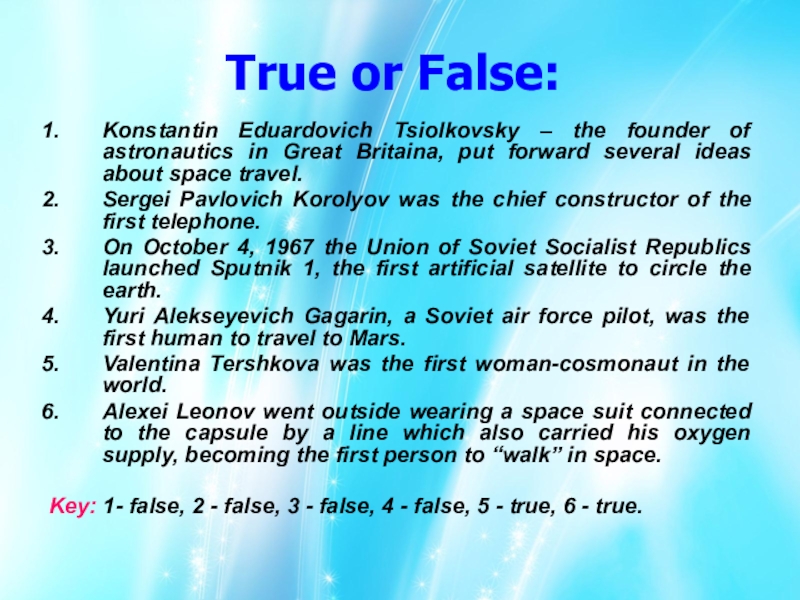
Konstantin Eduardovich Tsiolkovsky – the founder of astronautics in
Great Britaina, put forward several ideas about space travel.
Sergei Pavlovich Korolyov was the chief constructor of the first telephone.
On October 4, 1967 the Union of Soviet Socialist Republics launched Sputnik 1, the first artificial satellite to circle the earth.
Yuri Alekseyevich Gagarin, a Soviet air force pilot, was the first human to travel to Mars.
Valentina Tershkova was the first woman-cosmonaut in the world.
Alexei Leonov went outside wearing a space suit connected to the capsule by a line which also carried his oxygen supply, becoming the first person to “walk” in space.
Key: 1- false, 2 - false, 3 - false, 4 - false, 5 - true, 6 - true.
Sergei Pavlovich Korolyov was the chief constructor of the first telephone.
On October 4, 1967 the Union of Soviet Socialist Republics launched Sputnik 1, the first artificial satellite to circle the earth.
Yuri Alekseyevich Gagarin, a Soviet air force pilot, was the first human to travel to Mars.
Valentina Tershkova was the first woman-cosmonaut in the world.
Alexei Leonov went outside wearing a space suit connected to the capsule by a line which also carried his oxygen supply, becoming the first person to “walk” in space.
Key: 1- false, 2 - false, 3 - false, 4 - false, 5 - true, 6 - true.
Слайд 17Speaking. Discuss the quotations
I like the dreams of the future better
than the history of the past.
I never think of the future.
When you think all is lost, the future remains.
The best way to predict the future is to invent it.
I never think of the future.
When you think all is lost, the future remains.
The best way to predict the future is to invent it.