- Главная
- Разное
- Образование
- Спорт
- Естествознание
- Природоведение
- Религиоведение
- Французский язык
- Черчение
- Английский язык
- Астрономия
- Алгебра
- Биология
- География
- Геометрия
- Детские презентации
- Информатика
- История
- Литература
- Математика
- Музыка
- МХК
- Немецкий язык
- ОБЖ
- Обществознание
- Окружающий мир
- Педагогика
- Русский язык
- Технология
- Физика
- Философия
- Химия
- Шаблоны, фоны, картинки для презентаций
- Экология
- Экономика
Презентация, доклад по английскому языку на тему Pronunciation change in NEW ENGLISH and the Great Vowel Shift
Содержание
- 1. Презентация по английскому языку на тему Pronunciation change in NEW ENGLISH and the Great Vowel Shift
- 2. In the late-fifteenth century printers began printing
- 3. By the sixteenth century English spelling was
- 4. Chief among these was the so-called ‘Great
- 5. After the shift:long i became a diphthong (probably in
- 6. Слайд 6
- 7. A parallel change affected the back vowels
- 8. Additionally, during the period a number of
- 9. Important examples are:the long vowel a in mane and the diphthong ay or ai in may, mainthe
- 10. Numerous conditioned changes (i.e. changes in the
- 11. For example:ou in double, trouble and oo in blood, flood and good, hook became identical with short u (either as in bud or
- 12. Changes in the pronunciation of consonant sounds
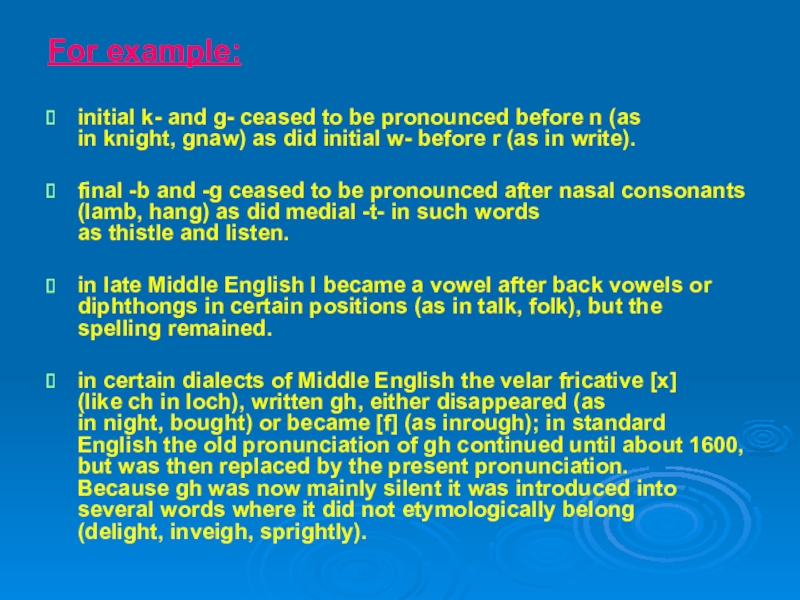
- 13. For example:initial k- and g- ceased to be pronounced
In the late-fifteenth century printers began printing books written in the form of London English which had already become a kind of standard in manuscript documents. Between 1475 and about 1630 English spelling gradually became regularized.
Слайд 2In the late-fifteenth century printers began printing books written in the
form of London English which had already become a kind of standard in manuscript documents. Between 1475 and about 1630 English spelling gradually became regularized. There are noticeable differences in the look of printed English before the mid-seventeenth century, but after that date it is largely the same as modern English, the major difference being the use of the long s (∫) in all positions except finally.
Слайд 3By the sixteenth century English spelling was becoming increasingly out of
step with pronunciation owing mainly to the fact that printing was fixing it in its late Middle English form just when various sound changes were having a far-reaching effect on pronunciation.
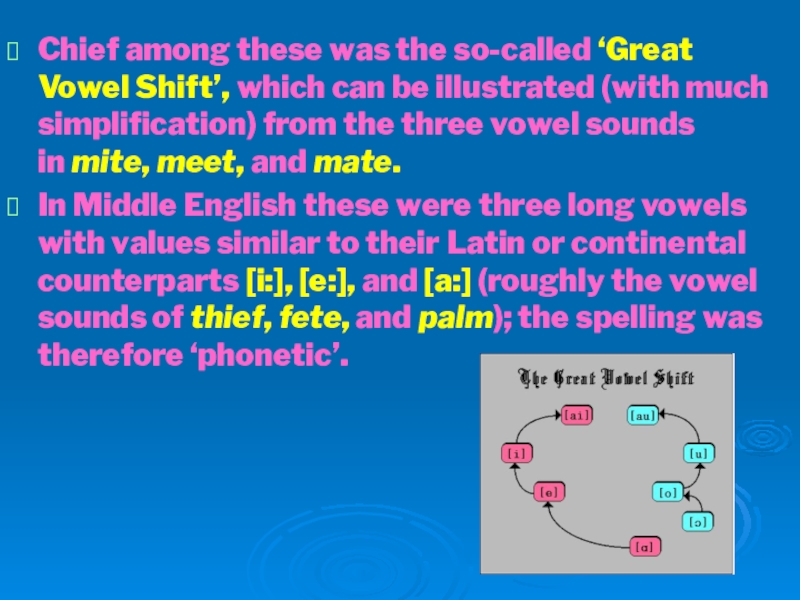
Слайд 4Chief among these was the so-called ‘Great Vowel Shift’, which can
be illustrated (with much simplification) from the three vowel sounds in mite, meet, and mate.
In Middle English these were three long vowels with values similar to their Latin or continental counterparts [i:], [e:], and [a:] (roughly the vowel sounds of thief, fete, and palm); the spelling was therefore ‘phonetic’.
In Middle English these were three long vowels with values similar to their Latin or continental counterparts [i:], [e:], and [a:] (roughly the vowel sounds of thief, fete, and palm); the spelling was therefore ‘phonetic’.
Слайд 5 After the shift:
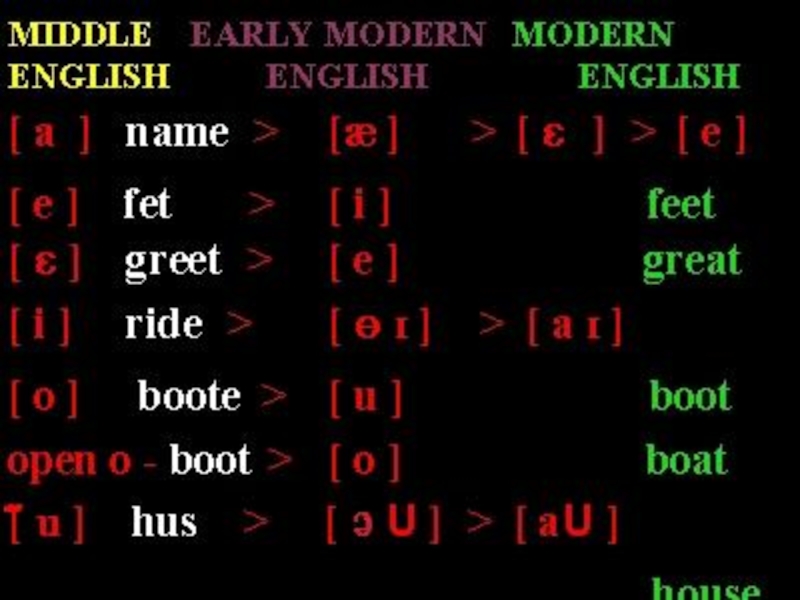
long i became a diphthong (probably in the sixteenth century pronounced
[əi] with a first element like the [ə] of the first syllable in ago)
long e took its place with the value [i:]
long a became a front vowel, more like that of air to begin with, but later [e:].
long e took its place with the value [i:]
long a became a front vowel, more like that of air to begin with, but later [e:].
![After the shift:long i became a diphthong (probably in the sixteenth century pronounced [əi] with a first element like](/img/thumbs/156a0127336f71d4f9c4b2810722e195-800x.jpg "Презентация по английскому языку на тему Pronunciation change in NEW ENGLISH and the Great Vowel Shift After the shift:long i became a diphthong (probably in the sixteenth century pronounced")
Слайд 7A parallel change affected the back vowels of mouth and moot. Hence the mismatch
of the long vowel sounds of English with their counterparts in other European languages.
Слайд 8Additionally, during the period a number of sets of vowel sounds
that had formerly been distinct became identical, while their spelling distinction was largely maintained, resulting in a further mismatch of spelling and pronunciation.
Слайд 9Important examples are:
the long vowel a in mane and the diphthong ay or ai in may, main
the long mid vowel o in sloe, so and the
diphthong ow or ou in slow, sow (= cast seed)
the diphthong represented by u in due and the diphthong ew, eu in dew,neuter.
the diphthong represented by u in due and the diphthong ew, eu in dew,neuter.
Слайд 10Numerous conditioned changes (i.e. changes in the sound of a vowel
or consonant when in the vicinity of another sound) also contributed to the mismatch. When long vowels were shortened in certain positions a given spelling could show either on the one hand a long vowel or diphthong or on the other a short vowel that would normally be spelt another way.
Слайд 11For example:
ou in double, trouble and oo in blood, flood and good, hook became identical with short u (either as in bud or as in put).
similarly originally long ea in bread, lead (the
metal) became identical with ein bred, led.
in southern (standard) English the short vowel u became an unrounded central vowel in most words (bud, cut) but remained a close rounded vowel in certain environments (full, put); the latter vowel subsequently merged with the originally long vowel spelt oo which had become short in certain environments (good, hook).
a after the sound of w became a back rounded vowel, identical with short o (e.g. wad, wash, squat as against mad, mash, mat).
in southern (standard) English the short vowel u became an unrounded central vowel in most words (bud, cut) but remained a close rounded vowel in certain environments (full, put); the latter vowel subsequently merged with the originally long vowel spelt oo which had become short in certain environments (good, hook).
a after the sound of w became a back rounded vowel, identical with short o (e.g. wad, wash, squat as against mad, mash, mat).
Слайд 12Changes in the pronunciation of consonant sounds during the early modern
English period contributed significantly to the incongruity between spelling and pronunciation.
Accordingly consonant sounds ceased to be pronounced in many contexts.
Accordingly consonant sounds ceased to be pronounced in many contexts.
Слайд 13For example:
initial k- and g- ceased to be pronounced before n (as in knight, gnaw) as did
initial w- before r (as in write).
final -b and -g ceased to be pronounced after nasal consonants (lamb, hang) as did medial -t- in such words as thistle and listen.
in late Middle English l became a vowel after back vowels or diphthongs in certain positions (as in talk, folk), but the spelling remained.
in certain dialects of Middle English the velar fricative [x] (like ch in loch), written gh, either disappeared (as in night, bought) or became [f] (as inrough); in standard English the old pronunciation of gh continued until about 1600, but was then replaced by the present pronunciation. Because gh was now mainly silent it was introduced into several words where it did not etymologically belong (delight, inveigh, sprightly).
final -b and -g ceased to be pronounced after nasal consonants (lamb, hang) as did medial -t- in such words as thistle and listen.
in late Middle English l became a vowel after back vowels or diphthongs in certain positions (as in talk, folk), but the spelling remained.
in certain dialects of Middle English the velar fricative [x] (like ch in loch), written gh, either disappeared (as in night, bought) or became [f] (as inrough); in standard English the old pronunciation of gh continued until about 1600, but was then replaced by the present pronunciation. Because gh was now mainly silent it was introduced into several words where it did not etymologically belong (delight, inveigh, sprightly).