- Главная
- Разное
- Образование
- Спорт
- Естествознание
- Природоведение
- Религиоведение
- Французский язык
- Черчение
- Английский язык
- Астрономия
- Алгебра
- Биология
- География
- Геометрия
- Детские презентации
- Информатика
- История
- Литература
- Математика
- Музыка
- МХК
- Немецкий язык
- ОБЖ
- Обществознание
- Окружающий мир
- Педагогика
- Русский язык
- Технология
- Физика
- Философия
- Химия
- Шаблоны, фоны, картинки для презентаций
- Экология
- Экономика
Презентация, доклад по английскому языку на тему Национальные символы Великобритании
Содержание
- 1. Презентация по английскому языку на тему Национальные символы Великобритании
- 2. The flag of the UKThe flag of
- 3. The flag of the UKIn the seventeenth
- 4. Слайд 4
- 5. The national flag of EnglandThe upright red
- 6. The national flag of Northern IrelandThe red
- 7. The national flag of ScotlandThe white diagonal
- 8. Сoats of arms In the Royal Arms
- 9. A red roseSt. George’s Day falls on
- 10. A red roseIn the 15th century there
- 11. Shamrock St. Patrick’s Day (the 17th of
- 12. Shamrock Another legend say that with the
- 13. A harp A harp is recognized as
- 14. A harpThe harp was chosen as the
- 15. Thistle St. Andrew’s Day (the 30th of
- 16. ThistleAnd the Scots have time to mobilize
- 17. The Royal Crown Jewels Of ScotlandAs an
- 18. A yellow daffodil and a leek St.
- 19. a leekAccording to legend, in 640 between
- 20. The Welsh Flag The Welsh Flag, a
- 21. Quiz What is the flag of the
- 22. Thank You!
The flag of the UKThe flag of the United Kingdom is officially called the Union flag, because it embodies the emblems of three countries united under one monarch. The Union Flag is commonly known as the
Слайд 2
The flag of the UK
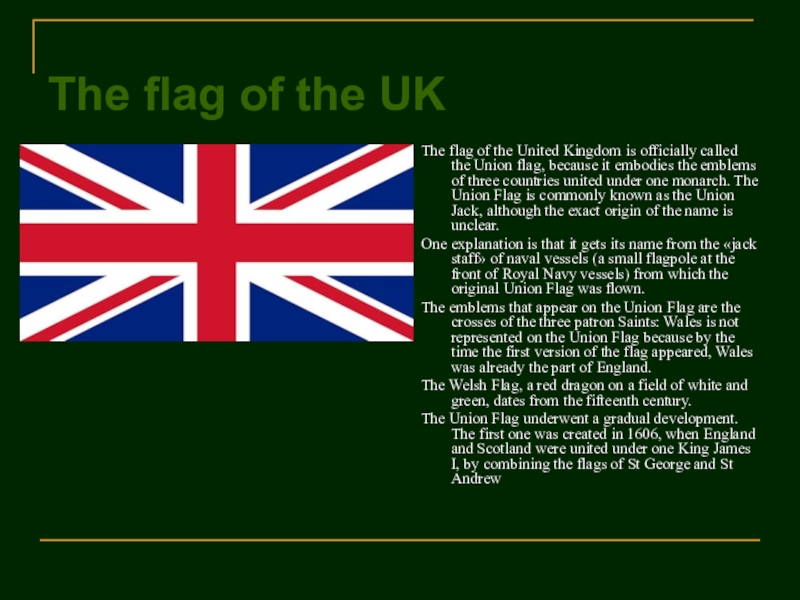
The flag of the United Kingdom is
officially called the Union flag, because it embodies the emblems of three countries united under one monarch. The Union Flag is commonly known as the Union Jack, although the exact origin of the name is unclear.
One explanation is that it gets its name from the «jack staff» of naval vessels (a small flagpole at the front of Royal Navy vessels) from which the original Union Flag was flown.
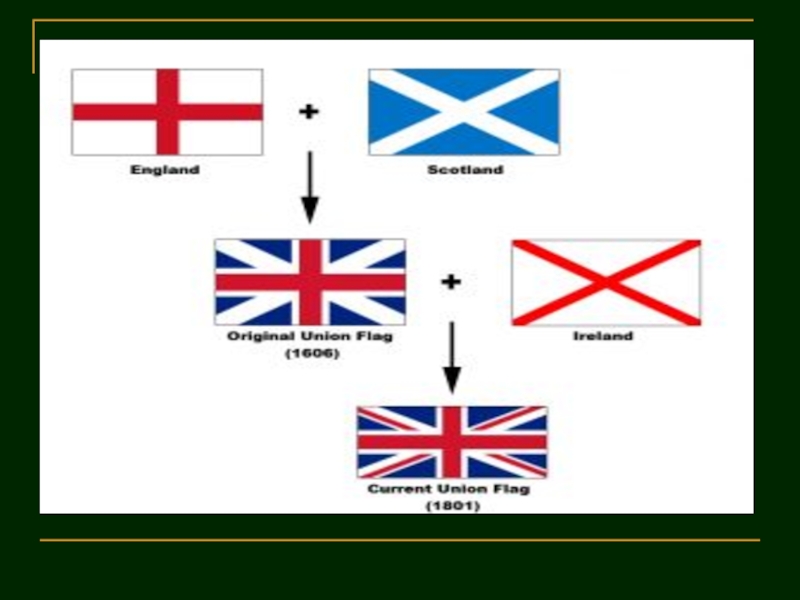
The emblems that appear on the Union Flag are the crosses of the three patron Saints: Wales is not represented on the Union Flag because by the time the first version of the flag appeared, Wales was already the part of England.
The Welsh Flag, a red dragon on a field of white and green, dates from the fifteenth century.
The Union Flag underwent a gradual development. The first one was created in 1606, when England and Scotland were united under one King James I, by combining the flags of St George and St Andrew
One explanation is that it gets its name from the «jack staff» of naval vessels (a small flagpole at the front of Royal Navy vessels) from which the original Union Flag was flown.
The emblems that appear on the Union Flag are the crosses of the three patron Saints: Wales is not represented on the Union Flag because by the time the first version of the flag appeared, Wales was already the part of England.
The Welsh Flag, a red dragon on a field of white and green, dates from the fifteenth century.
The Union Flag underwent a gradual development. The first one was created in 1606, when England and Scotland were united under one King James I, by combining the flags of St George and St Andrew
Слайд 3The flag of the UK
In the seventeenth century, the flag underwent
several changes. After the execution of Charles I in 1649, Oliver Cromwell, the Lord Protector, introduced a special Commonwealth flag consisting of St George’s cross and the gold harp of Ireland. When Charles II was restored to the throne in 1660 he reintroduced the Union Flag of James I.
The final version of the Union Flag appeared in 1801, following the union of Great Britain with Ireland, with the inclusion of the cross of St Patrick. The cross remains on the flag although only the northern part of Ireland now remains part of the United Kingdom.
The final version of the Union Flag appeared in 1801, following the union of Great Britain with Ireland, with the inclusion of the cross of St Patrick. The cross remains on the flag although only the northern part of Ireland now remains part of the United Kingdom.
Слайд 5The national flag of England
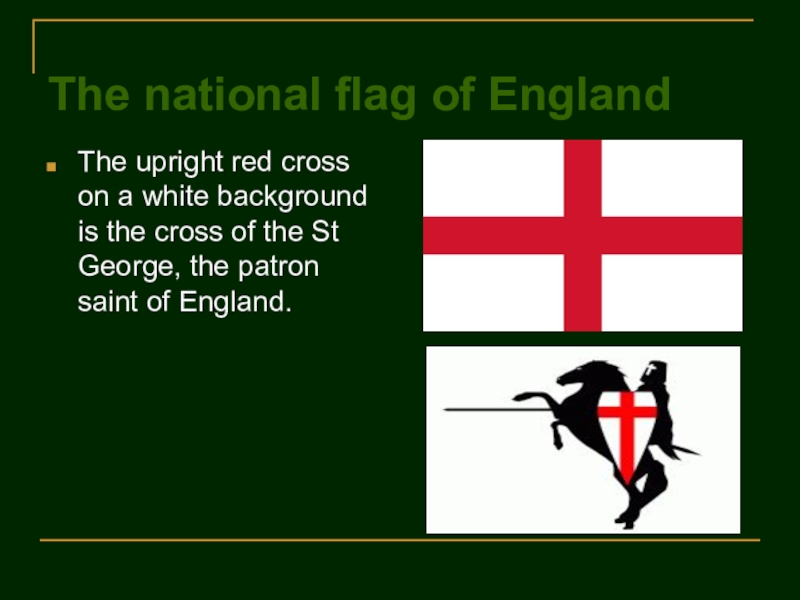
The upright red cross on a white
background is the cross of the St George, the patron saint of England.
Слайд 6The national flag of Northern Ireland
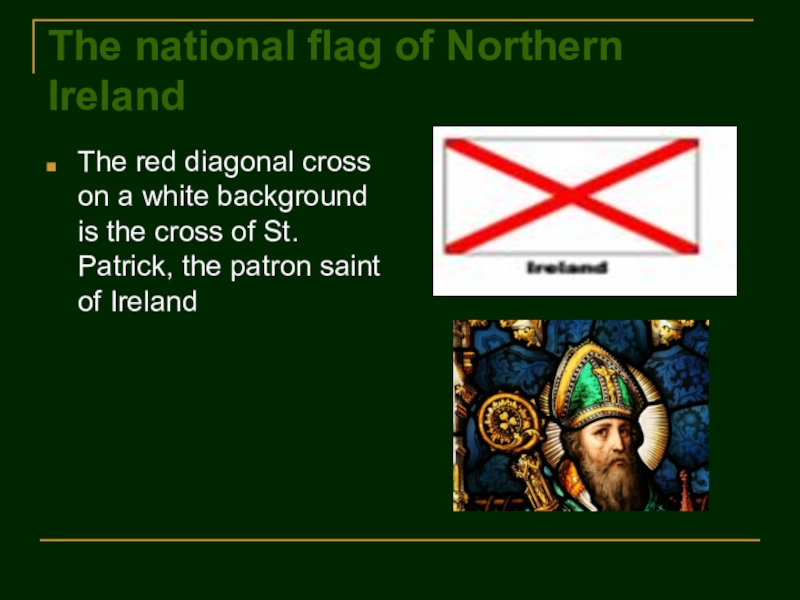
The red diagonal cross on a
white background is the cross of St. Patrick, the patron saint of Ireland
Слайд 7The national flag of Scotland
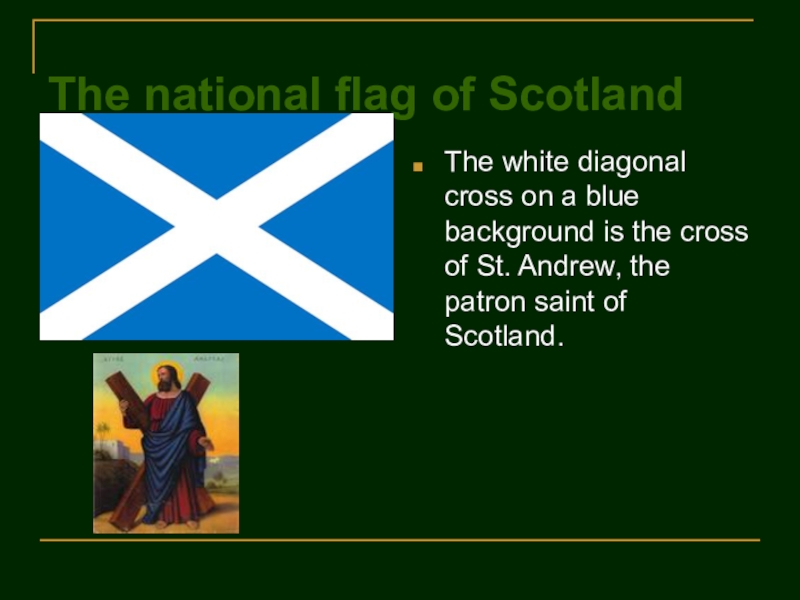
The white diagonal cross on a blue
background is the cross of St. Andrew, the patron saint of Scotland.
Слайд 8Сoats of arms
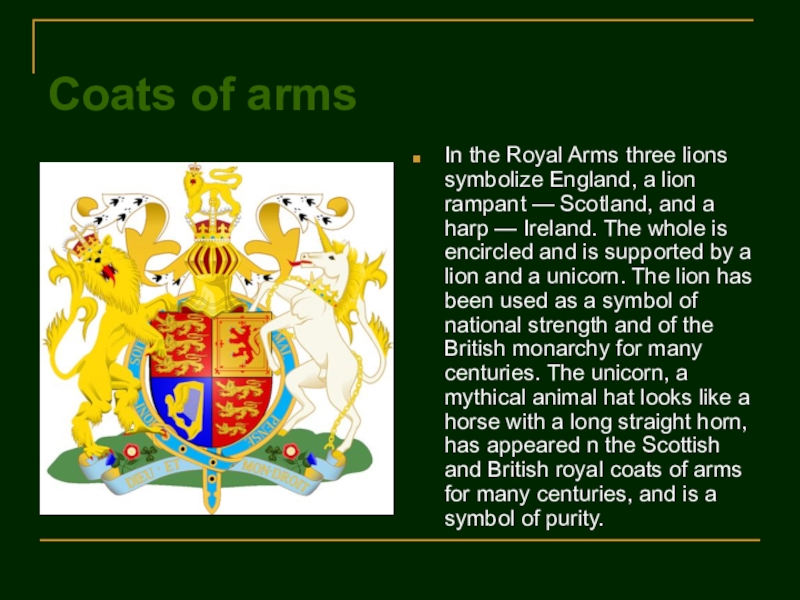
In the Royal Arms three lions symbolize England,
a lion rampant — Scotland, and a harp — Ireland. The whole is encircled and is supported by a lion and a unicorn. The lion has been used as a symbol of national strength and of the British monarchy for many centuries. The unicorn, a mythical animal hat looks like a horse with a long straight horn, has appeared n the Scottish and British royal coats of arms for many centuries, and is a symbol of purity.
Слайд 9A red rose
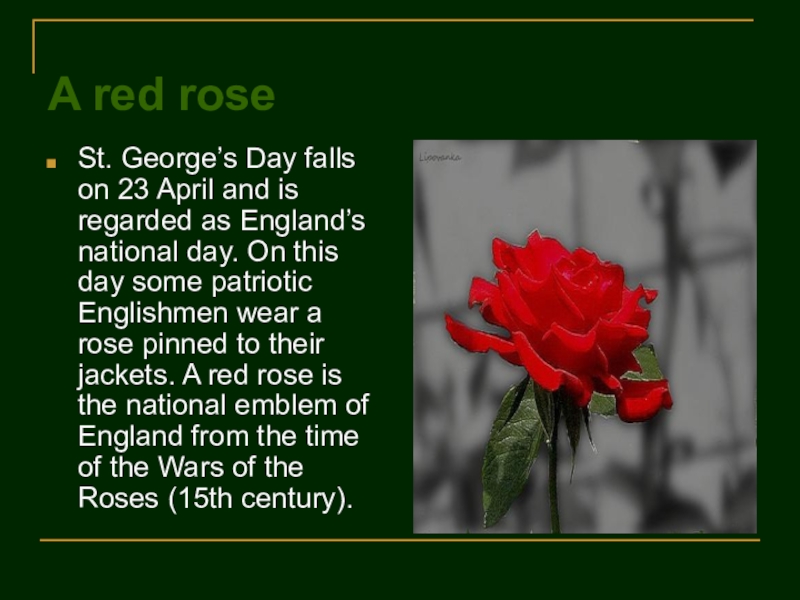
St. George’s Day falls on 23 April and is
regarded as England’s national day. On this day some patriotic Englishmen wear a rose pinned to their jackets. A red rose is the national emblem of England from the time of the Wars of the Roses (15th century).
Слайд 10A red rose
In the 15th century there was a series of
wars in England, which were called the Wars of the Roses. They were between two parts of the English royal family, each of which wanted its own leader to be king. One family was called Lancaster and was represented by a red rose, and the other was called York, and was represented by a white rose. The Wars of the Roses ended with the victory of Henry 7 (of Lancaster)
Слайд 11Shamrock
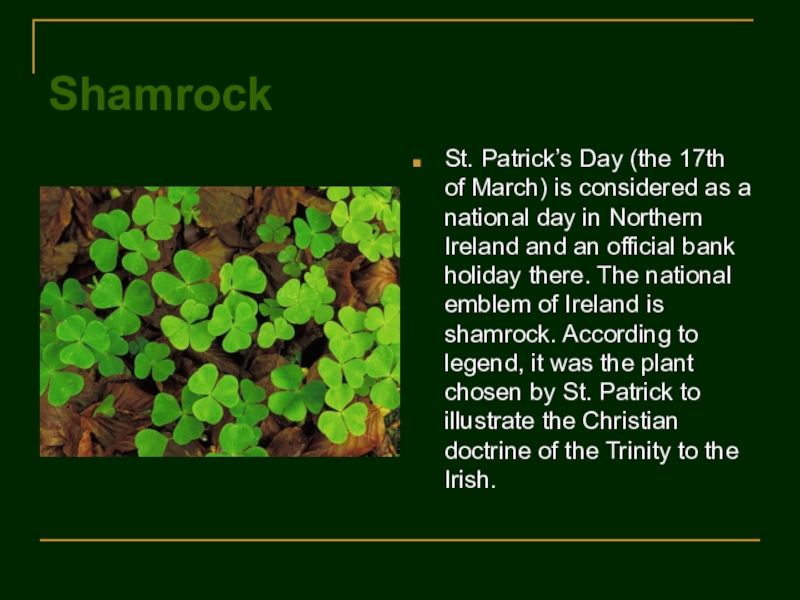
St. Patrick’s Day (the 17th of March) is considered as
a national day in Northern Ireland and an official bank holiday there. The national emblem of Ireland is shamrock. According to legend, it was the plant chosen by St. Patrick to illustrate the Christian doctrine of the Trinity to the Irish.
Слайд 12Shamrock
Another legend say that with the help of this herb
St. Patrick drove all the snakes out of Ireland. Still no snake there not found.
Слайд 13A harp
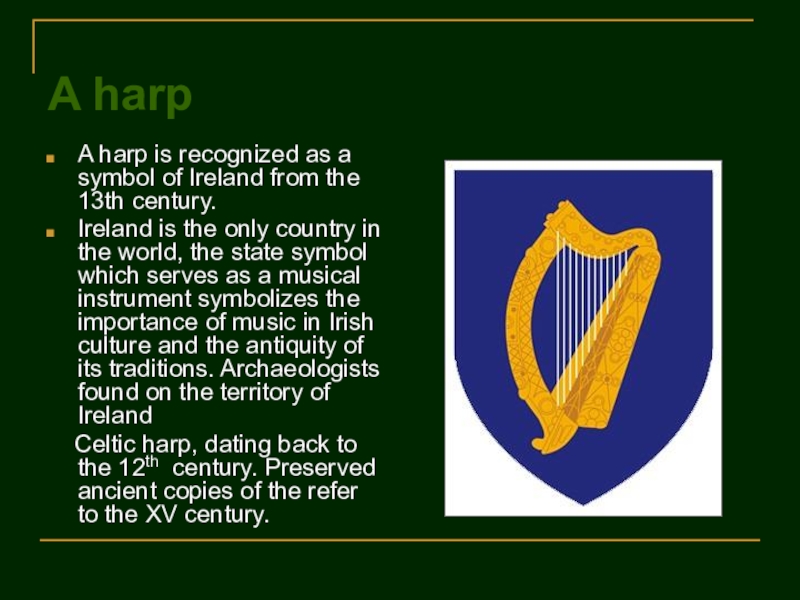
A harp is recognized as a symbol of Ireland
from the 13th century.
Ireland is the only country in the world, the state symbol which serves as a musical instrument symbolizes the importance of music in Irish culture and the antiquity of its traditions. Archaeologists found on the territory of Ireland
Celtic harp, dating back to the 12th century. Preserved ancient copies of the refer to the XV century.
Ireland is the only country in the world, the state symbol which serves as a musical instrument symbolizes the importance of music in Irish culture and the antiquity of its traditions. Archaeologists found on the territory of Ireland
Celtic harp, dating back to the 12th century. Preserved ancient copies of the refer to the XV century.
Слайд 14A harp
The harp was chosen as the symbol of the independent
Ireland. She continued to remain of the state emblem after the adoption of the constitution.
It is used on the coins, passports, official documents of state, as well as on the seals of the president and the government
It is used on the coins, passports, official documents of state, as well as on the seals of the president and the government
Слайд 15Thistle
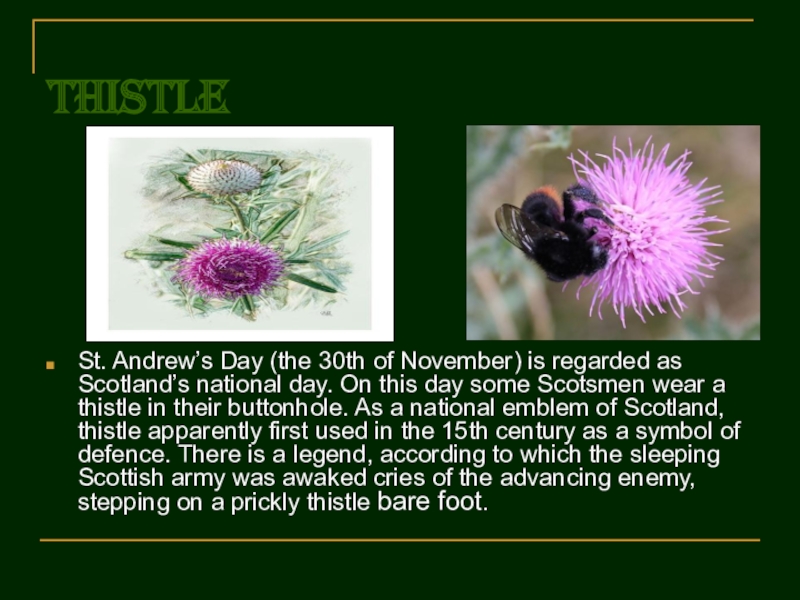
St. Andrew’s Day (the 30th of November) is regarded as
Scotland’s national day. On this day some Scotsmen wear a thistle in their buttonhole. As a national emblem of Scotland, thistle apparently first used in the 15th century as a symbol of defence. There is a legend, according to which the sleeping Scottish army was awaked cries of the advancing enemy, stepping on a prickly thistle bare foot.
Слайд 16Thistle
And the Scots have time to mobilize after sleep and win
the victory. In gratitude, the plant called the Guardian (Guardian). Thus with time the thistle became a symbol of Scotland. Unfortunately, the historical evidence of this history has not been preserved.
The Order of the Thistle is one of the highest orders of knighthood. It was founded in 1687, and is mainly given to Scottish noblemen (limited to 16 in number).
The Order of the Thistle is one of the highest orders of knighthood. It was founded in 1687, and is mainly given to Scottish noblemen (limited to 16 in number).
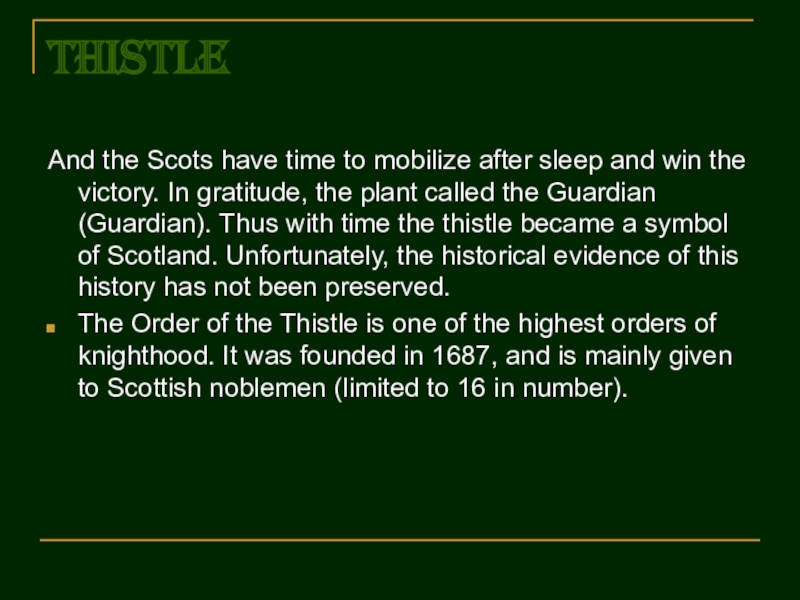
Слайд 17The Royal Crown Jewels Of Scotland
As an important symbol are the
royal regalia: the scepter and the sword and the crown. With them it is connected a lot of historical events, achievements and stories. They are the most ancient regalia (15 - 16th century) on the territory of all of the British Isles, and so for them always was a bitter struggle. At the present time, they are safely kept in the museum of Edinburgh castle and anyone can admire them.
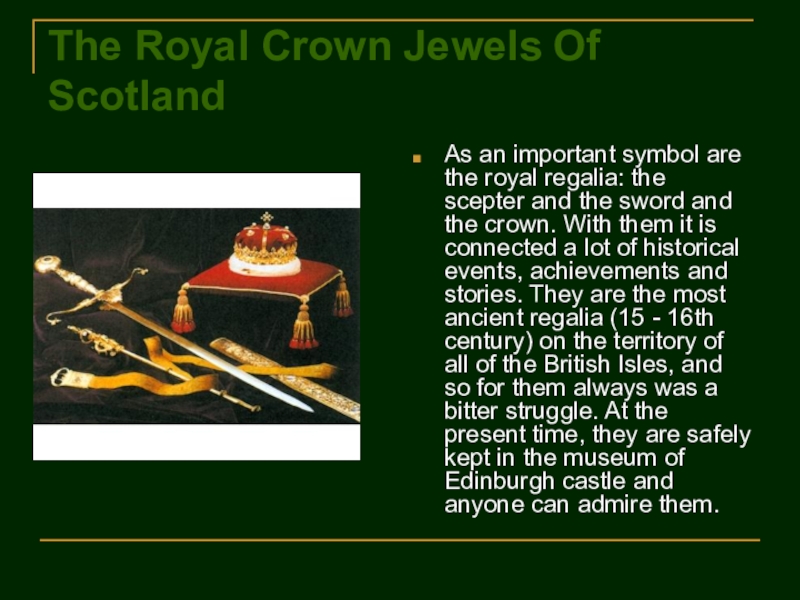
Слайд 18A yellow daffodil and a leek
St. David’s Day (the 1st
of March) is the church festival of St. David, a 6th-century monk and bishop, the patron saint of Wales. The day is regarded as the national holiday of Wales, although it is not an official bank holiday.
On this day, however, many Welshmen wear either a yellow daffodil or a leek pinned to their jackets, as both plants traditionally regarded as national emblems of Wales.
On this day, however, many Welshmen wear either a yellow daffodil or a leek pinned to their jackets, as both plants traditionally regarded as national emblems of Wales.
Слайд 19a leek
According to legend, in 640 between the welsh under the
leadership of the king of Wales Cadwallader and Saks a battle took place, during which the holy David suggested, Welshmen to attach to your hats stems leeks, in order to distinguish itself from the enemies. The battle was won, and the leeks became the emblem of Wales.
Слайд 20The Welsh Flag
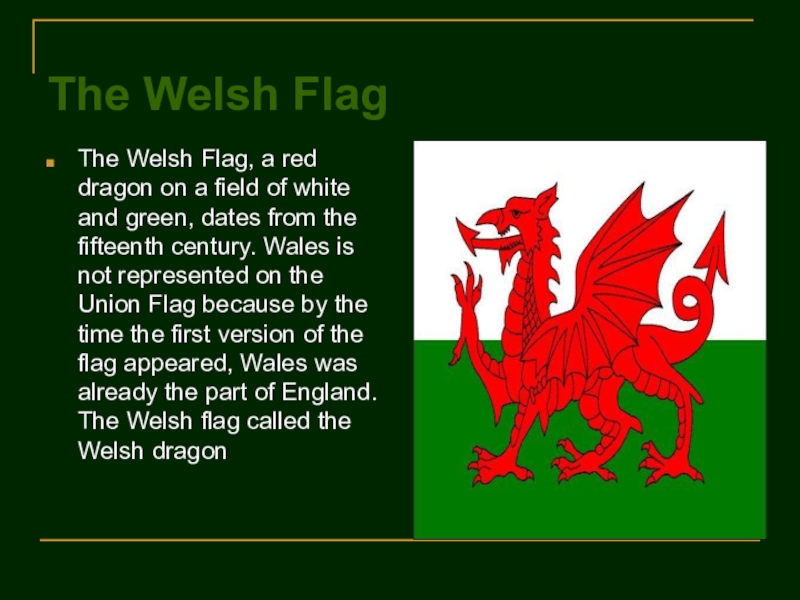
The Welsh Flag, a red dragon on a
field of white and green, dates from the fifteenth century. Wales is not represented on the Union Flag because by the time the first version of the flag appeared, Wales was already the part of England. The Welsh flag called the Welsh dragon
Слайд 21Quiz
What is the flag of the United Kingdom made up of?
When
was the first Union Flag created?
When did the final version of the Union Flag appear?
How is the Welsh flag called?
How does the Welsh flag look like?
What do some Englishmen wear on St. George’s Day?
What day is regarded as Scotland’s national day?
What day is a national day in Northern Ireland?
What plants are national symbols of Wales ?
What do three lions in the Royal Arms symbolize?
What does the unicorn symbolize?
What do you know about the harp?
What do you know about the Royal Crown Jewels of Scotland?
When did the final version of the Union Flag appear?
How is the Welsh flag called?
How does the Welsh flag look like?
What do some Englishmen wear on St. George’s Day?
What day is regarded as Scotland’s national day?
What day is a national day in Northern Ireland?
What plants are national symbols of Wales ?
What do three lions in the Royal Arms symbolize?
What does the unicorn symbolize?
What do you know about the harp?
What do you know about the Royal Crown Jewels of Scotland?