- Главная
- Разное
- Образование
- Спорт
- Естествознание
- Природоведение
- Религиоведение
- Французский язык
- Черчение
- Английский язык
- Астрономия
- Алгебра
- Биология
- География
- Геометрия
- Детские презентации
- Информатика
- История
- Литература
- Математика
- Музыка
- МХК
- Немецкий язык
- ОБЖ
- Обществознание
- Окружающий мир
- Педагогика
- Русский язык
- Технология
- Физика
- Философия
- Химия
- Шаблоны, фоны, картинки для презентаций
- Экология
- Экономика
Презентация, доклад по английскому языку на тему Halloween
Содержание
- 1. Презентация по английскому языку на тему Halloween
- 2. History
- 3. Celtic influencesThough the origin of the word
- 4. It was held on or about October
- 5. Christian influencesHalloween is also thought to have
- 6. The custom of wearing costumes has been
- 7. Symbols
- 8. The modern imagery of Halloween comes from
- 9. Trick-or-treating and guising
- 10. Trick-or-treating is a customary celebration for children
- 11. Costumes
- 12. Halloween costumes are traditionally modeled after supernatural
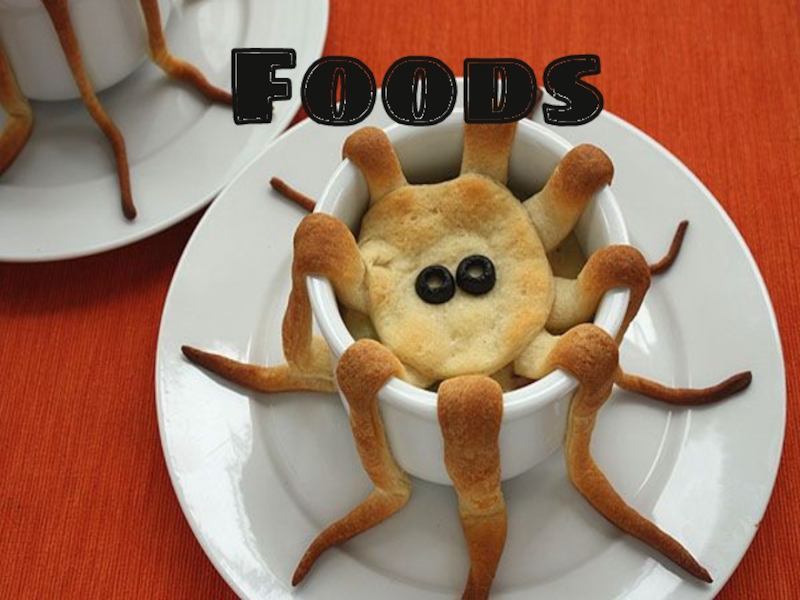
- 13. Foods
- 14. Because Halloween comes in the wake of
- 15. Haunted attractions
- 16. Haunted attractions are entertainment venues designed to
- 17. Слайд 17
History
Слайд 3Celtic influences
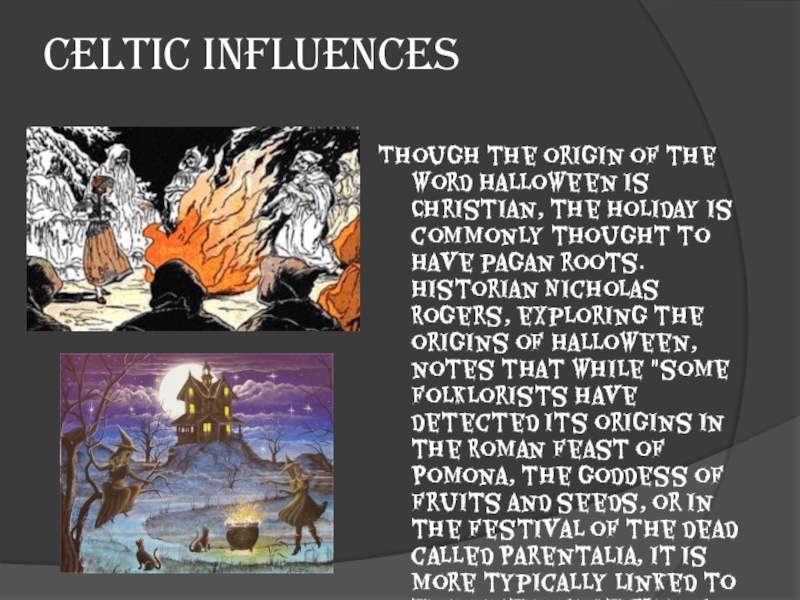
Though the origin of the word Halloween is Christian, the
holiday is commonly thought to have pagan roots. Historian Nicholas Rogers, exploring the origins of Halloween, notes that while "some folklorists have detected its origins in the Roman feast of Pomona, the goddess of fruits and seeds, or in the festival of the dead called Parentalia, it is more typically linked to the Celtic festival of Samhain", which comes from the Old Irish for "summer's end". Samhain was the first and most important of the four quarter days in the medieval Gaelic (Irish, Scottish and Manx) calendar.
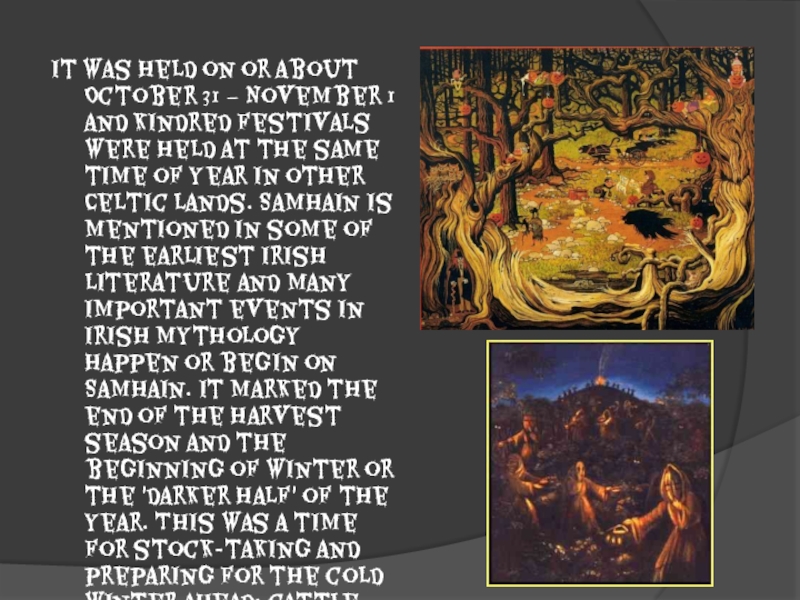
Слайд 4It was held on or about October 31 – November 1
and kindred festivals were held at the same time of year in other Celtic lands. Samhain is mentioned in some of the earliest Irish literature and many important events in Irish mythology happen or begin on Samhain. It marked the end of the harvest season and the beginning of winter or the 'darker half' of the year. This was a time for stock-taking and preparing for the cold winter ahead; cattle were brought back down from the summer pastures and livestock were slaughtered. In much of the Gaelic world, bonfires were lit and there were rituals involving them. Some of these rituals hint that they may once have involved human sacrifice. Divination games or rituals were also done at Samhain.
Слайд 5Christian influences
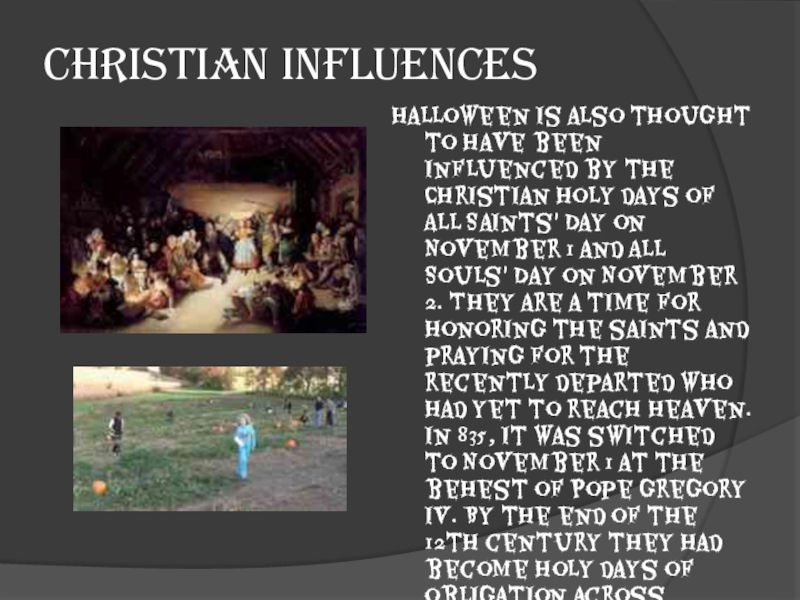
Halloween is also thought to have been influenced by the
Christian holy days of All Saints' Day on November 1 and All Souls' Day on November 2. They are a time for honoring the saints and praying for the recently departed who had yet to reach Heaven. In 835, it was switched to November 1 at the behest of Pope Gregory IV. By the end of the 12th century they had become holy days of obligation across Europe and involved such traditions as ringing bells for the souls in purgatory. "Souling", the custom of baking and sharing soul cakes for "all crysten christened souls", has been suggested as the origin of trick-or-treating. Groups of poor people, often children, would go door-to-door on All Saints collecting soul cakes, originally as a means of praying for souls in purgatory.
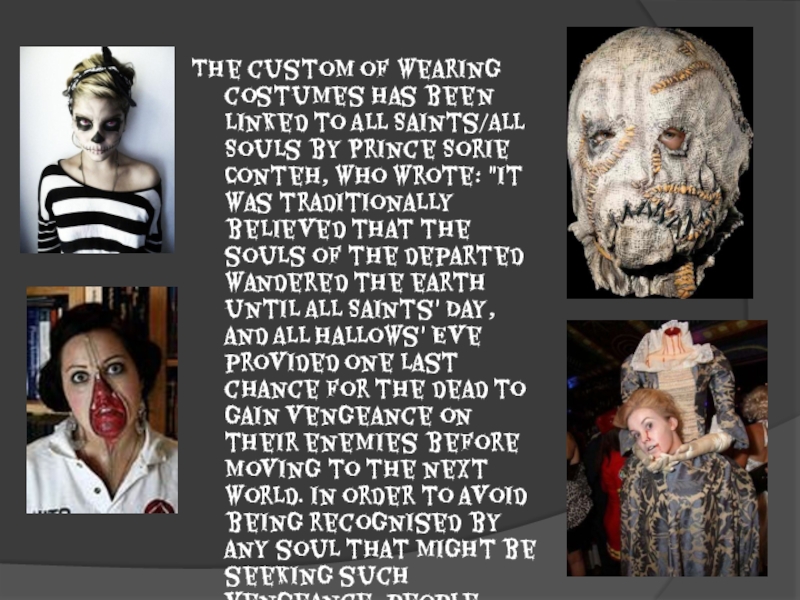
Слайд 6The custom of wearing costumes has been linked to All Saints/All
Souls by Prince Sorie Conteh, who wrote: "It was traditionally believed that the souls of the departed wandered the earth until All Saints' Day, and All Hallows' Eve provided one last chance for the dead to gain vengeance on their enemies before moving to the next world. In order to avoid being recognised by any soul that might be seeking such vengeance, people would don masks or costumes to disguise their identities". In Halloween: From Pagan Ritual to Party Night, Nicholas Rogers explained Halloween jack-o'-lanterns as originally being representations of souls in purgatory. In Brittany children would set candles in skulls in graveyards
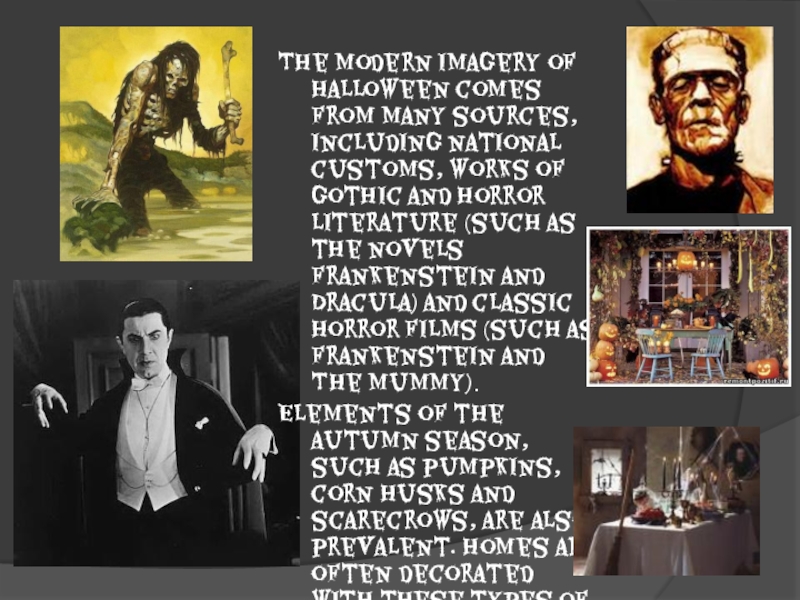
Слайд 8The modern imagery of Halloween comes from many sources, including national
customs, works of Gothic and horror literature (such as the novels Frankenstein and Dracula) and classic horror films (such as Frankenstein and The Mummy).
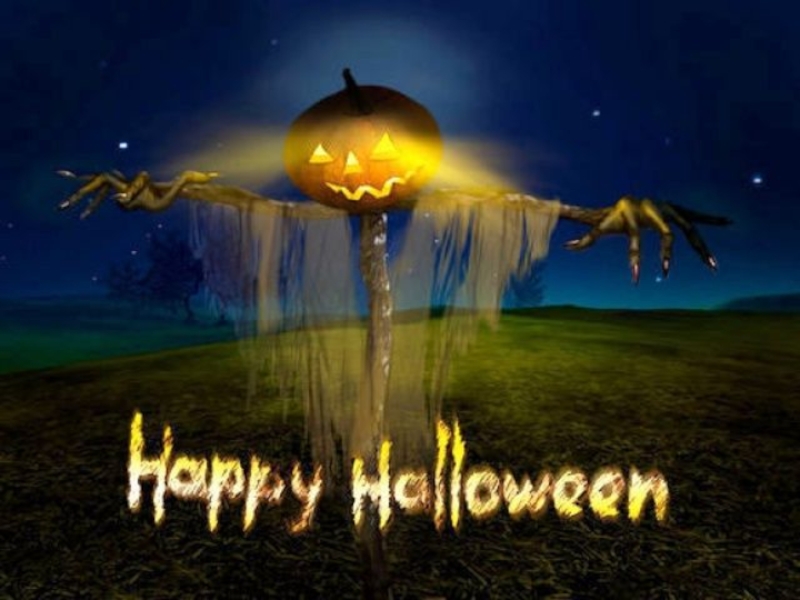
Elements of the autumn season, such as pumpkins, corn husks and scarecrows, are also prevalent. Homes are often decorated with these types of symbols around Halloween.
Halloween imagery includes themes of death, evil, the occult, and mythical monsters. Black, orange, and sometimes purple are Halloween's traditional colors.
Elements of the autumn season, such as pumpkins, corn husks and scarecrows, are also prevalent. Homes are often decorated with these types of symbols around Halloween.
Halloween imagery includes themes of death, evil, the occult, and mythical monsters. Black, orange, and sometimes purple are Halloween's traditional colors.
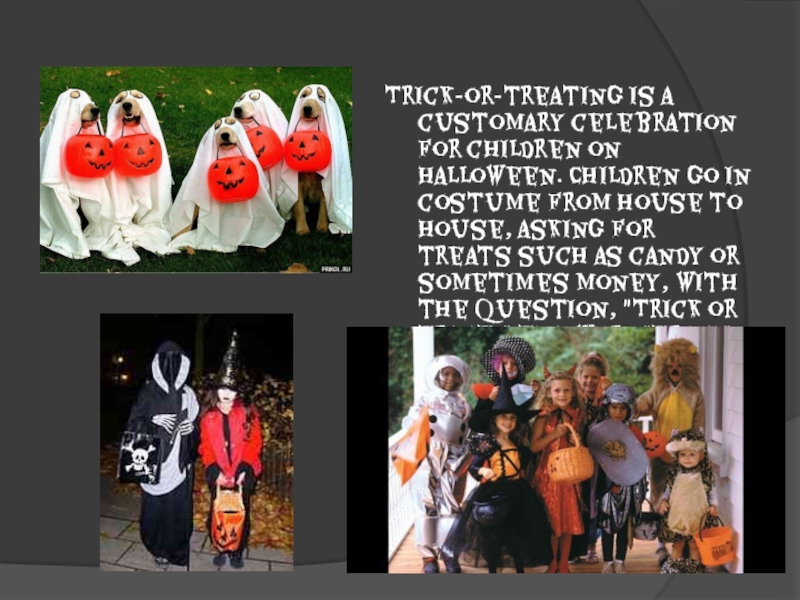
Слайд 10Trick-or-treating is a customary celebration for children on Halloween. Children go
in costume from house to house, asking for treats such as candy or sometimes money, with the question, "Trick or treat?" The word "trick" refers to "threat" to perform mischief on the homeowners or their property if no treat is given.
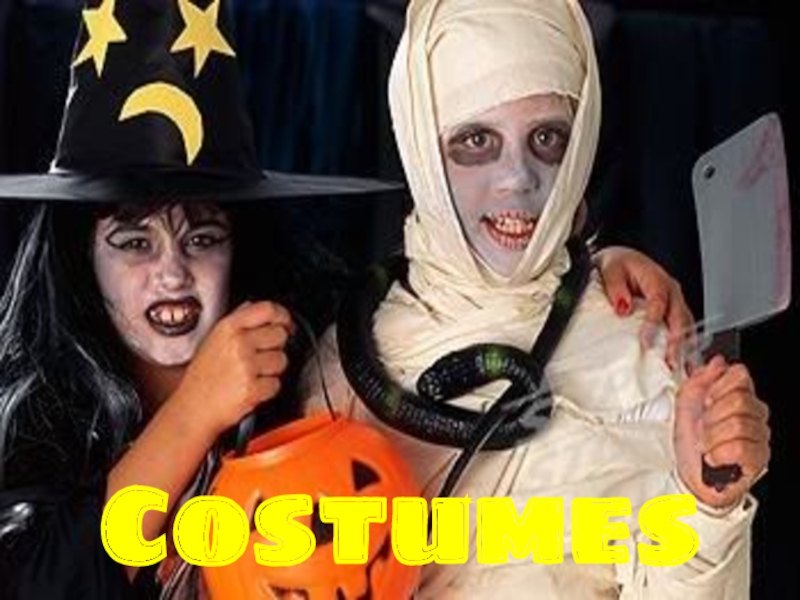
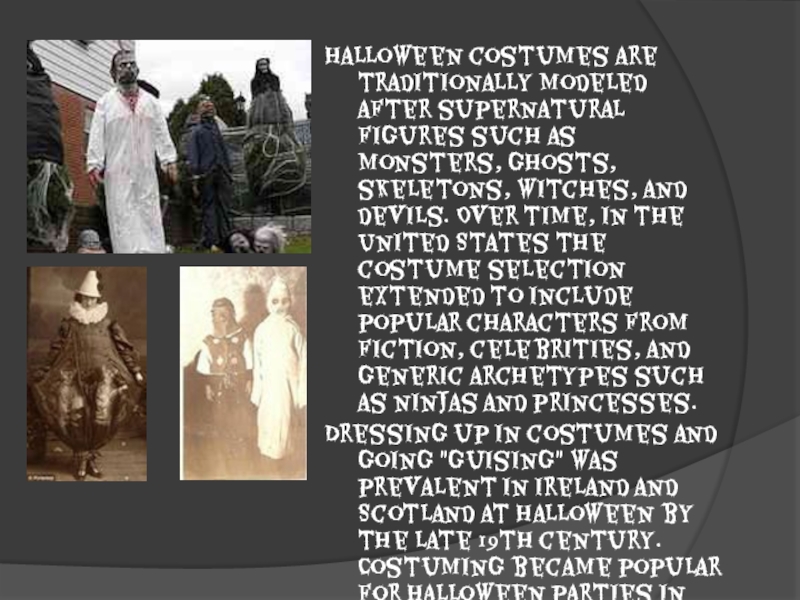
Слайд 12Halloween costumes are traditionally modeled after supernatural figures such as monsters,
ghosts, skeletons, witches, and devils. Over time, in the United States the costume selection extended to include popular characters from fiction, celebrities, and generic archetypes such as ninjas and princesses.
Dressing up in costumes and going "guising" was prevalent in Ireland and Scotland at Halloween by the late 19th century. Costuming became popular for Halloween parties in the US in the early 20th century, as often for adults as for children. The first mass-produced Halloween costumes appeared in stores in the 1930s when trick-or-treating was becoming popular in the United States.
Halloween costume parties generally fall on or around October 31, often on the Friday or Saturday before Halloween.
Dressing up in costumes and going "guising" was prevalent in Ireland and Scotland at Halloween by the late 19th century. Costuming became popular for Halloween parties in the US in the early 20th century, as often for adults as for children. The first mass-produced Halloween costumes appeared in stores in the 1930s when trick-or-treating was becoming popular in the United States.
Halloween costume parties generally fall on or around October 31, often on the Friday or Saturday before Halloween.
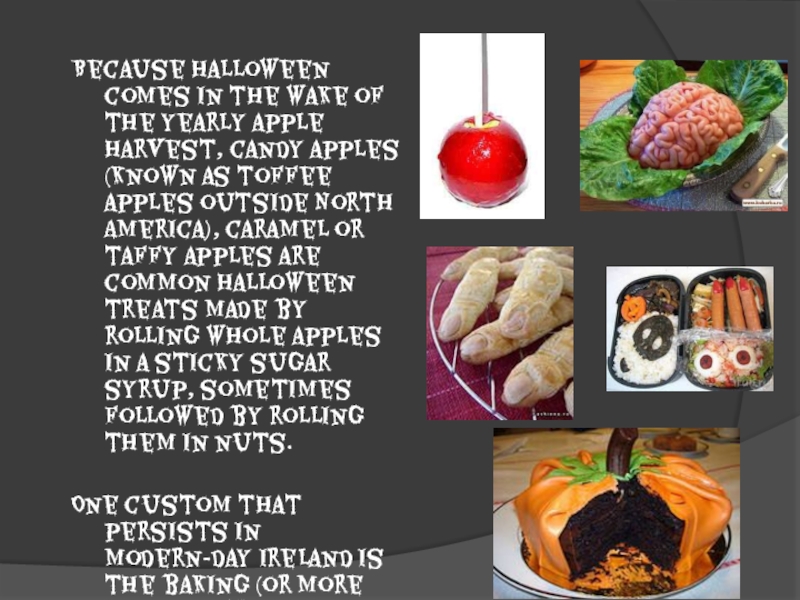
Слайд 14Because Halloween comes in the wake of the yearly apple harvest,
candy apples (known as toffee apples outside North America), caramel or taffy apples are common Halloween treats made by rolling whole apples in a sticky sugar syrup, sometimes followed by rolling them in nuts.
One custom that persists in modern-day Ireland is the baking (or more often nowadays, the purchase) of a barmbrack, which is a light fruitcake, into which a plain ring, a coin and other charms are placed before baking. It is said that those who get a ring will find their true love in the ensuing year. This is similar to the tradition of king cake at the festival of Epiphany.
One custom that persists in modern-day Ireland is the baking (or more often nowadays, the purchase) of a barmbrack, which is a light fruitcake, into which a plain ring, a coin and other charms are placed before baking. It is said that those who get a ring will find their true love in the ensuing year. This is similar to the tradition of king cake at the festival of Epiphany.
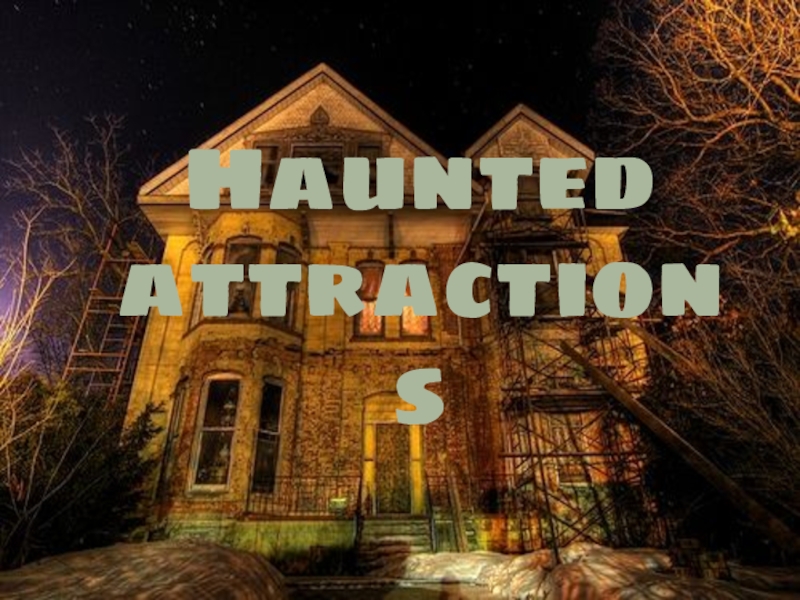
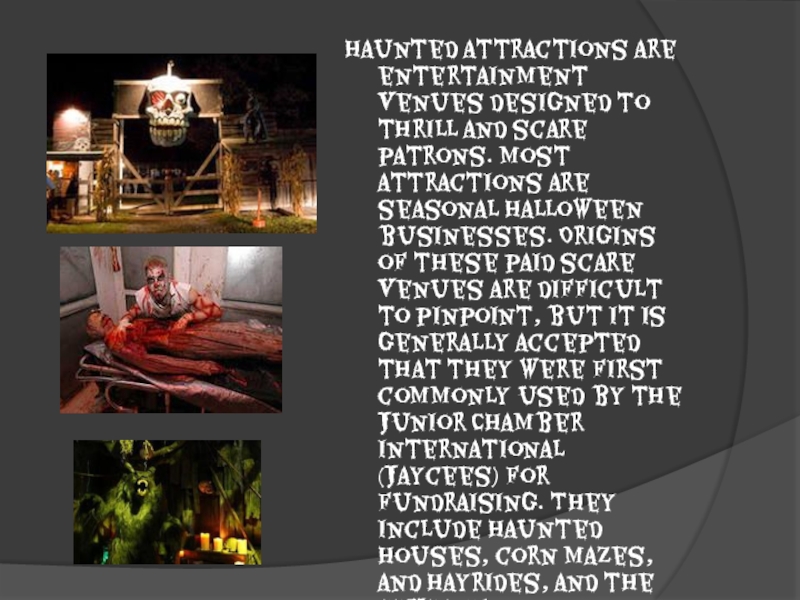
Слайд 16Haunted attractions are entertainment venues designed to thrill and scare patrons.
Most attractions are seasonal Halloween businesses. Origins of these paid scare venues are difficult to pinpoint, but it is generally accepted that they were first commonly used by the Junior Chamber International (Jaycees) for fundraising. They include haunted houses, corn mazes, and hayrides, and the level of sophistication of the effects has risen as the industry has grown. Haunted attractions in the United States bring in an estimate $300–500 million each year, and draw some 400,000 customers, although press sources writing in 2005 speculated that the industry had reached its peak at that time. This maturing and growth within the industry has led to technically more advanced special effects and costuming, comparable with that of Hollywood films.