Декабрь 2018
- Главная
- Разное
- Образование
- Спорт
- Естествознание
- Природоведение
- Религиоведение
- Французский язык
- Черчение
- Английский язык
- Астрономия
- Алгебра
- Биология
- География
- Геометрия
- Детские презентации
- Информатика
- История
- Литература
- Математика
- Музыка
- МХК
- Немецкий язык
- ОБЖ
- Обществознание
- Окружающий мир
- Педагогика
- Русский язык
- Технология
- Физика
- Философия
- Химия
- Шаблоны, фоны, картинки для презентаций
- Экология
- Экономика
Презентация, доклад по английскому языку на тему: Выдающиеся люди – outstanding people
Содержание
- 1. Презентация по английскому языку на тему: Выдающиеся люди – outstanding people
- 2. Изучение выдающихся научных деятелейЗадачи:1. Изучить биографии: Л.
- 3. Петр Леонидович Капица (1894-1984)физик, один из
- 4. Петр Леонидович Капица(1894-1984)Родился 8 июля 1894 г.
- 5. Ландау, Лев Давидович 1908-1968Лев Давидович Ландау родился
- 6. Ответь на вопрос о каком ученом идет
- 7. Прочитай, переведи, перескажи:Mikhail LomonosovMikhail Lomonosov was born
- 8. Ответь на вопросы письменноQuestions:1. When was Lomonosov
- 9. Сопоставь фото с именем деятеляLev LandauПётр Капица/ Pyotr KapitsaMikhail Lomonosov
- 10. Переведи, о ком идет речь?Wright brothers --Wilbur
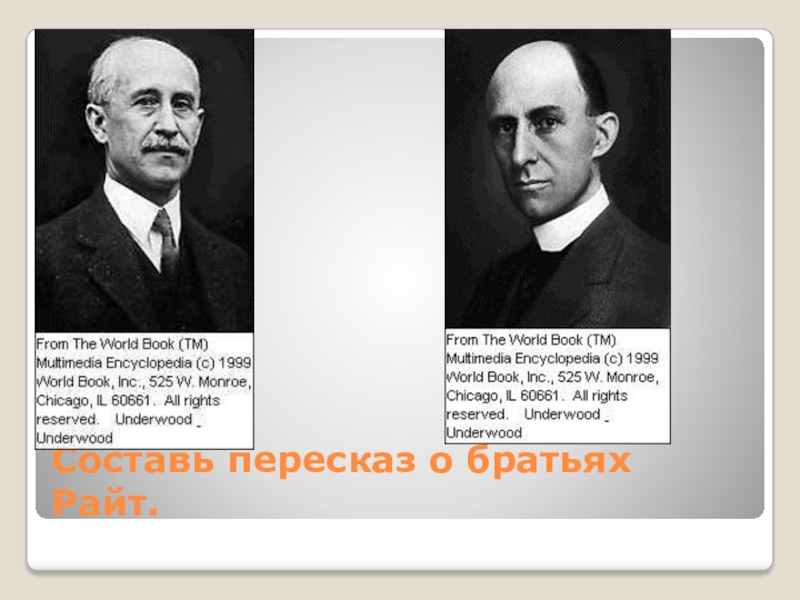
- 11. Составь пересказ о братьях Райт.
- 12. Домашнее задание.Основное задание:Перескажи кратко биографию одного из
- 13. Список использованной литературы:http://citaty.su/kratkaya-biografiya-petra-kapicyhttp://www.kapitza.ras.ru/history/PLKapitza/mainK.htmlhttps://ru.wikipedia.org/wiki/Ландау,_Лев_Давидовичhttps://en.wikipedia.org/wiki/Lev_Landau#Workshttp://library.by/shpargalka/belarus/english/001/eng-079.htm
Изучение выдающихся научных деятелейЗадачи:1. Изучить биографии: Л. Ландау, П. Капицы, М. Ломоносова и братьев Райт.2. Изучить достижения великих учёных.3. Изучить обще употребляемую лексику, а также основы научной терминологии.4. Научиться пересказывать биографию выдающихся деятелей.
Слайд 1Выдающиеся люди – outstanding people
Выполнил: Чернявский О.В.
Троицк
Троицкий авиационный
технический колледж ГА
Слайд 2Изучение выдающихся научных деятелей
Задачи:
1. Изучить биографии: Л. Ландау, П. Капицы, М.
Ломоносова и братьев Райт.
2. Изучить достижения великих учёных.
3. Изучить обще употребляемую лексику, а также основы научной терминологии.
4. Научиться пересказывать биографию выдающихся деятелей.
2. Изучить достижения великих учёных.
3. Изучить обще употребляемую лексику, а также основы научной терминологии.
4. Научиться пересказывать биографию выдающихся деятелей.
Слайд 3Петр Леонидович Капица
(1894-1984)
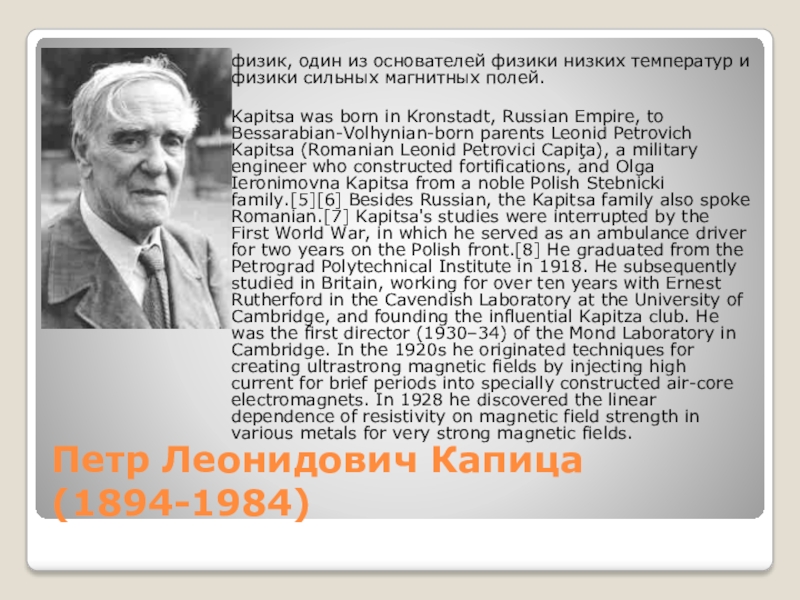
физик, один из основателей физики низких температур и
физики сильных магнитных полей.
Kapitsa was born in Kronstadt, Russian Empire, to Bessarabian-Volhynian-born parents Leonid Petrovich Kapitsa (Romanian Leonid Petrovici Capiţa), a military engineer who constructed fortifications, and Olga Ieronimovna Kapitsa from a noble Polish Stebnicki family.[5][6] Besides Russian, the Kapitsa family also spoke Romanian.[7] Kapitsa's studies were interrupted by the First World War, in which he served as an ambulance driver for two years on the Polish front.[8] He graduated from the Petrograd Polytechnical Institute in 1918. He subsequently studied in Britain, working for over ten years with Ernest Rutherford in the Cavendish Laboratory at the University of Cambridge, and founding the influential Kapitza club. He was the first director (1930–34) of the Mond Laboratory in Cambridge. In the 1920s he originated techniques for creating ultrastrong magnetic fields by injecting high current for brief periods into specially constructed air-core electromagnets. In 1928 he discovered the linear dependence of resistivity on magnetic field strength in various metals for very strong magnetic fields.
Kapitsa was born in Kronstadt, Russian Empire, to Bessarabian-Volhynian-born parents Leonid Petrovich Kapitsa (Romanian Leonid Petrovici Capiţa), a military engineer who constructed fortifications, and Olga Ieronimovna Kapitsa from a noble Polish Stebnicki family.[5][6] Besides Russian, the Kapitsa family also spoke Romanian.[7] Kapitsa's studies were interrupted by the First World War, in which he served as an ambulance driver for two years on the Polish front.[8] He graduated from the Petrograd Polytechnical Institute in 1918. He subsequently studied in Britain, working for over ten years with Ernest Rutherford in the Cavendish Laboratory at the University of Cambridge, and founding the influential Kapitza club. He was the first director (1930–34) of the Mond Laboratory in Cambridge. In the 1920s he originated techniques for creating ultrastrong magnetic fields by injecting high current for brief periods into specially constructed air-core electromagnets. In 1928 he discovered the linear dependence of resistivity on magnetic field strength in various metals for very strong magnetic fields.
Слайд 4Петр Леонидович Капица(1894-1984)
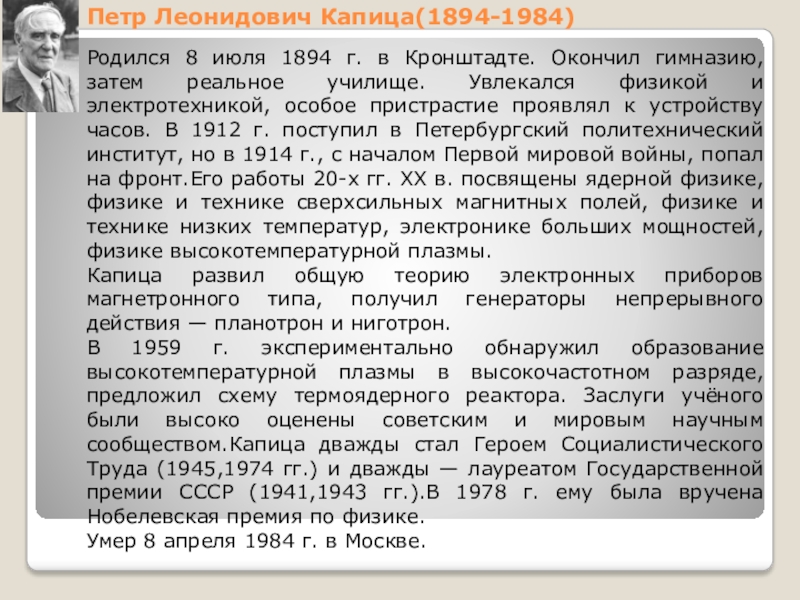
Родился 8 июля 1894 г. в Кронштадте. Окончил гимназию,
затем реальное училище. Увлекался физикой и электротехникой, особое пристрастие проявлял к устройству часов. В 1912 г. поступил в Петербургский политехнический институт, но в 1914 г., с началом Первой мировой войны, попал на фронт.Его работы 20-х гг. XX в. посвящены ядерной физике, физике и технике сверхсильных магнитных полей, физике и технике низких температур, электронике больших мощностей, физике высокотемпературной плазмы.
Капица развил общую теорию электронных приборов магнетронного типа, получил генераторы непрерывного действия — планотрон и ниготрон.
В 1959 г. экспериментально обнаружил образование высокотемпературной плазмы в высокочастотном разряде, предложил схему термоядерного реактора. Заслуги учёного были высоко оценены советским и мировым научным сообществом.Капица дважды стал Героем Социалистического Труда (1945,1974 гг.) и дважды — лауреатом Государственной премии СССР (1941,1943 гг.).В 1978 г. ему была вручена Нобелевская премия по физике.
Умер 8 апреля 1984 г. в Москве.
Капица развил общую теорию электронных приборов магнетронного типа, получил генераторы непрерывного действия — планотрон и ниготрон.
В 1959 г. экспериментально обнаружил образование высокотемпературной плазмы в высокочастотном разряде, предложил схему термоядерного реактора. Заслуги учёного были высоко оценены советским и мировым научным сообществом.Капица дважды стал Героем Социалистического Труда (1945,1974 гг.) и дважды — лауреатом Государственной премии СССР (1941,1943 гг.).В 1978 г. ему была вручена Нобелевская премия по физике.
Умер 8 апреля 1984 г. в Москве.
Слайд 5Ландау, Лев Давидович
1908-1968
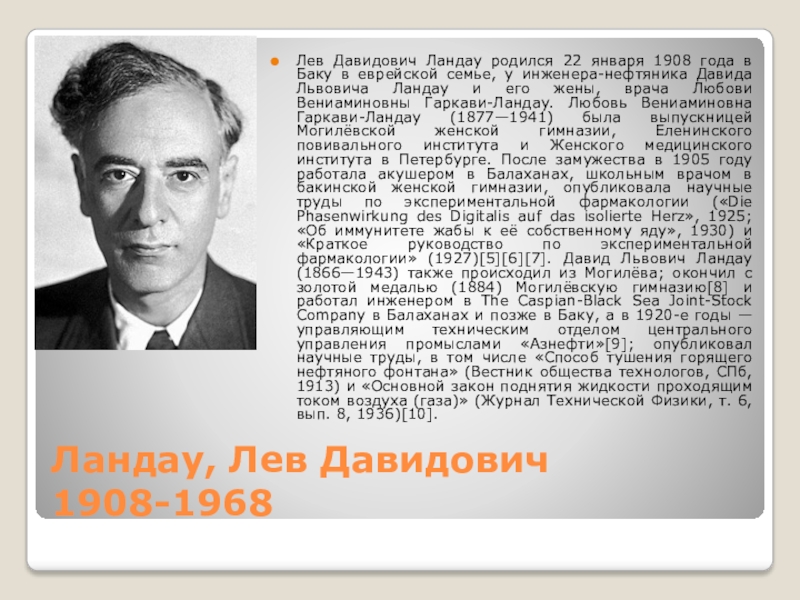
Лев Давидович Ландау родился 22 января 1908 года в
Баку в еврейской семье, у инженера-нефтяника Давида Львовича Ландау и его жены, врача Любови Вениаминовны Гаркави-Ландау. Любовь Вениаминовна Гаркави-Ландау (1877—1941) была выпускницей Могилёвской женской гимназии, Еленинского повивального института и Женского медицинского института в Петербурге. После замужества в 1905 году работала акушером в Балаханах, школьным врачом в бакинской женской гимназии, опубликовала научные труды по экспериментальной фармакологии («Die Phasenwirkung des Digitalis auf das isolierte Herz», 1925; «Об иммунитете жабы к её собственному яду», 1930) и «Краткое руководство по экспериментальной фармакологии» (1927)[5][6][7]. Давид Львович Ландау (1866—1943) также происходил из Могилёва; окончил с золотой медалью (1884) Могилёвскую гимназию[8] и работал инженером в The Caspian-Black Sea Joint-Stock Company в Балаханах и позже в Баку, а в 1920-е годы — управляющим техническим отделом центрального управления промыслами «Азнефти»[9]; опубликовал научные труды, в том числе «Способ тушения горящего нефтяного фонтана» (Вестник общества технологов, СПб, 1913) и «Основной закон поднятия жидкости проходящим током воздуха (газа)» (Журнал Технической Физики, т. 6, вып. 8, 1936)[10].
Слайд 6Ответь на вопрос о каком ученом идет речь?
He was born on
22 January 1908 to Jewish parents[4][5][6][7] in Baku, Azerbaijan, in what was then the Russian Empire. Landau's father was an engineer with the local oil industry and his mother was a doctor. A child prodigy in mathematics, he learned to differentiate at age 12 and to integrate at age 13. Landau graduated in 1920 at age 13 from gymnasium. His parents considered him too young to attend university, so for a year he attended the Baku Economical Technical School. In 1922, at age 14, he matriculated at the Baku State University, studying in two departments simultaneously: the Departments of Physics and Mathematics, and the Department of Chemistry. Subsequently, he ceased studying chemistry, but remained interested in the field throughout his life.
![Ответь на вопрос о каком ученом идет речь?He was born on 22 January 1908 to Jewish parents[4][5][6][7]](/img/tmb/4/352946/595c11bf6c67d77b4060f328814017d8-800x.jpg "Презентация по английскому языку на тему: Выдающиеся люди – outstanding people Ответь на вопрос о каком ученом идет речь?He was born on")
Слайд 7Прочитай, переведи, перескажи:
Mikhail Lomonosov
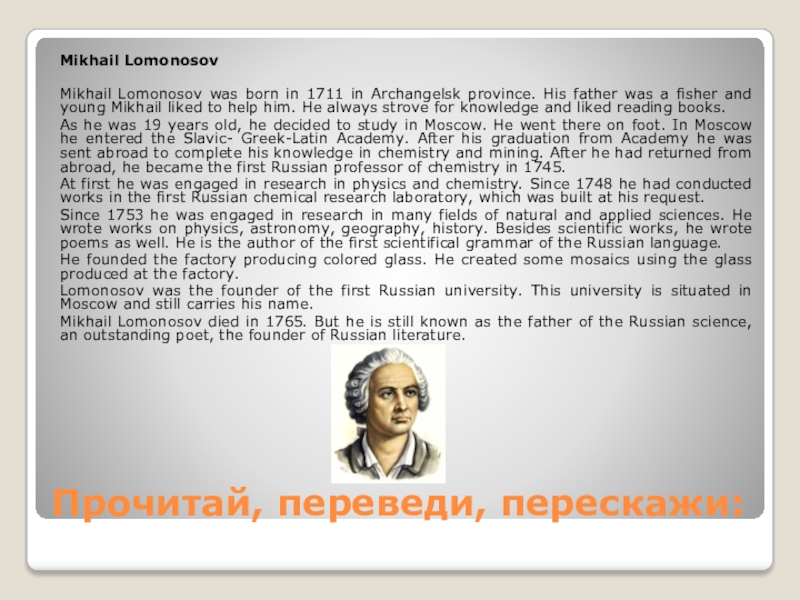
Mikhail Lomonosov was born in 1711 in Archangelsk
province. His father was a fisher and young Mikhail liked to help him. He always strove for knowledge and liked reading books.
As he was 19 years old, he decided to study in Moscow. He went there on foot. In Moscow he entered the Slavic- Greek-Latin Academy. After his graduation from Academy he was sent abroad to complete his knowledge in chemistry and mining. After he had returned from abroad, he became the first Russian professor of chemistry in 1745.
At first he was engaged in research in physics and chemistry. Since 1748 he had conducted works in the first Russian chemical research laboratory, which was built at his request.
Since 1753 he was engaged in research in many fields of natural and applied sciences. He wrote works on physics, astronomy, geography, history. Besides scientific works, he wrote poems as well. He is the author of the first scientifical grammar of the Russian language.
He founded the factory producing colored glass. He created some mosaics using the glass produced at the factory.
Lomonosov was the founder of the first Russian university. This university is situated in Moscow and still carries his name.
Mikhail Lomonosov died in 1765. But he is still known as the father of the Russian science, an outstanding poet, the founder of Russian literature.
As he was 19 years old, he decided to study in Moscow. He went there on foot. In Moscow he entered the Slavic- Greek-Latin Academy. After his graduation from Academy he was sent abroad to complete his knowledge in chemistry and mining. After he had returned from abroad, he became the first Russian professor of chemistry in 1745.
At first he was engaged in research in physics and chemistry. Since 1748 he had conducted works in the first Russian chemical research laboratory, which was built at his request.
Since 1753 he was engaged in research in many fields of natural and applied sciences. He wrote works on physics, astronomy, geography, history. Besides scientific works, he wrote poems as well. He is the author of the first scientifical grammar of the Russian language.
He founded the factory producing colored glass. He created some mosaics using the glass produced at the factory.
Lomonosov was the founder of the first Russian university. This university is situated in Moscow and still carries his name.
Mikhail Lomonosov died in 1765. But he is still known as the father of the Russian science, an outstanding poet, the founder of Russian literature.
Слайд 8Ответь на вопросы письменно
Questions:
1. When was Lomonosov born?
2. Where did
he study?
3. In what fields of science did he write works?
4. What did he write besides scientific works?
5. What university is named after his name?
6. When did he die?
3. In what fields of science did he write works?
4. What did he write besides scientific works?
5. What university is named after his name?
6. When did he die?
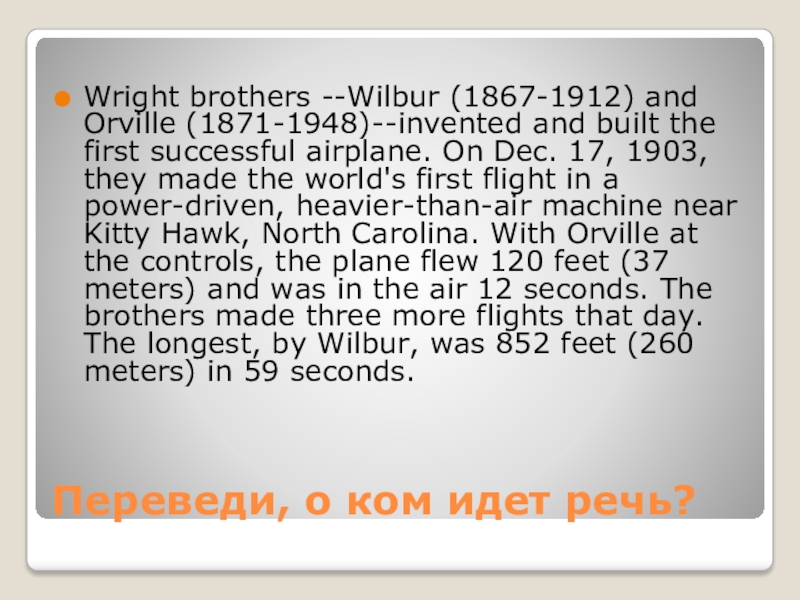
Слайд 10Переведи, о ком идет речь?
Wright brothers --Wilbur (1867-1912) and Orville (1871-1948)--invented
and built the first successful airplane. On Dec. 17, 1903, they made the world's first flight in a power-driven, heavier-than-air machine near Kitty Hawk, North Carolina. With Orville at the controls, the plane flew 120 feet (37 meters) and was in the air 12 seconds. The brothers made three more flights that day. The longest, by Wilbur, was 852 feet (260 meters) in 59 seconds.
Слайд 12Домашнее задание.
Основное задание:
Перескажи кратко биографию одного из выдающихся людей.
Творческое задание на
дополнительную оценку:
Составь кроссворд по одной из биографий выдающихся людей.
Составь кроссворд по одной из биографий выдающихся людей.
Слайд 13Список использованной литературы:
http://citaty.su/kratkaya-biografiya-petra-kapicy
http://www.kapitza.ras.ru/history/PLKapitza/mainK.html
https://ru.wikipedia.org/wiki/Ландау,_Лев_Давидович
https://en.wikipedia.org/wiki/Lev_Landau#Works
http://library.by/shpargalka/belarus/english/001/eng-079.htm