Презентация, доклад по английскому языку на тему Леди Ди

Содержание

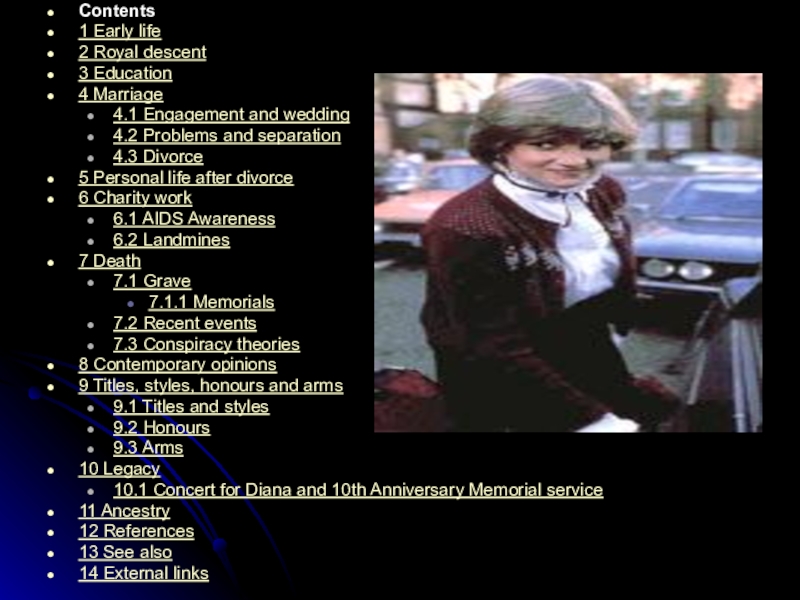
Contents1 Early life 2 Royal descent 3 Education 4 Marriage 4.1 Engagement and wedding 4.2 Problems and separation 4.3 Divorce 5 Personal life after divorce 6 Charity work 6.1 AIDS Awareness 6.2 Landmines 7 Death 7.1

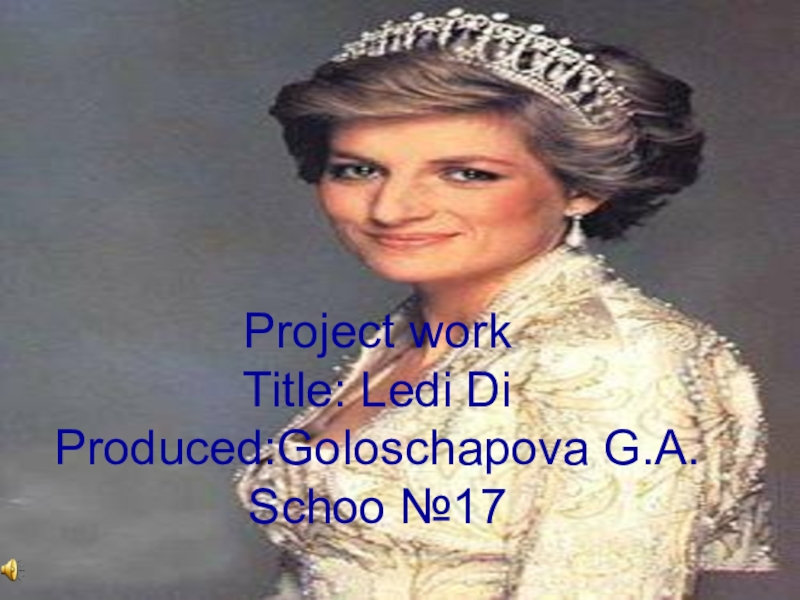
Слайд 1Project work Title: Ledi Di Produced:Goloschapova G.A. Schoo №17

Project work Title: Ledi Di Produced:Goloschapova G.A. Schoo №17

Слайд 2Contents
1 Early life
2 Royal descent
3 Education
4 Marriage
4.1

Engagement and wedding
4.2 Problems and separation
4.3 Divorce
5 Personal life after divorce
6 Charity work
6.1 AIDS Awareness
6.2 Landmines
7 Death
7.1 Grave
7.1.1 Memorials
7.2 Recent events
7.3 Conspiracy theories
8 Contemporary opinions
9 Titles, styles, honours and arms
9.1 Titles and styles
9.2 Honours
9.3 Arms
10 Legacy
10.1 Concert for Diana and 10th Anniversary Memorial service
11 Ancestry
12 References
13 See also
14 External links
Contents1 Early life 2 Royal descent 3 Education 4 Marriage 4.1 Engagement and wedding 4.2 Problems and

Слайд 3Diana, Princess of Wales
Jump to: navigationJump to: navigation, search
"Princess Diana" redirects

here. For the fictional character, see Wonder Woman.
"Diana Spencer" redirects here. For the granddaughter of John Churchill, 1st Duke of Marlborough"Diana Spencer" redirects here. For the granddaughter of John Churchill, 1st Duke of Marlborough, see Diana Russell, Duchess of Bedford.
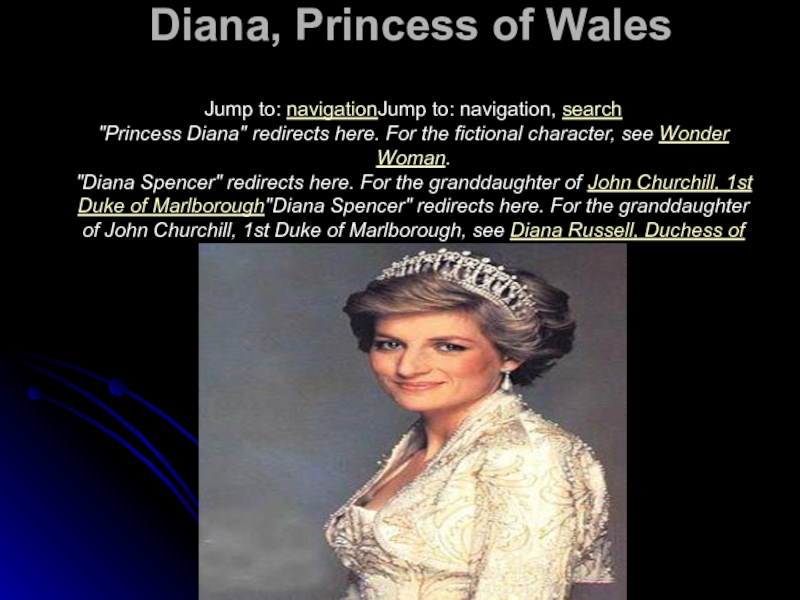
Diana, Princess of Wales Jump to: navigationJump to: navigation, search

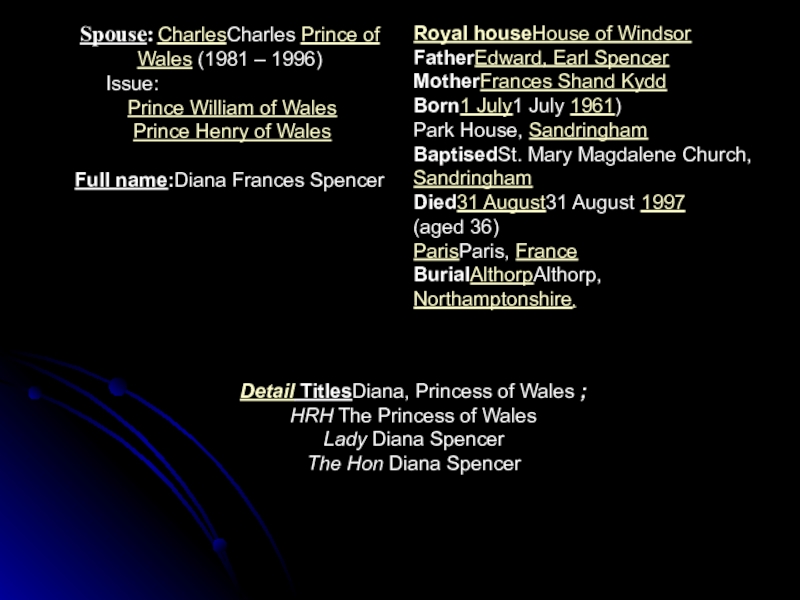
Слайд 5Diana, Princess of Wales (Diana Frances; née (Diana Frances; née Spencer

(Diana Frances; née Spencer; 1 July (Diana Frances; née Spencer; 1 July 1961 (Diana Frances; née Spencer; 1 July 1961 – 31 August (Diana Frances; née Spencer; 1 July 1961 – 31 August 1997 (Diana Frances; née Spencer; 1 July 1961 – 31 August 1997) was the first wife of Charles, Prince of Wales (Diana Frances; née Spencer; 1 July 1961 – 31 August 1997) was the first wife of Charles, Prince of Wales. Their sons, Princes William (Diana Frances; née Spencer; 1 July 1961 – 31 August 1997) was the first wife of Charles, Prince of Wales. Their sons, Princes William and Henry (Diana Frances; née Spencer; 1 July 1961 – 31 August 1997) was the first wife of Charles, Prince of Wales. Their sons, Princes William and Henry (Harry), are second and third in line to the thrones of the United Kingdom (Diana Frances; née Spencer; 1 July 1961 – 31 August 1997) was the first wife of Charles, Prince of Wales. Their sons, Princes William and Henry (Harry), are second and third in line to the thrones of the United Kingdom and 15 other Commonwealth Realms.
A public figure from the announcement of her engagement to Prince Charles, Diana remained the in the United Kingdom and around the world up to and during her marriage, and after her divorce. Her sudden death in a car accident was followed by a spontaneous and prolonged show of public mourning throughout the United Kingdom worldwide.
Diana, Princess of Wales (Diana Frances; née (Diana Frances; née Spencer (Diana Frances; née Spencer; 1 July

Слайд 6Early life
Diana Frances Spencer was the youngest daughter of Edward John
Spencer, Viscount Althorp, later John Spencer, 8th Earl Spencer was the youngest daughter of Edward John Spencer, Viscount Althorp, later John Spencer, 8th Earl Spencer, and his first wife, Frances Spencer, Viscountess Althorp was the youngest daughter of Edward John Spencer, Viscount Althorp, later John Spencer, 8th Earl Spencer, and his first wife, Frances Spencer, Viscountess Althorp She was born at Park House, Sandringham was the youngest daughter of Edward John Spencer, Viscount Althorp, later John Spencer, 8th Earl Spencer, and his first wife, Frances Spencer, Viscountess Althorp She was born at Park House, Sandringham in Norfolk was the youngest daughter of Edward John Spencer, Viscount Althorp, later John Spencer, 8th Earl Spencer, and his first wife, Frances Spencer, Viscountess Althorp She was born at Park House, Sandringham in Norfolk, England was the youngest daughter of Edward John Spencer, Viscount Althorp, later John Spencer, 8th Earl Spencer, and his first wife, Frances Spencer, Viscountess Althorp She was born at Park House, Sandringham in Norfolk, England and baptised there at St. Mary Magdalene Church by the Rt. Rev. Percy Herbert was the youngest daughter of Edward John Spencer, Viscount Althorp, later John Spencer, 8th Earl Spencer, and his first wife, Frances Spencer, Viscountess Althorp She was born at Park House, Sandringham in Norfolk, England and baptised there at St. Mary Magdalene Church by the Rt. Rev. Percy Herbert her godparents included John Floyd She was the third child to the couple, her four siblings being; The Lady Sarah Spencer was the youngest daughter of Edward John Spencer, Viscount Althorp, later John Spencer, 8th Earl Spencer, and his first wife, Frances Spencer, Viscountess Althorp She was born at Park House, Sandringham in Norfolk, England and baptised there at St. Mary Magdalene Church by the Rt. Rev. Percy Herbert her godparents included John Floyd She was the third child to the couple, her four siblings being; The Lady Sarah Spencer The Lady Jane Spencer was the youngest daughter of Edward John Spencer, Viscount Althorp, later John Spencer, 8th Earl Spencer, and his first wife, Frances Spencer, Viscountess Althorp She was born at Park House, Sandringham in Norfolk, England and baptised there at St. Mary Magdalene Church by the Rt. Rev. Percy Herbert her godparents included John Floyd She was the third child to the couple, her four siblings being; The Lady Sarah Spencer The Lady Jane Spencer The Honourable John Spencer and Charles Spencer
Early lifeDiana Frances Spencer was the youngest daughter of Edward John Spencer, Viscount Althorp, later John Spencer,

Слайд 7During her parents acrimonious divorce in 1969, (over Lady Althorp's affair
with wallpaper heir Peter Shand KyddDuring her parents acrimonious divorce in 1969, (over Lady Althorp's affair with wallpaper heir Peter Shand Kydd) Diana's mother took her and her younger brother to live in an apartment in London's KnightsbridgeDuring her parents acrimonious divorce in 1969, (over Lady Althorp's affair with wallpaper heir Peter Shand Kydd) Diana's mother took her and her younger brother to live in an apartment in London's Knightsbridge, where Diana attended a local day school. That Christmas the Spencer children went to celebrate with their father and he subsequently refused to allow them to return to London and their mother. Lady Althorp sued for custody of her children, but Lord Althorp's rank, aided by Lady Althorp's mother's testimony against her daughter during the trial, contributed to the court's decision to award custody of Diana and her brother to their father. On the death of her paternal grandfather, Albert Spencer, 7th Earl SpencerDuring her parents acrimonious divorce in 1969, (over Lady Althorp's affair with wallpaper heir Peter Shand Kydd) Diana's mother took her and her younger brother to live in an apartment in London's Knightsbridge, where Diana attended a local day school. That Christmas the Spencer children went to celebrate with their father and he subsequently refused to allow them to return to London and their mother. Lady Althorp sued for custody of her children, but Lord Althorp's rank, aided by Lady Althorp's mother's testimony against her daughter during the trial, contributed to the court's decision to award custody of Diana and her brother to their father. On the death of her paternal grandfather, Albert Spencer, 7th Earl Spencer in 1975, Diana's father became the 8th Earl Spencer, at which time she became Lady Diana Spencer and moved from her childhood home at Park House to her family's sixteenth-century ancestral home of Althorp.
During her parents acrimonious divorce in 1969, (over Lady Althorp's affair with wallpaper heir Peter Shand KyddDuring

Слайд 8In 1976 Lord Spencer married Raine, Countess of DartmouthIn 1976 Lord
Spencer married Raine, Countess of Dartmouth, the only daughter of romantic novelist Barbara CartlandIn 1976 Lord Spencer married Raine, Countess of Dartmouth, the only daughter of romantic novelist Barbara Cartland, after being named as the "other party" in the Earl and Viscountess Althorp's divorce. During this time Diana travelled up and down the country, living between her parents' homes - with her father at the Spencer seat in NorthamptonshireIn 1976 Lord Spencer married Raine, Countess of Dartmouth, the only daughter of romantic novelist Barbara Cartland, after being named as the "other party" in the Earl and Viscountess Althorp's divorce. During this time Diana travelled up and down the country, living between her parents' homes - with her father at the Spencer seat in Northamptonshire, and with her mother, who had moved to the Island of Seil off the west coast of Scotland. Diana, like her siblings, did not get along with her new stepmother.
In 1976 Lord Spencer married Raine, Countess of DartmouthIn 1976 Lord Spencer married Raine, Countess of Dartmouth,

Слайд 9Royal descent
Diana was born into an aristocratic family of royal Stuart
descent On her mother's side, Diana had IrishDiana was born into an aristocratic family of royal Stuart descent On her mother's side, Diana had Irish, ScottishDiana was born into an aristocratic family of royal Stuart descent On her mother's side, Diana had Irish, Scottish, EnglishDiana was born into an aristocratic family of royal Stuart descent On her mother's side, Diana had Irish, Scottish, English, and AmericanDiana was born into an aristocratic family of royal Stuart descent On her mother's side, Diana had Irish, Scottish, English, and American ancestry. Her great-grandmother was the New York heiress Frances WorkDiana was born into an aristocratic family of royal Stuart descent On her mother's side, Diana had Irish, Scottish, English, and American ancestry. Her great-grandmother was the New York heiress Frances Work. On her father's side, she was a descendant of King Charles II of England through four illegitimate sons:


Royal descentDiana was born into an aristocratic family of royal Stuart descent On her mother's side, Diana

Слайд 10She was also a descendant of King James II of EnglandShe

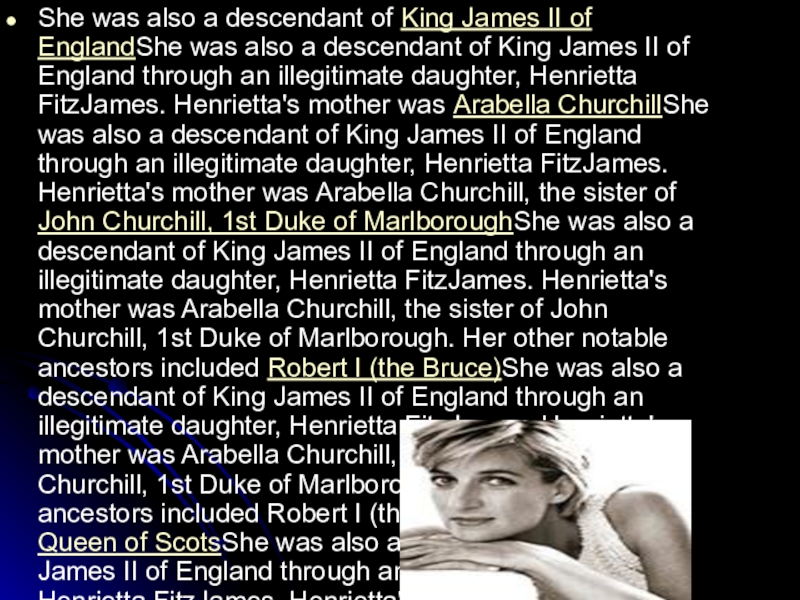
was also a descendant of King James II of England through an illegitimate daughter, Henrietta FitzJames. Henrietta's mother was Arabella ChurchillShe was also a descendant of King James II of England through an illegitimate daughter, Henrietta FitzJames. Henrietta's mother was Arabella Churchill, the sister of John Churchill, 1st Duke of MarlboroughShe was also a descendant of King James II of England through an illegitimate daughter, Henrietta FitzJames. Henrietta's mother was Arabella Churchill, the sister of John Churchill, 1st Duke of Marlborough. Her other notable ancestors included Robert I (the Bruce)She was also a descendant of King James II of England through an illegitimate daughter, Henrietta FitzJames. Henrietta's mother was Arabella Churchill, the sister of John Churchill, 1st Duke of Marlborough. Her other notable ancestors included Robert I (the Bruce) and Mary, Queen of ScotsShe was also a descendant of King James II of England through an illegitimate daughter, Henrietta FitzJames. Henrietta's mother was Arabella Churchill, the sister of John Churchill, 1st Duke of Marlborough. Her other notable ancestors included Robert I (the Bruce) and Mary, Queen of Scots (an aspect of family history in which Diana expressed great interest); Mary BoleynShe was also a descendant of King James II of England through an illegitimate daughter, Henrietta FitzJames. Henrietta's mother was Arabella Churchill, the sister of John Churchill, 1st Duke of Marlborough. Her other notable ancestors included Robert I (the Bruce) and Mary, Queen of Scots (an aspect of family history in which Diana expressed great interest); Mary Boleyn; Lady Catherine GreyShe was also a descendant of King James II of England through an illegitimate daughter, Henrietta FitzJames. Henrietta's mother was Arabella Churchill, the sister of John Churchill, 1st Duke of Marlborough. Her other notable ancestors included Robert I (the Bruce) and Mary, Queen of Scots (an aspect of family history in which Diana expressed great interest); Mary Boleyn; Lady Catherine Grey; Maria de SalinasShe was also a descendant of King James II of England through an illegitimate daughter, Henrietta FitzJames. Henrietta's mother was Arabella Churchill, the sister of John Churchill, 1st Duke of Marlborough. Her other notable ancestors included Robert I (the Bruce) and Mary, Queen of Scots (an aspect of family history in which Diana expressed great interest); Mary Boleyn; Lady Catherine Grey; Maria de Salinas; John Egerton, 2nd Earl of BridgewaterShe was also a descendant of King James II of England through an illegitimate daughter, Henrietta FitzJames. Henrietta's mother was Arabella Churchill, the sister of John Churchill, 1st Duke of Marlborough. Her other notable ancestors included Robert I (the Bruce) and Mary, Queen of Scots (an aspect of family history in which Diana expressed great interest); Mary Boleyn; Lady Catherine Grey; Maria de Salinas; John Egerton, 2nd Earl of Bridgewater; and James Stanley, 7th Earl of Derby.
The Spencers had been close to the British Royal FamilyThe Spencers had been close to the British Royal Family for centuries, rising in royal favour during the 1600s. Diana's maternal grandmother, Ruth, Lady FermoyThe Spencers had been close to the British Royal Family for centuries, rising in royal favour during the 1600s. Diana's maternal grandmother, Ruth, Lady Fermoy, was a long-time friend and a lady-in-waitingThe Spencers had been close to the British Royal Family for centuries, rising in royal favour during the 1600s. Diana's maternal grandmother, Ruth, Lady Fermoy, was a long-time friend and a lady-in-waiting to Queen Elizabeth the Queen Mother.
She was also a descendant of King James II of EnglandShe was also a descendant of King

Слайд 11Education
Diana was first educated at Silfield School in Kings Lynn, Norfolk,

then at Riddlesworth Hall in NorfolkDiana was first educated at Silfield School in Kings Lynn, Norfolk, then at Riddlesworth Hall in Norfolk and at West Heath Girls' School (later reorganised as the New School at West HeathDiana was first educated at Silfield School in Kings Lynn, Norfolk, then at Riddlesworth Hall in Norfolk and at West Heath Girls' School (later reorganised as the New School at West Heath, a special school for boys and girls) in SevenoaksDiana was first educated at Silfield School in Kings Lynn, Norfolk, then at Riddlesworth Hall in Norfolk and at West Heath Girls' School (later reorganised as the New School at West Heath, a special school for boys and girls) in Sevenoaks, KentDiana was first educated at Silfield School in Kings Lynn, Norfolk, then at Riddlesworth Hall in Norfolk and at West Heath Girls' School (later reorganised as the New School at West Heath, a special school for boys and girls) in Sevenoaks, Kent, where she was regarded as a poor student, having attempted and failed all of her O-levelsDiana was first educated at Silfield School in Kings Lynn, Norfolk, then at Riddlesworth Hall in Norfolk and at West Heath Girls' School (later reorganised as the New School at West Heath, a special school for boys and girls) in Sevenoaks, Kent, where she was regarded as a poor student, having attempted and failed all of her O-levels twice. In 1977, at the age of 16, she left West Heath and briefly attended Institut Alpin VidemanetteDiana was first educated at Silfield School in Kings Lynn, Norfolk, then at Riddlesworth Hall in Norfolk and at West Heath Girls' School (later reorganised as the New School at West Heath, a special school for boys and girls) in Sevenoaks, Kent, where she was regarded as a poor student, having attempted and failed all of her O-levels twice. In 1977, at the age of 16, she left West Heath and briefly attended Institut Alpin Videmanette, a finishing schoolDiana was first educated at Silfield School in Kings Lynn, Norfolk, then at Riddlesworth Hall in Norfolk and at West Heath Girls' School (later reorganised as the New School at West Heath, a special school for boys and girls) in Sevenoaks, Kent, where she was regarded as a poor student, having attempted and failed all of her O-levels twice. In 1977, at the age of 16, she left West Heath and briefly attended Institut Alpin Videmanette, a finishing school in RougemontDiana was first educated at Silfield School in Kings Lynn, Norfolk, then at Riddlesworth Hall in Norfolk and at West Heath Girls' School (later reorganised as the New School at West Heath, a special school for boys and girls) in Sevenoaks, Kent, where she was regarded as a poor student, having attempted and failed all of her O-levels twice. In 1977, at the age of 16, she left West Heath and briefly attended Institut Alpin Videmanette, a finishing school in Rougemont, SwitzerlandDiana was first educated at Silfield School in Kings Lynn, Norfolk, then at Riddlesworth Hall in Norfolk and at West Heath Girls' School (later reorganised as the New School at West Heath, a special school for boys and girls) in Sevenoaks, Kent, where she was regarded as a poor student, having attempted and failed all of her O-levels twice. In 1977, at the age of 16, she left West Heath and briefly attended Institut Alpin Videmanette, a finishing school in Rougemont, Switzerland. At about that time, she first met her future husband, who was dating her sister, Lady SarahDiana was first educated at Silfield School in Kings Lynn, Norfolk, then at Riddlesworth Hall in Norfolk and at West Heath Girls' School (later reorganised as the New School at West Heath, a special school for boys and girls) in Sevenoaks, Kent, where she was regarded as a poor student, having attempted and failed all of her O-levels twice. In 1977, at the age of 16, she left West Heath and briefly attended Institut Alpin Videmanette, a finishing school in Rougemont, Switzerland. At about that time, she first met her future husband, who was dating her sister, Lady Sarah. Diana reportedly excelled in swimmingDiana was first educated at Silfield School in Kings Lynn, Norfolk, then at Riddlesworth Hall in Norfolk and at West Heath Girls' School (later reorganised as the New School at West Heath, a special school for boys and girls) in Sevenoaks, Kent, where she was regarded as a poor student, having attempted and failed all of her O-levels twice. In 1977, at the age of 16, she left West Heath and briefly attended Institut Alpin Videmanette, a finishing school in Rougemont, Switzerland. At about that time, she first met her future husband, who was dating her sister, Lady Sarah. Diana reportedly excelled in swimming and divingDiana was first educated at Silfield School in Kings Lynn, Norfolk, then at Riddlesworth Hall in Norfolk and at West Heath Girls' School (later reorganised as the New School at West Heath, a special school for boys and girls) in Sevenoaks, Kent, where she was regarded as a poor student, having attempted and failed all of her O-levels twice. In 1977, at the age of 16, she left West Heath and briefly attended Institut Alpin Videmanette, a finishing school in Rougemont, Switzerland. At about that time, she first met her future husband, who was dating her sister, Lady Sarah. Diana reportedly excelled in swimming and diving and is said to have longed to be a ballerina but did not study ballet seriously and at 5'10" was too tall for such a career.
Once it was clear that she would not earn any formal educational qualifications, Diana begged her parents to allow her to move to London, a request granted before she was seventeen. An apartment was purchased for her at Coleherne Court in the Earls CourtOnce it was clear that she would not earn any formal educational qualifications, Diana begged her parents to allow her to move to London, a request granted before she was seventeen. An apartment was purchased for her at Coleherne Court in the Earls Court area, and she lived there until 1981 with three flatmates.
EducationDiana was first educated at Silfield School in Kings Lynn, Norfolk, then at Riddlesworth Hall in NorfolkDiana

Слайд 12Marriage
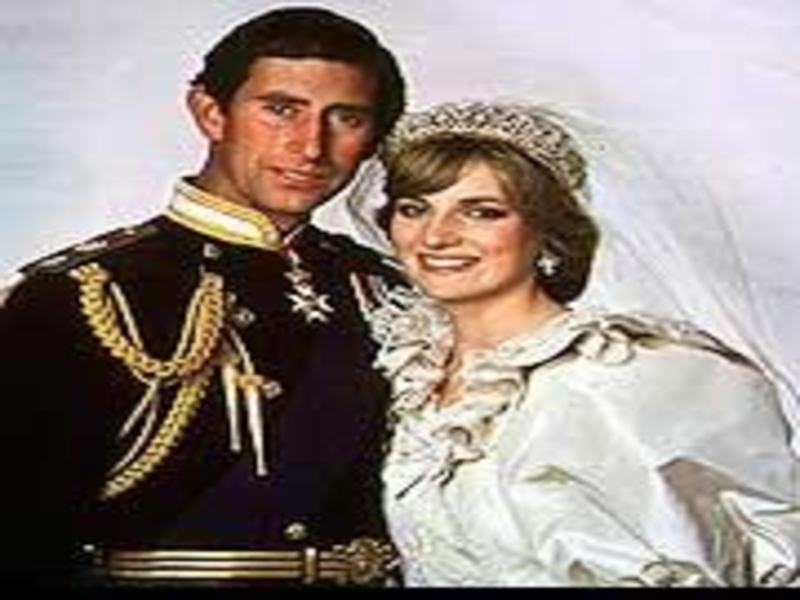
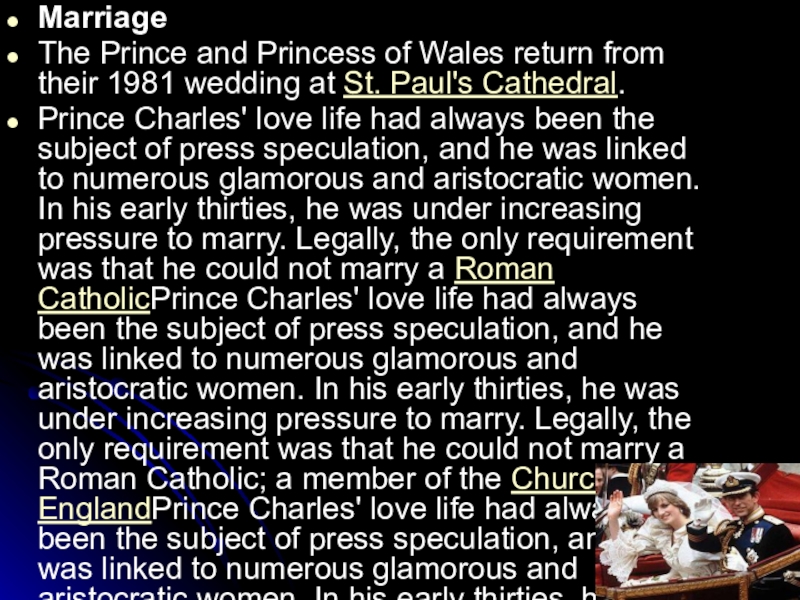
The Prince and Princess of Wales return from their 1981 wedding

at St. Paul's Cathedral.
Prince Charles' love life had always been the subject of press speculation, and he was linked to numerous glamorous and aristocratic women. In his early thirties, he was under increasing pressure to marry. Legally, the only requirement was that he could not marry a Roman CatholicPrince Charles' love life had always been the subject of press speculation, and he was linked to numerous glamorous and aristocratic women. In his early thirties, he was under increasing pressure to marry. Legally, the only requirement was that he could not marry a Roman Catholic; a member of the Church of EnglandPrince Charles' love life had always been the subject of press speculation, and he was linked to numerous glamorous and aristocratic women. In his early thirties, he was under increasing pressure to marry. Legally, the only requirement was that he could not marry a Roman Catholic; a member of the Church of England was preferred. In order to gain the approval of his family and their advisers, any potential bride was expected to have a royal or aristocratic background, be a virgin, as well as be Protestant. Diana met these qualifications
MarriageThe Prince and Princess of Wales return from their 1981 wedding at St. Paul's Cathedral.Prince Charles' love

Слайд 13Engagement and wedding-обязательство и свадьба
Their engagement became official February 24Their engagement

became official February 24, 1981Their engagement became official February 24, 1981[4]Their engagement became official February 24, 1981[4] and they married at St Paul's CathedralTheir engagement became official February 24, 1981[4] and they married at St Paul's Cathedral on 29 JulyTheir engagement became official February 24, 1981[4] and they married at St Paul's Cathedral on 29 July 1981, watched by a global audience of millions.
Problems and separation-проблемы и разделение
In the late 1980s, the marriage of Diana and Charles fell apart, an event at first suppressed, then sensationalised, by the world media. Both the Prince and Princess of Wales allegedly spoke to the pressIn the late 1980s, the marriage of Diana and Charles fell apart, an event at first suppressed, then sensationalised, by the world media. Both the Prince and Princess of Wales allegedly spoke to the press through friends, each blaming the other for the marriage's demise. Charles resumed his old, pre-marital affair with Camilla Parker BowlesIn the late 1980s, the marriage of Diana and Charles fell apart, an event at first suppressed, then sensationalised, by the world media. Both the Prince and Princess of Wales allegedly spoke to the press through friends, each blaming the other for the marriage's demise. Charles resumed his old, pre-marital affair with Camilla Parker Bowles, while Diana had an affair with her ridingIn the late 1980s, the marriage of Diana and Charles fell apart, an event at first suppressed, then sensationalised, by the world media. Both the Prince and Princess of Wales allegedly spoke to the press through friends, each blaming the other for the marriage's demise. Charles resumed his old, pre-marital affair with Camilla Parker Bowles, while Diana had an affair with her riding instructor, James HewittIn the late 1980s, the marriage of Diana and Charles fell apart, an event at first suppressed, then sensationalised, by the world media. Both the Prince and Princess of Wales allegedly spoke to the press through friends, each blaming the other for the marriage's demise. Charles resumed his old, pre-marital affair with Camilla Parker Bowles, while Diana had an affair with her riding instructor, James Hewitt. She later confirmed the affair with Hewitt in a television interview with Martin BashirIn the late 1980s, the marriage of Diana and Charles fell apart, an event at first suppressed, then sensationalised, by the world media. Both the Prince and Princess of Wales allegedly spoke to the press through friends, each blaming the other for the marriage's demise. Charles resumed his old, pre-marital affair with Camilla Parker Bowles, while Diana had an affair with her riding instructor, James Hewitt. She later confirmed the affair with Hewitt in a television interview with Martin Bashir for the BBC programme Panorama. Charles had confirmed his own affair over a year earlier in a televised interview with Jonathan Dimbleby. Charles had confirmed his own affair over a year earlier in a televised interview with Jonathan Dimbleby. Although no charges were ever considered, adultery. Charles had confirmed his own affair over a year earlier in a televised interview with Jonathan Dimbleby. Although no charges were ever considered, adultery with the Queen consort or Princess of Wales has been high treason. Charles had confirmed his own affair over a year earlier in a televised interview with Jonathan Dimbleby. Although no charges were ever considered, adultery with the Queen consort or Princess of Wales has been high treason for both parties in England at least since the Treason Act 1351.
Engagement and wedding-обязательство и свадьбаTheir engagement became official February 24Their engagement became official February 24, 1981Their engagement

Слайд 14Diana was also alleged to have had a relationship with James

Gilbey, her telephone partner in the so-called SquidgygateDiana was also alleged to have had a relationship with James Gilbey, her telephone partner in the so-called Squidgygate affair. Another supposed lover was her detective/bodyguard Barry MannakeeDiana was also alleged to have had a relationship with James Gilbey, her telephone partner in the so-called Squidgygate affair. Another supposed lover was her detective/bodyguard Barry Mannakee, who was assigned to the Princess's security detail, although the Princess adamantly denied a sexual relationship with him. After her separation from Prince Charles, she was said to have become involved with the married art dealerDiana was also alleged to have had a relationship with James Gilbey, her telephone partner in the so-called Squidgygate affair. Another supposed lover was her detective/bodyguard Barry Mannakee, who was assigned to the Princess's security detail, although the Princess adamantly denied a sexual relationship with him. After her separation from Prince Charles, she was said to have become involved with the married art dealer Oliver Hoare, to whom she admitted making numerous telephone calls, and with the rugby player Will CarlingDiana was also alleged to have had a relationship with James Gilbey, her telephone partner in the so-called Squidgygate affair. Another supposed lover was her detective/bodyguard Barry Mannakee, who was assigned to the Princess's security detail, although the Princess adamantly denied a sexual relationship with him. After her separation from Prince Charles, she was said to have become involved with the married art dealer Oliver Hoare, to whom she admitted making numerous telephone calls, and with the rugby player Will Carling. Other men rumoured to have been her lovers, both before and after her divorce, included the property developer Christopher Whalley, the banker Philip Waterhouse, KingDiana was also alleged to have had a relationship with James Gilbey, her telephone partner in the so-called Squidgygate affair. Another supposed lover was her detective/bodyguard Barry Mannakee, who was assigned to the Princess's security detail, although the Princess adamantly denied a sexual relationship with him. After her separation from Prince Charles, she was said to have become involved with the married art dealer Oliver Hoare, to whom she admitted making numerous telephone calls, and with the rugby player Will Carling. Other men rumoured to have been her lovers, both before and after her divorce, included the property developer Christopher Whalley, the banker Philip Waterhouse, King Juan Carlos I of SpainDiana was also alleged to have had a relationship with James Gilbey, her telephone partner in the so-called Squidgygate affair. Another supposed lover was her detective/bodyguard Barry Mannakee, who was assigned to the Princess's security detail, although the Princess adamantly denied a sexual relationship with him. After her separation from Prince Charles, she was said to have become involved with the married art dealer Oliver Hoare, to whom she admitted making numerous telephone calls, and with the rugby player Will Carling. Other men rumoured to have been her lovers, both before and after her divorce, included the property developer Christopher Whalley, the banker Philip Waterhouse, King Juan Carlos I of Spain, the singer Bryan AdamsDiana was also alleged to have had a relationship with James Gilbey, her telephone partner in the so-called Squidgygate affair. Another supposed lover was her detective/bodyguard Barry Mannakee, who was assigned to the Princess's security detail, although the Princess adamantly denied a sexual relationship with him. After her separation from Prince Charles, she was said to have become involved with the married art dealer Oliver Hoare, to whom she admitted making numerous telephone calls, and with the rugby player Will Carling. Other men rumoured to have been her lovers, both before and after her divorce, included the property developer Christopher Whalley, the banker Philip Waterhouse, King Juan Carlos I of Spain, the singer Bryan Adams, and John F. Kennedy, Jr.. There is little evidence to support the idea that her relationships with these men were anything more than friendships.

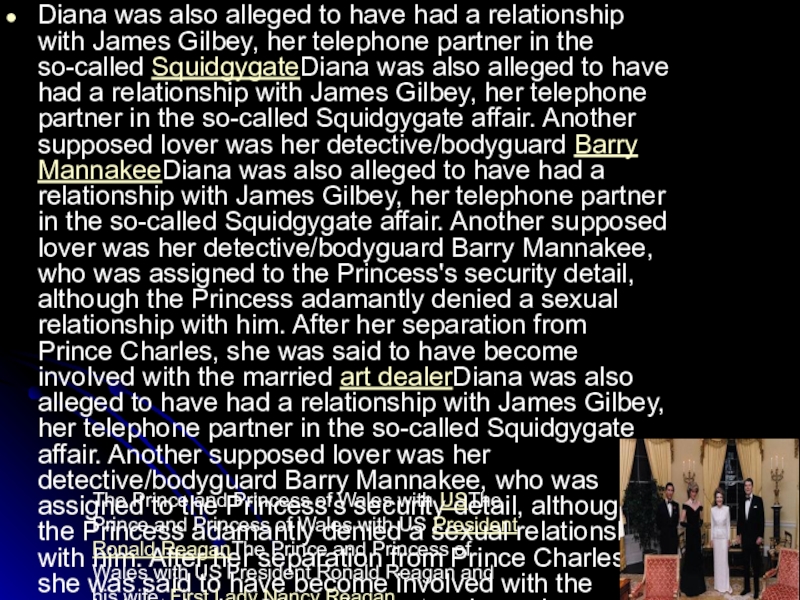
The Prince and Princess of Wales with USThe Prince and Princess of Wales with US President Ronald ReaganThe Prince and Princess of Wales with US President Ronald Reagan and his wife, First Lady Nancy Reagan.
Diana was also alleged to have had a relationship with James Gilbey, her telephone partner in the

Слайд 15Divorce
Their divorceTheir divorce was finalized on 28 AugustTheir divorce was finalized

on 28 August 1996.
Diana received a lump sum settlement of around £17,000,000 along with a legal order preventing her from discussing the details.

Days before the decree absolute of divorce, Letters Patent were issued by Queen Elizabeth II containing general rules to regulate the titles of people who married into the Royal Family after divorce. In accordance with those rules, as she was no longer married to the Prince of Wales, and so had ceased to be a Royal by-marriage, Diana lost the style Her Royal Highness and instead was styled, as Diana, Princess of Wales
DivorceTheir divorceTheir divorce was finalized on 28 AugustTheir divorce was finalized on 28 August 1996.Diana received a

Слайд 16Buckingham Palace stated that Diana was still officially a member of
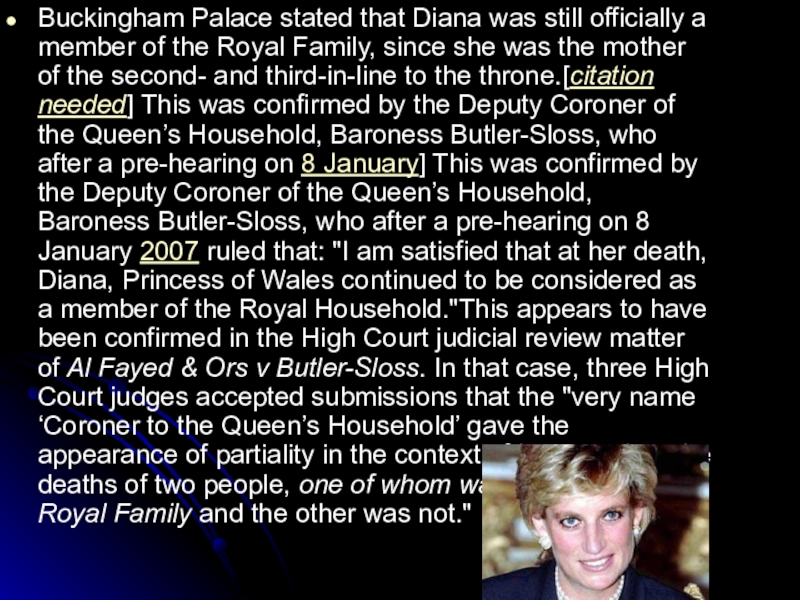
the Royal Family, since she was the mother of the second- and third-in-line to the throne.[citation needed] This was confirmed by the Deputy Coroner of the Queen’s Household, Baroness Butler-Sloss, who after a pre-hearing on 8 January] This was confirmed by the Deputy Coroner of the Queen’s Household, Baroness Butler-Sloss, who after a pre-hearing on 8 January 2007 ruled that: "I am satisfied that at her death, Diana, Princess of Wales continued to be considered as a member of the Royal Household."This appears to have been confirmed in the High Court judicial review matter of Al Fayed & Ors v Butler-Sloss. In that case, three High Court judges accepted submissions that the "very name ‘Coroner to the Queen’s Household’ gave the appearance of partiality in the context of inquests into the deaths of two people, one of whom was a member of the Royal Family and the other was not."
Buckingham Palace stated that Diana was still officially a member of the Royal Family, since she was

Слайд 17Personal life after divorce
After the divorce, Diana apartment in Kensington Palace,

completely redecorated, and it remained her home until her death. She gave her staff members a pay raise.
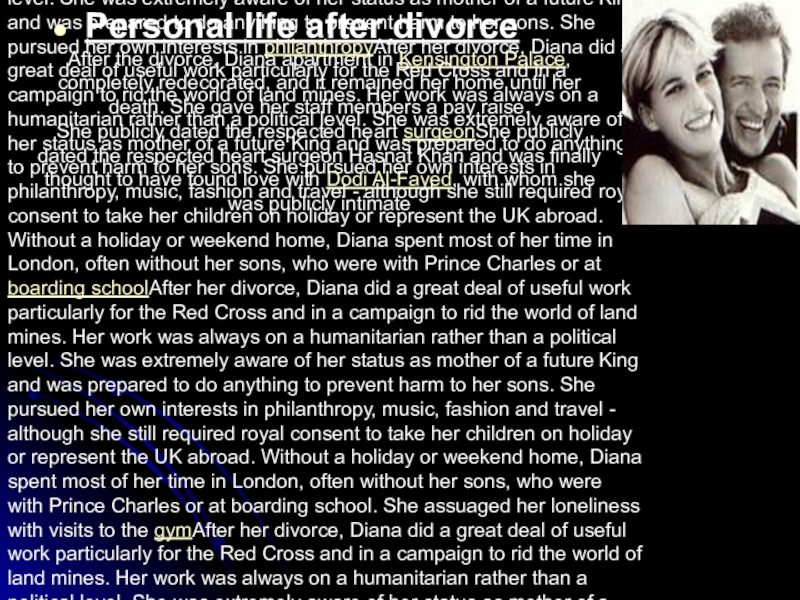
She publicly dated the respected heart surgeonShe publicly dated the respected heart surgeon Hasnat Khan and was finally thought to have found love with Dodi Al-Fayed, with whom she was publicly intimate

After her divorceAfter her divorce, Diana did a great deal of useful work particularly for the Red Cross and in a campaign to rid the world of land mines. Her work was always on a humanitarian rather than a political level. She was extremely aware of her status as mother of a future King and was prepared to do anything to prevent harm to her sons. She pursued her own interests in philanthropyAfter her divorce, Diana did a great deal of useful work particularly for the Red Cross and in a campaign to rid the world of land mines. Her work was always on a humanitarian rather than a political level. She was extremely aware of her status as mother of a future King and was prepared to do anything to prevent harm to her sons. She pursued her own interests in philanthropy, music, fashion and travel - although she still required royal consent to take her children on holiday or represent the UK abroad. Without a holiday or weekend home, Diana spent most of her time in London, often without her sons, who were with Prince Charles or at boarding schoolAfter her divorce, Diana did a great deal of useful work particularly for the Red Cross and in a campaign to rid the world of land mines. Her work was always on a humanitarian rather than a political level. She was extremely aware of her status as mother of a future King and was prepared to do anything to prevent harm to her sons. She pursued her own interests in philanthropy, music, fashion and travel - although she still required royal consent to take her children on holiday or represent the UK abroad. Without a holiday or weekend home, Diana spent most of her time in London, often without her sons, who were with Prince Charles or at boarding school. She assuaged her loneliness with visits to the gymAfter her divorce, Diana did a great deal of useful work particularly for the Red Cross and in a campaign to rid the world of land mines. Her work was always on a humanitarian rather than a political level. She was extremely aware of her status as mother of a future King and was prepared to do anything to prevent harm to her sons. She pursued her own interests in philanthropy, music, fashion and travel - although she still required royal consent to take her children on holiday or represent the UK abroad. Without a holiday or weekend home, Diana spent most of her time in London, often without her sons, who were with Prince Charles or at boarding school. She assuaged her loneliness with visits to the gym and cinema, private charity work, incognito midnight walks through Central London and by compulsively watching her favourite soap operas (EastEnders and Brookside) with a 'TV dinner' in the isolation of her apartment.[citation needed]
Personal life after divorceAfter the divorce, Diana apartment in Kensington Palace, completely redecorated, and it remained her

Слайд 18After her divorceAfter her divorce, Diana did a great deal of
useful work particularly for the Red Cross and in a campaign to rid the world of land mines. Her work was always on a humanitarian rather than a political level. She was extremely aware of her status as mother of a future King and was prepared to do anything to prevent harm to her sons. She pursued her own interests in philanthropyAfter her divorce, Diana did a great deal of useful work particularly for the Red Cross and in a campaign to rid the world of land mines. Her work was always on a humanitarian rather than a political level. She was extremely aware of her status as mother of a future King and was prepared to do anything to prevent harm to her sons. She pursued her own interests in philanthropy, music, fashion and travel - although she still required royal consent to take her children on holiday or represent the UK abroad. Without a holiday or weekend home, Diana spent most of her time in London, often without her sons, who were with Prince Charles or at boarding schoolAfter her divorce, Diana did a great deal of useful work particularly for the Red Cross and in a campaign to rid the world of land mines. Her work was always on a humanitarian rather than a political level. She was extremely aware of her status as mother of a future King and was prepared to do anything to prevent harm to her sons. She pursued her own interests in philanthropy, music, fashion and travel - although she still required royal consent to take her children on holiday or represent the UK abroad. Without a holiday or weekend home, Diana spent most of her time in London, often without her sons, who were with Prince Charles or at boarding school. She assuaged her loneliness with visits to the gymAfter her divorce, Diana did a great deal of useful work particularly for the Red Cross and in a campaign to rid the world of land mines. Her work was always on a humanitarian rather than a political level. She was extremely aware of her status as mother of a future King and was prepared to do anything to prevent harm to her sons. She pursued her own interests in philanthropy, music, fashion and travel - although she still required royal consent to take her children on holiday or represent the UK abroad. Without a holiday or weekend home, Diana spent most of her time in London, often without her sons, who were with Prince Charles or at boarding school. She assuaged her loneliness with visits to the gym and cinema, private charity work, incognito midnight walks through Central London and by compulsively watching her favourite soap operas (EastEnders and Brookside) with a 'TV dinner' in the isolation of her apartment.[citation needed]
After her divorceAfter her divorce, Diana did a great deal of useful work particularly for the Red

Слайд 19Charity work
Starting in the mid- to late 1980s, the Princess of
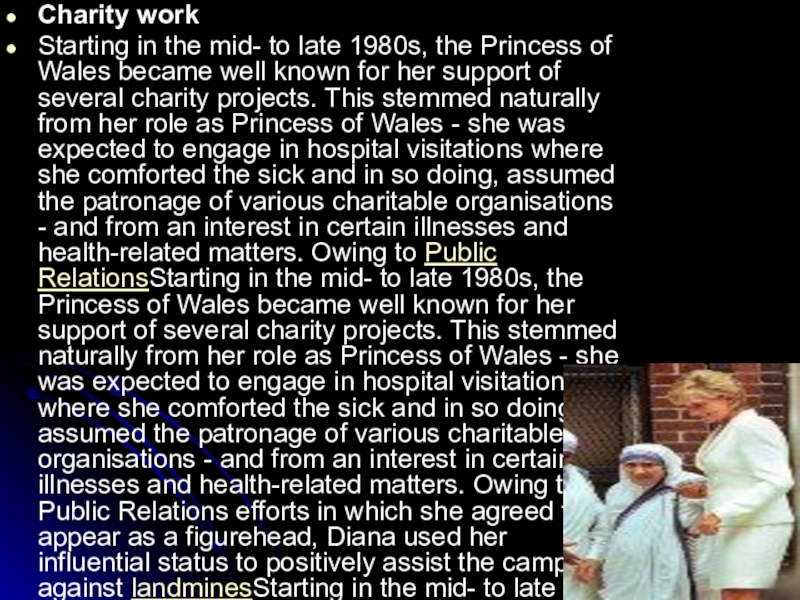
Wales became well known for her support of several charity projects. This stemmed naturally from her role as Princess of Wales - she was expected to engage in hospital visitations where she comforted the sick and in so doing, assumed the patronage of various charitable organisations - and from an interest in certain illnesses and health-related matters. Owing to Public RelationsStarting in the mid- to late 1980s, the Princess of Wales became well known for her support of several charity projects. This stemmed naturally from her role as Princess of Wales - she was expected to engage in hospital visitations where she comforted the sick and in so doing, assumed the patronage of various charitable organisations - and from an interest in certain illnesses and health-related matters. Owing to Public Relations efforts in which she agreed to appear as a figurehead, Diana used her influential status to positively assist the campaign against landminesStarting in the mid- to late 1980s, the Princess of Wales became well known for her support of several charity projects. This stemmed naturally from her role as Princess of Wales - she was expected to engage in hospital visitations where she comforted the sick and in so doing, assumed the patronage of various charitable organisations - and from an interest in certain illnesses and health-related matters. Owing to Public Relations efforts in which she agreed to appear as a figurehead, Diana used her influential status to positively assist the campaign against landmines, a cause which won the Nobel Prize in 1997 in tribute, and with helping to decrease discrimination against victims of AIDS.
Charity workStarting in the mid- to late 1980s, the Princess of Wales became well known for her

Слайд 20AIDS Awareness
In April 1987, the Princess of Wales was one of

the first high-profile celebritiesIn April 1987, the Princess of Wales was one of the first high-profile celebrities to be photographed touching a person infected with HIVIn April 1987, the Princess of Wales was one of the first high-profile celebrities to be photographed touching a person infected with HIV at the 'chain of hope' organization. Her contribution to changing the public opinion of AIDSIn April 1987, the Princess of Wales was one of the first high-profile celebrities to be photographed touching a person infected with HIV at the 'chain of hope' organization. Her contribution to changing the public opinion of AIDS sufferers was summarised in December 2001 by Bill Clinton at the 'Diana, Princess of Wales Lecture on AIDS':
“In 1987, when so many still believed that AIDS could be contracted through casual contact, Princess Diana sat on the sickbed of a man with AIDS and held his hand. She showed the world that people with AIDS deserve no isolation, but compassion and kindness. It helped change world's opinion, and gave hope to people with AIDS.”—Bill ClintonDiana also made clandestine visits to show kindness to the sick. According to nurses, she would turn up unannounced (for example, at the Mildmay Hospice in London) with specific instructions that her visit was to be concealed from the media.[citation needed
AIDS AwarenessIn April 1987, the Princess of Wales was one of the first high-profile celebritiesIn April 1987,

Слайд 21Death
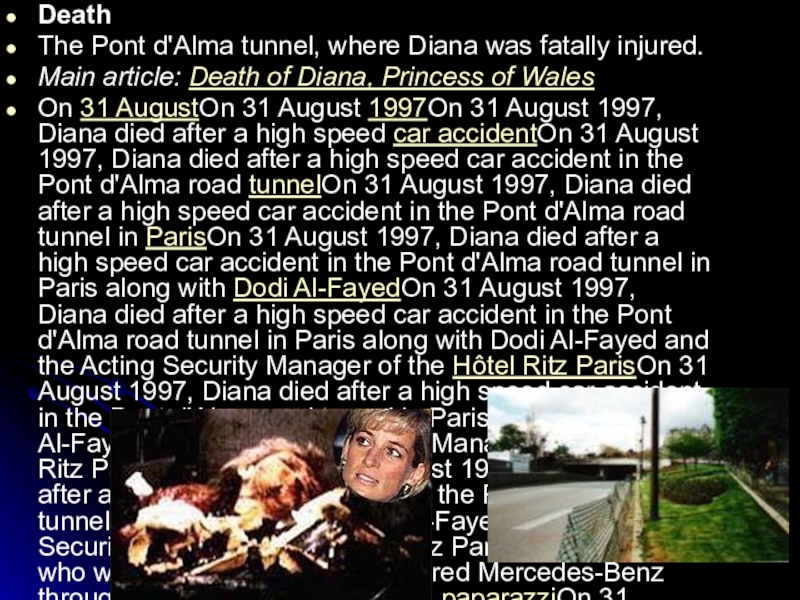
The Pont d'Alma tunnel, where Diana was fatally injured.
Main article: Death

of Diana, Princess of Wales
On 31 AugustOn 31 August 1997On 31 August 1997, Diana died after a high speed car accidentOn 31 August 1997, Diana died after a high speed car accident in the Pont d'Alma road tunnelOn 31 August 1997, Diana died after a high speed car accident in the Pont d'Alma road tunnel in ParisOn 31 August 1997, Diana died after a high speed car accident in the Pont d'Alma road tunnel in Paris along with Dodi Al-FayedOn 31 August 1997, Diana died after a high speed car accident in the Pont d'Alma road tunnel in Paris along with Dodi Al-Fayed and the Acting Security Manager of the Hôtel Ritz ParisOn 31 August 1997, Diana died after a high speed car accident in the Pont d'Alma road tunnel in Paris along with Dodi Al-Fayed and the Acting Security Manager of the Hôtel Ritz Paris, Henri PaulOn 31 August 1997, Diana died after a high speed car accident in the Pont d'Alma road tunnel in Paris along with Dodi Al-Fayed and the Acting Security Manager of the Hôtel Ritz Paris, Henri Paul, who was instructed to drive the hired Mercedes-Benz through Paris secretly eluding the paparazziOn 31 August 1997, Diana died after a high speed car accident in the Pont d'Alma road tunnel in Paris along with Dodi Al-Fayed and the Acting Security Manager of the Hôtel Ritz Paris, Henri Paul, who was instructed to drive the hired Mercedes-Benz through Paris secretly eluding the paparazzi.[14]On 31 August 1997, Diana died after a high speed car accident in the Pont d'Alma road tunnel in Paris along with Dodi Al-Fayed and the Acting Security Manager of the Hôtel Ritz Paris, Henri Paul, who was instructed to drive the hired Mercedes-Benz through Paris secretly eluding the paparazzi.[14] Their black 1994 Mercedes-Benz S280On 31 August 1997, Diana died after a high speed car accident in the Pont d'Alma road tunnel in Paris along with Dodi Al-Fayed and the Acting Security Manager of the Hôtel Ritz Paris, Henri Paul, who was instructed to drive the hired Mercedes-Benz through Paris secretly eluding the paparazzi.[14] Their black 1994 Mercedes-Benz S280 (registration no. 688 LTV 75) crashed into the thirteenth pillar of the tunnel. The two-lane tunnel was built without metal barriers between the pillars, so a slight change in vehicle direction could easily result in a head-on collision with a tunnel pillar. None of the four occupants wore seatbelts.
DeathThe Pont d'Alma tunnel, where Diana was fatally injured.Main article: Death of Diana, Princess of WalesOn 31

Слайд 22Grave
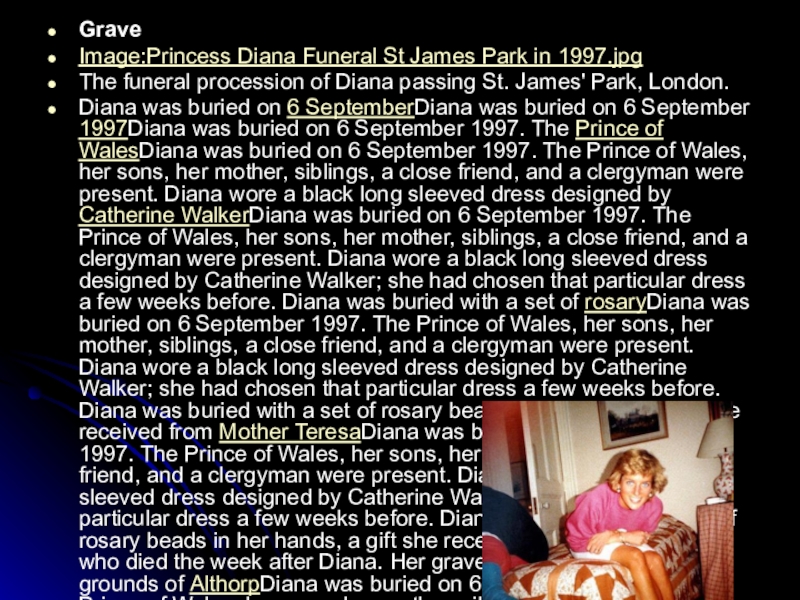
Image:Princess Diana Funeral St James Park in 1997.jpg
The funeral procession

of Diana passing St. James' Park, London.
Diana was buried on 6 SeptemberDiana was buried on 6 September 1997Diana was buried on 6 September 1997. The Prince of WalesDiana was buried on 6 September 1997. The Prince of Wales, her sons, her mother, siblings, a close friend, and a clergyman were present. Diana wore a black long sleeved dress designed by Catherine WalkerDiana was buried on 6 September 1997. The Prince of Wales, her sons, her mother, siblings, a close friend, and a clergyman were present. Diana wore a black long sleeved dress designed by Catherine Walker; she had chosen that particular dress a few weeks before. Diana was buried with a set of rosaryDiana was buried on 6 September 1997. The Prince of Wales, her sons, her mother, siblings, a close friend, and a clergyman were present. Diana wore a black long sleeved dress designed by Catherine Walker; she had chosen that particular dress a few weeks before. Diana was buried with a set of rosary beads in her hands, a gift she received from Mother TeresaDiana was buried on 6 September 1997. The Prince of Wales, her sons, her mother, siblings, a close friend, and a clergyman were present. Diana wore a black long sleeved dress designed by Catherine Walker; she had chosen that particular dress a few weeks before. Diana was buried with a set of rosary beads in her hands, a gift she received from Mother Teresa, who died the week after Diana. Her grave is on an island in the grounds of AlthorpDiana was buried on 6 September 1997. The Prince of Wales, her sons, her mother, siblings, a close friend, and a clergyman were present. Diana wore a black long sleeved dress designed by Catherine Walker; she had chosen that particular dress a few weeks before. Diana was buried with a set of rosary beads in her hands, a gift she received from Mother Teresa, who died the week after Diana. Her grave is on an island in the grounds of Althorp Park, her family home.[19]
The original plan was for her to be buried in the Spencer family vault at the local church in nearby Great BringtonThe original plan was for her to be buried in the Spencer family vault at the local church in nearby Great Brington, but Diana's brother, Charles, the 9th Earl SpencerThe original plan was for her to be buried in the Spencer family vault at the local church in nearby Great Brington, but Diana's brother, Charles, the 9th Earl Spencer, said that he was concerned about public safety and security and the onslaught of visitors that might overwhelm Great Brington. He decided that he wanted his sister to be buried where her grave could be easily cared for and visited in privacy by her sons and other relations
GraveImage:Princess Diana Funeral St James Park in 1997.jpg The funeral procession of Diana passing St. James' Park,

Слайд 23The island is in an ornamental lake known as The Round

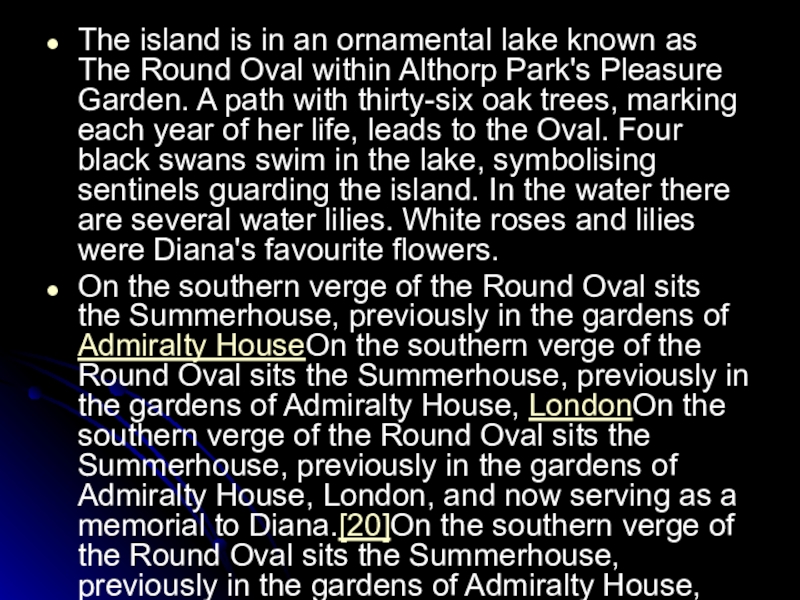
Oval within Althorp Park's Pleasure Garden. A path with thirty-six oak trees, marking each year of her life, leads to the Oval. Four black swans swim in the lake, symbolising sentinels guarding the island. In the water there are several water lilies. White roses and lilies were Diana's favourite flowers.
On the southern verge of the Round Oval sits the Summerhouse, previously in the gardens of Admiralty HouseOn the southern verge of the Round Oval sits the Summerhouse, previously in the gardens of Admiralty House, LondonOn the southern verge of the Round Oval sits the Summerhouse, previously in the gardens of Admiralty House, London, and now serving as a memorial to Diana.[20]On the southern verge of the Round Oval sits the Summerhouse, previously in the gardens of Admiralty House, London, and now serving as a memorial to Diana.[20] An ancient arboretumOn the southern verge of the Round Oval sits the Summerhouse, previously in the gardens of Admiralty House, London, and now serving as a memorial to Diana.[20] An ancient arboretum stands nearby, which contains trees planted by Prince WilliamOn the southern verge of the Round Oval sits the Summerhouse, previously in the gardens of Admiralty House, London, and now serving as a memorial to Diana.[20] An ancient arboretum stands nearby, which contains trees planted by Prince William and Prince Harry, other members of her family, and Diana herself.
The island is in an ornamental lake known as The Round Oval within Althorp Park's Pleasure Garden.

Слайд 24Memorials
Immediately after her death, many sites around the world became briefly

ad hoc memorials to Diana, where the public left flowers and other tributes. The biggest was outside the gates of Kensington Palace. Permanent memorials include:
The Diana, Princess of Wales Memorial FountainThe Diana, Princess of Wales Memorial Fountain in Hyde ParkThe Diana, Princess of Wales Memorial Fountain in Hyde Park, London.
The Diana, Princess of Wales Memorial PlaygroundThe Diana, Princess of Wales Memorial Playground in Kensington GardensThe Diana, Princess of Wales Memorial Playground in Kensington Gardens, London
MemorialsImmediately after her death, many sites around the world became briefly ad hoc memorials to Diana, where

Слайд 25Recent events
On 13 JulyOn 13 July 2006 Italian magazine Chi published

photographs showing the princess receiving oxygen in the wreckage of the car crash, [21] published photographs showing the princess receiving oxygen in the wreckage of the car crash, [21] despite an unofficial blackout on such photographs being published.[22] The photographs were taken minutes after the accident, and show the Princess slumped in the back seat while a paramedic attempts to fit an oxygen mask over her face. The editor of Chi defended his decision by saying that he published the photographs for the "very simple reason" that they had not been seen before, and that he felt the images do not disrespect the memory of the Princess.[22]The British media publicly refused to publish the images, with the exception of the tabloid newspaper, The Sun, which printed the picture with the face blacked out.[citation needed]
Fresh controversy arose over the issue of these photographs when Britain's Channel 4Fresh controversy arose over the issue of these photographs when Britain's Channel 4 broadcast them during a documentary in June 2007Fresh controversy arose over the issue of these photographs when Britain's Channel 4 broadcast them during a documentary in June 2007.[23]
July 1July 1, 2007 marked a concert held by her two sons celebrating the 46th anniversary of her birth. The concert was held at Wembley Stadium and featured many well known and popular acts on the bill.
Recent eventsOn 13 JulyOn 13 July 2006 Italian magazine Chi published photographs showing the princess receiving oxygen

Слайд 26The 2007 docudrama Diana: Last Days of a Princess details the

final two months of her life.
On an October 2007 episode of The Chaser's War on EverythingOn an October 2007 episode of The Chaser's War on Everything, Andrew HansenOn an October 2007 episode of The Chaser's War on Everything, Andrew Hansen remembered Diana in his now infamous "Eulogy Song." However it made fun of Diana, calling her a "slut", among other things. The song immediately gained considerable controversy in the Australian media.[24]
The 2007 docudrama Diana: Last Days of a Princess details the final two months of her life.On

Слайд 27Contemporary opinions
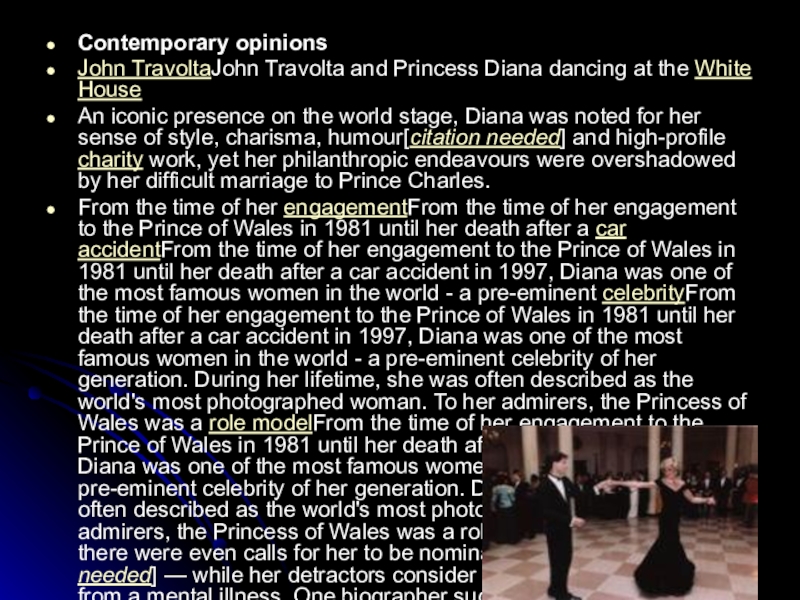
John TravoltaJohn Travolta and Princess Diana dancing at the White

House
An iconic presence on the world stage, Diana was noted for her sense of style, charisma, humour[citation needed] and high-profile charity work, yet her philanthropic endeavours were overshadowed by her difficult marriage to Prince Charles.
From the time of her engagementFrom the time of her engagement to the Prince of Wales in 1981 until her death after a car accidentFrom the time of her engagement to the Prince of Wales in 1981 until her death after a car accident in 1997, Diana was one of the most famous women in the world - a pre-eminent celebrityFrom the time of her engagement to the Prince of Wales in 1981 until her death after a car accident in 1997, Diana was one of the most famous women in the world - a pre-eminent celebrity of her generation. During her lifetime, she was often described as the world's most photographed woman. To her admirers, the Princess of Wales was a role modelFrom the time of her engagement to the Prince of Wales in 1981 until her death after a car accident in 1997, Diana was one of the most famous women in the world - a pre-eminent celebrity of her generation. During her lifetime, she was often described as the world's most photographed woman. To her admirers, the Princess of Wales was a role model — after her death, there were even calls for her to be nominated for sainthood[citation needed] — while her detractors consider her to have been suffering from a mental illness. One biographer suggested that Diana was possibly suffering from Borderline personality disorder] — while her detractors consider her to have been suffering from a mental illness. One biographer suggested that Diana was possibly suffering from Borderline personality disorder. [28]] — while her detractors consider her to have been suffering from a mental illness. One biographer suggested that Diana was possibly suffering from Borderline personality disorder. [28] Diana admitted to struggling with depression] — while her detractors consider her to have been suffering from a mental illness. One biographer suggested that Diana was possibly suffering from Borderline personality disorder. [28] Diana admitted to struggling with depression, and the eating disorder bulimia, which recurred throughout her adult life.
Contemporary opinionsJohn TravoltaJohn Travolta and Princess Diana dancing at the White HouseAn iconic presence on the world

Слайд 28Titles, styles, honours and arms
Titles and styles
1 July1 July 19611 July

1961 – 9 June1 July 1961 – 9 June 1975: The Honourable Diana Frances Spencer
9 June 1975 – 29 July9 June 1975 – 29 July 1981: The Lady Diana Frances Spencer
29 July 1981 – 28 August29 July 1981 – 28 August 1996: Her Royal Highness The Princess of Wales
28 August 1996 – 31 August28 August 1996 – 31 August 1997: Diana, Princess of Wales
Diana's full style, while married, was Her Royal Highness The Princess Charles Philip Arthur George, Princess of Wales and Countess of Chester, Duchess of Cornwall, Duchess of Rothesay, Countess of Carrick, Baroness of Renfrew, Lady of the Isles, Princess of Scotland.[31]
Titles, styles, honours and armsTitles and styles1 July1 July 19611 July 1961 – 9 June1 July 1961

Слайд 29Honours
British Honours
Royal Family Order of Queen Elizabeth II
Foreign Honours
Grand Officer,
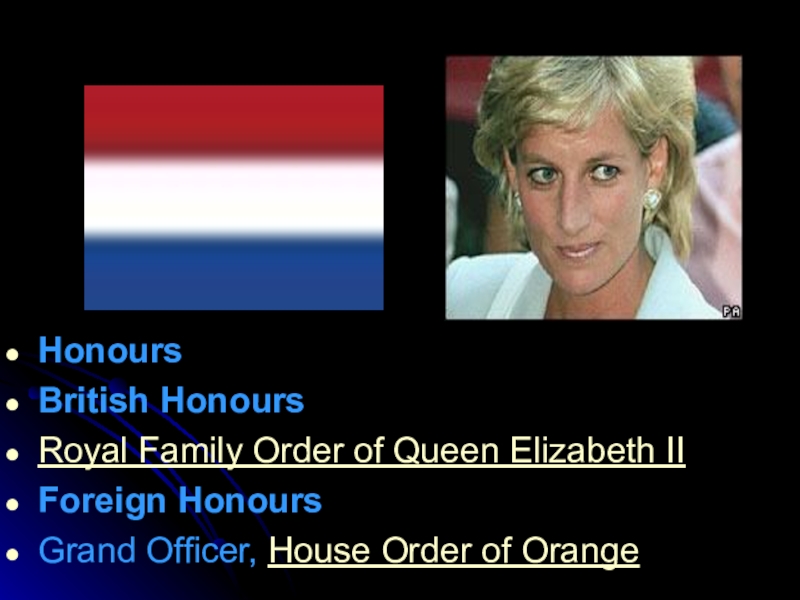
House Order of Orange
HonoursBritish HonoursRoyal Family Order of Queen Elizabeth II Foreign HonoursGrand Officer, House Order of Orange

Слайд 30Arms
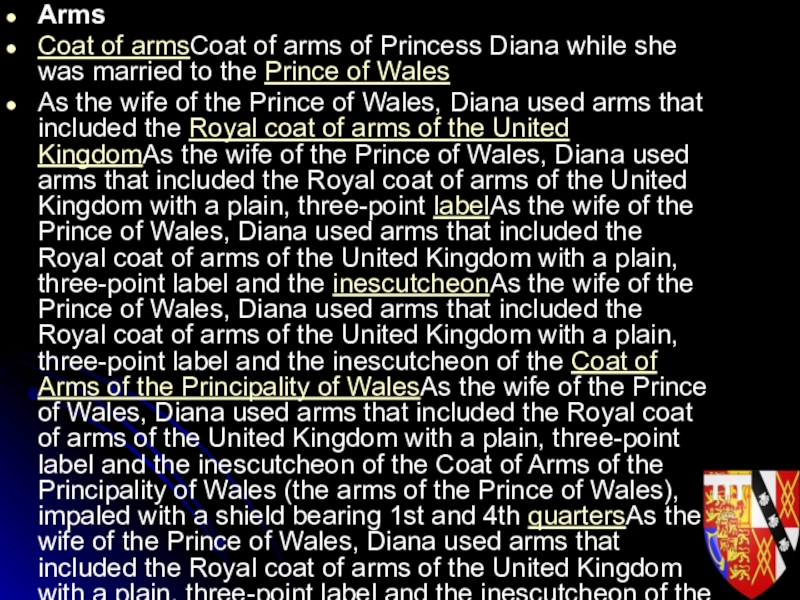
Coat of armsCoat of arms of Princess Diana while she was

married to the Prince of Wales
As the wife of the Prince of Wales, Diana used arms that included the Royal coat of arms of the United KingdomAs the wife of the Prince of Wales, Diana used arms that included the Royal coat of arms of the United Kingdom with a plain, three-point labelAs the wife of the Prince of Wales, Diana used arms that included the Royal coat of arms of the United Kingdom with a plain, three-point label and the inescutcheonAs the wife of the Prince of Wales, Diana used arms that included the Royal coat of arms of the United Kingdom with a plain, three-point label and the inescutcheon of the Coat of Arms of the Principality of WalesAs the wife of the Prince of Wales, Diana used arms that included the Royal coat of arms of the United Kingdom with a plain, three-point label and the inescutcheon of the Coat of Arms of the Principality of Wales (the arms of the Prince of Wales), impaled with a shield bearing 1st and 4th quartersAs the wife of the Prince of Wales, Diana used arms that included the Royal coat of arms of the United Kingdom with a plain, three-point label and the inescutcheon of the Coat of Arms of the Principality of Wales (the arms of the Prince of Wales), impaled with a shield bearing 1st and 4th quarters plain white, and the 2nd and 3rd quarters bearing a golden fretAs the wife of the Prince of Wales, Diana used arms that included the Royal coat of arms of the United Kingdom with a plain, three-point label and the inescutcheon of the Coat of Arms of the Principality of Wales (the arms of the Prince of Wales), impaled with a shield bearing 1st and 4th quarters plain white, and the 2nd and 3rd quarters bearing a golden fret on a red background defacedAs the wife of the Prince of Wales, Diana used arms that included the Royal coat of arms of the United Kingdom with a plain, three-point label and the inescutcheon of the Coat of Arms of the Principality of Wales (the arms of the Prince of Wales), impaled with a shield bearing 1st and 4th quarters plain white, and the 2nd and 3rd quarters bearing a golden fret on a red background defaced with three escallopesAs the wife of the Prince of Wales, Diana used arms that included the Royal coat of arms of the United Kingdom with a plain, three-point label and the inescutcheon of the Coat of Arms of the Principality of Wales (the arms of the Prince of Wales), impaled with a shield bearing 1st and 4th quarters plain white, and the 2nd and 3rd quarters bearing a golden fret on a red background defaced with three escallopes (the arms of the Earl SpencerAs the wife of the Prince of Wales, Diana used arms that included the Royal coat of arms of the United Kingdom with a plain, three-point label and the inescutcheon of the Coat of Arms of the Principality of Wales (the arms of the Prince of Wales), impaled with a shield bearing 1st and 4th quarters plain white, and the 2nd and 3rd quarters bearing a golden fret on a red background defaced with three escallopes (the arms of the Earl Spencer, her father). The supportersAs the wife of the Prince of Wales, Diana used arms that included the Royal coat of arms of the United Kingdom with a plain, three-point label and the inescutcheon of the Coat of Arms of the Principality of Wales (the arms of the Prince of Wales), impaled with a shield bearing 1st and 4th quarters plain white, and the 2nd and 3rd quarters bearing a golden fret on a red background defaced with three escallopes (the arms of the Earl Spencer, her father). The supporters were the crowned golden lion from the Royal Arms, and a winged griffinAs the wife of the Prince of Wales, Diana used arms that included the Royal coat of arms of the United Kingdom with a plain, three-point label and the inescutcheon of the Coat of Arms of the Principality of Wales (the arms of the Prince of Wales), impaled with a shield bearing 1st and 4th quarters plain white, and the 2nd and 3rd quarters bearing a golden fret on a red background defaced with three escallopes (the arms of the Earl Spencer, her father). The supporters were the crowned golden lion from the Royal Arms, and a winged griffin from the Spencer arms. The shield was topped by the Prince of Wales crown. Her motto was Dieu Defend le Droit (English: God defends the right), also used in the Spencer arms.
After her divorce, Diana used the arms of the Spencer family, crowned by a royal coronet
ArmsCoat of armsCoat of arms of Princess Diana while she was married to the Prince of WalesAs

Слайд 31Concert for Diana and 10th Anniversary Memorial service
Princes WilliamPrinces William and

HarryPrinces William and Harry organised a concert held to celebrate their mother's life and commemorate her work. All 60,000 tickets sold out in a matter of minutes when they went on sale in January. The Concert for DianaPrinces William and Harry organised a concert held to celebrate their mother's life and commemorate her work. All 60,000 tickets sold out in a matter of minutes when they went on sale in January. The Concert for Diana was staged on 1 JulyPrinces William and Harry organised a concert held to celebrate their mother's life and commemorate her work. All 60,000 tickets sold out in a matter of minutes when they went on sale in January. The Concert for Diana was staged on 1 July 2007Princes William and Harry organised a concert held to celebrate their mother's life and commemorate her work. All 60,000 tickets sold out in a matter of minutes when they went on sale in January. The Concert for Diana was staged on 1 July 2007, which would have been her 46th birthday, at LondonPrinces William and Harry organised a concert held to celebrate their mother's life and commemorate her work. All 60,000 tickets sold out in a matter of minutes when they went on sale in January. The Concert for Diana was staged on 1 July 2007, which would have been her 46th birthday, at London's new Wembley Stadium.
The Princes also arranged a Service of Thanksgiving on 31 AugustThe Princes also arranged a Service of Thanksgiving on 31 August 2007The Princes also arranged a Service of Thanksgiving on 31 August 2007 to mark the 10th anniversary of their mother's death.[33]The Princes also arranged a Service of Thanksgiving on 31 August 2007 to mark the 10th anniversary of their mother's death.[33] Ten years on, the depth of her legacy has been questioned, as has the appropriateness of the memorials and burial site tourism that has developed around her memory.[34]
Concert for Diana and 10th Anniversary Memorial servicePrinces WilliamPrinces William and HarryPrinces William and Harry organised a

Что такое shareslide.ru?

Это сайт презентаций, где можно хранить и обмениваться своими презентациями, докладами, проектами, шаблонами в формате PowerPoint с другими пользователями. Мы помогаем школьникам, студентам, учителям, преподавателям хранить и обмениваться учебными материалами.


Для правообладателей

Яндекс.Метрика

Обратная связь

Email: Нажмите что бы посмотреть