английского языка:
О.В. Колесникова
06.11.2018
- Главная
- Разное
- Образование
- Спорт
- Естествознание
- Природоведение
- Религиоведение
- Французский язык
- Черчение
- Английский язык
- Астрономия
- Алгебра
- Биология
- География
- Геометрия
- Детские презентации
- Информатика
- История
- Литература
- Математика
- Музыка
- МХК
- Немецкий язык
- ОБЖ
- Обществознание
- Окружающий мир
- Педагогика
- Русский язык
- Технология
- Физика
- Философия
- Химия
- Шаблоны, фоны, картинки для презентаций
- Экология
- Экономика
Презентация, доклад по английскому языку на тему: модуль 2.
Содержание
- 1. Презентация по английскому языку на тему: модуль 2.
- 2. Neurons and Neurotransmitters
- 3. Neurons and Neurotransmitters
- 4. BrainBecause the brain is the largest and
- 5. Neurons System
- 6. Neurons SystemAnatomy of the Nervous SystemThe nervous
- 7. Neurons
- 8. NeuronsNeurons, also called nerve cells, are highly
- 9. Classification. Types of Neurons.
- 10. ClassificationNeurons may be classified either according to
- 11. Home task p. 40 ex. 1
- 12. Список литературы:https://www.google.ru/search?q=nervous+system&newwindow=1&source=lnms&tbm=isch&sa=X&ved=0ahUKEwjujou8uL3eAhWOhqYKHW37AIQQ_AUIDigB&biw=1366&bih=587#imgdii=MjrkG2QMp9oU9M:&imgrc=0ujt1gz_8RnD2M:;https://nurseslabs.com/nervous-system/;spotlight 11 1) Учебник 2) Книга
Neurons and Neurotransmitters

Слайд 4Brain
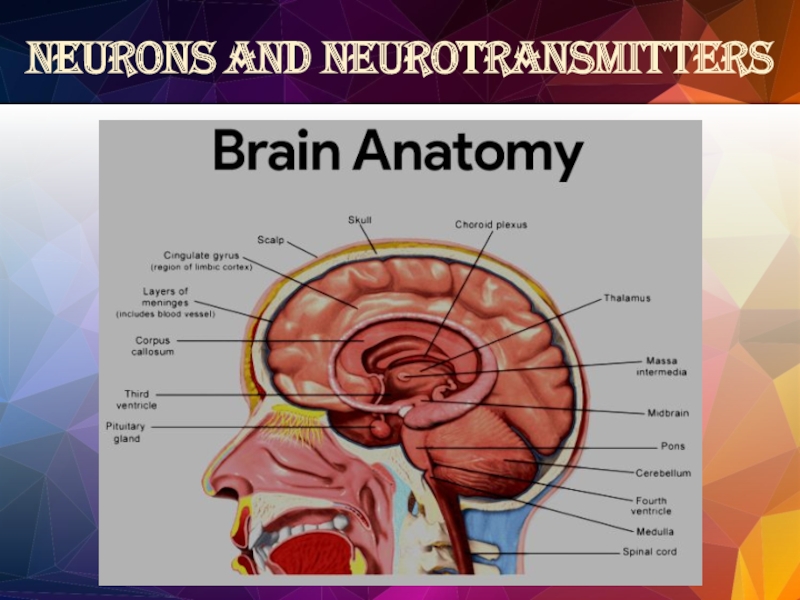
Because the brain is the largest and most complex mass of
nervous tissue in the body, it is commonly discussed in terms of its four major regions – cerebral hemispheres, diencephalon, brain stem, and cerebellum.
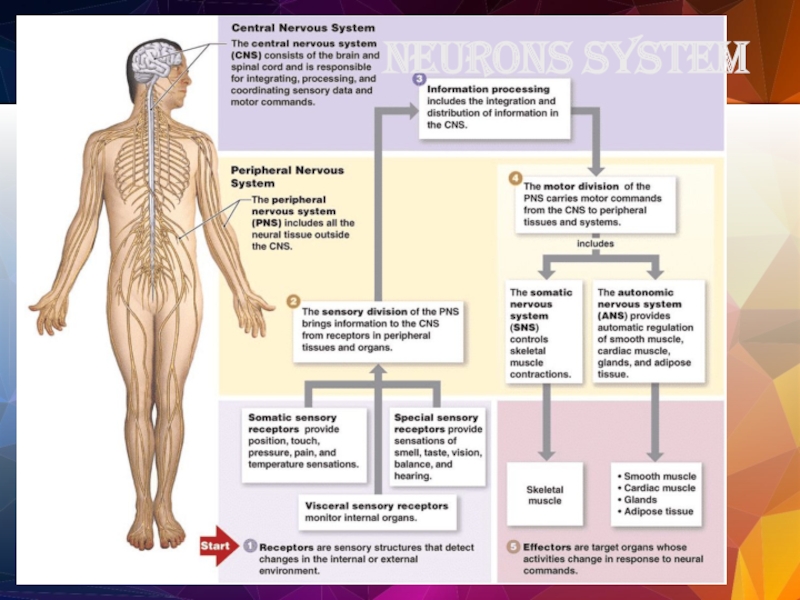
Слайд 6Neurons System
Anatomy of the Nervous System
The nervous system does not work
alone to regulate and maintain body homeostasis; the endocrine system is a second important regulating system.
Organization of the Nervous System
We only have one nervous system, but, because of its complexity, it is difficult to consider all of its parts at the same time; so, to simplify its study, we divide it in terms of its structures (structural classification) or in terms of its activities (functional classification).
Organization of the Nervous System
We only have one nervous system, but, because of its complexity, it is difficult to consider all of its parts at the same time; so, to simplify its study, we divide it in terms of its structures (structural classification) or in terms of its activities (functional classification).
Слайд 8Neurons
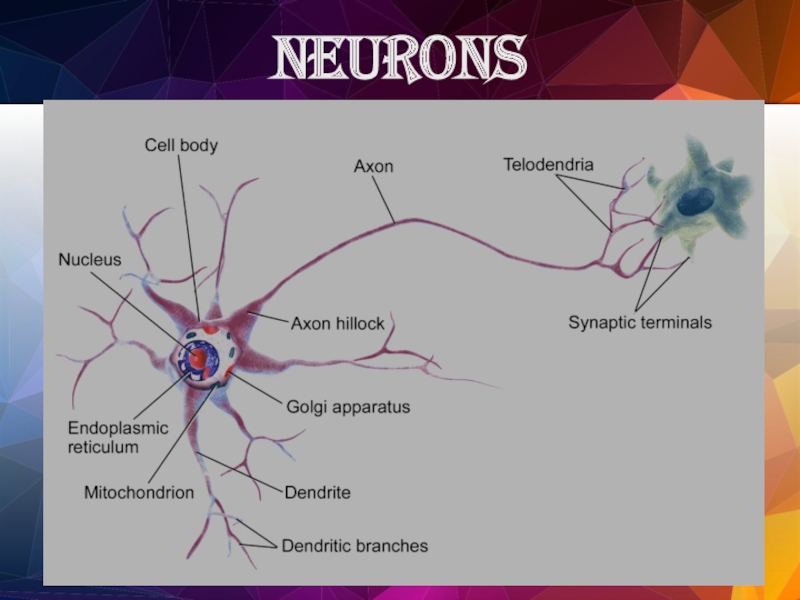
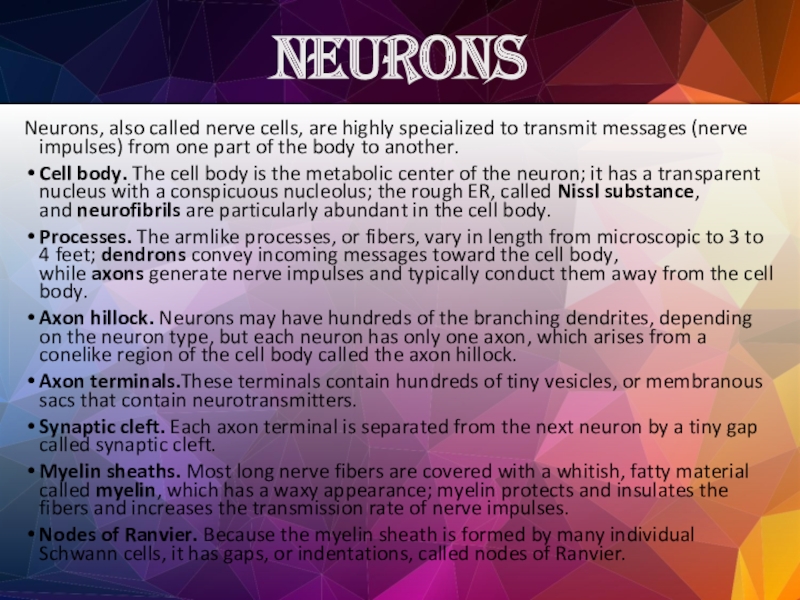
Neurons, also called nerve cells, are highly specialized to transmit messages
(nerve impulses) from one part of the body to another.
Cell body. The cell body is the metabolic center of the neuron; it has a transparent nucleus with a conspicuous nucleolus; the rough ER, called Nissl substance, and neurofibrils are particularly abundant in the cell body.
Processes. The armlike processes, or fibers, vary in length from microscopic to 3 to 4 feet; dendrons convey incoming messages toward the cell body, while axons generate nerve impulses and typically conduct them away from the cell body.
Axon hillock. Neurons may have hundreds of the branching dendrites, depending on the neuron type, but each neuron has only one axon, which arises from a conelike region of the cell body called the axon hillock.
Axon terminals.These terminals contain hundreds of tiny vesicles, or membranous sacs that contain neurotransmitters.
Synaptic cleft. Each axon terminal is separated from the next neuron by a tiny gap called synaptic cleft.
Myelin sheaths. Most long nerve fibers are covered with a whitish, fatty material called myelin, which has a waxy appearance; myelin protects and insulates the fibers and increases the transmission rate of nerve impulses.
Nodes of Ranvier. Because the myelin sheath is formed by many individual Schwann cells, it has gaps, or indentations, called nodes of Ranvier.
Cell body. The cell body is the metabolic center of the neuron; it has a transparent nucleus with a conspicuous nucleolus; the rough ER, called Nissl substance, and neurofibrils are particularly abundant in the cell body.
Processes. The armlike processes, or fibers, vary in length from microscopic to 3 to 4 feet; dendrons convey incoming messages toward the cell body, while axons generate nerve impulses and typically conduct them away from the cell body.
Axon hillock. Neurons may have hundreds of the branching dendrites, depending on the neuron type, but each neuron has only one axon, which arises from a conelike region of the cell body called the axon hillock.
Axon terminals.These terminals contain hundreds of tiny vesicles, or membranous sacs that contain neurotransmitters.
Synaptic cleft. Each axon terminal is separated from the next neuron by a tiny gap called synaptic cleft.
Myelin sheaths. Most long nerve fibers are covered with a whitish, fatty material called myelin, which has a waxy appearance; myelin protects and insulates the fibers and increases the transmission rate of nerve impulses.
Nodes of Ranvier. Because the myelin sheath is formed by many individual Schwann cells, it has gaps, or indentations, called nodes of Ranvier.
Слайд 10Classification
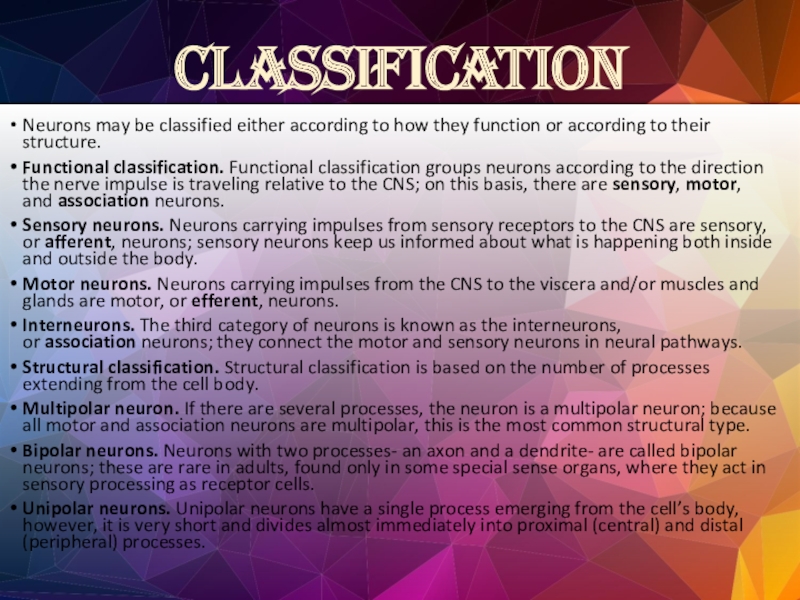
Neurons may be classified either according to how they function or
according to their structure.
Functional classification. Functional classification groups neurons according to the direction the nerve impulse is traveling relative to the CNS; on this basis, there are sensory, motor, and association neurons.
Sensory neurons. Neurons carrying impulses from sensory receptors to the CNS are sensory, or afferent, neurons; sensory neurons keep us informed about what is happening both inside and outside the body.
Motor neurons. Neurons carrying impulses from the CNS to the viscera and/or muscles and glands are motor, or efferent, neurons.
Interneurons. The third category of neurons is known as the interneurons, or association neurons; they connect the motor and sensory neurons in neural pathways.
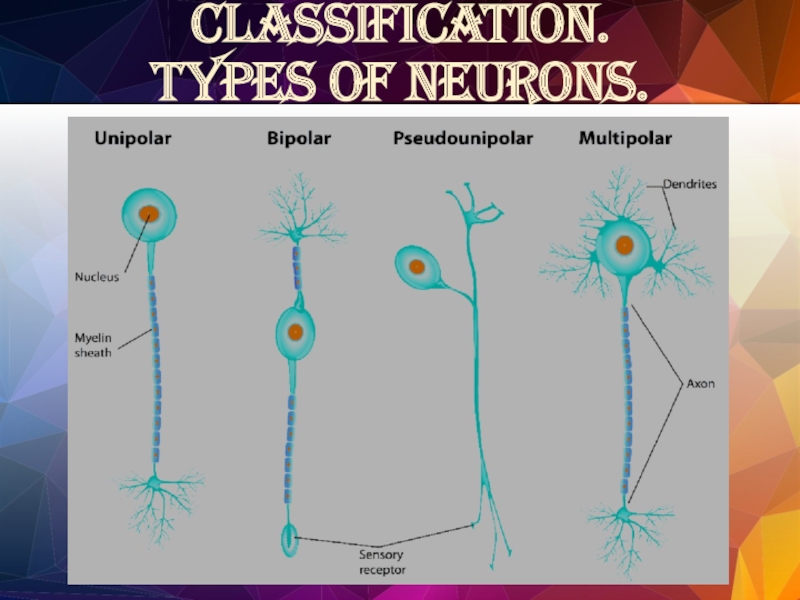
Structural classification. Structural classification is based on the number of processes extending from the cell body.
Multipolar neuron. If there are several processes, the neuron is a multipolar neuron; because all motor and association neurons are multipolar, this is the most common structural type.
Bipolar neurons. Neurons with two processes- an axon and a dendrite- are called bipolar neurons; these are rare in adults, found only in some special sense organs, where they act in sensory processing as receptor cells.
Unipolar neurons. Unipolar neurons have a single process emerging from the cell’s body, however, it is very short and divides almost immediately into proximal (central) and distal (peripheral) processes.
Functional classification. Functional classification groups neurons according to the direction the nerve impulse is traveling relative to the CNS; on this basis, there are sensory, motor, and association neurons.
Sensory neurons. Neurons carrying impulses from sensory receptors to the CNS are sensory, or afferent, neurons; sensory neurons keep us informed about what is happening both inside and outside the body.
Motor neurons. Neurons carrying impulses from the CNS to the viscera and/or muscles and glands are motor, or efferent, neurons.
Interneurons. The third category of neurons is known as the interneurons, or association neurons; they connect the motor and sensory neurons in neural pathways.
Structural classification. Structural classification is based on the number of processes extending from the cell body.
Multipolar neuron. If there are several processes, the neuron is a multipolar neuron; because all motor and association neurons are multipolar, this is the most common structural type.
Bipolar neurons. Neurons with two processes- an axon and a dendrite- are called bipolar neurons; these are rare in adults, found only in some special sense organs, where they act in sensory processing as receptor cells.
Unipolar neurons. Unipolar neurons have a single process emerging from the cell’s body, however, it is very short and divides almost immediately into proximal (central) and distal (peripheral) processes.
Слайд 12Список литературы:
https://www.google.ru/search?q=nervous+system&newwindow=1&source=lnms&tbm=isch&sa=X&ved=0ahUKEwjujou8uL3eAhWOhqYKHW37AIQQ_AUIDigB&biw=1366&bih=587#imgdii=MjrkG2QMp9oU9M:&imgrc=0ujt1gz_8RnD2M:;
https://nurseslabs.com/nervous-system/;
spotlight 11
1) Учебник
2) Книга для учителя
3) аудио материал
4) сборник упр.
5)
тетрадь (workbook)