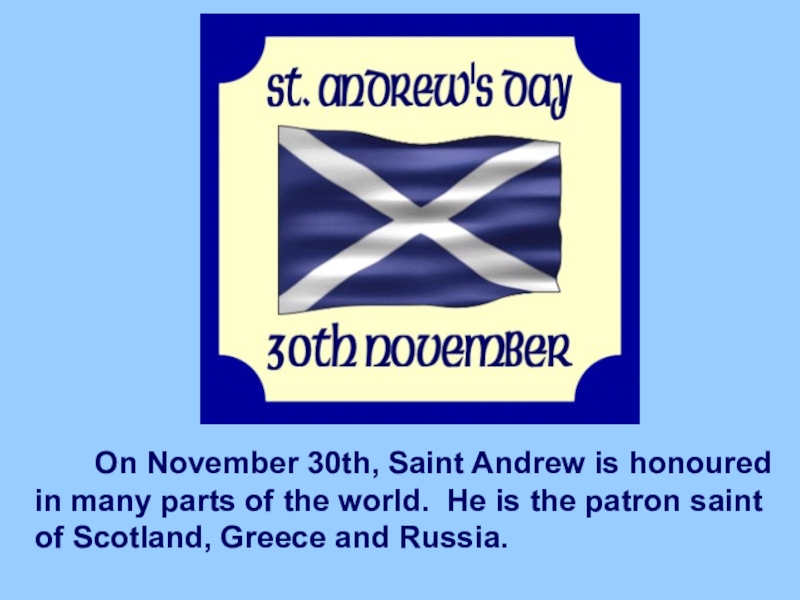
in many parts of the world. He is the patron saint of Scotland, Greece and Russia.
- Главная
- Разное
- Образование
- Спорт
- Естествознание
- Природоведение
- Религиоведение
- Французский язык
- Черчение
- Английский язык
- Астрономия
- Алгебра
- Биология
- География
- Геометрия
- Детские презентации
- Информатика
- История
- Литература
- Математика
- Музыка
- МХК
- Немецкий язык
- ОБЖ
- Обществознание
- Окружающий мир
- Педагогика
- Русский язык
- Технология
- Физика
- Философия
- Химия
- Шаблоны, фоны, картинки для презентаций
- Экология
- Экономика
Презентация, доклад по английскому языку на тему: Saint Andrew's Day
Содержание
- 1. Презентация по английскому языку на тему: Saint Andrew's Day
- 2. What countries is St Andrew the patron saint?
- 3. Patronage - покровительствоManly- мужественный Fishmongers- торговец рыбойMaiden-
- 4. St Andrew is the
- 5. Jesus- ИисусNets- рыболовная сетьApostles - апостолыAbout Saint
- 6. Where was St Andrew born? 2. What was St Andrew’s job?
- 7. Jesus commanded His apostles
- 8. He hung for
- 9. Why is
- 10. Martyr- мученикAdversarу- противникThat night Saint Andrew appeared
- 11. Emerg- появляться неожиданно Heraldic- геральдическийEntitled- давать правоIn
- 12. Слайд 12
- 13. William Wallace's battle-cry was "St. Andrew mot us speed“ (May Saint Andrew support us).
- 14. Flagpole- флагшток In January 2007, the
- 15. RecentComplainupdated The flying of
- 16. Regarded - считатьсяCrept up -подкрадыватьсяPrickles-колючка Penetrated-проникать внутрьYell
- 17. St Andrew's Day Celebrations
- 18. A Scottish girl about
- 19. “We have designed
- 20. Слайд 20
- 21. Слайд 21
- 22. Слайд 22
- 23. Слайд 23
- 24. Haggis
- 25. Sporran Kilt Bagpipes Tartan
- 26. A girl wishing to marry could:Throw a
- 27. Слайд 27
- 28. In some
- 29. Darling, I’ll be your future husband!
- 30. Слайд 30
- 31. Слайд 31
- 32. Слайд 32
- 33. Lock
- 34. Highlands
- 35. Highlands Games
What countries is St Andrew the patron saint?
Слайд 3Patronage - покровительство
Manly- мужественный
Fishmongers- торговец рыбой
Maiden- незамужняя девушка
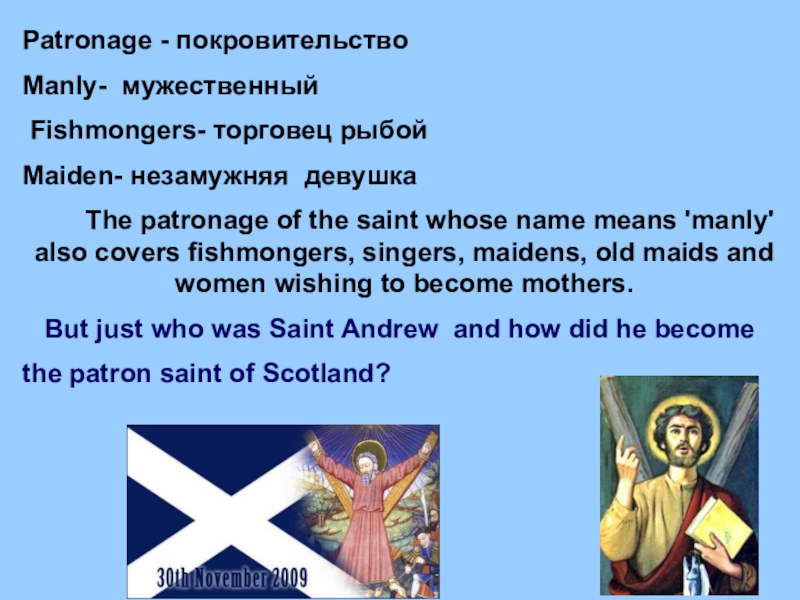
The patronage of the saint whose name means 'manly' also covers fishmongers, singers, maidens, old maids and women wishing to become mothers.
But just who was Saint Andrew and how did he become
the patron saint of Scotland?
But just who was Saint Andrew and how did he become
the patron saint of Scotland?
Слайд 4 St Andrew is the patron saint of:
fishermen, singers
and unmarried women
b. fishermen, ministers and married women
c. fishermen, highland dancing
b. fishermen, ministers and married women
c. fishermen, highland dancing
Слайд 5Jesus- Иисус
Nets- рыболовная сеть
Apostles - апостолы
About Saint Andrew
Andrew was a simple fisherman who lived with his brother Peter in Galilee. One day a man named Jesus came to him and his brother and asked them to follow Him – “I will make you fishers of men,” Jesus promised them. So the two men put down their nets and followed Jesus. Because Andrew was probably the first of the apostles, he is often spoken of as “The First-Called”.
Слайд 7 Jesus commanded His apostles to “go into the
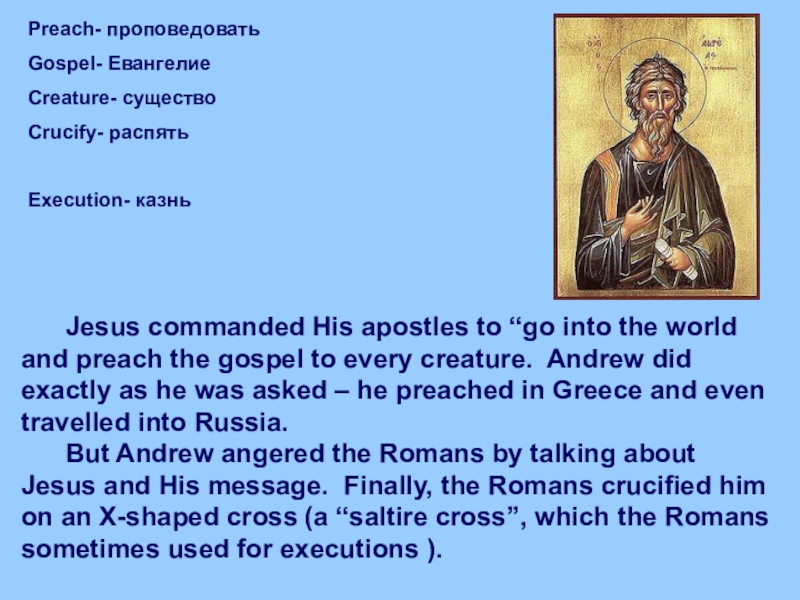
world and preach the gospel to every creature. Andrew did exactly as he was asked – he preached in Greece and even travelled into Russia.
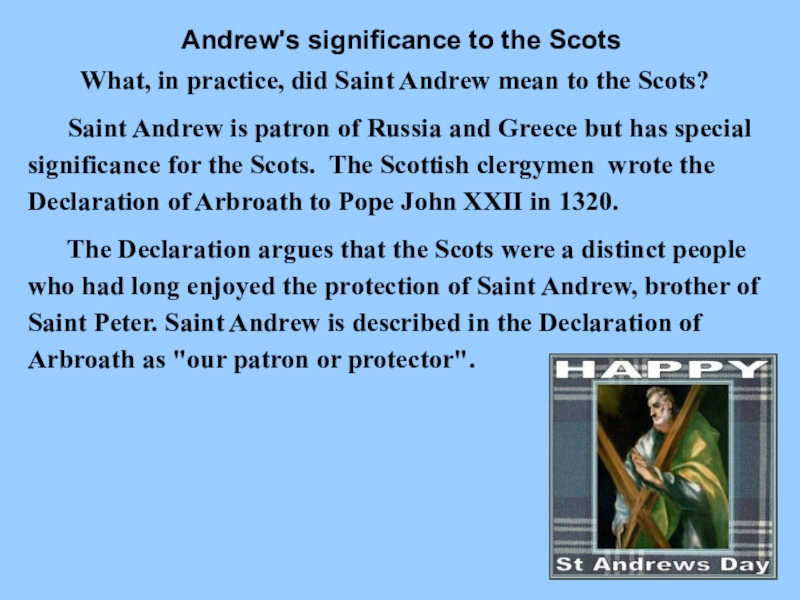
But Andrew angered the Romans by talking about Jesus and His message. Finally, the Romans crucified him on an X-shaped cross (a “saltire cross”, which the Romans sometimes used for executions ).
But Andrew angered the Romans by talking about Jesus and His message. Finally, the Romans crucified him on an X-shaped cross (a “saltire cross”, which the Romans sometimes used for executions ).
Preach- проповедовать
Gospel- Евангелие
Creature- существо
Crucify- распять
Execution- казнь
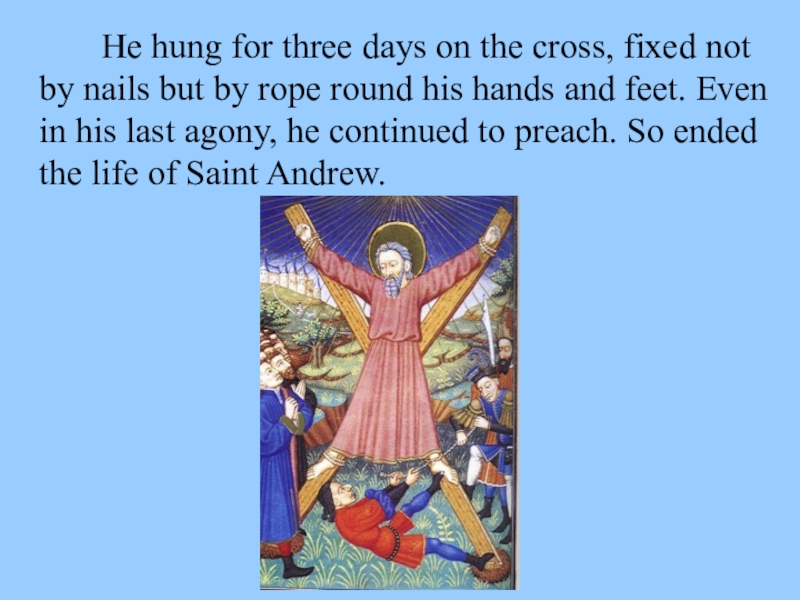
Слайд 8 He hung for three days on the
cross, fixed not by nails but by rope round his hands and feet. Even in his last agony, he continued to preach. So ended the life of Saint Andrew.
Слайд 9
Why is St Andrew's symbol a
white cross on a blue background?
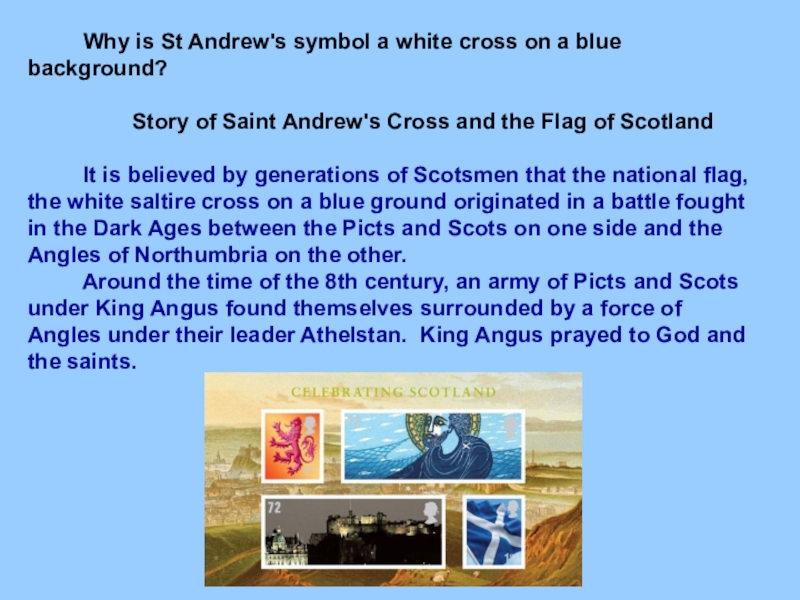
Story of Saint Andrew's Cross and the Flag of Scotland
It is believed by generations of Scotsmen that the national flag, the white saltire cross on a blue ground originated in a battle fought in the Dark Ages between the Picts and Scots on one side and the Angles of Northumbria on the other. Around the time of the 8th century, an army of Picts and Scots under King Angus found themselves surrounded by a force of Angles under their leader Athelstan. King Angus prayed to God and the saints.
Story of Saint Andrew's Cross and the Flag of Scotland
It is believed by generations of Scotsmen that the national flag, the white saltire cross on a blue ground originated in a battle fought in the Dark Ages between the Picts and Scots on one side and the Angles of Northumbria on the other. Around the time of the 8th century, an army of Picts and Scots under King Angus found themselves surrounded by a force of Angles under their leader Athelstan. King Angus prayed to God and the saints.
Слайд 10Martyr- мученик
Adversarу- противник
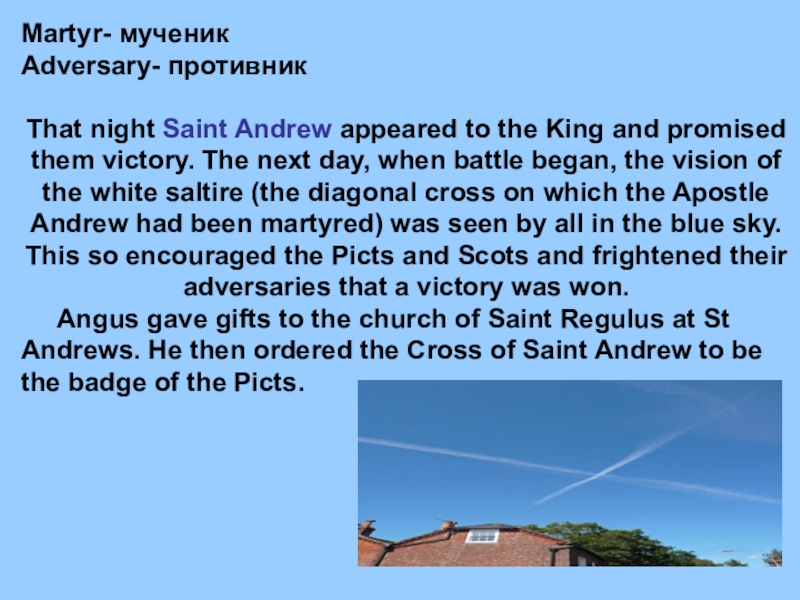
That night Saint Andrew appeared to the King and
promised them victory. The next day, when battle began, the vision of the white saltire (the diagonal cross on which the Apostle Andrew had been martyred) was seen by all in the blue sky. This so encouraged the Picts and Scots and frightened their adversaries that a victory was won.
Angus gave gifts to the church of Saint Regulus at St Andrews. He then ordered the Cross of Saint Andrew to be the badge of the Picts.
Angus gave gifts to the church of Saint Regulus at St Andrews. He then ordered the Cross of Saint Andrew to be the badge of the Picts.
Слайд 11Emerg- появляться неожиданно
Heraldic- геральдический
Entitled- давать право
In heraldry- геральдика
Stitch- петля
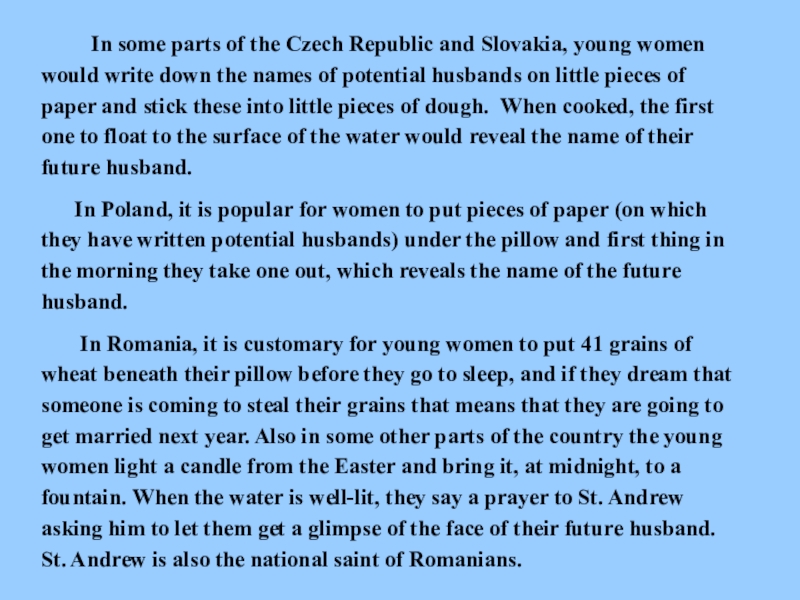
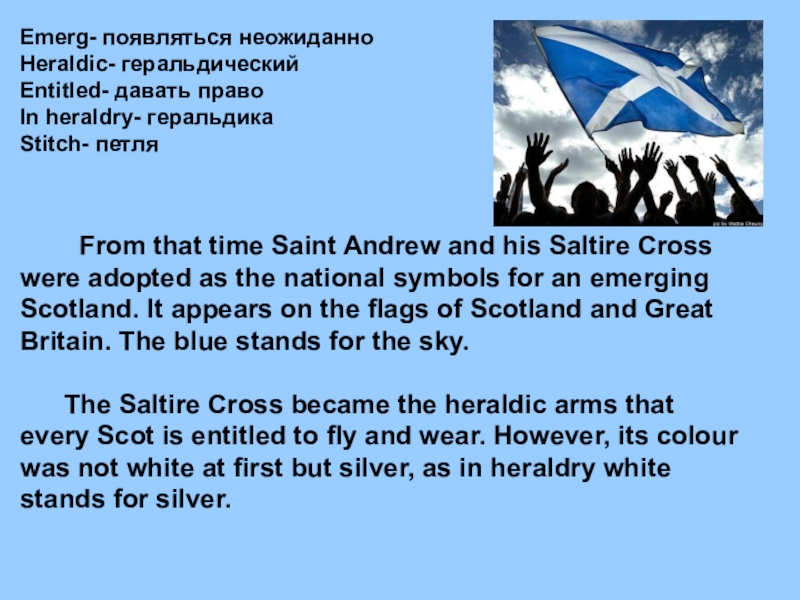
From that time Saint Andrew and his Saltire Cross were adopted as the national symbols for an emerging Scotland. It appears on the flags of Scotland and Great Britain. The blue stands for the sky.
The Saltire Cross became the heraldic arms that every Scot is entitled to fly and wear. However, its colour was not white at first but silver, as in heraldry white stands for silver.
The Saltire Cross became the heraldic arms that every Scot is entitled to fly and wear. However, its colour was not white at first but silver, as in heraldry white stands for silver.
Слайд 12
Andrew's significance to the Scots
What, in practice, did Saint Andrew mean to the Scots?
Saint Andrew is patron of Russia and Greece but has special significance for the Scots. The Scottish clergymen wrote the Declaration of Arbroath to Pope John XXII in 1320.
The Declaration argues that the Scots were a distinct people who had long enjoyed the protection of Saint Andrew, brother of Saint Peter. Saint Andrew is described in the Declaration of Arbroath as "our patron or protector".
What, in practice, did Saint Andrew mean to the Scots?
Saint Andrew is patron of Russia and Greece but has special significance for the Scots. The Scottish clergymen wrote the Declaration of Arbroath to Pope John XXII in 1320.
The Declaration argues that the Scots were a distinct people who had long enjoyed the protection of Saint Andrew, brother of Saint Peter. Saint Andrew is described in the Declaration of Arbroath as "our patron or protector".

Слайд 14Flagpole- флагшток
In January 2007, the St Andrew's Day Bank
Holiday (Scotland) Act was given royal assent, making 30 November (or the nearest Monday if a weekend) a bank holiday in Scotland.
Although it is a bank holiday, banks are not required to close and employers are not required to give their employees the day off as a holiday. St Andrew's Day is an official flag day in Scotland. The Scottish Government’s flag-flying regulations state that the Flag of Scotland (The Saltire) shall fly on all its buildings with a flagpole. The Union Flag is also flown if the building has more than one flagpole. The arrangements for the United Kingdom Government in Scotland are the opposite. They fly the Union Flag, and will only fly the Saltire if there is more than one flagpole.
Although it is a bank holiday, banks are not required to close and employers are not required to give their employees the day off as a holiday. St Andrew's Day is an official flag day in Scotland. The Scottish Government’s flag-flying regulations state that the Flag of Scotland (The Saltire) shall fly on all its buildings with a flagpole. The Union Flag is also flown if the building has more than one flagpole. The arrangements for the United Kingdom Government in Scotland are the opposite. They fly the Union Flag, and will only fly the Saltire if there is more than one flagpole.
Слайд 15Recent
Complain
updated
The flying of the Saltire on St
Andrew's Day is a recent development. Prior to 2002, the Scottish Government followed the UK Government's flag days and would only fly the Union Flag on St Andrew's Day.
This led to Members of the Scottish Parliament complaining that Scotland was the only country in the world that could not fly its national flag on its national day. The regulations were updated to state that the Union Flag would be removed and replaced by the Saltire on buildings with only one flagpole.
This led to Members of the Scottish Parliament complaining that Scotland was the only country in the world that could not fly its national flag on its national day. The regulations were updated to state that the Union Flag would be removed and replaced by the Saltire on buildings with only one flagpole.
Слайд 16Regarded - считаться
Crept up -подкрадываться
Prickles-колючка
Penetrated-проникать внутрь
Yell – кричать
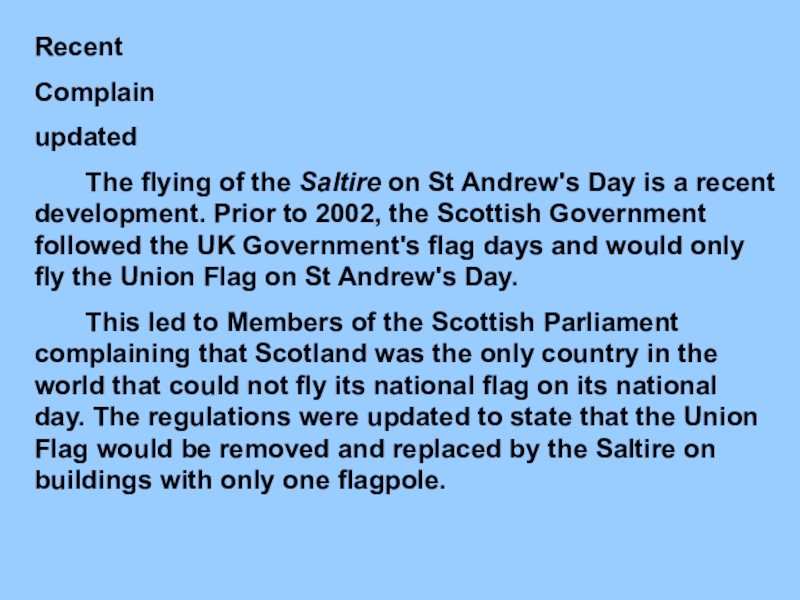
The thistle is widely regarded as the emblem of Scotland. How the thistle became an emblem of Scotland?
A legend tells of how a group of Scots were sleeping in a field when a group of Vikings crept up to attack. Fortunately one of the Vikings stood on a thistle, whose prickles penetrated through to his foot and made him yell with pain. His cries woke the sleeping Scots who were able to fight off their attackers. It is said that from this day the thistle has been adopted as Scotland's national emblem.
A legend tells of how a group of Scots were sleeping in a field when a group of Vikings crept up to attack. Fortunately one of the Vikings stood on a thistle, whose prickles penetrated through to his foot and made him yell with pain. His cries woke the sleeping Scots who were able to fight off their attackers. It is said that from this day the thistle has been adopted as Scotland's national emblem.
Слайд 17 St Andrew's Day Celebrations
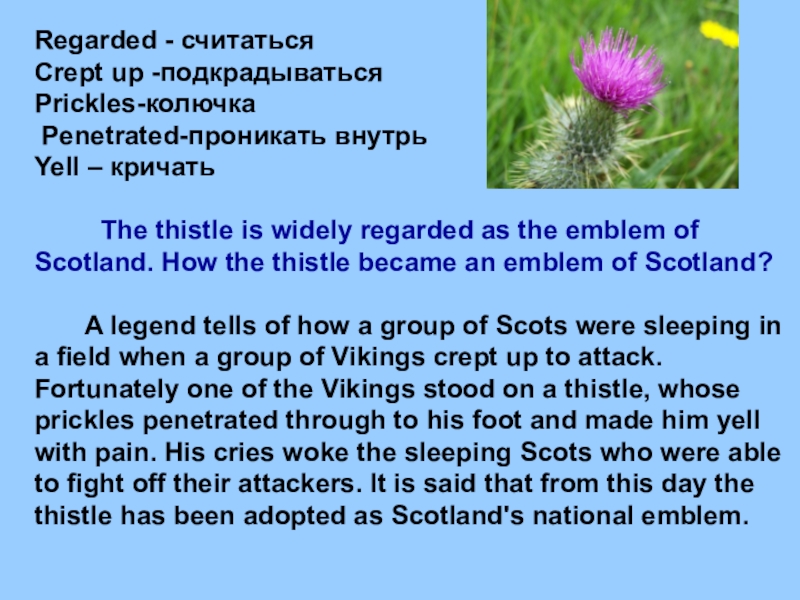
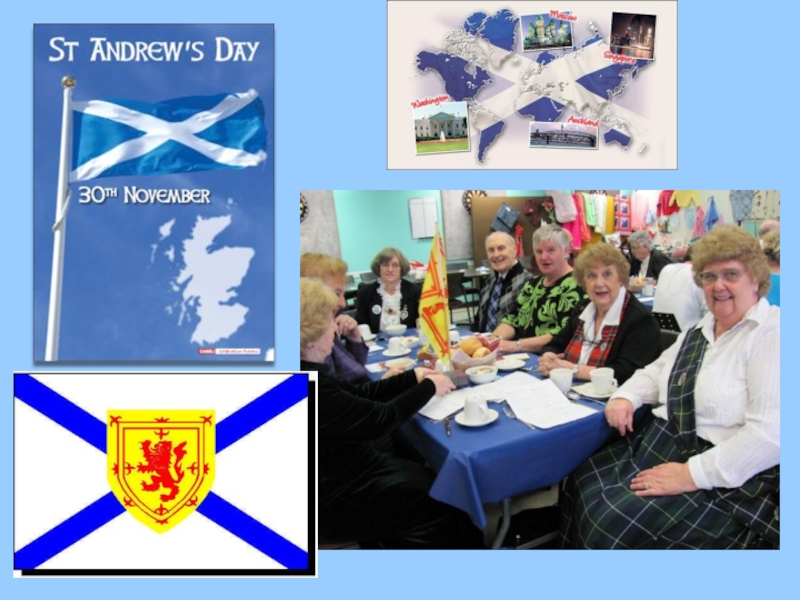
St Andrew's Day
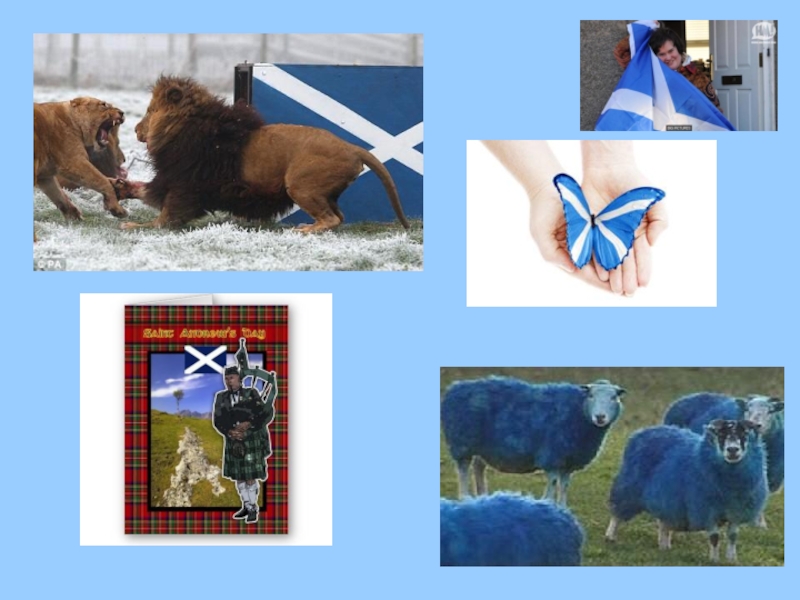
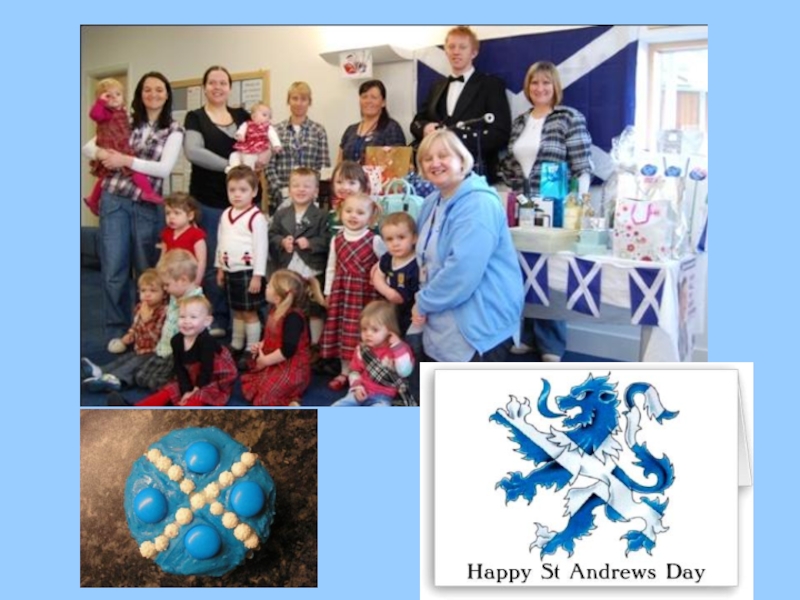
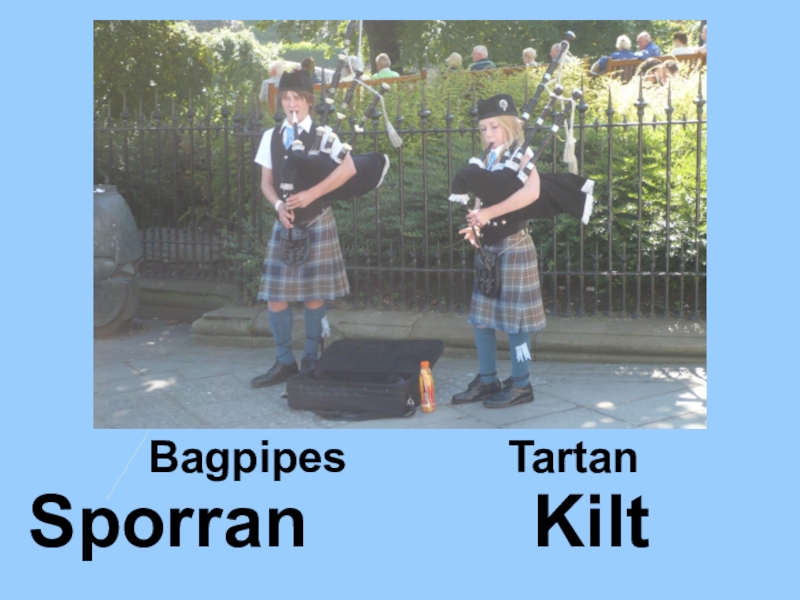
is often a celebration of general Scottishness with traditional food, music (especially bagpipes) and dancing.
Слайд 18 A Scottish girl about the holiday:
“We are
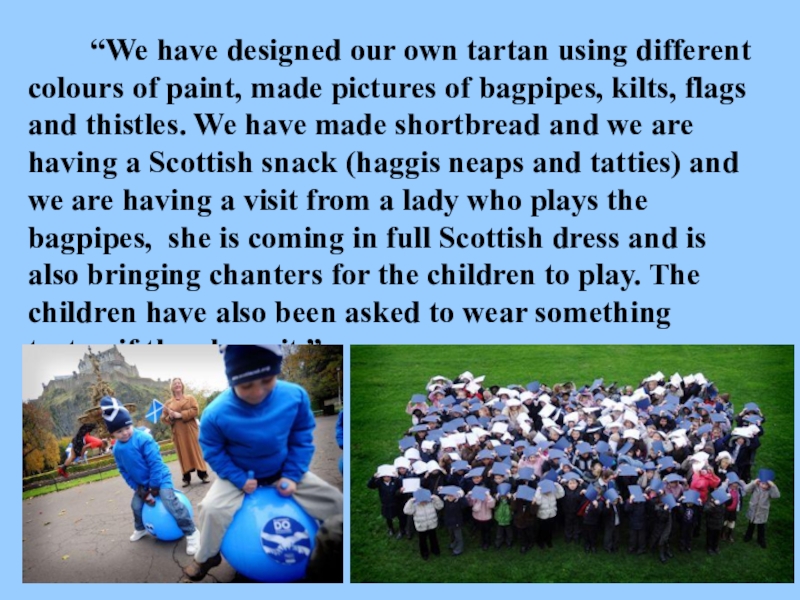
having a Scottish Day with a special Scottish Themed school dinner. We are all wearing tartan and have been taking part in Scottish themed lessons all week. We have looked at Scots language, highland dancing, poetry and writing. We have made Scottish art work and have decorated the hall with The St. Andrew's Cross flags. We are then having a Scottish afternoon with each class showing us what they have learned.

Слайд 19 “We have designed our own tartan using
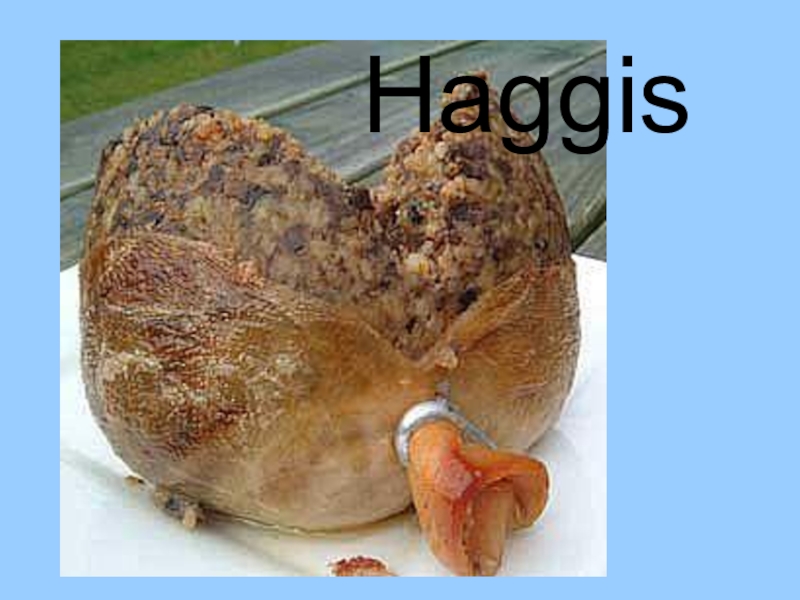
different colours of paint, made pictures of bagpipes, kilts, flags and thistles. We have made shortbread and we are having a Scottish snack (haggis neaps and tatties) and we are having a visit from a lady who plays the bagpipes, she is coming in full Scottish dress and is also bringing chanters for the children to play. The children have also been asked to wear something tartan if they have it.”



Слайд 26A girl wishing to marry could:
Throw a shoe at a door.
If the toe of the shoe pointed in the direction of the exit, then she would marry and leave her parents' house within a year.
Peel a whole apple without breaking the peel and throw the peel over the shoulder. If the peel formed a letter of the alphabet, then this suggested the name of her future groom.
Peel a whole apple without breaking the peel and throw the peel over the shoulder. If the peel formed a letter of the alphabet, then this suggested the name of her future groom.
Слайд 27 Related
traditions in Europe.
In parts of Germany, Austria, the Czech Republic, Slovakia, Poland, Romania superstitious belief exists that the night before St. Andrew's Day is specially suitable for magic that reveals a young woman's future husband or that binds a future husband to her. Many related customs exist: for example, the pouring of hot lead into water (in Poland, one usually pours hot wax from a candle through a key hole into cold water), divining the future husband's profession from the shape of the resulting piece. In some areas in Austria, young women would drink wine and then perform a spell “Saint Andrew's prayer”, while nude and kicking a straw bed. This was supposed to magically attract the future husband. Yet another custom is to throw a clog over one's shoulder: if it lands pointing to the door, the woman will get married in the same year.
In parts of Germany, Austria, the Czech Republic, Slovakia, Poland, Romania superstitious belief exists that the night before St. Andrew's Day is specially suitable for magic that reveals a young woman's future husband or that binds a future husband to her. Many related customs exist: for example, the pouring of hot lead into water (in Poland, one usually pours hot wax from a candle through a key hole into cold water), divining the future husband's profession from the shape of the resulting piece. In some areas in Austria, young women would drink wine and then perform a spell “Saint Andrew's prayer”, while nude and kicking a straw bed. This was supposed to magically attract the future husband. Yet another custom is to throw a clog over one's shoulder: if it lands pointing to the door, the woman will get married in the same year.
Слайд 28 In some parts of the Czech
Republic and Slovakia, young women would write down the names of potential husbands on little pieces of paper and stick these into little pieces of dough. When cooked, the first one to float to the surface of the water would reveal the name of their future husband.
In Poland, it is popular for women to put pieces of paper (on which they have written potential husbands) under the pillow and first thing in the morning they take one out, which reveals the name of the future husband.
In Romania, it is customary for young women to put 41 grains of wheat beneath their pillow before they go to sleep, and if they dream that someone is coming to steal their grains that means that they are going to get married next year. Also in some other parts of the country the young women light a candle from the Easter and bring it, at midnight, to a fountain. When the water is well-lit, they say a prayer to St. Andrew asking him to let them get a glimpse of the face of their future husband. St. Andrew is also the national saint of Romanians.
In Poland, it is popular for women to put pieces of paper (on which they have written potential husbands) under the pillow and first thing in the morning they take one out, which reveals the name of the future husband.
In Romania, it is customary for young women to put 41 grains of wheat beneath their pillow before they go to sleep, and if they dream that someone is coming to steal their grains that means that they are going to get married next year. Also in some other parts of the country the young women light a candle from the Easter and bring it, at midnight, to a fountain. When the water is well-lit, they say a prayer to St. Andrew asking him to let them get a glimpse of the face of their future husband. St. Andrew is also the national saint of Romanians.